Quetzalcoatl: The Feathered Serpent of Toltec Religion
Quetzalcoatl stood at the center of Toltec religion as creator, priest-king, and cosmic wind. His myth shaped Mesoamerica for centuries and still resists easy explanation.
Contents
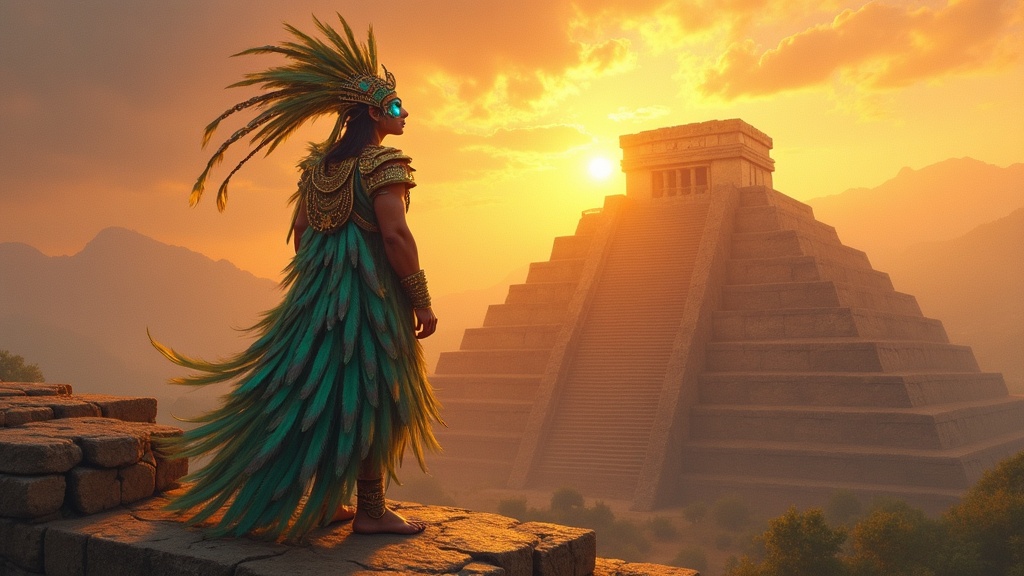
The pyramid at Tula rises from the dry scrubland of Hidalgo state, its carved Atlantean warriors frozen mid-stride at the summit, staring north across the valley as if waiting for someone to return. At the base, a serpent frieze coils endlessly along the stone walls. This is Quetzalcoatl's city. The feathered serpent did not merely inhabit Tula; Toltec theology was built around him, and when the city fell, he carried its memory into every tradition that came after.
Quetzalcoatl: the Feathered Serpent of Toltec religion occupies a singular position in the mythology of ancient Mexico. He is simultaneously a cosmic force, a historical ruler, a penitent god, and a figure of prophecy. No other deity in the Mesoamerican pantheon accumulated so many contradictory layers, and none traveled as far, appearing at Teotihuacan centuries before the Toltec horizon, surviving in Aztec ritual, echoing at Chichen Itza among the Maya as Kukulkan. To follow his story is to trace the deepest currents in pre-Columbian thought.
The Name and Its Deep Grammar
Quetzalli referred specifically to the long iridescent tail feathers of the resplendent quetzal (Pharomachrus mocinno), a bird so rare and so brilliant that its plumes circulated as currency and were reserved for royal headdresses. Combining that word with coatl was not mere poetic whimsy. The serpent represented the earth, the underworld, cyclical time, and the power to shed one's skin and be reborn. The quetzal bird represented the celestial, the rare, the unreachable.
Together they described a principle of cosmic union: the earthly and the heavenly folded into one being. Mesoamerican religion consistently worked through this kind of paired duality. Binary forces did not cancel each other in Toltec and later Aztec theology; they generated creation through their tension. Quetzalcoatl was the visible sign of that generative tension.
The name also carried an alternate reading. In some texts coatl means "twin," making Quetzalcoatl the "precious twin," a reading that aligns him with Venus, which appears twice in the sky, once as the Morning Star before dawn and once as the Evening Star after dusk. That double appearance meant the planet was understood as a being that dies and is reborn on a fixed 584-day cycle, making it the perfect celestial body for a god of death, resurrection, and time-keeping.
Quetzalcoatl at Tula: The Toltec Heartland
The city of Tula (Tollan in Nahuatl, meaning "Place of Reeds") flourished from roughly 900 to 1150 CE in what is now the Mexican state of Hidalgo. At its height it may have held 60,000 people, making it one of the largest urban centers in the Western Hemisphere at that time. Its architecture, its warrior imagery, its trade networks reaching to the Gulf Coast and the turquoise routes of the American Southwest, all bore the stamp of Quetzalcoatl's cult.
Toltec cosmology positioned Quetzalcoatl as the chief deity of civilization itself. He taught the arts that separated humans from animals: agriculture, the calendar, writing, metallurgy, the cutting and polishing of jade and turquoise. The Anales de Cuauhtitlan, one of the key post-Conquest Nahuatl sources, describes the paradise of Tollan as a city where corn grew in colors, where cacao and cotton bloomed in every shade, where songbirds filled the air. This was Quetzalcoatl's gift to humanity.
He was also identified as the high priest of Tula, sometimes called Ce Acatl Topiltzin Quetzalcoatl (One Reed, Our Lord the Feathered Serpent). Here the mythological and historical registers blur deliberately. The Toltec tradition recorded a great ruler-priest who embodied the god, who refused human sacrifice and offered only jade, butterflies, and serpents on the altar, who lived in absolute purity. Whether a historical person named Topiltzin actually ruled Tula in the tenth century is debated by archaeologists; the textual records are late (mostly sixteenth century), filtered through Aztec memory and Spanish colonial glosses. What is clear is that the Toltecs believed this figure had lived, had been betrayed, and had left.
The Fall: Betrayal, Exile, and the Promise of Return
The most dramatic episode in the Toltec account of Quetzalcoatl is his fall. The Anales de Cuauhtitlan and the Historia de los Mexicanos por sus Pinturas both preserve versions of the same catastrophe. Tezcatlipoca (the Smoking Mirror, god of night and conflict and the adversarial twin of Quetzalcoatl) conspired against the priest-king, using sorcery and a mirror to shatter his purity.
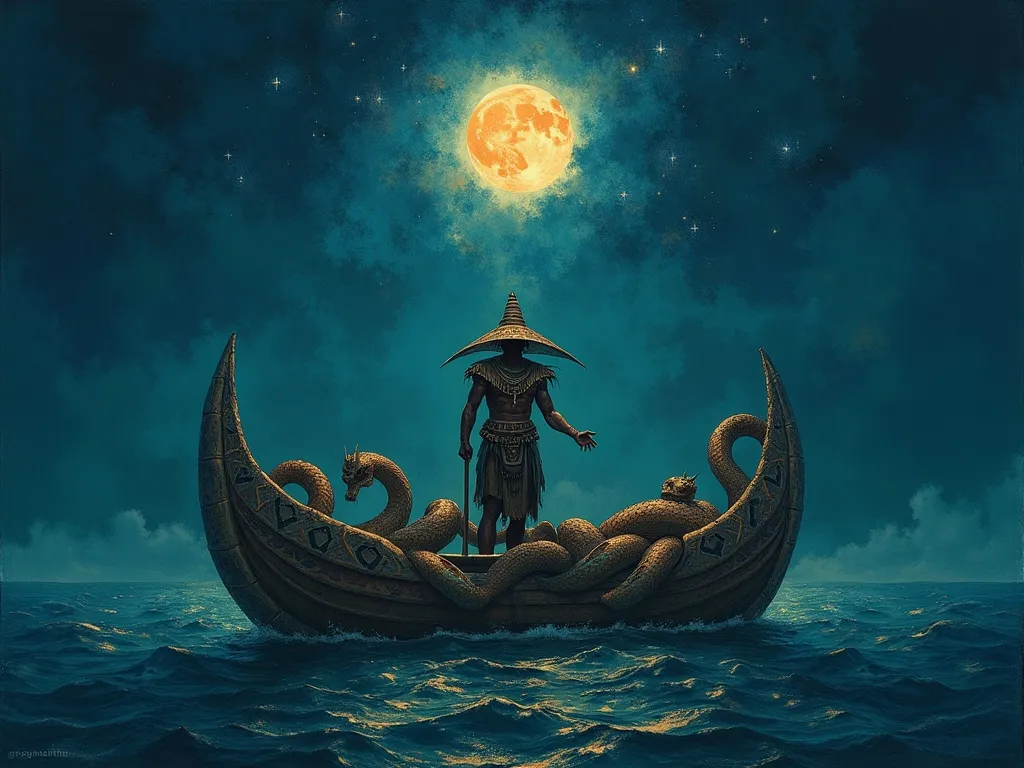
In the most vivid version, Tezcatlipoca tricked Quetzalcoatl into drinking pulque, the fermented agave liquor, and into committing an act that violated his vows of celibacy. Overwhelmed by shame, Quetzalcoatl could no longer rule. He left Tula, walked east to the shore of the Gulf of Mexico, built a raft of serpents, and set sail for the mythic land of Tlapallan (the Red Land), promising to return in the year One Reed, which was also his birth-year name.
Tezcatlipoca stands here as the mirror image of Quetzalcoatl: where the Feathered Serpent represented light, order, priestly self-restraint, and the Morning Star, Tezcatlipoca embodied darkness, chaos, the night sky, and the unpredictable will of fate. Their conflict is not a simple good-versus-evil story. Both were necessary. The Aztec creation myths required them to cooperate to build the current world-age; their enmity was a productive friction, not a moral condemnation of either.
The departure scene carries enormous freight in Mesoamerican cultural memory. After Tula fell (for reasons that included drought, political fragmentation, and possibly military pressure, around 1150 CE), the myth of the returning god became portable. It traveled south and east with the Toltec diaspora, embedding itself in Chichen Itza, in Cholula, eventually in Aztec Tenochtitlan.
Quetzalcoatl as Creator and Cosmic Principle
Before the Toltec historical layer there is an older, more abstract Quetzalcoatl rooted in Teotihuacan, the great city that dominated central Mexico from roughly 100 BCE to 550 CE. The Temple of the Feathered Serpent at Teotihuacan, dated to around 200 CE, is encrusted with carved feathered serpent heads alternating with what many scholars identify as the face of Tlaloc, the rain god. Hundreds of sacrificial victims were buried in the temple's foundations, a scale of ritual violence that sits oddly beside the pacifist priest-king image of later Toltec tradition.
This older Quetzalcoatl was a force of creation itself. The Leyenda de los Soles (Legend of the Suns) and the cosmogonic portions of the Florentine Codex (compiled by Fray Bernardino de Sahagun in the 1570s from Nahua informants) describe Quetzalcoatl and Tezcatlipoca working together to create the earth. In one account they transform themselves into trees or giant serpents and tear apart the primordial earth-monster Cipactli to form the land and sky. The violence of creation is inseparable from the creator.
Quetzalcoatl also played the central role in creating the current race of humans. After the destruction of the fourth sun-age, the gods resolved to repopulate the earth. Quetzalcoatl descended to Mictlan, the underworld ruled by Mictlantecuhtli, to retrieve the bones of previous human generations. The lord of Mictlan set trap after trap; Quetzalcoatl stumbled, dropped the bones, and they shattered into pieces of unequal length. He gathered the fragments anyway, carried them to Tamoanchan (a paradisiacal creation-place), ground them with the help of the goddess Cihuacoatl, and mixed them with his own blood. From that mixture humans were made. The story encodes a precise theological statement: humans are incomplete, made from broken pieces, kept alive only because a god bled for them.
Quetzalcoatl and Venus: The Astronomical Layer
Mesoamerican priests tracked Venus with a precision that impresses modern astronomers. The Dresden Codex, a Maya hieroglyphic book from around the eleventh or twelfth century, contains detailed Venus tables accurate to within two hours per 584-day cycle. This obsession with Venus was inseparable from the mythology of Quetzalcoatl.
The planet's cycle mapped almost exactly onto the god's narrative arc. Venus disappears from view for roughly eight days when it passes between earth and sun (inferior conjunction), then reappears as the brilliant Morning Star. The Mesoamerican interpretation: the god dies, descends into the underworld, and rises reborn. Quetzalcoatl's exile and promised return followed the same script.
The year One Reed (Ce Acatl) in the 52-year xiuhpohualli calendar cycle was particularly charged. If Venus rose as the Morning Star in One Reed, the omen was considered especially powerful. When Hernan Cortes arrived on the Gulf Coast in 1519, the Aztec calendar year was One Reed, and some later colonial texts suggest that Moctezuma II's hesitation before the Spanish was partly shaped by the resonance between Cortes's arrival and the prophecy of Quetzalcoatl's return. Historians including David Carrasco and Matthew Restall have argued at length about how much this "returning god" framework shaped actual Aztec political decisions versus how much it was constructed after the Conquest to explain the Spanish victory. The debate remains genuinely open.
Quetzalcoatl at Chichen Itza: The Toltec Reach into the Maya World
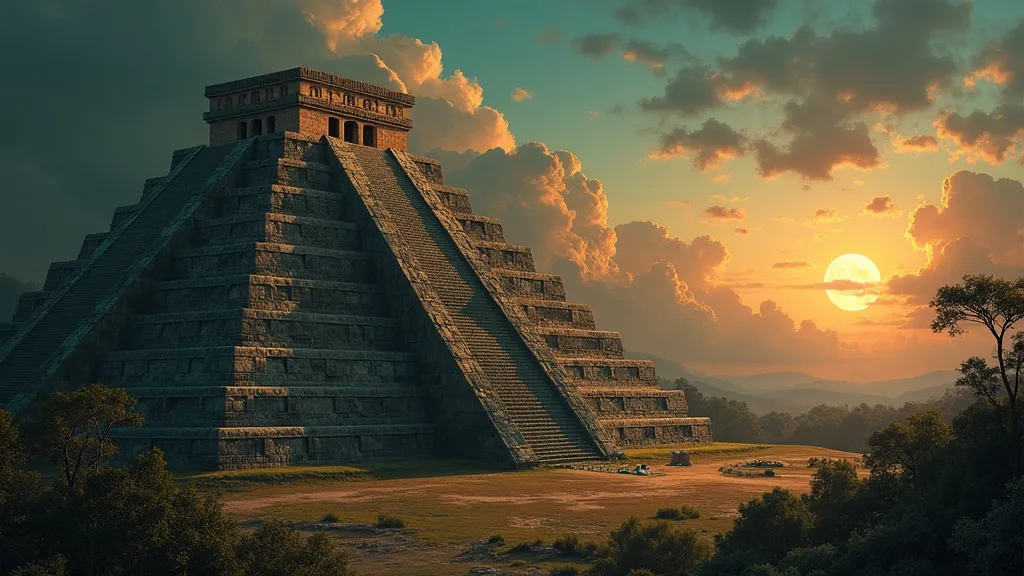
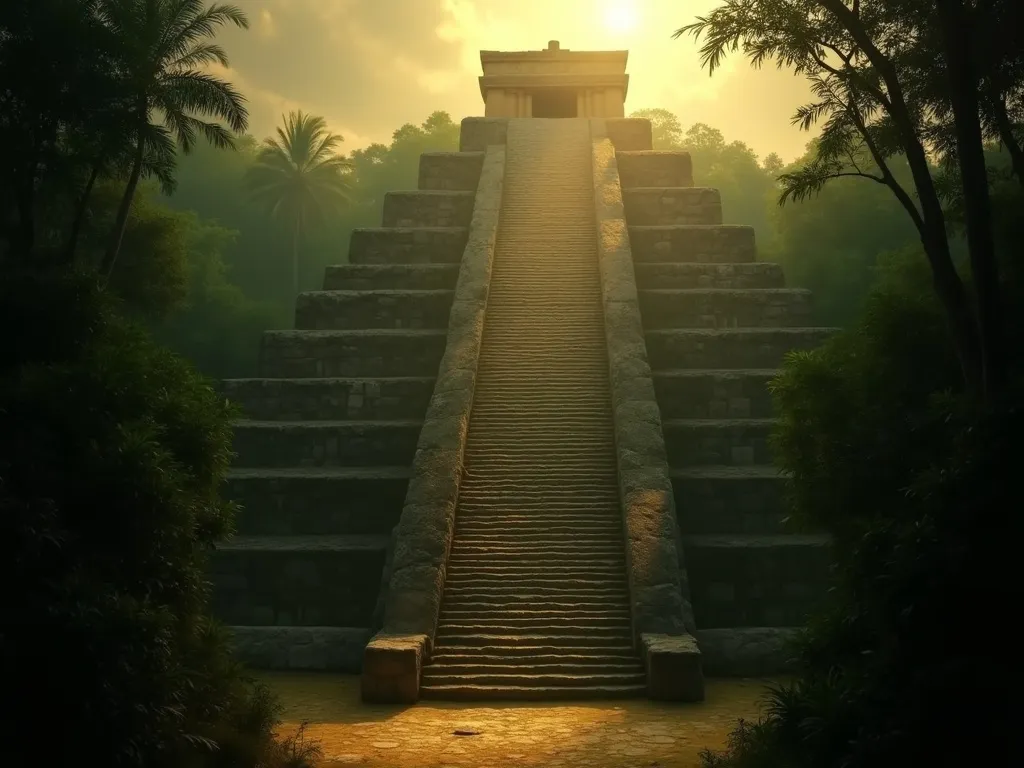
After Tula's decline, the Toltec cultural sphere spread south into the Yucatan Peninsula. At Chichen Itza, the great pyramid known today as El Castillo (formally the Temple of Kukulkan) was designed so that on the spring and autumn equinoxes, a diamond pattern of light and shadow moves along the northern staircase, creating the visual illusion of a serpent descending from the temple summit to a stone serpent head at the base. The effect is not accidental. Kukulkan is the Maya rendering of the same name: kukul (feathered) + kan (serpent).
The architectural, iconographic, and mythological parallels between Tula and Chichen Itza are so striking that scholars spent decades debating whether Toltec warriors actually conquered Chichen Itza, or whether elite migration and trade brought Toltec ideas south voluntarily, or whether both cities drew independently from an older shared tradition. The current consensus, led by researchers like Clemency Coggins and Karl Taube, leans toward a complex pattern of shared ideology and elite mobility rather than a straightforward military conquest.
The feathered serpent also appears at Xochicalco (roughly 650-900 CE) in Morelos, at El Tajin on the Gulf Coast, and in painted murals at Cacaxtla. This distribution confirms that Quetzalcoatl was not a parochial Toltec invention but a pan-Mesoamerican principle that different cultures dressed in their own theological vocabulary.
Quetzalcoatl in Aztec Religion: Adaptation and Survival
When the Aztec (Mexica) established Tenochtitlan in the fourteenth century and built their empire across central Mexico, they absorbed Toltec cosmology wholesale. The Aztecs legitimized their rule partly by claiming Toltec descent, and Quetzalcoatl became one of the central deities of the Aztec pantheon, though his role shifted.
In Aztec theology, Quetzalcoatl was specifically identified as the patron of the priesthood, of learning, of the calendar, and of the wind (Ehecatl, the wind deity, was often depicted as an aspect of Quetzalcoatl wearing a beaked mask). His temples were cylindrical rather than rectangular, because round structures offer no resistance to the wind. One of the most important Aztec temples at Tenochtitlan was the circular Temple of Ehecatl, uncovered beneath the streets of modern Mexico City in excavations near the Zocalo.
Aztec priests kept Quetzalcoatl's ritual calendar meticulously. The tonalpohualli (the 260-day sacred calendar) assigned specific days to his patronage. Merchants, who traveled dangerous roads and whose success required both cunning and divine favor, honored Quetzalcoatl specifically. He was their protector.
The Aztec also preserved the theological tension between Quetzalcoatl and Huitzilopochtli, the solar war deity who demanded mass human sacrifice. Quetzalcoatl's domain was self-sacrifice and penitence; he drew blood from his own body with thorns. Huitzilopochtli's domain was the sacrificial heart. These two modes of ritual violence, the personal and the collective, defined the moral universe of Aztec religion.
Symbolism and Iconography: Reading the Feathered Serpent's Image
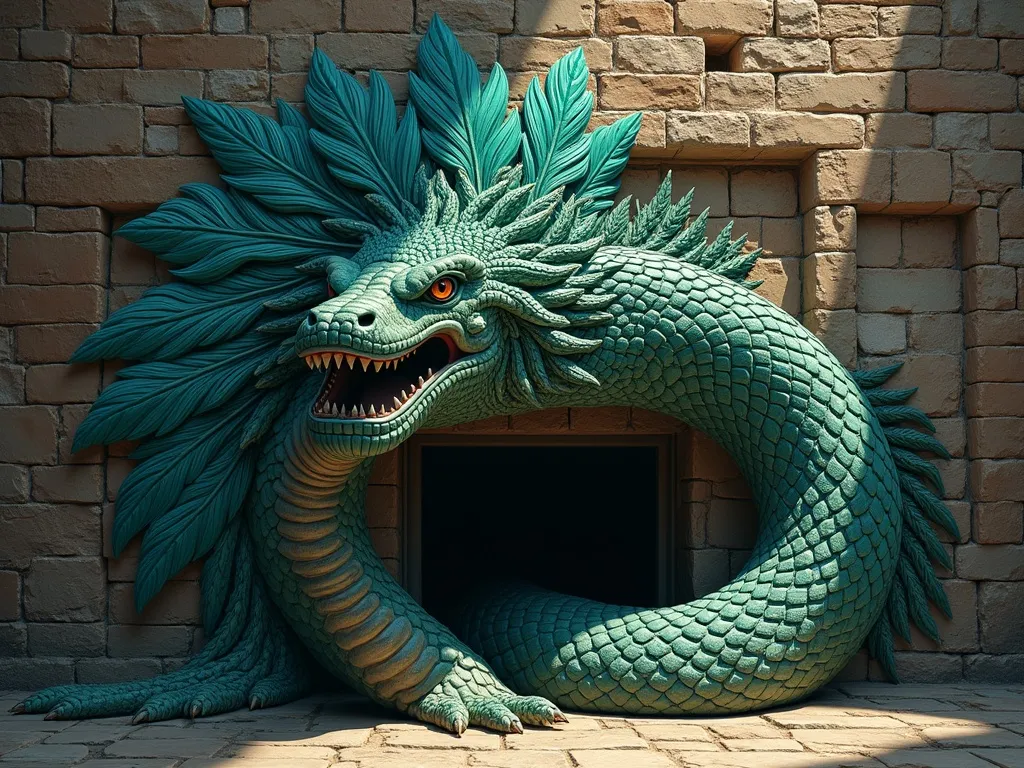
Identifying Quetzalcoatl in Mesoamerican art requires knowing his specific visual language. The core motif is straightforward: a rattlesnake body covered in the green and blue-green feathers of the quetzal bird, often rearing upward or forming a circle. The open mouth frequently frames a human face, representing the god emerging from the serpent, or the sun emerging from darkness.
As Ehecatl, he wears a beak-like mask (sometimes compared to a duck's bill), a conical hat, and a wind jewel (ehecachiztli) made from a cross-section of a conch shell. That conch section, cut to show a spiral, became one of the most recognizable symbols in Mesoamerican iconography. Wind instruments (particularly conch trumpets) were played in his rites.
The color green carried specific theological weight. Green-blue (xihuitl) was the color of preciousness, of water, of growing corn, of the sky at the horizon. Quetzalcoatl's feathers, Aztec turquoise headdresses, the color of jade: all belonged to the same semantic field, all marked contact between the human and the divine.
At Teotihuacan, the feathered serpent heads on the temple alternate with a differently styled head that some scholars (notably Esther Pasztory) identify as a headdress-wearing deity rather than Tlaloc. The debate over what exactly is depicted at Teotihuacan's earliest feathered serpent imagery is still active, which underscores how far back the iconographic tradition reaches and how much of it remains contested.
Quetzalcoatl and the Spanish Conquest: Myth Weaponized
No aspect of Quetzalcoatl's story has generated more controversy than the so-called "returning god" narrative. In several early colonial sources, most prominently the Florentine Codex, Aztec informants describe Moctezuma II interpreting Cortes as the returning Quetzalcoatl or his emissary. The narrative has a clean dramatic logic: the god promised to return from the east in the year One Reed; Cortes arrived from the east in the year One Reed.
But historians have scrutinized this story hard. Restall, in Seven Myths of the Spanish Conquest (2003), argues that the "Cortes-as-Quetzalcoatl" narrative was largely constructed after the fact, partly by indigenous noble families seeking to explain their survival by framing the Conquest as theological inevitability, partly by Spanish chroniclers who found the story useful for justifying colonization. Camilla Townsend's archival work (Annals of Native America, 2017) reinforces this skepticism, showing that the earliest indigenous-language Nahua sources written in the 1540s and 1550s do not frame the Conquest in Quetzalcoatl terms.
This does not shrink Quetzalcoatl's significance. It actually clarifies it: the god was powerful enough that both the colonized and the colonizers reached for his myth to make sense of a catastrophe neither could fully process.
Quetzalcoatl Across Modern Scholarship and Living Culture
The scholarly literature on Quetzalcoatl is vast and still growing. David Carrasco's Quetzalcoatl and the Irony of Empire (1982) remains a foundational text, reading the Feathered Serpent as the theological motor of Toltec and Aztec imperialism. Alfredo Lopez Austin's work on Mesoamerican body-soul concepts shows how Quetzalcoatl's nature as a wind deity connected to breath, spirit, and the animating force of life. Kay Read's studies of Mesoamerican time-keeping deepen the Venus connection.
For contemporary Indigenous communities in Mexico and the American Southwest, Quetzalcoatl is not an archaeological artifact. Nahua-speaking communities in Morelos and Guerrero maintain ritual practices that scholars recognize as continuous with pre-Columbian traditions. The feathered serpent appears in murals by Diego Rivera, in the architecture of the National Autonomous University of Mexico, in the names of sports teams and airlines. He has been appropriated, misread, and commercialized across a century of Mexican nationalism and New Age spiritualism.
Quetzalcoatl survives all of this with his core paradox intact: a god who creates and destroys, who rises and falls, whose feathers mean heaven and whose scales mean earth, who left a promise open enough that every subsequent generation could fill it with whatever it most needed to believe.
Explore the full sweep of Aztec mythology to see how Quetzalcoatl's relationships with Huitzilopochtli, Coatlicue, and the other Aztec deities shaped the ritual calendar and the structure of the cosmos.
Frequently Asked Questions About Quetzalcoatl and Toltec Religion
Frequently asked questions
Was Quetzalcoatl a real historical person or purely a deity?
Both categories existed simultaneously in Toltec thinking. The texts distinguish Ce Acatl Topiltzin Quetzalcoatl, a ruler-priest who governed Tula, from the cosmic deity Quetzalcoatl who participated in creation. Whether a historical individual actually ruled Tula under that name is debated. Archaeologists have not found inscriptions at Tula itself confirming a king named Topiltzin; the textual records all date from after the Conquest. Most scholars now treat the figure as a mythologized composite: a real ruling lineage whose memory was gradually divinized and fused with the older cosmic deity.
How are Quetzalcoatl and Kukulkan related?
Kukulkan is the Yucatec Maya name for the same divine figure: kukul means "feathered" and kan means "serpent." The Maya tradition absorbed the Toltec feathered serpent cult at Chichen Itza sometime around the ninth to tenth centuries CE, though the exact mechanism (military conquest, trade contact, or shared older roots) is still debated. The iconography, the Venus astronomy, and the temple forms at Chichen Itza align closely with Tula, confirming a genuine theological transfer even if its political context remains unclear.
What primary sources describe Quetzalcoatl's mythology?
The main written sources are all post-Conquest Nahuatl and Spanish texts from the sixteenth century. The Anales de Cuauhtitlan (ca. 1570) contains the most detailed account of Ce Acatl Topiltzin Quetzalcoatl's life and exile. The Florentine Codex (compiled by Sahagun ca. 1577) covers his role in Aztec religion. The Leyenda de los Soles records cosmogonic myths. For earlier periods, scholars rely on archaeological evidence: the Teotihuacan temple (ca. 200 CE), Tula's architecture (ca. 900-1150 CE), and Maya codices like the Dresden Codex for the Venus tables.
Did Moctezuma really believe Cortes was Quetzalcoatl?
Probably not in any straightforward way. The narrative that Moctezuma mistook Cortes for a returning Quetzalcoatl appears most clearly in colonial-era Spanish sources and in the Florentine Codex, which was compiled decades after the Conquest. Historians Camilla Townsend and Matthew Restall have shown that the earliest indigenous-language accounts of the Conquest do not use this framing. The "returning god" story likely developed after 1521 as a way of explaining the Aztec defeat in terms that fit Mesoamerican cosmological categories, rather than as a documented belief that shaped Moctezuma's actual military and diplomatic decisions.
What role did Venus play in Quetzalcoatl's mythology?
Venus was Quetzalcoatl's celestial body. The planet's 584-day synodic cycle, which includes periods of invisibility followed by its dramatic appearance as the Morning Star or Evening Star, mapped onto the god's narrative of death and resurrection. Mesoamerican priests tracked Venus with great precision. A Venus table in the Dresden Codex covers 104 calendar years (two complete 52-year cycles) and predicts Venus's appearances with striking accuracy. The day on which Venus first appeared as the Morning Star after inferior conjunction was considered especially powerful, associated with the return of Quetzalcoatl and sometimes with warfare and sacrifice directed at the rising star.
Why did the Toltec worship Quetzalcoatl over other deities?
"Over" is a slight misreading of Mesoamerican polytheism, which organized deities into complementary groups rather than a strict hierarchy. That said, Quetzalcoatl held a position of special prominence at Tula because his domain covered the civilizational arts (calendrics, writing, agriculture, craft production) that defined Toltec identity. The Toltecs understood themselves as the transmitters of toltecayotl (Toltec skill or knowledge), and Quetzalcoatl was the divine source of that knowledge. His prominence was therefore inseparable from Toltec political ideology: venerating him was also a claim to cultural authority over neighboring peoples.
The Feathered Serpent's Unresolved Legacy in Contemporary Research
Three major questions keep Quetzalcoatl scholarship alive and contested well into the twenty-first century.
The first concerns Teotihuacan. The Temple of the Feathered Serpent there predates the Toltec horizon by 700 years, yet its imagery overlaps unmistakably with later Quetzalcoatl iconography. Scholars are still mapping exactly what beliefs the Teotihuacanos held, since they left no deciphered written language. New isotope analysis and DNA studies of the mass burials in the temple's foundations (published in studies from 2017 onward by researchers including Nawa Sugiyama) are reshaping the understanding of who was sacrificed, where they came from, and what theological logic demanded their deaths.
The second question is the transmission problem: how exactly did Toltec religious ideas move to the Yucatan, the Gulf Coast, and the American Southwest? Recent LiDAR surveys are revealing the scale and complexity of pre-Columbian urban networks, suggesting that the movement of ideas was faster and more systematic than scholars assumed a generation ago.
The third question is the most philosophically interesting: what does it mean to continue studying Quetzalcoatl in the 2020s, when descendant communities actively use this figure in political and cultural self-determination? Some Nahua scholars and activists argue that academic mythology studies still treat their traditions as dead objects of analysis rather than living systems. That argument is reshaping how researchers approach sources, how museums display Mesoamerican objects, and how the feathered serpent's image is used or restricted in commercial and artistic contexts.
None of these questions diminish the god. They confirm what Toltec theology knew from the start: Quetzalcoatl is a figure that cannot be fixed in place, cannot be fully possessed by any single interpretation. He sheds his skin, rises with the Morning Star, and keeps moving.
Read the full book
Want the whole story?
The complete edition is an instant PDF download here, with a paperback on Amazon for selected titles.

Toltec
The Toltec Mythology Book: Quetzalcoatl, Tezcatlipoca, and the Lost City of Tula
Quetzalcoatl, Tezcatlipoca, and the Lost City of Tula
The myths of the Toltecs, the master-builders the Aztecs remembered as the source of all civilization: the priest-king Quetzalcoatl and his fall, the dark sorcerer Tezcatlipoca, the morning star, and the stone warriors who still stand guard over the ruins of Tula.