Toltec
The Toltec civilization gave Mesoamerica some of its most enduring gods, cosmic dramas, and sacred cities. Explore the myths, deities, and spiritual philosophy that shaped a world.
The World the Toltecs Built
Long before the Aztecs proclaimed themselves heirs to a golden past, the Toltecs occupied that past as living memory. From roughly 900 to 1150 CE, the city of Tollan, identified by most scholars with the archaeological site of Tula in the present-day Mexican state of Hidalgo, stood as the political and spiritual axis of central Mexico. Its fame spread so thoroughly that later Nahuatl-speaking peoples used the word "toltec" not merely as an ethnonym but as a synonym for artisan, sage, and civilized person.
To call someone a Toltec was to call them a maker of beautiful things, a knower of hidden truths. This dual identity, craftsman and mystic, saturates Toltec mythology from its creation accounts to its legends of fallen kings. The myths did not exist in isolation; they were civic theology, explaining why the sun moved, why maize grew, and why the greatest ruler the city ever knew had to be destroyed before he could become divine.
Quetzalcoatl: The Feathered Serpent and the Priest-King
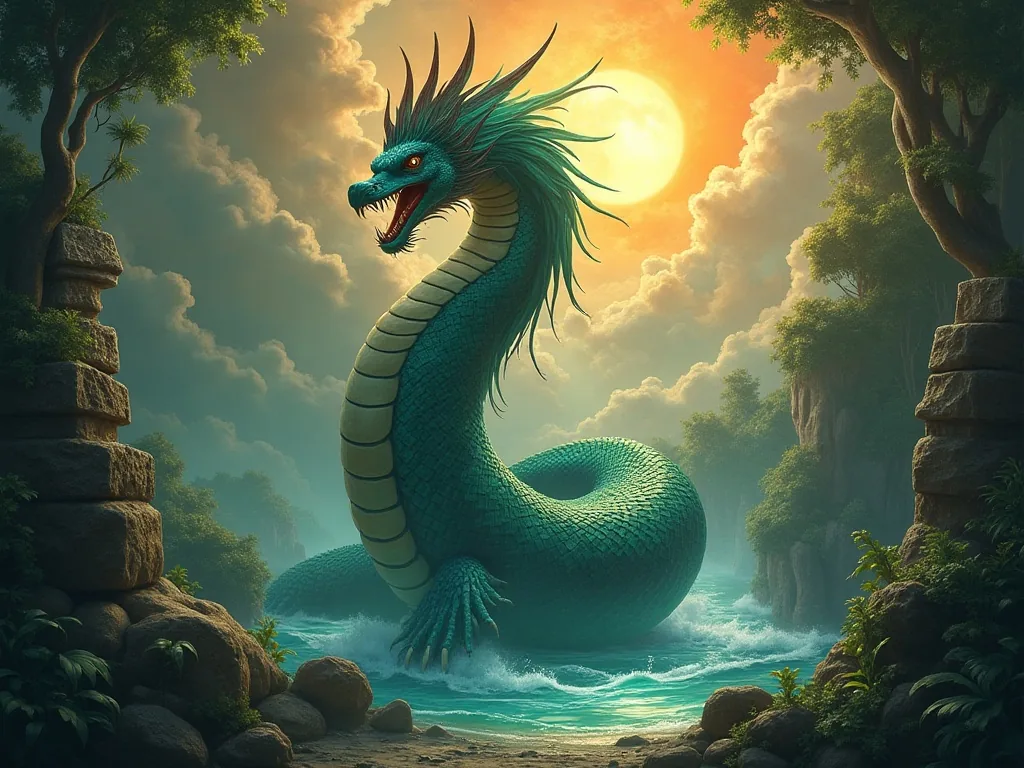
No figure dominates Toltec religious imagination more completely than Quetzalcoatl, the Feathered Serpent. In purely theological terms, Quetzalcoatl represented the union of quetzal, the iridescent highland bird associated with precious things and sky, and coatl, serpent, symbol of earth and underworld. The combination described a deity who bridged heaven and ground, spirit and matter.
The Toltecs, however, did something remarkable with this ancient Mesoamerican god. They fused him with a historical or semi-historical ruler named Ce Acatl Topiltzin, "One Reed, Our Prince." According to the tradition preserved in sources such as the Historia Tolteca-Chichimeca and the accounts compiled by Bernardino de Sahagún, Ce Acatl Topiltzin became the high priest of Quetzalcoatl at Tollan and eventually so identified with the deity that the two became inseparable in oral memory.
The Reign of the Priest-King
Under Topiltzin Quetzalcoatl, Tollan supposedly flourished. Cacao grew in colors. Maize ears were so enormous they could not be carried in two arms. Cotton bloomed already dyed in crimson, yellow, and blue. These are not merely poetic embellishments; they encode a theology of right rulership. When the sacred king practiced proper devotion, the cosmos responded with abundance. Order above produced fertility below.
Topiltzin was also said to have forbidden human sacrifice, demanding only the blood of quails, butterflies, and snakes in place of human hearts. This detail became enormously important in later Aztec interpretation, which portrayed the Toltec golden age as a time of ritual purity that subsequent ages had corrupted or deliberately destroyed.
The Fall and the Departure
The destruction of Topiltzin Quetzalcoatl is one of the great mythological tragedies of the pre-Columbian world. His enemy was Tezcatlipoca, the Smoking Mirror, a god of night, sorcery, and unpredictable power. Tezcatlipoca, in several versions, tricked Topiltzin into drunkenness with pulque, the fermented agave beverage. In a state of intoxication, Topiltzin broke his priestly vows by sleeping with his celibate sister Quetzalpetlatl.
Shamed and spiritually broken, Topiltzin left Tollan. The accounts of his departure vary. In some, he burned his palaces of turquoise and coral and walked east toward the sea. In others, he sailed away on a raft of serpents. In still others, he immolated himself on a pyre and his heart rose as the planet Venus, the Morning Star, returning after eight days of absence. The number eight here is not accidental; Venus disappears from evening visibility for roughly eight months and reappears as the Morning Star, a celestial rhythm the Mesoamerican world mapped onto myth with precise astronomical care.
The promise, or threat, embedded in his departure, that he would one day return from the east in a One Reed year, resonated so powerfully that it arguably shaped Aztec responses to the Spanish arrival in 1519, itself a One Reed year.
Tezcatlipoca and the Cosmic Conflict
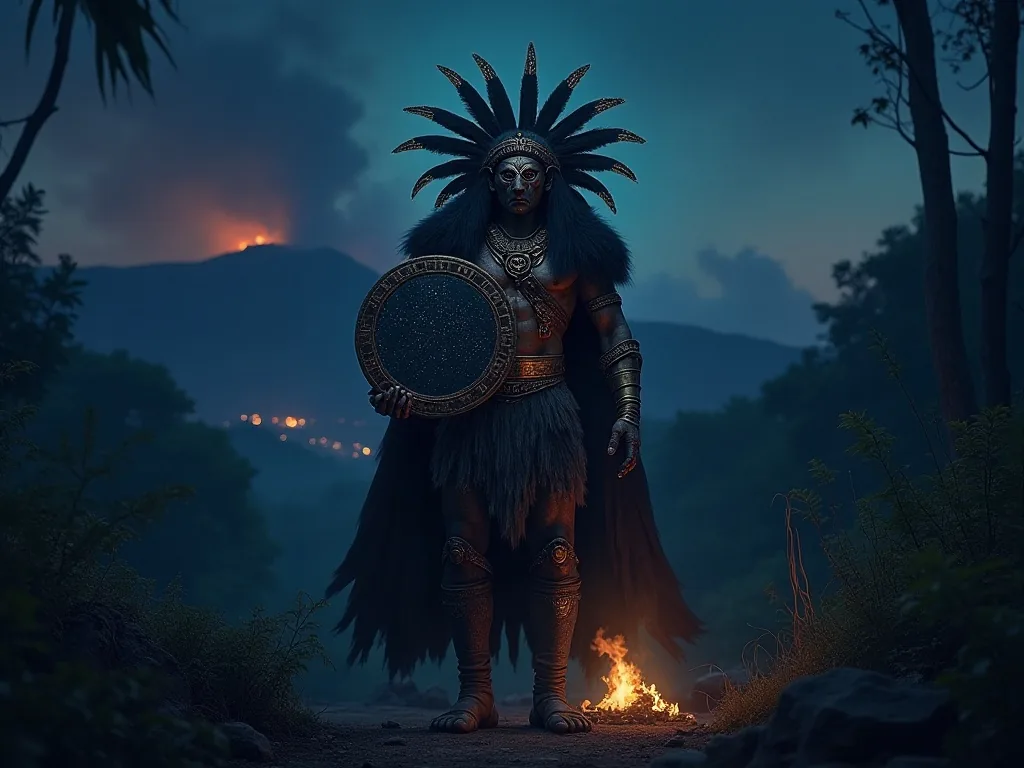
If Quetzalcoatl embodied light, craft, and priestly devotion, Tezcatlipoca embodied everything that resisted neat categorization. He was the lord of the nocturnal sky, a jaguar deity, a sorcerer, and a tester of human integrity. His characteristic attribute was the smoking obsidian mirror, a divination tool in which he could see all human deeds and in which a brave person might perceive their own fate.
The antagonism between Quetzalcoatl and Tezcatlipoca was not simply good versus evil. Mesoamerican theology rarely operated on that binary. Rather, both forces were necessary. Creation itself, in the Toltec and later Aztec cosmological tradition, arose from their conflict. The successive world-ages known as the Suns were created, destroyed, and replaced through the interplay of these two competing cosmic principles.
The Five Suns
The doctrine of the Five Suns, preserved most fully in Aztec sources but rooted in earlier Toltec theological frameworks, held that the current world was the fifth successive creation. Each prior world, or Sun, ended in catastrophe. The first Sun, governed by Tezcatlipoca, ended when Quetzalcoatl knocked the sun-jaguar from the sky. The second ended in hurricanes. The third in a rain of fire. The fourth in a flood.
The fifth Sun, the one in which humanity currently lives, was purchased at Teotihuacan when the humble god Nanahuatzin threw himself into a bonfire and became the moving sun. But even this Sun is destined to end in earthquakes. Toltec mythology thus operated inside a framework of sacred time that was both cyclical and contingent: the cosmos survived not through inevitability but through correct human action, including ritual, sacrifice, and devotion.
The Sacred City of Tollan and Its Cosmic Architecture
Tula, the physical Tollan, was built to mirror cosmic order. Its great pyramid, the Pyramid B, was crowned with the famous Atlantean warriors, colossal basalt figures more than four meters tall that once supported the roof of the temple. Their imagery, feathered headdresses, butterfly pectorals, and atlatl spearthrowers, encodes a specific warrior-priestly identity associated with Venus as the Morning Star, the celestial aspect of Quetzalcoatl himself.
The Toltec ball court at Tula echoed a myth that pervaded all of Mesoamerica: the ballgame as cosmic drama, a reenactment of the struggle between sun and underworld forces. The rubber ball represented the sun moving through the sky and descending into death each night, only to be reborn at dawn. Playing the sacred game was an act of cosmological maintenance, keeping the celestial order running through human participation.
The coatepantli, the Serpent Wall, that ran along the north face of the main pyramid depicted skeletal serpents devouring human figures. This was not gratuitous imagery. It expressed the Toltec understanding that life and death interpenetrated constantly, that the serpentine earth consumed flesh to produce the crops that sustained new flesh.
Deities of the Toltec Pantheon
While Quetzalcoatl and Tezcatlipoca occupy the dramatic foreground, Toltec mythology was populated by a rich assembly of other divine powers.
- Tlaloc: The ancient rain deity whose goggle-eyed mask appeared at Tula, connecting Toltec religion to far older Mesoamerican traditions rooted at Teotihuacan.
- Xipe Totec: "Our Lord the Flayed One," a deity of agricultural renewal, seasonal regeneration, and the cyclical shedding of the earth's skin. His rites involved priests wearing the skins of sacrificed humans, a symbolic enactment of the new growing season emerging from the old.
- Mixcoatl: The Cloud Serpent, a stellar deity associated with the Milky Way and hunting, and the divine father attributed to Ce Acatl Topiltzin in mythological genealogies.
- Itzpapalotl: The Obsidian Butterfly, a fearsome goddess associated with warfare, sacrifice, and the paradox of beauty concealing lethal power. She ruled over the paradise of Tamoanchan, the primordial garden from which humanity first descended.
These deities were not passive recipients of prayers. They acted, quarreled, transformed, and sometimes failed. Toltec theology granted its gods authentic dramatic interiority.
Tamoanchan and the Origins of Humanity
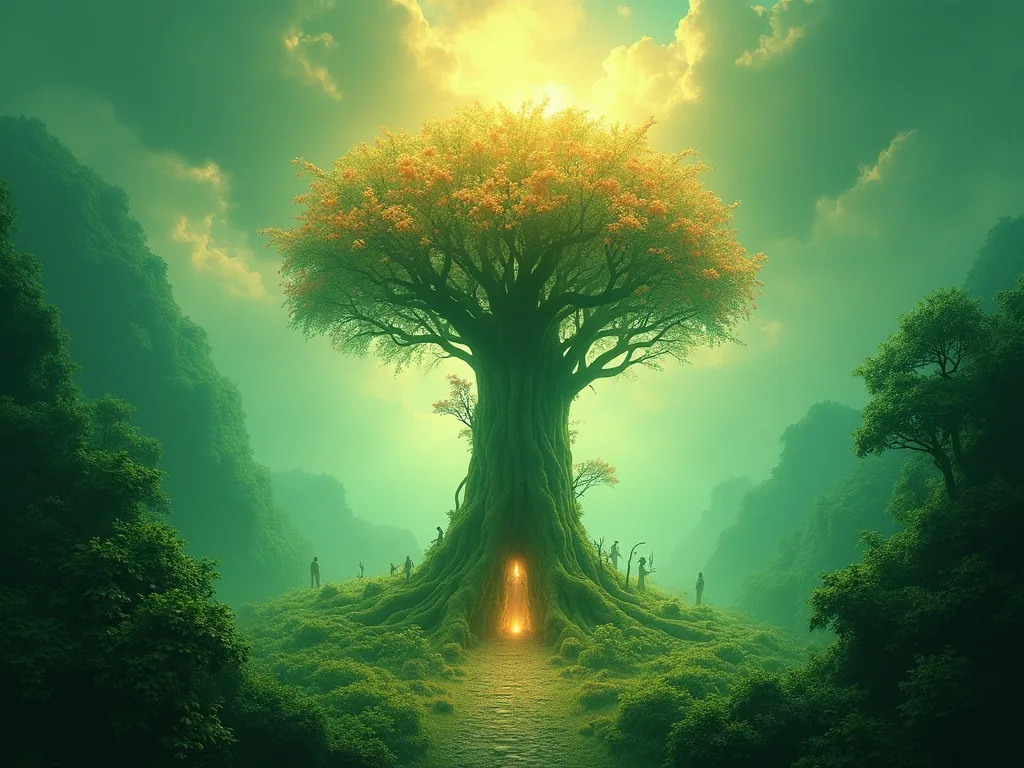
Tamoanchan was the mythological garden where the gods created human beings. Its name likely derives from a Mayan phrase meaning "the place of the misty sky," pointing to the deep cultural entanglements between the Toltec world and earlier and contemporary Mayan civilizations. In Tamoanchan, the gods broke the cosmic flowering tree, an act that brought mortality, sex, and time into existence.
This origin myth parallels creation stories across the globe: a primordial state of undifferentiated wholeness, a transgression, and then the fall into the mortal, temporally structured world. For the Toltecs, however, the transgression was not solely humanity's fault. The gods themselves broke the tree. Humanity inherited a world already cracked, already in motion, already requiring the constant labor of ritual to keep it from collapsing.
The goddess Xochiquetzal, "Flower Quetzal," was said to have been abducted from Tamoanchan by Tezcatlipoca, and this abduction introduced erotic desire and aesthetic pleasure, both gifts and disruptions, into the human world. Weaving, flowers, song, and sexual love all fell under her domain, and the myth encoded the Toltec understanding that beauty itself had a slightly transgressive, destabilizing quality.
The Toltec Legacy and Its Transformation Into Aztec Myth
The fall of Tula around 1150 CE scattered Toltec populations across Mesoamerica. Groups claiming Toltec descent arrived in the Valley of Mexico, at Cholula, and as far south as the Guatemalan highlands. The Aztecs, who founded Tenochtitlan in 1325, were particularly aggressive in claiming Toltec heritage, inserting Toltec genealogies into their own dynastic histories and adopting the cult of Quetzalcoatl into their own state religion.
This transmission was not simple preservation. The Aztecs reinterpreted Toltec myths through their own imperial theology, amplifying the role of human sacrifice and recasting the gentler portrait of Topiltzin's reign as a distant, irrecoverable past that justified the violence of the present age. The Toltec golden age became, in Aztec hands, a lost paradise that could be approached but never fully recovered, a theological engine generating both piety and power.
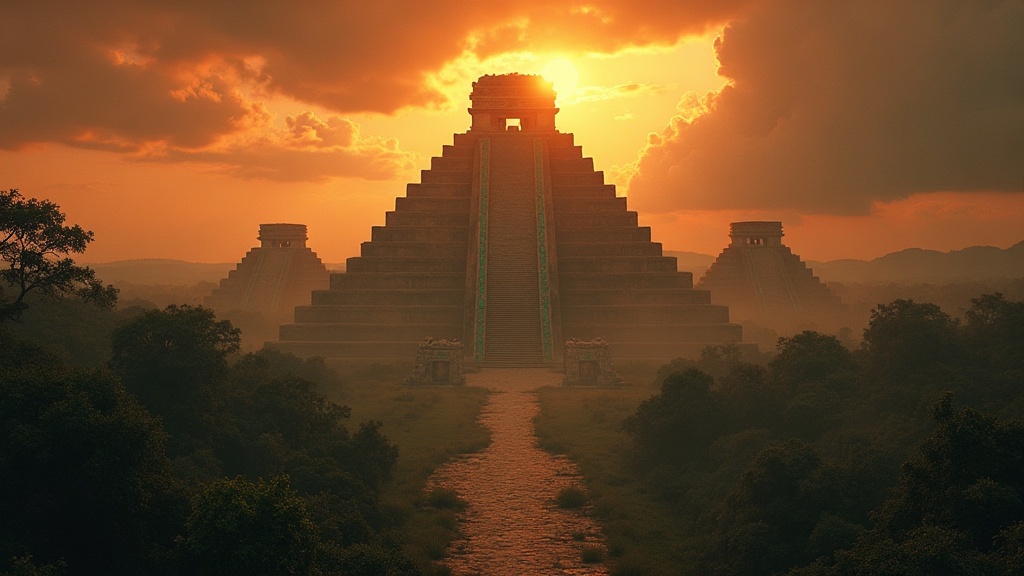
The influence extended beyond the Valley of Mexico. The feathered serpent iconography traveled to Chichen Itza in the Yucatan, where the great Kukulcan pyramid (Kukulcan being the Mayan name for Quetzalcoatl) almost certainly reflects Toltec religious diffusion during the Terminal Classic and Early Postclassic periods, between roughly 800 and 1100 CE.
Reading Toltec Myth in the Archaeological Record
Unlike the Aztecs, who were encountered by European chroniclers in 1519, the Toltecs left no surviving native codices of their own. What survives is a combination of archaeological evidence at Tula, later Nahuatl-language texts compiled in the early colonial period (particularly the Anales de Cuauhtitlan and Sahagún's Florentine Codex), and comparative Mesoamerican art history.
This means Toltec mythology must always be read through layers of transmission and reinterpretation. The myths described here were recorded decades or even centuries after Tula's fall, shaped by the agendas of Aztec theologians, Spanish friars, and indigenous informants navigating a colonized world.
Yet the core images persist across these layers with remarkable stability: the feathered serpent bridging sky and earth, the smoking mirror revealing uncomfortable truths, the sacred city that was once and might be again, and a cosmos sustained not by mechanical necessity but by the ongoing negotiation between humans and the divine forces they both worship and resemble.
The Living Resonance of Toltec Sacred Thought
In the twentieth century, Toltec spirituality experienced an unexpected renaissance through the work of anthropologists and, more controversially, through popular authors such as Miguel Ruiz, whose book "The Four Agreements" claims a lineage from Toltec wisdom traditions. While scholars approach such neo-Toltec frameworks with appropriate caution, their popularity signals something genuine: Toltec mythology speaks to perennial questions about how imperfect beings inhabit a fragile cosmos.
The myth of Ce Acatl Topiltzin remains perhaps the most haunting of all Mesoamerican stories precisely because it refuses easy resolution. A righteous ruler is undone not by cowardice or malice but by a moment of weakness engineered by a force the cosmos itself requires. He departs, promises to return, and becomes the Morning Star. That image, the brilliant planet rising before the sun after its long absence, visible to any observer who wakes before dawn and looks east, continues to carry the full weight of the Toltec mythological inheritance: loss, transformation, and the stubborn persistence of light.