Ce Acatl Topiltzin Quetzalcoatl: The Priest-King of Tula
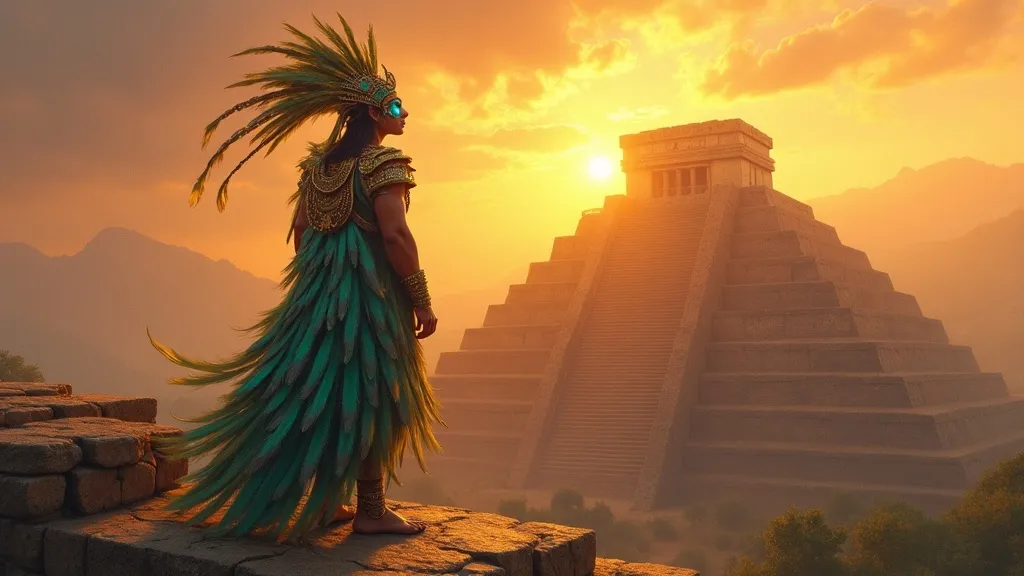
Half man, half god, and entirely myth: Ce Acatl Topiltzin Quetzalcoatl ruled Tula as a priest-king whose fall and promised return shaped Mesoamerican history for centuries.
Contents
The night Ce Acatl Topiltzin Quetzalcoatl looked into the mirror, he did not see a king. He saw a face ravaged by age, by drink, by the schemes of sorcerers. What happened next shook the Toltec world to its foundations and sent reverberations through every Mesoamerican civilization that came after.
He was born, the sources say, on the day Ce Acatl, "One Reed," in the Nahuatl ritual calendar, a date so charged with celestial meaning that it became his name. He would die, or vanish, on the same calendrical date decades later. Between those two points, he built a golden age, lost it through a single night of weakness, and walked east into the sunrise, promising to return when One Reed came again. Few promises in the ancient world proved so politically consequential.
His story sits at the seam between history and myth. Archaeologists find real walls at Tula, real basalt warriors, real evidence of a city that once commanded much of central Mexico. The chronicles written after the Spanish conquest dress those facts in feathered serpent skin, and distinguishing the man from the god he became is one of the great puzzles of Mesoamerican studies.
The Birth of a Priest-King: Myth, Parentage, and Prophecy
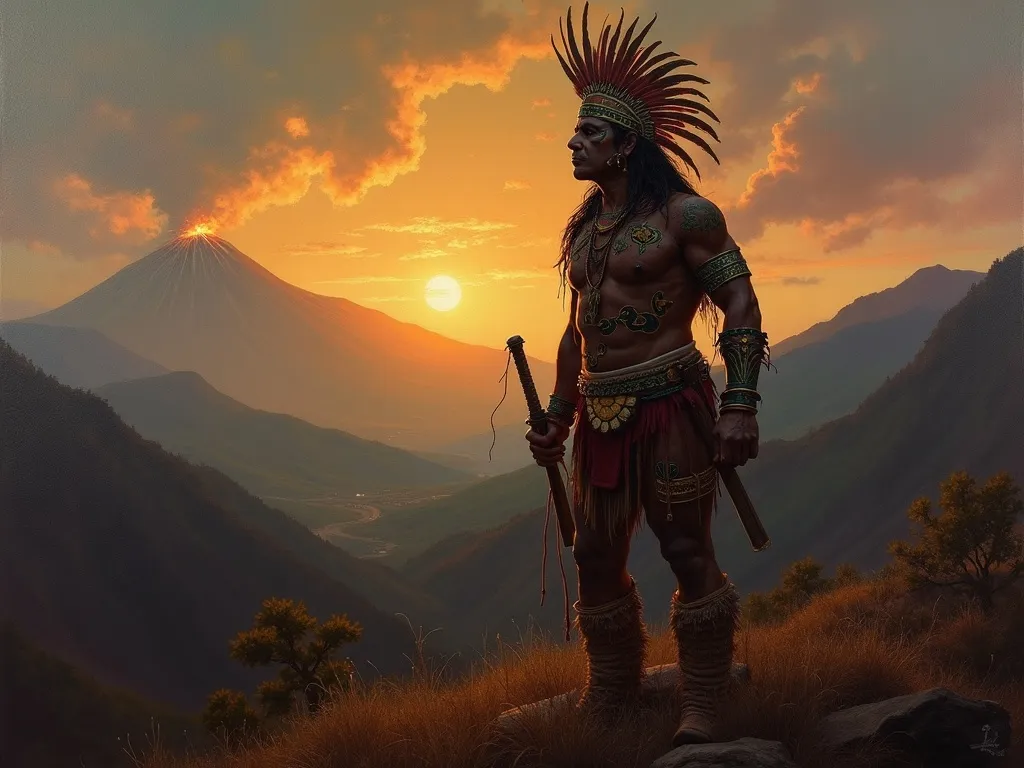
The Anales de Cuauhtitlan, one of the richest post-conquest Nahuatl sources, opens his life with a paradox. His father was Mixcoatl, the Cloud Serpent, a fierce warrior-chief who united nomadic Chichimec groups and created the first kernels of what would become Toltec power. His mother, Chimalma, died in childbirth, leaving Ce Acatl to be raised by maternal grandparents. Mixcoatl was later assassinated by his own brothers before his son could know him.
The child grew up with vengeance already written into his fate. He tracked down his father's killers, executed them, and reclaimed his father's bones for proper burial. That act established the template: Ce Acatl Topiltzin Quetzalcoatl as restorer of right order, a role he would play on a civilizational scale at Tula.
His name deserves careful unpacking. Ce Acatl is his calendrical name, the day sign under which he was born. Topiltzin means "Our Prince" or "Our Lord," a title of honor. Quetzalcoatl fuses quetzal (the iridescent highland bird, symbol of rarity and divine beauty) with coatl (serpent), yielding the Feathered Serpent. He did not invent the deity; he became its living vessel, its priest and earthly regent. The distinction collapsed in memory until man and god became one layered figure that later dynasties could claim or repudiate as needed.
Tula: The City He Built and What It Actually Looked Like
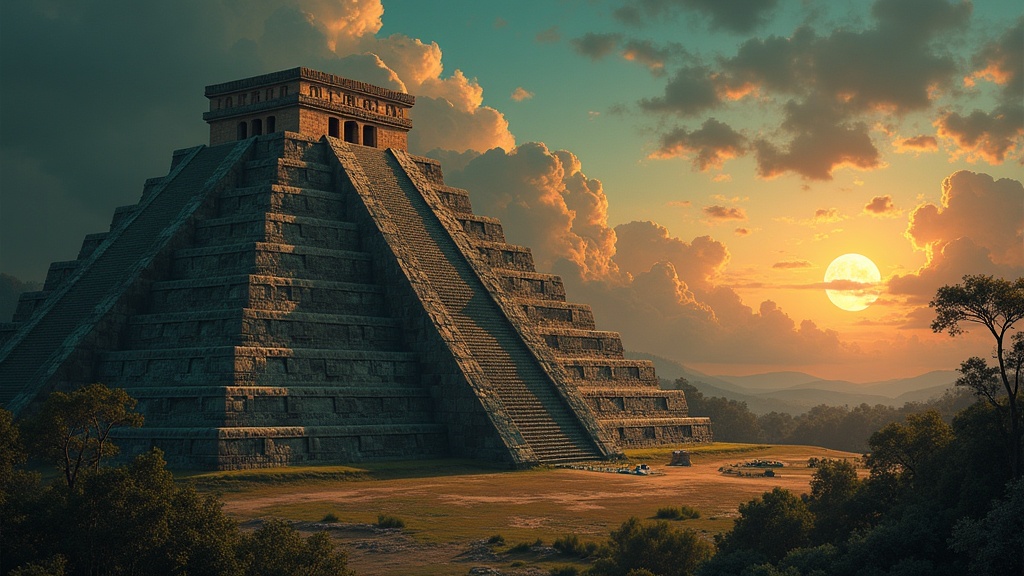
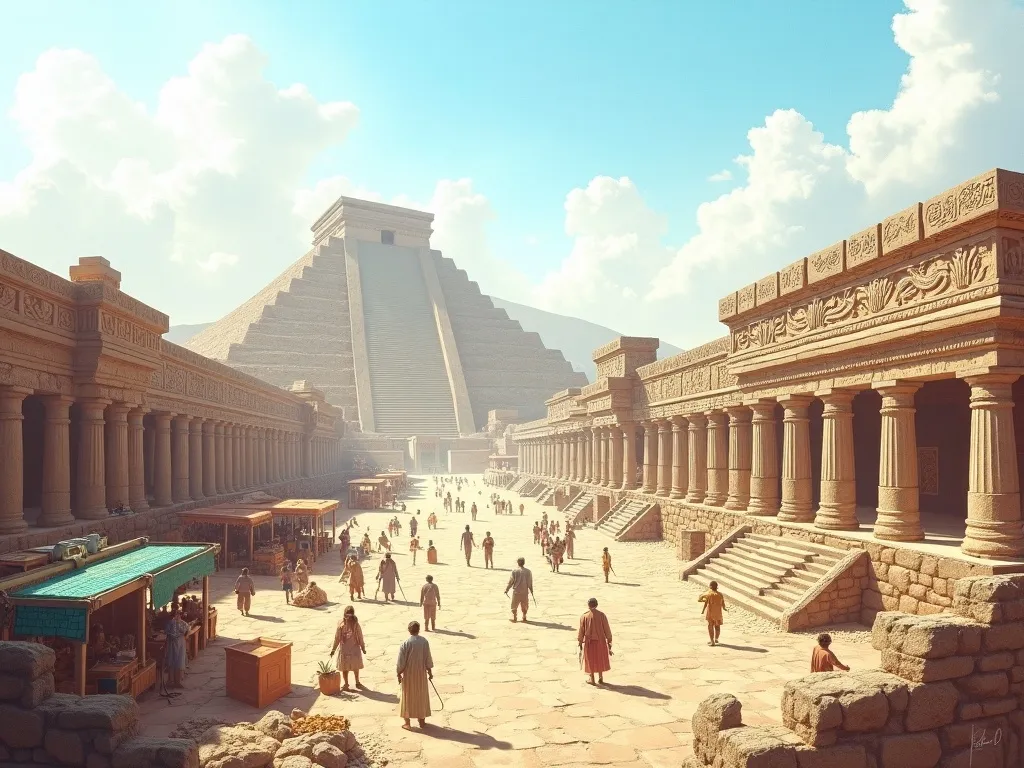
Tula, known in Nahuatl sources as Tollan, sits in the modern state of Hidalgo, roughly 80 kilometers north of Mexico City. At its height between approximately 900 and 1150 CE, it housed perhaps 60,000 people, making it one of the largest urban centers in pre-Columbian North America. The Aztec sources remembered it with something close to awe: a city where maize grew as tall as trees, where cotton flowered already dyed in brilliant colors, where cacao was abundant, and where artisans worked turquoise, jade, and gold with unmatched skill.
Archaeology is more sober but still striking. The Pyramid B at Tula stands with its four famous Atlantes, basalt warrior columns nearly 4.6 meters tall, their faces stern, their atlatl spear-throwers raised. The Temple of Quetzalcoatl bears carved friezes of feathered serpents alternating with jaguar and coyote processions. A chac mool figure reclines at the temple entrance, its stone bowl waiting for offerings.
The myth added layers the stones cannot confirm. Topiltzin Quetzalcoatl reportedly built four palaces facing the cardinal directions, each made from a different material: turquoise, gold, white shell, and red shell. He introduced, or intensified, a priestly reform: human sacrifice was to be stopped or reduced. He preferred to offer jade, butterflies, and feathered serpents rather than human blood. This put him in direct conflict with other priestly factions, particularly those devoted to Tezcatlipoca, the Smoking Mirror, whose cult required blood and whose sorcerers would eventually engineer Topiltzin's ruin.
The Night of the Mirror: Tezcatlipoca's Trap
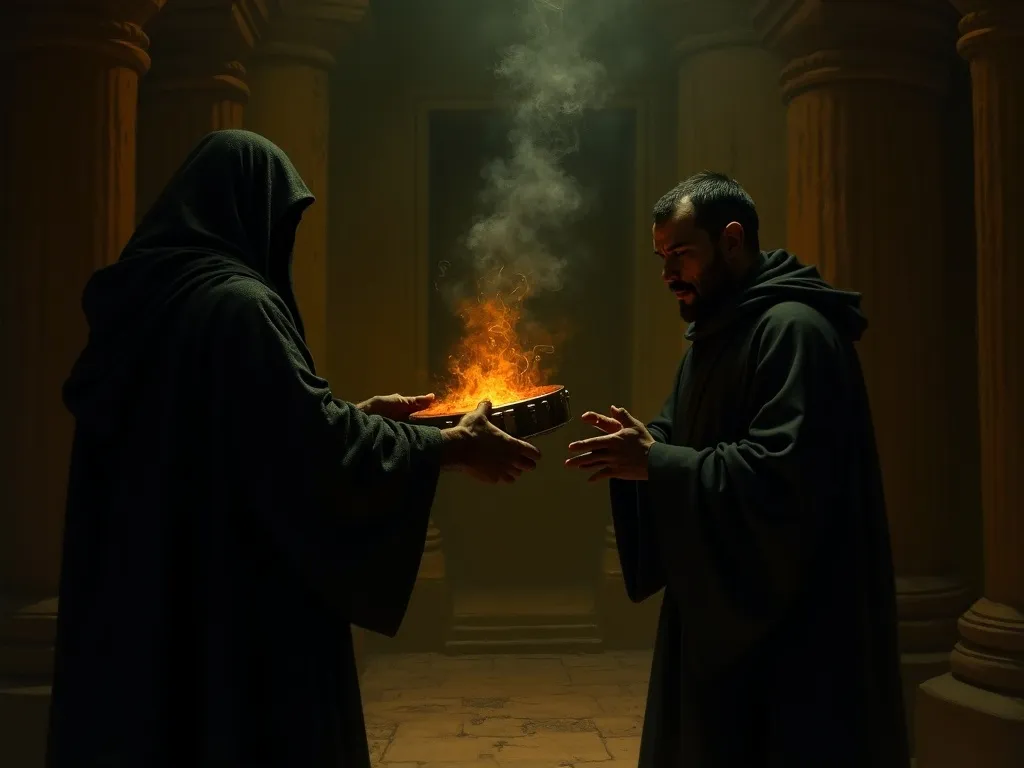
This is the pivot point in every version of the legend. Tezcatlipoca, rival deity and master of darkness, appears at Tula in disguise. The precise form varies between sources: sometimes he comes as a merchant, sometimes as a healer. In the Leyenda de los Soles and the Historia de los Mexicanos por sus Pinturas, the trap is set with pulque.
Tezcatlipoca offers Topiltzin a drink, insisting it is medicine. Topiltzin resists. He refuses once, twice, four times. On the fifth offering, he relents, drinks, and then calls for his sister to drink also. Both fall into an intoxication that breaks his priestly vows of chastity. When he wakes and understands what has happened, shame dismantles him faster than any army could.
The mirror element deserves its own attention. In some tellings, Tezcatlipoca first tricks Topiltzin into looking at his own reflection in an obsidian mirror. What the priest-king sees horrifies him: his own aged, mortal face, wrinkled and impermanent. The sorcerer whispers that no one will follow a ruler who looks like this. He offers face paint to conceal the damage, begins to make Topiltzin vain and self-conscious before the fatal drink is ever poured.
It is a sophisticated mythological argument. The mirror that Tezcatlipoca carries reveals truth the viewer cannot bear. Topiltzin, who governed through spiritual authority and self-denial, crumbles not through military defeat but through a confrontation with his own mortality and desire. The most powerful priest in Mesoamerica falls to pulque and vanity. The Aztec inheritors of this story read it as cosmic warning: no human, however sanctified, stands entirely outside the reach of darkness.
After the night of failure, plague and disaster reportedly struck Tula. The maize withered. Frost came in summer. The skilled artisans, who the sources call the tolteca, scattered. Topiltzin gathered those who remained loyal and began his procession toward the east.
The Journey East and the Promise of Return
The procession from Tula is one of the most elaborately described episodes in any Nahuatl source. Topiltzin Quetzalcoatl moved through the landscape burying his treasures, burning his palaces of feathers and gold, and transforming the land as he passed. Trees became stone. Birds fell silent. He crossed mountains and deserts, teaching and lamenting, mourning the city he had built.
At the Gulf Coast, different traditions diverge. The Anales de Cuauhtitlan says he built a funeral pyre and threw himself into the flames; from the smoke rose the planet Venus, Tlahuizcalpantecuhtli, the Morning Star. The cycle matched perfectly: Venus disappears below the horizon (apparent death), then reappears as the morning star (resurrection). His calendrical birth date, One Reed, corresponded in the Aztec solar calendar with the year the planet Venus made a particular heliacal rise. The god and the astronomical body merged.
Other versions, particularly those preserved through the Cholula tradition, say he boarded a raft of serpents and sailed east across the sea, promising to return from the direction of the rising sun in a year Ce Acatl, wearing his trademark attributes: a black mask, a red beak, a feathered cloak.
That promise would acquire devastating political weight in 1519. When Hernando Cortés arrived on the Gulf Coast in a year that corresponded roughly to One Reed in the Aztec calendar, the question of whether the Mexica emperor Moctezuma II genuinely believed Cortés was the returning Topiltzin Quetzalcoatl has been debated by historians for five centuries. Modern scholars including Camilla Townsend have argued the Cortés-as-Quetzalcoatl story was largely a post-conquest invention, a narrative frame imposed after the fact to explain catastrophic defeat. But the myth existed, the expectation existed, and the year One Reed was already freighted with meaning before any Spanish ship crested the horizon.
Quetzalcoatl at Cholula: The Parallel Tradition
Tula is not the only city that claimed Topiltzin Quetzalcoatl. The city of Cholula, in the modern state of Puebla, built a tradition equally insistent. The Great Pyramid of Cholula, the largest pyramid by volume in the world, was dedicated in part to Quetzalcoatl, and Cholula's priests maintained that the Feathered Serpent had lived and ruled there.
The Cholula tradition tends to emphasize the priestly and pacifist aspects of Topiltzin: he opposed blood sacrifice, he cultivated learning, he introduced the use of the calendar for agricultural planning. The Tula tradition, as preserved through Aztec sources, emphasizes the tragic fall and the cosmic resurrection. These are not simply duplicate accounts; they preserve different facets of a figure who was claimed, reshaped, and redeployed by every major power in central Mexico.
The Aztec mythology that forms the richest body of written evidence about Topiltzin Quetzalcoatl is itself a latecoming inheritor. The Mexica arrived in central Mexico as relative newcomers around the 13th century. They absorbed Toltec prestige wholesale, claiming Toltec ancestry and adopting the Quetzalcoatl cult in part to legitimate their own rule. Understanding Ce Acatl Topiltzin Quetzalcoatl requires reading through the Aztec layer to the older Toltec substrate beneath.
The Priest-King's Reforms: Calendar, Craft, and the Rejection of Blood
The sources credit Ce Acatl Topiltzin Quetzalcoatl with a remarkable legislative agenda for a mythological hero. He is said to have perfected the tonalpohualli, the 260-day ritual calendar that governed Mesoamerican religious life, timing ceremonies, naming children, and determining auspicious days for planting and warfare. His astronomers tracked Venus with precision that still impresses modern scholars: the Aztec Venus calendar, which locks the 365-day solar year and the 260-day ritual year into an 18,980-day cycle, required generations of careful observation that roots earlier than Tula.
He is also credited with introducing or refining toltecat craftsmanship, the hallmark technical excellence from which the Nahuatl word tolteca ultimately derived its meaning of "skilled artisan" rather than simply "person of Tula." Featherwork, goldsmithing, mosaic, fine ceramics: the Aztec artist who wanted to claim the highest legitimacy called himself a tolteca.
The reform most remembered, and most contentious, was his stance on human sacrifice. Topiltzin reportedly tried to substitute other offerings: copal incense, snakes, butterflies, quail. The priestly faction he opposed, centered on Tezcatlipoca's cult, insisted the sun required human hearts to complete its daily journey across the sky. This theological conflict was real in the sense that Mesoamerican polities genuinely differed on sacrifice frequency and scale, and the Quetzalcoatl tradition consistently sits toward the lower end of that spectrum.
It would be naive to read this as a simple Good King versus Evil Sorcerer narrative. The sources that preserved Topiltzin's memory were shaped by multiple political agendas. Some communities used his pacifist reputation to critique Aztec imperial excess. Others used his failure and exile to argue that bloodless religion was inherently weak. The myth is a screen onto which every subsequent generation projected its own anxieties.
The Feathered Serpent Before and After Tula
The deity Quetzalcoatl as a concept long predates any historical priest-king. The feathered or plumed serpent appears at Teotihuacan no later than 150 CE, carved in spectacular relief on the Temple of the Feathered Serpent in the Street of the Dead complex. At that date, Tula did not yet exist and the Toltec people had not yet coalesced as a cultural entity.
The serpent combined two poles of the Mesoamerican cosmos: the quetzal bird that inhabits highland cloud forest canopy (the upper, celestial realm) and the serpent that moves through earth and water (the lower, chthonic realm). Together they embodied a synthesis: the living bridge between sky and underworld, the axis that makes cosmic circulation possible. When Topiltzin took that deity's name and priestly role, he was not inventing; he was inserting himself into a venerable theological structure.
After Tula's collapse around 1150 CE, the feathered serpent travelled further. The archaeological record at Chichen Itza in the Yucatan Peninsula shows unmistakable Toltec influence: the famous El Castillo pyramid's serpent balustrades, the warrior columns echoing Tula's Atlantes, the chac mool figures. Whether this represents Toltec military conquest, trade influence, or the movement of displaced Toltec communities remains debated. But the figure of Kukulkan, the Yucatec Maya name for the Feathered Serpent, carried the same essential symbolism. The priest-king's mythological DNA spread even as his city fell.
Ce Acatl Topiltzin Quetzalcoatl in Aztec Political Thought
By the time the Aztec empire reached its peak in the 15th century, Ce Acatl Topiltzin Quetzalcoatl had become a political instrument of the first order. Aztec rulers who wanted to project wisdom and priestly legitimacy invoked his memory. Moctezuma I, who reigned 1440-1469, reportedly wore priestly vestments modeled on Topiltzin's iconography. The Aztec huey tlatoani was, in theory, steward of the realm until Quetzalcoatl's return.
This created a theological vulnerability unique in pre-Columbian political thought. The rightful ruler was absent. The current ruler held his seat on behalf of a returning god. What happened when someone arrived from the east, dressed in unfamiliar materials, in a year close enough to One Reed to invite interpretation?
Camilla Townsend's careful reading of early colonial Nahuatl documents, particularly in her 2019 book Fifth Sun, argues that Moctezuma's reported veneration of Cortés as a returning deity was largely inserted into the record by later indigenous authors navigating colonial power. The Florentine Codex, compiled by Fray Bernardino de Sahagún from indigenous informants in the 1570s, is the richest source for this identification, but it was recorded fifty years after the conquest by people who had lived through it. The retrospective theological explanation served political purposes under colonial rule: it framed defeat as destiny rather than failure.
Still, the myth was alive enough to shape behavior. Moctezuma sent gifts, including Quetzalcoatl's ritual regalia, to the approaching Spaniards. That is historical fact. The interpretation layered onto the gesture is where myth and history become inseparable.
Unresolved Debates: The Historical Topiltzin and What Archaeology Confirms
Can archaeology confirm a historical ruler named Ce Acatl Topiltzin Quetzalcoatl? The honest answer is: not directly. No contemporary inscription at Tula names him. The richest textual accounts, the Anales de Cuauhtitlan, the Leyenda de los Soles, the Historia Tolteca-Chichimeca, all date from the 16th century or later and were recorded under colonial conditions.
What Tula's archaeology does confirm: the city existed, flourished between roughly 900 and 1150 CE, showed deliberate destruction events possibly consistent with internal conflict or external pressure, and then declined sharply. The architecture documents a powerful priestly-military ruling class with access to long-distance trade networks reaching as far as the American Southwest and coastal Guatemala.
The historian Nigel Davies, in his 1977 study The Toltecs: Until the Fall of Tula, proposed that there may have been two historical figures collapsed into one myth: an early Quetzalcoatl-cult priest who established Tula's religious foundation and a later ruler whose political fall became the exile narrative. Richard Diehl's more recent archaeological work at Tula suggests the city's end involved fire and deliberate monument destruction, consistent with internal factional violence, which maps loosely onto the Tezcatlipoca conflict stories.
The mythological and historical layers will probably never fully separate. That is not a failure of scholarship; it is the nature of the evidence. Topiltzin Quetzalcoatl became too useful a figure, too theologically resonant, for any subsequent culture to leave him in plain historical form.
What Survives: Art, Memory, and the Feathered Serpent's Long Presence
The physical legacy of Ce Acatl Topiltzin Quetzalcoatl moves through Mesoamerican art like a recurring chord. The Atlante warriors at Tula stare south toward the pyramid they once crowned. The Feathered Serpent frieze at Teotihuacan predates them by seven centuries. The serpent balustrades at Chichen Itza echo both. Aztec goldsmiths made pectoral ornaments shaped like the Feathered Serpent. The Codex Vindobonensis, a pre-conquest Mixtec manuscript, includes scenes interpreted as episodes from the Topiltzin cycle.
After the Spanish conquest, the imagery shifted register. Friars like Sahagún recorded the myths in Nahuatl, sometimes with barely concealed sympathy for the priest-king's pacifism, which they read as a proto-Christian gesture toward sacrifice-free religion. Later writers in the 17th and 18th centuries proposed, without serious evidence, that Quetzalcoatl was actually the apostle Thomas, Quetzalcoatl being a phonological echo of Thomas. The idea reveals more about colonial theology than about Toltec religion, but its persistence into the 19th century shows the myth's continuing power to attract reinterpretation.
In Mexican national identity after independence, the Feathered Serpent became a symbol of indigenous civilizational achievement, invoked by muralists like Diego Rivera who painted Topiltzin Quetzalcoatl as a bearded sage presiding over an idealized Toltec golden age. The actual Toltec sources do not describe him as bearded in any unusual way; that detail crept in through colonial-era speculation that he was European. Rivera's murals at the National Palace in Mexico City remain among the most viewed Mesoamerican-themed artworks in the world, and they carry this mythologized image to millions of visitors each year.
Frequently Asked Questions About Ce Acatl Topiltzin Quetzalcoatl
Frequently asked questions
Was Ce Acatl Topiltzin Quetzalcoatl a real historical person?
Most scholars accept that a historical ruler associated with Tula and the Quetzalcoatl priestly office probably lived around 947-999 CE, based on dates preserved in the Anales de Cuauhtitlan. However, no contemporary Toltec inscription names him directly. The figure as described in all surviving sources is a composite of historical memory, priestly myth, and later political manipulation by Aztec and colonial-era writers. He was real in the way that many ancient priest-kings are real: a historical kernel surrounded by centuries of accretion.
What is the difference between Quetzalcoatl the deity and Topiltzin Quetzalcoatl the ruler?
The deity Quetzalcoatl, the Feathered Serpent, appears in Mesoamerican iconography at least as early as 150 CE at Teotihuacan, centuries before Tula existed. Ce Acatl Topiltzin Quetzalcoatl was a Toltec ruler who served as the chief priest of the Quetzalcoatl cult, effectively becoming the deity's earthly embodiment. Over time, the distinction collapsed in collective memory. Later Nahuatl sources use the name interchangeably for both the god and the historical ruler, which is a major source of scholarly confusion.
Did Moctezuma really believe Cortés was the returning Quetzalcoatl?
This is one of the most contested questions in Mesoamerican historiography. The richest account identifying Cortés as the returning Topiltzin Quetzalcoatl comes from the Florentine Codex, compiled fifty years after the conquest. Historian Camilla Townsend and others argue this identification was a post-conquest explanatory narrative rather than a genuine pre-conquest belief. Moctezuma did send Quetzalcoatl's regalia to Cortés, but whether that expressed theological conviction or diplomatic protocol is unresolved. The myth of the returning god was real; the degree to which it shaped Moctezuma's decisions in 1519 remains genuinely debated.
What primary sources describe the life and fall of Topiltzin Quetzalcoatl?
The main sources are: the Anales de Cuauhtitlan (a 16th-century Nahuatl annals text); the Leyenda de los Soles (part of the Chimalpopoca Codex); the Historia Tolteca-Chichimeca; the Historia de los Mexicanos por sus Pinturas; and sections of the Florentine Codex compiled by Sahagún. None are contemporaneous with the Toltec period. All reflect indigenous oral traditions filtered through post-conquest colonial conditions. The Mixtec Codex Vindobonensis contains pre-conquest pictorial material that some scholars connect to the Quetzalcoatl cycle, though interpretation is contested.
How did the Topiltzin Quetzalcoatl myth spread beyond the Toltecs?
After Tula's collapse around 1150 CE, Toltec populations dispersed across Mesoamerica, carrying their religious and political traditions with them. The Aztec state actively absorbed Toltec prestige, claiming Toltec ancestry and installing Quetzalcoatl as a central deity. In the Yucatan Peninsula, the Maya Feathered Serpent deity Kukulkan shows strong Toltec influence, visible in the architecture at Chichen Itza. The Quiche Maya Popol Vuh includes figures and narrative patterns with parallels to the Topiltzin cycle. The myth traveled through cultural contact, conquest, trade, and the movement of displaced communities.
The Myth That Keeps Remaking Itself
The story of Ce Acatl Topiltzin Quetzalcoatl does something unusual for an ancient myth: it resists closure. Most hero myths end with death, apotheosis, or the establishment of an enduring order. This one ends with a departure and a conditional promise. He will come back. He left. He has not yet returned.
That open structure made the myth infinitely adaptable. Every generation that wanted a golden age to have existed could locate it at Tula. Every ruler who wanted legitimate authority could claim Toltec descent. Every oppressed community under Aztec rule could nurse the hope that the pacifist priest-king would return and displace the blood-demanding imperial cult. Every colonial-era friar could read Quetzalcoatl's anti-sacrifice stance as an intimation of Christian truth planted in the New World before European contact.
Modern Nahua communities in Hidalgo and Puebla maintain ceremonial traditions they trace to the Quetzalcoatl cult. The pyramid at Tula draws visitors who press their palms against the basalt Atlantes and feel something, even if they cannot name it. Mexican muralists, novelists, and poets have made Topiltzin a recurring figure: the wise ruler betrayed, the civilization interrupted before it could complete itself, the return perpetually deferred.
What the story preserves, underneath all its political uses, is a genuinely sophisticated theological vision. A ruler who governs through spiritual discipline rather than terror. A civilization whose value lies in craft and knowledge rather than conquest. A catastrophe caused not by an enemy's superior force but by a moment of human weakness skillfully exploited. And a cosmos so interconnected that a single night of failure can unravel an entire golden age, sending a planet into exile and a people into mourning.
The Toltec legacy passed to the Aztec, the Maya, the Mixtec, and ultimately to the world beyond the Gulf. The feathered serpent flies still.
Read the full book
Want the whole story?
The complete edition is an instant PDF download here, with a paperback on Amazon for selected titles.

Toltec
The Toltec Mythology Book: Quetzalcoatl, Tezcatlipoca, and the Lost City of Tula
Quetzalcoatl, Tezcatlipoca, and the Lost City of Tula
The myths of the Toltecs, the master-builders the Aztecs remembered as the source of all civilization: the priest-king Quetzalcoatl and his fall, the dark sorcerer Tezcatlipoca, the morning star, and the stone warriors who still stand guard over the ruins of Tula.