
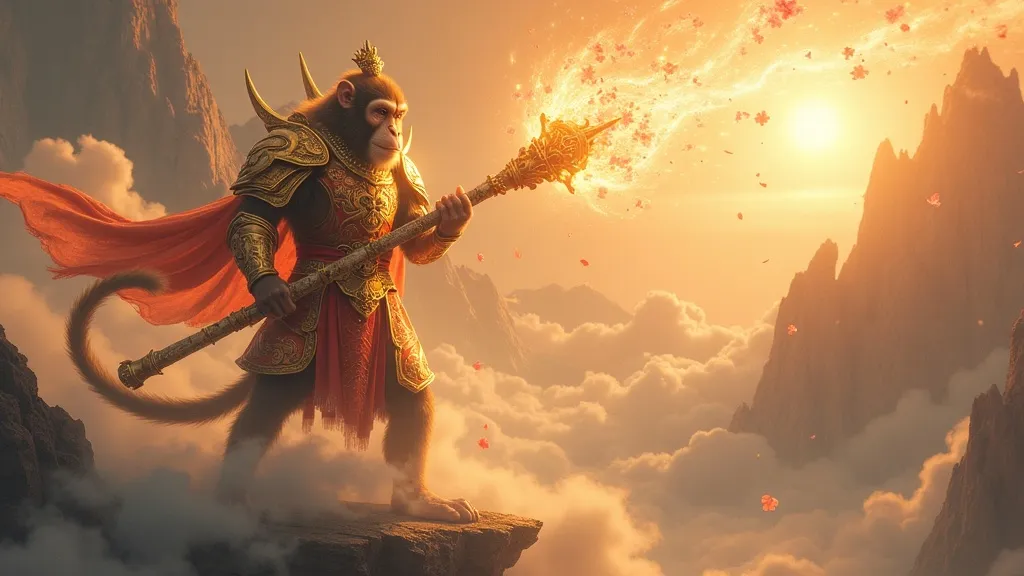
Sun Wukong the Monkey King: Trickster, Rebel, and Immortal of Chinese Myth
Born from stone, crowned king of monkeys, and bold enough to defy heaven itself: Sun Wukong stands as the most electrifying hero in Chinese mythology, a shape-shifter whose story refuses to stay still.
Contents
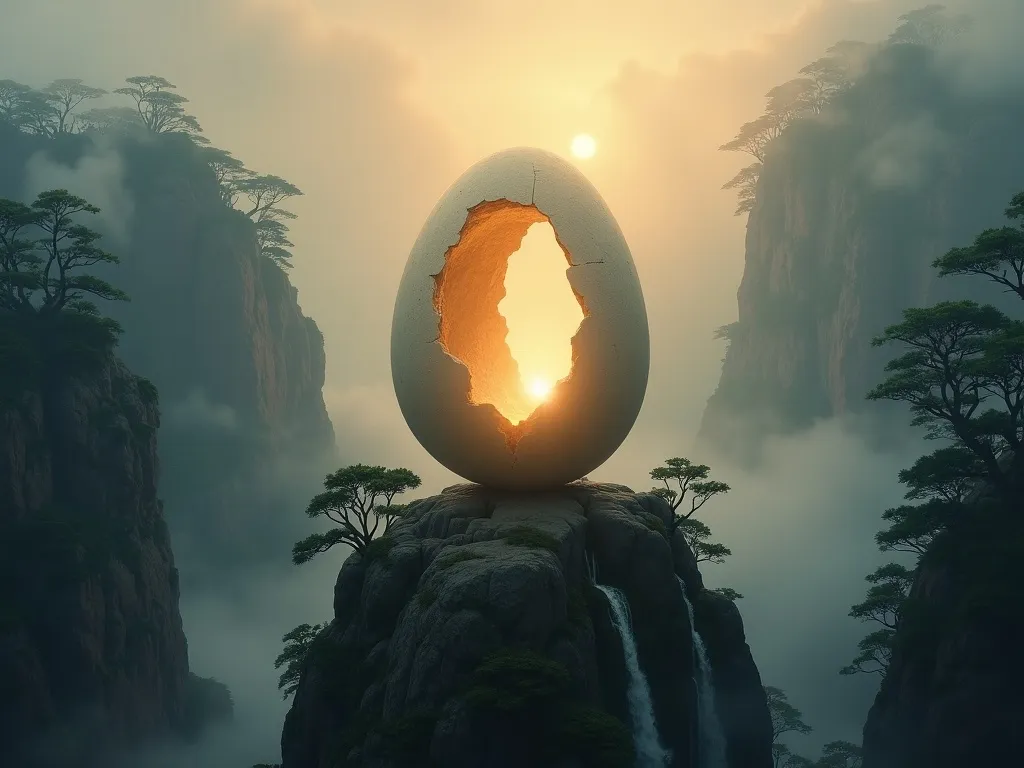
A boulder splits open on the peak of the Mountain of Flowers and Fruit. No midwife, no mother, no prayer spoken beforehand. A stone egg cracks and out steps a monkey, already upright, already scanning the horizon. The Jade Emperor looks down from his celestial court and watches. He is not yet worried. He should be.
Sun Wukong the Monkey King is the pivot around which the Journey to the West (Xiyou Ji) spins. Written by Wu Cheng'en and published around 1592 during the Ming Dynasty, the novel crystallised centuries of oral tradition, Buddhist allegory, and Daoist cosmology into a single irresistible figure. Wukong is simultaneously the protagonist, the comic, the saint, and the anarchist. No other character in Chinese literature occupies all four seats at once.
His story does not begin with a quest. It begins with an appetite, specifically the appetite to be more than what he was born as.
From Stone Egg to Monkey King: The Origin of a Miraculous Birth
The Mountain of Flowers and Fruit (Huaguoshan) sits off the eastern coast of the mythological continent Aolai. The boulder there had absorbed celestial energies since the beginning of creation, fed by sun and moon in equal measure. When it finally split, the monkey who emerged already had the glow of supernatural origin in his eyes, described in the text as two beams of golden light shooting toward heaven and alarming the Jade Emperor's sentinels.
The early community he finds on the mountain is a gathering of monkeys, gibbons, and macaques who live in ordinary animal pleasure. Sun Wukong proves himself almost immediately: he leaps through a waterfall that none of the others dare enter, discovers the Water Curtain Cave behind it, and returns announcing a home for them all. The monkeys crown him Handsome Monkey King (Meihouwang). He is not yet a god. He is not yet a rebel. He is simply the one brave enough to jump first.
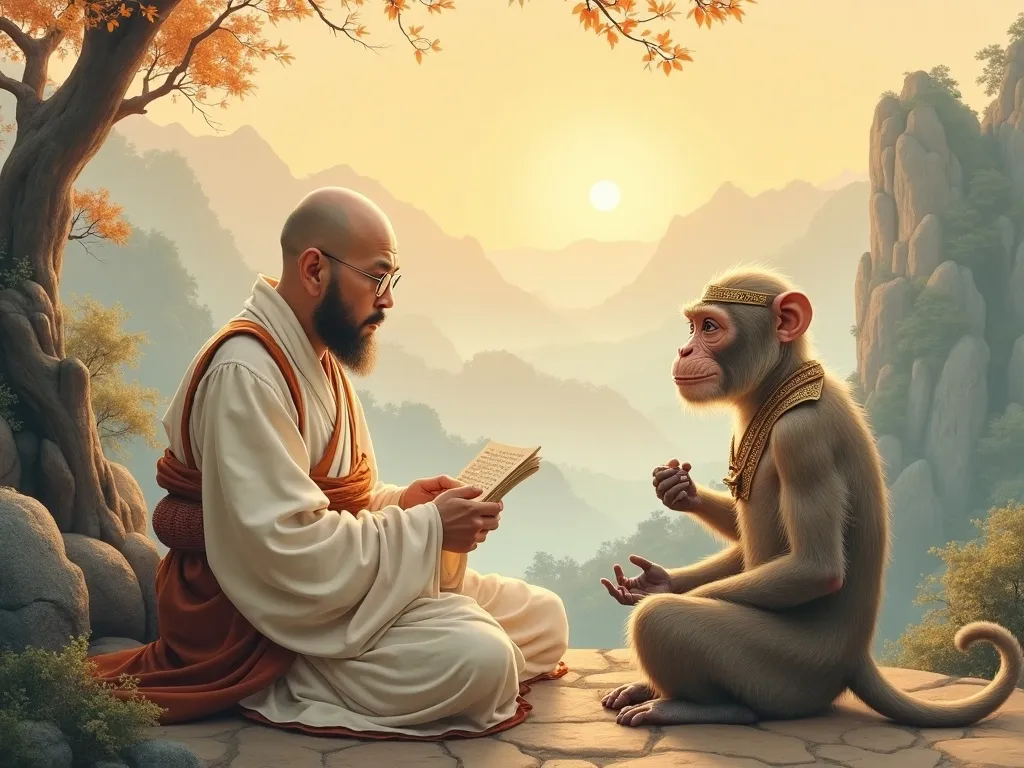
That changes when mortality becomes real to him. A feast pauses because an elder monkey weeps. The Monkey King presses him, and the answer is simple: even kings die. Wukong refuses this. He sails across the sea to find an immortal master, eventually reaching the cave of the Daoist patriarch Subodhi (Puti Zushi), who gives him his name, his foundational techniques, and, after years of patience and disguised brilliance, the 72 transformations.
The Seventy-Two Transformations and the Staff of Heaven
Subodhi's cave becomes a second origin. Wukong studies for over a decade, then reveals that he has been secretly mastering the more esoteric techniques his teacher demonstrated late at night. Subodhi, reading the room, expels him, but the knowledge is already lodged.
Back on his mountain, Wukong realises his wooden staff is insufficient for a monkey of his new power. He descends to the underwater palace of Ao Guang, the Dragon King of the Eastern Sea, and takes what he wants: the Ruyi Jingu Bang, a pillar of iron that once steadied the bed of the sea and weighed 13,500 jin (roughly 8,100 kilograms). The staff obeys its new owner's will, shrinking to a needle behind Wukong's ear or expanding to fill the sky.
The same visit introduces his armor: he effectively bullies all four Dragon Kings of the cardinal seas into gifting him a golden crown, a phoenix-feather cap, golden chainmail, and cloud-walking boots. He arrives in heaven armed, dressed, and completely self-appointed.
His next demand is immortality itself. He visits the underworld, finds his name in the ledger of death, and crosses it out, along with the names of every monkey on his mountain. The Ten Kings of the Dead complain to heaven. The stage is set.
Sun Wukong Before Enlightenment
Driven by ego, hunger for status, and refusal of limits. Crashes heaven's banquets, steals immortal peaches, downs Laozi's elixir pills, declares himself equal to heaven. Every action radiates unchecked power.
Sun Wukong After Enlightenment
Still fierce, still irreverent, but capacity for compassion and sacrifice grows alongside Xuanzang. Protects the pilgrim against genuine malice. The trickster energy becomes purposeful rather than self-serving.
The Havoc in Heaven: When a Monkey Challenged the Jade Emperor
The celestial bureaucracy tries to manage Sun Wukong rather than confront him. The Jade Emperor offers him a minor post, Keeper of the Heavenly Horses (Bimawen), hoping the title will satisfy. Wukong accepts, then discovers the position ranks at the very bottom of the celestial hierarchy. Furious, he returns to his mountain and declares himself "Great Sage Equal to Heaven" (Qitian Dasheng). Heaven blinks first: envoys arrive with a new, actual title conceding the name.
The concession doesn't hold. Wukong is invited to tend the Garden of Immortal Peaches (Pantao Yuan) but excluded from the Jade Empress's Peach Banquet because, as a monkey, he is deemed unsuitable company for the immortals he nominally serves. He eats all the best peaches. He drinks all the jade wine laid out for the feast. He stumbles into Laozi's laboratory and swallows the pills of immortal elixir (jindanjiu) like candy.
A hundred thousand heavenly soldiers cannot stop him. Nezha fights him and retreats. The Four Heavenly Kings fall back. Even Erlang Shen (Erlang Daxian), the warrior-god with the third eye, only manages a draw through cunning shape-shifting, and the battle reads like two illusionists testing each other to exhaustion. Wukong matches every transformation: Erlang becomes a hawk, Wukong becomes a sea bird one rank larger.
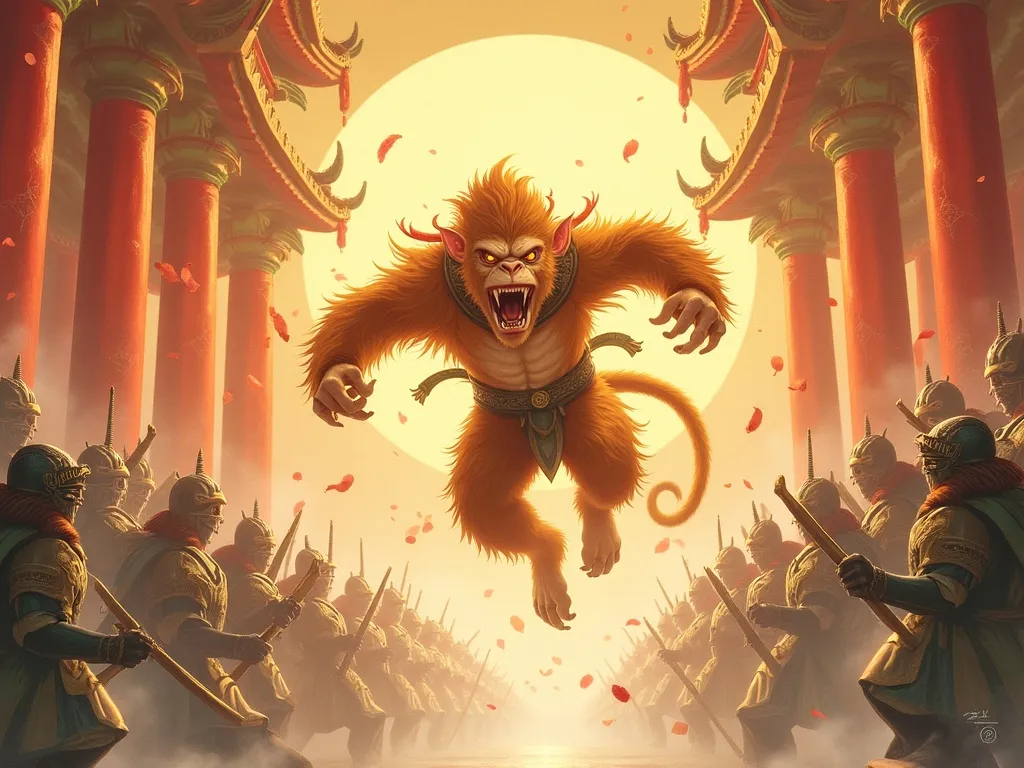
Only the Buddha ends the rampage. Wukong bets he can leap off the Buddha's palm. He soars to what he believes are the five pillars at the edge of the universe and signs his name on one. He returns triumphant. The Buddha turns his hand over: the five "pillars" were the fingers. The signature is there on the middle finger. Wukong is trapped under the Five Elements Mountain (Wuxing Shan) for five hundred years.
Five Hundred Years Under the Mountain: Stillness as Transformation
Five centuries compressed into a single chapter. Wukong does not sleep through them. He is awake, fed occasionally by iron pellets and molten copper that passing deities provide, aware of every slow season. The mountain is both prison and furnace. Something burns away inside him, though the novel never shows us exactly what. By the time the monk Xuanzang (Tang Sanzang) arrives with a release order authorised by the Bodhisattva Guanyin, Wukong is not humble, but he is ready.
The relationship between prisoner and pilgrim is the emotional core of the entire novel. Xuanzang is fragile, frequently terrified, and morally absolute. Wukong is practically invincible and morally flexible. They need each other in ways neither would publicly admit. Wukong needs a purpose to channel his energy. Xuanzang needs a guardian capable of handling threats that virtue alone cannot deflect.
The golden headband (jingu) placed on Wukong's head by Guanyin's instruction, and tightened by a spell whenever Wukong steps out of line, is one of the great images in Chinese literature. It is not just a leash. It represents the pressure that discipline applies to genius, the cost of working within a structure rather than against it.
The Pilgrimage to the West: Eighty-One Trials
The journey from Tang-Dynasty China to India (the novel's mythologised Tianzhu) covers 108,000 li according to the text, a number heavy with Buddhist numerological significance. Xuanzang cannot cover that distance alone, which is why Guanyin assembles his company: Wukong as primary protector, the gluttonous and self-interested Zhu Bajie (Pigsy) as second disciple, the steadfast water-demon-turned-monk Sha Wujing (Sandy) as third, and the White Dragon Horse who carries the Tang priest.
The eighty-one ordeals (jie) they face are not random. Each demon, monster, or celestial trap corresponds to a specific attachment or weakness. Many of the antagonists turn out to be celestial beings or divine animals whose brief absence from heaven was permitted, even engineered, precisely to test the pilgrims. The cosmos is, in this reading, a structured examination rather than a hostile chaos.
Sun Wukong the Monkey King carries the bulk of the combat weight. His methods are rarely direct. He impersonates demons, turns his hairs into duplicate armies, borrows celestial weapons, tricks enemies into revealing their weak points, and occasionally calls in favors from the gods he once terrorised. The episodes read like a rogue's manual for problem-solving: brute force is the last resort, not the first.
One of the most celebrated episodes, the three battles with the demon Red Boy (Hong Hai'er), shows Wukong outmatched by True Samadhi Fire (sanwei zhenhuo) that burns even underwater. He cannot win alone. He summons Guanyin, who subdues Red Boy not with force but with a set of golden rings and compassion. The lesson embedded is deliberate: the Monkey King's power has a ceiling, and that ceiling is reached precisely where ego takes over.
The Jade Emperor and the entire celestial bureaucracy recur throughout the pilgrimage, not as enemies but as reluctant infrastructure. Heaven keeps a wary eye on Wukong, intervening when demons prove too powerful, and the dynamic between the reformed rebel and the institution he once ransacked gives the journey much of its comic tension.
The Golden Headband and the Problem of Genius Under Constraint
Wu Cheng'en spent more pages on Wukong's psychology than on any single battle sequence, and the golden headband is the sharpest tool he used. It appears in Chapter 14, just after Wukong kills six bandits who attack the pilgrims. Xuanzang's reproach triggers Wukong's first abandonment of the journey; Guanyin intercepts and gives the monk the hat containing the band.
The mechanics are precise: Xuanzang recites the Band-Tightening Spell (jingu zhou) and the band contracts around Wukong's skull, producing agonising headaches. Wukong quickly learns that threatening the monk simply makes the pain worse. The spell cannot be removed by any transformation; it is the one thing in the novel that his 72 techniques cannot answer.
Scholars have read the headband through multiple lenses: Buddhist commentators see it as the restraint of the "monkey mind" (xinyuan), the chattering, restless consciousness that leaps between thoughts and must be stilled for meditation to occur. Daoist readers note that constraint here comes from outside, not from inner cultivation, which marks Wukong's journey as incomplete until he chooses self-restraint rather than enduring imposed limitation. The novel validates both readings without collapsing them.
Sun Wukong Across Traditions: Buddhist Allegory, Daoist Cosmology, and Folk Religion
Sun Wukong did not arrive fully formed from Wu Cheng'en's brush. Earlier versions appear in a 13th-century precursor text, Dazheng Xiyouji, where a monkey disciple accompanies the historical monk Xuanzang (602-664 CE) without the elaborate supernatural backstory. The monkey figure may draw on the Hindu deity Hanuman, whose own pilgrimage-adjacent role in the Ramayana scholars have long discussed as a possible influence via Buddhist transmission routes through Central Asia and Southeast Asia.
The 72 transformations echo the 72 arts of Chinese esoteric tradition. The number 72 also appears as the number of disciples of Confucius, suggesting that Wu Cheng'en was threading multiple symbolic systems together. Wukong's birth from stone connects to older Chinese creation myths in which stone is the generative material of cosmic beginnings, notably in the story of Nü Wa, who patched the sky with five-colored stones after a primordial catastrophe.
In folk religion, Sun Wukong the Monkey King became a protective deity associated with exorcism and the protection of children. Temples dedicated to him (Qitian Dasheng miao) are found across southern China, Taiwan, Malaysia, and Singapore. Worshippers bring offerings of peaches and wine, a direct echo of the Peach Garden episode. The fictional trickster slid into genuine devotional practice so thoroughly that the line between literary character and deity became functionally irrelevant for millions of practitioners.
The 108,000-Li Staff: Symbolism of the Ruyi Jingu Bang
The staff deserves its own attention. Its name translates roughly as "As-You-Will Gold-Banded Rod." The ruyi prefix is critical: it denotes an object that responds to the user's will, a concept central to Daoist notions of the ideal tool, one that becomes an extension of intention rather than requiring force. The staff shrank to a needle precisely so it could rest behind Wukong's ear, invisible to enemies, always available.
Its original function, a measuring rod used by Yu the Great (Da Yu) to calibrate flood-control channels, grounds the mythological object in one of China's oldest heroic narratives. Yu the Great tamed the floods at the command of the divine, spending thirteen years redirecting rivers, and the rod served cosmic regulation. In Wukong's hands, the same object becomes the instrument of cosmic disruption. The symmetry is deliberate. Regulation and disruption use the same tools; the difference lies in who wields them and toward what end.
Sun Wukong in Modernity: From Ming Novel to Global Archetype
Few mythological figures have migrated as aggressively into modern media. The 1986 Chinese television series Journey to the West introduced Wukong to an entire generation of children across Asia with the iconic performance of Liu Xiao Ling Tong; the series ran for 25 episodes and became one of the most-watched programs in Chinese broadcasting history. Dragon Ball's Son Goku, created by Akira Toriyama in 1984, draws his name directly from the Japanese reading of Sun Wukong (Son Goku) and replicates the stone birth, the staff, and the cloud-riding, though filtered entirely through a different cosmological system.
Video games have been the most recent vector. The 2024 action game Black Myth: Wukong (by Chinese studio Game Science) became the first Chinese-developed title to break global sales records exceeding 10 million copies in days, re-introducing Wukong to players with no prior mythology background as a figure of unresolved grief and cyclical conflict. The game's frame, centered on a successor monk retracing the original journey to recover Wukong's scattered relics, adds a melancholy layer absent from Wu Cheng'en's comic register.
The archetype Wukong represents, the genius who must decide whether to destroy institutions or reform from within, resonates because it is genuinely unresolved. His story offers no clean answer. He ends the pilgrimage crowned as Victorious Fighting Buddha (Dou Zhansheng Fo), but the title is given, not earned by his own terms. Whether the headband was ever removed is a question different editions of the novel answer differently. That ambiguity keeps him alive.
Frequently Asked Questions About Sun Wukong the Monkey King
Frequently asked questions
What is the primary source text for Sun Wukong's story?
The definitive literary source is Xiyou Ji (Journey to the West), attributed to Wu Cheng'en and first published in full around 1592 during the Ming Dynasty. Earlier versions of a monkey-disciple figure appear in the anonymous 13th-century Dazheng Xiyouji and in Southern Song theatrical traditions, but Wu Cheng'en's 100-chapter novel fixed the character's powers, personality, and narrative arc in the form that all subsequent traditions draw from.
Is Sun Wukong related to the Hindu deity Hanuman?
Scholars continue to debate this. Both are powerful monkey figures who serve on a transcontinental spiritual journey, and Buddhist pilgrims travelling the Silk Road between India and China carried texts and iconography in both directions from at least the 2nd century CE. The 7th-century monk Xuanzang, whose real journey the novel fictionalises, left detailed records of Indian religious culture. A direct textual borrowing has not been proven, but the structural parallels are close enough that many comparative mythologists treat the relationship as a probable influence rather than coincidence. Both traditions, however, developed the figures independently into very different psychological types.
What do the 72 transformations symbolise?
The number 72 carries layered significance in Chinese cosmological thought: it appears in Daoist catalogues of esoteric arts, in Confucian tradition as the number of the Master's closest disciples, and in numerological systems tied to the calendar. Within the novel, the transformations are not just combat tools; they embody the Buddhist concept of anatta (no fixed self) and the Daoist ideal of adaptive responsiveness to circumstance. Wukong can become anything, which raises the persistent question of whether there is a core "Wukong" beneath the shapes, a question the novel never fully resolves.
Why can't Sun Wukong remove the golden headband?
The band is installed by the Bodhisattva Guanyin and activated through a spell given to the monk Xuanzang. Within the novel's logic, no physical transformation or force can remove it because it operates on a different register than physical power: it is an instrument of karmic consequence and pedagogical design. Wukong's strength can shift mountains but cannot undo accumulated spiritual debt. Some Buddhist commentators read this as meaning that ego-driven power, however vast, is structurally unable to dissolve the very constraints ego creates; only genuine inner change can accomplish that.
Does Sun Wukong achieve Buddhahood at the end of the journey?
The 100th chapter of Xiyou Ji grants him the title Victorious Fighting Buddha (Dou Zhansheng Fo). The title acknowledges both his martial function and his spiritual progress. However, critics have long noted that the title is conferred, not chosen, and that Wukong's final attitude, still irreverent, still crackling with energy, sits uneasily with the stillness conventional Buddhahood implies. Some later critical readings argue that the ending is deliberately ironic: the institution rewards him with a label that contains him one final time. Whether Wukong himself would agree to that reading is, characteristically, left open.
The Unresolved Rebel: What Sun Wukong Still Has to Say
No mythological figure exports well to tidiness, and Sun Wukong the Monkey King resists it harder than most. The same qualities that make him impossible to cage, his speed of mind, his refusal to accept hierarchies that haven't earned his respect, his capacity to change shapes without changing allegiances, also make him a genuine philosophical provocation rather than a simple folk hero.
Contemporary readers keep returning to him because the central tension in his story is structural, not personal. Institutions need disruptive intelligence to survive, and disruptive intelligence needs institutional purpose to avoid eating itself. The Jade Emperor's court becomes functional again only after Wukong's rampage exposes its hollow bureaucracy. The pilgrimage succeeds only because Wukong's rule-breaking instincts repeatedly find solutions that the rules themselves couldn't generate.
The question his myth keeps asking is not whether the rebel or the institution wins. It is whether a mind capable of 72 transformations can find, in discipline, something genuinely more interesting than chaos. Five hundred years under a mountain, and a staff that still responds to pure will: the Monkey King's answer has never quite finished arriving.
Read the full book
Want the whole story?
The complete edition is an instant PDF download here, with a paperback on Amazon for selected titles.

Chinese
The Chinese Mythology Book: Pangu, Nuwa, the Jade Emperor, and the Sacred Stories of the World's Oldest Living Tradition
5,000 Years of Dragons, Immortals, and the Celestial Court
From Pangu's creation to Sun Wukoku's rebellion: the unbroken mythological tradition of China, spanning the Yellow Emperor, Nuwa's clay humans, and the Jade Emperor's court.
More from Chinese
All articles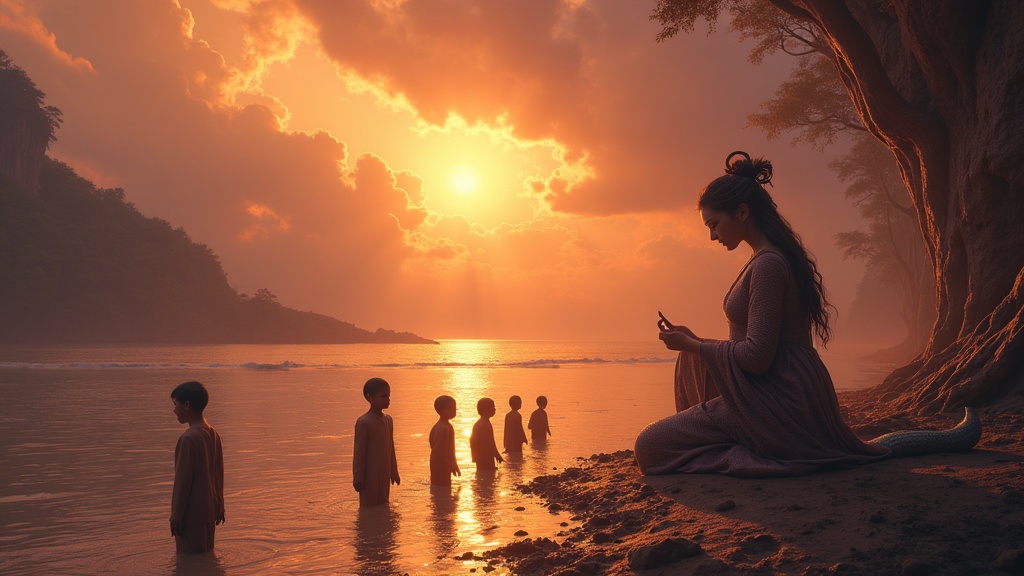
Chinese
Nuwa the Creator Goddess: Myth, Power, and the Making of Humanity
Nuwa shaped the first humans from yellow earth, mended the cracked sky, and held creation together when it threatened to fall apart. She is the oldest mother in Chinese mythology, and her stories run deeper than most Western readers know.
Chinese
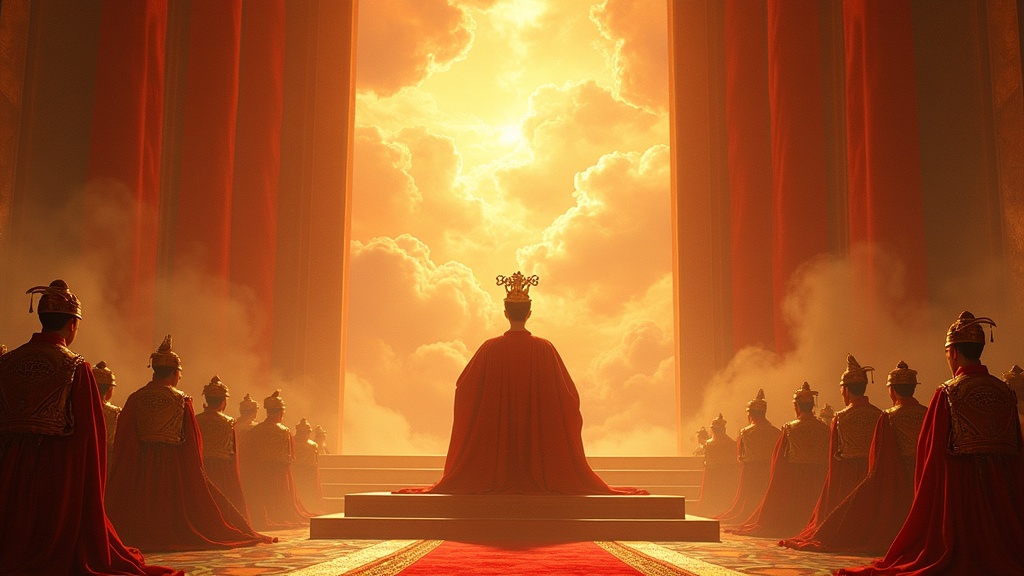
The Jade Emperor: Ruler of Heaven and Lord of the Chinese Cosmos
The Jade Emperor sits atop the Chinese divine bureaucracy as sovereign of heaven, earth, and the underworld. His court mirrors imperial China in every detail, and his reach shapes festivals, folk religion, and literature to this day.
Chinese
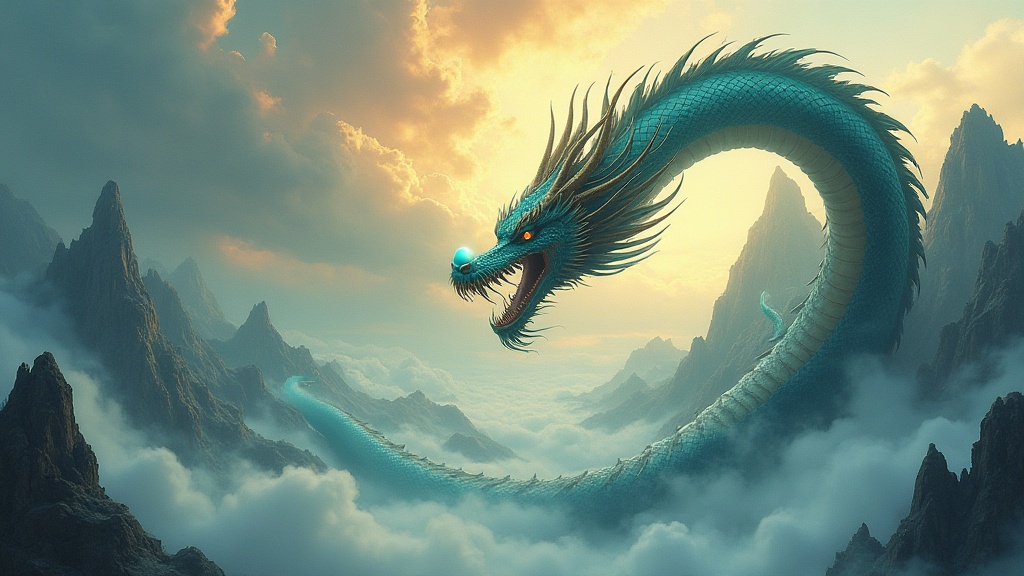
The Dragon Symbolism in Chinese Myth: Sovereign of Waters, Heaven, and Time
In Chinese mythology, the dragon is not a monster to be slain but a cosmic sovereign: lord of rivers, rain, and imperial destiny. Its symbolism reaches from creation itself to the bones of the earth.