
Ishtar: Goddess of Love and War in Ancient Mesopotamia
Ishtar ruled the Mesopotamian cosmos as the goddess of desire, war, and the morning star. Her myths shaped civilization for three thousand years and still echo in every culture that followed.
Contents
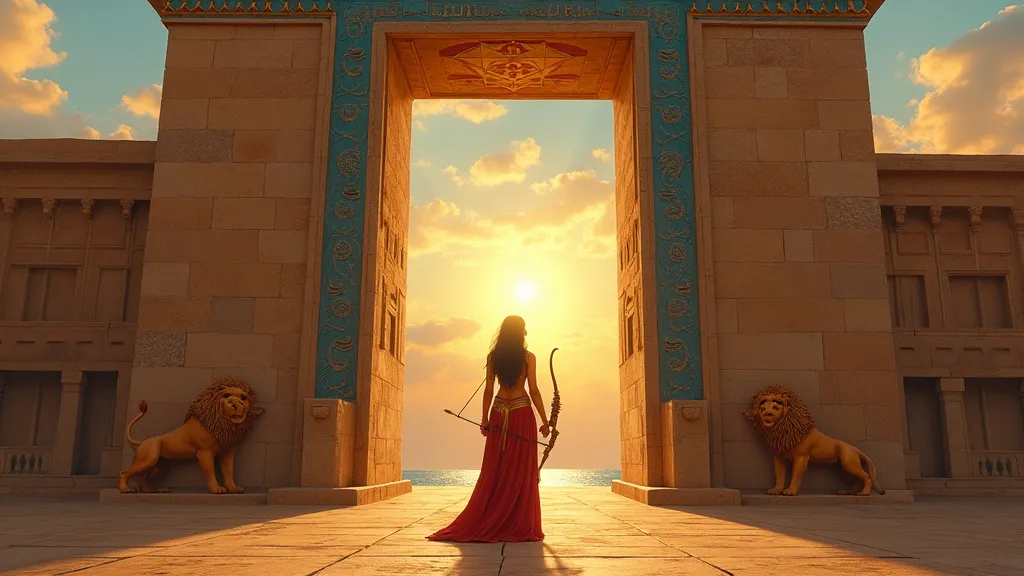
The gates of Uruk opened at dawn, and the city already knew she was near. Soldiers sharpened their spears. Lovers whispered her name. The planet Venus blazed over the ziggurat, and priests poured barley beer onto the altar steps. Ishtar, goddess of love and war, arrived not gently but as a force: radiant, dangerous, insatiable, and wholly her own.
She is the oldest fully formed goddess on record whose myths survive in continuous, readable text. Hymns carved into Sumerian clay tablets between 2300 and 2000 BCE describe her pulling the sky low with her fury and filling the streets with the flush of desire. She is simultaneously the force that makes grain grow and the storm that levels cities. No other deity in the ancient Near East carried both domains with such unapologetic authority.
That contradiction is the point. Ancient Mesopotamian theology did not separate love from violence, because the people who built it lived at the junction of those forces every single day: floods that fertilized and drowned, wars that brought loot and slaves, marriages arranged at the edge of a sword. Ishtar did not merely represent those realities. She personified the raw energy that drove them.
From Inanna to Ishtar: The Deep Roots of a Divine Name
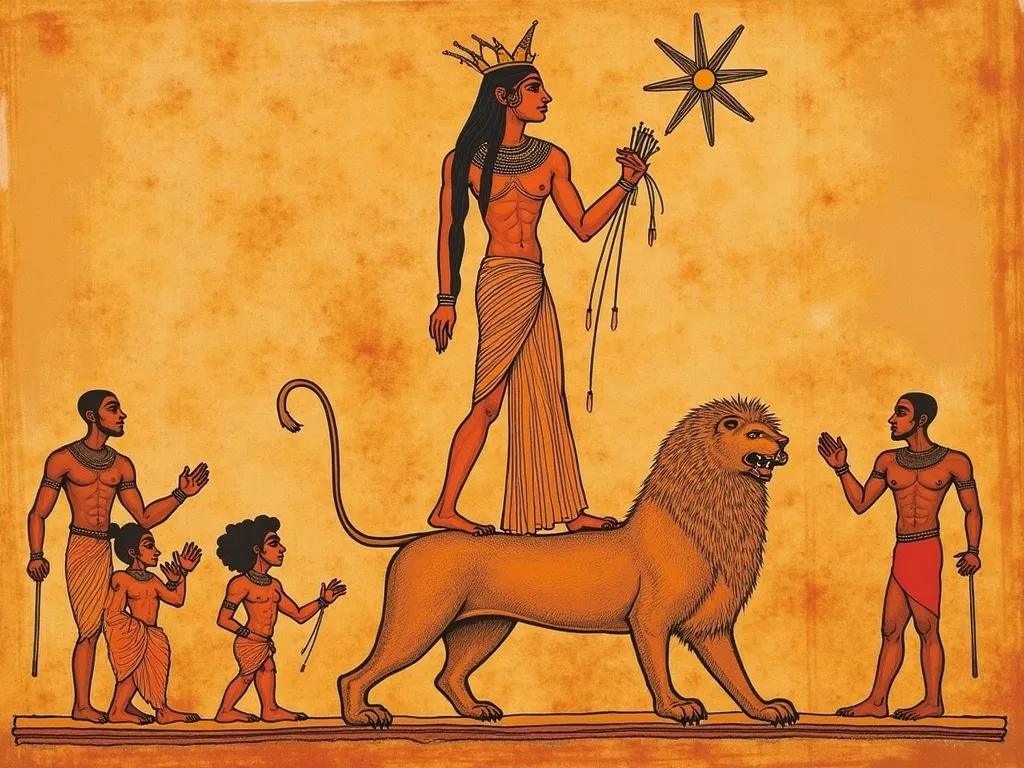
The goddess the Akkadians called Ishtar was already ancient by the time Akkad rose to power around 2334 BCE. Her Sumerian predecessor, Inanna, "Queen of Heaven," had been worshipped in the city of Uruk since the Uruk period (roughly 4000-3100 BCE). Cylinder seals from that era show a figure flanked by lions and marked with the eight-pointed star that would become her permanent symbol.
The merger of Inanna and Ishtar was not a simple renaming. When Sargon of Akkad unified Sumer and Akkad into the world's first empire, Akkadian religious scribes absorbed the Sumerian pantheon and layered it onto their own. Inanna's attributes bled into those of the Semitic Ishtar, who carried additional martial weight and a fiercer cosmological role. The poetess Enheduanna, daughter of Sargon and arguably the earliest named author in human history, composed the Hymn to Inanna around 2285 BCE and explicitly fused the two identities in verse. She wrote of a goddess who could overturn the divine decrees (me) herself and whose fury blackened the sky like a thunderstorm.
By the Old Babylonian period (roughly 2000-1600 BCE), Ishtar had absorbed not only Inanna but aspects of Ninsun, Antu, and several local storm goddesses. The eight-pointed star carved above city gates across Mesopotamia meant one thing: she watches here.
Her parents in the standard Akkadian canon were the sky god Anu and, in some traditions, the mother goddess Antu. But earlier Sumerian texts give Inanna different parentages depending on the city: she is sometimes the daughter of the moon god Nanna in Ur, sometimes the daughter of Enki the god of wisdom in Eridu. These variations were not contradictions to ancient scribes; they reflected the fact that each major city possessed its own theological tradition, and Ishtar was simply large enough to contain all of them.
The Me: Stolen Powers and the Architecture of Civilization
Ishtar's relationship with civilization was not passive admiration. According to the Sumerian myth preserved in the text known as Inanna and Enki, she sailed to the abyssal sweet-water ocean of the underworld city Eridu, where Enki the god of wisdom lived, and she drank him under the table.
While Enki lay drunk on šikaru (a strong barley beer), Ishtar loaded her boat with the me: the divine decrees that made civilization function. The me included kingship, the art of lovemaking, the scribal craft, the descent into the underworld, the ascent from the underworld, the musical instruments, the art of war, the straightening of lies. Over one hundred attributes of ordered existence. She sailed them back to Uruk and distributed them to her city.
Enki sobered up and sent sea monsters after her. She defeated each one. The me stayed in Uruk.
This myth is not a comedy, though it reads like one at moments. It is a theological claim: civilization belongs to Ishtar. She did not receive these powers as a gift. She seized them, which is exactly what the goddess of love and war would do.
The Descent into the Great Below
No story in Mesopotamian mythology matches the structural audacity of Ishtar's Descent to the Underworld, preserved in both a Sumerian version (Inanna's Descent) and a later, more compressed Akkadian version on tablets found at Nineveh, Ashur, and Sultantepe.
The narrative opens with Ishtar, fully armed and adorned, announcing she will enter Kur (the Sumerian underworld) or Irkalla (the Akkadian name), the land of no return. She passes through seven gates. At each gate, the gatekeeper strips one of her divine attributes: her crown, her earrings, her lapis lazuli beads, her breastplate, her gold ring, her lapis measuring rod, and finally her garment. She arrives in the presence of her sister Ereshkigal, Queen of the Underworld, stripped of everything.
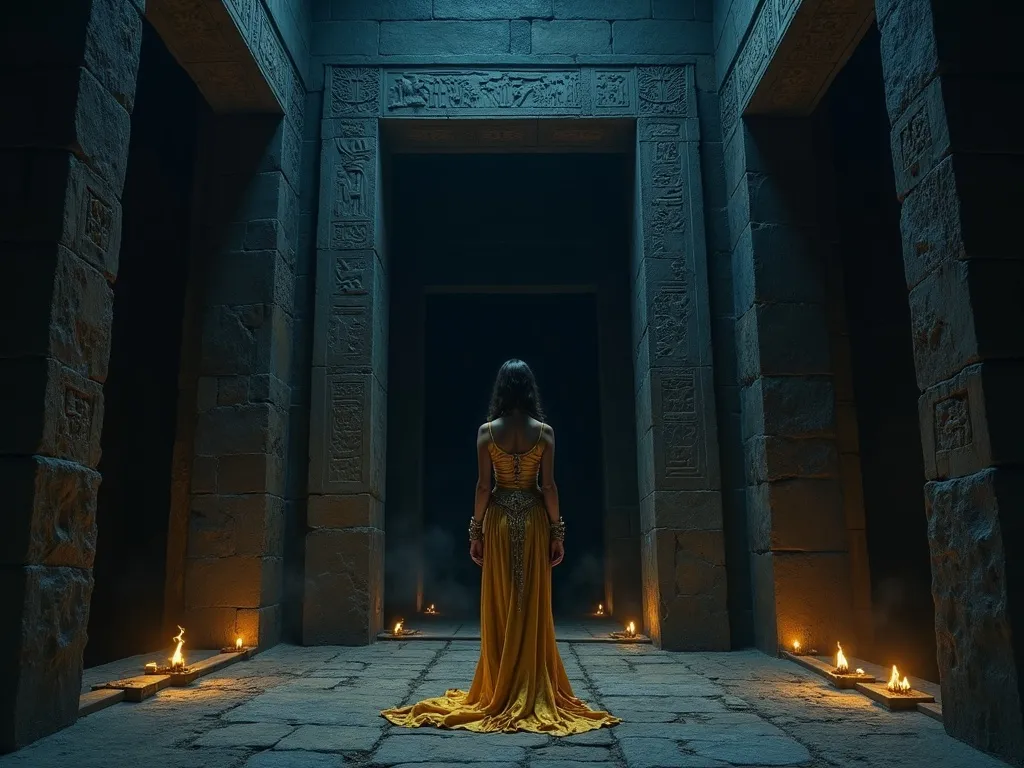
Ereshkigal kills her and hangs her corpse on a hook.
While Ishtar languishes in the underworld, all sexuality ceases on earth. Animals do not breed. Humans lose desire. The fields dry up. The god Enki sends two sexless beings, kurgarra and galatur, made from the dirt beneath his fingernail, to sprinkle the water and food of life on her body. She is revived. But the laws of the underworld cannot be broken: whoever leaves must send a substitute.
The kurgarra and galatur are followed back to the surface by the galla, demons of the underworld who will collect the substitute. Ishtar, walking through the upper world again, encounters various minor gods who are mourning her absence, dressed in rags. She does not ask them to take her place. When she arrives at her husband Tammuz (Sumerian: Dumuzid), the shepherd king, she finds him sitting on his throne wearing fine clothes and not mourning at all.
She points at him. The galla take him.
The Akkadian version ends there, with Tammuz descending. The Sumerian version adds a resolution: Tammuz's sister Geshtinanna volunteers to share the burden, so each spends half the year in the underworld while the other returns to the living world. This alternation explains the seasons: when Tammuz is above, grain grows; when he is below, the earth mourns.
The structural parallel with Persephone's myth is not accidental. Scholars including Thorkild Jacobsen and Samuel Noah Kramer have traced the diffusion lines: the death-and-resurrection vegetation cycle moves westward from Sumer into Canaan (as the myth of Baal and Mot), then into Greece. The details shift. The emotional architecture stays the same.
Ishtar in Battle: The Goddess Who Broke Heaven
Ishtar's martial aspect was not a metaphor. Temples dedicated to her warrior aspect stood in Akkad, Nineveh, and Arbela. The city of Arbela (modern Erbil, Iraq) housed a cult of Ishtar-of-Arbela whose oracles guided Assyrian kings into battle. When the Assyrian king Esarhaddon launched his campaign against Egypt around 671 BCE, he specifically consulted Ishtar-of-Arbela first.
In the Epic of Gilgamesh, Ishtar's fury takes center stage in Tablet VI. After Gilgamesh kills the monster Humbaba and strips the Cedar Forest, Ishtar proposes marriage to him. He refuses, devastatingly and at length, listing her previous lovers and describing their fates: Tammuz condemned to weeping, a bird with a broken wing, a lion hunted by its own master. She responds by going directly to her father Anu and demanding he release the Bull of Heaven (Gudanna) to destroy Uruk.
Anu initially refuses. She threatens to smash the gates of the underworld and let the dead outnumber the living. He relents. The Bull of Heaven tears open the earth with its breath, swallowing men by the hundreds. Gilgamesh and his companion Enkidu kill it together. Enkidu hurls the bull's haunch at Ishtar's face as an insult.
The gods punish Enkidu with death for this act. The death of Enkidu shatters Gilgamesh and sets him on his search for immortality. Ishtar's wounded pride, in other words, is the hinge on which the entire second half of the greatest Mesopotamian epic turns.
Ishtar the Lover
Governs desire, fertility, and the marriage bond. Seduces kings and shepherds alike. Her sacred prostitutes (qadishtu) served in temple precincts, mediating between human sexuality and divine abundance. The New Year ritual hieros gamos (sacred marriage) enacted her union with the king to ensure harvest. Her symbol: the evening star.
Ishtar the Warrior
Bears a bow and quiver, rides a lion into battle. Her roar precedes armies. Assyrian war hymns describe her eyes as flames and her voice as thunder. Kings received divine commissions from her oracles before every major campaign. She could strip enemy soldiers of their will to fight with a look. Her symbol: the morning star.
The Sacred Marriage and the Economy of Desire
The hieros gamos, or sacred marriage rite, was one of the most politically charged rituals in Mesopotamian life. Once a year, the king of Sumer performed a ritual union with Ishtar, mediated either through her high priestess or through a symbolic ceremony at the temple. The Sumerian love songs attributed to this rite (preserved in the collections known as the Bridal Songs of Inanna) are among the most sensual texts in world literature.
One of them reads, translated closely: "He has sprouted, he has burgeoned. My lord is good gold come from the mountain. He is the caretaker of Dilmun, he is the caretaker of my mother Ninsun's garden. My lover, I will love you in the grain store, I will love you in the great grain store."
These are not merely erotic. They are economic. The king's ritual potency guaranteed Ishtar's blessing on the harvest. Her desire was agricultural policy.
The priestesses who served Ishtar (qadishtu, "the holy ones," and naditu, temple women of higher rank) were not marginal figures. Naditu women of the Old Babylonian period owned property, conducted business, and wrote their own contracts on clay tablets that archaeologists have excavated from the temple precinct of Sippar. The institution of sacred women was a form of structured female agency within a patriarchal economy, functioning under Ishtar's divine protection.
Ishtar's Lovers and the Price of Her Attention
The list Gilgamesh recites in Tablet VI was not invented satire. Mesopotamian mythology preserved multiple traditions about Ishtar's former consorts and their unhappy endings. Each is a controlled narrative about the danger of proximity to divine power.
Tammuz (Dumuzid), the most famous, was a shepherd king who became Inanna's chosen husband, celebrated in hymns as the ideal lover. He ended up in the underworld for half of every year.
Ishullanu, a date-palm gardener who served Anu, rejected Ishtar's advances and was turned into a frog (or dwarf, depending on the manuscript tradition).
The lion, once Ishtar's favorite, was hunted with pit and snare.
The horse was condemned to drink muddy water and its mother wept.
These are not misogynistic cautionary tales, though later classical authors read them that way. In the Mesopotamian theological framework, they describe the natural consequence of any mortal (or lesser being) touching divine energy: transformation, disruption, permanent change. Ishtar's love was real. It was also lethal, in the way that lightning is real and lethal.
Ishtar Across the Ancient World: Astarte, Aphrodite, Venus
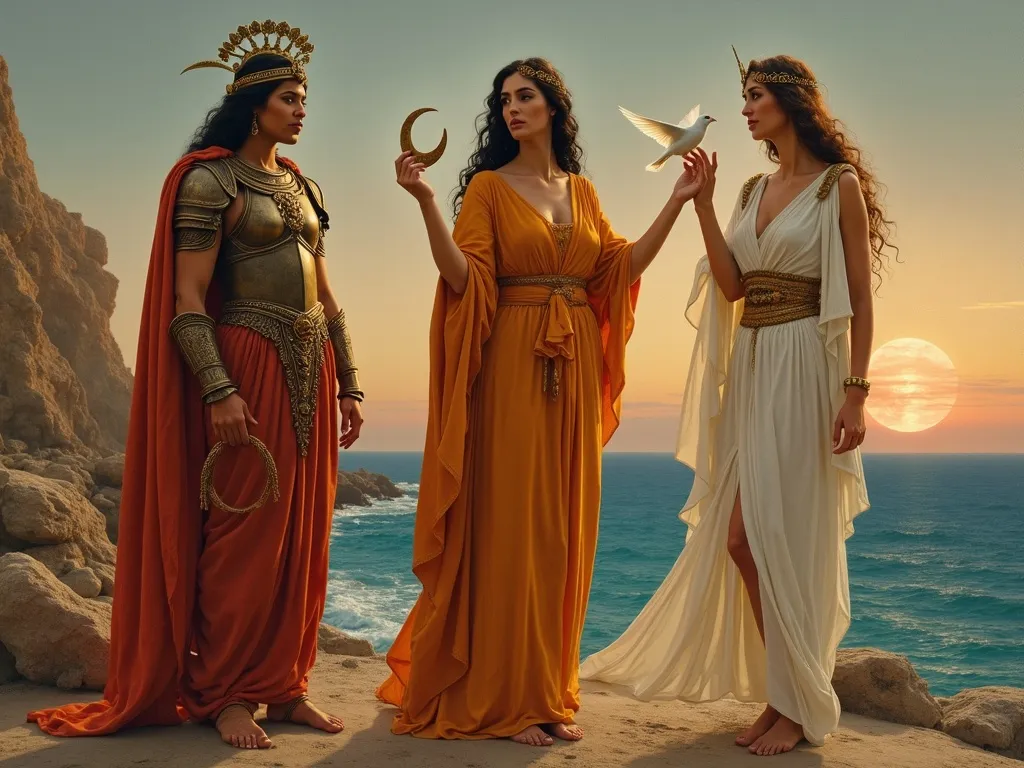
The Ishtar goddess of love and war became the template for an entire lineage of Near Eastern and Mediterranean goddesses. The diffusion followed trade routes, conquest, and cultural synthesis over roughly two millennia.
Astarte (Phoenician, Canaanite) was her direct western iteration, worshipped in Byblos, Sidon, Tyre, and Carthage. The Old Testament's frequent condemnations of Ashtoreth worship among the Israelites record her real historical presence in the Levant. Her lion throne and eight-pointed star traveled with Phoenician merchant ships to Cyprus, Malta, and Sicily.
Aphrodite absorbed Astarte when Phoenician traders settled in Cyprus. Ancient Greek authors including Herodotus explicitly identified the two. Aphrodite's unusual attributes for a Greek goddess (her connections to war in Sparta and Corinth, her armed iconography on Cyprus) make no sense in the Greek context but make perfect sense as Astarte inheritance.
The Roman Venus inherited the lineage from Aphrodite, but also received direct Etruscan transmission from Uni, who herself carried Astarte features into the Italian peninsula. By the time Julius Caesar claimed descent from Venus, he was, theologically speaking, claiming descent from a goddess whose lineage ran unbroken back to Uruk.
The planet Venus bears her name still. The association of Venus the planet with love and beauty in Western astrology derives directly from Ishtar's role as the deity of the morning and evening star in Babylonian astrology. Babylonian astronomical texts from the first millennium BCE record Venus as "the bright star of Ishtar" and track its movements to predict harvest conditions and royal fates.
Ishtar's Legacy in Modernity and Unresolved Debates
The modern reception of Ishtar has been uneven. The 1987 film that bears her name used her as a punchline. The Neo-Pagan and Wiccan movements of the twentieth century reclaimed her as an archetype of the sacred feminine, often stripping her martial character entirely and reducing her to pure fertility goddess, which misreads the sources badly.
Feminist scholars of the 1980s and 1990s, particularly Diane Wolkstein and Samuel Noah Kramer in their 1983 translation Inanna: Queen of Heaven and Earth, restored her complexity and brought her Sumerian poetry to a wide audience. Classicist Walter Burkert's 1992 work The Orientalizing Revolution documented the channels through which her mythology entered archaic Greece. Both projects recovered what generations of classical bias had obscured: that the Mesopotamian tradition was not a primitive precursor to Greek religion but a fully developed system of extraordinary sophistication.
One scholarly debate remains genuinely open. The hieros gamos ritual and the role of temple women in Mesopotamian cult have generated controversy for over a century. Nineteenth-century scholars (most notoriously Herodotus's description of Babylonian "sacred prostitution" repeated by later scholars) projected a lurid narrative onto the evidence. Current Assyriologists including Julia Assante and Rivkah Harris have argued that the evidence for institutionalized sacred prostitution is weak and that the qadishtu were primarily religious functionaries with no necessary sexual role. The debate turns on how to read ambiguous Akkadian terminology and on whether Greek and Roman accounts of Babylonian practice can be trusted at all.
What is not in dispute: Ishtar's priestesses held real institutional power, the temple economy of Mesopotamia was enormous, and her cult shaped the moral and economic architecture of cities for three thousand years. The Ishtar goddess of love and war was not a story people told to amuse themselves. She was the operating system underneath civilization itself, the divine guarantee that desire and violence, which are the engines of human history, had a name, a face, and a set of rules.
Her gate in Babylon, the Ishtar Gate completed under Nebuchadnezzar II around 575 BCE, still exists. Its reconstructed form stands in the Pergamon Museum in Berlin. The deep lapis blue of its glazed bricks has not faded. The lions and dragons still march forward in perfect register, row after row, as if the procession never stopped.
Frequently Asked Questions About the Ishtar Goddess of Love and War
Frequently asked questions
What is Ishtar the goddess of, exactly?
Ishtar governed three primary domains: erotic love and sexual desire, warfare and military victory, and the planet Venus as both morning and evening star. In the Sumerian tradition as Inanna she also controlled the me, the divine decrees that ordered civilization. Mesopotamian theology held these domains together without contradiction: desire, violence, and the celestial movements were all expressions of the same cosmic force.
What is the difference between Inanna and Ishtar?
Inanna is the Sumerian name; Ishtar is the Akkadian and Babylonian name for the same goddess. When Sargon of Akkad unified Mesopotamia around 2334 BCE, Akkadian scribes merged Ishtar's own Semitic traditions with those of Inanna. The poet Enheduanna (circa 2285 BCE) was instrumental in fusing the two identities in written hymns. By the second millennium BCE, the names were fully interchangeable in most cultic contexts, though Sumerian ritual texts continued to use Inanna.
Why did Ishtar go to the underworld?
Mesopotamian sources give no explicit motive. The Sumerian version of Inanna's Descent says only that she "set her ear toward the Great Below." Scholars have proposed multiple readings: she went to claim power over death itself, she went to attend the funeral of her sister Ereshkigal's husband Gugalanna (the Bull of Heaven), or the myth dramatizes the seasonal disappearance and return of the planet Venus. Thorkild Jacobsen argued it was primarily a vegetation myth, mapping onto the death of Tammuz and the fertility cycle. No consensus exists.
How is Ishtar related to Aphrodite and Venus?
The connection is historical, not merely symbolic. Ishtar's Semitic form became the Phoenician-Canaanite Astarte, who was brought to Cyprus by Phoenician traders. Greek colonists at Cyprus absorbed Astarte's iconography and mythology into a new figure they called Aphrodite. The Roman Venus was then identified with Aphrodite. The planet Venus kept the Babylonian astronomical tradition of being called "the star of Ishtar," which is why Venus in Western astrology still represents love, beauty, and desire.
Who were Ishtar's most important temples?
The most politically significant temples were the Eanna temple in Uruk (Sumer's oldest, dedicated to Inanna from the Uruk period onward), the great temple at Nineveh, and the temple of Ishtar-of-Arbela in modern Erbil, Iraq. The last functioned as a major oracular center for the Assyrian Empire, where her priestesses delivered divine messages to kings before military campaigns. The Ishtar Gate in Babylon, completed around 575 BCE under Nebuchadnezzar II, was a processional entrance used during the New Year Akitu festival.
What primary sources describe Ishtar's myths?
The key primary texts are: the Hymn to Inanna by Enheduanna (circa 2285 BCE, Sumerian), Inanna's Descent to the Underworld (Sumerian, various Old Babylonian manuscripts), The Descent of Ishtar to the Underworld (Akkadian, tablets from Nineveh and Ashur), Tablet VI of the Epic of Gilgamesh (Old Babylonian and Standard Babylonian versions), and the Bridal Songs of Inanna (Sumerian love poetry from the Ur III period). The cuneiform tablets are held across several collections including the British Museum, the Iraq Museum in Baghdad, and the Oriental Institute in Chicago.
Read the full book
Want the whole story?
The complete edition is an instant PDF download here, with a paperback on Amazon for selected titles.

Mesopotamian
The Mesopotamian Mythology Book: Marduk, Tiamat, Ishtar and the Sacred Stories of Babylon's Cosmic Order
From Sumer to Assyria: The Gods Who Shaped Civilization
The full sweep of Mesopotamian myth from Sumer through Babylon and Assyria. Marduk's battle with Tiamat, Ishtar's descent, the Enuma Elish, and the Anunnaki who ruled before the flood.
More from Mesopotamian
All articles
Mesopotamian
Marduk: King of the Babylonian Gods
Marduk rose from a minor deity of Babylon to the supreme god of Mesopotamia, slaying the chaos-dragon Tiamat and building the cosmos from her body. His story reshaped ancient religion for over a thousand years.
Mesopotamian
The Epic of Gilgamesh: Humanity's Oldest Mirror
Carved into clay tablets over four thousand years ago, the Epic of Gilgamesh wrestles with immortality, grief, and what it means to be human. It remains the oldest surviving work of literary mythology the world possesses.
Mesopotamian
Enuma Elish: The Babylonian Creation Epic
The seven-tablet epic that made Marduk supreme. How Babylon rewrote creation to justify empire, tablet by tablet.