Ainu
Explore the Kamuy spirits, oral epics, and animist worldview of Hokkaido's indigenous Ainu people, a tradition rooted in reverence for nature
Long before the modern borders of Japan took shape, the indigenous Ainu people of Hokkaido, the Kuril Islands, and Sakhalin cultivated a spiritual tradition as intricate as the forests and rivers they called home. At its heart lies the concept of kamuy, divine beings inhabiting every element of the natural world: fire, water, bears, owls, even tools and weapons. Unlike the hierarchical pantheons of many mythologies, Ainu cosmology distributes sacred power across the landscape itself, making every hunt, every harvest, and every hearthside a site of ritual negotiation between human and divine. Transmitted through oral epics called yukar, these stories preserve not only narrative but also the ethical framework of a people who understood survival as inseparable from reverence.
This guide examines the structure of Ainu belief, the roles of major kamuy, the ceremonial life that sustained community bonds, and the epic poetry that carried wisdom across generations. Drawing on ethnographic records and the voices of Ainu elders who fought to preserve their language and traditions, we reconstruct a worldview in which the sacred is never distant, never abstract, but woven into the grain of daily existence.
The Kamuy: Divine Beings in Every Form
The term kamuy (sometimes rendered kamui) denotes spirits or deities, but the Ainu understanding resists easy translation. Kamuy are not remote gods enthroned in distant heavens; they are active presences who visit the human realm in material guise. A bear is a kamuy wearing a fur coat. A salmon ascending a river is a kamuy bringing sustenance. Fire, the most honored kamuy in the domestic sphere, dwells at the hearth and mediates between the human and divine worlds.
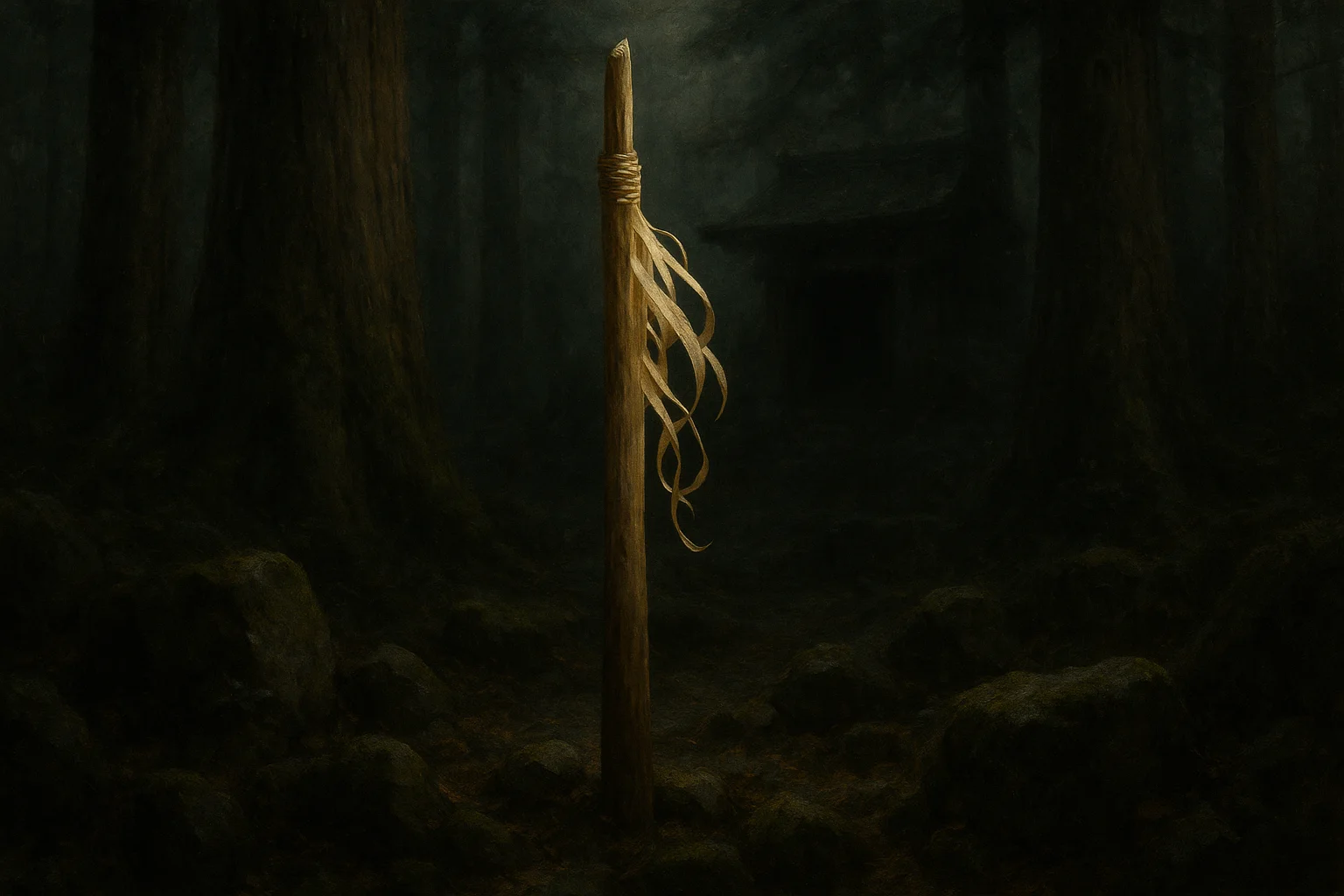
This animist framework extends to objects crafted by human hands. A well-made knife or a treasured lacquer bowl can house a kamuy, especially if treated with respect and gratitude. The Ainu term inaw refers to ritual wands, carved sticks with shaved curls of wood that serve as messengers and offerings to kamuy. Inaw are placed at altars, riverbanks, and mountain passes, physical anchors for prayers and petitions.
Kamuy exist in a parallel realm called Kamuy Mosir, the "land of the gods," which overlaps with the human world, Ainu Mosir. When a kamuy visits the human realm, it assumes a temporary form. Death, in this cosmology, is not annihilation but return: the kamuy sheds its earthly guise and travels back to its divine home. Proper ritual ensures the kamuy departs satisfied, willing to visit again. Disrespect or carelessness offends the kamuy, inviting misfortune or scarcity.
Kim-un Kamuy: The Bear God
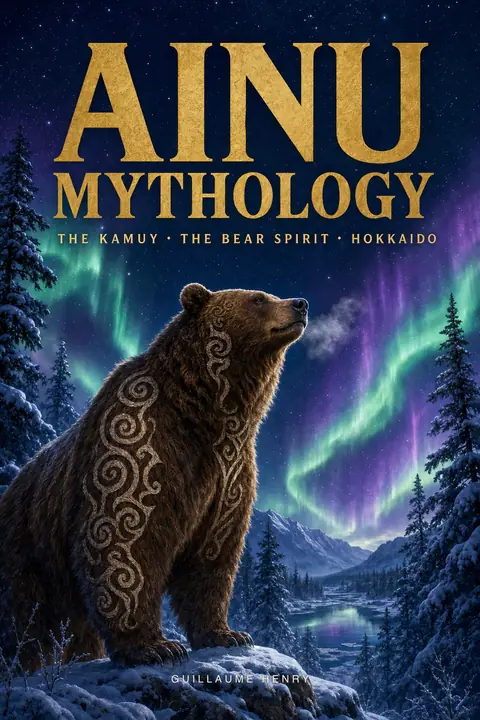
Among all kamuy, the bear holds supreme status. Kim-un Kamuy, the mountain god, embodies strength, generosity, and the sacred contract between predator and prey. The Iyomante, or bear-sending ceremony, stands as the most elaborate ritual in Ainu culture. A bear cub, captured in the wild, is raised within the village for one to two years, nursed and cared for as an honored guest. When the cub reaches maturity, the community gathers for a multi-day ceremony in which the bear is ritually killed, its spirit sent back to Kamuy Mosir laden with gifts: inaw, sake, millet dumplings, and prayers of gratitude.
The Iyomante is not sacrifice in the sense of appeasement; it is reciprocity. The bear kamuy has chosen to visit the Ainu in physical form, offering its body as food and fur. In return, the Ainu honor the kamuy with feasting, song, and reverence, ensuring it will speak well of them in the divine realm and encourage other kamuy to visit. Ethnographer Bronisław Piłsudski, who lived among the Ainu in the early twentieth century, documented the ceremony's emotional complexity: grief at parting, joy in communion, and the weight of responsibility to perform every gesture correctly.
Other Major Kamuy
Fire, Ape-huci Kamuy or Fuchi, is the grandmother of the hearth, guardian of the home and mediator of prayers. Every household maintains a sacred fire, never allowed to die completely. Offerings of food and drink are cast into the flames before meals, and prayers are whispered to Fuchi, who carries them to higher kamuy.
The owl, particularly the Blakiston's fish owl, is Kotan-kor Kamuy, the village guardian. Its deep hooting warns of danger and watches over the community at night. Owls appear frequently in yukar as messengers and protectors, their keen sight piercing the boundary between worlds.
Water kamuy inhabit rivers, lakes, and the sea. Wakka-us Kamuy, the water deity, governs the flow of rivers and the abundance of fish. Salmon, ascending rivers to spawn, are kamuy visiting in great numbers, and their arrival is met with ritual and thanksgiving. The sea itself, Atuy, is home to orca and whale kamuy, powerful beings whose favor determines the success of coastal hunts.
Yukar: The Oral Epics
Ainu mythology survives primarily through yukar, long narrative poems chanted in a rhythmic, formulaic style that aids memorization. These epics, some spanning thousands of lines, recount the adventures of kamuy and culture heroes, encoding moral lessons, ecological knowledge, and cosmological principles. Unlike written scripture, yukar are living texts, adapted and embellished by each performer while maintaining core narrative structures.
Two main categories exist: kamuy yukar, sung from the perspective of kamuy themselves, and Ainu yukar, which follow human or semi-divine heroes. Kamuy yukar often begin with the formula "I am the kamuy of such-and-such a place," establishing the narrator's divine identity. The kamuy then recounts its journey to the human world, the challenges it faces, and the lessons it imparts.
The Epic of Okikurmi
Okikurmi, sometimes called Aeoina Kamuy, is a culture hero who taught the Ainu essential skills: hunting, fishing, weaving, and ritual practice. In the epic cycles devoted to him, Okikurmi descends from Kamuy Mosir to live among humans, taking a mortal wife and fathering children. His adventures include battles with demons (wen kamuy or "bad kamuy"), contests with rival hunters, and journeys to the underworld.
One well-known episode describes Okikurmi's encounter with a monstrous serpent threatening a village. Using cunning rather than brute force, he lures the serpent into a trap and defeats it, teaching the Ainu that intelligence and preparation are as vital as courage. The story echoes themes found in dragon myths across cultures, where serpentine monsters embody chaos and the hero's victory restores order.
The Poronaup and Other Legendary Beings
Ainu epics feature a range of supernatural creatures. The Poronaup, a race of small, mischievous beings, inhabit the deep forests and play tricks on travelers. Unlike malevolent demons, Poronaup are ambiguous figures, sometimes helpful, sometimes harmful, depending on how they are treated. Offerings of food or tobacco can win their favor.
The Mintuci, water spirits, dwell in rivers and lakes, occasionally dragging careless swimmers to their deaths. Parents warn children to respect the water and avoid swimming alone, a practical lesson wrapped in mythic narrative. These cautionary tales share thematic ground with mermaid legends from other maritime cultures, where water spirits embody both allure and danger.
Cosmology and the Structure of the Universe
Ainu cosmology envisions a multi-layered universe. The human world, Ainu Mosir, occupies the middle realm. Above it lies Kamuy Mosir, the land of benevolent kamuy, a place of abundance and light. Below stretches Pokna Mosir, the underworld, home to demons and malevolent spirits. These realms are not sealed; kamuy and spirits travel between them, and humans can, under certain conditions, journey to the divine or demonic planes.
The cosmos is also horizontally divided. The Ainu recognize six cardinal directions: the four compass points, plus up and down. Each direction has its own kamuy and associations. East, where the sun rises, is particularly auspicious. West, where the sun sets, is linked to death and the journey of the soul. Rituals are oriented to these directions, and the placement of inaw and altars follows cosmological principles.
Time, in Ainu thought, is cyclical rather than linear. The seasons turn, salmon return, bears emerge from hibernation, and the kamuy visit in their appointed times. Human life participates in these cycles, and ritual ensures their continuation. Disruption of the natural order, whether through environmental destruction or ritual neglect, invites disaster.
Ritual and Ceremonial Life
Ainu ritual is not confined to grand ceremonies like the Iyomante. Daily life is punctuated by small acts of reverence: prayers to Fuchi before meals, offerings to water kamuy before fishing, libations poured at the threshold before a journey. These gestures maintain the reciprocal relationship between human and kamuy, ensuring the flow of blessings.
The Role of the Shaman
While every Ainu adult knows basic rituals, certain individuals possess the gift of deeper communion with kamuy. The tusu kur, or shaman, serves as intermediary, diagnosing illness, retrieving lost souls, and negotiating with offended kamuy. Shamanic practice involves trance, often induced by drumming and chanting, during which the shaman's soul travels to Kamuy Mosir or Pokna Mosir.
Illness, in Ainu understanding, often results from spiritual imbalance: a kamuy has been offended, or a malevolent spirit has attached itself to the sufferer. The shaman identifies the cause and prescribes the remedy, which may include offerings, purification rituals, or the crafting of protective amulets. This holistic approach to health integrates physical, social, and spiritual dimensions.
Life-Cycle Rituals
Birth, coming-of-age, marriage, and death are marked by rituals that integrate the individual into the community and the cosmos. A newborn is presented to Fuchi and the ancestral kamuy, receiving a name that often references natural phenomena or desired qualities. Adolescent boys undergo initiation rites that test their hunting skills and knowledge of ritual; girls learn weaving, embroidery, and the songs that accompany domestic work.
Death is a transition, not an end. The deceased's soul journeys to the afterlife, guided by prayers and offerings. Grave goods, including tools and ornaments, accompany the body, ensuring the soul has what it needs in the next realm. Mourning rituals last for a prescribed period, after which the deceased becomes an ancestor, a benevolent presence watching over the living.
Ainu Mythology and the Natural World
Ainu cosmology is inseparable from ecology. The mythology encodes deep knowledge of animal behavior, plant cycles, and seasonal patterns. Stories about kamuy teach sustainable practices: when to hunt, when to let prey populations recover, which plants are edible, which are medicinal, which are sacred.
The concept of iwor, often translated as "hunting ground" or "territory," reflects a sophisticated understanding of resource management. Each family or clan has traditional iwor, areas where they hunt, fish, and gather. These territories are not owned in the modern sense but held in trust, managed according to principles passed down through yukar and elder teaching. Overhunting or waste is not merely impractical; it is sacrilege, an insult to the kamuy who provide.
This ecological ethic has drawn attention from contemporary environmental thinkers. The Ainu model of reciprocity, in which humans are one species among many in a web of mutual obligation, offers an alternative to extractive relationships with nature. It is a worldview in which mythological creatures and spirits are not fanciful inventions but expressions of ecological interdependence.
Historical Context and Cultural Resilience
Ainu mythology cannot be understood apart from the history of colonization and cultural suppression. As Japanese expansion into Hokkaido accelerated in the Meiji era, Ainu land was seized, traditional practices were banned, and the Ainu language was forbidden in schools. The Iyomante was outlawed in 1955, though it has since been revived. For much of the twentieth century, Ainu identity was stigmatized, and many Ainu concealed their heritage to avoid discrimination.
Despite these pressures, Ainu culture has endured. Elders preserved yukar by teaching them in secret. Artisans continued to carve inaw and embroider traditional robes. In recent decades, a cultural renaissance has taken root, driven by Ainu activists, scholars, and artists. The Ainu language, critically endangered, is being taught to new generations. Museums and cultural centers in Hokkaido present Ainu history and mythology to Japanese and international audiences.
In 2019, Japan officially recognized the Ainu as an indigenous people, a milestone that came after decades of advocacy. This recognition, while symbolic, has opened space for Ainu voices in national discourse and provided resources for cultural preservation. Mythology, once dismissed as primitive superstition, is now acknowledged as a sophisticated intellectual tradition deserving study and respect.
Comparative Perspectives
Ainu mythology shares structural features with other animist and shamanistic traditions. The concept of kamuy parallels the kami of Shinto, though the two systems developed independently and have distinct theological emphases. The Ainu focus on reciprocity and the temporary embodiment of spirits in animal form finds echoes in circumpolar cultures: the Inuit, the Sami, and indigenous Siberian peoples all practice bear ceremonies and honor animal spirits.
The yukar tradition invites comparison with other oral epic forms: the Finnish Kalevala, the Mongolian Epic of King Gesar, and the Homeric epics of ancient Greece. All use formulaic language, repetition, and stock epithets to aid memorization and performance. All encode cultural values and historical memory in narrative form. The study of yukar has contributed to broader theories of oral composition and transmission, demonstrating that non-literate societies develop sophisticated techniques for preserving complex knowledge.
Certain Ainu motifs resonate with global mythic patterns. The culture hero who descends from the divine realm to teach humanity appears in countless traditions, from Prometheus to Quetzalcoatl. The trickster figure, embodied in the Poronaup, is a near-universal archetype. The journey to the underworld, a common yukar theme, structures myths from the Mesopotamian Descent of Inanna to the Greek story of Orpheus. These parallels do not imply direct influence but suggest that certain narrative structures emerge independently in response to shared human concerns: the origins of culture, the mystery of death, the negotiation of power between human and divine.
Ainu Mythology in Contemporary Culture
Ainu mythology has begun to reach global audiences through literature, film, and popular media. The manga and anime series Golden Kamuy, set in early twentieth-century Hokkaido, features Ainu characters and incorporates authentic cultural details, including yukar excerpts and ritual practices. While a work of fiction, Golden Kamuy has sparked international interest in Ainu culture and prompted discussions about representation and appropriation.
Ainu artists and writers are reclaiming their mythology on their own terms. Poet and activist Shigeru Kayano (1926–2006) devoted his life to recording yukar and advocating for Ainu rights. His collections of oral literature remain essential resources. Contemporary Ainu musicians blend traditional instruments, like the tonkori (a five-stringed zither), with modern genres, creating soundscapes that honor the past while engaging the present.
The global rise of indigenous rights movements has created new contexts for Ainu mythology. As indigenous peoples worldwide assert their sovereignty and cultural autonomy, Ainu stories of reciprocity, respect for nature, and resistance to assimilation resonate beyond Hokkaido. Ainu cosmology, once marginalized, is now recognized as a vital contribution to global conversations about sustainability, spirituality, and the ethics of coexistence.