
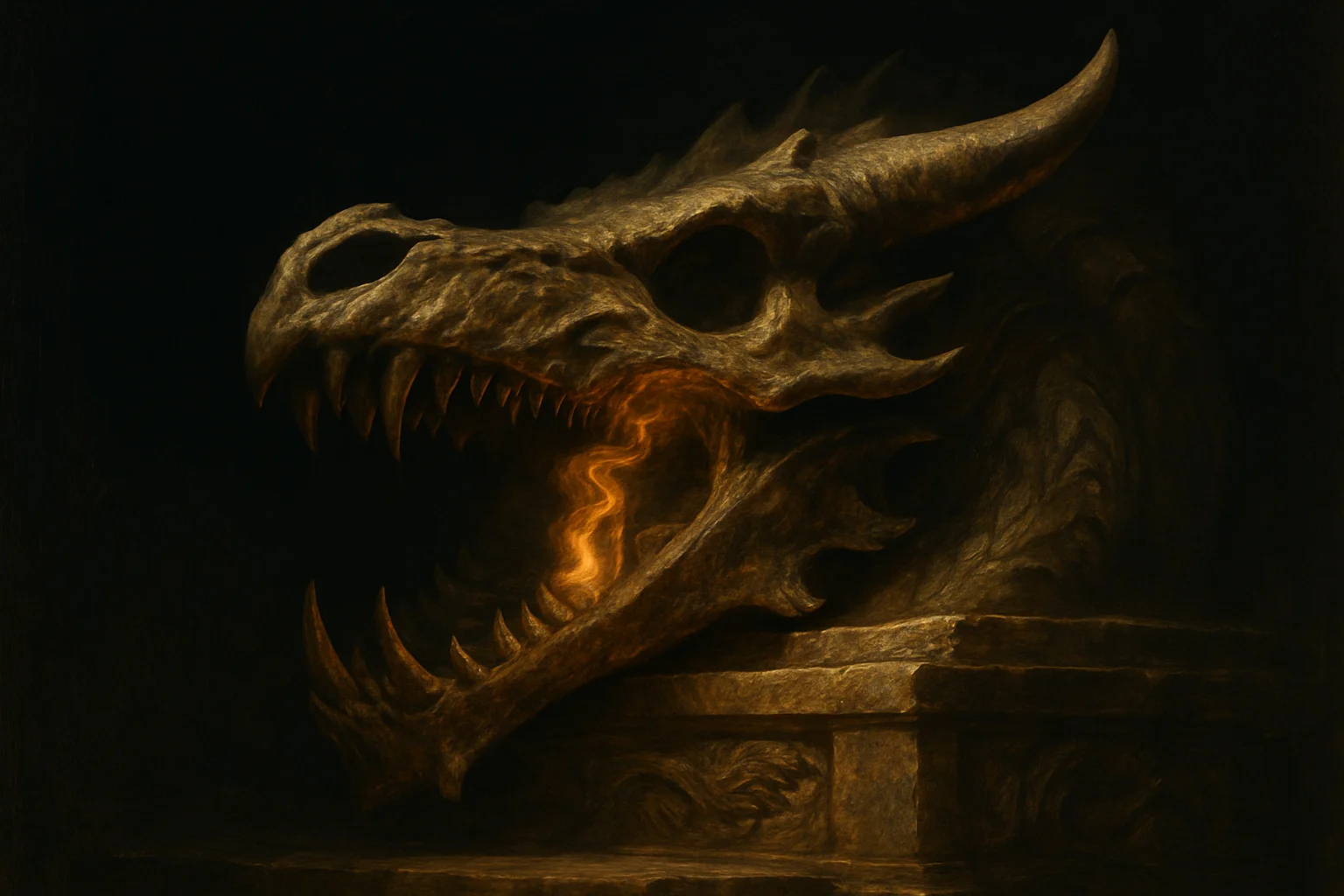
Dragon in Mythology
Dragons appear across cultures but differ wildly. Greek drakōn, Norse lindworm, Chinese lóng: primary sources reveal when wings and fire entered the canon.
Contents
Dragons in mythology are not a single archetype but a family of serpentine creatures whose traits vary radically by region and era. The fire-breathing, winged reptile familiar from medieval European fantasy appears surprisingly late in the textual record, while the oldest dragon-type beings are wingless serpents guarding sacred sites or embodying cosmic forces. Greek drakōn referred to giant snakes, not flying lizards; Chinese lóng brought rain and good fortune rather than destruction; and Mesopotamian serpents like Tiamat represented primordial chaos defeated at creation.
The modern image of the dragon conflates traditions separated by thousands of miles and centuries of storytelling. Fire-breathing enters European sources only in the early medieval period, wings become standard even later, and the notion of the dragon as universal villain ignores benevolent serpent deities across Asia and the Americas. What follows distinguishes these lineages using primary texts and traces how a Greek word for snake became shorthand for fantasy's favorite monster.
What the Word Dragon Meant Before Fantasy
The English word dragon derives from Latin draco, itself borrowed from Greek drakōn. In classical Greek, drakōn designated any large serpent, especially one with a watchful or guardian role. Hesiod's Theogony uses the term for the hundred-headed serpent Ladon, and the Homeric Hymn to Apollo calls the snake slain by Apollo at Delphi a drakaina, the feminine form. Neither text mentions wings, legs, or fire.
The semantic shift from serpent to composite monster happens gradually across centuries and languages. Roman authors retain the Greek sense: Pliny the Elder describes dracones as oversized snakes in India and Ethiopia, dangerous for their size and venom but biologically plausible. Medieval Latin begins to blend the classical serpent with local folklore about lindworms and sea serpents, adding limbs and eventually wings. By the time Isidore of Seville compiles his Etymologies in the seventh century, the dragon is still primarily a snake, but one capable of strangling elephants and living in caves.
The creature we recognize today is a medieval European invention, assembled from older parts.
Greek Drakōn: Serpent Guardians Without Wings
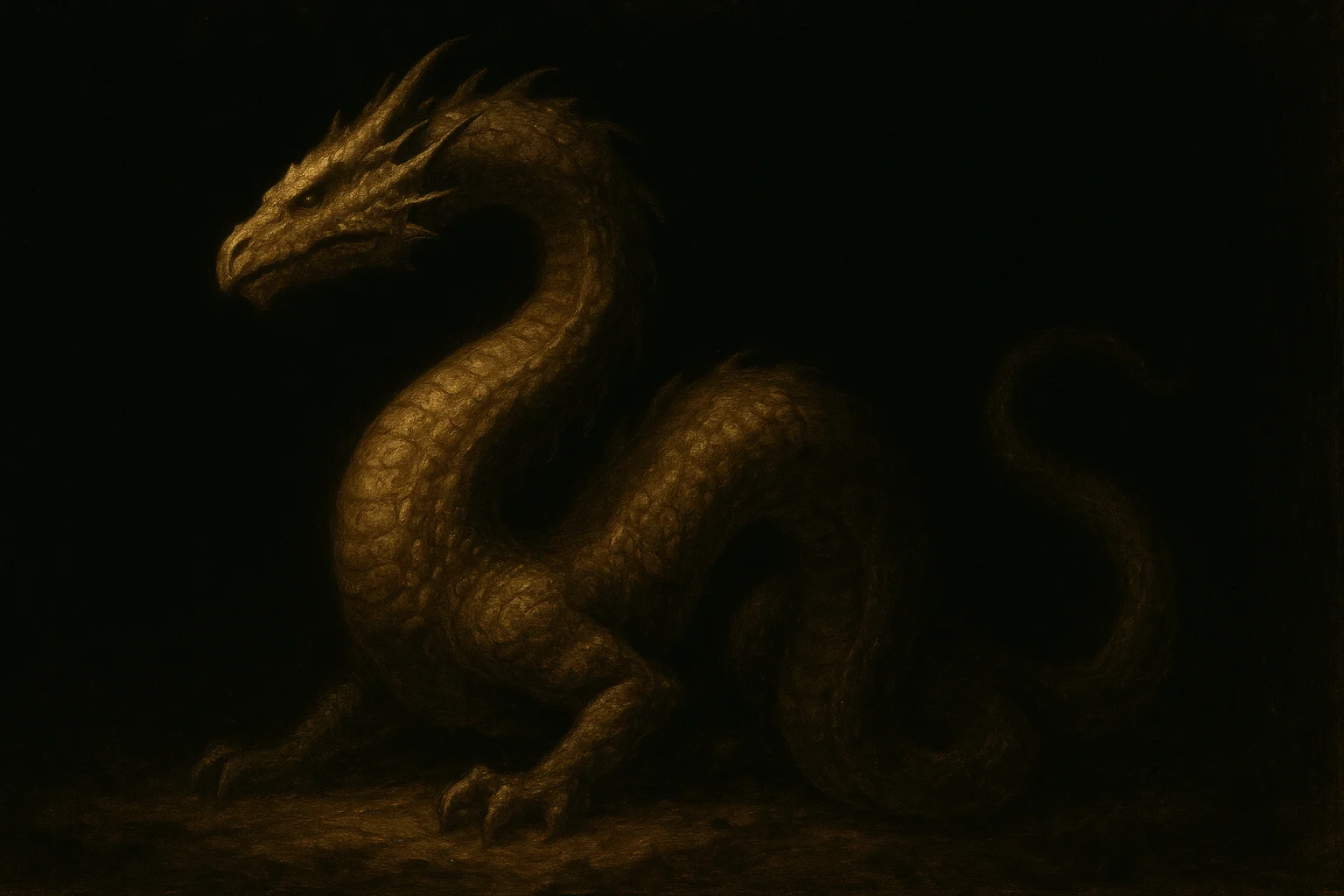
Greek mythology features several prominent drakōn figures, all of them serpents tasked with guarding something sacred or forbidden. They are obstacles in the hero's journey, not cosmic destroyers. Their role is static: they coil around a treasure or sacred site and wait for a hero or god to kill them.
Python at Delphi
The Homeric Hymn to Apollo, lines 300 to 374, recounts how the young god Apollo slays the serpent Python at the site that will become Delphi. Python is female in this version, a drakaina who guards the oracle and the sacred spring. Apollo shoots her with arrows, and she rots in the sun, giving the place its original name, Pytho, from the Greek verb pythein, to rot.
No fire. No wings. Python is a giant snake whose death establishes Apollo's cult and transfers control of the oracle from an older chthonic power to the Olympian order. The story is about succession, not monster-slaying for its own sake.
Ladon and the Golden Apples
Ladon, the serpent coiled around the tree bearing the golden apples of the Hesperides, appears in Hesiod's Theogony, lines 333 to 336, as the offspring of Phorcys and Ceto, both primordial sea deities. Apollodorus' Library 2.5.11 describes Ladon as sleepless and many-headed, killed by Heracles during his eleventh labor. Ladon never leaves the tree. His function is to guard, not to hunt or hoard.
The pattern repeats: the Greek drakōn is a boundary marker, a living lock on something humans or gods desire. It does not rampage through villages or demand tribute.
Norse Lindworm and Serpent Cosmology
Old Norse tradition distinguishes between ormr, serpent, and dreki, a loanword from Latin draco that appears in later sagas. The native term linnormr or lindworm refers to a legless, wingless serpent, often venomous and always dangerous. Norse cosmology places serpents at structural points in the universe: Jörmungandr encircles Midgard, Níðhöggr gnaws the roots of Yggdrasil, and Fafnir guards cursed gold in the mortal realm.
Fafnir: Greed in Reptile Form
The Völsunga saga, chapters 18 to 20, tells how Fafnir, originally a dwarf, transforms into a linnormr after murdering his father for a hoard of cursed gold. The transformation is not magical punishment but a physical manifestation of greed. Fafnir becomes a serpent because that is what hoarding does to the soul in Norse moral logic.
Sigurd kills Fafnir by digging a pit beneath the serpent's daily path to the water and stabbing upward into its belly. Fafnir speaks before dying, warning Sigurd that the gold is cursed. The creature is intelligent, tragic, and entirely wingless. Later Scandinavian art sometimes adds legs or wings to Fafnir, but the saga describes him as a worm, not a composite beast.
Níðhöggr and the World Tree
The Prose Edda, Gylfaginning 16, places Níðhöggr at the base of Yggdrasil, gnawing the roots alongside other serpents. Níðhöggr is not a guardian but a destroyer, aligned with the forces of entropy and chaos. At Ragnarök, he will fly over the battlefield carrying corpses, one of the few Norse serpents explicitly described with wings in the primary sources. His role ties him to apocalypse traditions and the cyclical destruction of world tree cosmologies.
The Norse serpent is existential threat or moral symbol, rarely a mere obstacle.
When Fire-Breathing Enters the Canon
Beowulf, composed sometime between the eighth and early eleventh centuries, contains the first unambiguous description of a fire-breathing dragon in European literature. The dragon in lines 2200 to 2400 guards a barrow full of treasure, sleeps on gold, and breathes fire when a thief steals a cup. The poet calls it a draca and a wyrm, using both Latin and Old English terms.
"The hoard-guardian waited restless until evening came; then the barrow-keeper was enraged, the fierce one would requite with fire the precious drinking-cup." Beowulf, lines 2302-2305, translated by Seamus Heaney
This is the template for medieval and modern dragons: winged, fire-breathing, treasure-hoarding, and vengeful. But it appears more than a millennium after Hesiod and Homer. Greek and Roman dragons do not breathe fire. Neither do the dragons of the Hebrew Bible, where tannin refers to sea serpents or crocodiles. The innovation is early medieval, possibly influenced by Germanic folklore about lindworms and volcanic imagery.
Wings arrive even later in visual art. Manuscript illuminations before 1200 CE often depict dragons as serpents with legs but no wings. The fully winged, four-legged dragon becomes standard only in the high medieval period, codified in heraldry and romance literature.
Chinese Lóng: Rain Bringer, Not Monster
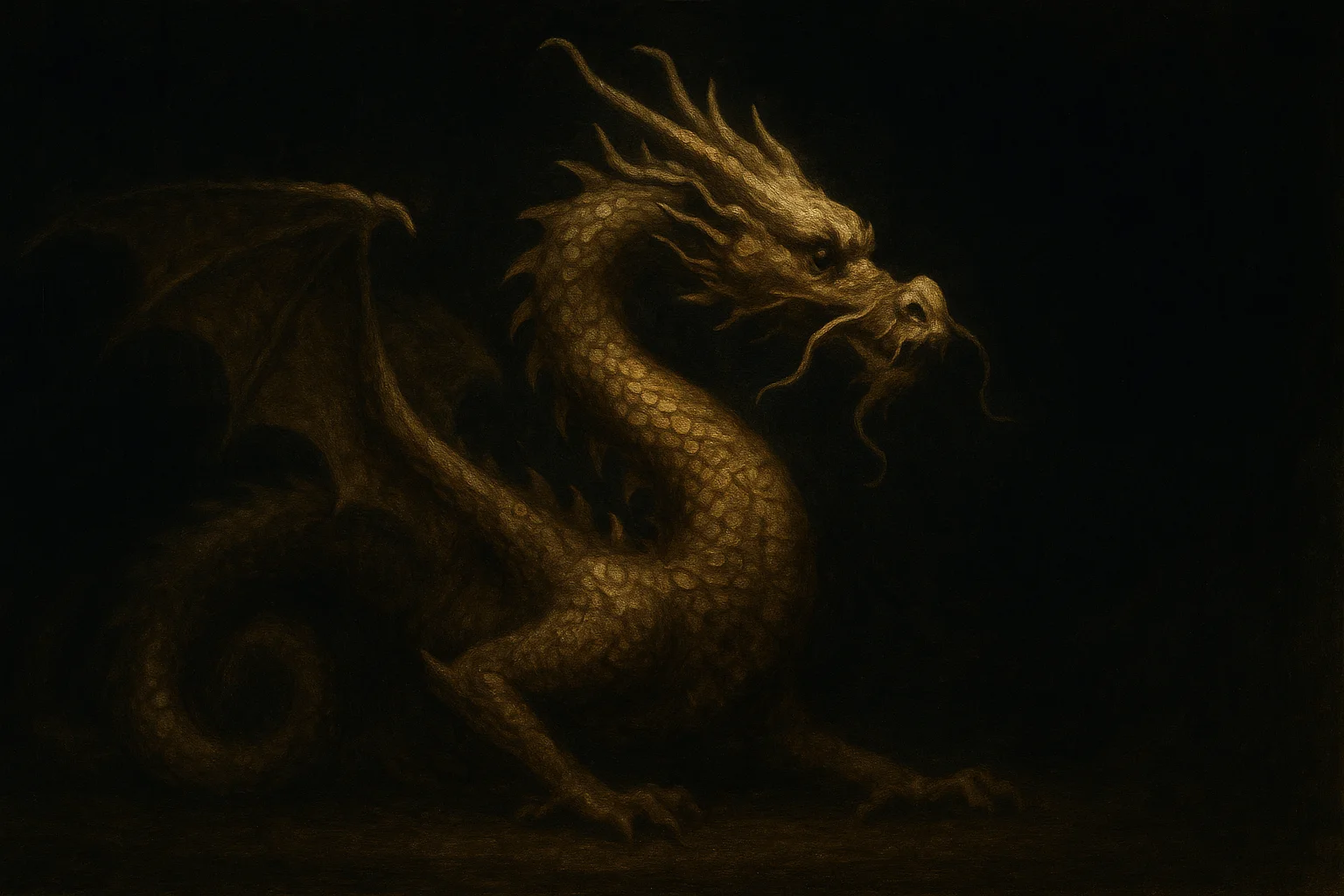
The Chinese lóng shares almost nothing with the European dragon except a vaguely reptilian appearance and association with water. Lóng are benevolent, associated with emperors, and control rain and rivers. They do not guard treasure or fight heroes. The Huainanzi, chapter 4, describes lóng as responsive to ritual and capable of ascending to the heavens or descending into deep water, embodying the cosmic principle of transformation.
European Dragon
Hostile, fire-breathing, guards treasure, killed by heroes. Symbolizes chaos, greed, or paganism in Christian contexts. Wingless in early sources, gains wings and legs by the medieval period.
Chinese Lóng
Benevolent, controls rain and rivers, associated with imperial authority. Symbolizes power, wisdom, and good fortune. Wingless but capable of flight, often depicted with antlers, whiskers, and scales.
The lóng appears in creation myths, in stories of the Yellow Emperor, and in Daoist cosmology as one of the four celestial animals. It is never slain. To kill a lóng would be sacrilege, not heroism. The semantic overlap between "dragon" and "lóng" is a translation accident, not a mythological kinship.
Mesopotamian Tiamat and the Chaos Serpent
The Enuma Elish, tablets I through IV, recounts the Babylonian creation myth in which the god Marduk slays Tiamat, the primordial saltwater ocean, and fashions the world from her corpse. Tiamat is called a serpent or dragon in some translations, but the Akkadian term tiamat simply means "sea." She is personified chaos, not a creature with a fixed zoological form.
Tiamat creates an army of monsters to fight the younger gods, including serpents, storm demons, and hybrid beasts. Marduk defeats her with winds and arrows, then splits her body to create heaven and earth. The story is cosmogonic, not a hero tale. Tiamat's death is necessary for order to exist, linking her to other chaos serpents in flood myths and creation narratives.
The serpent as embodiment of pre-creation chaos recurs in Egyptian Apep, the Canaanite Leviathan, and the Vedic Vritra. These beings are cosmic, not local. They do not hoard gold or live in caves. Their defeat is the precondition for the world.
Why Dragons Guard Treasure
The association between dragons and treasure is strong in European sources but absent or weak elsewhere. Fafnir and the Beowulf dragon both guard gold, and medieval romances routinely place dragons atop hoards. The pattern has three likely roots.
- Serpents in Greek and Near Eastern myth guard sacred objects: the golden apples, the golden fleece, the tree of life. Treasure is a later substitution for these numinous objects.
- Barrow-wights and grave goods in Germanic tradition associate burial mounds with treasure and with serpents or worms that infest the dead. The dragon becomes the animate guardian of the tomb.
- Hoarding behavior mirrors the dragon's role as boundary-keeper. The creature that will not move, will not share, and will not die until killed is the perfect symbol of wealth removed from circulation.
Chinese lóng do not guard treasure. Neither do the serpents of Mesoamerican mythology, where feathered serpents like Quetzalcoatl are creators and culture-bringers. The hoard is a European fixation, tied to specific economic and narrative concerns about wealth, inheritance, and the dangers of accumulation.
The Convergence Problem: Fossils, Serpents, and Storytelling
Speculation about real-world origins for dragon myths is popular but rarely supported by the sources themselves. The fossil hypothesis, which suggests that ancient peoples interpreted dinosaur bones as dragon remains, has no textual evidence. Greek and Roman authors who describe large bones attribute them to giants, not serpents. Pausanias and Pliny mention enormous skeletons but never connect them to drakōn or draco.
More plausible is convergent storytelling around serpents, which exist on every continent and provoke universal fear. Large constrictors, venomous snakes, and crocodiles all contribute to the image of the dangerous reptile. Add the human tendency to place guardians at thresholds, to imagine underworld journeys guarded by monsters, and to symbolize chaos as serpentine, and the dragon becomes inevitable without requiring a single shared origin.
The Sphinx and other composite creatures in other mythological creatures follow similar patterns: local animals recombined into symbolic forms that serve narrative and religious functions. The dragon is not a memory of a real animal but a narrative tool, refined over centuries into the form modern fantasy takes for granted.
Frequently asked questions
Did ancient dragons breathe fire in the earliest sources?
Ancient dragons in Greek, Roman, and early Norse sources do not breathe fire; the trait first appears in the Old English poem Beowulf, composed between the eighth and eleventh centuries CE, where the dragon guarding a treasure barrow uses fire as a weapon. Greek drakōn figures like Python and Ladon are giant serpents killed with arrows or swords, and Roman descriptions by Pliny treat dragons as large snakes, dangerous for venom and constriction but not flame. Fire-breathing becomes standard in European dragon lore only after the early medieval period, likely influenced by Germanic and Christian apocalyptic imagery.
Why do European and Asian dragons look and behave so differently?
European dragons and Chinese lóng developed independently in separate mythological and religious systems with no direct contact until the early modern period. European dragons, rooted in Greek serpent guardians and Germanic lindworms, are typically hostile creatures killed by heroes, symbolizing chaos or evil, especially in Christian contexts. Chinese lóng are benevolent deities associated with rain, rivers, and imperial authority, never slain and often depicted as wise and transformative. The visual and behavioral differences reflect fundamentally different symbolic roles: the European dragon as obstacle or enemy, the Chinese lóng as cosmic benefactor.
Which mythologies feature dragons as benevolent rather than hostile?
Chinese mythology treats the lóng as benevolent rain-bringers and symbols of imperial power, never as enemies to be slain, and Daoist cosmology includes them among the four celestial animals. Mesoamerican traditions feature feathered serpents like Quetzalcoatl, who function as creator gods and culture heroes rather than monsters. Japanese ryū, derived from Chinese lóng, are similarly protective water deities. In contrast, most European, Near Eastern, and Norse serpent figures are hostile or chaotic, though even in these traditions some serpents, like the healing serpents of Asclepius, carry positive associations.
When did wings become a standard dragon trait?
Wings become a standard feature of dragons in European visual art and literature only during the high medieval period, after roughly 1200 CE, when heraldry and romance codify the image of the four-legged, winged, fire-breathing dragon. Earlier Greek and Roman dragons are wingless serpents, and manuscript illuminations before the twelfth century often depict dragons with legs but no wings. The Norse dragon Níðhöggr is described with wings in the Prose Edda only in his apocalyptic role at Ragnarök, and the Beowulf dragon's wings are implied by its ability to fly but not described in anatomical detail. The fully realized winged dragon is a late medieval synthesis.
What is the connection between dragons and treasure hoarding?
Dragons guard treasure in European sources beginning with the Völsunga saga and Beowulf, where the behavior symbolizes greed, the dangers of wealth removed from circulation, and the association of burial mounds with both grave goods and serpentine grave-wights in Germanic tradition. Greek dragons guard sacred objects like the golden apples or the golden fleece, and treasure-hoarding is a later substitution for these numinous items. Chinese lóng and Mesopotamian serpents do not hoard treasure; the motif is specific to European dragon lore and reflects medieval concerns about inheritance, kingship, and the moral dangers of accumulation.
Are dragons and giant serpents the same creature in mythology?
Dragons and giant serpents are the same creature in Greek and early Roman sources, where the word drakōn simply means large snake, but the terms diverge in medieval European tradition as "dragon" acquires wings, legs, and fire-breathing while "serpent" retains the older, simpler form. Norse tradition uses ormr for serpent and linnormr for a legless, wingless dragon-type creature, with dreki as a later loanword. In Chinese, lóng is never translated as serpent; it is a distinct category of divine being. The modern distinction between dragon and serpent is a product of medieval European fantasy consolidation, not an ancient taxonomic divide.
Further reading on Mythologis
Read the full book
Want the whole story?
The complete edition is an instant PDF download here, with a paperback on Amazon for selected titles.
Mythology
The World Mythology Book: The Gods, Heroes and Myths of Every Culture
The Gods, Heroes and Myths of Every Culture, in One Volume
The whole of world mythology in a single volume: Greek, Norse, Egyptian, Japanese, Hindu, Celtic, Slavic, Mesoamerican and African myths gathered side by side, each drawn from the primary sources.