
Sphinx: Mythical Creature Symbol of Strength and Wisdom
The sphinx appears in Egypt as royal protector, in Greece as deadly riddler. Explore the creature's forms, riddles, and meanings across cultures.
Contents
The sphinx is a composite creature combining a lion's body with a human head, appearing in both Egyptian and Greek traditions with markedly different roles: the Egyptian sphinx serves as a solar guardian and royal protector, while the Greek sphinx is a destructive riddler who devours travelers. The creature symbolizes strength through its leonine form and wisdom through its human intellect. Hesiod's Theogony (lines 326-332) places the Greek sphinx in a genealogy of monsters, while Egyptian Pyramid Texts describe the pharaoh himself as a sphinx guarding the horizon.
The sphinx did not migrate unchanged. As the form moved from the Nile Valley to the Aegean, it acquired wings, shifted gender, and transformed from protector to destroyer. Similar hybrids appear across Mesopotamia, South Asia, and Southeast Asia, each culture reshaping the composite body to serve its own cosmological needs.
The Egyptian Sphinx: Guardian of Horizons
Form and Function in the Old Kingdom
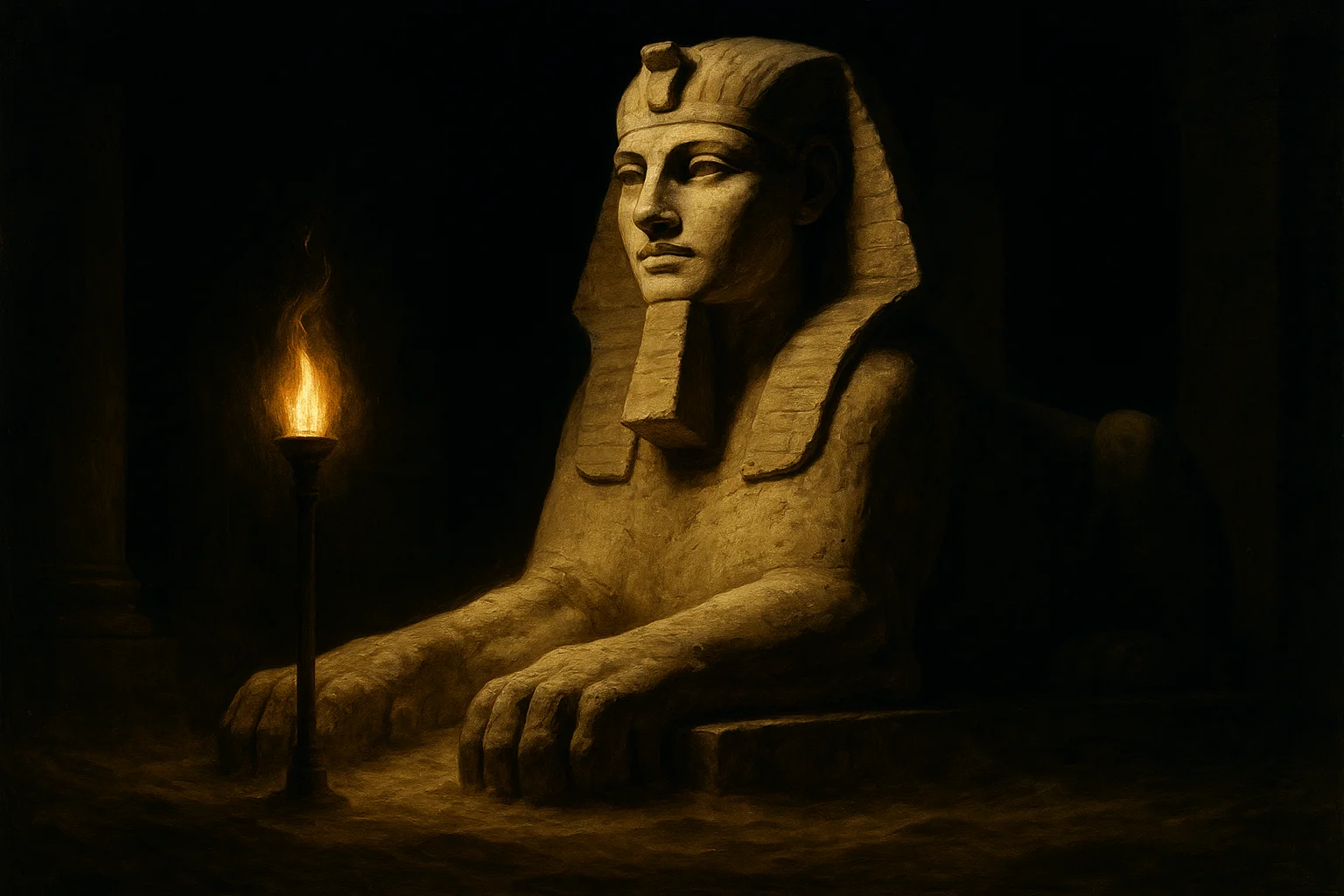
The Egyptian sphinx appears in the Old Kingdom as a male figure with a lion's body and the head of a pharaoh, typically wearing the royal nemes headdress. No wings. No riddles. The creature functions as a solar symbol and a boundary marker, positioned at temple entrances and along processional routes to repel chaos. The Egyptian term shesep-ankh, meaning "living image," emphasizes the sphinx as an embodiment of royal power rather than a separate mythological entity.
Pyramid Texts from the Fifth and Sixth Dynasties describe the deceased king as a sphinx. Utterance 523 declares the pharaoh "a lion, he is a god." The identification is direct: the king does not merely resemble a sphinx; he becomes one in the afterlife, guarding the threshold between the ordered world and the primordial waters.
The Great Sphinx of Giza and Solar Theology
The Great Sphinx of Giza, carved during the reign of Khafre around 2500 BCE, measures 73 meters long and 20 meters high. It faces due east, aligned with the rising sun. Later tradition identified it with the god Hor-em-akhet, "Horus of the Horizon," linking the monument to solar theology and the daily rebirth of Ra. The Dream Stele, erected between the paws by Thutmose IV in the fifteenth century BCE, records the prince's vision in which the sphinx promised him kingship in exchange for clearing away the encroaching sand.
The solar association persists across Egyptian history. Sphinxes flank temple avenues at Karnak and Luxor, their lion bodies representing the sun's strength, their human heads the divine intelligence that orders the cosmos. They do not pose questions. They assert presence.
Sphinx as Royal Protector
Smaller sphinx statues, often depicting specific pharaohs, served as votive offerings and tomb guardians. The form conveyed the king's dual nature: human reason governing animal strength. Diodorus Siculus, writing in the first century BCE, notes that Egyptian priests interpreted the sphinx as a symbol of the union between physical power and intellectual governance, a reading that aligns with the creature's consistent placement at sites requiring protection.
The Egyptian sphinx never asks riddles in surviving texts. That transformation occurs elsewhere.
The Greek Sphinx: Riddler and Destroyer
Hesiod's Genealogy and the Theban Monster
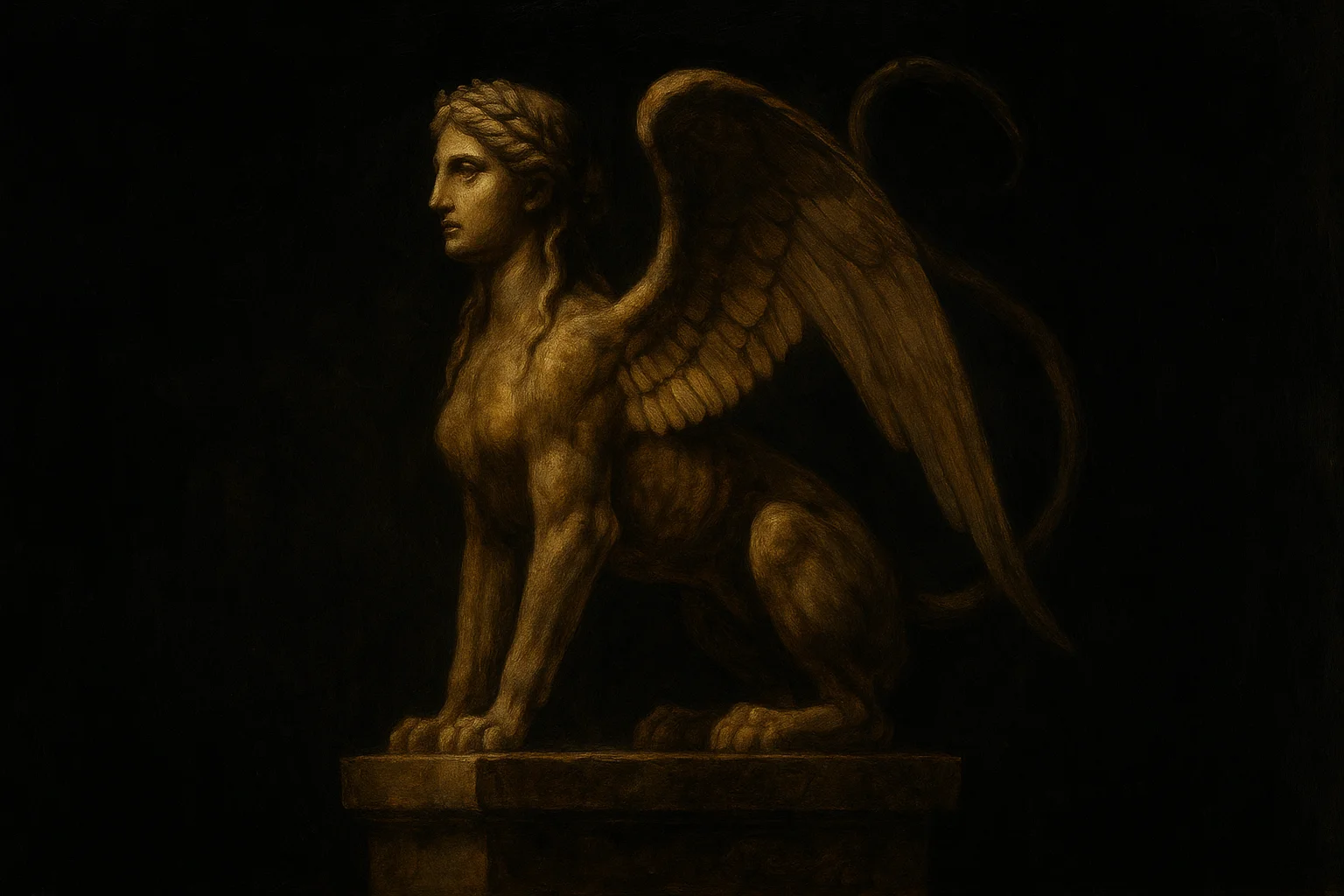
The Greek sphinx enters the literary record in Hesiod's Theogony, where she is born of Echidna and Orthrus (or Typhon, sources vary). Hesiod places her among a brood of monsters: the Nemean Lion, the Hydra, and the Chimera. Unlike her Egyptian counterpart, the Greek sphinx is female, winged, and explicitly hostile. She is not a guardian but a plague sent by the gods, or by Hera specifically, to punish Thebes.
Apollodorus' Library (3.5.8) describes her perched on Mount Phicium outside Thebes, where she poses a riddle to every passerby and devours those who fail to answer. The riddle is a test not of piety or strength but of human wit. The creature embodies a different kind of wisdom: the wisdom that destroys the ignorant.
The Riddle of Oedipus
The riddle, as preserved in later sources including scholia on Sophocles' Oedipus Rex, asks: "What walks on four legs in the morning, two at noon, and three in the evening?" Oedipus answers: man, who crawls as an infant, walks upright in adulthood, and uses a cane in old age. The sphinx, defeated, throws herself from the cliff. Pausanias (Description of Greece 9.26.2) records that the Thebans erected a monument to commemorate Oedipus' victory, though he notes some claimed the sphinx was a bandit queen rather than a monster.
The riddle's structure mirrors the hero's journey: the traveler confronts a threshold guardian who tests his readiness to enter the city. Oedipus passes, but the victory is pyrrhic. He wins Thebes and marries Jocasta, fulfilling the prophecy that will destroy him. The sphinx, in this reading, is less an obstacle than a hinge in fate.
Wings, Gender, and the Shift in Iconography
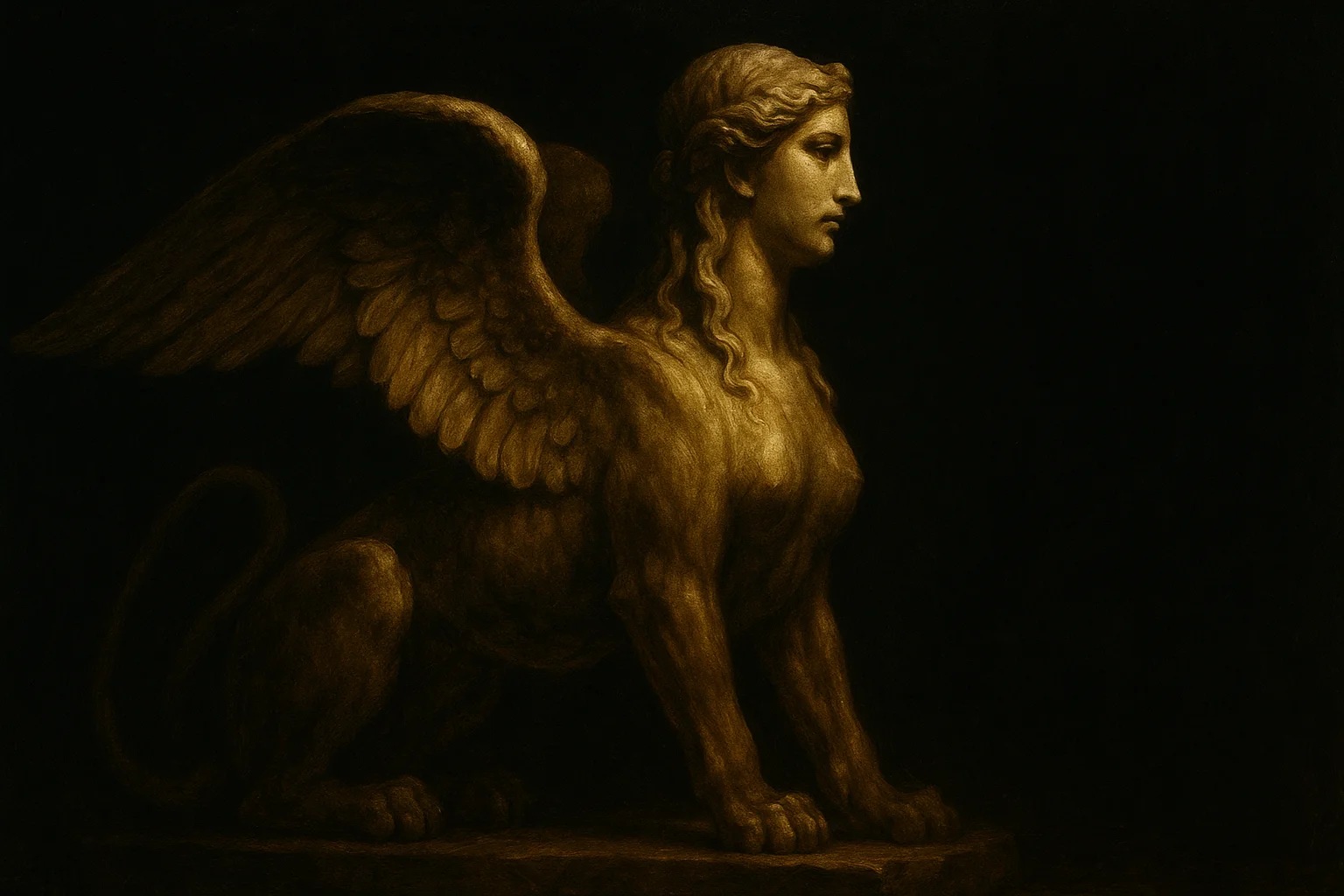
Greek vase painting from the sixth century BCE depicts the sphinx with a woman's head and breasts, a lion's body, a serpent's tail, and eagle's wings. The composite form multiplies symbolic registers: lion for strength, wings for divine or chthonic origin, human face for intelligence, serpent for danger. The gender shift from Egyptian male to Greek female aligns the creature with other dangerous female figures in Greek myth, including the Sirens, the Harpies, and Medusa.
The wings, absent in Egypt, may derive from Near Eastern iconography. Mesopotamian and Levantine art from the second millennium BCE features winged lions and human-headed bulls, forms that Greek traders and colonists would have encountered. The sphinx becomes a site of cultural synthesis, Egyptian form refracted through Aegean and Asiatic lenses.
Egyptian Sphinx
Male, wingless, solar guardian aligned with royal power and temple protection. No riddles; embodies pharaoh's divine authority.
Greek Sphinx
Female, winged, chthonic destroyer sent as divine punishment. Poses riddle; devours the ignorant; destroyed by Oedipus.
Sphinx-like Creatures Beyond Egypt and Greece
The Lamassu of Mesopotamia
Mesopotamian palaces from the ninth century BCE onward feature lamassu: colossal statues with a bull's or lion's body, eagle's wings, and a bearded human head wearing a horned crown. They flank city gates and palace entrances at Nineveh, Dur-Sharrukin, and Nimrud. Inscriptions identify them as protective spirits, apotropaic figures that repel evil and assert the king's cosmic authority. The lamassu shares the sphinx's composite anatomy and guardian function but adds a fifth leg, visible from both front and side, to convey perpetual motion.
The formal similarity suggests shared symbolic logic across the ancient Near East: the hybrid body combines the best attributes of multiple creatures to produce a being greater than any single form. The lamassu, like the Egyptian sphinx, does not interrogate. It guards.
Purushamriga and Narasimha in South Asia
South Asian traditions feature the purushamriga, a "man-beast" with a human head and leonine body, appearing in temple sculpture from the early centuries CE onward. The form echoes the sphinx but develops independently within Hindu and Buddhist iconography. More prominent is Narasimha, Vishnu's fourth avatar, who takes the form of a man-lion to destroy the demon Hiranyakashipu. Narasimha is not a hybrid guardian but an active divine intervention, embodying the paradox that defeats the demon's boon: neither fully man nor fully beast, appearing at twilight, neither day nor night.
The purushamriga, by contrast, serves as a decorative and protective motif on temple friezes, particularly in South India and Sri Lanka. It shares the sphinx's liminal status but lacks the narrative prominence of the Greek version or the cultic centrality of the Egyptian.
Hybrid Guardians in Southeast Asian Temple Architecture
Khmer and Thai temple complexes feature singha and naga-lion hybrids guarding staircases and gates. Angkor Wat and Angkor Thom deploy lion-bodied figures with human or semi-divine faces at thresholds, blending Indian and local Cambodian motifs. These guardians function like the Egyptian sphinx: they mark sacred space, repel chaos, and embody royal or divine authority. They do not speak. They stand.
The recurrence of the composite guardian across unrelated cultures suggests a common symbolic grammar. The lion provides strength and ferocity; the human head provides reason and divine sanction. The hybrid is always more than decoration. It is a statement about power and order.
Symbolism: Strength, Wisdom, and the Composite Body
The sphinx's body is a theological argument. The lion, king of beasts, represents physical dominance, solar power, and untamed nature. The human head represents intellect, speech, and the capacity for judgment. The union of the two produces a being that transcends both: a guardian who combines force with discernment, a riddle-poser who wields language as a weapon, a king who rules by both might and divine right.
In Egyptian theology, the sphinx embodies ma'at, the cosmic order maintained by the pharaoh. The creature does not merely guard the temple; it is the temple's logic made flesh. In Greek myth, the sphinx inverts that order. She is chaos disguised as reason, a test that reveals the fragility of human knowledge. Oedipus solves the riddle but misses the deeper warning: knowing the answer is not the same as understanding the question.
The composite body also appears in other composite creatures across world mythology, including the dragon, the mermaid, and the centaur. Each hybrid negotiates the boundary between human and animal, culture and nature, order and chaos. The sphinx is unique in making that boundary a site of interrogation. The riddle is the threshold.
"What creature walks on four legs in the morning, two at noon, and three in the evening?" The answer is man, but the question is time, mortality, and the arc of human life compressed into a single sentence.
Later allegorists read the sphinx as a symbol of enigma itself, the irreducible mystery at the heart of existence. Renaissance emblem books depict the sphinx alongside mottos about hidden knowledge and the limits of reason. The creature becomes a figure for philosophy, for the questions that resist easy answers.
The Sphinx in Later Tradition and Modern Culture
The sphinx enters European art and literature through Greek and Roman sources, often stripped of its Egyptian origins. Medieval bestiaries occasionally include the sphinx among exotic creatures, though it lacks the prominence of the dragon, the werewolf, or the vampire. The Renaissance revives interest in Egyptian monuments, and the Great Sphinx becomes a symbol of ancient wisdom and inscrutable antiquity.
Nineteenth-century Egyptology places the sphinx at the center of popular fascination with the ancient world. Travelers' accounts, engravings, and later photographs circulate images of the Giza monument, often framed as a riddle in stone. The Greek sphinx, meanwhile, appears in retellings of the Oedipus myth, from Sophocles' tragedies to Freud's psychoanalytic readings. The creature becomes a figure for the unconscious, the repressed knowledge that destroys those who uncover it.
Modern fantasy literature and games deploy the sphinx as a challenge-giver, a creature who tests heroes with riddles or moral dilemmas. The form is flexible: sometimes Egyptian, sometimes Greek, often a blend. The sphinx appears in works ranging from Harry Potter to Dungeons & Dragons, where it functions as a narrative hinge, a moment when the hero must prove intellectual rather than physical prowess. The creature's association with trickster gods and enigmatic wisdom persists, even as its mythological context fades.
The sphinx also appears in modern occult and esoteric traditions, where it symbolizes initiation, hidden knowledge, and the synthesis of opposites. Aleister Crowley and other ceremonial magicians invoke the sphinx as a guardian of mysteries, a figure who reveals truth only to those who can answer correctly. The creature's composite body becomes a metaphor for the integrated self, the union of animal instinct and rational mind.
Frequently asked questions
What is the difference between the Egyptian sphinx and the Greek sphinx?
The Egyptian sphinx is a male, wingless guardian with a lion's body and a pharaoh's head, serving as a solar protector of temples and tombs and never posing riddles in surviving texts. The Greek sphinx is a female, winged monster with a woman's head, lion's body, and serpent's tail, sent to punish Thebes by devouring travelers who fail to answer her riddle. The Egyptian form appears as early as the Old Kingdom (circa 2500 BCE) and embodies royal and divine authority, while the Greek version, first mentioned by Hesiod in the eighth century BCE, functions as a destructive threshold guardian defeated by Oedipus.
What riddle did the sphinx ask Oedipus?
The sphinx asked Oedipus, "What walks on four legs in the morning, two at noon, and three in the evening?" Oedipus answered that the creature is man, who crawls on all fours as an infant, walks upright on two legs as an adult, and uses a cane as a third leg in old age. Upon hearing the correct answer, the sphinx threw herself from the cliff and died. The riddle appears in scholia and later retellings of Sophocles' Oedipus Rex, though no version survives in texts earlier than the fifth century BCE.
Why does the sphinx have a lion's body and a human head?
The sphinx's composite form combines the lion's physical strength and solar symbolism with the human head's capacity for reason, speech, and divine intelligence, creating a being that embodies both power and wisdom. In Egyptian theology, the hybrid represents the pharaoh's dual nature as both mortal ruler and divine protector, guarding the boundaries between order and chaos. The Greek sphinx inverts this symbolism, using the composite body to signal a creature that is neither fully human nor fully beast, a liminal figure who tests travelers at the threshold of the city.
Are there sphinx-like creatures in other mythologies?
Mesopotamian lamassu, South Asian purushamriga, and Southeast Asian temple guardians all feature composite bodies combining human heads with animal forms, typically lions or bulls, and serve protective or apotropaic functions similar to the Egyptian sphinx. The lamassu, appearing in Assyrian palaces from the ninth century BCE, combines a bull's or lion's body with a bearded human head and eagle's wings. South Asian traditions include the purushamriga in temple sculpture and Narasimha, Vishnu's man-lion avatar, while Khmer and Thai temples deploy lion-bodied guardians with human or divine faces at sacred thresholds.
What does the sphinx symbolize in mythology?
The sphinx symbolizes the union of strength and wisdom, combining the lion's physical power and solar associations with the human capacity for reason, judgment, and divine authority. In Egyptian tradition, the creature embodies the pharaoh's role as cosmic guardian and maintainer of ma'at, the universal order. In Greek myth, the sphinx represents the destructive potential of knowledge, testing human wit and devouring those who fail, serving as a threshold figure who guards the boundary between ignorance and understanding. Later allegorical readings interpret the sphinx as a symbol of enigma itself, the irreducible mystery at the heart of existence.
Did the Egyptian sphinx ask riddles?
The Egyptian sphinx did not ask riddles in any surviving texts from ancient Egypt; it functioned exclusively as a solar guardian, royal protector, and boundary marker at temples and tombs. The riddle-posing sphinx is a Greek innovation, first appearing in Athenian sources from the fifth century BCE and associated specifically with the Theban monster defeated by Oedipus. The confusion between the two traditions arises from later European conflation of Egyptian and Greek sources, particularly during the Renaissance and the nineteenth-century Egyptology craze, when the Great Sphinx of Giza was popularly imagined as a riddler despite no textual evidence supporting that interpretation.
Further reading on Mythologis
Read the full book
Want the whole story?
The complete edition is an instant PDF download here, with a paperback on Amazon for selected titles.
Mythology
The World Mythology Book: The Gods, Heroes and Myths of Every Culture
The Gods, Heroes and Myths of Every Culture, in One Volume
The whole of world mythology in a single volume: Greek, Norse, Egyptian, Japanese, Hindu, Celtic, Slavic, Mesoamerican and African myths gathered side by side, each drawn from the primary sources.