70 Fantastic Creatures from Mythology
From dragons to sphinxes, explore 70 mythological creatures organized by role and tradition, with primary sources and cross-cultural patterns.
Contents
Fantastic creatures from mythology span every inhabited continent and include guardians like Cerberus and the Sphinx, shapeshifters such as werewolves and selkies, world-ending serpents like Jörmungandr and Apophis, hybrid beings from griffins to centaurs, and psychopomps that guide souls between realms. These seventy examples are drawn from primary texts including Hesiod's Theogony, the Poetic Edda, the Ramayana, and the Popol Vuh, as well as documented oral traditions. The number seventy is not arbitrary: it reflects the threshold at which patterns of function, form, and cultural role become visible across unrelated mythologies.
Organizing creatures by what they do rather than where they come from reveals how human imagination returns to the same solutions. Guardians watch thresholds. Shapeshifters test identity. Monsters embody the collapse of order. The details differ, but the grammar repeats.
Why Seventy Creatures
The number seventy is large enough to show patterns without claiming completeness. Every mythology produces more creatures than can fit in a single catalogue. The Theogony alone names dozens of offspring born to Echidna and Typhon. The Mahabharata describes entire species of beings that populate the cosmos. Oral traditions from the Amazon to Siberia preserve creature lore that was never written down until ethnographers arrived with notebooks.
Seventy allows comparison without flattening. It includes the famous and the obscure, the written and the spoken, the singular monster and the species. The goal is not exhaustive listing but functional taxonomy: what roles do these beings play, and why do those roles recur.
Guardians and Sentinels
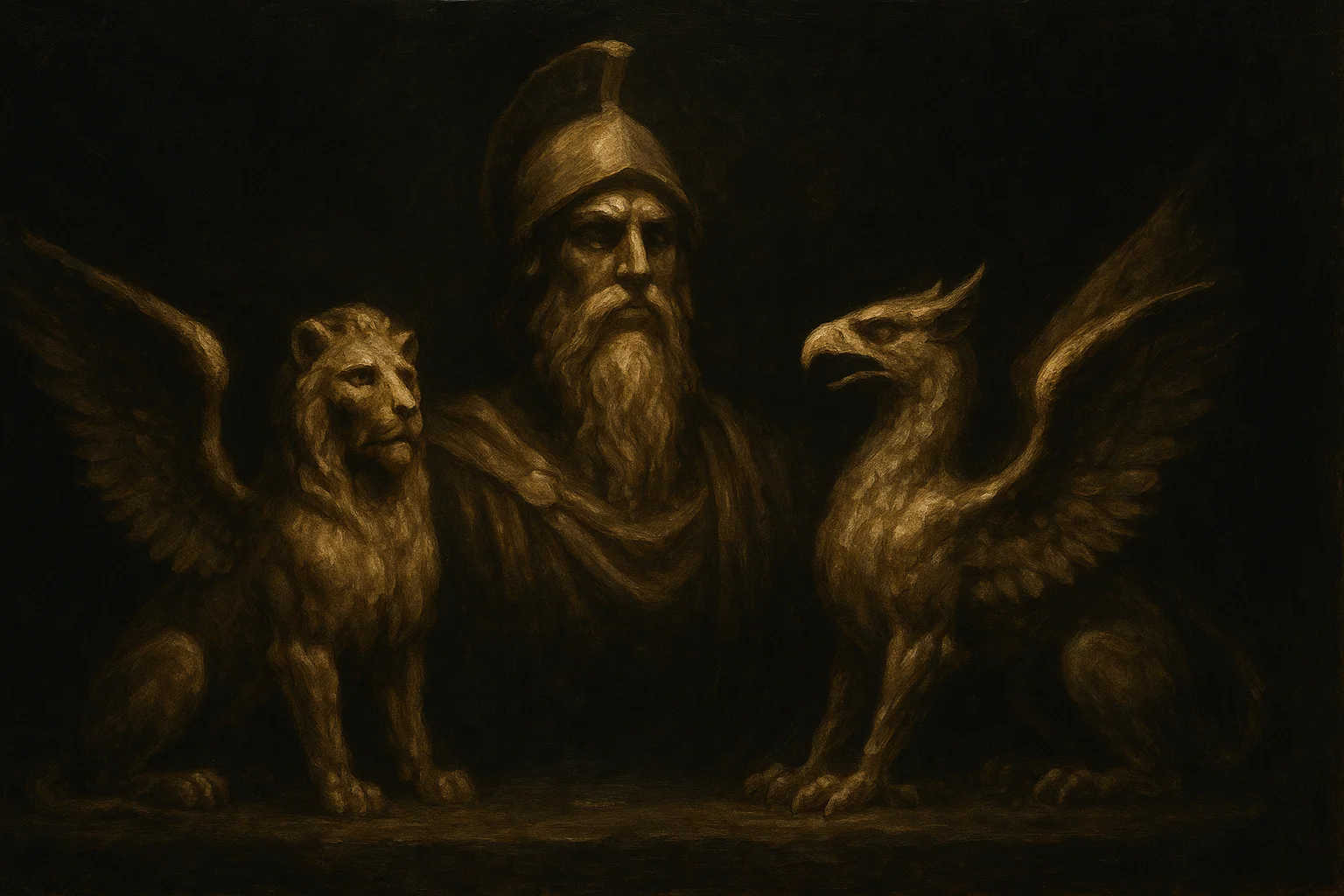
Guardians stand at boundaries. They do not wander. Their presence marks a threshold that matters: the gate to the underworld, the tree of immortality, the hoard that must not be touched. Crossing means confronting them.
Threshold Keepers
Cerberus, the three-headed hound of Hades, appears in Hesiod's Theogony (lines 310-312) as the offspring of Typhon and Echidna. He permits entry to the dead but prevents exit. Heracles' twelfth labor, described in Apollodorus' Library (2.5.12), requires bringing Cerberus to the surface without weapons, a task that tests strength and nerve in equal measure. The Sphinx guards the road to Thebes, killing travelers who fail her riddle. Oedipus' answer opens the city but dooms him. The riddle is not decoration; it is the gate itself.
The Anubis-headed guardians of Egyptian tomb chambers serve a parallel function. They do not ask riddles but weigh the heart against the feather of Ma'at. Failure means consumption by Ammit, a hybrid creature part crocodile, part lion, part hippopotamus. The weighing scene appears in countless copies of the Book of the Dead, each one a manual for navigating the threshold.
Treasure Wardens
Dragons hoard. The pattern appears in Mesopotamia, Scandinavia, China, and Wales. Fafnir, described in the Poetic Edda's Fáfnismál, was a dwarf who murdered his father for gold and transformed into a dragon to guard it. Sigurd kills him and takes the cursed hoard. The Colchian dragon never sleeps, coiled around the Golden Fleece in Apollonius of Rhodes' Argonautica. Medea drugs it so Jason can steal the prize.
Chinese long (dragons) differ. They control water, not gold, and their hoards are rivers and rain. The Shanhaijing (Classic of Mountains and Seas) catalogs dozens of dragon types, each associated with specific waterways. The function shifts from guarding wealth to regulating the element that sustains life.
Boundary Beasts
Garmr, the hound chained at Gnipahellir, guards the entrance to Hel in Norse cosmology. The Prose Edda's Gylfaginning describes him breaking free at Ragnarök to fight Tyr. The Simurgh of Persian tradition nests in the world tree Gaokerena, which grows in the middle of the cosmic sea. It scatters the seeds of all plants when it takes flight, linking the guardian role to regeneration.
The Naga kings of Hindu and Buddhist tradition guard treasures, thresholds, and sacred waters. The Mahabharata's Adi Parva describes the burning of the Khandava Forest, where Nagas perish defending their realm. Vasuki, king of the Nagas, later serves as the rope in the churning of the ocean, a guardian repurposed as tool.
Shapeshifters and Liminal Beings
Shapeshifters trouble the boundary between categories. They are human and animal, divine and mortal, self and other. The transformation is rarely comfortable.
Human to Animal
The werewolf appears in Ovid's Metamorphoses (Book 1, lines 209-239) when Jupiter turns the impious King Lycaon into a wolf. The transformation is punishment, but it reveals what was already present: Lycaon's savagery made visible. Pliny the Elder's Natural History (Book 8, Chapter 34) reports the belief that certain families in Arcadia transform into wolves for nine years, a detail he treats with skepticism but records nonetheless.
Norse berserkir and úlfhéðnar (wolf-coats) blur the line between ritual and transformation. The Ynglinga saga describes Odin's warriors fighting in animal frenzy, "strong as bears or bulls." Whether the transformation is literal, spiritual, or pharmaceutical (some scholars suggest psychoactive mushrooms) remains debated. The sources do not clarify.
Hybrid Forms
Centaurs combine human torso and horse body, appearing throughout Greek myth as both savage (the centauromachy at Pirithous' wedding) and wise (Chiron, tutor of heroes). The duality is structural: reason and instinct in one frame. Harpies, described in Hesiod's Theogony (lines 265-269) as the daughters of Thaumas and Electra, snatch and defile. Homer's Odyssey (Book 20) mentions them as storm winds that carry people away.
The Sphinx combines lion, eagle, and human. The Lamassu of Assyrian palace gates merges bull, eagle, and bearded man. The Naga is serpent below, human above. The Kinnara and Kinnari of Hindu and Buddhist tradition have human heads and torsos with bird limbs, serving as celestial musicians. Hybrid forms signal beings that operate between realms.
Greek Centaur
Half-human, half-horse. Divided between civilization (Chiron the healer) and wilderness (the drunken centaurs of Thessaly). Embodies internal conflict.
Hindu Kinnara
Half-human, half-bird. Serves in celestial courts as musician and companion to gods. Embodies harmony between realms, not conflict.
Fluid Identities
Selkies of Scottish and Irish tradition are seals in water, humans on land. The transformation depends on a sealskin, which can be stolen to trap the selkie in human form. The stories are often tragic: a man hides the skin, marries the selkie woman, and she eventually finds it and returns to the sea. The skin is identity made object.
Swan maidens appear across Europe and Asia. The Völundarkviða in the Poetic Edda describes valkyries who shed swan cloaks to bathe. Völund captures one by hiding her cloak. The pattern repeats in Slavic and Chinese tales: the stolen garment, the forced marriage, the eventual escape. The vampire of Eastern European folklore shifts between corpse and predator, often taking animal forms (wolf, bat, mist) to cross thresholds.
Monsters of Chaos and Destruction
Some creatures exist to end things. They are not guardians or guides. They devour, flood, burn, or poison. Their presence signals breakdown.
World-Enders
Jörmungandr, the Midgard Serpent, encircles the world in Norse cosmology. The Prose Edda's Gylfaginning describes Thor's failed attempt to lift it (disguised as a cat) and their final battle at Ragnarök, where they kill each other. The serpent's release poisons the sky. Apophis (Apep) threatens to swallow the sun each night in Egyptian myth. The Book of Overthrowing Apophis provides spells to ensure Ra's solar barque completes its journey. The serpent is chaos that must be defeated daily.
The Fenris Wolf grows too large to bind. The Gylfaginning recounts how the gods trick Fenrir into wearing the magical fetter Gleipnir, but at Ragnarök he breaks free and swallows Odin. Typhon, described in Hesiod's Theogony (lines 820-868), nearly defeats Zeus before being buried under Mount Etna. His hundred dragon heads and storm-voice embody elemental fury. These are not creatures to negotiate with. They are forces to contain or die trying.
Devourers
Charybdis, described in Homer's Odyssey (Book 12), swallows the sea three times daily, creating a whirlpool that destroys ships. Odysseus loses six men to Scylla, the six-headed monster on the opposite cliff. The strait offers no safe passage, only choice of loss. The Leviathan of the Hebrew Bible (Job 41) is uncatchable, impervious to weapons, breathing fire. God describes it to Job as proof of divine power beyond human comprehension.
The Ammit of Egyptian tradition devours hearts that fail the weighing. She is not evil but necessary: the consequence of imbalance. The Wendigo of Algonquian oral tradition is a human transformed by cannibalism into an insatiable hunger. The more it eats, the larger it grows, and the hungrier it becomes. The creature is a warning and a diagnosis.
Storm Bringers
The Thunderbird of many North American Indigenous traditions creates thunder with its wings and lightning with its eyes. Specific details vary by nation: Lakota, Kwakwaka'wakw, and Ojibwe traditions each describe the being differently, but the association with storm power remains consistent. The Zu bird (Anzu) of Mesopotamian myth steals the Tablet of Destinies in the Anzû Epic, threatening cosmic order. Ninurta defeats it and restores the tablet.
The Fenghuang, often mistranslated as "Chinese phoenix," governs wind and harmony rather than destruction, but its appearance signals dynastic change. The Roc, described by Ibn Battuta and featured in the Thousand and One Nights, is large enough to carry elephants. Sinbad escapes by tying himself to its leg. The bird's size makes it a natural disaster with wings.
Messengers, Guides, and Psychopomps
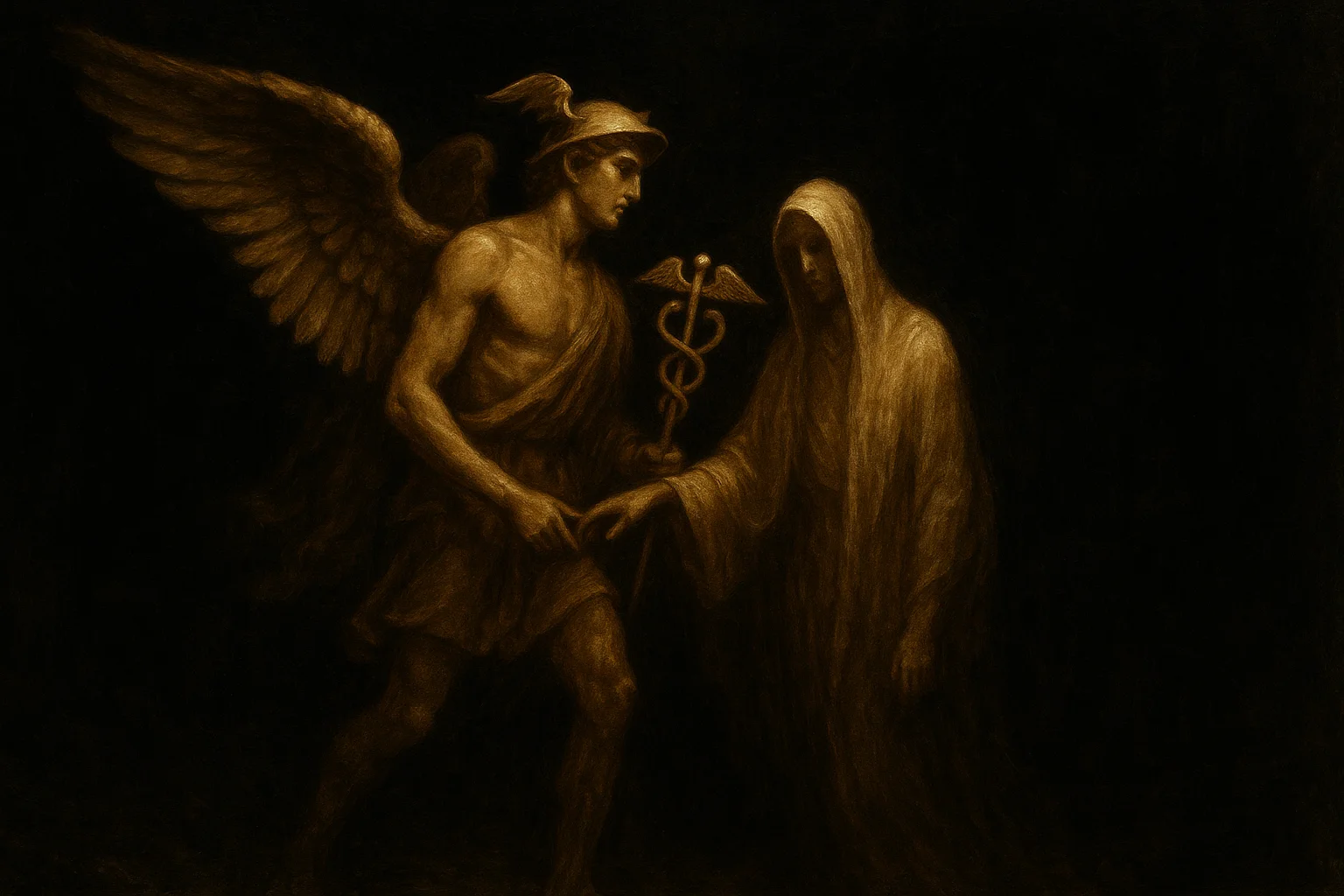
Hermes guides souls to the underworld in his role as psychopomp, but he is a god, not a creature. The Valkyries of Norse tradition select the slain and escort them to Valhalla, as described throughout the Poetic Edda. They are divine agents, not monsters. The Banshee of Irish tradition wails to announce death but does not cause it. Her cry is message, not weapon.
Sleipnir, Odin's eight-legged horse born to Loki, carries the Allfather between worlds. The Prose Edda recounts his strange birth: Loki transforms into a mare to distract the giant's stallion Svaðilfari, and later gives birth to Sleipnir. The horse is a guide capable of crossing boundaries that stop others. The Simurgh guides the hero Zal in the Shahnameh, offering wisdom and feathers that summon aid. The Garuda, vehicle of Vishnu, carries the god and battles Nagas. The Ramayana's Yuddha Kanda describes Garuda freeing Rama and Lakshmana from serpent bonds.
The Caladrius, a white bird described in medieval bestiaries (drawing on Pliny and earlier sources), diagnoses illness by looking at the patient. If it turns away, death is certain. If it gazes steadily, it absorbs the illness and flies toward the sun, burning it away. The creature is both messenger and healer, reading fate and sometimes altering it.
Tricksters and Deceivers
Trickster creatures differ from trickster gods in that they are not worshiped. They disrupt, deceive, and occasionally teach, but they do not receive cult. The Kitsune (fox spirit) of Japanese tradition gains tails as it ages, up to nine, and can shapeshift into human form. Stories range from malicious deception to loyal service. The Tanuki (raccoon dog) shares shapeshifting ability but leans toward mischief rather than malice.
The Anansi spider of Akan tradition (West Africa and Caribbean diaspora) tricks gods and animals alike, often to obtain stories or knowledge for humanity. The tales, preserved orally and later written, position Anansi as culture hero and troublemaker in one. The Coyote of many Indigenous North American traditions serves a similar role: creator and fool, necessary and dangerous. Details vary widely by nation, and no single version is authoritative.
The Puck or Robin Goodfellow of English folklore misleads travelers, curdles milk, and occasionally helps with chores if properly appeased. Shakespeare's version in A Midsummer Night's Dream is literary adaptation, not primary source, but it draws on older oral tradition. The Leshy of Slavic forests leads travelers astray unless they wear their clothes backward or turn their pockets inside out. The trick is spatial: the creature controls direction.
Creatures of Water and Sky
Water and sky produce creatures that humans cannot easily follow. These beings inhabit spaces where human control falters.
Aquatic Beings
Mermaids and mermen appear in traditions worldwide, often with conflicting natures. Greek Sirens, described in Homer's Odyssey (Book 12), lure sailors with song. Early sources depict them as bird-women; later tradition makes them fish-tailed. The shift reflects changing associations between danger and beauty. The Ningyo of Japanese tradition grants long life if eaten but brings storms and misfortune if captured. The Rusalka of Slavic tradition is a drowned woman, dangerous to men who encounter her near water.
The Kraken, described in Scandinavian sources and popularized by Erik Pontoppidan's eighteenth-century Natural History of Norway, is large enough to be mistaken for an island. Sailors who land on it drown when it submerges. The creature may derive from sightings of giant squid, but the mythic version exceeds any biological specimen. The Leviathan functions similarly in biblical tradition: a sea creature beyond human scale or mastery.
The Bunyip of Australian Aboriginal tradition inhabits waterholes and billabongs. Descriptions vary by region and language group, but the creature is consistently dangerous and associated with deep water. European settlers recorded the term in the nineteenth century, but the traditions are far older, preserved orally.
Winged Entities
The Griffin combines eagle and lion, appearing in ancient Near Eastern art and later Greek sources. Herodotus (Histories 3.116) places them in the far north, guarding gold from the one-eyed Arimaspians. The creature marks the edge of the known world. The Hippogriff, half-horse and half-griffin, is a literary invention (Ludovico Ariosto's Orlando Furioso, 1516) rather than ancient myth, but it follows the hybrid logic of older creatures.
The Phoenix, described by Herodotus (2.73) and later Pliny (Natural History 10.2), burns and regenerates every five hundred years. Only one exists at a time. The bird's association with resurrection made it a popular Christian symbol, but the creature predates Christianity by centuries. The Fenghuang of Chinese tradition is often compared to the phoenix but does not burn. It appears in times of peace and prosperity, a sign rather than a cycle.
The Stymphalian Birds, driven from their marsh by Heracles in his sixth labor (Apollodorus, Library 2.5.6), have bronze beaks and metallic feathers they launch as weapons. They are pest and plague, not symbol. The Alkonost and Sirin of Slavic tradition are bird-women with beautiful voices, the former bringing joy, the latter sorrow. They are not sirens but echoes of older motifs adapted to Christian cosmology.
Regional Patterns and Shared Motifs
Certain creature types appear in mythologies with no plausible contact. Multi-headed serpents guard or destroy in Mesopotamia, Greece, India, Mesoamerica, and Scandinavia. Shapeshifters trouble boundaries in every tradition that has boundaries to trouble. Hybrid creatures mark thresholds. The specifics differ, but the grammar repeats.
One explanation is convergent imagination: humans facing similar challenges (predators, storms, death) generate similar symbolic responses. Another is deep prehistory: motifs carried by migration and preserved through oral tradition long before writing. A third is structural: certain narrative problems (how to represent chaos, how to mark a boundary) have limited symbolic solutions. All three likely operate at once.
The Nagas of Hindu tradition and the Feathered Serpent (Quetzalcoatl) of Mesoamerica both combine serpent and divine power, but the cultures had no contact. The Thunderbird and the Zu bird both create storms with their wings, separated by an ocean and millennia. The Cerberus of Greece and the Garmr of Scandinavia both guard the entrance to the land of the dead. The details are distinct, but the function matches.
Guardians recur because thresholds recur. Shapeshifters recur because identity is never stable. Monsters recur because order is always threatened. The creatures are not arbitrary. They are solutions to problems that every culture faces.
"From Typhoeus come boisterous winds, except Notus and Boreas and clearing Zephyr; these are of the race of gods, a great boon to mortals. But the others blow fitfully upon the seas, and some fall upon the misty deep and work great havoc among men with their evil, raging blasts." Hesiod, Theogony, lines 869-874 (trans. Evelyn-White)
The passage links Typhon, the chaos monster, to destructive winds. The creature's defeat does not eliminate chaos but contains it. The storms that remain are Typhon's children, manageable but never fully tamed. The pattern holds across traditions: monsters are defeated, not erased. Their presence explains why the world is dangerous.
Comparative mythology risks flattening difference. The Sphinx is not the same as the Lamassu, even though both are hybrid guardians. The Wendigo is not the same as the Ghoul, even though both are associated with consuming the dead. Context matters. The Popol Vuh describes the Camazotz (death bat) decapitating a hero in the underworld trial, a detail specific to K'iche' Maya cosmology and the role of the ballgame in underworld journeys. Comparison illuminates; it does not erase.
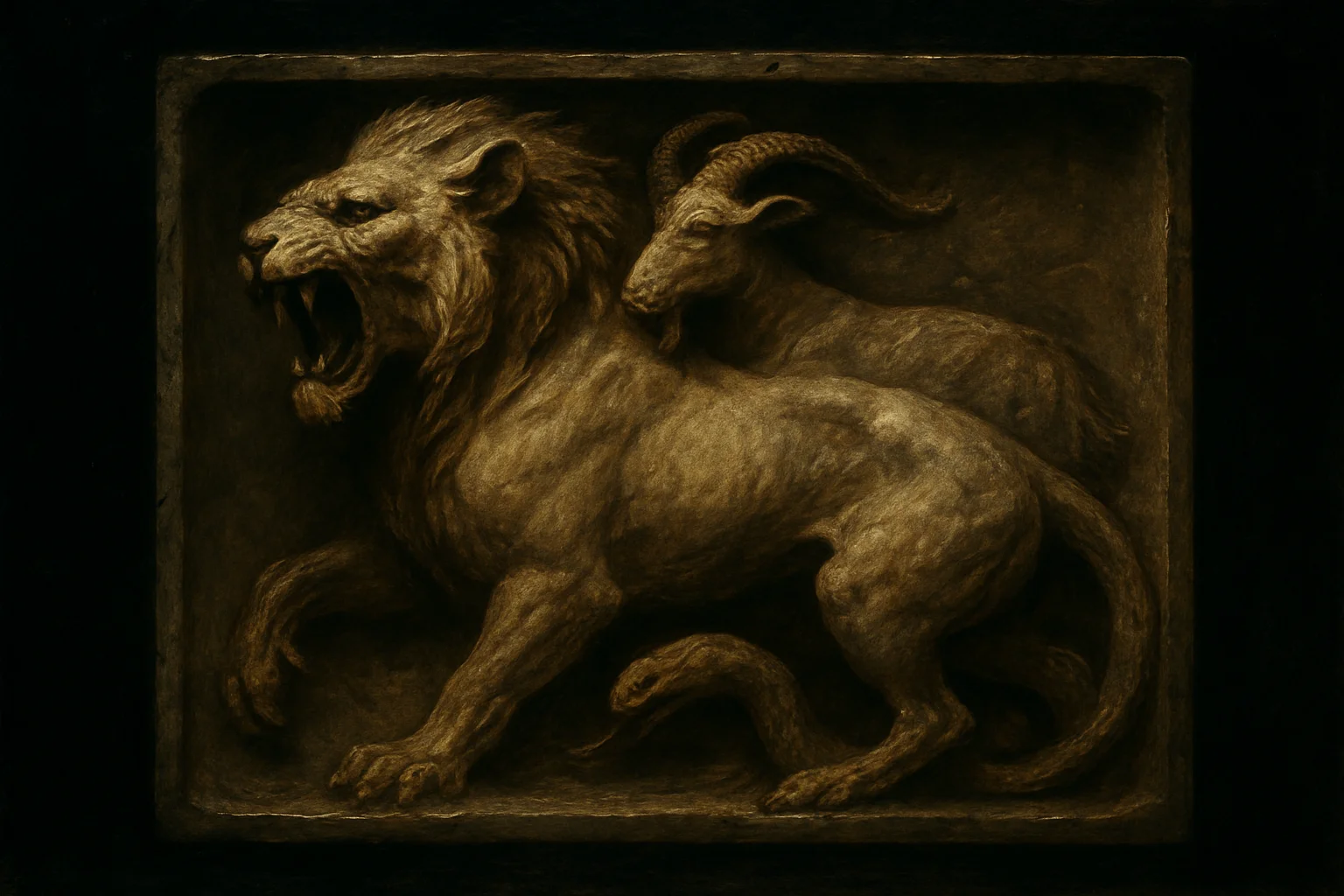
The seventy creatures listed here are entry points, not conclusions. Each one connects to a wider web of stories, symbols, and functions. The Minotaur is not just a bull-headed man in a labyrinth; he is the product of divine punishment, architectural ingenuity, and human sacrifice, tied to Cretan politics and Greek anxieties about the sea. The Chimera, described by Hesiod (Theogony 319-325) as lion-headed, goat-bodied, and serpent-tailed, breathing fire, is killed by Bellerophon riding Pegasus. The creature is composite chaos; the hero's victory is temporary order.
Some creatures resist easy categorization. Bigfoot, reported across North America, occupies a space between cryptozoology and folklore. Indigenous traditions describe various forest beings (Sasquatch among the Salish, for example), but the modern "Bigfoot" phenomenon blends oral tradition, misidentification, hoax, and genuine mystery. The creature belongs to contemporary mythology, still forming.
The Chupacabra, first reported in Puerto Rico in the 1990s, spread rapidly through Latin America and the southern United States. Descriptions vary: reptilian, canine, or something between. The creature is too recent for primary texts, but it follows old patterns: livestock predator, nocturnal, elusive. New creatures still emerge when cultural anxieties need shape.
Frequently asked questions
What are the most famous mythological creatures across cultures?
The most famous mythological creatures include dragons (appearing in Chinese, European, and Mesopotamian traditions), the Greek Sphinx, Cerberus the three-headed hound of Hades, the Norse Fenris Wolf and Jörmungandr, the Hindu Garuda and Nagas, the Thunderbird of North American Indigenous traditions, and the Phoenix described by Herodotus and Pliny. Fame often correlates with literary preservation: creatures described in widely translated texts like Homer's Odyssey, Hesiod's Theogony, or the Ramayana circulate more broadly than those preserved only in oral tradition or regional sources.
How do different traditions categorize fantastic beings?
Different mythological traditions categorize creatures by function, origin, and relationship to humans and gods. Greek sources distinguish between children of gods (like the Sphinx, offspring of Echidna and Typhon in Hesiod's Theogony) and transformed humans (like Lycaon the werewolf in Ovid's Metamorphoses). Hindu and Buddhist cosmologies organize beings into hierarchical realms: devas, asuras, nagas, yakshas, and others, each with specific duties and domains. Norse tradition divides creatures by their association with different worlds in the cosmological tree Yggdrasil. Many oral traditions categorize by habitat (water, forest, sky) or by danger level to humans.
Which creatures appear in multiple mythologies with similar roles?
Multi-headed serpents guarding thresholds or embodying chaos appear in Greek (Hydra), Norse (Jörmungandr), Hindu (Shesha, Vasuki), and Mesopotamian (Tiamat) traditions. Psychopomp birds or creatures that guide souls appear as the Egyptian Bennu, the Greek Charon (ferryman, not bird, but functionally similar), and various birds in Siberian shamanic traditions. Hybrid guardian creatures combining human, lion, and bird elements appear as the Greek Sphinx, Assyrian Lamassu, and Egyptian Sphinx. Shapeshifting predators that blur human and animal boundaries appear as werewolves in Europe, werejaguars in Mesoamerica, and various were-creatures in African and Asian traditions. The roles converge despite geographic separation.
What primary sources describe these mythological creatures?
Primary sources for mythological creatures include Hesiod's Theogony (Greek monsters and their genealogies), Homer's Odyssey (Scylla, Charybdis, Sirens, Cyclops), Apollodorus' Library (comprehensive Greek creature catalog), Ovid's Metamorphoses (transformation stories), the Poetic Edda and Prose Edda (Norse creatures), the Ramayana and Mahabharata (Hindu beings), the Epic of Gilgamesh (Humbaba, the Bull of Heaven), the Popol Vuh (Maya underworld creatures), and Pliny the Elder's Natural History (ancient reports of distant creatures). Many creatures are preserved only through oral tradition documented by later ethnographers.
Why do certain creature types recur across unrelated cultures?
Certain creature types recur across unrelated cultures because humans face similar existential challenges and use similar symbolic tools to address them. Guardians recur because every culture has thresholds that matter (death, sacred spaces, treasure). Shapeshifters recur because identity and transformation are universal human concerns. Multi-headed serpents and world-ending monsters recur because chaos and destruction require representation. Some scholars argue for deep prehistoric migration of motifs, others for psychological archetypes, and still others for convergent symbolic evolution. The most likely explanation combines all three: shared human cognition, ancient cultural contact, and parallel responses to similar environmental and social pressures.
How do guardians differ from monsters in mythological function?
Guardians in mythology protect specific thresholds, treasures, or boundaries and can often be bypassed through knowledge, strength, or divine favor, while monsters embody chaos or destruction and exist to be defeated or contained rather than negotiated with. Cerberus guards the underworld but permits Heracles to pass under specific conditions; Typhon, by contrast, must be defeated and buried by Zeus to preserve cosmic order. Guardians like the Sphinx test worthiness through riddles; monsters like the Hydra simply destroy. The distinction is functional: guardians maintain boundaries, monsters threaten to collapse them. Some creatures, like dragons, occupy both roles depending on the story: Fafnir guards treasure, but Jörmungandr at Ragnarök is pure destruction.
Further reading on Mythologis
Read the full book
Want the whole story?
The complete edition is an instant PDF download here, with a paperback on Amazon for selected titles.
Mythology
The World Mythology Book: The Gods, Heroes and Myths of Every Culture
The Gods, Heroes and Myths of Every Culture, in One Volume
The whole of world mythology in a single volume: Greek, Norse, Egyptian, Japanese, Hindu, Celtic, Slavic, Mesoamerican and African myths gathered side by side, each drawn from the primary sources.