
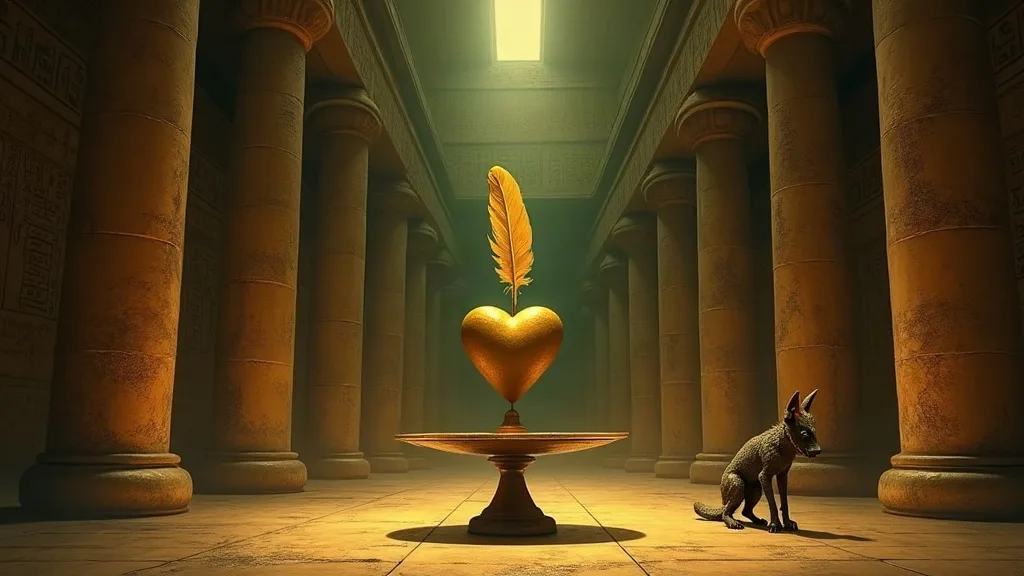
Ammit, Devourer of Souls: The Egyptian Judge of the Dead
Ammit waits in the Egyptian underworld to devour the hearts of those who fail the judgment of Maat. This hybrid creature, part lion, hippopotamus, and crocodile, embodies the ultimate fate of the morally unworthy and shaped how Egyptians imagined death, justice, and eternity.
Contents
The Creature at the Scales
In the deepest chamber of the Duat, the Egyptian underworld, stands a creature that no soul wishes to encounter. Ammit waits beside the scales of justice, part predator and part demon. Her name means "the eater" or "the devourer of the dead," and she is the price of a life lived wrongly.
The ancient Egyptians imagined the moment after death in precise, almost legal terms. When your soul arrived in the Hall of Two Truths, a court convened. Thoth, the ibis-headed god of wisdom, kept the records. Anubis, the jackal god, oversaw the ritual. And Ammit crouched in the shadows, waiting.
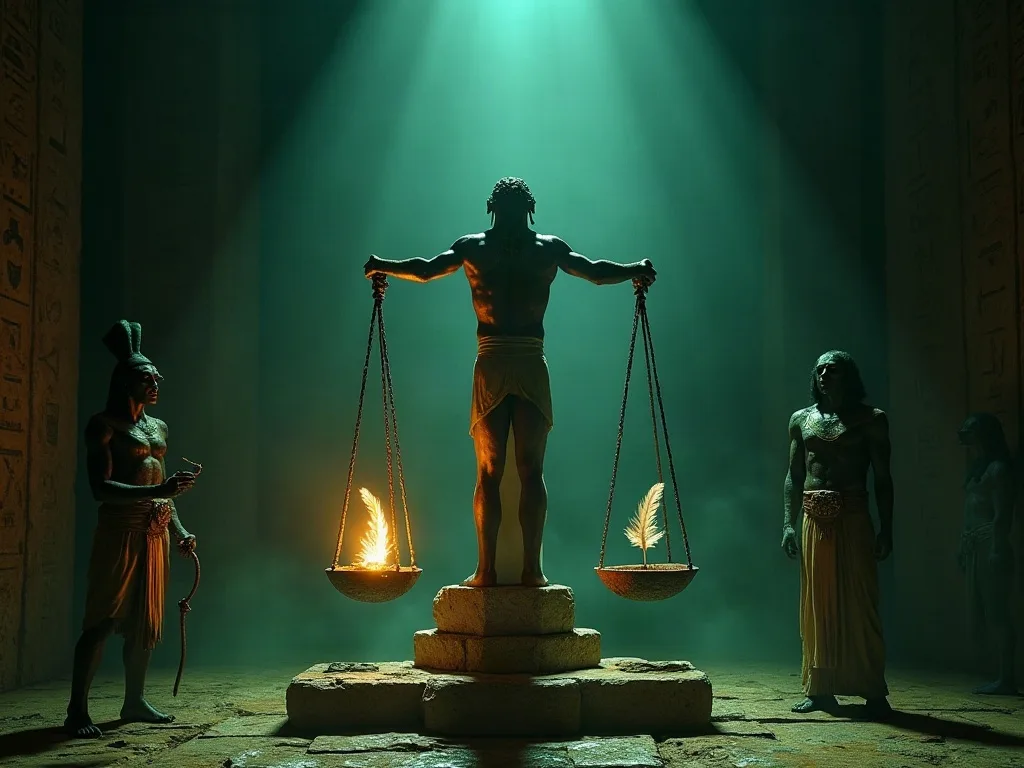
Your heart would be placed on one side of a great balance. On the other sat a single feather, the symbol of Maat, the goddess of truth and cosmic order. If your heart was heavy with sin, if you had lied, murdered, stolen, or betrayed the gods, the scales would dip. And then Ammit would rise. There would be no second chances, no resurrection, no journey to the blessed fields of Aaru. Ammit would consume you entirely, and you would cease to exist.
This was the fear that shaped Egyptian morality for three thousand years.
Origins and Divine Genealogy
Ammit appears in the earliest burial texts and becomes fully documented in the Book of the Dead, a collection of spells and instructions for the afterlife compiled from sources dating back to at least 1500 BCE. The earliest temple references place her in the Ptolemaic period (305-30 BCE), though her role in the judgment scene was already ancient by then.
No god created Ammit in the traditional sense. She simply existed, as a necessary force of cosmic order. Some texts suggest she was born from Sekhmet, the lion-headed goddess of plague and destruction, or that she emerged from the chaos waters of Nun before creation itself took shape. Others describe her as a manifestation of divine judgment itself.
What matters is not her birth, but her function. Ammit was not a deity to be worshipped in temples or offered prayers. There were no priests of Ammit, no festivals in her honor, no statues placed in homes for protection. Instead, she was a deterrent, a living embodiment of consequence. The Egyptians did not love Ammit; they feared her into righteousness.
The Form of Terror
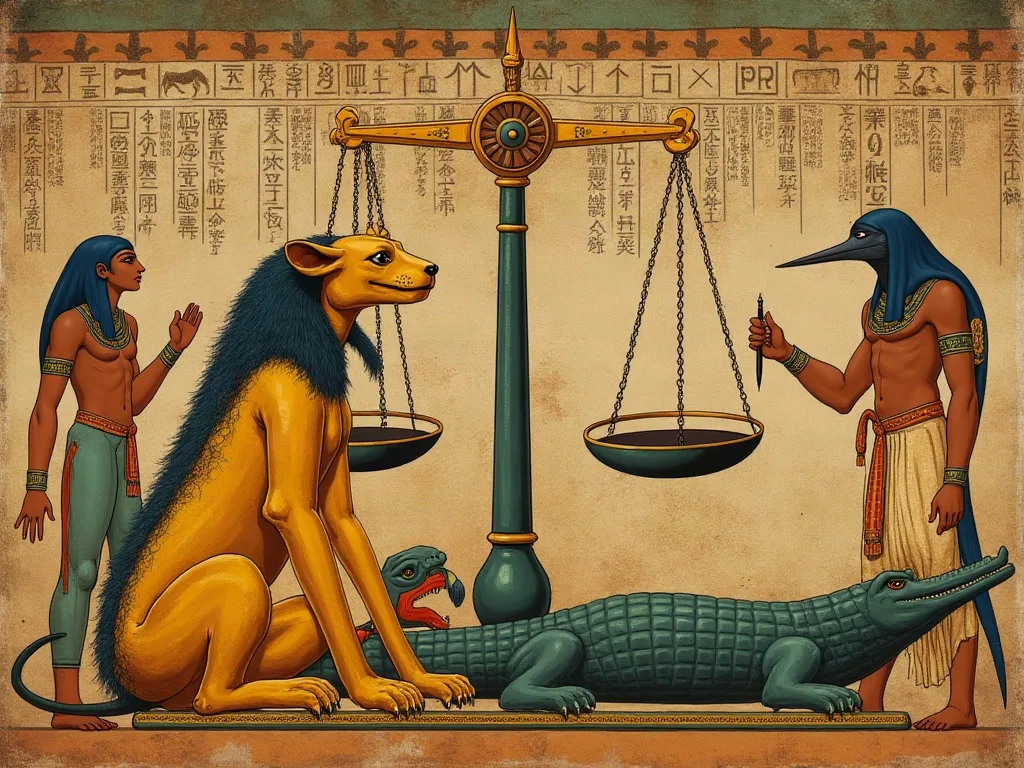
The genius of Ammit's design lies in her composite body. She combines three of Egypt's most dangerous predators: the head and forequarters of a lion, the massive belly and hind legs of a hippopotamus, and the tail and jaws of a crocodile. No creature in nature matches her; she is pure myth, pure threat.
The lion represents hunting prowess and divine wrath. The hippopotamus, surprisingly, symbolized both fertility and chaos in Egyptian thought. A hippo could crush a boat or a human with casual indifference. The crocodile, with its patience and sudden violence, embodied the ancient waters from which danger always emerged. Together, they formed a creature so terrible that merely naming her aloud was considered unwise.
She is sometimes called "Eater of Hearts" rather than by her direct name, a linguistic superstition meant to keep her attention elsewhere. In tomb paintings and papyri, she sits hunched, waiting, her eyes fixed on the scales. Her size is often exaggerated in art, making her larger than a full-grown man, sometimes as tall as the gods themselves.
The Hall of Two Truths: Where Judgment Happens
The process unfolded in the Hall of Two Truths, a realm accessible only to the dead. The recently deceased was led through the Duat by Anubis or guided by spells from the Book of the Dead. Upon arrival, they stood before a tribunal of 42 divine judges, each representing a different region of Egypt and a specific moral law.
The deceased would recite the "Negative Confession," a list of sins they claimed not to have committed. "I have not killed. I have not stolen. I have not borne false witness. I have not been angry without cause." Each statement was an oath to Maat and to the court.
Then came the crucial moment: the weighing of the heart. Anubis would remove the heart from the body (or the spirit of the heart from the dead person's essence) and place it on one pan of the balance. Thoth, holding his pen, waited to record the result. The feather of Maat rested on the other side.
If the heart balanced against the feather, the deceased had lived well. They were welcomed into Aaru, the Field of Reeds, a paradise resembling the fertile Nile Valley, where they could dwell eternally with the gods.
If the heart was heavy, the scales tipped. Ammit stepped forward.
The Devouring: A Second Death
What exactly happened when Ammit devoured a soul was a matter of terrifying speculation. The Egyptians called it the "second death," a concept more final than death itself. The body would be gone, burned or buried. The soul would be consumed. There would be no afterlife, no reunion with loved ones, no existence in any form.
The Book of the Dead never graphically describes Ammit's feeding. The texts simply say the soul is "taken," "consumed," or "destroyed." This vagueness may have been intentional. The Egyptians understood that an image left to the imagination is often more frightening than one spelled out.
Some scholars interpret the devouring as a form of non-existence, a return to the chaos waters from which creation first emerged. Others see it as eternal torment, a state of being devoured repeatedly without the mercy of oblivion. What survives in every interpretation is the certainty of absolute, irrevocable loss.
The threat was so powerful that even stone-hardened pharaohs, even gods themselves in mortal form, could not ignore it. In one famous scene from the Book of the Dead, the pharaoh Thutmose III specifically mentions Ammit by name in a protective spell, seeking assurance that he will not face her in the judgment hall.
Ammit in the Book of the Dead
The most detailed accounts of Ammit come from the Book of the Dead, a collection of spells, passwords, and instructions that the living inscribed on the walls of tombs, coffins, and papyri. Egyptians believed that if a dead person possessed these spells, they could navigate the Duat and protect themselves in the judgment hall.
Chapter 125, titled "The Declaration of Innocence," is the primary guide to facing the tribunal and Ammit. It lists the 42 sins a deceased person must deny having committed, addressing each judge by name and title. The declarations touch on murder, theft, adultery, anger, and more abstract moral failures like "causing pain" or "being noisy."
The spells also contain protective formulas. In Spell 30B, the deceased declares knowledge of the parts of the balance itself, as if merely naming and understanding the mechanism of judgment could somehow shift the outcome. "I know you, I know your name, I know the names of the gods who guard you," the formula reads. Knowing a god's true name was believed to grant power over that god.
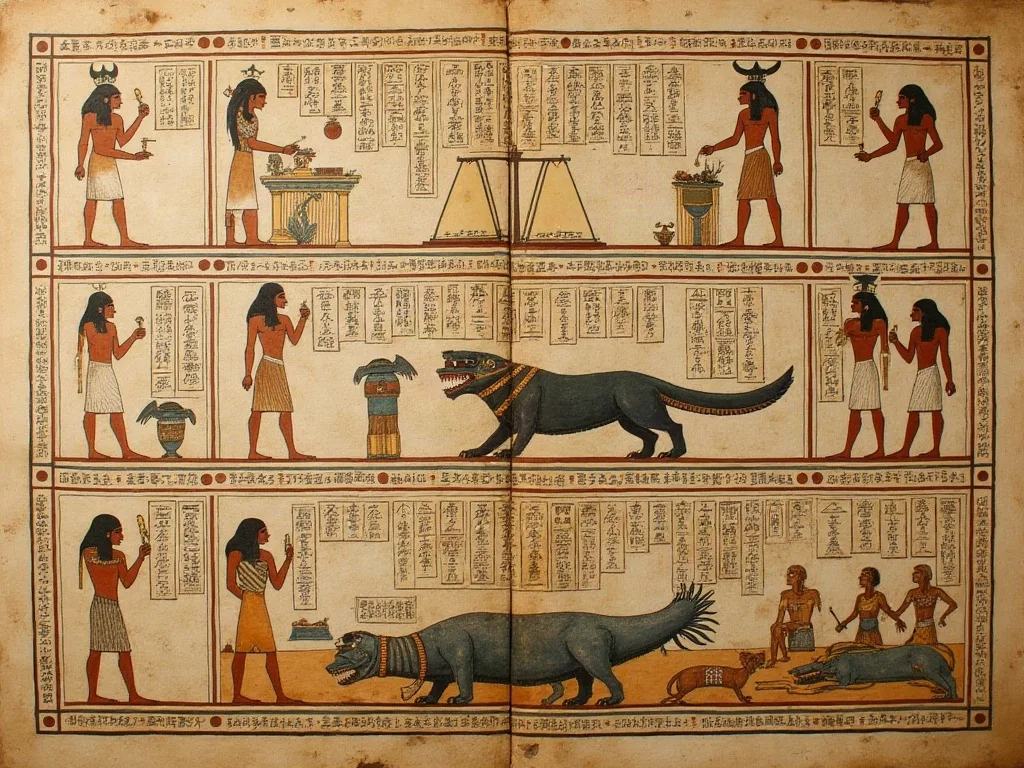
Other texts, like the Papyrus of Ani (dated around 1250 BCE), show Ammit in actual scenes. In the famous Ani papyrus, you can see Ammit crouching beside the scales, her three-part body clearly rendered. Anubis oversees the weighing. Thoth records the result. And in the lower registers, successfully judged souls enjoy their eternal reward, while the others simply vanish.
Maat and Moral Law
To truly understand Ammit, you must understand Maat, the goddess of truth, order, and cosmic balance. Maat was not just a moral principle; she was the foundation of Egyptian civilization itself. The universe operated according to her laws, and chaos (called isfet) lurked always at the edges, waiting for order to falter.
Ammit served Maat as an enforcer. She was not cruel for cruelty's sake; she was the instrument through which Maat's laws were made absolute. In a world where the pharaoh was responsible for maintaining Maat on behalf of the entire kingdom, a world where the balance between human order and cosmic chaos was felt as a genuine, existential threat, Ammit made that balance tangible and personal.
The feather placed on the scales belonged to Maat. Its lightness was meant to symbolize that truth has no weight, that it is simple and clear and uncomplicated. A heart heavy with wrongdoing could not balance it. This metaphor persisted for millennia; it is one of the most enduring images in Egyptian religion.
Worship and Religious Practice
Unlike most Egyptian deities, Ammit had no organized priesthood and no temples dedicated to her worship. No one brought offerings to her shrines, no one prayed to her for protection or abundance. Instead, Egyptians feared her into moral behavior.
Her presence was invoked indirectly. In ethical texts and wisdom literature, scribes referenced the judgment scene and Ammit's role to warn against sin. A famous text called the "Maxims of Ptahhotep," dating to the Old Kingdom (around 2350 BCE), repeatedly emphasizes correct behavior partly as a path to Maat and partly as a way to avoid judgment and Ammit.
Some scholars argue that Ammit served a psychological function similar to conscience. In a society without a concept of personal guilt before a monotheistic god, Ammit externalized moral accountability. The fear of her devouring gaze was internalized as self-regulation. To act wrongly meant you would face her; therefore, you acted rightly.
The only "worship" of Ammit took the form of avoidance. Egyptians took care not to speak her name unnecessarily, not to draw her attention, not to give her power over them. Some amulets and spells were designed specifically to protect the wearer from Ammit in the afterlife, but these were protective charms against her, not devotional objects.
Ammit Across Egyptian Periods
Ammit appears consistently across more than 2000 years of Egyptian history, from the Middle Kingdom (around 2050 BCE) through the Ptolemaic period (305-30 BCE), with particularly vivid references in New Kingdom texts (1550-1070 BCE).
In the Middle Kingdom, she is mentioned in the Coffin Texts, collections of spells painted inside wooden coffins meant to protect the deceased in the afterlife. These texts were more popular among the middle classes than the royal Book of the Dead, suggesting that fear of Ammit transcended social hierarchy. A wealthy official feared her judgment just as much as a laborer did.
By the New Kingdom, the judgment scene had become standardized in Egyptian tomb art. The depictions are remarkably consistent: Anubis with his hand on the balance, Thoth with stylus raised, Ammit crouched and waiting, and the deceased's heart suspended on one side, the feather on the other. This formula appeared in tomb after tomb, temple after temple.
When the Greeks arrived under Alexander the Great and Egypt entered the Ptolemaic period, foreign ideas began to mix with Egyptian traditions. Even so, Ammit remained a fundamental part of Egyptian religion. Greek settlers in Egypt adopted the judgment scene and incorporated Ammit into their own spiritual expectations.
Comparative Echoes: Judgment Across Cultures
The concept of a supernatural judge and a test in the afterlife is not unique to Egypt. Many cultures imagined a moment of reckoning after death, though the details varied wildly.
In Zoroastrianism, the Persian religion that influenced later monotheistic faiths, a dead person's soul faced judgment by divine beings and crossed a bridge that either led to paradise or torment depending on their earthly conduct. The mechanism differs from Egypt, but the principle is identical: morality determined afterlife fate.
In Greek mythology, the underworld was presided over by Hades, who was more custodian than judge. However, the concept of punishment for wrongdoing persisted. Prometheus was eternally tormented, as were others who defied the gods. Greek mythology lacked the systematic judgment moment that Egypt possessed, but the idea that the cosmos enforces moral law was present.
In Hinduism and Buddhism, the concept of karma and rebirth serves a similar function to Ammit's judgment. Actions in this life determine one's form and circumstances in the next life. Though the mechanism is reincarnation rather than devouring, the underlying principle is that the universe keeps moral accounts and settles them.
What distinguishes Egyptian judgment is its finality and its formalization. The scales, the feather, the tribunal of 42 judges, the specific moment of weighing, the absolute consequence: these elements created a coherent, systematic vision of cosmic accountability that persisted for millennia.
The Psychology of Ammit
Modern scholars studying Egyptian religion have noted that Ammit may represent an early form of conscience made external. The ancient Egyptians did not have a concept of guilt before an all-knowing God in the monotheistic sense. Instead, they projected moral accountability outward, into Ammit.
Knowing that a supernatural being would judge you based on your actions created an internalized brake on behavior. You could not lie to Ammit; she would know. You could not hide wrongdoing; it would be weighed in the scales. This created a form of social order that operated partly through law and enforcement, partly through religious fear, and partly through genuine ethical teaching.
The psychologist Otto Rank, studying myth and psychology, noted that fear-based religious systems often reflect genuine psychological needs. The Egyptians needed to believe that morality mattered, that evil could not go unpunished, that the universe was fundamentally ordered by justice. Ammit provided that belief system with a face, a form, a presence.
Whether Egyptians literally believed that a hybrid creature would devour their hearts or whether they understood Ammit more symbolically is a question that cannot be answered with certainty. What is clear is that Ammit's image was powerful enough to influence behavior across a vast empire and a vast span of time.
Ammit and the Pharaoh
The pharaoh's relationship with Ammit was paradoxical. The pharaoh was believed to be a god incarnate, a son of Ra and a living embodiment of Horus. Yet even the pharaoh could not escape the judgment of Maat and the threat of Ammit.
In one famous inscription, the Eighteenth Dynasty pharaoh Thutmose I declares that he acted according to Maat and will therefore be judged favorably. He does not claim exemption from judgment; he claims righteousness. This suggests that even divine pharaohs saw Ammit's judgment as a real and serious prospect.
Some pharaohs added protective spells specifically against Ammit to their tombs and coffins. Thutmose III, one of Egypt's greatest military conquerers, included Spell 30B from the Book of the Dead in his tomb, speaking directly to Ammit: "I know your form, I know your name." The implication is that even a god-king needed protection from being devoured in the afterlife.
This paradox reveals something profound about Egyptian theology. The order of the cosmos was not arbitrary, not subject to divine whim, not negotiable. Even the gods had to follow the laws of Maat. Ammit was there to ensure that they did.
Ammit in Egyptian Art and Iconography
In tomb paintings and papyri, Ammit is rendered with remarkable consistency. She is always shown in her composite form: the head and front legs of a lion, the rotund body and hind legs of a hippopotamus, and a crocodile's tail. Her proportions are often exaggerated, making her appear massive and terrifying.
She is often depicted in a seated or crouching position, placed directly beneath or beside the scales of judgment. Her eyes are typically drawn wide open, watching the scales intently. There is no emotion in her face; she is not angry or cruel, simply present and attentive.
The color of her body varied depending on the artist's choice. Some renderings show her in golden tones, others in dark green or blue, the colors of Nile mud and chaos water. Sometimes her body is striped with the patterns of a leopard skin, a reference to Sekhmet, the fierce lioness goddess.
She is never shown eating or attacking. The depictions are purely anticipatory. She waits. The threat comes from her readiness, not from action. In this way, the art mirrors the theology: Ammit's power lies in her function as a deterrent, not in any active violence.
Ammit (Egyptian)
A composite predator (lion, hippo, crocodile) stationed in the judgment hall. Devours the hearts of those judged morally unworthy. No worship or priesthood. Enforces cosmic order through fear of obliteration. Part of a systematic, judicial underworld process.
Cerberus (Greek)
A three-headed dog guarding the gates of the underworld. Prevents the living from entering and the dead from leaving. Worshipped indirectly through Hades worship. Embodies a barrier rather than a judgment mechanism. Part of a more spatially organized underworld.
The Threat of Non-Existence
What made Ammit uniquely terrifying in the Egyptian imagination was not merely punishment, but obliteration. Most underworld deities from other cultures punish the wicked with torment. Hades sends sinners to Tartarus. Hell in later Abrahamic religions features endless suffering. But Ammit offered something worse: non-existence.
For a culture obsessed with immortality and eternity, the idea of being completely unmade was the ultimate horror. The Egyptians invested enormous resources in mummification, in tomb building, in the preservation of names and images precisely because they believed that being remembered was a form of afterlife survival. Ammit took that away completely. She ate not just the heart, but the very possibility of memory, of continuity, of any kind of eternal existence.
This fear drove behavior across all social classes. Inscriptions from the tombs of wealthy nobles and humble workers alike emphasize their moral conduct. "I have not robbed widows." "I have not caused pain." "I have not been angry without cause." These were not generic moral boasts; they were specific protections against Ammit's judgment.
Ammit's Decline and Legacy
As Egyptian culture gradually transformed under Greek and then Roman rule, as monotheistic religions emerged and spread throughout the Mediterranean and beyond, the cult of Ammit faded. She did not disappear from Egyptian religion suddenly; instead, her importance waned as the broader religious system shifted.
By the end of the Ptolemaic period (30 BCE), when Egypt became a Roman province, traditional Egyptian religion was already fragmenting. The old gods remained in temples and in popular belief, but the unified theological system that had sustained Ammit's role was breaking apart.
Yet even as the fear of Ammit's devouring dissipated, the image endured. The judgment scene became a symbol of Egyptian civilization itself, reproduced endlessly in museums and books. Ammit, once a genuine terror to Egyptian souls, became an exotic relic, a curiosity of ancient belief.
In modern popular culture, Ammit has experienced a minor renaissance. She appears in contemporary fiction, video games, and fantasy art, usually as a monstrous guardian or a symbol of cosmic justice. Most modern portrayals strip away the theological sophistication of the original concept, reducing her to a generic "devourer" or "monster." Nevertheless, her image retains power. Even divorced from the context of Maat and the judgment of the dead, Ammit remains viscerally unsettling, a creature that speaks to some deep human anxiety about being weighed, found wanting, and destroyed.
Frequently asked questions about Ammit, devourer of souls?
Frequently asked questions
Could the pharaoh escape judgment by Ammit?
No. Even the pharaoh, believed to be a living god, could not escape the judgment of Maat and the threat of Ammit. Pharaohs included protective spells in their tombs specifically to protect themselves from being devoured in the afterlife. The most famous example is Thutmose III, who added Spell 30B from the Book of the Dead to his tomb, directly addressing Ammit and declaring knowledge of her name and form. This suggests that even god-kings took the threat seriously and did not believe they were automatically exempt from judgment.
Did the ancient Egyptians have temples or priests dedicated to Ammit?
No. Ammit was unique among Egyptian deities in having no temples, no organized priesthood, and no public worship. Instead of being honored with offerings and prayers, she was feared into moral behavior. Her role was to deter wrongdoing through the threat of absolute destruction. The Egyptians' relationship with her was one of avoidance rather than devotion; many avoided speaking her name directly, referring to her instead as "the Eater" or protecting themselves with spells designed specifically to keep her attention elsewhere.
What happened if Ammit devoured a soul?
The Egyptians called it the "second death," a state of complete obliteration. The body would be gone through mummification or burial, and the soul would be consumed entirely. There would be no afterlife, no reunion with family members in the Field of Reeds, no existence in any form. This non-existence was considered far worse than death itself. For a culture obsessed with immortality and eternal life, being completely unmade was the ultimate terror. Ancient texts never graphically describe Ammit's feeding, leaving the horror to the reader's imagination.
How did Ammit relate to Maat and cosmic order?
Ammit served as the enforcer of Maat's laws. Maat was the goddess of truth, justice, and cosmic order, the fundamental principle that kept the universe balanced and chaos at bay. Ammit was the mechanism through which Maat's judgment became absolute. When the scales tipped, when a heart proved too heavy with sin, Ammit executed the consequence. She was not a cruel deity but an instrument of cosmic law, ensuring that even gods and pharaohs could not escape moral accountability.
Did other ancient cultures have similar creatures or judgment mechanisms?
Many cultures imagined a moment of moral reckoning after death, though the details varied. In Zoroastrianism, souls were judged by divine beings and crossed a bridge that led to paradise or torment. In Greek mythology, sinners faced eternal punishment, though without a formal judgment process. In Hinduism and Buddhism, karma and rebirth serve a similar function, determining one's next existence based on past actions. What makes the Egyptian system unique is its formality, its consistency, and its depiction in detailed, standardized imagery that persisted for over 2000 years.
Why did Ammit have the form of three different animals?
Ammit's composite body combined three of Egypt's most dangerous predators: the lion (hunting prowess and divine wrath), the hippopotamus (fertility and chaos), and the crocodile (patience and sudden violence). No creature in nature matched her; she was pure myth, pure threat. The three-part form made her utterly alien and terrifying, a creature that existed only in the imagination and in religious art. Her size was often exaggerated in tomb paintings and papyri, making her appear massive and inescapable, emphasizing that there was nowhere to hide from her judgment.
The Modern Resurrection of Ammit
In recent decades, Ammit has experienced a surprising cultural resurgence. Contemporary authors, filmmakers, and game designers have adopted her image as a symbol of cosmic justice and ancient mystery. She appears in novels, graphic novels, role-playing games, and fantasy settings, usually as a guardian, a judge, or a monstrous protector of hidden knowledge.
Most modern portrayals lack the theological depth of the original concept. They reduce Ammit to a generic "devourer" or "chaos monster" without exploring her role in Egyptian ethics and morality. Yet even these simplified versions retain the essential power of the original image. Ammit, whatever her context, continues to evoke a sense of inevitable consequence, of a judgment that cannot be escaped or bribed or negotiated.
This modern resurrection reveals something about the enduring appeal of the judgment concept itself. Across the centuries and across cultures, humans remain fascinated by the idea that actions have consequences, that the universe keeps moral accounts, that someone or something watches and weighs our deeds. Ammit, stripped of her ancient theological context, continues to serve that function. She has become a symbol of accountability itself, a creature that embodies the universal human fear of being weighed, found wanting, and unmade.
The journey of Ammit from ancient terror to modern symbol reflects the journey of Egyptology itself. As scholars have recovered and studied Egyptian texts and images, once-forgotten deities have returned to human consciousness. Ammit, who was feared into silence by ancient Egyptians, has become famous in the modern world, known to millions who have never heard of Thoth or studied the Book of the Dead. In a strange reversal, the creature designed to fade from memory has instead become immortal.
Free 25-page sample
Want the whole story?
Take the first 25 pages free. If it pulls you in, the full edition is yours as an instant PDF download, with a paperback on Amazon for selected titles.

Mythology
The World Mythology Book: The Gods, Heroes and Myths of Every Culture
The Gods, Heroes and Myths of Every Culture, in One Volume
The whole of world mythology in a single volume: Greek, Norse, Egyptian, Japanese, Hindu, Celtic, Slavic, Mesoamerican and African myths gathered side by side, each drawn from the primary sources.