
Creation Myths Compared Across 10 Cultures: How the World Was Born
Ten civilizations. Ten answers to the same burning question: where did everything come from? This deep comparison of global creation myths reveals the patterns that unite us and the ideas that set each tradition apart.
Contents
The universe did not explain itself. Every culture that ever left a record wrestled with the same silence before the first word: nothing existed, and then something did. How? The answers they gave are not primitive guesses. They are the most ambitious thinking any community ever produced, pressed into image and story so the mind could hold what reason alone cannot.
Creation myths compared across 10 cultures reveals something remarkable: the same handful of moves appears everywhere. A god speaks light into being. A primordial sea is divided. A giant is sacrificed and dismembered to build the world from its parts. A cosmic egg cracks open. These are not coincidences of borrowing; they are the shapes the human mind reaches for when it stands at the edge of absolute mystery.
What follows is not a ranking or a catalogue. It is a genuine comparison, myth by myth, structure by structure, so you can see the shared grammar beneath ten different languages of origin.
The Void That Speaks: Egyptian Cosmogony from Heliopolis
Before the world, there was Nun, the dark, limitless ocean of chaos. No shore. No sky. No distinction between up and down. Then, from the depths of that water, a mound of earth rose on its own, and standing on it was Atum, the self-created god.
The Heliopolitan creation account, preserved in the Pyramid Texts from around 2400 BC (the oldest religious texts in the world), describes Atum as "the one who came into being by himself." He had no parents. He needed none. He spat or sneezed out the first divine pair: Shu (air) and Tefnut (moisture). Those two produced Geb (earth) and Nut (sky), who were locked in an embrace until Shu physically separated them, lifting Nut above Geb. That separation is, literally, the creation of space. Before it, everything was crushed together into undifferentiated matter.
The Memphite version, recorded on the Shabaka Stone around 710 BC but almost certainly drawn from older sources, credits Ptah instead. Ptah created the world through Hu (authoritative utterance) and Sia (creative thought). He conceived the cosmos in his heart and spoke it into being. This is a profoundly intellectual image: reality as language, existence as the consequence of divine thought made audible.
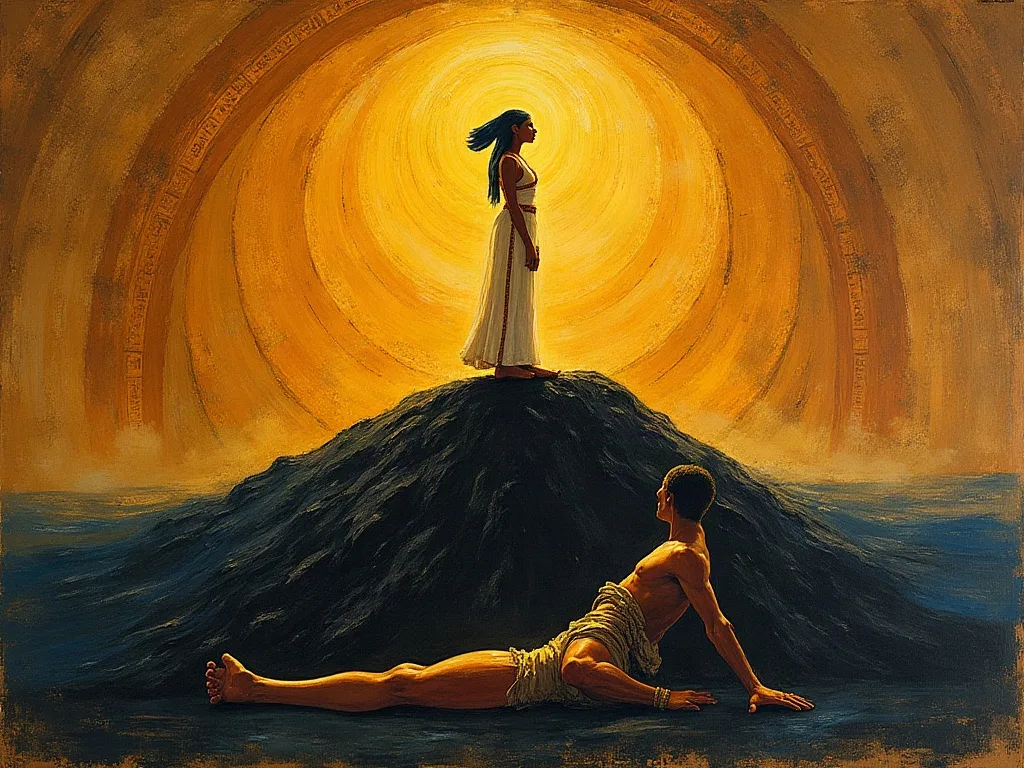
Two cities, two versions, one underlying logic: chaos precedes order, and a singular divine intelligence imposes structure. The watery abyss appears in almost every tradition that follows.
The Norse Void: Ice, Fire, and the Body That Became Everything
The Old Norse Prose Edda, compiled by the Icelandic scholar Snorri Sturluson around 1220 AD from much older oral material, opens with Ginnungagap: a yawning void between two realms, Niflheim (land of ice and mist) and Muspelheim (land of fire). Where streams of ice met sparks of fire, the first being condensed from the mist: Ymir, a frost giant.
Ymir was not created by any god. He self-generated from the collision of elemental opposites. While he slept, a man and a woman grew from his armpit, and one leg fathered a son with the other. From the ice also came a cow, Audhumbla, who fed Ymir with her milk and licked the salty ice-blocks until she revealed another being, Buri, grandfather of the gods.
Buri's grandsons, Odin, Vili, and Ve, killed Ymir. His blood flooded the void and drowned nearly all the other giants. Then the three brothers carried his body to the center of Ginnungagap and built everything from it: his flesh became the earth, his bones the mountains, his teeth the stones, his blood the seas and lakes, his skull the sky (held up by four dwarves at its corners), his brains the clouds, his eyebrows the wall around Midgard (the human world). They fashioned the first humans, Ask and Embla, from two trees they found on the shore, breathing life, wit, and warmth into the wood.
The Norse myth shares a deep structure with the Hindu Purusha hymn (see below): a primordial body dismembered to make the world. Violence is generative. The cosmos is not created from nothing; it is recycled from a prior being.
Yggdrasil, the great ash tree grows from the corpse of that first world, its roots pushing down into the well of primordial memory.
The Spoken Word: Genesis and the Abrahamic Tradition
The first chapter of Genesis, probably shaped into its current form during the Babylonian exile around the 6th century BC, does something almost unique: it establishes a God who exists entirely prior to and outside the material he creates, and who makes through speech alone.
"In the beginning, God created the heavens and the earth. Now the earth was formless and empty, darkness was over the surface of the deep, and the Spirit of God was hovering over the waters." The deep, the water, the void: recognizable shapes, present again. But then: "And God said, 'Let there be light,' and there was light."
No battle. No sacrifice. No prior body to dismantle. The Genesis account broke sharply from the mythologies surrounding ancient Israel, particularly the Babylonian Enuma Elish (see below), which described the world as built from a slain goddess. The biblical writers seem almost to be arguing against that model: the world is not divine matter rearranged; it is a product of will, made good, declared ordered, and then handed to humanity as steward.
The seven-day structure imposes rhythm and hierarchy. Light before stars. Plants before animals. Humanity last, placed not at the bottom but at the apex of a deliberate sequence. That sequence becomes a template: cosmos as crafted object, its maker remaining separate from it.
Tiamat Divided: The Babylonian Enuma Elish
The Enuma Elish, whose title simply means "When on high" (the first words of the text), was recited in Babylon during the New Year festival each year. It dates in written form to around 1100 BC, but the story is older. It begins with primordial waters: Apsu (fresh water) and Tiamat (salt water) mingling together before separation.
From their mingling, the younger gods were born, noisy and disruptive. Apsu, unable to sleep, plotted to destroy them. The god Ea learned of the plan, killed Apsu first, and built his temple over Apsu's body. From Ea came Marduk, born magnificent, four-eyed, four-eared, the most powerful being yet.
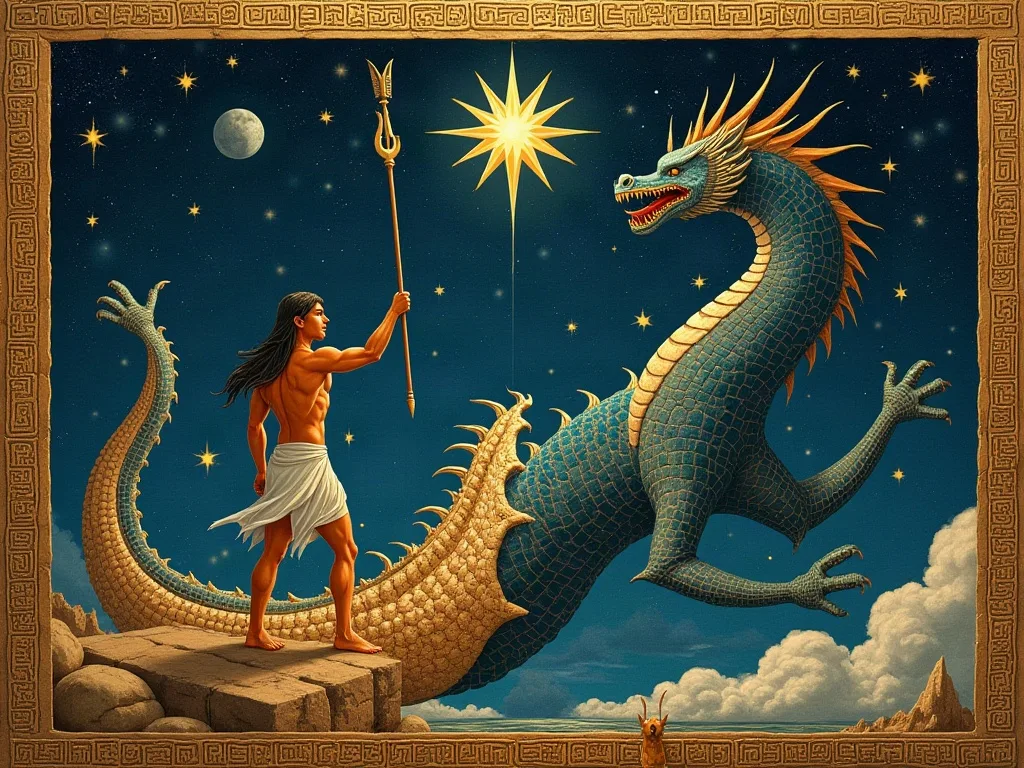
Tiamat, now furious and joined by an army of monsters, advanced. The other gods were terrified. Marduk alone agreed to fight her, but only if granted supremacy over all the gods in return. He encircled Tiamat with his net, blew wind into her open mouth so she could not close it, and drove a spear through her belly. Then he split her body in two: one half became the sky, the other the earth. He set the stars in their courses, established the calendar, created rivers from her eyes.
Humanity was fashioned last, from the blood of Kingu, Tiamat's defeated general, mixed with clay, so humans could do the labor the gods no longer wished to perform.
The Enuma Elish is a creation myth wrapped around a political argument: Marduk, city-god of Babylon, stands at the center of the cosmos because he alone had the courage and power to make the cosmos. Order comes from violence, from the conquest of chaos embodied as a female serpent-dragon.
The Cosmic Egg: Hindu Vedic and Puranic Origins
The Hindu tradition holds not one creation account but dozens, reflecting a tradition that actively embraced multiple, sometimes contradictory answers to the same question.
The oldest is the Nasadiya Sukta, Hymn 10.129 of the Rigveda, composed probably between 1500 and 1200 BC. It opens with perhaps the most intellectually humble creation text in history: "There was neither non-existence nor existence then. There was neither the realm of space nor the sky which is beyond. What stirred? Where? In whose protection?" It ends with genuine uncertainty: "He who surveys it in the highest heaven, perhaps he knows, perhaps he does not."
The later Puranic tradition, developed between roughly 300 and 900 AD, offered more concrete imagery. From the primordial waters, a golden egg, the Hiranyagarbha ("golden womb"), formed and floated for a year. When it split, the upper half became the sky, the lower half the earth, and from inside emerged Brahma, the creator. In the Purusha Sukta (Rigveda 10.90), the cosmos was built from the sacrifice of the cosmic man, Purusha: his mind became the moon, his eye the sun, his mouth the brahmin caste, his arms the warrior caste, his thighs the merchant caste, his feet the servant caste. This is the myth that embedded the social order into the fabric of creation itself.
Vishnu, in the tradition of the Bhagavata Purana, floats on the cosmic serpent Ananta Shesha atop the primordial ocean, and from his navel grows a lotus on which Brahma sits, ready to begin his work. These images are not competing but layered: the Hindu tradition deliberately holds multiple frames simultaneously.
Shiva enters later traditions as the one whose dance both creates and destroys the universe in an eternal cycle, which is itself a creation myth of a different kind: not a single originary moment but an infinite pulse.
The Popol Vuh: A Quiche Maya Genesis of Sound and Naming
The Popol Vuh, the sacred book of the K'iche' Maya, was written down in the 16th century but preserves oral traditions stretching back to pre-Columbian Mesoamerica. Its opening is one of the most beautiful creation passages in any mythology.
"This is the account, here it is: Now it still ripples, now it still murmurs, ripples, it still sighs, still hums, and it is empty under the sky. This is the first account, the first narrative." Before the world: only sky and sea, and the gods Tepeu and Gucumatz (Feathered Serpent, the same figure that appears in Aztec tradition as Quetzalcoatl) thinking in the darkness.
Creation happens through agreement and speech: the gods confer, they agree on what should exist, they speak the word "earth," and the earth rises from the water. Mountains lift. Forests cover them. Then begins the long, unsuccessful series of attempts to make humans: first from mud (they dissolved), then from wood (they lacked memory and soul; most were destroyed, and some survived as monkeys). Only on the fourth attempt, when the gods used white and yellow maize ground by the goddess Ixmucane, did humans emerge with blood, flesh, sight, and speech good enough to praise their creators.
The Maya creation myth is deeply practical: humans are made of corn because corn is what the Maya lived on. The body is made of the staple crop. Eating is, in a literal sense, a participation in the substance of one's own origin.
Quetzalcoatl, the Feathered Serpent, bridges the Maya and Aztec traditions: a deity of wind, knowledge, and creation present in both.
The Five Suns: Aztec Creation and the Debt of Blood
Where the Maya Popol Vuh describes one creation (with failed attempts), the Aztec tradition preserved in the Leyenda de los Soles (Legend of the Suns) describes five successive creations, each called a "Sun," each destroyed.
The First Sun was ruled by Tezcatlipoca (the Smoking Mirror) and populated by giants who ate acorns. It ended when Quetzalcoatl knocked Tezcatlipoca from the sky and jaguars devoured the giants. The Second Sun, ruled by Quetzalcoatl, ended in a hurricane that turned humans into monkeys. The Third Sun ended in a rain of fire. The Fourth in a great flood. Each Sun was a world, complete and destroyed.
The Fifth Sun, our current world, was created at Teotihuacan, the "place where the gods go to become gods." The gods gathered in darkness and one god, the scabrous and lowly Nanahuatzin, threw himself into the fire and became the sun. But the sun would not move. The gods asked why. The sun demanded blood. So all the gods offered their own lives, sacrificed by Quetzalcoatl, and their blood set the sun in motion.
Humanity was created from bones retrieved from the underworld Mictlan by Quetzalcoatl himself, who ground the bones and mixed them with his own blood drawn by piercing himself. Humans are literally divine blood poured over ancestral bone. The ritual of bloodletting and human sacrifice in Aztec religion was not gratuitous cruelty; it was, from inside the myth, the repayment of a cosmic debt. The gods died to move the sun. Humans return the gesture.
The Shinto Void: Japan's Churning of the Primordial Sea
The Kojiki (Record of Ancient Matters), compiled in 712 AD and the oldest Japanese chronicle, opens in a state of chaos described as an unformed, drifting mass, like oil floating on water. Heaven and earth were not yet separated. The text calls this early state konton (chaos), and the first stirring within it produced the three "hidden gods," who formed spontaneously and then hid themselves.
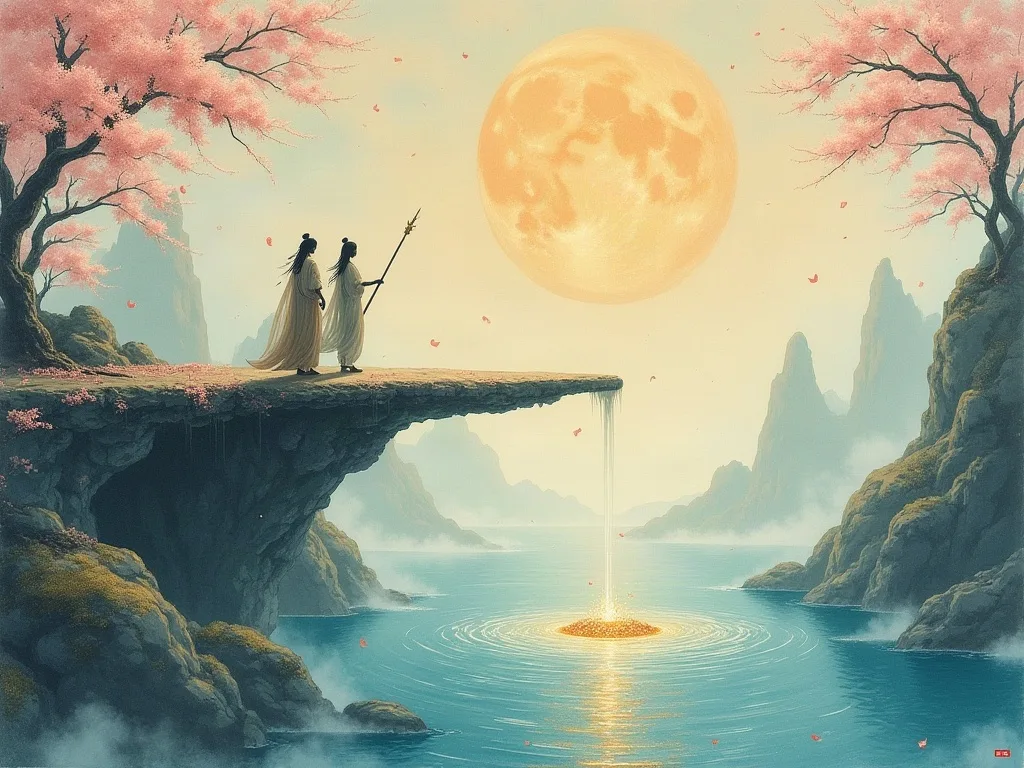
When heaven and earth finally divided, a succession of divine generations emerged. The seventh generation produced the pair that matters most: Izanagi (the Male Who Invites) and Izanami (the Female Who Invites). Standing on the Floating Bridge of Heaven, they lowered a jeweled spear into the brine below, stirred it, and when they lifted the spear, the drops that fell formed the island Onogoro, the first land.
They descended, built a pillar around which they circled in opposite directions, met, and from their union came the Japanese islands and the gods of wind, sea, mountains, fire, and food. The fire god Kagutsuchi burned Izanami fatally as he was born. Izanagi, grief-stricken, cut the fire god into eight pieces, which became eight new volcanic mountains. He then descended to the underworld, Yomi, to retrieve Izanami, but she had already eaten the food of the dead. He fled, she pursued, and the world of the living was permanently sealed from the dead by a great boulder placed at the passage between worlds.
The Shinto creation myth is extraordinarily physical: geography is genealogy. Each island, mountain, and river is a divine child or a consequence of divine action. The land of Japan is not a setting for the story; it is a character within it.
The Dreamtime: Aboriginal Australian Origins Outside Linear Time
The Aboriginal Australian concept of creation sits outside almost every category used above. The Dreaming (or Dreamtime) is not a time "before" the present in any linear sense. It is a dimension that exists simultaneously with the present, accessible through sacred sites, songs, ceremonies, and art.
In Dreaming narratives, the landscape itself was sung into existence by Ancestor beings who traveled across a featureless earth. As they walked and sang, they named what they encountered, and the naming made it real: a waterhole, a hill, a species of bird. The paths they traveled became Songlines, invisible tracks across the continent still followed in ceremony today. To sing a Songline correctly is to participate in ongoing creation.
The Ancestor beings eventually transformed into features of the land: a rock formation, a river bend, a constellation. They did not die; they sedimented into the physical world, which is why that land is sacred. To damage a sacred site is not vandalism; it is violence against the ancestor whose body became that place.
This model of creation has no equivalent in any Eurasian tradition. It is not creation ex nihilo (from nothing). It is not creation from a body. It is creation as performance: existence is sustained by the continuous act of naming and remembering. If the songs are forgotten, the world they describe would cease, in a real sense, to exist.
The Yoruba Orishas: Obatala, Sand, and a Hen with Five Toes
The Yoruba people of what is now Nigeria and Benin preserve one of Africa's richest cosmological traditions. In the beginning, according to accounts recorded by scholars like Bolaji Idowu and reflected across Yoruba oral tradition, there was only the sky above and a watery, marshy expanse below.
Olodumare, the supreme being (unreachable, beyond personification, never depicted in art), commissioned the Orisha (divine intermediaries) to create the earth. Obatala, the deity of white cloth and creative purity, was given a snail shell filled with sand, a five-toed hen, and a palm nut. He descended on a chain of iron from the sky, poured the sand onto the water, and set the hen on it. The hen scratched and scattered the sand, and where the sand spread, land formed. The largest patch became Ile-Ife, the sacred city, the spiritual center of the Yoruba world.
Obatala then planted the palm nut, which grew into a tree whose oil feeds the divination system of Ifa. He shaped human bodies from clay, and Olodumare breathed life into them. In some accounts, Obatala drank palm wine while shaping bodies, becoming drunk, and this explains why some humans are born with physical disabilities: they are sacred to Obatala, marked as his own.
The Yoruba model decouples creation from the supreme being. Olodumare is too fundamental, too absolute, to get his hands in the clay. Creation is delegated downward, through a hierarchy of divine agents whose personalities, conflicts, and errors leave marks on the humans they make.
The Chinese Cosmic Egg: Pangu and the Hammer of Separation
Chinese creation mythology, preserved in texts compiled during the Han dynasty (206 BC to 220 AD) but certainly drawing on older materials, centers on the figure of Pangu (sometimes written Pan Gu), the primordial giant who formed inside the cosmic egg.
The universe began as a vast egg filled with chaos. Pangu grew inside it for eighteen thousand years. When he was large enough, he cracked it open with a great axe. The light, clear elements floated up to become the sky; the dark, heavy elements sank to become the earth. Pangu stood between them, growing taller at the same rate the sky rose and the earth thickened, keeping them apart. He did this for eighteen thousand more years.
When he died, his body became everything: his breath the wind and clouds, his voice the thunder, his left eye the sun, his right eye the moon, his hair the stars, his limbs the four cardinal mountains, his blood the rivers, his flesh the soil, his skin and hair the trees and plants, his teeth the metals and stones, his sweat the rain, and the fleas on his fur became human beings.
The Pangu myth belongs to the same "body as cosmos" family as the Norse Ymir and the Hindu Purusha. The closeness of these parallels across Eurasia has led some scholars, including Calvert Watkins in his comparative work on Indo-European poetry, to speculate about very deep shared heritage, though the Pangu story's Han-dynasty textual date makes direct borrowing difficult to establish.
How the Ten Myths Speak to Each Other
Lay the ten stories side by side and three structural types emerge with striking clarity:
Type 1 - Creation from a Void or Chaos: Egypt (Nun), Genesis, Norse (Ginnungagap), Shinto (formless chaos), Yoruba (watery expanse). The void is almost always watery or dark. Separation of sky from earth, light from dark, is the first creative act.
Type 2 - Creation from a Body: Norse (Ymir), Hindu Purusha, Babylonian (Tiamat), Chinese (Pangu). A prior being, usually killed or sacrificed, provides the raw material. The world is not made from nothing; it is re-formed from something. This type carries an implicit message: existence is not free. It costs a life.
Type 3 - Creation through Speech, Naming, or Thought: Genesis ("God said"), Maya Popol Vuh (gods confer and speak), Memphite theology (Ptah's utterance), Aboriginal Songlines (singing into being). Language and consciousness precede matter. Reality is fundamentally verbal.
The Aztec Five Suns tradition and the Hindu Puranic cycles add a fourth pattern: recursive creation, where the cosmos is made, unmade, and remade in repeating cycles. This challenges the very idea of a single origin point. For these traditions, the question "where did it all begin?" may not have a final answer because there is no final beginning.
Creation from Nothing (Ex Nihilo)
- Genesis: God speaks light into a pre-existing void; matter is called, not recycled.
- Memphite theology: Ptah thinks and speaks; no prior body is required.
- Aboriginal Dreamtime: Ancestor beings sing the world into existence through naming.
- Maya Popol Vuh: Tepeu and Gucumatz agree and speak; earth rises from water.
Creation from a Body
- Norse Eddas: Ymir's flesh, blood, bones, and skull become earth, sea, mountains, sky.
- Hindu Purusha Sukta: the cosmic man's body parts become sky, moon, sun, social castes.
- Enuma Elish: Marduk splits Tiamat; her two halves become sky and earth.
- Chinese Pangu: his eyes become sun and moon, his breath the winds, his sweat the rain.
What Scholars Make of These Patterns
The study of creation myths became a serious academic field in the 20th century, partly through Mircea Eliade's concept of the illud tempus, the "sacred time" in which mythological events occur. Eliade argued, in his 1954 work The Myth of the Eternal Return, that creation myths function as templates: by ritually re-enacting creation, a society renews itself, cancels the decay of linear time, and returns to the primal moment when the world was fresh.
Claude Levi-Strauss, working from a structuralist angle in the 1950s and 1960s, proposed that myths were not primarily about what they appeared to be about. They were thinking machines that resolved contradictions the culture could not resolve in ordinary life: life and death, nature and culture, male and female. Creation myths, on his reading, use the story of cosmic origins to work through the problem of how opposites can coexist.
Bruce Lincoln, in his 1986 study Myth, Cosmos, and Society, documented the body-as-cosmos pattern across Indo-European traditions specifically, arguing that the Vedic Purusha, the Norse Ymir, and the Roman figure of Romulus all belonged to the same deep mythological structure: a body sacrificed and divided to produce the world and the social order simultaneously. This is probably the most cited piece of evidence for genuine cross-cultural inheritance rather than coincidental similarity.
The Aboriginal Dreaming sits outside all these frameworks in productive ways. It challenged Western scholars to recognize that the very category of "creation" (a singular, past event) was a cultural assumption, not a universal. Some traditions describe not a creation but a continuous performance of existence.
Frequently Asked Questions About Creation Myths Compared Across Cultures
Frequently asked questions
Do all creation myths describe the world being made from nothing?
No, and this is one of the most important distinctions. The theological concept of creation ex nihilo (from nothing) is specific largely to Abrahamic monotheism, though it is often read back into other traditions. Most mythologies describe creation as a transformation: chaos becomes order, a body becomes a world, a void is separated into sky and earth. The Egyptian Nun, the Norse Ginnungagap, and the Shinto pre-cosmic mass are all something, even if undefined. The Aboriginal Dreaming goes furthest in subverting the category: for many Aboriginal traditions, creation is not a past event but an ongoing act of maintenance through ceremony.
Why do so many creation myths involve a great flood or a watery chaos before the world appears?
Water appears as the pre-cosmic state in Egyptian, Babylonian, Norse, Shinto, Genesis, Yoruba, and Maya traditions, among others. Scholars offer several explanations. Water is the most obvious image of formlessness: it has no fixed shape, it erases distinctions, it fills every space. Some researchers, including those working on the Black Sea deluge hypothesis, have proposed that folk memory of actual prehistoric flood events contributed to these narratives. Others, following Eliade, argue that water symbolizes the undifferentiated potential from which all form can emerge, a universal psychological archetype. The similarity is real; the cause remains debated.
Is there a creation myth in which humans are the accidental or secondary result of creation rather than the goal?
Several. In the Babylonian Enuma Elish, humans are an afterthought: made from the blood of a defeated general to free the gods from manual labor. In the Aztec tradition, the current human race is one of several attempts, and our existence depends on the ongoing repayment of divine blood debt. The Aboriginal Dreamtime does not foreground humanity at all; Ancestor beings created the landscape and then became it, with humans as participants in an existing song rather than the purpose of creation. These contrast sharply with Genesis, where humanity is the explicit culmination and appointed steward of the entire creative sequence.
What is the oldest written creation myth we have?
The Pyramid Texts of ancient Egypt, dating to approximately 2400 BC, contain the Heliopolitan creation narrative and are the oldest religious texts found so far. The Sumerian creation accounts, which influenced the Babylonian Enuma Elish, are also extremely old, with written versions from the third millennium BC. The Rigvedic Nasadiya Sukta is estimated between 1500 and 1200 BC. It is worth noting that most creation myths were oral long before they were written, so their textual date does not reflect when the story was first told.
Do comparative mythologists believe these similarities prove contact between ancient cultures?
For some clusters, yes; for others, the evidence is much weaker. Bruce Lincoln and other scholars of Indo-European mythology make a strong case that the Norse, Hindu, and Roman body-sacrifice creation patterns share a common ancestor in proto-Indo-European religion, a parent tradition reconstructed from linguistic and mythological comparison. The similarities between the Babylonian Enuma Elish and Genesis are explained by direct cultural contact: Israel spent time in Babylonian exile, and the texts overlap in very specific ways. But the parallels between, say, the Chinese Pangu myth and the Norse Ymir are almost certainly coincidental structural similarities, not evidence of contact between Han China and Viking Scandinavia. Scholars distinguish between diffusion (borrowing through contact) and polygenesis (independent parallel development). Both happen. Both are real.
Are creation myths still believed literally by people today?
Many are, yes, across multiple traditions. For observant Jews, Christians, and Muslims, Genesis describes a real event. For many Hindu practitioners, the Puranic accounts are not allegory but cosmological truth. Aboriginal Australians who practice traditional religion regard the Dreaming not as a story from the past but as an active, present reality. Scholars of religion distinguish between myths believed as literal cosmology and myths functioning as symbolic frameworks, but this distinction is not always useful or respectful when applied from outside a tradition. The operative question for any tradition is how its own practitioners understand and use the story, not how outsiders categorize it.
Creation Myths in Modern Thought: Science, Story, and What Neither Alone Can Carry
The 20th century added a secular creation myth to the list: the Big Bang. An unimaginably hot, dense point. An expansion. Hydrogen coalescing into stars. Stars exploding and seeding heavier elements. Planets forming. Life. The sequence is as remarkable as any told in the texts above, and it shares structural features with the mythological accounts: a formless beginning, a separation (matter from antimatter), a long development culminating in something that can ask how it began.
Scientists are generally careful not to call the Big Bang a "creation" in the theological sense, because it describes the development of the observable universe from a prior state, not the production of existence from nothing. The question of what preceded or caused that initial state remains genuinely open. In that openness, physicists like Lawrence Krauss and cosmologists like Stephen Hawking proposed models (quantum fluctuation, no-boundary condition) that sound, to mythologically trained ears, remarkably like the Vedic Nasadiya Sukta: something from a kind of nothing, a self-originating structure that precedes the question of cause.
This is not to collapse science into myth or vice versa. It is to observe that the questions driving both are identical, and that the answers in every tradition, ancient or modern, reach for images of darkness, water, void, explosion, and separation because these are the images the mind has available when it stands at the limit of what can be known.
The ten traditions covered here are not quaint ancestors of a better answer. They are records of sustained, serious thinking about the hardest question any mind has ever faced. Read together, they show not confusion but creativity: ten different ways to make the unthinkable thinkable, each shaped by the land, the language, and the social world that produced it. The Norse see a cosmos built from a body because they lived in a world where nothing was wasted and survival required using every part of every animal. The Maya see humans made of maize because maize kept every Maya child alive. The Aboriginal Australians see creation as song because their relationship to land was inseparable from memory and performance.
Every creation myth is, at its root, a people explaining why they are here, why the world is the way it is, and why that should matter to the person listening.
Free 25-page sample
Want the whole story?
Take the first 25 pages free. If it pulls you in, the full edition is yours as an instant PDF download, with a paperback on Amazon for selected titles.

Mythology
The World Mythology Book: The Gods, Heroes and Myths of Every Culture
The Gods, Heroes and Myths of Every Culture, in One Volume
The whole of world mythology in a single volume: Greek, Norse, Egyptian, Japanese, Hindu, Celtic, Slavic, Mesoamerican and African myths gathered side by side, each drawn from the primary sources.