
The Creation of the World in Norse Mythology: From Void to Nine Realms
Before time began, there was only void. Norse mythology describes creation as a violent collision of fire and ice that births a giant, a cow, and eventually the nine worlds we know. Discover how the Norse imagined existence emerging from nothingness.
Contents
In the beginning, there was nothing. Not darkness, not silence, not even the concept of emptiness. The Norse called this primordial state Ginnungagap, the "yawning void". Everything that would become the cosmos hung suspended in potential.
Then the void began to work. Fire and ice, the most elemental forces, collided at its edges. Where they met, they did not balance or fade. Instead, they sparked. Creatures appeared. Worlds took shape. The nine realms emerged from this cosmic collision, each one threaded onto a massive ash tree called Yggdrasil.
This is the Norse understanding of how existence began. Not a gentle word spoken by a calm god, but a violent, sensuous act of creation born from the meeting of opposites. The story survives in two main sources: the Poetic Edda, a collection of Old Norse poems written down around 1270 CE (though the poems themselves are much older), and the Prose Edda, a guide to Norse mythology and poetics compiled by Icelandic scholar Snorri Sturluson around 1220 CE.
The Void Before All Things
Ginnungagap was not a place. It was the absence of place. To the Norse mind, it existed in the deepest past, a time so remote and foreign that it had no comparison to anything in the lived world. The name itself carries weight: ginnung means "yawning" or "gaping", and gap is a void or chasm. It was pregnant with possibility but empty of form.
To the north of this void lay Muspelheim, the realm of fire. This was not a gentle warmth but a scorching, primordial inferno, ruled by the giant Surtr (whose name means "the swarthy one"). Flames leapt from Muspelheim in all directions, and they were alive with creative force.
To the south lay Niflheim, the realm of ice. Here, primordial fog rolled across glaciers that had existed since before memory. From Niflheim flowed poisoned rivers called the Élivágar, and they moved toward Ginnungagap, carrying their ancient cold into the void.
When the heat from Muspelheim met the cold and moisture of Niflheim, the ice began to melt. Drops fell into the void. Rime accumulated. A shape emerged from the frost and steam: Ymir, the primordial giant.
The Birth of Ymir and the First Act of Destruction
Ymir was neither good nor evil. He was immense, a being of raw cosmic substance, and he was alone. The Poetic Edda describes how the heat continued to work on the ice of Niflheim, and from this process another creature took form: Auðumbla, a vast cow.
Ymir fed from Auðumbla's udders. Four rivers of milk flowed from her teats. But Auðumbla herself needed to eat. She licked the salt ice of Niflheim, and as she licked, a figure emerged from the ice itself. On the first day, hair appeared. On the second day, a head. On the third day, a complete man stood before her: Búri, grandfather of the gods.
Búri had a son, Borr, who married a giant woman named Bestla. From this union came three sons: Odin, Vili, and Vé. These three brothers would change everything.
As Ymir slept, the brothers looked upon him and saw not a father figure but a problem to be solved. They killed him.
This was not a quick death. The Prose Edda records: "They took Ymir and carried him to the middle of Ginnungagap, and made of his body the earth, of his blood the seas and lakes, of his bones the mountains, of his hair the trees, of his skull the sky, and of his brains the clouds."
Every part of Ymir's corpse was repurposed. Nothing was wasted. The Norse understood creation not as emergence from chaos but as transformation of chaos into structure. This is a fundamentally different vision from creation myths centered on a creator speaking things into being. Here, creation is violence. It is work. It is a reshaping of what already exists.
The blood pooled in vast quantities. Ymir's brothers shaped some of it into an ocean that surrounded the new world. The rest they held in reserve, and these reserves became the rivers and lakes that water the earth. Ymir's bones became the mountains and rocky outcrops. His teeth and fragments of shattered bone became the stones and pebbles.
The Shaping of the Nine Realms and the Construction of Order
From Ymir's skin and flesh, the brothers created Midgard, the realm of humans. Midgard means "the middle enclosure", and it was placed in the center of the cosmos, suspended between other realms on the branches and roots of Yggdrasil.
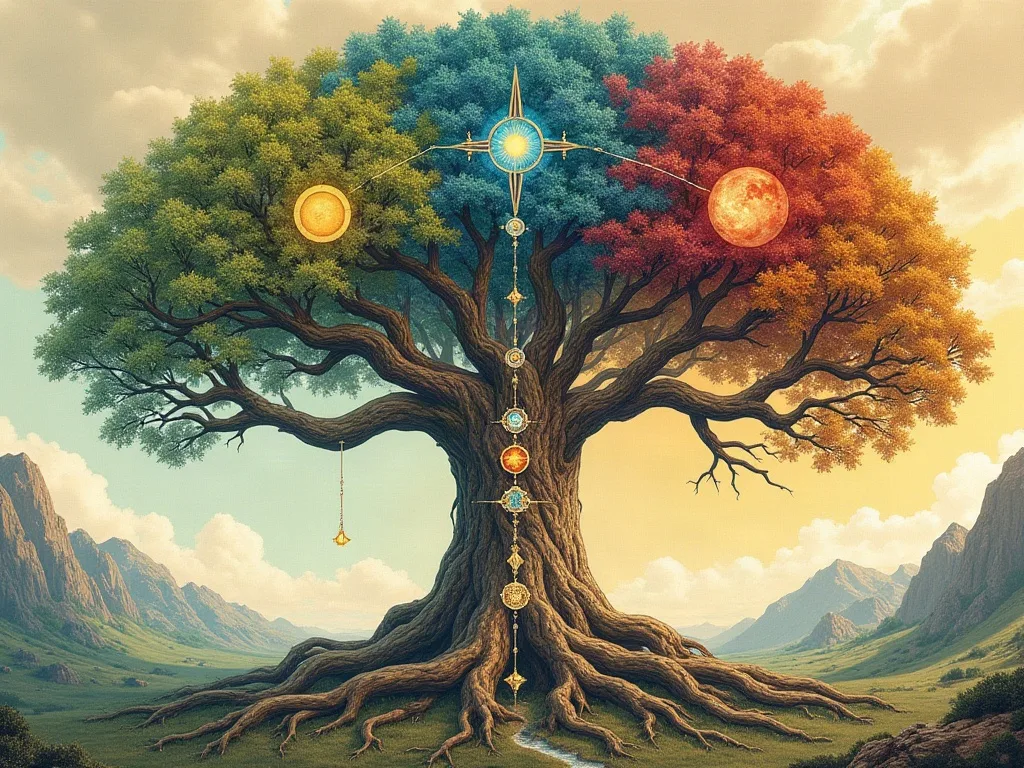
The nine realms were not all created at once. They emerged as the work of shaping the cosmos continued. The structure was this: Yggdrasil, the world ash, is an immense tree with roots reaching into different realms and branches that stretch across the sky. One root reaches into Niflheim, the realm of ice and fog. Another root reaches into Muspelheim, the realm of fire. The third root reaches into Jotunheim, the realm of the giants, where the frost giants dwell.
The Muspelheim that once collided with Niflheim did not disappear. It remained a separate realm, hot and hostile, always threatening to expand. The frost giants of Jotunheim, descendants of Ymir and kin to the elder forces, lived in eternal opposition to the gods. This was not an evil opposition. It was the way the cosmos was structured: it required tension between opposing forces to remain in balance.
The gods built a fortress in the sky called Asgard, the realm of the Aesir (the principal gods). They also created Vanaheim, the realm of the Vanir (another group of divine beings). They made Alfheim, the realm of the light elves; Svartalfheim, the realm of the dark elves; Jotunheim, already inhabited by giants; Muspelheim, already inhabited by fire giants; and Niflheim, already inhabited by primordial cold. Some accounts also include Hel, the underworld where the dead dwell.
Nine realms in total, each distinct, each with its own character and inhabitants. They were held together by the roots and branches of Yggdrasil. A squirrel named Ratatoskr ran up and down the trunk, carrying gossip between the eagle that perched at the top of the tree and the serpent Nidhogg that gnawed at its roots.
The Creation of the First Humans and the Gift of Consciousness
Ymir's body had been used to shape the inanimate world, but the gods desired beings that could speak, think, and feel. Walking along the shore of the new world, the brothers found two pieces of driftwood. Some accounts say they were an ash tree and an elm. Other tellings describe them as unremarkable logs.
Odin gave them breath and life. Vili gave them consciousness and emotion. Vé gave them appearance and the ability to speak. From these two logs came Ask (whose name means "ash") and Embla (whose name possibly means "elm"). They were the first man and woman.
This act of creation through the infusion of consciousness is crucial to understanding Norse philosophy. The Norse did not imagine humans as clay shaped by divine hands. Instead, they imagined life as something that could be given, transferred from one being to another. Odin's breath was not metaphorical. It was a literal force of vitality, the same force that moved through all living things.
The brothers gave Ask and Embla a home in Midgard, protected within the great walls that surrounded their realm. These walls were built from Ymir's eyebrows, raised to shield humanity from the threats that lay beyond: the giants, the chaos at the edges of the cosmos, the cold and fire that still lingered from the primordial age.
The Cosmic Order and Yggdrasil's Role
The act of creation was complete, but the work was not. The Norse cosmos required constant maintenance. The roots of Yggdrasil extended into three wells, each with its own guardian and its own power.
In Muspelheim, beneath the root that fed the realm of fire, lay the well Muspelheim's spring, endlessly warm and dangerous.
In Niflheim, beneath the root that fed the realm of ice, lay the well Hvergelmir, the "boiling kettle". From this well flowed all the cold and poison that kept Niflheim frozen and hostile.
In Jotunheim, beneath the root that fed the realm of the giants, lay the well Mimisbrunnr, the "well of Mir" or "well of memory". The giant Mimir guarded this well, and its waters contained all the wisdom and memory of the cosmos. Odin once came to drink from this well, and the price of wisdom was one of his eyes.
These wells were not separate from creation. They were part of it. They represented the ongoing forces that had shaped the cosmos and that continued to shape it. The cold of Niflheim would always seek to expand. The heat of Muspelheim would always press outward. The balance between them was what allowed Midgard to exist.
The Norse called this balance Orlog, or "primal law". It was not a law imposed by the gods, but something deeper: the fundamental structure of existence itself, the necessity that governed all things. Even the gods could not break Orlog. They could only work within it, shape themselves to it, and try to maintain the delicate equilibrium that allowed life to continue.
The Shaping of Time and the Ordering of Days
Creation in Norse mythology was not only spatial but temporal. The brothers did not merely arrange the world in its place; they arranged time itself.
The Prose Edda describes how Odin set two swift horses to carry the sun and moon across the sky each day. The sun, Sol, rode in a chariot pulled by the horses Arvak (whose name means "early-waker") and Alsvinnr (whose name means "all-swift"). The moon, Mani, rode in a similar chariot.
But the sun and moon were not safe in their courses. Behind Sol's chariot came a great wolf named Skoll, pursuing her endlessly. Behind Mani's chariot came another wolf, Hati, pursuing him. These wolves were children of the giant Fenrir, and they had been born for this task: to chase the lights across the sky, to represent the eternal motion of the cosmos toward its own ending.
This is a crucial detail. Even in the newly created world, even in the ordered cosmos, chaos is not eliminated. It is channeled. The wolves chase the sun and moon, and this chase is part of the rhythm of creation. One day, in the age of Ragnarok, the wolves would catch their prey and devour them. But until that time, the very act of pursuit creates the cycle of day and night that all living things depend upon.
The stars, too, were assigned their places. The Prose Edda describes how the gods took sparks from Muspelheim and hurled them into the sky, arranging them to give light to day and night. These sparks became the stars, scattered and eternal, never moving from their appointed places.
The Divine Assembly and the First Laws
Once the cosmos was shaped and ordered, the gods needed to establish how they would rule it. The Prose Edda describes how all the gods gathered in a great assembly called Idavoll, a plain in the heart of Asgard.
Here they debated and decided: what should be the laws of the cosmos? How should time flow? How should the realms relate to one another? What would be permitted, and what forbidden?
It was in this assembly that Heimdall was appointed as the guardian of Bifrost, the rainbow bridge that connects Asgard to the other realms. It was here that Thor was given his role as the defender of Midgard against the giants and the forces of chaos. Loki, the trickster giant who had been adopted into the divine community, was present at these councils, though his intentions were always ambiguous.
The gods also created treasures of great power in this age. Sif was given hair of pure gold. Gungnir, the spear of Odin, was forged, so perfectly balanced that it never missed its mark. Mjolnir, the hammer of Thor, was created, capable of leveling mountains and always returning to its thrower's hand.
These were not mere weapons or ornaments. They were expressions of cosmic order, tools through which the gods would maintain the balance that creation had established.
Comparative Echoes: Creation Across Cultures
The Norse creation shares patterns with other Indo-European mythologies, yet also stands apart. In Greek mythology, Chaos comes first, then Uranus and Gaia. In Hindu mythology, creation emerges from the cosmic waters through the meditation or dance of a divine being. In Mesopotamian mythology, creation comes through combat, as Marduk slays the chaos serpent Tiamat and reshapes her body into the world.
The Norse version combines elements of these patterns: there is cosmic chaos (Ginnungagap), there is the reshaping of a primordial being's body (Ymir), and there is the establishment of divine order. But the tone is uniquely Norse. Creation is violent, yes, but it is also practical. The gods do not rest in satisfaction. They build, they shape, they defend. The cosmos they create is beautiful but fragile. It will not last forever. Indeed, the Norse knew from the beginning that it would end.
This eschatological awareness, baked into the creation narrative itself, marks Norse mythology as distinct. The gods are not eternal. The cosmos is not permanent. All things, even the gods themselves, move toward their ending. Yet this does not make creation meaningless. If anything, it makes it more precious.
The Ongoing Work of Creation and Maintenance
Creation in Norse mythology did not end with Ymir's death or the placement of Ask and Embla in Midgard. The Norse understood the cosmos as a place that required constant work to maintain.
Every day, the Norns (three divine beings named Urd, Verdandi, and Skuld, representing past, present, and future) tended to Yggdrasil, watering its roots from the well Mimisbrunnr. Without this daily care, the world tree would wither. The roots would rot. The realms would collapse.
The gods themselves engaged in this maintenance. They rode out to Idavoll to hold court, to judge disputes, and to prepare for the inevitable attacks from the giants and the forces of chaos. They were not passive rulers, but active defenders of order against entropy.
Ragnarok, the prophesied end of all things, was not a surprise to the Norse gods. The seer Volva revealed to Odin that one day Yggdrasil would shudder. The bonds holding the giants would break. Fire would consume the sky. The sun would be devoured. The stars would vanish from sight.
But Ragnarok was not the final end. The Voluspa, the first poem in the Poetic Edda, describes how, after the fire and darkness, a new sun would be born. New lands would rise from the sea. Two humans, Líf and Lífthrasir, would survive in the wood of Yggdrasil and repopulate the new world. The gods themselves would be reborn in a new realm.
Creation, in the Norse view, was cyclical. The world was born from the collision of fire and ice. It would be destroyed by those same forces. And from that destruction, something new would grow. This vision of cosmic renewal, emerging from apocalypse, shapes the entire meaning of the original creation act.
Frequently asked questions about the creation of the world in Norse mythology?
Frequently asked questions
What was Ginnungagap, and why did creation begin there?
Ginnungagap was the primordial void, the absolute nothingness that existed before time began. Creation did not happen by deliberate design but through the collision of opposing natural forces: the scorching heat of Muspelheim meeting the numbing cold of Niflheim at the void's edges. This collision produced warmth that melted the ice of Niflheim, and from the resulting moisture and vapor, Ymir and then other beings emerged. It represents the Norse idea that creation arises not from will but from the meeting of elemental opposites.
Why did Odin and his brothers kill Ymir, and what exactly happened?
The Prose Edda does not explain their motivation, but the act was not portrayed as evil. The brothers recognized that Ymir's body could be transformed into a living cosmos: his blood became the oceans, his bones the mountains, his hair the trees, his skull the sky, and his brains the clouds. This transformation was the necessary step that moved the cosmos from formless potential to inhabited structure. In the Norse worldview, destruction and creation were not opposites but two sides of the same process.
Who were Ask and Embla, and how were they different from other humans?
Ask and Embla were the first human man and woman, created from driftwood or logs by Odin, Vili, and Vé. Rather than being sculpted or bred, they were brought to life through the infusion of divine breath and consciousness. This made them unique: they possessed ond (spirit), ast (understanding), and la (movement and appearance). All later humans descended from them. The Norse believed that this gift of consciousness, not any special creation process, defined humanity.
How did the nine realms connect, and what was Yggdrasil's role?
Yggdrasil, the world ash, was the cosmic scaffolding that held all nine realms in relation to one another. Its three roots extended into Niflheim, Muspelheim, and Jotunheim. Its branches and trunk connected Midgard (human realm), Asgard (realm of the Aesir gods), Vanaheim, Alfheim, Svartalfheim, Muspelheim, Niflheim, Jotunheim, and Hel. The Norns watered Yggdrasil daily from the well Mimisbrunnr; without this care, the cosmic order would collapse. The tree itself was under constant threat from Nidhogg, a serpent that gnawed at its roots.
Does Norse mythology describe the end of the created world, and if so, what happens?
Yes. Ragnarok (the "twilight of the gods") is the prophesied end of the current cosmos. The bonds holding back chaos will break. Fenrir will swallow the sun. Jormungandr, the world serpent, will rise from the ocean and flood the land. Muspelheim and Niflheim will expand, fire will consume the sky, and the stars will vanish. However, the Voluspa makes clear this is not the final ending: after the destruction, a new sun will be born, new lands will rise from the sea, and two humans, Líf and Lífthrasir, will repopulate the world, sheltering in Yggdrasil's wood.
What primary sources do we have for the Norse creation myth?
The two main sources are the Poetic Edda, a collection of Old Norse poems (collected around 1270 CE but based on much older oral traditions) and the Prose Edda, written by Snorri Sturluson around 1220 CE as a guide to Old Norse poetry and mythology. The creation story is told in the Voluspa ("Prophecy of the Seer") from the Poetic Edda, and in the Gylfaginning ("The Deluding of Gylfi") section of the Prose Edda. Both sources derive from a shared body of Norse mythological knowledge, though they emphasize different details.
The Vision of a Cosmos That Transforms
The Norse creation myth stands as one of the most philosophically rich accounts of how a cosmos comes to be. It does not imagine creation as a command issued by an all-knowing god, nor as a gradual emergence of order from primordial waters overseen by a mother goddess. Instead, it describes creation as a harsh, physical act: the reshaping of a giant's corpse into a functioning world.
This vision reflects the Norse lived experience. They inhabited a landscape carved by glaciers, where mountains jutted suddenly from the earth, where cold and darkness returned each winter with absolute certainty, where nothing was guaranteed to persist. The cosmos, in their mythology, mirrored this reality. It was real, substantial, and always threatened by forces that sought to unmake it.
Yet the Norse were not fatalists. They did not believe that because Ragnarok was coming, nothing mattered. Instead, they believed that the proper response to inevitable decline was to create beauty, order, and meaning while the cosmos endured. The gods did not rest after creation. They held councils, they made laws, they forged weapons, they prepared. The cosmos required tending, and the price of existence was the eternal labor of maintenance.
This is perhaps the deepest gift of the Norse creation myth: the understanding that what is made can be unmade, and that this does not negate its value. Ask and Embla would have descendants who would live, love, struggle, and die. The gods would fight. The cosmos would endure for a time, and then transform. But in that span of existence, between creation and apocalypse, all the stories of the Norse, all the struggles of gods and humans and giants, would unfold.
The void gave birth to fire and ice. Fire and ice produced a giant. The giant's body became a world. In that world, the first people stood and drew breath. And from that moment onward, they knew one truth: the cosmos they inhabited had been made through violence, would be maintained through effort, and would one day be unmade. And yet, it was worth defending. It was worth cherishing. It was worth the cost of creating stories about.
Free 25-page sample
Want the whole story?
Take the first 25 pages free. If it pulls you in, the full edition is yours as an instant PDF download, with a paperback on Amazon for selected titles.

Mythology
The World Mythology Book: The Gods, Heroes and Myths of Every Culture
The Gods, Heroes and Myths of Every Culture, in One Volume
The whole of world mythology in a single volume: Greek, Norse, Egyptian, Japanese, Hindu, Celtic, Slavic, Mesoamerican and African myths gathered side by side, each drawn from the primary sources.