

Freyr: The Norse God of Fertility, Sunlight, and Sacred Kingship
Freyr rules harvests, rain, and the light that makes crops grow. This deep guide draws on the Eddas and the sagas to tell the full story of the Vanir lord who gave up his sword for love.
Contents
The sword is gone. Freyr handed it away for a glimpse of a frost giant's daughter, and that single act of desire set the terms of his entire mythology: a god who chose beauty and abundance over power, who ruled through generosity rather than force, and who would pay for that choice at the end of the world.
Freyr, god of fertility, is one of the most beloved figures in the Norse pantheon, yet he is also one of the least understood. People reach for Odin when they want wisdom, for Thor when they want thunder. Freyr is where they go when the soil needs rain and the year needs to start again. He belongs to the Vanir, a race of gods older than the Aesir, and his domain stretches from the first green shoots of spring through the gold of harvest to the quiet sexuality that keeps any community alive. The Norse poet Snorri Sturluson, writing around 1220 CE in the Prose Edda, summed him up plainly: "He governs the rain and the shining of the sun, and therewithal the fruitfulness of the earth, and it is good to call on him for fruitful seasons and peace."
That sentence, so calm on the surface, hides one of the richest divine portfolios in northern mythology.
Freyr's Place Among the Vanir
The Norse cosmos held two tribes of gods. The Aesir, headquartered in Asgard, were the war gods, the sky gods, the gods of contract and oath. The Vanir lived in Vanaheim and governed a different kind of power: fertility, magic, seafaring, prophecy, and the generative forces of nature.
Freyr belongs to the Vanir by birth. His father is Njord, god of wind and coastal waters, and his twin sister is Freya, goddess of love and seidr magic. The name "Freyr" is Old Norse for "lord," just as "Freya" means "lady." These are titles as much as names, suggesting that in some earlier layer of belief these twins may have represented the sacred male and female principles of fertility itself.
The Aesir-Vanir War, described briefly in the Poetic Edda poem Voluspa and more fully in Snorri's Ynglinga saga, ended with a prisoner exchange. Freyr, Freya, and Njord went to live in Asgard as hostages turned honoured guests. Odin gave Freyr a spectacular gift to seal the peace: the realm of Alfheim, home of the light elves, handed over as a tannfé, a "tooth gift," the traditional Norse present given to a child when their first tooth appears. Freyr, in other words, received an entire world as a christening gift.
The Attributes That Define a Harvest God
Freyr's physical iconography is consistent across sources. He carries or owns three objects that define his nature, and every one of them rewards a closer look.
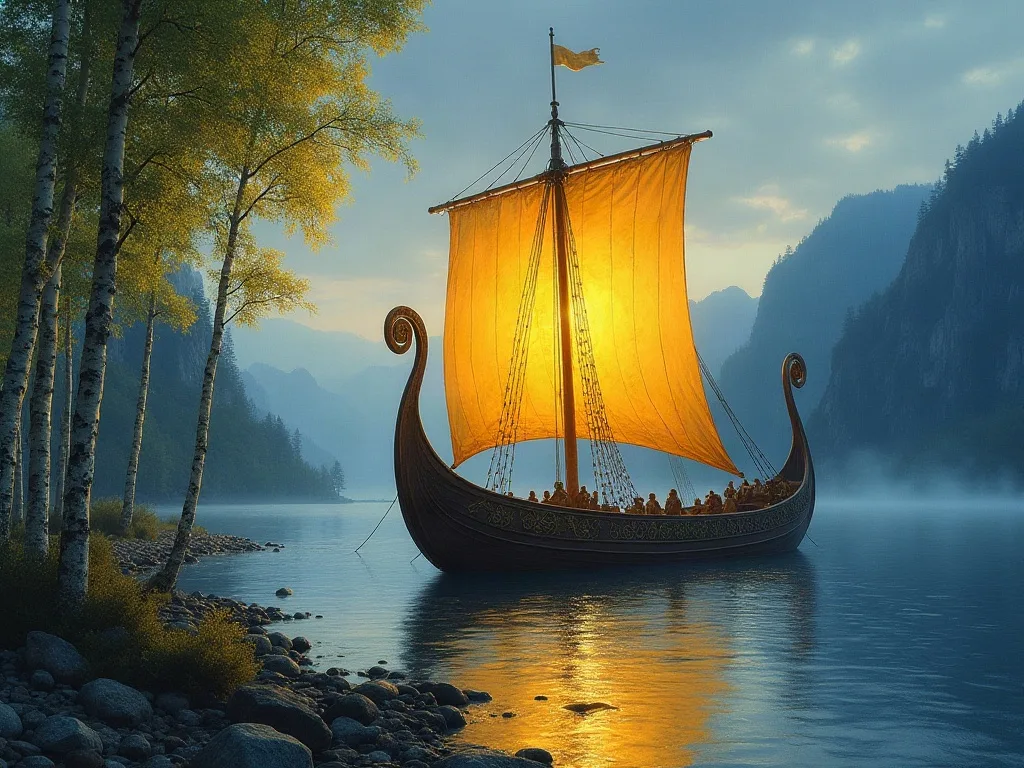
Skidbladnir, his ship, was built by the dwarves known as the Sons of Ivaldi. It was the largest ship in existence, large enough to carry all the gods with their weapons and armour, yet it could be folded like a cloth and tucked into a pouch when not needed. It always sailed with a fair wind, no matter where its prow pointed. Ships in Norse society meant trade, movement, seasonal return. A ship that always had wind was a god who always made the conditions right.
Gullinbursti, his golden boar, was also a dwarf-work. Its bristles shone like the sun and lit the way through any darkness. The boar was the sacred animal of the Vanir, and boar sacrifices at dísablót (the winter sacrifice for the female protective spirits) and sonargöltr (the "atonement boar" at Yule) were Freyr's particular offering. Eating the boar at Yule brought the sun's warmth into the body during the darkest month.
The third object is the sword. Snorri describes it as a sword that fights of its own accord, striking automatically against giants and monsters. Then Freyr gives it away, and it is never recovered. At Ragnarok, without his self-wielding blade, he faces the fire giant Surtr armed with nothing but an antler. He falls.
These three attributes together read as a complete cosmology of fertility: the ship brings seasonal return and bounty from the sea; the boar represents solar warmth and the sacred animal cycle; the sword is the protective power that guards the growing season from chaos. Losing it tells the whole Norse story about what happens when beauty and love compete with survival. They rarely coexist cleanly.
The Story of Gerdr: Love at the Cost of Power
The central myth of Freyr appears in Skirnismál, one of the oldest poems in the Poetic Edda. The setup is almost cinematically simple.
One day Freyr climbs to Hlidskjalf, Odin's high seat from which all the nine worlds can be seen. Sitting there without permission, he looks north into Jotunheim, the land of frost giants, and sees Gerdr, daughter of the giant Gymir. She is raising her arms, and the light from her bare skin illuminates the sky and sea. Freyr falls so hard for her that he cannot eat, cannot sleep, cannot speak.
His father Njord notices his son's silence and sends the servant Skirnir to find out what is wrong. When Freyr admits he wants Gerdr, Skirnir agrees to go north and court her on Freyr's behalf, but he demands a price: the self-wielding sword. Freyr, without a moment of calculation, hands it over.
What follows is one of the strangest courtship scenes in world mythology. Skirnir rides through fire and ice to reach Gerdr's hall. He offers her eleven golden apples. She refuses. He offers Draupnir, Odin's ring that produces eight new rings every nine nights. She refuses. Then Skirnir threatens her with a carved stick, a gand (a wand of sorcery), engraving on it a níð curse: if she refuses, she will be condemned to a life of exile, desire without satisfaction, married to a three-headed creature in the realm of giants, drinking goat's urine in Hel's shadow. It is a brutal sequence, and scholars have debated for decades whether it represents genuine ancient courtship ritual, a magical fertility rite involving the symbolic coercion of the earth goddess, or simply a poem about the unequal dynamics of desire.
Gerdr agrees to meet Freyr in nine nights, in a grove called Barri. The nine nights are agony. In one of the Edda's most raw passages, Freyr says:
"Long is one night, longer are two; how shall I endure three? Often a month seemed less to me than half this waiting-night for my wedding."
Nine nights. Almost certainly a ritual number: nine is the sacred count in Norse cosmology, the number of worlds, the days Odin hung on Yggdrasil, the nights between seed and first green shoot.

Freyr as Sacred King: The Yngling Line
The Ynglinga saga, the first book of Snorri's Heimskringla (a history of Norse kings written around 1230 CE), gives Freyr a role that goes far beyond mythology into the origin of human kingship.
After Odin establishes the gods in Sweden, Freyr takes over as chieftain of the Aesir in Uppsala, building the great temple there and establishing a period of peace and prosperity so abundant it becomes known as the Fróðafrið, the "Peace of Frothi." Crops grow without fail. No wars break out. The land is simply, stubbornly generous.
When Freyr dies, his followers are so afraid of losing the good harvests that they refuse to announce his death. They carry his body secretly into a great burial mound at Uppsala and go on making offerings to him through slits in the mound wall, three years of tribute to a dead king whose fertility the land still needs. The story is deeply serious: the Norse understanding of Freyr as fertility god was not abstract theology. It was practical. A bad harvest meant starvation. Freyr's goodwill was not optional.
The Swedish royal family traced itself directly from this divine line. The Ynglings claimed Freyr as their ancestor, making every Swedish king a son of the harvest god, a living guarantor of the land's abundance. The historian Bede, writing in Britain around the same period, noted similar divine kingship claims among Anglo-Saxon dynasties who traced themselves to the god Ing, a figure almost certainly cognate with Freyr. In Old English, the word Ing appears in the Runic Poem as the name of a great chieftain who rode east across the waves, his wagon following behind him.
The wagon detail matters. Freyr's cultic worship, according to the Flateyjarbók (a fourteenth-century Icelandic manuscript compiling older material), involved a sacred wagon in which the god's image was carried around farmsteads to bless the fields, accompanied by a priestess. The Roman historian Tacitus, writing about the Germanic tribe of the Suebi in his Germania (98 CE), describes an almost identical ritual for a goddess he calls Nerthus, "Mother Earth," whose wagon was pulled around the land by cattle before being ceremonially washed in a lake. Scholars widely consider Nerthus a cognate of Njord, Freyr's father. The family pattern holds.
Cross-Cultural Reflections: Freyr and the Dying Gods
Freyr belongs to a category of deity that appears across many cultures, sometimes called "vegetation gods" or "sacred kings": divine figures whose vitality is directly tied to the health of the land, who sometimes must suffer or die so that the earth can renew itself.
The closest parallel in the Mediterranean world is Osiris, the Egyptian god of grain and resurrection, whose dismembered body scattered across Egypt and whose annual death and return mirrored the flooding and retreating of the Nile. Both Freyr and Osiris rule over abundance, both have sister-consorts of enormous power (Freya, Isis), and both are fated to fall before chaos in the cosmic endgame, only for the world to potentially renew.
The Sumerian Dumuzi, husband of Inanna, is another echo. Dumuzi is a shepherd-king whose marriage to the goddess of love and war guarantees the land's fertility. When Inanna descends to the underworld and must offer up someone in her place, Dumuzi is taken. The land grieves. The parallels with Freyr handing over his sword for Gerdr, sacrificing his protective power for love, are not likely direct borrowings. They point instead to a much older pattern: the male fertility principle is always, in some sense, vulnerable. Its power passes through the body, through sexuality, through seasonal cycles that include death.
In Hindu tradition, Indra controls rain and the agricultural miracle of the monsoon. He fights the drought-serpent Vritra, and when he wins, water returns. He also has moments of weakness, hubris, and exile that echo the Norse pattern of the harvest god brought low. The structural comparison is not tight, but the anxiety underneath is the same: what if the rain does not come? What if the god falters?
Freyr's Sword and the Shadow of Ragnarok
The sword lost to Gerdr is not a decorative detail. It is the structural crack in the Norse cosmos.
Snorri specifies in the Prose Edda's Gylfaginning section that at Ragnarok, when Surtr the fire giant rides north with his burning blade and the gods ride out to meet the giants, Freyr faces Surtr unarmed because he has given his sword to Skirnir. He holds nothing but a deer's antler, and Surtr cuts him down.
This is, on the surface, a myth about the consequences of desire. Give up your protection for love, and you die when the monsters come. But there is a deeper reading that Norse scholars like John Lindow (in Norse Mythology: A Guide to the Gods, Heroes, Rituals, and Beliefs, 2001) and Margaret Clunies Ross (in Prolonged Echoes, 1994) have developed carefully. Freyr's sword was not just a weapon. It fought automatically against jotnar, giants. It was the principle of the land's self-defense, the protective force that kept chaos at the borders of the cultivated world. When Freyr gave that up, the cultivated world became permanently mortal. Ragnarok was always coming; Freyr's choice made it slightly more inevitable.
This reading also connects Freyr to the theme of Norse sacred kingship and the cost of fertility: a king who wishes to guarantee abundance must sometimes sacrifice something vital. In the Uppsala ritual described in the Gautreks saga, a king hangs himself on a tree as an offering to Odin, Freyr, and Thor for victory and good harvests. The Blot at Uppsala, described by the German chronicler Adam of Bremen around 1070 CE, involved sacrifices of nine males of every species, human and animal, hung in a sacred grove. Adam notes the temple at Uppsala specifically housed statues of Odin, Thor, and Freyr, with Freyr's statue being ithyphallic, emphasising his role as lord of human sexuality and generation.
Freyr's Cult in Archaeological Record
Words on parchment are one kind of evidence. The ground holds another.
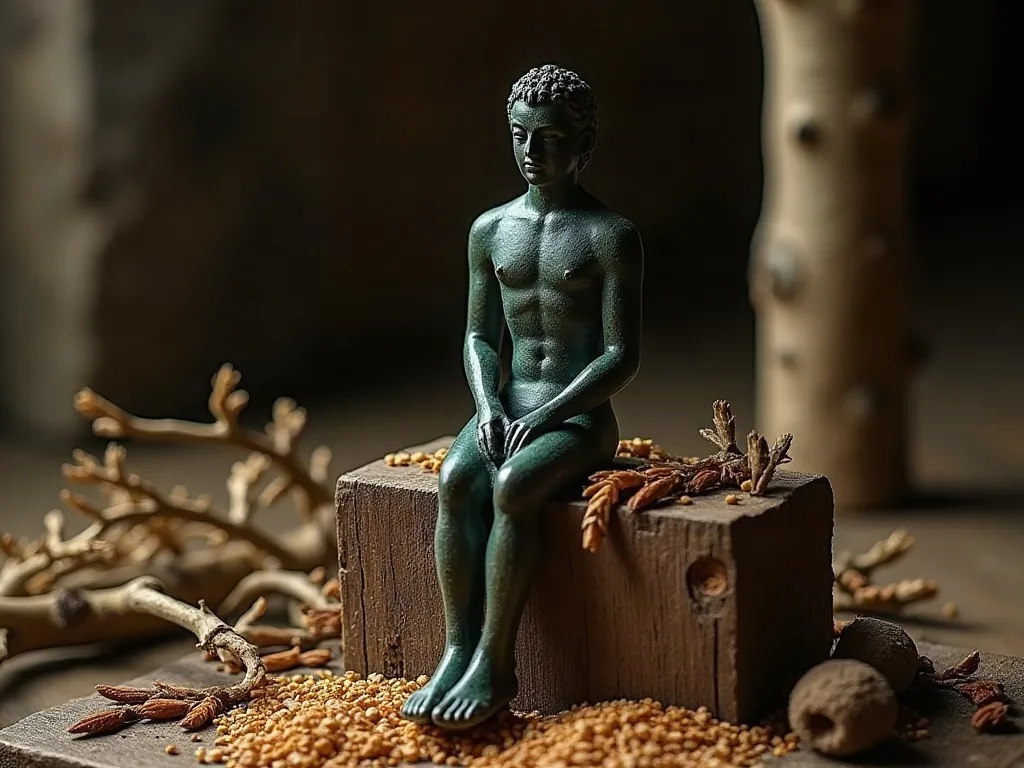
Small bronze figurines of an ithyphallic male deity, found across Scandinavia and northern Europe, are widely identified as Freyr images. The most famous is the Rällinge figurine, found in Södermanland, Sweden, and dated to around 800-1000 CE. It shows a seated figure with a prominent phallus, hands on his knees, possibly in a posture of ritual presentation. The figure carries no weapon. His power is not martial.
Place names across Scandinavia preserve his cult geography. In Sweden, the place name Frösön ("Freyr's island") in Jämtland contains a long-excavated ritual site. A large birch tree there, discovered by archaeologists in the 1980s, had animal bones wrapped around its roots, offerings that fit the pattern of Freyr-cult blót (sacrifice). Oak trees were connected to Thor; birches, tender and early-blooming, seem to have been Freyr's tree.
The Víga-Glúms saga, a family saga from Iceland written in the thirteenth century but set in the tenth, gives Freyr a local temple at Hripkelsstaðir, where the hero Glum makes a sacrificial bull offering to the god for protection. When Glum's luck runs out and he must leave his land, he is forced to confess publicly that he has violated Freyr's sacred peace on the god's own ground. The god is not forgiving. Freyr in the sagas is mild in his gifts, implacable when his sanctity is crossed.
How Freyr Became Ing: The Anglo-Saxon Connection
The Old English Runic Poem, composed sometime before the ninth century CE, has a stanza for the rune Ingwaz:
"Ing was first seen by men among the East-Danes, till, followed by his chariot, he went eastward over the wave. Thus the Heardingas named the hero."
Linguists are confident that Ing is the same Proto-Germanic divine figure who became Freyr in Scandinavia. The chariot-over-the-sea image maps directly onto the sacred wagon procession described in Norse sources and in Tacitus's account of Nerthus. The "East-Danes" locate the original cult in the Danish heartland, from which it spread north into Scandinavia and west into Anglo-Saxon England.
This means Freyr's fertility cult left traces not only in Swedish field names and Icelandic legal texts but in the rune-alphabet of the English people. He walked into Britain on the keels of migration, stripped of his name, called only "the lord," and planted himself in the soil well before the Viking raids that later history dramatises.
The Mercian royal family, the Wuffinga dynasty of East Anglia (who buried their king at Sutton Hoo around 625 CE), and several other Anglo-Saxon lineages claimed descent from Ing. If Freyr was their ancestor, then the helmet and ship-burial at Sutton Hoo sit inside the same mythological orbit as the Uppsala mound where Freyr's followers fed offerings through the mound wall to keep the harvests coming.
Frequently Asked Questions About Freyr, Norse God of Fertility
Frequently asked questions
What exactly does Freyr rule over in Norse mythology?
Freyr governs rain, sunlight, and the fertility of the earth, according to Snorri Sturluson's Prose Edda. His portfolio also includes peace between people, sexual vitality, and the health of the harvests. He rules Alfheim, home of the light elves, as a personal domain gifted by Odin. The sagas add a role as divine ancestor of the Swedish Yngling royal line, making him a god of kingship and political legitimacy as well.
Why did Freyr give away his sword, and what were the consequences?
Freyr gave his self-wielding sword to his servant Skirnir as payment for courting the giantess Gerdr on his behalf, as told in the Poetic Edda poem Skirnismál. The consequence was permanent: at Ragnarok, Freyr faced the fire giant Surtr without his weapon and was killed. Scholars like John Lindow read this as a structural statement about the nature of fertility religion: generative power and martial power cannot fully coexist, and the choice of love over force carries mortal costs.
How was Freyr actually worshipped in ancient Scandinavia?
Freyr received animal sacrifices, particularly of boars, at autumn and winter festivals. Adam of Bremen, writing around 1070 CE, describes a large temple at Uppsala, Sweden, where Freyr's ithyphallic statue stood alongside Odin and Thor. A sacred wagon carrying Freyr's image was reportedly driven around farmsteads to bless the land, accompanied by a priestess. Archaeological finds like the Rällinge figurine (c. 800-1000 CE) and ritual bone deposits at Frösön in Jämtland confirm the material reality of this cult.
Is Freyr related to Freya, and are they the same deity?
Freyr and Freya are twins, both children of the Vanir god Njord. Their names mean "lord" and "lady" respectively in Old Norse, which has led some scholars to suggest they were once aspects of a single divine pair representing the male and female poles of fertility. They are distinct figures in the surviving mythology, with different attributes, stories, and cults, but their structural parallelism is undeniable: both are Vanir, both crossed to Asgard as hostages, and both govern erotic and generative forces.
What is the connection between Freyr and the Anglo-Saxon god Ing?
Linguists and mythologists are confident that the Old English deity Ing, named in the pre-ninth-century Runic Poem, is the same Proto-Germanic figure who became Freyr in Norse tradition. Both are associated with sacred wagon processions, kingship, and agricultural blessing. Several Anglo-Saxon royal dynasties, including the Wuffingas of East Anglia, claimed descent from Ing, just as the Swedish Ynglings claimed Freyr as their ancestor. The root Ing also appears in the tribal name "Ingaevones," recorded by the Roman historian Tacitus as one of the great Germanic peoples of the North Sea coast.
How does Freyr compare to other fertility gods in world mythology?
Freyr belongs to a pattern found across multiple ancient cultures: a male deity whose vitality mirrors the land's health, whose relationship with a powerful female partner guarantees abundance, and who is fated to fall before chaos in the cosmic endgame. The Egyptian Osiris, the Sumerian Dumuzi, and to some extent the Hindu Indra share structural features with Freyr, particularly the idea that the fertility principle is vulnerable, mortal in some sense, and maintained only through ritual and devotion. These parallels are not lines of direct borrowing but convergent responses to the same agricultural anxieties.
Freyr After the Viking Age: Survival, Suppression, and Modern Return
Christianity came to Scandinavia in waves between roughly 950 and 1100 CE. The temple at Uppsala was demolished around 1087, according to Adam of Bremen's account, and its sacred grove cleared. The statues of Odin, Thor, and Freyr came down. But Freyr proved harder to extinguish than a wooden idol.
His name vanished from the liturgy, but the practices persisted in folk memory. The Yule boar, the julegrisen, is still a feature of Scandinavian winter tradition. Swedish Midsommar, the great summer solstice celebration of maypoles, flower crowns, and communal feasting, carries the unmistakable rhythm of a Freyr festival: the return of light, the peak of the growing season, the celebration of fertility without any Christian theological content to anchor it. Folklorists in the nineteenth century, particularly in Sweden and Denmark, traced these practices back to pre-Christian festivals with reasonable confidence.
The philologist Viktor Rydberg, in his 1886-89 Undersökningar i germanisk mythologi (Investigations in Germanic Mythology), went so far as to reconstruct an elaborate pre-Christian theology around Freyr, though later scholars found his reconstructions too speculative. More reliable is the work of Hilda Ellis Davidson, whose Gods and Myths of Northern Europe (1964) remains a benchmark, and of Anders Hultgård, whose archaeological and textual work on the Uppsala cult has done most to establish what Freyr's worship actually looked like in practice.
In the twenty-first century, Ásatrú and Heathenry communities across Scandinavia, the United States, and Britain have brought Freyr back into active devotion. He sits at the center of Vanatru, a specific current within modern Norse paganism that focuses on the Vanir rather than the Aesir. For these practitioners, Freyr's choice in Skirnismál reads not as a tragic miscalculation but as a deliberate statement: the god of life chose life, even at the cost of the weapon that could have prolonged it. That reading has a quiet power that old Adam of Bremen could not quite destroy, no matter how thoroughly he cleared the grove at Uppsala.
Freya, Freyr's twin sister, survived the transition in similar ways, her name absorbed into the word "Friday" and her image into the figure of the independent woman who owns her power. The pair of them, born in Vanaheim and exiled to Asgard, never stopped speaking through the grain and the light and the turning year.
Free 25-page sample
Want the whole story?
Take the first 25 pages free. If it pulls you in, the full edition is yours as an instant PDF download, with a paperback on Amazon for selected titles.

Mythology
The World Mythology Book: The Gods, Heroes and Myths of Every Culture
The Gods, Heroes and Myths of Every Culture, in One Volume
The whole of world mythology in a single volume: Greek, Norse, Egyptian, Japanese, Hindu, Celtic, Slavic, Mesoamerican and African myths gathered side by side, each drawn from the primary sources.