

Idun, Keeper of the Golden Apples: Youth, Loss, and the Gods Who Cannot Live Without Her
Idun guards the apples that keep the Norse gods young. Without her, Asgard crumbles. Discover her myth, her abduction, and why she matters across world mythology.
Contents
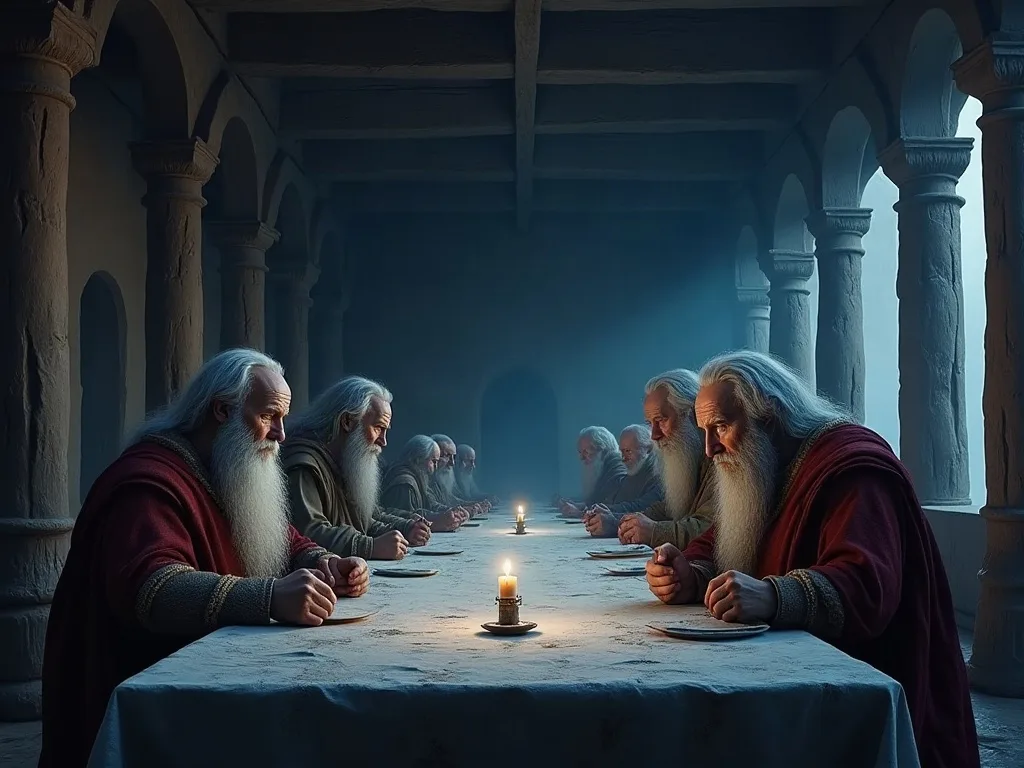
The gates of Asgard were still. No feast. No laughter. The Aesir moved through their halls with stiff joints and grey, thinning hair, and none of them could explain why. Idun was gone. And with her, every apple she kept in her ash-wood box had vanished too.
That image, a goddess carrying a small locked casket filled with immortality, is one of the most quietly powerful in all of Norse mythology. Idun, keeper of the golden apples, does not throw lightning or swing a war-hammer. She tends an orchard that stands between the gods and death, and when she disappears, the whole architecture of divine power begins to rot. The story is told in the Skáldskaparmál, the second part of Snorri Sturluson's Prose Edda, written in Iceland around 1220 CE, drawing on oral traditions that stretch back centuries before the page was ever inked.
She is easy to overlook. She rarely speaks in the sources. She carries no weapon. But strip Idun from the Norse cosmos and Odin goes blind with age, Thor's hammer arm weakens, and the Aesir become exactly what their enemies have always wanted them to be: mortal.
Who Idun Is: Name, Family, and Place Among the Aesir
Idun's name is Old Norse, spelled Iðunn in the original manuscripts. Scholars debate its root. The most widely accepted reading connects it to the Old Norse verb iðja, meaning "to do again" or "to renew." Linguist John Lindow, in his 2001 reference work Norse Mythology: A Guide to the Gods, Heroes, Rituals, and Beliefs, reads the name as "the rejuvenating one" or "the ever-renewing." A minority reading proposed by some nineteenth-century philologists linked the name to the prefix ið- meaning "again" combined with unna, "to love," which would yield something like "she who loves again." Neither reading is settled, but both circle the same idea: renewal, return, continuity.
Idun is the wife of Bragi, the god of poetry and the divine skald of Asgard. The Prose Edda gives this detail plainly. The pairing is not accidental. Bragi weaves words that outlast their speaker; Idun tends the fruit that outlasts the body. Together they form a marriage of immortality through art and immortality through biology, two very different answers to the same fear.
She belongs to the Aesir, the principal tribe of Norse gods, though Snorri does not dwell on her genealogy the way he does for, say, Odin or Freya. Her domain is specific and singular: she keeps the apples, she gives the apples, she alone decides who eats. That exclusivity is the source of her power.
The apples themselves deserve attention. Snorri calls them epli in Old Norse, a word that in medieval Scandinavian usage could mean any round fruit, not strictly the Malus domestica we picture today. Some scholars, including Rudolf Simek in his Dictionary of Northern Mythology (1993), suggest the original objects may have been hazelnuts, a fruit with deep pre-Christian sacred associations in northern Europe. Others point to parallels with the golden apples of the Hesperides in Greek myth, though the transmission path between those traditions remains unproven. What matters mythologically is the function: small, precious, given by a specific keeper, eaten by the gods to hold back time.
The Abduction: How Loki Betrayed Asgard's Most Vital Goddess
The central narrative attached to Idun is her theft by the giant Þjazi (pronounced roughly "Thyatsi"), told in the Skáldskaparmál. The story begins not with Idun at all, but with a hungry eagle.
Odin, Loki, and Hœnir are traveling through wild country when they stop to roast an ox. The meat will not cook. A large eagle perched above them announces that it is the source of the trouble, and offers a deal: let it eat its share first, and the cooking will resume. They agree. The eagle tears away the haunches and both shoulders, the prime cuts, before the gods can eat. Loki, furious, strikes the eagle with a pole. The pole sticks to the bird. Loki's hands stick to the pole. The eagle, who is Þjazi in disguise, hauls Loki into the sky and refuses to let him go until he swears an oath: deliver Idun and her apples out of Asgard.
Loki swears. He returns to Asgard. Then, with the casual cruelty that defines him in so many of the Eddic poems, he tells Idun he has found other apples in a forest nearby, apples that might interest her for comparison. She follows him out of the walls of Asgard carrying her casket. Þjazi, in eagle form again, seizes her and carries her to Þrymheimr, his hall in the mountains of Jötunheimr.
The gods age. They grow grey and bent. They realise Idun was last seen with Loki. They threaten him with violence and death if he does not bring her back. Loki borrows Freyja's falcon cloak (the fjaðrhamr, the feather-shape that allows travel between worlds) and flies to Þrymheimr. He finds Þjazi at sea fishing. He turns Idun into a nut, takes the nut in his talons, and flies back toward Asgard at full speed.
Þjazi returns to find his prize gone and gives chase in eagle form. The Aesir, waiting at the walls of Asgard, have gathered wood shavings in preparation. The moment Loki-as-falcon clears the walls, they ignite the shavings. Þjazi cannot stop. He flies into the fire and burns. The gods kill him there at the threshold.
The story ends with a brief coda: Þjazi's daughter Skaði arrives in full armor to demand compensation for her father's death. Odin scatters his eyes as stars. The gods make her laugh. She is given the right to choose a husband among them, sight unseen except for their feet, and she picks wrongly, choosing the sea-god Njörðr when she wanted the shining feet of Baldr. But that is Skaði's story. The thread returns to Idun: she is home, her apples are restored, and the Aesir become young again.

What the Apples Mean: Immortality, Seasons, and the Fear of Decay
Why apples? The question is not naive; it points toward some of the oldest anxieties in human culture.
The Norse gods are not immortal by nature. That is the crucial point the Idun myth makes explicit. The Prose Edda says the gods "must eat" of her apples whenever they feel old age approaching. This places them in a category closer to humanity than to the abstract, eternal divinity of, say, the God of Christian theology. The Aesir are powerful, long-lived, and supremely capable, but they are also subject to time. Idun's apples are a pharmaceutical intervention. Stop the prescription, and the condition returns.
This makes Idun's golden apples something rarer and more interesting than a simple symbol of eternal youth. They represent a conditional immortality, one that depends on relationship, on access, on someone choosing to give. Power, the myth says, is not self-sustaining. Even Odin's sovereignty runs on a supply chain.
Several scholars have read Idun as a goddess whose roots reach back to proto-Indo-European beliefs about a divine custodian of life-extending substance. The linguist Calvert Watkins pointed to the ambrosia of Greek tradition, the amrita of Vedic myth (literally "non-death"), and the haoma of Iranian religion as cognate ideas: a sacred fluid or food, guarded, given to gods, denied to ordinary mortals. Idun may be the Norse branch of that ancient tree.
Seasonal readings of the myth have also been popular since the nineteenth century, when Jacob Grimm influentially read the abduction of Idun as an allegory for winter stealing away the summer. Þjazi carries her north to his frozen hall; the world ages; spring must be recovered. The problem with this reading, as John Lindow notes, is that the Norse sources themselves never make the seasonal allegory explicit. It is an attractive overlay, but it may be ours more than theirs.
What the sources do make explicit is fear. The passage in the Skáldskaparmál where the gods notice they are aging is one of the emotionally sharpest moments in Snorri's writing. There is no drama, no battle, only the quiet horror of men and women who should be immortal noticing their hands are growing old.
Bragi and Idun: The Marriage of Memory and Renewal
Bragi appears in the Prose Edda as the greatest of skalds, the god to whom the art of poetry belongs in Asgard. He is mentioned in the Lokasenna, one of the Eddic poems preserved in the Codex Regius manuscript (compiled around 1270 CE), where Loki attacks every god in the hall with insults. When Loki reaches Idun, his jab is that she has embraced her brother's killer, meaning she holds no grudge against Loki for his role in Þjazi's death. Idun defuses the insult with pragmatic calm, urging Bragi not to escalate. She is the peacekeeper here, as she is the life-keeper elsewhere.
The marriage between Bragi and Idun has a structural logic that repays attention. In Norse cosmology, what survives after death arrives in two forms: the deed remembered in verse, and the body renewed by something beyond ordinary nature. Bragi handles the first. Idun handles the second. They are, together, the gods' answer to oblivion.
This pairing also shadows the relationship between art and biology in human experience. Poets have always claimed their verses make things immortal. "Not marble, nor the gilded monuments / Of princes, shall outlive this powerful rhyme," Shakespeare would write fifteen centuries after the Norse traditions were being shaped. The Norse version of that claim is literalised: the skald-god marries the goddess of biological renewal, and both forms of immortality live in the same hall.
Idun Across World Mythology: Parallel Keepers of Life
The figure of a woman who guards the food or drink of immortality, and whose absence causes the cosmos to decay, appears in traditions far removed from Iceland.
Amaterasu, the Japanese sun goddess, withdraws into a cave when she is offended by her brother Susanoo's violence. The world goes dark, crops fail, demons proliferate. Her absence is the catastrophe; her return is the restoration. The structure rhymes with Idun's abduction: divine feminine power removed, world in crisis, divine feminine power recovered, world renewed.
In Vedic tradition, the goddess Aditi is described in the Rigveda as the mother of the Adityas, the gods who sustain cosmic order. She is not a keeper of apples, but she is the source from which the gods' vitality ultimately derives. The parallel is conceptual: a feminine principle of boundless generative power, without which the male gods of action and war cannot function.
Greek mythology offers the clearest structural parallel. The Hesperides, nymphs who tend a garden of golden apple trees at the western edge of the world, guard fruit that belongs to Hera. Heracles steals the apples as his eleventh labour. The function is different (the Greek apples do not seem to be consumed for immortality in the same pharmaceutical sense), but the imagery is nearly identical: golden apples, female guardians, a western garden, contested access. Whether this represents shared Indo-European heritage or parallel invention, scholars have not agreed.
The Sumerian myth of Inanna's descent offers a different angle. When Inanna goes into the underworld and cannot return, every living thing stops reproducing. The world threatens to die. Only when she comes back does fertility resume. The mechanism differs from Idun's story, but the underlying logic is the same: the cosmic female principle is not decorative. Remove her, and creation stalls.
What these parallels reveal is that Idun, keeper of the golden apples, is not an eccentric local invention. She is a Norse expression of something very old: the understanding that renewal is neither automatic nor guaranteed, and that the one who holds the source of renewal holds the deepest power of all.

Idun in the Skaldic Tradition and Later Literature
Beyond Snorri's account, Idun appears in a kenning tradition that scattered her image across Old Norse poetry. Iðunnar epli, "Idun's apples," became a standard skaldic phrase for the apples of youth. The ninth-century skald Þjóðólfr of Hvinir composed Haustlöng ("Autumn-long"), one of the oldest surviving skaldic poems, which recounts the Þjazi myth in dense, allusive verse. Þjóðólfr's version predates Snorri by roughly three centuries and confirms that the Idun abduction story was not Snorri's invention but a well-established narrative long before the Prose Edda was written.
Snorri himself cites Haustlöng while telling the story in Skáldskaparmál, weaving the skaldic stanzas into his prose to prove that his narrative has poetic authority behind it. This is characteristic of his method: he is not making things up. He is explaining what the older skalds already knew.
In later periods, Idun becomes a magnet for Romantic-era Norse revival. The Swedish poet Esaias Tegnér, writing in the early nineteenth century, invoked her as a symbol of the old Nordic spirit. The German composer Felix Mendelssohn considered an opera on her story. She surfaces in William Morris's 1876 epic poem Sigurd the Volsung, and later in Neil Gaiman's 2017 retelling Norse Mythology, where her abduction is one of the book's most effective episodes.
Her modern appearances lean toward the same quality the medieval sources give her: quiet, non-martial, essential. She tends not to be the warrior goddess that twenty-first century popular culture gravitates toward. She is something harder to dramatise and perhaps more unsettling: the person everyone forgot about until they were gone.
Idun and Loki: Agency, Complicity, and the Logic of the Trickster
Loki's role in the Idun story deserves its own reading, because it is more complicated than simple villainy.
Loki does not want to betray Idun. He is coerced: Þjazi will kill him unless he swears. The oath extracted under duress is still an oath, and in Old Norse moral culture, oaths bind absolutely. Having sworn, Loki fulfils his word with the minimum necessary deception: he tricks Idun out of Asgard by feeding her curiosity about other apples. There is no violence. He is, in his way, efficient.
But Loki then also fixes the problem he caused. When the gods threaten him, he volunteers the rescue plan and borrows Freyja's falcon cloak to execute it. He recovers Idun. He turns her into a nut (a transformation that requires skill and implies intimate knowledge of shape-shifting magic). He outraces a giant in eagle form. He saves her.
The Skáldskaparmál does not moralize about Loki's dual role. He is both the cause and the cure, which is precisely the trickster's structural position in mythology worldwide. The Loki of this story is neither the comic prankster of some popular retellings nor the purely Satanic figure he becomes after Baldr's death. He is the necessary irritant, the character who breaks the system and then, under pressure, forces it to repair itself.
Idun, meanwhile, has almost no agency in the narrative. She is tricked, carried off, recovered. This passivity has troubled some modern readers. But it is worth asking whether the source assigns passivity to her or simply focuses the camera elsewhere. She keeps her apples. She gives them to the right gods at the right time. The narrative just does not show her refusing or resisting, perhaps because the more interesting question for Snorri's audience was not "will Idun escape?" but "will Loki fix what he broke?"
Idun's Lasting Place in the Asgardian Cosmos
After the abduction story, Idun fades from the major surviving narratives. She does not appear in the Völuspá, the great prophetic poem of the Codex Regius that charts the Norse cosmos from creation to Ragnarok. She is not named among those who survive the apocalypse or those who die in it.
This silence has led to speculation. Some scholars, including Hilda Ellis Davidson in her Gods and Myths of Northern Europe (1964), suggest Idun may be among those figures whose mythological weight was greater in oral tradition than the surviving written record reveals. The written corpus is, after all, a fraction of what once existed. The Codex Regius was found by Brynjólfur Sveinsson in 1643; before that, it had sat unknown in an Icelandic farmhouse. How much else was lost? The answer is almost certainly: a great deal.
What the texts do preserve is enough to argue that Idun's golden apples represent one of the most structurally load-bearing concepts in Norse religion. Odin can lose an eye for wisdom. Thor can lose his hammer and retrieve it. But if Idun stays gone, there is no recovery. The Ragnarok itself, the total destruction of the cosmos, is arguably just a version of the Idun scenario scaled to its logical endpoint: a world from which renewal has been permanently removed.
She is not the most dramatic goddess in the Norse pantheon. She is, in a specific and important sense, the most necessary.
Frequently Asked Questions About Idun, Keeper of the Golden Apples
Frequently asked questions
What are Idun's golden apples and what do they actually do?
Idun's apples are described in Snorri Sturluson's Prose Edda (written around 1220 CE) as the food the Aesir gods eat whenever they feel old age coming on. The apples restore youth and keep the gods from dying of natural decay. They are not magical in a flashy sense; they function more like a medicine that must be regularly consumed. Without them, the gods age and weaken just as humans do. The Old Norse word epli could refer to any round fruit, so the objects may originally have been imagined as hazelnuts or some other sacred fruit rather than the apples we picture today.
Who abducts Idun and why?
The giant Þjazi abducts Idun. He does it by coercing Loki: after capturing Loki mid-flight (as an eagle), Þjazi extracts an oath from him to bring Idun out of Asgard. Loki then tricks Idun by claiming to have found other apples in a nearby forest worth comparing to hers. She follows him outside Asgard's walls, and Þjazi seizes her and carries her to his hall in Jötunheimr. The motive is not explained in detail, but access to Idun's apples would presumably give Þjazi and the giants the same advantage in immortality that the Aesir currently hold.
What is the primary source for Idun's myth, and how reliable is it?
The fullest account appears in the Skáldskaparmál, a section of Snorri Sturluson's Prose Edda. Snorri himself cites the ninth-century skaldic poem Haustlöng by Þjóðólfr of Hvinir, which tells the same abduction story in older, more allusive verse. This cross-reference is significant: it means the Idun narrative was established in Norse tradition at least three centuries before Snorri wrote it down. Haustlöng is preserved in two manuscripts and is generally accepted as authentic ninth-century composition. Snorri's account is therefore not invention but the prose explanation of a poetic tradition already centuries deep.
Are there parallels to Idun in other world mythologies?
Several. The Greek Hesperides tend golden apple trees at the world's western edge. The Vedic tradition has amrita, the drink of immortality that the gods must protect from demons. The Sumerian goddess Inanna, when she descends to the underworld, leaves the surface world infertile until she returns. Japanese mythology has the sun goddess Amaterasu, whose withdrawal into a cave causes the world to deteriorate until she is coaxed back out. All these figures share a structural role: a feminine divine principle whose absence triggers cosmic decay, and whose return restores order. Whether these represent shared Indo-European inheritance or parallel mythological reasoning, scholars continue to debate.
What happens to Idun during Ragnarok?
The surviving sources do not specify. Idun is not named in the Völuspá, the great prophetic poem of the Norse apocalypse, either among those who die or those who survive. This silence has frustrated scholars for generations. Hilda Ellis Davidson and others have suggested that much of Idun's mythology may have been lost, since the written record represents only a portion of the oral tradition that preceded it. Some modern retellings imagine her role in Ragnarok, but these are creative extrapolations, not textual evidence.
Is Idun a major or minor goddess in Norse mythology?
By number of surviving narrative appearances, Idun is minor. She speaks rarely and acts primarily as the object of other characters' actions. But by structural importance, she is arguably one of the most significant figures in the Norse cosmos. The Prose Edda states explicitly that all the Aesir depend on her apples to remain immortal. Without her, Odin, Thor, Freya, and the rest would age and die. No other single figure in Norse mythology holds that kind of leverage over the entire divine order, which is precisely why her abduction functions as such a powerful crisis in the story.
Idun's Quiet Revolution: What Modern Readers Take From Her
The twenty-first century has turned to Norse mythology with unusual appetite. The Prose Edda and the Eddic poems now reach general readers through translations, novels, games, and films that would have seemed impossible even twenty years ago. In this landscape, Idun tends to be underwritten compared to Odin or Thor or even Loki. She does not fit the warrior-goddess archetype that currently dominates pop-cultural Norse mythology.
But there is a growing critical conversation, partly shaped by scholars like Carolyne Larrington (The Norse Myths: A Guide to the Gods and Heroes, 2017), that asks what Norse mythology looks like when you read it from the margins. Idun, read that way, turns out to be central. She is the reason the heroic gods can be heroic at all. She sustains the conditions for every adventure, every battle, every act of divine will in Asgard. The dramatic figures exist because she quietly maintains the biological substrate that makes them possible.
That is a genuinely radical idea, and it is entirely present in the medieval sources. It does not need to be imposed from outside. Snorri Sturluson, writing in thirteenth-century Iceland, made it plain: let Idun leave, and Asgard falls. Not in the spectacular conflagration of Ragnarok, but in the slow, grey way that old age claims everyone who has no apple left to eat.
There is something in that for any reader. The most powerful thing in any system is rarely the most visible.
Free 25-page sample
Want the whole story?
Take the first 25 pages free. If it pulls you in, the full edition is yours as an instant PDF download, with a paperback on Amazon for selected titles.

Mythology
The World Mythology Book: The Gods, Heroes and Myths of Every Culture
The Gods, Heroes and Myths of Every Culture, in One Volume
The whole of world mythology in a single volume: Greek, Norse, Egyptian, Japanese, Hindu, Celtic, Slavic, Mesoamerican and African myths gathered side by side, each drawn from the primary sources.