
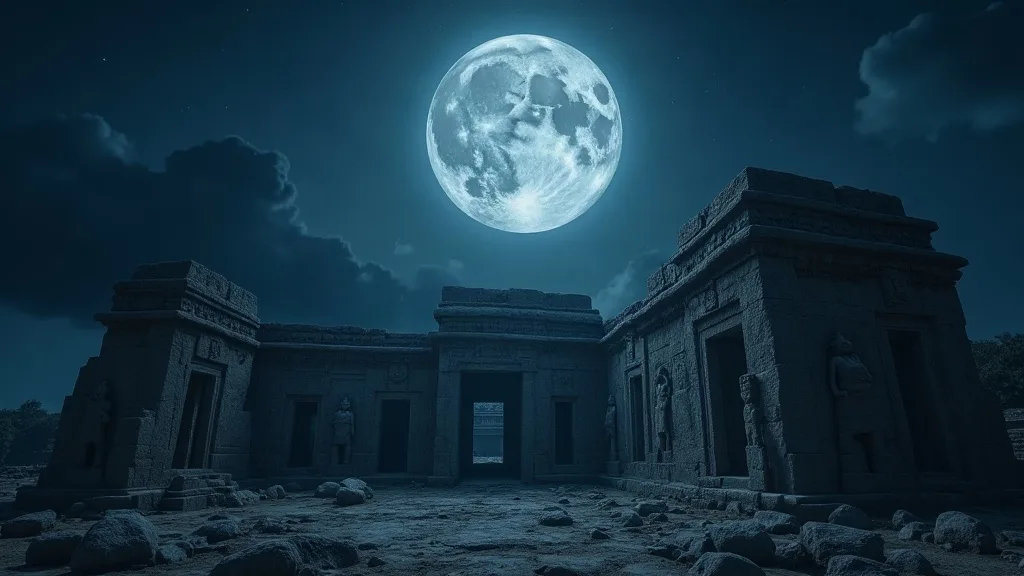
Moon Deities Across Mythologies: How Every Civilization Looked Up and Saw a God
From Mesopotamia's silver-bearded Sin to Japan's jealous Tsukuyomi, moon deities shaped how humanity counted time, waged war, and mourned the dead. A deep cross-pantheon guide.
Contents
The moon bleeds silver into the dark, and then it vanishes. Three nights of nothing, then the thin crescent returns. Every culture on earth watched this cycle and reached the same reflex: something up there is alive.
Moon deities across mythologies are not a curiosity at the edge of the story. They sit at its center. They invented the calendar. They ruled the tides of blood and birth. They kept the dead quiet in their graves. The sheer spread of lunar worship, from the river valleys of Mesopotamia to the highland jungles of Guatemala, tells us something urgent about how human minds work: we need the sky to mean something, and the moon is the sky's most eloquent speaker.
What follows is not a list of names. It is a cross-pantheon portrait, tracing the recurring shapes that lunar divinity takes across radically different cultures, showing where the images converge, and where one tradition goes somewhere no other dared.
Sin and Nanna: The Mesopotamian Moon Before All Others
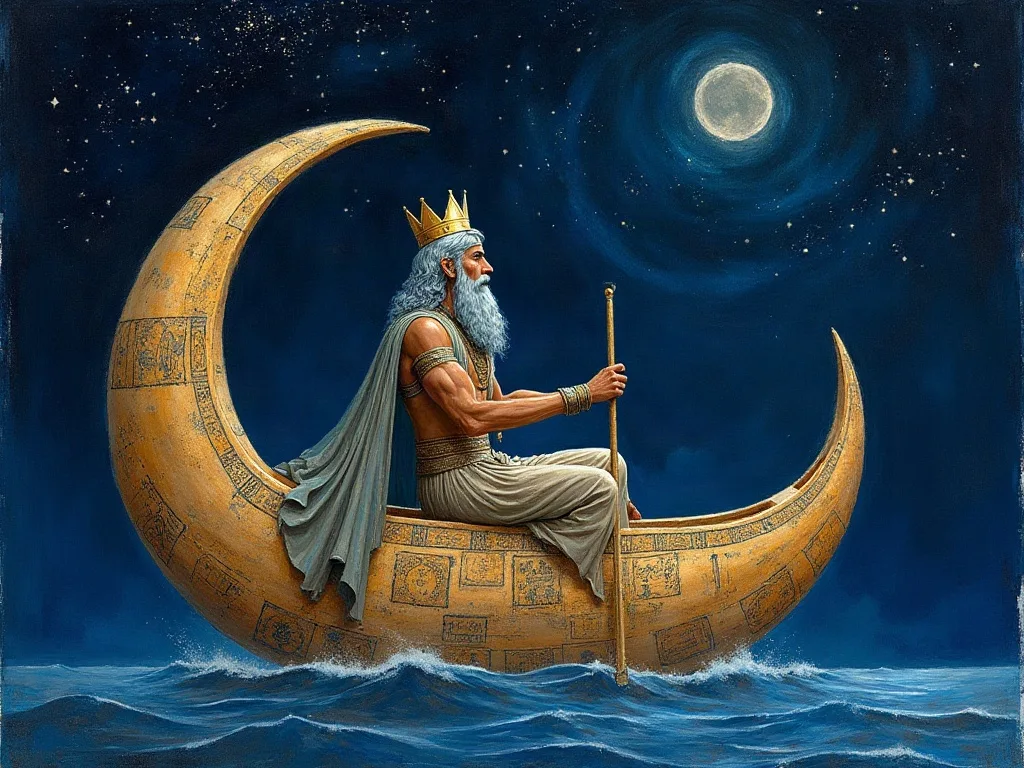
The oldest documented lunar deity is Nanna, known in Akkadian as Sin (pronounced "seen"). The Sumerians pictured Nanna as a wise, silver-bearded king sailing a celestial boat across the night sky, the crescent his vessel. Tablets from Ur, the city that claimed Nanna as its patron, date this image to at least 2100 BC, though the cult is older still.
Nanna was not just pretty light. He was the measurer of time, the lord of months, the keeper of cattle herds. Sumerian texts say he crossed the sky counting days the way a shepherd counts sheep. He was also father of the sun god Utu (Shamash in Akkadian) and the goddess Inanna, which already tells us something: in Mesopotamian cosmology, the moon outranks the sun in the divine family tree.
The great hymn to Nanna recorded in cuneiform calls him "the boat of heaven, full of loveliness," and asks him to bring prosperity to flocks, to women giving birth, and to the rivers. His temple at Ur, the ziggurat rebuilt by Ur-Nammu around 2100 BC, was the largest building in the world at its completion. A god worth that much stone was not a minor figure.
The king of Babylon, Nabonidus, sparked a political crisis in the sixth century BC by moving his court to the Arabian desert and intensifying Sin worship, reportedly neglecting Marduk, the city's patron deity. That a moon cult could fracture an empire tells you how much weight the silver god carried.
Khonsu and Thoth: The Two Faces of the Egyptian Moon
Egypt gave the moon not one god but a rivalry. Khonsu and Thoth both claimed the lunar disc, and the tension between them reveals how much the Egyptians expected a single heavenly body to do.
Thoth came first in theological prestige. The Egyptians called him the Measurer, the Scribe, the Lord of Divine Words. He invented writing, maintained the balance of Ma'at (cosmic order, often translated as "truth"), and recorded the weight of the dead heart at judgment. His animal was the ibis, sometimes the baboon, both creatures associated with the moon's light and rhythm. The Pyramid Texts, inscribed inside burial chambers from around 2400 BC, already name Thoth as the moon and ask him to guide the pharaoh safely through the night sky.
Khonsu was younger, fiercer, more bodily. His name means "the traveler," and early texts describe him as a predator who helped the pharaoh hunt other gods for food, a cannibalistic cosmic image from the Old Kingdom that later softened into healing. By the New Kingdom, Khonsu was the gentle moon of Thebes: a young man wrapped in mummy bandages, with a side-lock of hair marking him as a child, carrying a crook and flail. His temple at Karnak, built mainly under Ramesses III in the twelfth century BC, still stands.
The two gods did not cancel each other. Thoth was the moon as mind; Khonsu was the moon as body and time. Egyptians were comfortable holding both.
Selene, Artemis, and Hecate: The Greek Triple Moon
Greek mythology split the moon three ways, and the split was deliberate. Each of the three figures governed a different aspect of lunar power.
Selene was the moon itself, the raw luminous disc. She drove a silver chariot across the sky, pulled by white horses. Hesiod's Theogony, written around 700 BC, places her among the Titans, the generation of gods before Zeus. She was not especially worshipped in cult, because she was more phenomenon than personality. Her most famous story is her love for the shepherd Endymion, whom she asked Zeus to grant eternal sleep so she could visit him on the hillside forever without him aging or dying. It is a myth about the moon's relationship with night: always watching, never quite touching.
Artemis was something else. She was the goddess of the hunt, of childbirth, and of wild places, and her identification with the moon was a secondary development, increasingly emphasized from the fifth century BC onward. As a moon goddess, Artemis governed the waxing crescent, the moon's active, growing phase. Her silver bow was the crescent itself. She was dangerous, chaste, and precise.
Hecate took the dark: the waning moon, the new moon's absence, the three-way crossroads lit by torches at midnight. By the classical period, Hecate was triple-formed, facing three directions at once, associated with ghosts, dogs, magic, and the restless dead. The Chaldean Oracles, late antique texts from around the second century AD, made her a cosmic principle connecting the material world to the divine. She stands at the edge where the moon's logic breaks down into mystery.
Three goddesses, one sky object. The Greeks were mapping psychology onto astronomy: growth, light, and darkness as distinct divine moods.
Artemis (Greek)
Artemis began as a huntress and nature goddess. Her lunar identity strengthened over centuries, grafted from Selene. Fierce, virginal, tied to untamed wilderness. Her cult center at Ephesus was one of the ancient world's great pilgrimage sites. She punished human transgression against nature swiftly and without mercy.
Diana (Roman)
Diana inherited Artemis's lunar role but wore it differently in Roman practice. She was goddess of the plebeians and slaves, with a major temple on the Aventine Hill. As Diana Lucifera (light-bearer), she held a torch rather than a bow. Roman poets like Ovid layered her with Hecate and the underworld goddess Proserpina, creating the composite diva triformis, the three-form goddess. More civic, less wild.
Tsukuyomi: The Moon God Japan Exiled
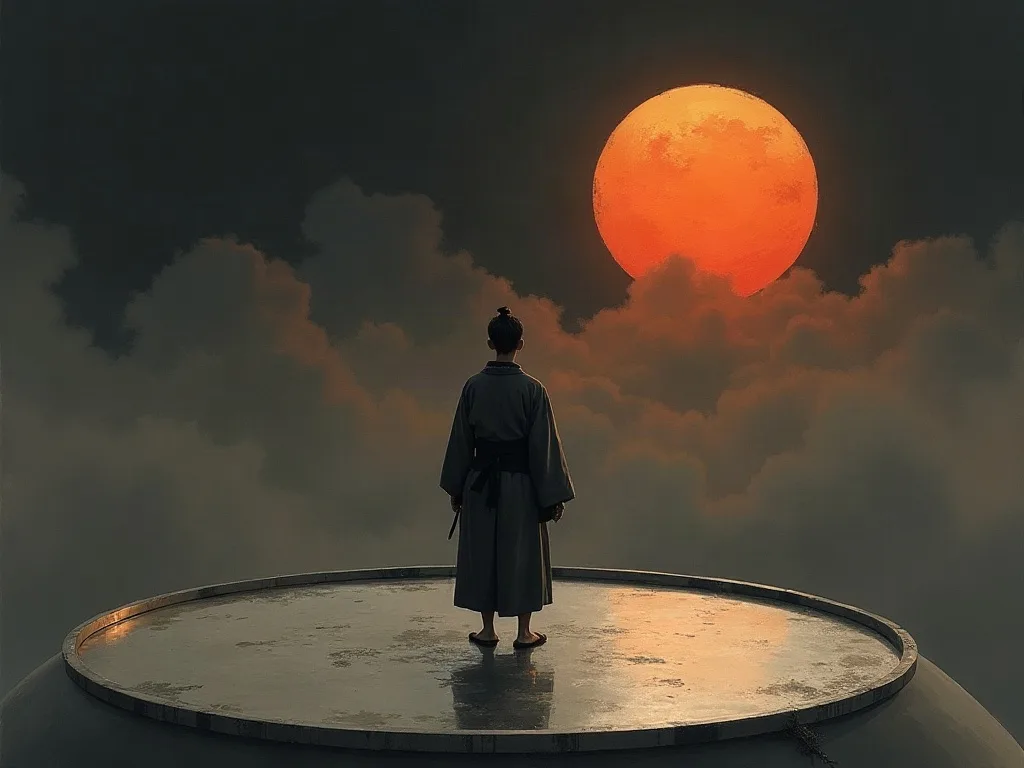
Japanese mythology gives the moon to Tsukuyomi-no-Mikoto, and then, almost immediately, gets rid of him. The story in the Kojiki, Japan's oldest chronicle compiled in 712 AD, is brief and violent.
The sun goddess Amaterasu and Tsukuyomi were siblings, born from the eyes of the creator god Izanagi when he washed his face after visiting the land of the dead. Amaterasu emerged from the left eye; Tsukuyomi from the right. For a time they ruled together.
Then Tsukuyomi was invited to a banquet hosted by the food goddess Uke Mochi. Offended by how she prepared the food, vomiting and defecating various dishes onto the table, Tsukuyomi drew his sword and killed her. When Amaterasu heard what he had done, she declared him wicked and resolved never to look at him again. Since then, day and night have been separate. The sun and moon never share the same sky.
It is a peculiar myth for a culture that otherwise celebrated lunar timekeeping. The agricultural calendar in ancient Japan ran on the moon. Lunar festivals like Otsukimi (moon-viewing, held on the fifteenth day of the eighth lunar month) are still observed today. But the cosmic narrative buried Tsukuyomi under a quarrel, leaving lunar mythology in Japan populated more by folklore than divine biography: the rabbit who pounds rice cakes on the moon's surface, the bamboo-cutter's daughter who returns there in the tale of Kaguya-hime.
Tsukuyomi's exile is itself a kind of theology. The moon is beautiful but it did something wrong. You can admire it from a distance.
Chandra and Soma: The Hindu Moon as Ambrosia and King
Sanskrit has two words for the moon: Chandra (the shining one) and Soma (the sacred drink). In Hindu cosmology, these are the same god seen from two angles.
Chandra is the moon as planet-king, one of the Navagraha, the nine celestial bodies that govern human fate in Vedic astrology. He rides a chariot pulled by ten white horses or antelopes. He is beautiful, restless, and morally unstable. The Mahabharata and the Puranas both record that Chandra abducted Tara, wife of Brihaspati the divine teacher, and refused to return her. The resulting war between the gods and the demons, the Tarakamaya war, ended with Brahma forcing Chandra to give Tara back. She was already pregnant with Chandra's child, the god Budha (Mercury). That scandal runs through the Lunar Dynasty, the Chandravamsha, the lineage that includes the Pandava heroes of the Mahabharata.
Soma is different. In the Rig Veda, the oldest Sanskrit text (composed roughly 1500-1200 BC), Soma is the moon but also a pressed plant juice drunk in ritual to achieve divine vision. The entire ninth Mandala of the Rig Veda, 114 hymns, is addressed to Soma. The drink was sacred; the moon was sacred; over time the two fused into a single deity who is simultaneously celestial body and cosmic nourishment. The gods, it was said, consumed Soma from the moon each month, which is why it waned, and grew full again as it refilled.
This double identity, light and drink, king and sacrament, makes Chandra-Soma one of the richest lunar figures anywhere. No other tradition made the moon physically consumable, a food that could make mortals temporarily divine.
Ix Chel and the Maya Moon Goddess: Weaver, Healer, Destroyer
Mesoamerican lunar tradition centers on a figure scholars often call the Moon Goddess, identified in the Classic Maya period with the aged deity Ix Chel and the young woman sometimes shown in the Dresden Codex cradling a rabbit.
Ix Chel (roughly "Lady Rainbow" or "She of the Pale Face") was a goddess of medicine, weaving, childbirth, and floods. Her associations run the full lunar range: the waxing moon brought healing and growth; the waning moon brought the flood that could drown crops. She was sometimes depicted as a crone pouring water from an inverted jar, the deluge as old age. Sometimes she appeared young, wearing a lunar crescent as a headdress.
The rabbit on the moon, visible in the lunar surface's dark patches, appears widely across Mesoamerican art. The Popol Vuh, the K'iche' Maya creation epic written down in the sixteenth century from older oral tradition, connects the moon to Xbalanque, one of the Hero Twins, who becomes the moon after defeating the lords of the underworld. In that reading, the moon carries the mark of a warrior who died and came back, the same logic as the lunar cycle itself.
Quetzalcoatl operated in a solar-lunar balance in Aztec theology, but the Aztec moon deity Tecuciztecatl carries the most pointed myth: at Teotihuacan, both he and Nanahuatzin (the sun) threw themselves into the fire to become celestial bodies. Tecuciztecatl hesitated four times before jumping. For his cowardice, a god struck the moon with a rabbit, dimming it, which is why the moon is less bright than the sun.
Two creation moments, two acts of sacrifice. The moon earns its light at cost.
Mani, Sin, and the Norse Moon as Hostage
Old Norse mythology gives the moon to Mani, a young man who drives the moon-chariot across the sky and is perpetually chased by a wolf. The Prose Edda, compiled by Snorri Sturluson around 1220 AD, tells us that Mani was the son of a man named Mundilfari, who named his children after the sun (Sol) and moon (Mani) out of pride. The gods found this offensive and conscripted both children into the sky to drive the celestial vehicles.
Mani steers the moon and guides its waxing and waning. He took two children from earth, Hjuki and Bil, as they carried water up a hill, a story some scholars connect to the origins of the Jack-and-Jill nursery rhyme. At Ragnarok, the world's end, the wolf Hati will catch Mani and swallow him. The moon dies with the cosmos.
What is striking about Mani is his smallness compared to the great Aesir. He is not worshipped as a major deity. He has a function, not a cult. Norse religion was not particularly lunar in its devotion: the major sacrificial cycle, the blot, aligned with solar seasons. Mani matters more as myth than as theology.
Odin and the wider Norse cosmos are profoundly solar and cosmic in orientation, but Mani's presence confirms that the lunar slot must be filled, even in a tradition that did not prioritize it.
Khonsu to Chang'e: The Moon's Recurring Shapes Across Cultures
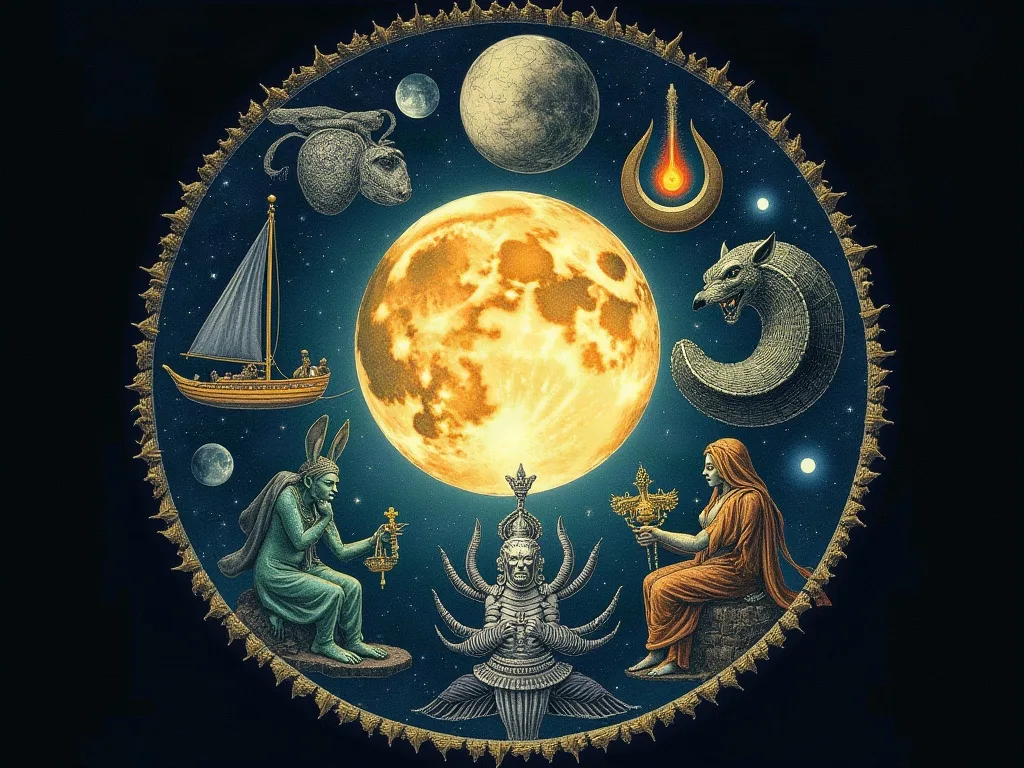
When you stand back from the individual traditions, the same shapes keep appearing. They are not proof of diffusion (the cultures had no contact), but of something simpler: the moon behaves the same way everywhere, and human minds run the same tracks.
The moon as time-keeper. Sin in Mesopotamia, Thoth in Egypt, Chandra in India, and Mani in Norse myth all share this function. The lunar calendar was the first human tool for measuring months, governing agriculture, menstruation cycles, and ritual dates. Every society needed a divine face behind that function.
The moon as the realm of the dead. Greek Hecate, Aztec Tecuciztecatl, and the Egyptian Thoth (who guided souls) all connect the moon to what happens after death. The moon disappears for three days each month and returns. That pattern mapped perfectly onto ideas of death and resurrection before any theology was written down.
The moon and women. Lunar goddesses and the feminine divine are linked in almost every tradition: Selene, Artemis, Hecate, Ix Chel, and the nameless Maya moon goddess are all female. Chandra and Tsukuyomi are male exceptions. The menstrual cycle's approximate match to the lunar month made this connection almost inevitable in pre-scientific thinking.
The moon as food or drink. The Vedic Soma is the clearest case, but the Aztec image of the moon feeding the gods through sacrifice, and even the European folk idea that the moon controls plant growth, touches the same nerve: the moon gives something edible, something that sustains life.
The moon as danger. Lunacy. The word still exists in English. Hecate drove people mad. Chandra's unstable desire caused a cosmic war. Tsukuyomi committed murder at a dinner party. The moon's beauty came with an asterisk.
Chang'e and the Chinese Lunar Tradition
No cross-pantheon account is complete without Chang'e, the Chinese moon goddess whose image appears on the Chinese National Space Administration's lunar exploration program logos to this day.
The myth has several versions. In the most common, Chang'e's husband Hou Yi shot down nine of the original ten suns to save humanity from burning. As reward, he received an elixir of immortality. Chang'e either stole it and drank it herself to prevent a villain from taking it, or drank it accidentally, depending on which text you follow. Either way, she floated up to the moon and has lived there ever since, accompanied by a jade rabbit who pounds medicinal herbs in a mortar.
The Mid-Autumn Festival, celebrated on the fifteenth day of the eighth lunar month, is China's second largest holiday. Families eat mooncakes, look at the full moon, and think of Chang'e. She is not a remote mythological relic; she is an active cultural presence in one of the world's most populous nations.
Chang'e's myth carries an emotion unusual in lunar theology: loneliness. She did not choose her exile freely. The moon, in this reading, is a beautiful trap. That particular note, the moon as isolation, as separation from what you love, resonates with Selene's endless watch over the sleeping Endymion and with Amaterasu's refusal to share the sky with Tsukuyomi.
The moon keeps its distance. Every culture noticed.
Frequently Asked Questions About Moon Deities Across Mythologies
Frequently asked questions
Which is the oldest moon deity in recorded history?
The oldest documented lunar deity is Nanna, the Sumerian moon god worshipped at the city of Ur. Written records of his cult go back to at least 2500 BC, and the cult itself is older. Nanna is the Sumerian name; the Akkadian form is Sin. His temple-tower at Ur, rebuilt around 2100 BC under King Ur-Nammu, was among the largest structures of its age.
Why are so many moon deities female?
The approximate match between the lunar month (29.5 days) and the average human menstrual cycle made the connection almost universal in pre-scientific cultures. Goddesses like Selene, Artemis, Hecate, Ix Chel, and Chang'e govern fertility, childbirth, and cyclical renewal. Male lunar deities, like Sin, Mani, Chandra, and Tsukuyomi, do exist and are significant, but they appear in traditions where the moon's role as time-keeper or cosmic ruler outweighed its reproductive symbolism.
What is the connection between the moon and the underworld in mythology?
The moon's three-day disappearance each month was widely interpreted as a death and resurrection. Thoth in Egypt guided the souls of the dead and was linked to the moon. Greek Hecate ruled ghosts and the dark of the moon. The Aztec moon deity Tecuciztecatl was reborn from fire. In Hindu cosmology, the souls of the dead rested in the moon between incarnations, according to the Chandogya Upanishad, a text from roughly 700 BC. The pattern is consistent: where the moon goes in the dark, the dead go too.
Did any cultures worship the moon more than the sun?
Yes. Mesopotamia is the clearest case: the moon god Sin stood above the sun god Shamash in the divine hierarchy, and lunar timekeeping dominated Sumerian and Babylonian religious calendars. Arabia before Islam had strong lunar cult traditions, and Sin was worshipped at the Nabataean site of Harran well into the early medieval period. Many pastoral and nomadic cultures, who moved at night and navigated by stars and moon, tended to favor lunar over solar worship.
Are there cross-cultural connections between the moon and rabbits?
Independently in both East Asian and Mesoamerican traditions, the dark patches on the moon's surface were read as a rabbit. Chinese, Japanese, and Korean mythology all describe a rabbit (or hare) on the moon, often grinding medicine or pounding rice cakes. In Maya iconography, the rabbit appears in the arms of the moon goddess on Classic period ceramics. There is no evidence of cultural contact between these traditions; the image arose separately, likely because the maria (dark lunar plains) visually suggested the shape.
Which primary sources describe lunar deities in the most detail?
The Sumerian Hymn to Nanna, preserved on cuneiform tablets from Ur, is among the earliest. Egypt's Pyramid Texts mention Thoth extensively. Hesiod's Theogony describes Selene in detail. For India, the ninth Mandala of the Rig Veda is devoted entirely to Soma. The Kojiki covers Tsukuyomi briefly but clearly. The Prose Edda by Snorri Sturluson handles Mani. The Maya Dresden Codex contains lunar tables accurate to within two minutes per synodic month, demonstrating how seriously the moon goddess was tracked astronomically.
The Moon in the Modern Mythological Imagination
The moon landing in 1969 did not kill lunar mythology. It relocated it.
China named its lunar rover Yutu, the jade rabbit from the Chang'e myth. The name was chosen by public vote in 2013. Chang'e herself names the Chinese lunar program. Japan's lunar mission launched in 2024 was called SLIM: a technical acronym, but the satellite Kaguya, which mapped the moon between 2007 and 2009, took its name directly from Kaguya-hime, the bamboo-cutter's moon princess.
Poets and novelists kept the older images alive long before the space programs reached for them. Keats wrote Endymion in 1818, a 4,000-line poem following Selene's sleeping shepherd. Borges returned to lunar imagery throughout his career, particularly the moon as the face of infinite repetition. Contemporary fantasy fiction from N.K. Jemisin's work to the Sailor Moon franchise (whose main character transforms into a warrior of the moon) draws from the same ancient well: the moon as divine feminine, as cyclical power, as something watching from too far away to touch.
What the mythologies agree on, stripped of their local color, is this: the moon is the sky's most personal object. The sun is constant; the sun belongs to everyone equally. The moon changes. It vanishes and returns. It pulls the ocean. It looks, on a clear night, close enough to speak to.
Moon deities across mythologies were never simply astronomical figures. They were the first proof that the universe was paying attention, counting the days alongside us, keeping track. That is a need that no space mission, however precise, has managed to make obsolete.
Free 25-page sample
Want the whole story?
Take the first 25 pages free. If it pulls you in, the full edition is yours as an instant PDF download, with a paperback on Amazon for selected titles.

Mythology
The World Mythology Book: The Gods, Heroes and Myths of Every Culture
The Gods, Heroes and Myths of Every Culture, in One Volume
The whole of world mythology in a single volume: Greek, Norse, Egyptian, Japanese, Hindu, Celtic, Slavic, Mesoamerican and African myths gathered side by side, each drawn from the primary sources.