
The Nagas: Serpent Beings of Hindu Mythology and the Cosmic Order
The nagas are powerful serpent beings in Hindu tradition, far more than monsters. They guard treasures, dwell in the underworld, and embody both chaos and cosmic order. Meet the serpent dynasty that shapes creation itself.
Contents
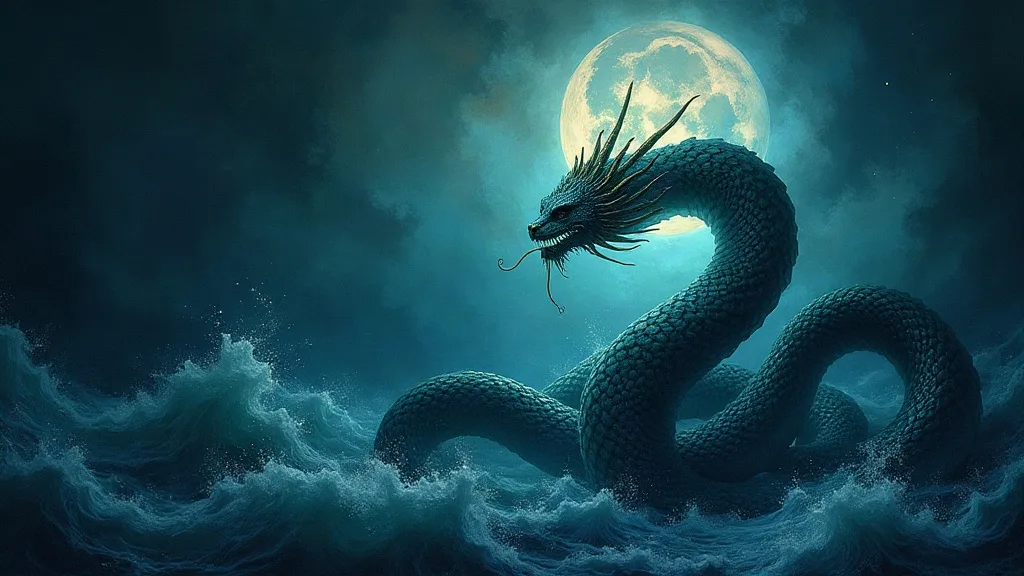
The serpent raises its hood. In the darkness beneath the earth, where water pools in chambers no human eye has ever seen, the nagas coil and watch. They are not merely snakes. They are shape-shifters, palace-dwellers, guardians of buried wealth, and sometimes adversaries of the gods themselves. In Hindu mythology, the nagas occupy a liminal space: half divine, half bestial, neither fully good nor fully evil, but essential to the cosmic machinery that holds reality together.
When a naga appears in Hindu scripture, it commands attention. The god Shiva wears snakes around his neck like garlands. Vishnu reclines on a coiled naga, using the serpent's body as his bed. The creation myth itself hangs on the coils of a naga named Shesha, the thousand-headed snake who supports all of existence. To understand the nagas is to understand something fundamental about how Hindu cosmology works: the idea that power, fertility, danger, and protection are often the same force, wearing different faces.
Origins of the Nagas: Children of Daksha and Kadru
The nagas do not emerge from chaos. They have a genealogy, written in the oldest Sanskrit texts. According to the Mahabharata and the Bhagavata Purana (sacred verses that form the core of Hindu teaching), the nagas are descended from the sage Daksha and his daughter Kadru.
Daksha was not a minor figure. He was a Prajapati, one of the progenitors, one of the ten mind-born sons of the creator god Brahma. Daksha had thirteen daughters, each of whom married a god or cosmic being. One of these daughters was Kadru. When Kadru married the sage Kashyapa, she gave birth to a thousand serpent offspring. These were the nagas.
But Kadru was not alone. Her sister Vinata, also married to Kashyapa, gave birth to two sons: the solar bird Garuda and his brother Aruna. This detail matters. It establishes the nagas as part of a cosmic family tree, not as monsters spawned from primordial slime, but as beings with noble ancestors and a place in the order of things. It also sets up one of mythology's great rivalries: the serpents and the birds, locked in eternal opposition.
The Rig Veda, the oldest of the Vedas (the sacred texts that form Hinduism's foundation, composed around 1500 BCE), mentions serpents called ahi and vritra. These are often depicted as demons or chaos-dragons. But the nagas as a distinct category, intelligent, wealthy, capable of assuming human form, crystallize more fully in the later Puranas (encyclopedic texts composed between 400 and 1600 CE). By then, the nagas have become civilized. They build underwater kingdoms. They marry humans. They become subjects of negotiation and alliance rather than mere opponents to be slain.
The Underworld Empire: Patala and Naga Royalty
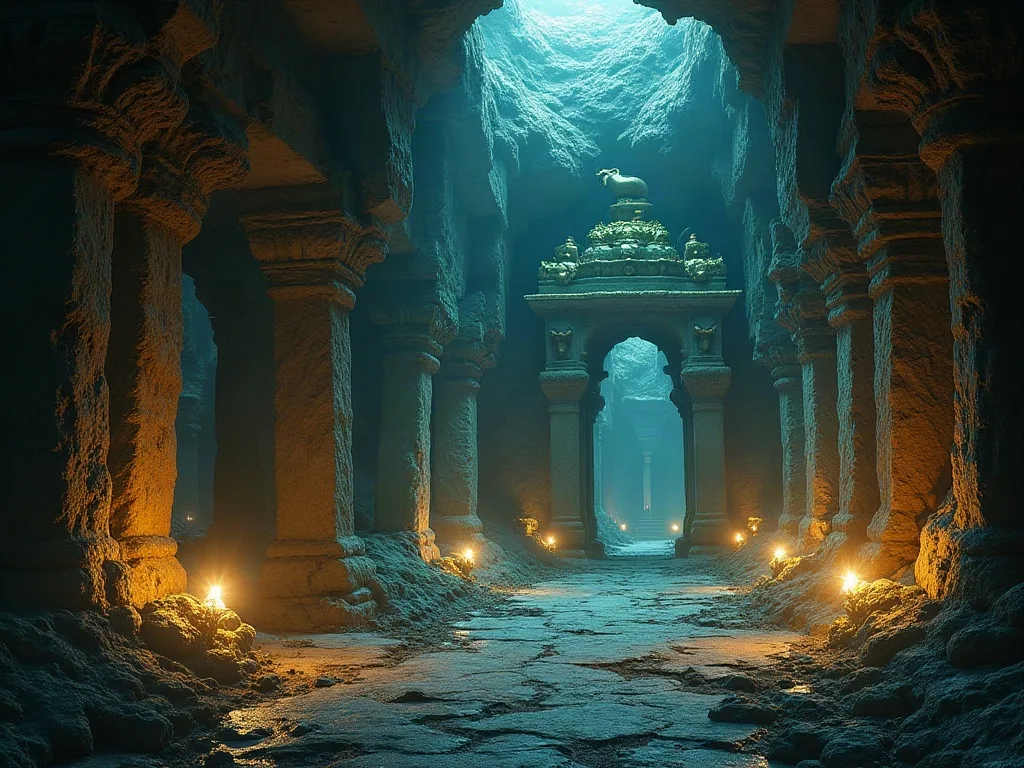
The nagas rule their own realm, called Patala or Nagaloka. This is not the hell of Christian tradition, nor is it merely a place of punishment. Patala is an entire underground dimension, as vast and complex as the world above. It has cities, palaces, gardens, and an elaborate social hierarchy.
At the head of this serpent empire stands a dynasty. The first and most prominent king is Vasuki, the great naga whose body is so immense that it encircles the cosmic mountain Mandara. Vasuki is not a faceless monster. The Mahabharata describes him as a noble being, capable of holding conversations with gods. When the gods and demons churned the Ocean of Milk (a mythological event that generated all the treasures of creation, recounted in the Bhagavata Purana), Vasuki allowed his own body to be used as a rope. His churning generated venom so toxic that it threatened to destroy creation itself, forcing Shiva to drink it and hold it in his throat (which is why he is called the blue-throated one).
Beneath Vasuki rule other great naga kings: Dhritarashtra, Takshaka, and Karkotaka. Each controls a province of Patala. Each has treasures of gold and jewels. Each maintains a court of lesser nagas, naga women (called nagins), and hybrid beings. This underground society mirrors the structure of human kingdoms, evidence that Hindu mythology saw the nagas not as aliens but as an alternate civilization, one with its own laws, customs, and politics.
The wealth of the nagas is legendary. The nagas are guardians of buried treasure, keepers of gems and metals. They coil around hoards in caves and in the depths of the earth. This association with underground wealth connects them to the earth itself, to fertility, to the hidden resources that make life possible. A farmer who discovers gold while digging might be said to have encountered a naga's gift. A healer who finds rare medicinal plants might be honoring an ancient serpent pact.
Shesha: The Cosmic Serpent Who Holds All Worlds
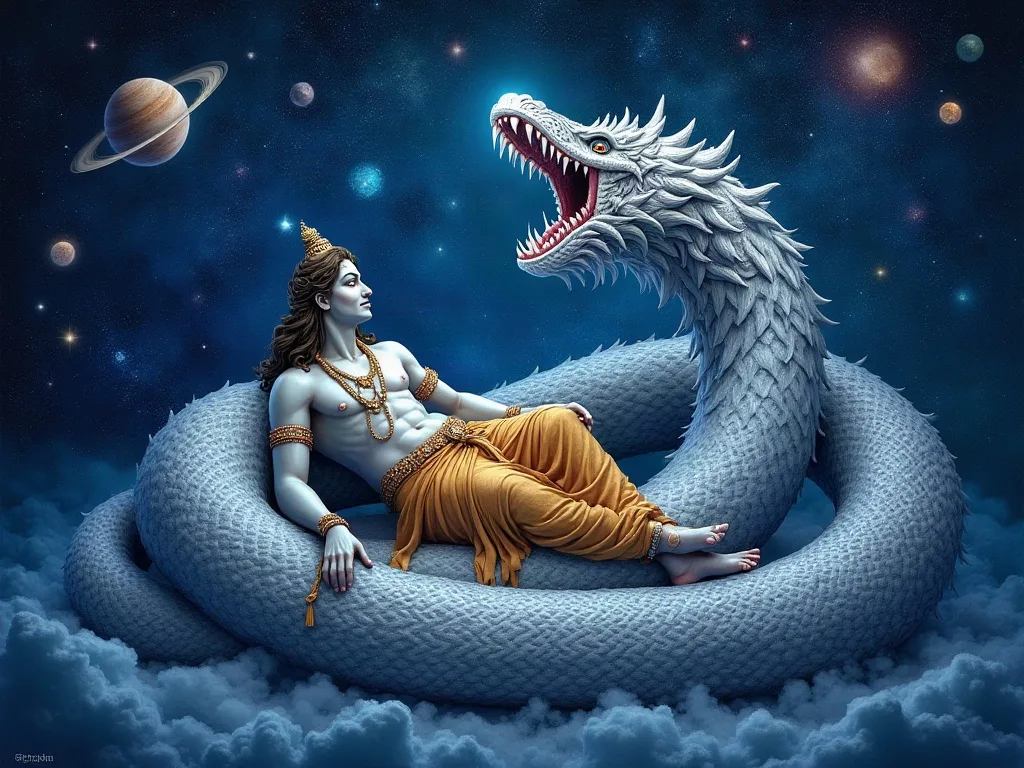
Of all the nagas, one stands apart: Shesha, whose name means "remainder" or "that which is left behind." Shesha is not merely a king among serpents. He is the cosmic principle of support and eternity itself.
Shesha is depicted with a thousand heads, each one a full serpent, spreading like a crown of hoods. Some texts describe him as having ten thousand heads, or infinite heads. He lies coiled in the cosmic ocean, the dark waters that exist before and after creation. On his coils rests the entire world: the continents, the oceans, the sky. When Vishnu descends to earth as an avatar (an incarnation), he reclines upon Shesha's body, using the serpent as a throne and a bed. In one pose, Shesha's serpent hood rises behind Vishnu's head like a halo of protection.
The Bhagavata Purana describes Shesha this way: he is not merely a naga but the king of nagas, the supreme serpent, the embodiment of time itself. Each thousand years, the universe dissolves into the cosmic ocean. Shesha remains. When creation emerges again, Shesha is there, coiled and waiting, ready to bear all worlds upon his back once more. This is why his name means "remainder", he is what persists when everything else returns to the void.
Shesha represents several profound truths. First, that the universe itself rests on a foundation of endless time and eternal support. Second, that the serpent, the most feared of creatures, can be the most sacred. Third, that power and service are inseparable, Shesha rules, but his kingship is defined by his willingness to bear the entire cosmos.
Vasuki at the Churning of the Ocean: The Naga's Sacrifice
One of the most vivid scenes in Hindu mythology involves a naga in a moment of cosmic significance. This is the churning of the Ocean of Milk, recounted in full in the Bhagavata Purana and referenced in the Mahabharata.
At one point in time, the gods (the devas) have grown weak. They have lost their immortality and their strength. The only way to regain them is to churn the cosmic ocean, to agitate it so violently that it yields up amrita, the nectar of immortality. But the gods alone are not strong enough. They must recruit the demons (the asuras) as allies.
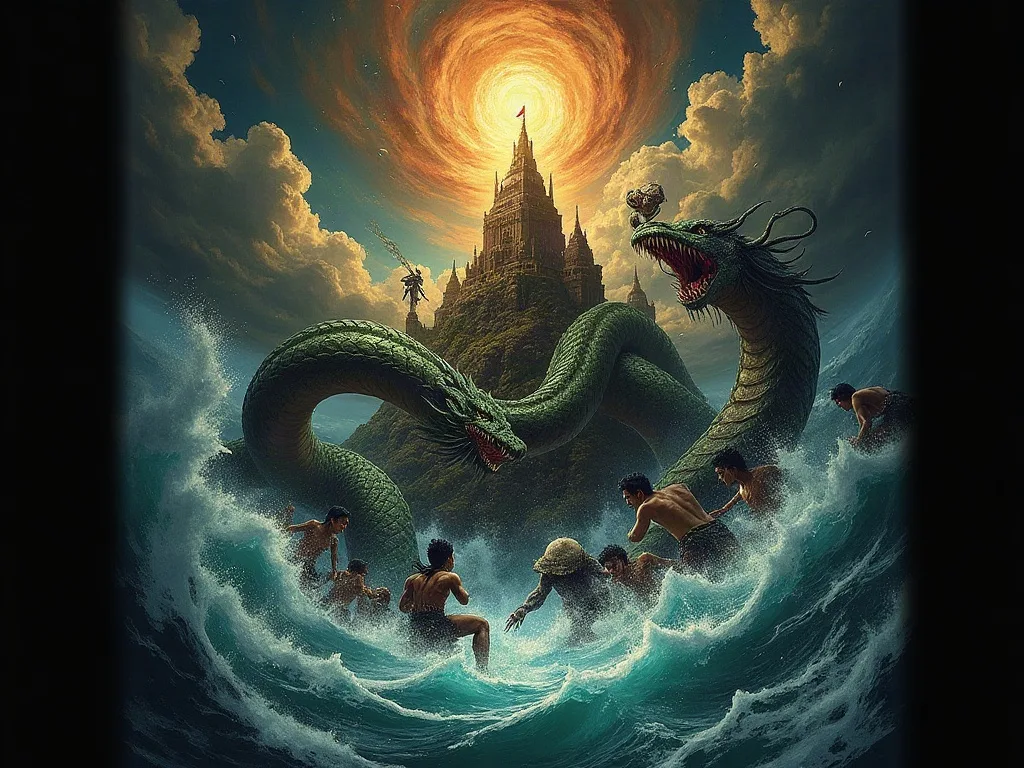
The two forces, gods and demons, gather at Mount Mandara. This mountain will serve as the churning rod. For the rope, they use Vasuki, the great naga king. The demons grasp one end of the serpent; the gods grasp the other. They begin to pull, back and forth, again and again. Mount Mandara turns and turns in the ocean, like a giant drill boring into water and stone.
As they churn, the ocean roils. Fire erupts. Smoke fills the sky. Vasuki thrashes and vomits forth venom so potent that it threatens to destroy both the gods and demons. At this moment, Shiva intervenes. He drinks the poison himself, holding it in his throat, turning his skin blue. Vasuki, the naga, has been willing to suffer and sacrifice. His venom becomes sacred, the mark of transformation.
Eventually, the ocean yields its treasures: Lakshmi (the goddess of wealth and fortune), the white horse, the celestial elephant, the wish-granting tree. And the amrita emerges. The ritual works. But the naga's role is essential. Without Vasuki's strength and sacrifice, creation could not have been renewed.
This myth illustrates something crucial about how Hindus understand nagas. They are not obstacles to overcome. They are allies, even if dangerous ones. They are part of the cosmic machinery. To succeed in creation itself requires negotiating with them, honoring them, and sometimes enduring their venom.
Takshaka: The Naga of Venom and Destiny
Not all nagas are benign. Among the most fearsome is Takshaka, whose name means "carpenter" (because his venom carves decay into the world). Takshaka is remembered primarily for one deed: the death of King Parikshit in the Mahabharata.
Parikshit was a human king, descended from the heroes of the great war recounted in the Mahabharata. At one point, he offended a sage by placing a dead snake around his neck as an insult. The sage's son cursed Parikshit: a naga would bite him and kill him within seven days. When those seven days arrived, Takshaka appeared, disguised as a hermit, and bit the king. The venom spread through Parikshit's body. He died.
But Takshaka is not depicted as evil in the way a modern reader might expect. He is a being bound by dharma (duty and cosmic law). The curse demanded that a naga act. Takshaka fulfilled that duty. The Mahabharata presents his deed not as cruelty but as part of the inevitability of fate. Moreover, Takshaka rules his own region of Patala. He is a king among serpents, governing his kingdom with authority and law.
This story, retold across centuries, established one of the central fears of Hindu culture: the naga's bite. In a world where actual cobras and vipers posed a genuine danger, the myth of the serpent's deadly venom held practical reality. But it also encoded a deeper truth: that life and death, fertility and destruction, are paired. The serpent that fertilizes the earth (through the cycle of decay and renewal) also threatens it.
The Nagin: Serpent Women and Hybrid Love
The mythology of nagas includes a vital female dimension. Nagins are female serpents, often depicted as more beautiful and seductive than their male counterparts. In art and literature, the nagin is typically shown as a woman from the waist up and a serpent from the waist down, or as a woman able to shed her serpent skin like a garment.
The nagin appears frequently in Hindu narrative as a figure of erotic power and danger. One famous tale involves a nagin who falls in love with a human prince and bears his children. She is both devoted and dangerous, if her human lover betrays her, she may strike. This archetype recurs in regional folklore across India: the serpent woman as lover, as mother, as a being suspended between two worlds.
Nagins also appear in temple worship. In many parts of India, particularly in rural areas, serpent worship persists. A nagin may be propitiated during festivals, offered milk and flowers, treated as a protective ancestor. The nagin becomes a guardian figure, a force that must be honored to avert harm but that, if respected, may bring blessing and fertility to the land.
Nagas in the Cosmic Order: Protectors and Enemies of the Gods
The relationship between the nagas and the gods is complex. They are not simply enemies. Yet neither are they allies in any permanent sense. They are, more accurately, figures with whom the gods must continually negotiate.
The god Indra (the king of the gods in Vedic tradition) is particularly associated with the slaying of snakes. The Rig Veda celebrates Indra's defeat of Vritra, a chaos-serpent, in some of the most violent and triumphant language in Hindu scripture. This victory is described as a cosmological necessity: Vritra blocked the flow of waters, preventing creation. Only by slaying Vritra could Indra release the life-giving waters and allow the world to exist.
Yet simultaneously, Vishnu reclines upon the coils of Shesha. Shiva wears snakes. The image of the serpent as enemy and the serpent as sacred companion exist side by side in Hindu thought. This is not a contradiction but a reflection of a central truth: power is ambiguous. The serpent represents the forces of nature, fertility and death, life and venom, creation and destruction, all at once.
Regional Variations: Nagas Across Indian Subcultures
The nagas are not monolithic across the Hindu world. Regional traditions have developed their own interpretations and emphasis.
In South India, particularly in Tamil and Kannada regions, naga worship takes on distinctive forms. The Nagapanchami festival (celebrated in July or August, depending on the lunar calendar) is an occasion to honor nagas. Devotees fast, make offerings of milk and flowers to serpent deities, and recite prayers seeking protection from snakebites and curses. Some regions celebrate by drawing serpent designs in sacred rice paste, or by bathing serpent idols in milk.
In Bengal and Eastern India, the nagin figure is particularly prominent in folk narratives and local cults. Stories of nagins who marry human men and bear hybrid children persist. These tales often encode anxieties about boundaries (between human and animal, between civilization and wilderness, between safety and danger) while also celebrating the possibility of union across those boundaries.
In Kashmir and the Himalayan regions, nagas are closely linked to water, to springs, lakes, and rivers. A mountain stream might be said to have a naga guardian. The serpent becomes a personification of water's life-giving and destructive power.
Across all these variations, one element remains constant: the naga is a being that must be acknowledged, that cannot be ignored or conquered permanently, that represents forces in the world that exceed human control. To live in a world with nagas (literal snakes, mythological serpents, natural forces of water and fertility and death) is to live in a world that is not entirely knowable or manageable. This acceptance of ambiguity and power beyond human mastery is itself a profound teaching.
Nagas in Sacred Architecture and Temple Iconography
The nagas appear not only in myth but in stone. Across Hindu temples, naga symbolism is woven into the very fabric of sacred space.
The naga is a common motif in temple architecture, particularly in South India. Temple gateways (gopurams) are often guarded by serpent figures. The base of temple pillars may feature carved nagas. This placement is deliberate: the serpent stands at the threshold between the profane world and the sacred sanctum. It is both guardian and gatekeeper, keeping out the unworthy while permitting the pure to enter.
In tantric and yogic iconography, the serpent takes on a different meaning. The kundalini, described as a coiled serpent energy resting at the base of the human spine, is said to awaken and rise through the energy centers (chakras) of the body during advanced yogic practice. This serpent is not external but internal, a force within human physiology that connects the material world (represented by the lower chakras) to the divine consciousness (represented by the upper chakras). The kundalini serpent is a naga in miniature, a force of cosmic power contained within the human body.
The Nagas and Water: Guardians of Life's Source
One of the most consistent associations is between nagas and water. Nagas dwell in rivers, lakes, springs, and the underground aquifers that feed the world. They are guardians of these waters, keepers of the life force that flows through the earth.
In many villages across India, local legends preserve memory of a naga or nagin that dwells in a particular well or spring. The serpent is not hunted or harmed; to do so would cause the water source to dry up or become poisoned. This myth encodes practical wisdom: a water source sustained by belief and ritual is more likely to be protected from pollution or over-extraction. The naga mythology, then, is also an environmental ethic.
The association with water connects the nagas to fertility and agricultural abundance. The serpent that embodies water also embodies the monsoon rains, the irrigation channels, the annual flooding of the Ganges, all the hydrological cycles on which agricultural civilization depends. To honor the nagas is to honor the water that makes survival possible.
Nagas in Hindu Festivals and Living Worship
The nagas are not historical or theological abstractions in Hindu practice. They are living presences, honored in festivals and daily rituals across the Indian subcontinent.
Nagapanchami (the Festival of the Serpents) is celebrated primarily in Maharashtra, Karnataka, Andhra Pradesh, and other regions. The name comes from the Sanskrit: naga (serpent) and panchami (the fifth day of the lunar month). On this day, devotees wake early and fast. They draw serpents in colored rice paste (called rangoli) on the ground. They make offerings of milk, honey, and flowers to actual snakes or to serpent deities represented in sacred images. The festival is a moment of propitiation and honor, a time to acknowledge the serpent's power and to seek its blessing and protection.
In many temples dedicated to Shiva or Vishnu, serpents are present in a material form. Live snakes are sometimes kept as sacred beings, fed and cared for by temple priests. This living worship embodies the principle that the naga is not merely a symbol but a reality, the actual serpent is a manifestation of the divine.
Comparative Echoes: Serpents in World Mythology Beyond Hindu Tradition
The nagas invite comparison with serpent figures in other mythologies, reminding us that the serpent occupies a liminal and powerful place across human cultures.
In Mesoamerica, Quetzalcoatl, the feathered serpent god of the Aztecs, combines bird and reptile in a figure of cosmic ambiguity not unlike the naga. Like the naga, Quetzalcoatl is a civilizing force, a bringer of knowledge and order, yet also a figure of power and potential destruction.
In ancient Egypt, Apophis (or Apep) is a chaos-serpent that must be defeated nightly so that the sun can be reborn. This recalls the Hindu image of serpents as forces that must be overcome for creation to continue. Yet the serpent is not wholly evil, it is a natural force that must be managed.
In Norse mythology, the World Serpent Jörmungandr encircles the earth, holding its own tail in its mouth. Like Shesha, Jörmungandr supports and frames the cosmos. Yet Jörmungandr is also destined to participate in the destruction of the world at Ragnarok. The serpent thus bridges creation and destruction, order and chaos.
These parallels suggest that across cultures, humans have recognized something fundamental about the serpent: it is simultaneously a figure of fertility and danger, of cosmic order and cosmic threat. The naga mythology is one expression of this archetype, refined through centuries of philosophical and religious elaboration into a complex system of cosmic principles.
The Nagas in Modernity: From Ancient Text to Contemporary Culture
The nagas have not faded into historical memory. They remain active in contemporary Hindu practice, in folklore, in art, and in popular culture.
In modern India, the nagas appear in films, television series, and graphic novels that reinterpret classical mythology for contemporary audiences. Regional cinema, particularly in South India and in Bengali film, has produced works that explore naga mythology as a lens through which to examine themes of power, desire, identity, and the encounter between civilization and the wild.
The figure of the nagin, particularly, has experienced a resurgence in Indian television. Series that dramatize the life of a nagin warrior or seductress appeal to audiences interested in female power and agency. These modern adaptations often emphasize the nagin's ability to move between human and serpent form, to operate in both the civilized world and the wilderness, to embody a kind of freedom and power that transcends ordinary human categories.
In spiritual and yogic circles, the kundalini serpent remains central to practice and teaching. Western practitioners drawn to yoga often encounter naga symbolism, learning that the serpent coiled within the body is not a threat but a source of power and transformation.
Academic scholarship has deepened understanding of the nagas as reflecting genuine religious concepts about power, duality, and the ambiguity of nature itself. Rather than dismissing the nagas as mere superstition or primitive serpent worship, scholars recognize them as expressions of sophisticated metaphysical thinking about the nature of creation, time, and cosmic order.
Frequently asked questions about the nagas serpent beings
Frequently asked questions
Why do the nagas represent both good and evil in Hindu mythology?
The nagas embody the Hindu principle of duality, known as the interplay of opposing forces. In nature, the serpent is both life-giver (through its association with water and fertility) and life-taker (through its venom). Hindu philosophy does not divide reality into absolute good and evil, but rather sees opposing forces as complementary aspects of a unified cosmos. The naga, as a bridge between opposites, reflects this core teaching.
What is Shesha, and why does Vishnu recline on him?
Shesha is the great cosmic serpent with a thousand heads who coils beneath the universe, supporting all worlds on his body. He represents eternal time, infinite support, and the principle that creation rests upon a foundation of endless duration. Vishnu reclines on Shesha because the act represents divine rest within creation, the god permits creation to exist by trusting in the naga's eternal support. This image also shows that the highest god honors the serpent as an equal cosmic principle.
Are the nagas ever depicted as purely benevolent, or are they always ambiguous?
The nagas are most commonly depicted as ambiguous. Even great naga kings like Vasuki or Dhritarashtra are both noble and dangerous. However, some texts and regional traditions emphasize protective and healing aspects. In temple worship and village religion, local nagas are often propitiated as guardians and bringers of blessing. The ambiguity reflects the reality that natural forces, water, weather, the life cycle, are neither wholly benevolent nor malevolent but neutral powers that must be respected and understood.
What role do nagins (female serpents) play in Hindu mythology?
Nagins are female nagas, often portrayed as more seductive and emotionally complex than their male counterparts. They appear as lovers of humans, as mothers bearing hybrid children, as guardians of sacred spaces, and as figures of power in their own right. In regional folklore and modern retellings, nagins are often central agents rather than supporting figures. They embody the intersection of civilization and wilderness, reason and desire, human and divine.
Is Nagapanchami still widely celebrated in India today?
Yes. Nagapanchami (the Festival of Serpents) is widely celebrated across India, particularly in regions such as Maharashtra, Karnataka, and Andhra Pradesh. Devotees fast, draw serpent designs in rice paste, and make offerings of milk and flowers to serpent deities. The festival remains an expression of living Hindu tradition, blending ancient mythology with contemporary practice. Even in urban areas, many Hindus observe the festival as a way to honor serpents and seek protection and blessing.
How do the nagas connect to the kundalini serpent in yoga and tantra?
In yogic philosophy, the kundalini is described as a divine serpent energy coiled at the base of the spine. When awakened through practice, it rises through seven energy centers (chakras) to the crown of the head, bringing enlightenment and transformation. The kundalini is a naga in miniature, an internal representation of cosmic serpent power. The kundalini's journey mirrors the naga's role as a force that connects the material and divine realms, the earthly and the transcendent.
The Naga's Enduring Mystery: Why the Serpent Remains Sacred
The nagas persist in Hindu consciousness because they represent something that cannot be fully rationalized or conquered. They are the serpent in the well, the cobra at the crossroads, the hidden force beneath the earth, realities that every person who lives on the Indian subcontinent may encounter at any moment.
But they are more than that. The nagas encode a philosophical truth: that the universe rests on principles that exceed human understanding and control, that power is ambiguous and dual, that the forces that threaten life are inseparable from the forces that sustain it. To know the nagas is to accept that reality is stranger and vaster than certainty allows.
This is why temples still honor them, why festivals are still celebrated, why the kundalini serpent still awakens in yogic practice, and why the nagin still walks through contemporary stories, beautiful and dangerous, neither fully of the human world nor entirely other. The naga is not a relic of the past. It is a teaching, alive in stone and story, in scripture and ritual, in the earth beneath our feet and in the coiled potential within our own spines.
Free 25-page sample
Want the whole story?
Take the first 25 pages free. If it pulls you in, the full edition is yours as an instant PDF download, with a paperback on Amazon for selected titles.

Mythology
The World Mythology Book: The Gods, Heroes and Myths of Every Culture
The Gods, Heroes and Myths of Every Culture, in One Volume
The whole of world mythology in a single volume: Greek, Norse, Egyptian, Japanese, Hindu, Celtic, Slavic, Mesoamerican and African myths gathered side by side, each drawn from the primary sources.