
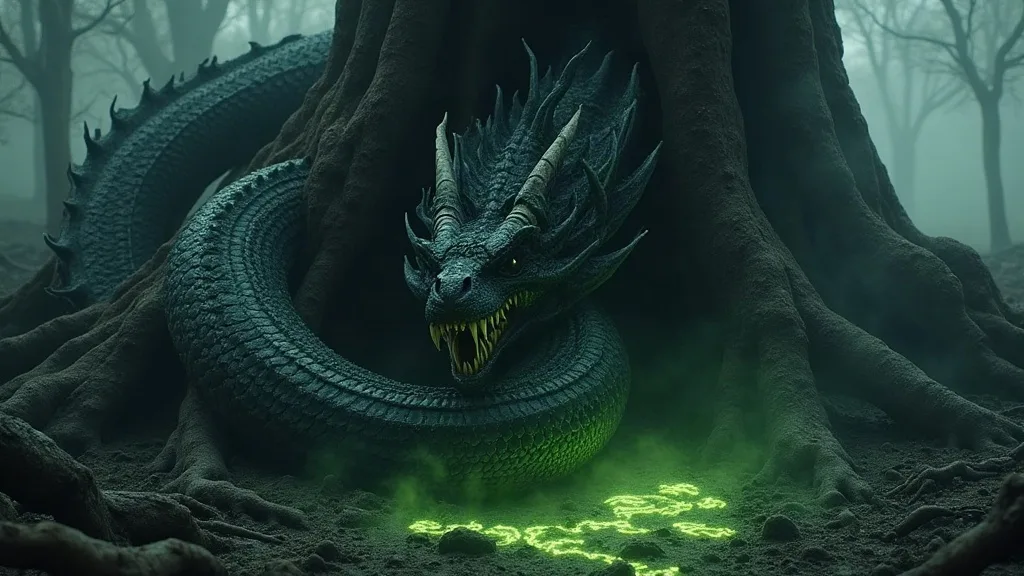
Nidhogg the Corpse-Eater: The Dragon Who Gnaws the World Tree
Nidhogg, the corpse-eating dragon of Norse mythology, gnaws at the roots of Yggdrasil while feasting on the dead. Discover the creature who embodies decay, destruction, and the inevitable end of all things in the Viking cosmos.
Contents
At the deepest roots of Yggdrasil, where even light dies, a dragon coils in shadow. Its name is Nidhogg the corpse eater, and for ages beyond counting, it gnaws at the foundation that holds the nine worlds. The creature does not hunger for gold or maiden hearts like dragons of other stories. It feeds on death itself, on corpses and betrayal and the breaking of oaths. When Ragnarok comes, when the worlds burn and the tree trembles, Nidhogg will rise at last.
The Vikings saw this dragon not as a monster to conquer, but as a force of nature: inevitable, terrible, and absolutely essential to how the cosmos works. Without Nidhogg's hunger, there would be no decay. Without decay, there would be no change, no ending, no making room for what comes next. The creature was woven into the fabric of Norse cosmology so deeply that the gods themselves could not stop it, only watch and wait.
This is the story of Nidhogg, the dragon who gnaws the world tree, and what that hunger means for everything that lives.
The Roots of the World Tree: Where Nidhogg Dwells
The Norse cosmos is built on a single structure: Yggdrasil, an immense ash tree that holds all nine worlds in its branches and roots. The poem called the Poetic Edda, a collection of Old Norse verses preserved from around the 10th century, describes this tree in haunting detail. At Yggdrasil's base, three roots stretch into three different lands. One root reaches into Asgard, home of the Aesir gods. Another plunges into Jotunheim, the realm of giants. The third descends into Niflheim, the primordial realm of ice and mist.
Nidhogg makes its lair far below, in one of the deepest pits of Niflheim. The Prose Edda, a 13th-century guide to Norse mythology written by the scholar Snorri Sturluson, describes it plainly: "Nidhogg's name is a dragon, and bites the roots of Yggdrasil below." It does not merely live there. It gnaws, constantly, relentlessly, chewing at the very wood that holds existence together.
The tree itself is ancient beyond measure, immortal yet not invincible. Its bark never withers, its branches never break with age, but they can be damaged. Nidhogg is that damage, made flesh and hunger. Every bite weakens the root. Every day it gnaws, the world tree grows a little less stable.
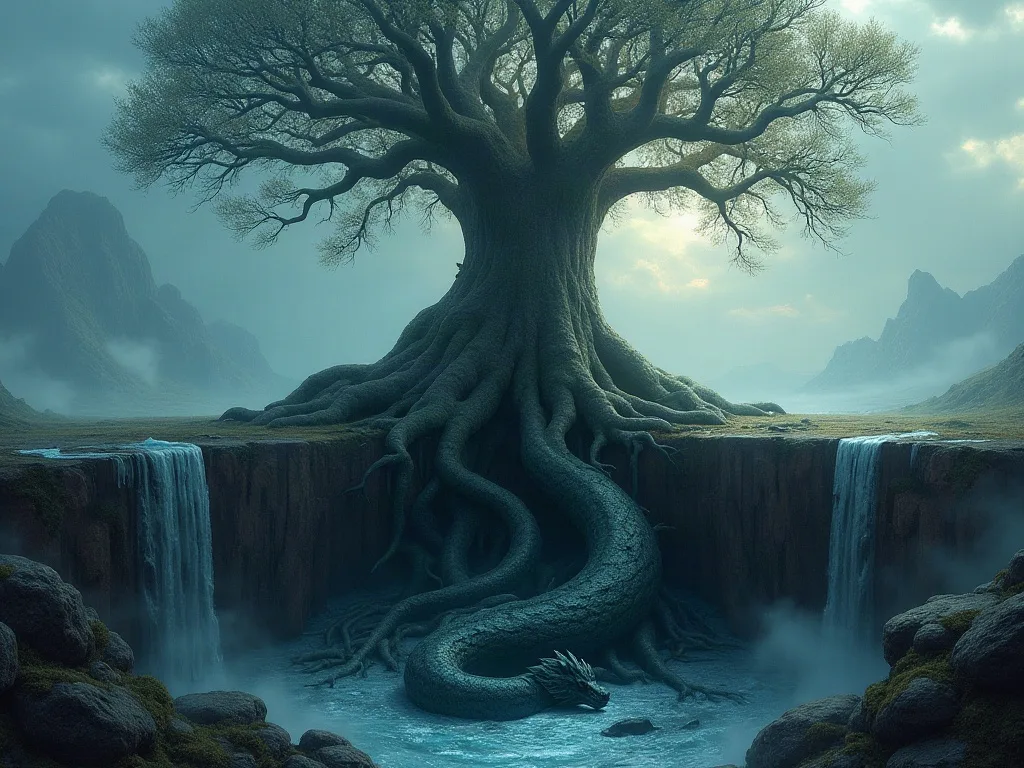
The dragon is not alone in its work. Around it writhe serpents and worms without number, all gnawing and twisting in the darkness below the world. The Poetic Edda mentions a serpent named Jormungandr, the world serpent, who also challenges the cosmic order (though most sources place him in the ocean, not at Yggdrasil's roots). Nidhogg has a different role, a slower one. While other creatures scheme and strike, Nidhogg simply eats, consuming the very structure that holds the nine worlds.
What Nidhogg Feeds On: Death, Oaths, and Betrayal
Nidhogg the corpse eater is not called by that name by accident. The creature's primary food is death itself. The Poetic Edda tells us that Nidhogg gnaws not only the roots of the world tree but also the corpses of the dead. In the Norse cosmology, the dead do not all go to the same place. Some fall to Hel, a cold underworld ruled by a half-living goddess of that name. Others are burned or buried with their possessions. But Nidhogg consumes them all, in a sense: it devours the essence of death, transforming ending into the substance that keeps it alive.
This is where Nidhogg differs from the fire-breathing, treasure-hoarding dragons of other Norse tales, such as Smaug (who appears in The Hobbit, a modern work inspired by Norse tradition). Nidhogg does not want silver or swords. It wants what everything that lives must eventually become: waste, decay, the return to nothing. The dragon is, in a real sense, doing the work that must be done.
There is also something darker in Nidhogg's hunger. Some Norse poems associate it with the breaking of oaths and the betrayals that tear communities apart. An oath broken is a kind of death: trust dies, bonds are severed, the social fabric rots. Nidhogg feeds on that too. The creature embodies the consequences of human failing as much as natural decay.
In this way, Nidhogg is less monster and more principle. It is entropy given teeth and malice. The Vikings did not pray to slay it, as warriors prayed to slay giants or other foes. Instead, they acknowledged it: a power in the world that must be, that cannot be stopped, that will eventually claim everything.
Nidhogg and Yggdrasil's Stability: A Constant Threat
What happens if Nidhogg gnaws through the root? This is a question the Norse took seriously. According to the Prose Edda, the consequence is catastrophic. If the dragon succeeds in fully severing the root that anchors Yggdrasil to Niflheim, the entire tree will begin to topple. The nine worlds will separate. Reality itself will destabilize.
This is not a distant threat. The gnawing is always happening. Every moment, every day of the age of the world, Nidhogg works. The tree does not grow weaker visibly, but it is always in danger. This gives the Norse cosmos a peculiar tension: it is stable, yet fragile. The gods maintain order and beauty in Asgard; the Aesir and Vanir rule justly; civilization grows in Midgard, the world of humans. Yet underneath, in the dark places, the work of dissolution never stops.
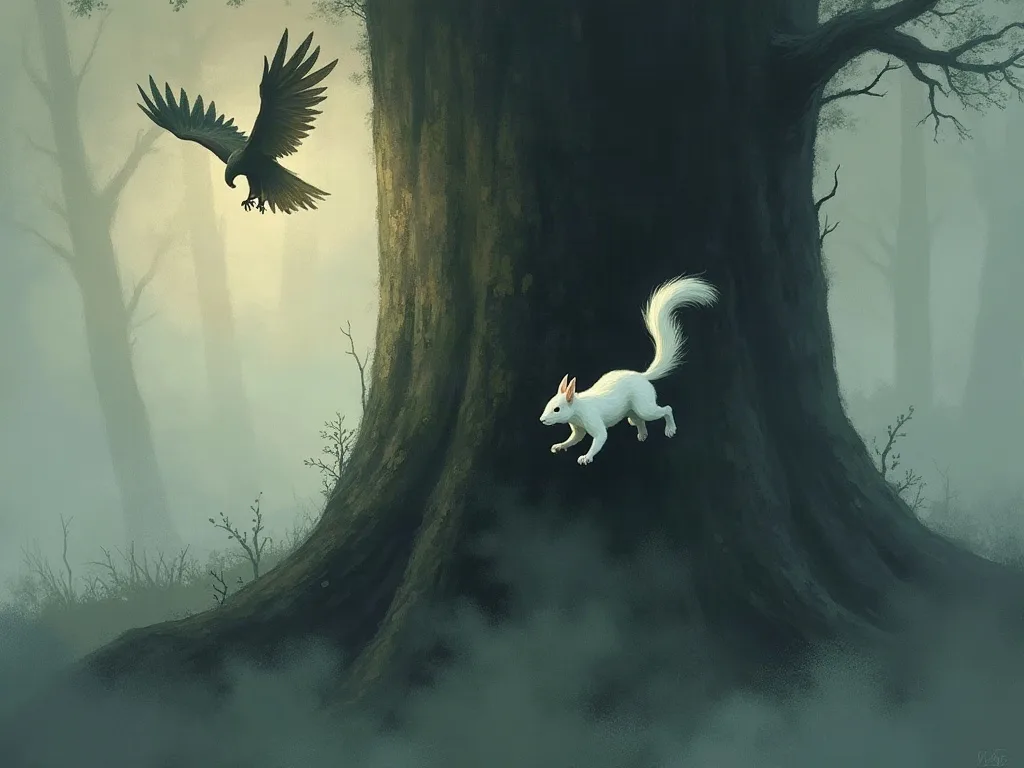
The Poetic Edda also mentions a creature called the squirrel Ratatosk, who lives in the branches of Yggdrasil and runs up and down the trunk carrying messages. One of its tasks is to run between Nidhogg below and an eagle perched in the highest branches, carrying insults and provocation back and forth. It is a strange, almost comic image: while the dragon gnaws at the roots and the eagle watches from above, this small creature scurries between them, stirring enmity. It suggests that even the cosmic order is riddled with small conflicts and tensions, layers of antagonism from the smallest creature to the largest.
Nidhogg's Role in Ragnarok: The Final Gnawing
The Nidhogg corpse eater dragon plays a crucial role in Ragnarok, the Norse apocalypse. In the Poetic Edda poem called the Voluspa (The Seeress's Prophecy), which describes the end of the world, Nidhogg appears at the climax of destruction.
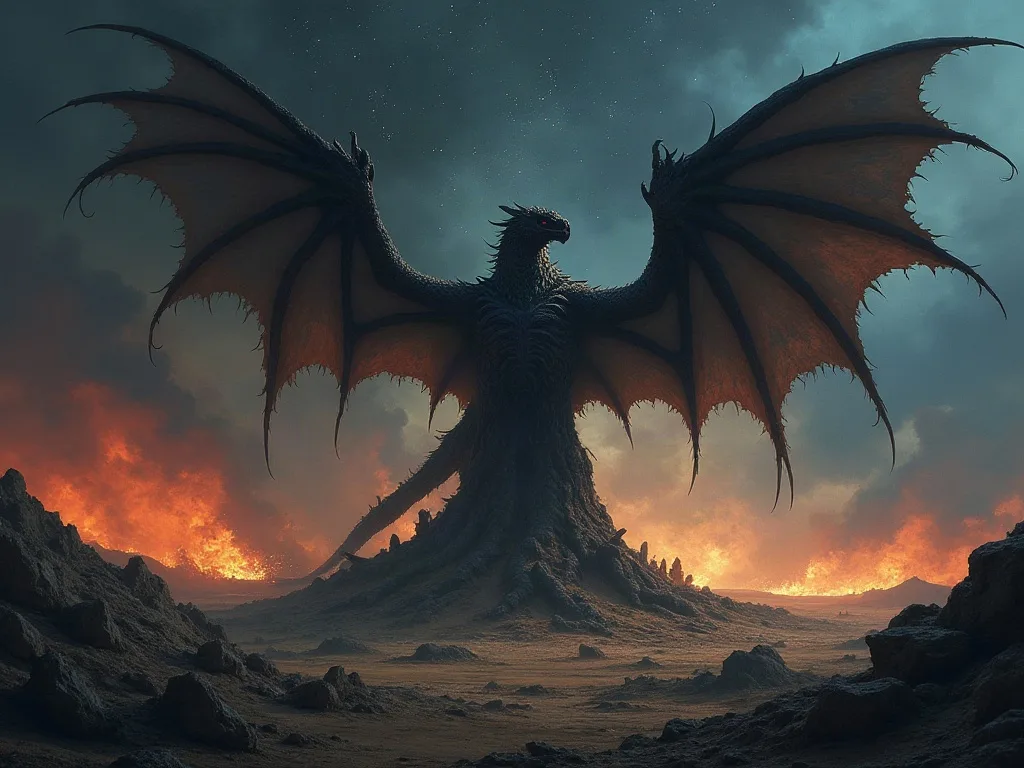
When Ragnarok begins, the world trembles. The Bifrost bridge cracks. The giants break free from their bonds. The stars vanish from the sky. In this chaos, Nidhogg finally completes its work. Having gnawed through enough of Yggdrasil's roots, the tree begins to fall. As it does, Nidhogg rises from the darkness, flying upward with its wings spread wide, carrying corpses on its wings. It is described as emerging from Niflheim in triumph, no longer hidden in shadow but revealed in catastrophic light.
This is Nidhogg's true moment: not a defeat, but a victory. The creature has been patient for an age, gnawing slowly while the gods ruled and humans lived and civilization flourished. When everything ends, Nidhogg is vindicated. Decay wins. The beautiful ash tree falls. The order the gods built crumbles. The dragon rises.
But even Ragnarok is not the end in Norse mythology. After the fire and flood, the world is reborn. New life emerges. Yggdrasil's roots remain, and new branches grow. In some versions of the myth, Nidhogg survives even this apocalypse, preserved to gnaw on the roots of the new world tree. Death and decay are not destroyed; they are eternal, recycled, necessary. The corpse-eater dragon continues its work in the new age.
Nidhogg and Dragons in Cross-Cultural Mythology: A Different Kind of Beast
To understand what makes Nidhogg unique, it helps to see what Norse dragons are not. In many mythologies, dragons are hoarded-wealth guarding lords of fire, or serpentine tricksters, or chaos monsters that must be defeated by a hero. The Greek Typhon, a titan-dragon hybrid, fought Zeus for supremacy. The Mesopotamian dragon Tiamat embodied primordial chaos and was slain by the young god Marduk. In each case, the dragon represents something to be overcome.
Nidhogg is different. It is not an enemy to be conquered. The Norse gods cannot kill it, do not try to kill it, and recognize that they should not. Instead, it is a cosmic function. It is what must be, what allows the universe to work as it does.
This reflects a deeper difference in how the Norse imagined their world compared to many other mythologies. The Greek and Mesopotamian cosmos tends toward order imposed by divine power: Zeus rules through strength, Marduk through victory. The Norse cosmos is older, colder, and more fatalistic. The gods know that Ragnarok is coming. They know they will lose. They fight and live anyway, not because they will win, but because struggle and courage matter even in the face of inevitable defeat.
Nidhogg embodies this vision. It is not evil, not in the way a chaos monster is evil. It is necessary. The corpse-eater dragon does what must be done, and the cosmos is shaped by accepting that work rather than denying it.
The closest parallel in other traditions might be the Hindu concept of Kali, the dark goddess of destruction and renewal. Like Nidhogg, Kali's work of destruction is not something to be mourned but something to be accepted as part of the eternal cycle. Both figures challenge the idea that the divine must always mean order and light. Sometimes the sacred wears a darker face.
Sources in Stone and Parchment: What We Know of Nidhogg
Our knowledge of Nidhogg comes primarily from two sources: the Poetic Edda and the Prose Edda. The Poetic Edda is a collection of Old Norse poems, some of which were likely composed before the Christianization of Iceland in the year 1000 CE. These poems were preserved orally for centuries before being written down in a manuscript called the Codex Regius, copied around 1270. The language is sparse, poetic, and often cryptic. The poems do not explain the myths systematically; they assume the audience knows the stories and focuses on evoking atmosphere and emotion.
The Prose Edda, written by Snorri Sturluson around 1220 CE, is a different kind of text. It is a handbook, a guide written to teach poets how to use Norse mythology in their verse. Snorri was a Christian, writing after Iceland had converted, and his goal was to preserve the old stories so that poets could still reference them with accuracy. The Prose Edda is more straightforward and explanatory, though it is also closer to that original Christian perspective.
Both sources describe Nidhogg, but neither gives vast detail. The creature is mentioned in key moments: living at Yggdrasil's roots, gnawing the corpses of the dead, flying upward at Ragnarok with corpses on its wings. The Vikings seem to have known much more through oral tradition, through tales told in halls on long winter nights. What survives in the Eddas is the skeleton of a much larger story.
This is both a strength and a challenge for understanding Nidhogg. The lack of detail invites imagination; the creature is powerful precisely because it is not fully explained. But it also means that some aspects of the myth are simply lost to time.
Why Nidhogg Matters: Reading the Dragon as Philosophy
To the modern reader, Nidhogg might seem like a simple monster in a far-off mythology. But the creature represents something profound about how the ancient Norse understood reality. They lived in a harsh climate, at the edge of the known world. Seasons came and went with brutal swiftness. People died young. Crops failed. Ships sank in storms. The Vikings knew intimately that human life is fragile and temporary.
This experience shaped how they imagined the cosmos. They did not picture a world governed by eternal progress or divine benevolence. Instead, they saw a world held together by constant effort, always threatened by forces beyond human control, and destined eventually to fail. This is not pessimism, exactly. It is realism. And within that realism, the Norse found meaning: live well while you can, honor your oaths, face difficulty with courage, and know that death comes for everyone.
Nidhogg the corpse eater dragon is the mythological embodiment of that knowledge. It is the dragon that cannot be defeated because it should not be defeated. It is the principle of ending, and the Norse cosmos depends on it. Without Nidhogg, there would be no decay, no change, no renewal. The creature is horrible and necessary at once.
In a world that often presents death and decay as enemies to be fought and overcome, Nidhogg offers a different perspective. It suggests that some forces in existence are not enemies but partners in a larger dance. The work of dissolution is as important as the work of creation. The corpse-eater, however dark, has a place in the order of things.
Frequently Asked Questions About Nidhogg the Corpse-Eater Dragon
Frequently asked questions
What exactly does Nidhogg eat?
According to the Norse texts, Nidhogg feeds primarily on corpses of the dead and the roots of Yggdrasil itself. Some sources also associate it with consuming the consequences of broken oaths and betrayals. The creature does not hoard treasure like other dragons; death and decay are its only sustenance.
Could the Norse gods kill Nidhogg?
The texts never suggest that the gods attempted to slay Nidhogg or that they could. The creature is presented as a cosmic force woven into the structure of existence, not an enemy to be defeated. Its work is necessary, even if it leads ultimately to Ragnarok. The gods accept this rather than resist it.
Does Nidhogg survive Ragnarok?
In some versions of the myth, yes. Nidhogg persists even after the apocalypse and continues to gnaw at the roots of the reborn Yggdrasil in the new world. This suggests that decay and renewal are eternal cycles rather than one-time events.
How does Nidhogg compare to other world-destroying creatures in mythology?
Unlike the Greek Typhon or Mesopotamian Tiamat, who are defeated by gods, Nidhogg is never conquered. The Norse dragon represents an accepted principle of cosmic decay rather than chaos to be overcome. This reflects a fundamental difference in how Norse and Mediterranean cultures imagined divine order and the limits of divine power.
Why is Nidhogg called the corpse-eater?
The name Nidhogg may derive from Old Norse roots meaning 'malice' or 'spite' combined with a word for 'striking' or 'gnawing'. The corpse-eating element comes from the texts that describe it devouring the dead. Together, the name emphasizes both the creature's hunger and its role as an agent of decay and consequence.
The Corpse-Eater in Modern Memory: When the Dragon Gnaws at Culture
Nidhogg has been revived and reinterpreted countless times since the Norse Age ended. The creature appears in fantasy literature (notably in Tolkien-inspired work), in video games, in metal bands with Norse themes, and in the efforts of various modern traditions to reclaim Norse spirituality. Sometimes Nidhogg is depicted as a cosmic villain, sometimes as a misunderstood force. These modern visions tell us as much about ourselves as about the original myth.
What is interesting is how modern retellings often struggle with the Norse acceptance of Nidhogg. Many cannot resist trying to make it defeatable, or to frame its work as fundamentally wrong. The corpse-eater dragon becomes a problem to solve rather than a principle to accept. This reflects our modern discomfort with death and decay, our drive to overcome rather than to coexist.
The original myth, by contrast, offers something different. It does not resolve the problem of Nidhogg; it makes peace with it. The dragon gnaws. The tree weakens. The end comes. And then, improbably, the world is reborn. There is no triumph, no hero's victory, no rescue from above. There is only the cycle: growth and decay, life and death, ending and beginning again. The corpse-eater dragon is the maestro of that rhythm, and the Norse understood themselves to be dancing to its ancient beat.
Nidhogg remains one of mythology's most patient creatures: not rushing, not roaring, but quietly, steadily gnawing at the roots of the world, waiting for the day when its work is finally revealed.
Free 25-page sample
Want the whole story?
Take the first 25 pages free. If it pulls you in, the full edition is yours as an instant PDF download, with a paperback on Amazon for selected titles.

Mythology
The World Mythology Book: The Gods, Heroes and Myths of Every Culture
The Gods, Heroes and Myths of Every Culture, in One Volume
The whole of world mythology in a single volume: Greek, Norse, Egyptian, Japanese, Hindu, Celtic, Slavic, Mesoamerican and African myths gathered side by side, each drawn from the primary sources.