
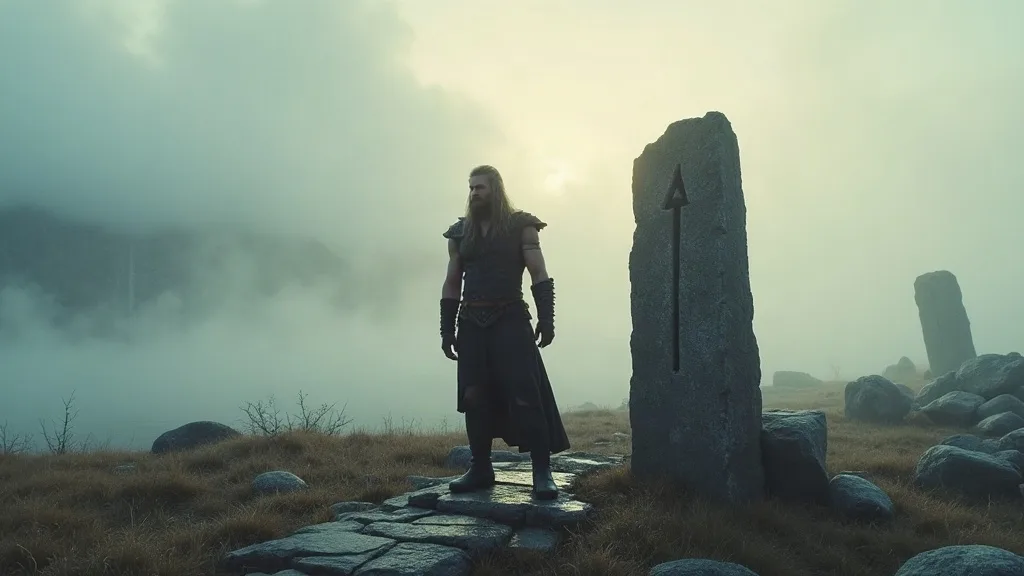
Tyr: The Norse God of War and Justice
Tyr gave his hand to bind the wolf Fenrir and became the god who holds law above survival. Explore his myths, his Proto-Indo-European roots, and why the Eddas call him the boldest of the Aesir.
Contents
The wolf lunged forward. The chain snapped. Again. Every fetter the Aesir had placed on Fenrir had been torn apart like thread. So the gods went to the dwarves of Svartalfheim and came back with something new: Gleipnir, a ribbon so thin it looked like silk, yet forged from the sound of a cat's footstep, the roots of a mountain, the sinews of a bear. Fenrir was no fool. He refused to be bound unless one of the gods placed a hand inside his jaws as a pledge of good faith.
Every god stepped back. Except one.
Tyr, the one-handed Aesir, reached forward and laid his right hand between the wolf's teeth. Fenrir strained against Gleipnir, found he could not break it, and bit down. The gods laughed, all of them, except Tyr. He had known what the pledge would cost. He paid it anyway. That single act, a deliberate and reasoned sacrifice for the good of all, is the core of everything the Norse tradition says about this god.
Who Is Tyr? Name, Origins, and Proto-Indo-European Roots
The name Tyr (Old Norse: Týr) descends directly from the Proto-Indo-European root *Dyeus, meaning "shining sky" or "daytime sky." This single root also produced the Latin Deus (god), the Greek Zeus, the Sanskrit Dyaus Pita (sky father), and the Vedic Dyaus. Tyr is not a later invention of the Norse imagination. He is one of the oldest divine concepts in the entire Indo-European tradition, a deity whose name was already ancient when the Romans carved their first temples.
Germanic peoples knew him as Tiw or Tiwaz. The Romans, always eager to map foreign gods onto their own, called him Mars Thingsus, linking him to both the war god Mars and the thing, the Germanic law assembly. That double identification is the key to understanding Tyr: he governs both battle and the legal order that battle is supposed to protect. An inscription from the third century AD at Housesteads on Hadrian's Wall actually names him Mars Thingsus, showing that Roman soldiers stationed in Britain already recognized this pairing.
Tuesday carries his name directly. Old English Tiwesdæg, "Tiw's Day," became Tuesday, just as the Roman dies Martis (Mars's Day) became the French mardi. The parallel reinforces what the Romans saw: Tyr and Mars occupied the same structural slot in their respective pantheons, though Tyr's character would take a distinctly different shape.

Tyr in the Eddas: The Primary Sources
Two main texts preserve the Norse myths as we now have them. The Prose Edda, written by the Icelandic scholar Snorri Sturluson around 1220 AD, and the older Poetic Edda, a collection of poems compiled in the Codex Regius manuscript around 1270 AD but containing verses far older than that. Both describe Tyr, though the Prose Edda gives him the most explicit definition.
In the Gylfaginning section of the Prose Edda, Snorri writes that Tyr "is the most daring and bold, and he has great power over victory in battles; it is good for men of action to invoke him." He adds that "he is so wise that it is also said of anyone who is especially sagacious, that he is Tyr-wise." Tyr-wise: a compound that puts intelligence and courage side by side as a single quality. That is not how most cultures describe a war god.
The Poetic Edda mentions him more briefly. In the poem Sigrdrífumál, the valkyrie Sigrdrifa instructs the hero Sigurd to carve runes of victory and name Tyr twice, a formula for invoking power in combat. The Lokasenna, a poem in which the trickster Loki trades insults with every god in Asgard, includes Tyr, and the exchange is pointed: Loki reminds Tyr that he lost his hand, and Tyr replies without flinching, pointing out that at least Loki's wife is loyal, which she is not. Tyr does not rage. He argues.
The Binding of Fenrir: A Sacrifice Built on Law
The Fenrir story, told most fully in the Gylfaginning, is worth reading slowly because its logic is subtle.
Fenrir the wolf was the son of Loki and the giantess Angrboda. The Norns had prophesied that Fenrir would swallow Odin at Ragnarok, the final battle. So the Aesir resolved to bind him before that day arrived. They tried two iron fetters in succession: Loeding and Dromi. Fenrir broke both with ease and wore the feat as a badge of pride. The Aesir then asked the dwarves of Svartalfheim to craft something no physical force could shatter.
The dwarves returned with Gleipnir, made from six impossible things: the sound of a cat's footstep, the beard of a woman, the roots of a mountain, the sinews of a bear, the breath of a fish, and the spittle of a bird. None of these things exist, which is precisely why Gleipnir is unbreakable; it is woven from the world's own logical impossibilities.
Fenrir looked at the ribbon and suspected treachery. He agreed to be bound only if a god placed a hand in his mouth as collateral. The gods deliberated. Placing your hand in a wolf's mouth as a token of honest intent is an oath gesture, a legal act. If the gods lied, the wolf had the right to take the hand. If the gods told the truth and Gleipnir were harmless, the hand would be returned unharmed.
Tyr stepped forward.
What makes this moment so carefully crafted in the Norse imagination is that Tyr knew the Aesir were lying. Gleipnir was not harmless. It was designed to hold. The gods had no intention of freeing Fenrir once he was bound. So Tyr's hand was forfeit from the moment he extended it. He was not tricked. He chose, fully informed, to pay the price of a necessary deception with his own body. He bore the cost so that the lie would have legal standing. It is the single most morally complex act in the Eddas.
Fenrir could not break free. He bit down on Tyr's wrist. The god bore it in silence. From that day, Tyr is depicted with one hand.

Tyr as the God of the Thing: Law Before Battle
The Roman identification of Tyr with Mars Thingsus deserves more attention than it usually gets. The thing (Old Norse: þing) was the public assembly where Germanic and Norse communities gathered to settle disputes, make laws, and pass judgments. It was not a casual gathering. The thing was the highest legal authority a free person could appeal to. Calling Tyr the god of the thing means he presided over the entire structure of Norse civic life.
This is why modern scholars like Rudolf Simek, in his Dictionary of Northern Mythology (1993), describe Tyr as a "sky and war god" who also "played an important role in legal matters." Georges Dumézil, the French comparative mythologist whose three-function theory shaped twentieth-century Indo-European studies, saw Tyr as an embodiment of what he called the sovereign function, specifically the juridical and contractual pole of sovereignty. Where Odin represented magical, unpredictable sovereignty, Tyr represented the sovereignty of the oath, the covenant, and the fair judgment.
That framing reorients the whole picture. Tyr is not a berserker. He is not a god who glorifies slaughter. He governs the outcome of battles that have already been declared lawful, victories won through righteous cause. A warrior invokes Tyr not for blind aggression but for justified force, the kind of force that society, gathered at the thing, would recognize as correct.
Tyr at Ragnarok: The Final Duel
At Ragnarok, the apocalyptic battle described in the Voluspa poem of the Poetic Edda, every major Aesir god faces a nemesis. Odin fights Fenrir. Thor faces the Midgard Serpent. Freyr, weaponless, is killed by the fire giant Surtr.
Tyr's opponent is Garm, the hound who guards Hel's realm, a creature of monstrous size and ferocity described in the Voluspa as howling before Gnipahellir, the cave at the entrance to the underworld. The stanza is short and brutal: Tyr and Garm kill each other. Both fall.
The symmetry matters. Tyr, who gave his hand to contain one monstrous canine, dies fighting another at the end of all things. This is not coincidence in a tradition where the Norns weave fate into every life. His entire mythic arc begins with a wolf and ends with one. The man who understood that law must sometimes pay a price in blood pays the final price at Ragnarok.
What survives him is the principle he embodied. Norse cosmology does not end at Ragnarok. The Voluspa describes a new earth rising from the sea afterward, green and renewed. Tyr does not reappear in the post-Ragnarok world in the surviving texts, but the values his myths encode, oath-keeping, courageous sacrifice, the subordination of personal safety to collective survival, are precisely the values that make a renewed world possible.
Tyr Across Traditions: Mars, Ares, and the Justice Warriors
The comparison between Tyr and other Indo-European war gods reveals how distinctly moral his character is.
Tyr (Norse)
Tyr governs lawful battle and the outcome of just conflicts. He sacrifices his own body as a legal pledge. He is described as wise, not bloodthirsty. His war is purposeful, restrained, and bound to civic order. The Prose Edda praises him for sagacity as much as courage.
Ares (Greek)
Ares in the Greek tradition is feared and often mocked by the other Olympians. He represents the raw violence of combat with no necessary moral direction. Homer's Iliad shows him fighting for Troy against the Greeks, then being wounded by the mortal Diomedes and fleeing to Olympus in pain. He is powerful but not admired.
The Roman Mars offers a middle ground. He began as an agricultural deity and only gradually became the god of war through Rome's military expansion. By the imperial period, Mars was a god of ordered military power, protective of Rome, not merely hungry for blood. That Roman version is much closer to Tyr than Ares is.
The Vedic parallel is equally instructive. Varuna, the great Vedic deity of cosmic order, rta (the Sanskrit word for the right ordering of the universe), and oath-enforcement, carries an authority that directly echoes Tyr's function. Varuna punishes those who break their word. He watches all covenants. If Tyr is the Norse form of the *Dyeus root, and Varuna occupies the juridical-sovereign slot in the Vedic system, then Georges Dumézil's argument that they represent parallel survivals of a single Proto-Indo-European function becomes very hard to dismiss.
Odin eventually absorbed much of Tyr's older sovereignty role in the Norse tradition, which is why Tyr appears less frequently in the Eddas than a god of his age would suggest. Scholars like Hilda Ellis Davidson, in her Gods and Myths of Northern Europe (1964), argued that Tyr was probably more central in earlier Germanic religion and that the rise of the Odin cult gradually displaced him from the top tier. The rune named after him, the Tiwaz rune, which looks like an upward-pointing arrow, was carved on weapons and used in runic inscriptions asking for victory in battle well into the Migration Period (roughly 300-600 AD), long before the Prose Edda was written.
The Tiwaz Rune and the Living Cult
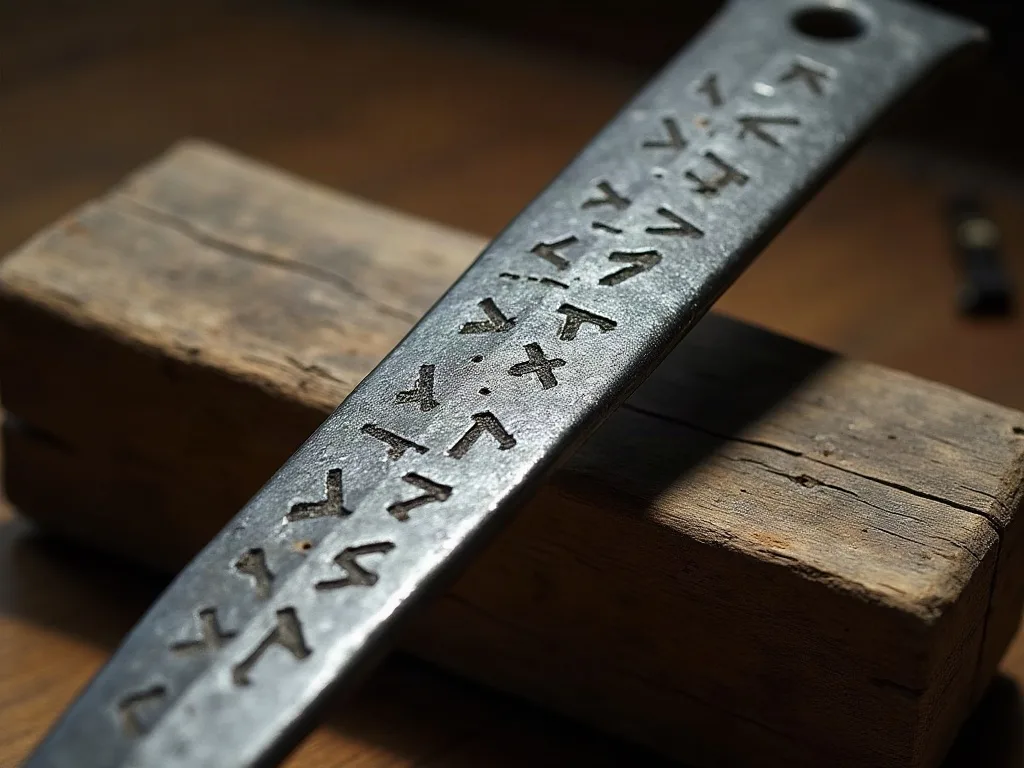
The Tiwaz rune (ᛏ) is one of the oldest runes in the Elder Futhark, the runic alphabet used by Germanic peoples from roughly the second to eighth centuries AD. Its shape, a vertical line with two diagonal lines angled upward from the top, resembles a spear or a stylized arrow pointing skyward. Both images fit Tyr precisely.
Archaeological finds across northern Europe show the Tiwaz rune inscribed on spear shafts, sword hilts, and bracteates (decorative gold discs worn as amulets). The Kragehul lance shaft, found in Denmark and dating to roughly the fifth century AD, bears a runic inscription that several scholars read as an invocation of Tyr for victory. The rune appears repeated, tripled in some inscriptions, suggesting a ritual amplification of the deity's name.
In the Sigrdrífumál, the valkyrie tells Sigurd to carve "victory runes" on a sword and to "name Tyr twice." That instruction links the rune to an actual practice: repeating the divine name was not poetic decoration but a ritual act with expected consequences. The rune was Tyr's name written in the alphabet that predated writing as most people understand it, a sacred signature pressed into iron.
The rune also appears in the Rune Poems. The Old English Rune Poem, composed sometime before the eleventh century, says of the Tir rune (the English cognate of Tiwaz): "Tir is a token, it keeps troth well with noble men, it is always on its course over the mists of night, it never fails." The image of a guiding star, constant and reliable, is exactly the quality the Norse mind attached to Tyr: the fixed point when everything else is chaos.
Tyr's Parentage: A Question the Eddas Do Not Fully Settle
The Prose Edda gives Tyr a father: Hymir, the jötunn (giant) who appears in the poem Hymiskvida as the owner of a great cauldron. In that poem, Thor and Tyr travel together to Hymir's hall to retrieve the cauldron so the gods can brew enough ale for a feast. The trip is adventurous, involving Hymir's very large cows and a sea fishing expedition during which Thor famously hooks the Midgard Serpent.
The detail that Tyr's father is a giant sits oddly against his role as one of the Aesir's most steadfast defenders. But it is not unusual in Norse myth: Odin himself has giant blood, and Loki is fully of giant descent yet lived among the Aesir for most of the mythological cycle. The Norse cosmos did not map morality neatly onto species. What mattered was where you stood and what you chose.
Some scholars, including Jan de Vries in his Altgermanische Religionsgeschichte (1956), have proposed that Tyr was originally identified as a son of Odin, as might befit a god of his stature, and that the Hymir connection is a later tradition, perhaps a scribal error or a regional variant. The texts do not resolve this cleanly. The ambiguity is genuine.
What the texts agree on is more important than the parentage dispute: Tyr acts like an Aesir, thinks like an Aesir, and dies like one at Ragnarok. His lineage is a philological puzzle. His function in the mythological world is crystal clear.
Frequently Asked Questions about Tyr, the Norse God of War and Justice
Frequently asked questions
Is Tyr the same as Odin or Thor in Norse mythology?
No. Tyr, Odin, and Thor are three distinct members of the Aesir, each governing different domains. Odin rules wisdom, death, and kingship. Thor commands thunder and physical protection of Midgard. Tyr specifically oversees lawful battle, oaths, and the assembly of justice called the thing. Snorri Sturluson's Prose Edda (c. 1220) describes all three separately, giving each a distinct set of qualities and stories.
Why does Tyr have only one hand?
Tyr lost his right hand to the wolf Fenrir during the binding described in the Gylfaginning section of the Prose Edda. Fenrir agreed to be bound by the magical ribbon Gleipnir only if a god placed a hand in his jaws as a legal pledge of good faith. Tyr volunteered. When Fenrir found he could not escape Gleipnir, he bit off Tyr's hand. Tyr accepted this outcome because the sacrifice was the price of a necessary act to protect all of creation.
What is the connection between Tyr and Tuesday?
Tuesday comes from Old English "Tiwesdæg," meaning Tiw's Day. Tiw is the Old English form of Tyr (Old Norse: Týr). When early Germanic peoples adopted the Roman seven-day week, they mapped their own gods onto the Roman planetary days. The Roman dies Martis (Mars's Day, Monday in modern French "mardi") became Tyr's day in the Germanic languages, because Romans had already identified Tyr with Mars under the name Mars Thingsus.
What primary sources mention Tyr?
The two main sources are the Prose Edda, written by Snorri Sturluson around 1220 AD, and the Poetic Edda, preserved in the Codex Regius manuscript of around 1270 AD. Within the Poetic Edda, Tyr appears or is referenced in the Voluspa (Ragnarok prophecy), the Lokasenna (Loki's flyting), the Sigrdrífumál (victory rune instruction), and the Hymiskvida (the cauldron quest). Roman-era inscriptions, including the Mars Thingsus dedication at Housesteads on Hadrian's Wall (third century AD), provide earlier archaeological evidence.
How does Tyr compare to the Greek god Ares?
They occupy similar structural positions as war gods but differ sharply in character. Ares in Homer's Iliad is impulsive, wounded by a mortal, and generally mocked by the other gods for fighting without wisdom. Tyr in the Eddas is described as the wisest and most daring of the Aesir, a god whose war is guided by law, oath, and collective well-being. The Roman Mars Thingsus, the specific form Romans gave to Tyr, is closer in character: ordered, civic, and directed toward protection rather than slaughter for its own sake.
Was Tyr ever more important than Odin in Germanic religion?
Several scholars think so. Hilda Ellis Davidson in Gods and Myths of Northern Europe (1964) argued that Tyr was probably a more central deity in early Germanic religion before the Odin cult rose to dominance, particularly during the Migration Period (300-600 AD). The Tiwaz rune, Tyr's personal rune, is one of the oldest in the Elder Futhark alphabet and appears widely on weapons from that era. Tyr's Proto-Indo-European root (*Dyeus) also predates Odin's mythology, suggesting an older and once higher-ranking divine status.
Tyr's Shadow in Modern Culture: Law, Sacrifice, and the Rune That Survived
The twentieth century rediscovered Tyr through two very different channels: academic comparative mythology and popular culture. The academic path runs through Dumézil, de Vries, and Davidson, all of whom treated Tyr as a key witness to the original Indo-European religious system. That line of scholarship continues today, with Tyr appearing regularly in discussions of Proto-Indo-European religion alongside Varuna, Zeus, and Jupiter as evidence of a shared ancient theological structure.
The popular path is messier. The Tiwaz rune was adopted by various nationalist movements in the twentieth century, a misappropriation that has complicated honest engagement with Tyr's symbolism. Modern Norse paganism, particularly the Asatru movement, has worked to reclaim Tyr as a symbol of justice and reasoned sacrifice rather than aggression, closer to his actual Eddic character. The Asatru Folk Assembly and the wider heathenry community celebrate Tyr specifically as a patron of law and courage under constraint.
In video games, God of War: Ragnarok (2022) gave Tyr a prominent narrative role, portraying him as a imprisoned peacemaker, a god who had traveled across mythologies to build connections rather than start wars. That portrayal, while freely invented for the game's story, is not as far from the Eddas as it might seem: the actual Tyr is indeed a god who uses legal ceremony and personal sacrifice rather than brute force. The game's creators read their sources carefully enough to understand that Tyr's power was never primarily physical.
The rune itself shows perhaps the most continuous thread. Carved on weapons fifteen centuries ago, written in modern tattoos and jewelry, the Tiwaz rune (ᛏ) remains one of the most recognizable symbols of the entire Norse tradition. Its meaning has held, even when the name above it changed. It still points upward, like a fixed star, still signals that someone trusts in a law larger than themselves.
That is exactly what Tyr taught. Not that war is noble, but that some sacrifices are necessary. Not that force is always right, but that force can be just. And not that a god must be invincible to be great. Sometimes the greatest act is reaching a hand into the dark, knowing full well what waits there.
Free 25-page sample
Want the whole story?
Take the first 25 pages free. If it pulls you in, the full edition is yours as an instant PDF download, with a paperback on Amazon for selected titles.

Mythology
The World Mythology Book: The Gods, Heroes and Myths of Every Culture
The Gods, Heroes and Myths of Every Culture, in One Volume
The whole of world mythology in a single volume: Greek, Norse, Egyptian, Japanese, Hindu, Celtic, Slavic, Mesoamerican and African myths gathered side by side, each drawn from the primary sources.