

The Valknut: Symbol of the Slain and the Warrior's Fate
The Valknut appears throughout Norse art as three interlocked triangles. Its name means "knot of the slain," linking it to Odin, battle, and the passage of warriors into the afterlife. Discover what this symbol truly represented in Viking culture and why it endures today.
Contents
The image appears suddenly: three triangles looped together so perfectly that your eye cannot trace one line without touching all three. A Norse warrior's tunic bears it. A runestone shows it carved beside a fallen king. It has no beginning and no end, only eternal knots. This is the Valknut, the knot of the slain, and it was no decoration. It was a promise about death, a statement of power, a compass pointing toward the gods themselves.
The Valknut does not whisper. It announces. Warriors wore it into battle knowing that if they fell, they would not remain fallen. That was the bargain the symbol carried, written in loops and angles across the cloth of Norse belief.
Origins and Names of the Valknut
The word Valknut breaks into two parts: val, meaning the slain, and knut, meaning knot. Norse people called it other names too: Hrungnir's Heart, after the giant killed by Thor; sometimes Odin's Knot. But the slain is what stuck. That phrase is not casual. It describes a specific moment: the moment a warrior falls in battle and his fate is sealed.
The symbol itself appears in the archaeological record from around the 7th century onward, most clearly in Scandinavia and Viking-influenced lands. It carved into runestones where men lay buried. It marked grave goods in cremation sites. It decorated high-status objects: swords, saddles, helmets. The Gotlandic stones (runestones from Gotland, an island in the Baltic where thousands of memorial stones were raised) show it most frequently, often beside images of ships and warriors.
Scholars debate exactly why the Valknut appears where it does. No surviving text from the Vikings themselves explains it; the Norse sagas and poems speak of fate, of Odin's reach, of death in battle as a highway to something greater, but they do not name this knot in surviving manuscripts. That silence makes the symbol even more powerful. It existed in the visual world, the world of cloth and stone and metal, while words stayed sealed in the gods' domain.
Odin's Mark: Death, Fate, and Divine Selection
No Norse god owns death as Odin does. He rules the hanged, the drowned, the pierced. He is the god of ecstasy and of terrible knowledge. When a warrior died in battle, Odin was near; when a king was sacrificed to ensure a good harvest, Odin's ravens watched. The Valknut, therefore, is Odin's mark. It brands a moment and a man.
On the Tängelgårda Stone in Gotland, the Valknut appears directly above a figure on horseback; below, a ship sails into the other world. The rider is not shown falling. He is shown passing. The knot signals that transition: this person did not simply die. They crossed a threshold. Odin's hand was on them.
The Valkyries, Odin's warrior-women who chose the slain on the battlefield, would have recognized that knot. They flew over carnage seeking men worthy of immortality in Valhalla, the great hall where fallen warriors wait for Ragnarok. The Valknut was their signal, perhaps, or their sign: This one is chosen. This interpretation, while not explicitly stated in the sources, rings true with how the symbol appears in graves and on monuments. It marks the boundary between the living and the honored dead.

Three Interlocked Triangles: Geometry and Meaning
The form of the Valknut is a trinity: three triangles, each pointing outward, each folded through the others in a way that creates a single, unbroken line. If you trace one triangle with your finger, you trace the entire symbol. No part stands alone.
This geometry speaks to interconnection. Death and life. The mortal world and the realm of gods. The body and the soul. The three triangles might also echo the three daughters of Loki, the three levels of the World Tree Yggdrasil, or the three threads the Norns (fate-weavers) spin for every being. Norse culture loved the number three; it carried weight and completeness.
Some scholars suggest the knot represents the nine worlds themselves, since three times three equals nine, and Norse cosmology describes nine realms hung on the branches and roots of Yggdrasil. Others see it as a binding: the knot that binds the warrior to Odin, or to fate, or to the promise of an afterlife. No single interpretation killed the others in the Norse sources because the sources never explained it. That mystery is part of its power.
The geometric perfection of the Valknut also matters. It cannot be torn apart. You cannot remove one triangle without unraveling the whole. It is an image of inescapability, of fate locked in place. If you are marked by the Valknut, you are bound.
The Valknut in Burial and Ritual
The Valknut appears most abundantly where the dead rested. Grave goods show it. Runestones raise it. Cremation urns carry its shape. This is not coincidence. The symbol was a companion for the journey into the afterlife.
Wealthy Norse burials often included objects meant for use in the next life: weapons, jewels, horses, even ships (or ships were buried as grave markers). The Valknut, carved or woven into these objects, told the departed soul that it was remembered, that its death had meaning, that the gods recognized its passage. For warriors, especially those who fell in battle, the knot was a promise: You are not abandoned. You are claimed.
The practice of ship burial, particularly in Scandinavia and among Viking peoples, frequently paired the Valknut symbol with ship imagery. The ship was the ferry to another realm; the Valknut was the seal of safe passage. A warrior buried with a ship and marked with the knot was understood to sail into Odin's presence, fully equipped and fully honored.

The Valknut Across Norse Culture: From Warrior to King
The Valknut was not exclusively a warrior's symbol, though that is its strongest association. It marked high-status graves across all categories of the dead. Kings, wealthy landowners, priestesses: if they were important enough to warrant stone or rich grave goods, they might be marked with the knot.
This widening suggests the symbol carried a broader meaning than battle alone. It may have signaled not just death in war, but death acknowledged and elevated. Death transformed into something sacred. When a person of standing died, the Valknut announced: This person did not vanish. They entered the realm of the gods. Their death was not random; it was woven into the design of things.
The appearance of the Valknut on weapons and armor is telling. Warriors did not carry it as a charm for survival; a charm would be hidden or private. They wore it openly, as a statement of willingness. It said: I know I may fall. I accept it. When I do, I will be remembered. That acceptance is not suicidal. It is clarity. The Valknut allowed a warrior to stare at death without flinching because death, to a Norse person, was not an ending. It was a gate.
Comparative Echoes: Death Symbols in Other Traditions
Valknut (Norse)
Three interlocked triangles marking the warrior chosen by Odin; carved on grave stones and weapons; signifies passage to Valhalla and immortal fame.
Other Traditions
The Egyptian ankh (eternal life and divine protection), the Hindu om (the ultimate reality connecting all existence), the Celtic triskelion (spiraling motion and the three realms); all are geometric symbols encoding death, transformation, and cosmic order without requiring a word to explain them.
Every culture that feared death sought to master it symbolically. The Valknut is Norse mastery: a knot so perfect that it cannot be untied, applying that permanence to the idea of a warrior's fame. Death will come, the symbol says, but your name will not follow you into the grave. It stays here, carved in stone, worn by the living, proof that you mattered.
The Egyptian Book of the Dead served a similar function: a map for the soul's journey and a promise that the dead would be remembered and guided. The Hindu concept of moksha offered liberation from the cycle of death through spiritual understanding. The Valknut offered something simpler and fiercer: a promise that if you fell in battle, the gods would see you, name you, and keep you at their table forever.
The Valknut in Modern Interpretation: Symbol and Controversy
Today, the Valknut adorns tattoos, necklaces, and banners. Modern pagans who honor Norse gods wear it as a marker of faith. Historical enthusiasts use it in museums and reconstructions. This modern revival is authentic in impulse but complicated in execution.
The symbol has been appropriated by white nationalist and far-right groups over the past three decades, stripped of its spiritual context and weaponized as a badge of ethnic supremacy. This is not a misinterpretation of "what the Vikings meant"; the Vikings never meant anything like it. It is a modern corruption, a theft of a beautiful thing. The appropriation is real and harmful, and it matters to acknowledge that when discussing the symbol today.
Genuine practitioners of Norse-inspired spirituality (Heathenry, Asatru, reconstructionist Norse paganism) have worked to reclaim the Valknut from these associations and restore it to its original meaning: honoring the dead, acknowledging fate, respecting the gods, and accepting the warrior's path without grandiosity. This work is essential and ongoing.
If you wear the Valknut, or carve it, or study it, you inherit both its depth and its burden. You inherit the promise it makes: that death is not the end of meaning, that fate is not shameful but sacred, that the gods see those who fall with honor. You also inherit the responsibility not to let its image be darkened by those who would use Norse symbols as tools of hatred.
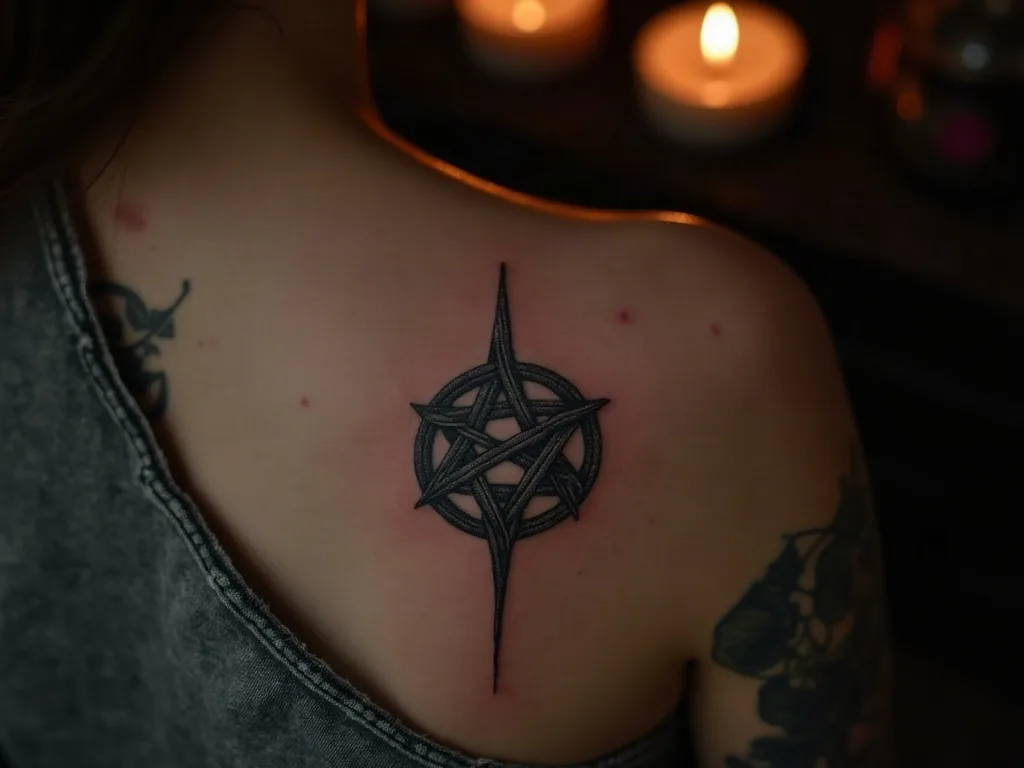
The Valknut and Modern Tattoo Culture
In tattoo communities, the Valknut meaning has become distinct from historical practice. A person choosing to tattoo the knot today rarely intends to announce their status as fallen or chosen by Odin. Instead, the symbol draws people for several reasons: its visual elegance, its connection to resilience and fate, its association with warrior spirit, or simply its place in the broader aesthetic of Norse mythology.
Tattoo artists have elaborated the basic three-triangle design into countless variations: interweaving the knots with runes, surrounding them with shields or axes, blending them with Celtic knotwork or other symbols. These modern interpretations are not "wrong." They show how symbols evolve when they move across time and culture. What matters is that the person wearing it understands what it historically meant, and chooses thoughtfully whether that meaning resonates with them.
The Valknut Beyond the Vikings: Cross-Cultural Resonance
The power of the Valknut lies partly in something universal. All cultures have symbols for death, binding, and transformation. The specific geometry is Norse, but the impulse behind it is not unique.
The Mesoamerican Aztec symbol of Ollin, representing movement, the fifth sun, and the cosmic dance between creation and destruction, carries a similar weight: a visual proclamation that change and death are not opposites but partners in a greater design. The Celtic triskelion, three spirals radiating from a center, moves through the same conceptual space: balance, motion, the three realms of earth, sea, and sky. Each culture creates its own knot because each culture needs to know that death can be understood, contained, honored, and transformed into something that outlasts it.
The Valknut does this for the Norse world. It says: This is how we bind death to meaning. This is how we make fate visible. This is how we tell the gods: We see you. We accept your design. We walk into the dark knowing we might be remembered.
Frequently asked questions about the Valknut
Frequently asked questions
What does the Valknut symbol actually mean?
The Valknut means "knot of the slain." It represents the bond between a warrior who falls in battle and Odin, the god who claims such deaths. The symbol marks the transition from the mortal world into the divine realm, particularly into Valhalla, the hall where fallen warriors wait for Ragnarok. It is not a charm for survival but an acknowledgment that death in battle carries meaning and honor.
Why do the three triangles matter?
The three interlocking triangles form a perfect geometric knot that cannot be separated without unraveling the entire symbol. This mirrors the Norse understanding of fate as inescapable and interconnected. The number three held deep significance in Norse cosmology (three Norns who weave fate, three levels of the World Tree, potentially nine worlds). The unbreakable form emphasizes that once a person is marked by the Valknut, they are bound to their destiny and to the gods.
Did historical Vikings actually explain what the Valknut meant?
No surviving Norse texts explicitly explain the Valknut. It appears abundantly in archaeology (carved on runestones, grave goods, weapons, armor) but the Vikings left no written definition. This silence does not diminish its meaning; it shows the symbol operated in a visual, ritual register that did not require words. We understand its significance through its context: where it appears, who wore it, and what the broader religious framework of Norse culture tells us about death, battle, and Odin's power.
Is it safe to wear a Valknut tattoo today?
The symbol itself is historically authentic and meaningful. However, it has been appropriated by far-right and white nationalist groups over recent decades. If you choose to wear it, understand both its genuine Norse spiritual significance and its modern misuse by hate movements. Many practitioners of reconstructionist Norse paganism actively reclaim the Valknut from these associations and restore it to its original context. Wear it with intention and awareness, and be clear about which meaning you carry.
How does the Valknut connect to other Norse symbols like runes?
The Valknut is a geometric symbol tied to divine fate and warrior death, while runes are both a writing system and a magical alphabet in Norse culture. Both appear together on many runestones and objects. The runes carry meanings tied to natural forces and spiritual concepts; the Valknut carries meaning tied specifically to death, binding, and Odin's claim on warriors. They complemented each other in Norse spiritual practice but represent different types of power.
Why is the Valknut called Hrungnir's Heart?
Hrungnir was a giant killed by Thor in a famous duel. Some sources connect the Valknut to Hrungnir's heart, possibly because a warrior's heart is where courage and fate dwell, or because Hrungnir, despite being a giant, fell to divine power much as a human warrior would fall in battle. The exact reason for this association is unclear in surviving texts, but it reinforces the symbol's link to death inflicted by divine or superior force.
The Valknut's Persistence: Why Ancient Symbols Endure
The Valknut has outlasted the Norse kingdoms and the belief system that created it. This persistence tells us something important about symbols: they are not just pictures. They are compressions of meaning, capable of holding complex ideas in a single visual form.
A warrior seeing the Valknut carved into a sword or his own tunic understood instantly that someone had thought about his death before the battle. That someone had woven it into the economy of meaning that surrounded him. He was not alone. The gods were watching. The Norns, the three fate-weavers, had already seen his thread and where it would end. The Valknut made that knowledge visible. It made the invisible visible.
That is why modern people are drawn to it. We live in a time when death is hidden, when fate seems absent, when warriors (in every sense: soldiers, athletes, artists, workers) are often told their sacrifices do not matter. The Valknut says the opposite. It says: Your death means something. It is woven into the design. The gods see you.
Whether you understand "the gods" as literal divine beings, as the forces of nature, as culture and memory, or as the deeper self, the Valknut works. It has worked for over a thousand years. It will likely work for a thousand more, because it speaks to something in us that never changes: the need to believe that when we fall, we will not be forgotten.
Free 25-page sample
Want the whole story?
Take the first 25 pages free. If it pulls you in, the full edition is yours as an instant PDF download, with a paperback on Amazon for selected titles.

Mythology
The World Mythology Book: The Gods, Heroes and Myths of Every Culture
The Gods, Heroes and Myths of Every Culture, in One Volume
The whole of world mythology in a single volume: Greek, Norse, Egyptian, Japanese, Hindu, Celtic, Slavic, Mesoamerican and African myths gathered side by side, each drawn from the primary sources.