
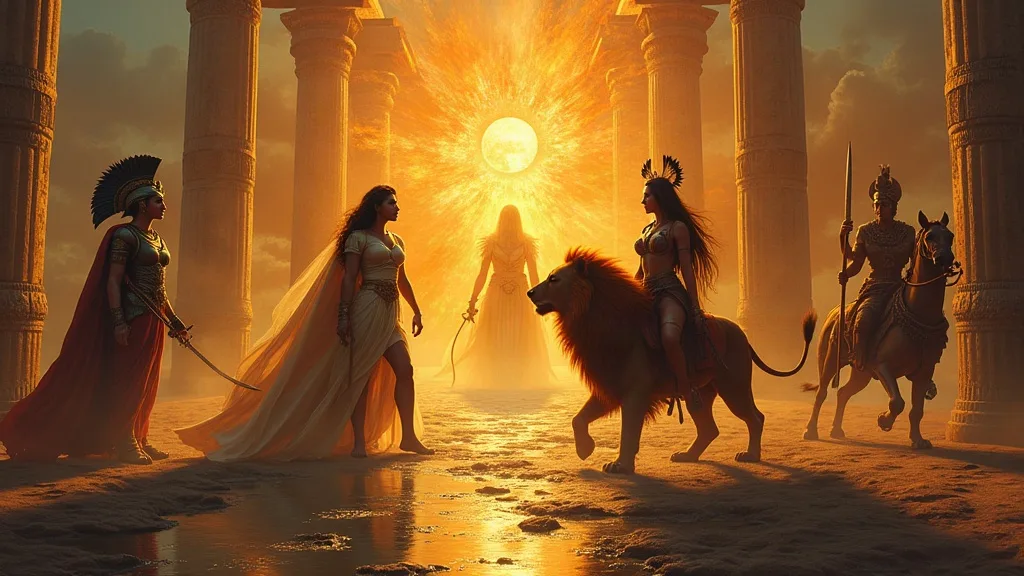
War Goddesses Compared: Athena, Sekhmet, the Morrigan, and Durga
Four goddesses, four civilizations, one obsession with sacred war. Compare Athena, Sekhmet, the Morrigan, and Durga to see what they share, and where they clash.
Contents
The battlefield is sacred ground in almost every mythology ever recorded. Blood falls, and a goddess watches.
Not a passive witness. An active force, a presence that tilts the scales between order and annihilation. Four cultures, spread across thousands of miles and several millennia, built their most powerful female figures around the same terrible subject: war. War goddesses compared across traditions reveal something that no single pantheon can show on its own. The patterns are too consistent to be coincidence. The differences are too sharp to be ignored.
Athena of Greece. Sekhmet of Egypt. The Morrigan of Ireland. Durga of India. Each one commands armies, shapes fates, and holds power over life and death. Yet each one does it differently, and those differences say everything about the civilization that shaped her.
Athena: the War That Thinks
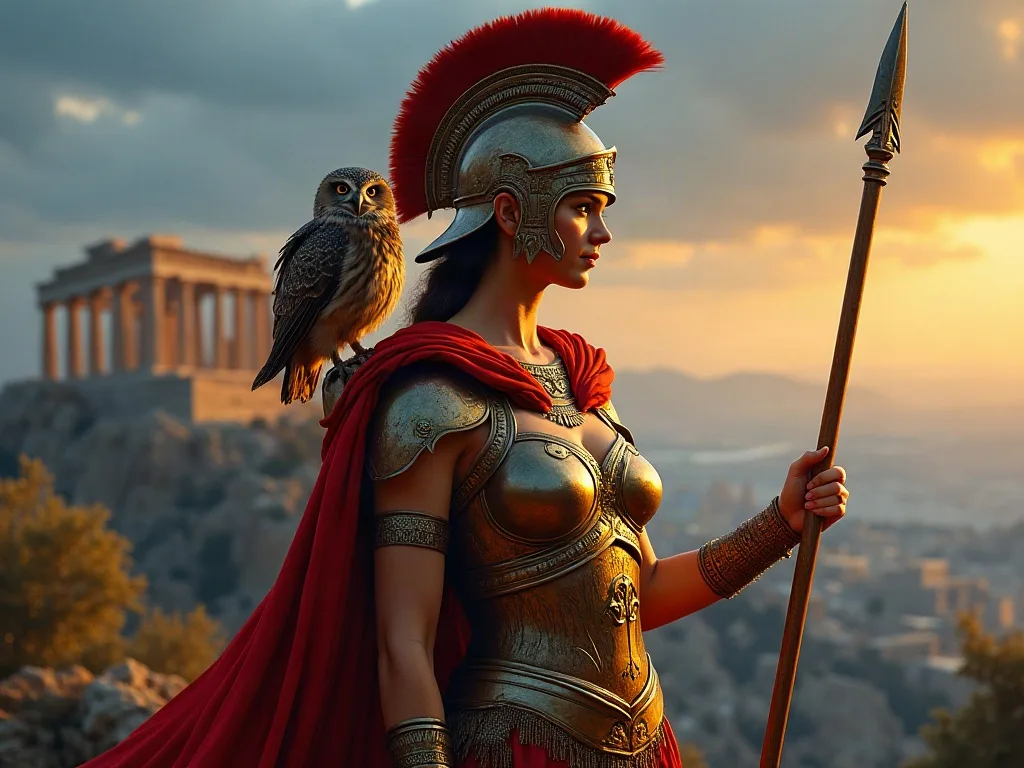
The Greeks had two war deities, and the contrast between them is almost a joke. Ares is brute violence, unpredictable, disliked even by his father Zeus, as Homer notes in the Iliad. Athena is everything war requires beyond raw force: strategy, discipline, civic order, the cold geometry of a siege plan.
She was born already armoured. Hesiod, writing around 700 BC in the Theogony, tells how Zeus swallowed his first consort Metis, goddess of cunning, fearing a prophecy that her child would surpass him. The child grew inside his head, and when the craftsman god Hephaestus split the divine skull open with an axe, Athena emerged fully formed, helmeted, spear in hand, shouting her war cry. She arrived complete. No childhood, no apprenticeship.
That detail matters enormously. Athena did not learn war; she is the intellect of war made flesh. She invented the bridle that tames horses for cavalry. She taught mortals to build ships for naval combat. In the Odyssey, Homer shows her managing an entire decade-long aftermath of battle, personally guiding Odysseus home, step by calculated step. She does not just win fights. She engineers outcomes.
Her domain in Athens, the city that bore her name, extended to weaving, crafts, and law, making her unique among the four goddesses here. The same mind that arranges a phalanx formation also plots the warp threads of a loom. Both require precision. Both reward patience. The Athenians understood war as a civic institution, governed by rules, serving the polis. Their goddess reflected exactly that.
She also protects heroes selectively, and that selectivity is key. Athena does not love all soldiers equally. She chooses those who show metis, cunning intelligence. Odysseus, not the physically superior Ajax. Perseus, guided by her mirrored shield when facing the Gorgon. Heracles, supported through labors that require thinking as much as muscle. She is not democratic in her patronage. She is meritocratic.
Her symbol, the owl, sees in the dark. Her sacred tree, the olive, feeds cities for generations without being destroyed. Even her iconography resists raw violence. The Parthenon frieze shows her robed as often as armoured, presiding over the Panathenaic procession, a goddess of civilization first.
Sekhmet: the War That Burns
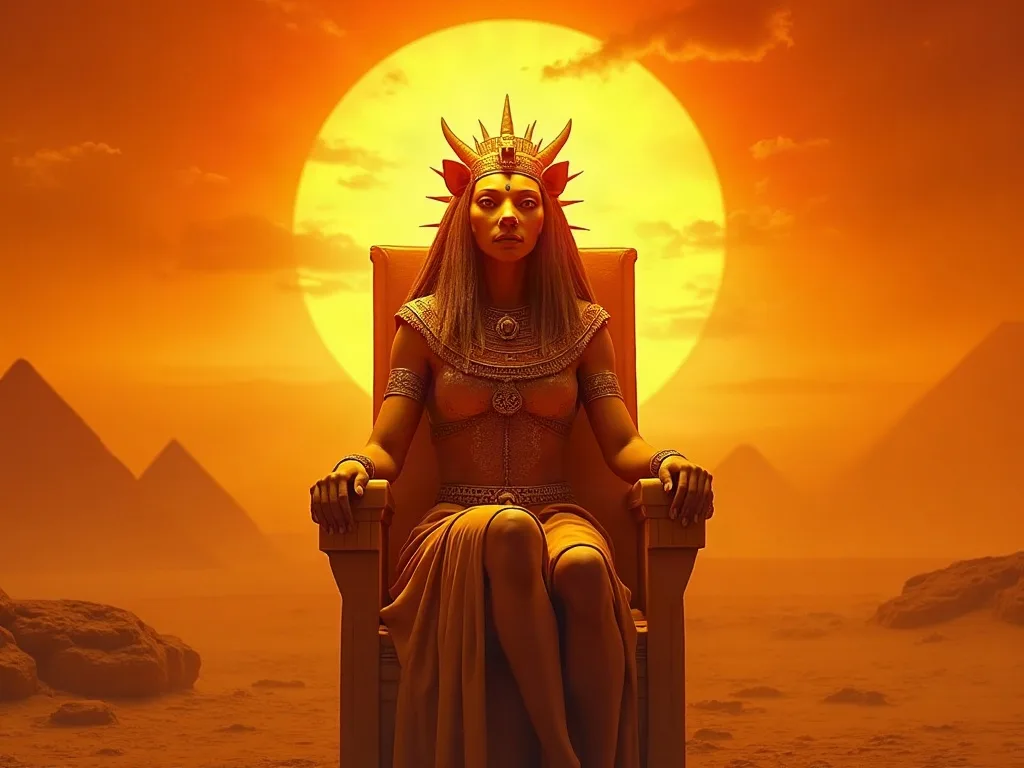
Cross the Mediterranean and follow the Nile south. In Egyptian theology, power over destruction wore the head of a lioness.
Sekhmet, whose name translates from ancient Egyptian as "the Powerful One" or "She Who Is Powerful," was a solar deity whose destructive capacity was understood to be heat itself, the lethal force of the desert sun turned personal. She breathed fire at Egypt's enemies. Her arrows carried plague. Priests of Sekhmet were simultaneously physicians, because the deity who inflicted disease was also the only one who could lift it.
The myth that most defines her is the Destruction of Mankind, recorded on the walls of royal tombs from around 1350 BC, including the tomb of Seti I. Ra, the sun god, hears that humanity is conspiring against him. He sends his Eye, his most potent emanation of solar power, in the form of Sekhmet, to punish them. She does so with terrifying efficiency, killing without pause, wading through blood. The slaughter grows so extreme that Ra regrets the decision. Humanity may be wiped out entirely.
He cannot simply call her back. Sekhmet in full rampage is not obedient. So the gods flood the land with red-dyed beer, 7,000 jars of it, making it look like blood. Sekhmet drinks it, becomes intoxicated, and stops. Humanity survives, barely.
That detail about the beer is not merely picturesque. It encodes an Egyptian theological idea: destruction and mercy are not opposites held by different gods. They are two faces of the same force, managed by ritual. Every year, at the Festival of Sekhmet's Intoxication, Egyptians drank beer and played music to ritually soothe the goddess, re-enacting the moment catastrophe was narrowly averted. Ritual performance was cosmic maintenance.
Sekhmet was also the protector of pharaohs in battle. Images of pharaohs on temple walls often show them accompanied by a leonine solar force, the heat that surrounds and empowers the king's charge. She was, in this sense, a war goddess of totality. Not strategy, not sovereignty, but the full burning weight of divine wrath brought to bear on an enemy.
Her connection to healing is not paradoxical once you accept the Egyptian framework. Sekhmet's priests, known as the Priests of Sekhmet, were medical practitioners who performed surgery, treated disease, and understood anatomy at a level that impressed later Greek visitors. They worked under the lioness's authority precisely because they had to manage the forces she embodied: infection, fever, violent trauma. She was the pathogen and the cure, inseparable.
The Morrigan: the War That Chooses
The Celts of Ireland left no pyramids and no Parthenon. They left stories, and in those stories, war has a presence that feels fundamentally different from anything in Greek or Egyptian tradition.
The Morrigan (her name is debated; it likely means "Great Queen" or "Phantom Queen" in Old Irish) does not fight. She shapes the outcome of a fight from the boundary. She is a shapeshifter, appearing as a crow, an eel, a wolf, a beautiful young woman, an old hag at a river ford washing the armour of men about to die. That last image, the bean nighe, the washing woman, is one of the most haunting recurring figures in Irish mythology.
She appears centrally in the Ulster Cycle, the great body of Irish mythological texts written down by medieval monks between the 8th and 12th centuries, though the stories they recorded are far older. In the Táin Bó Cúailnge (the Cattle Raid of Cooley), she approaches the hero Cú Chulainn and offers him her love. He rejects her, not even recognising her for what she is. It is an act of catastrophic arrogance.
She does not kill him for it, not directly. Instead she sabotages him three times during combat, first as an eel tripping him in the ford, then as a wolf stampeding cattle into the water, then as a heifer leading a frenzied herd against him. Each time, wounded and off-balance, he strikes her. Each time, when she later appears as an old woman milking a cow, he unknowingly blesses her wounds closed. Only the goddess who cursed him can heal herself; only the hero who wronged her provides the blessing that heals her. The relationship is a closed loop of injury and repair.
She is also intimately linked to sovereignty itself, a concept central to Celtic political theology. The land of Ireland was understood as a goddess, and a king's right to rule depended on a ritual marriage to her. The Morrigan, as Phantom Queen, held that sovereignty in her hands. To offend her was to lose the land. Her connection to war was inseparable from her connection to political legitimacy.
At the death of Cú Chulainn, she settles on his shoulder as a crow. It is confirmation. It is also, in its way, the final gesture of possession: he was always hers, from the moment he refused her.
Durga: the War That Creates
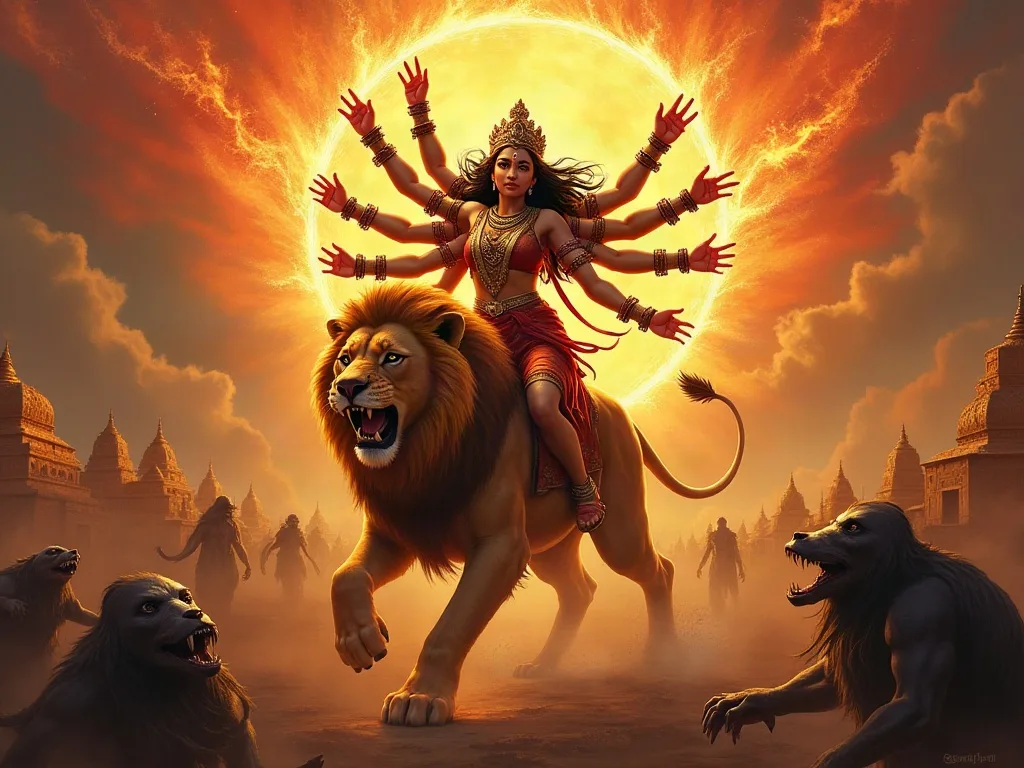
Move east to the Indian subcontinent, and the scale changes. Durga, whose name in Sanskrit means "the Inaccessible" or "the Invincible," is not a war goddess in any limited sense. She is the concentrated martial power of the entire cosmos, summoned when the gods themselves cannot win.
Her origin story, told in the Devi Mahatmya (a Sanskrit text from roughly the 5th to 6th century AD, embedded within the larger Markandeya Purana) is extraordinarily direct. A buffalo demon named Mahishasura has conquered the three worlds. The gods, defeated, are driven from heaven. They pool their divine energies, their tejas, and from that pooled radiance Durga emerges, fully formed, her eighteen arms each bearing a weapon gifted by a different god. Shiva gives his trident. Vishnu gives his discus. Indra gives his thunderbolt.
She is not a daughter or a consort. She is a coalition of power given female form, a war machine assembled by necessity. And she does what no male deity could do: she defeats Mahishasura after a battle that shakes creation.
The Devi Mahatmya describes the combat in overwhelming detail. Durga fights the demon army alone, her lion mount raking the battlefield, her weapons striking in every direction at once. When Mahishasura shifts between forms, buffalo to lion to man to elephant, she matches every transformation. She pins him as he half-emerges from his buffalo form, and kills him in that moment of transition, between states, between forms. It is a deeply symbolic act: she defeats illusion itself.
Her ten-day festival, Durga Puja, celebrated across Bengal and much of South Asia every autumn, draws tens of millions of participants. It is arguably the largest annual festival dedicated to a single deity anywhere on Earth. The ritual is not a re-enactment of violence but a celebration of cosmic protection, the confirmation that creation is defended.
Durga is also the mother of Ganesha and Kartikeya (the war god, her son), and the fierce form of Parvati, Shiva's consort, within certain theological frameworks. The Hindu tradition layers identities in ways that Greek or Celtic thought typically does not. Durga is simultaneously an independent absolute power and one form of a larger feminine divine called the Devi or Mahadevi. War, for her, is an act of cosmic motherhood: she destroys what threatens her children. Every demon she kills is a threat to the universe she maintains.
Comparing the Four: Strategy, Rage, Fate, and Protection
The four goddesses now sit in the same frame. Differences emerge fast.
Athena operates through chosen intermediaries. She works with heroes, through them, behind them. She equips Perseus, advises Odysseus, stands beside Heracles. The warrior is the instrument; she is the intelligence directing the instrument. Greek warfare was a political and civic enterprise, and its goddess reflected that. The polis fights; the goddess thinks.
Sekhmet operates through overwhelming direct force. She does not choose champions. She is the force unleashed. The Egyptian model of divine war power was solar, total, and required management through ritual lest it consume everything. Pharaoh fought because Sekhmet was his charge. The king's body was the channel through which she moved.
The Morrigan operates through fate and will. She does not fight. She determines who wins before the first blow falls, and the hero who ignores her forfeits his fate. Celtic warfare was entangled with prophecy, sovereignty, and the will of the land itself. The Morrigan controlled the thread; men ran along it.
Durga operates as cosmic emergency power. She is called into existence because the existing order has failed. No strategy, no ritual management, no prophecy. Pure assembled divine force, directed at the threat that the regular hierarchy cannot handle. The Hindu model allows for cosmic crisis, and Durga is the answer to crisis.
Athena
- Born from a single male deity (Zeus), no mother's role
- Operates through selected mortal champions
- Governs strategy, crafts, civic law
- Rarely fights directly; guides from behind
- Linked to wisdom and the owl
- Patroness of a specific city (Athens)
Durga
- Born from the combined energy of all the gods
- Fights directly, alone, across the entire cosmos
- Governs cosmic protection, destroying all demonic force
- Central combatant, eighteen-armed warrior
- Linked to the lion, the tiger, cosmic abundance
- Worshipped across an entire subcontinent
One more comparison cuts across all four: their relationship to death.
Athena accepts the death of her champions with a kind of tragic composure. She mourns Achilles, even though she opposes him at times, and she weeps for the cost of the Trojan War while still prosecuting it. Death is the price of civilization's defence.
Sekhmet causes death wholesale, without grief, and must be stopped from causing more. Death is her natural medium. Healing is her compensation.
The Morrigan announces death. She does not cause it directly but she confirms it. The crow settling on a dying man's shoulder is her signature. She knows who will die before they do.
Durga accepts death as the price of cosmic restoration. She grieves nothing in the Devi Mahatmya; she fights with the clarity of absolute necessity. Her violence is not cruel because it is not personal. The demons she kills are threats to the order of existence.
The Lion, the Owl, and the Crow: Reading the Sacred Animals
Animals are never decorative in mythology. They are theological statements.
Athena's owl sees in darkness, hunts silently, and misses nothing. It is the animal of the mind working when others sleep, the faculty of perception that predates action. Athens stamped the owl on its silver coins, the tetradrachm, the most widely traded currency of the ancient Greek world. The image of the owl implied: this city thinks before it strikes.
Sekhmet's lioness is solar power given teeth. The lion in Egyptian iconography was connected to heat, to the desert, to the killing force of the noon sun. A lioness hunts; a lion lazes. The Egyptians chose the lioness specifically. Sekhmet is not a passive solar symbol. She is the active, hunting expression of divine energy.
The Morrigan's crow (or raven, in some variants) is the bird that appears after the battle. It eats the dead. In Celtic thought, this was not macabre but correct: the crow closes the loop, returns flesh to the earth, completes the cycle. The Morrigan as crow is the goddess of endings, of the moment war stops and consequence begins.
Durga's lion or tiger carries her forward into battle. It is power in motion, controlled power, because Durga rides it rather than being overwhelmed by it. The mount is not separate from the goddess; it is an extension of her force made visible.
Where the Traditions Agree
Under the theological differences, four points of convergence hold.
First, war belongs to women as much as to men. All four traditions gave their most significant martial authority to a goddess. This is not incidental. In Greek, Egyptian, Celtic, and Hindu thought, war was too important, too sacred, too intimately connected to fate and cosmic order to be left to a male principle alone.
Second, the war goddess is never single-purpose. Athena governs wisdom. Sekhmet governs plague and healing. The Morrigan governs sovereignty. Durga governs cosmic protection. Every one of them holds the war function inside a larger cluster of meaning. This suggests that ancient peoples did not experience war as a separate activity but as a dimension of politics, medicine, nature, and cosmic survival all at once.
Third, ritual manages the goddess as much as worships her. The Festival of Sekhmet's Intoxication. The Panathenaic procession for Athena. Durga Puja. The warrior's propitiation of the Morrigan before battle. Every tradition built ceremonies to approach these goddesses correctly, because approaching them incorrectly was genuinely dangerous. The goddess was not a vending machine of military victory. She was a power that required relationship.
Fourth, the goddesses are ultimately protective, not aggressive. None of them starts wars for pleasure. Athena defends cities and heroes. Sekhmet defends Ra and Egypt. The Morrigan defends the sovereignty of the land. Durga defends the cosmos from demons that would consume it. The violence each one embodies is, in her tradition's own terms, a response to a greater threat. It is war in the service of something larger.
The Scholarly Debate: Shared Origin or Parallel Invention?
Comparative mythologists have been arguing this question for 150 years, and it remains genuinely open.
The older tradition, associated with the 19th-century scholar Max Müller, looked at similarities like these and argued for shared Indo-European roots. Greek, Celtic, and Sanskrit traditions do share a common ancestor language and, to some degree, a common mythological inheritance. Athena and Durga, on that reading, might share a distant proto-goddess, a warrior figure from the peoples who spread across Eurasia around 3000-2000 BC.
But Sekhmet sits outside that family. Egyptian mythology developed independently of the Indo-European streams. Yet Sekhmet shares structural features with the other three: the protective warrior function, the dangerous uncontrolled power, the ritual management, the healing paradox. That parallel has to be explained differently.
The anthropologist Joseph Campbell argued for what he called "elementary ideas," Elementargedanken, patterns so fundamental to human experience that they emerge independently in every culture that reaches a certain level of complexity. War, plague, healing, fate, and sovereignty are universal human concerns. Goddesses who combine them may be independent inventions that converge on the same structural solutions.
Both explanations are probably partly right. The Indo-European connections between Greek, Celtic, and Indian traditions are real and well-documented. The convergence with Egyptian tradition points to something deeper: a recurring human need to assign sacred female authority to the most dangerous dimensions of collective life.
Frequently Asked Questions About War Goddesses Across Mythologies
Frequently asked questions
Is Athena stronger than Ares in Greek mythology?
In terms of narrative authority, yes. Homer's Iliad repeatedly shows Athena outmaneuvering Ares and even wounding him directly in Book 21. Greek culture valued strategic intelligence over brute force, and Athena embodied that value. She is the war deity the Olympians actually respect.
Why does Sekhmet have healing powers if she is a war and plague goddess?
Because in Egyptian theology, the power to inflict a condition and the power to lift it belonged to the same divine force. Sekhmet's priests were medical practitioners precisely because they worked under her authority. Managing disease meant managing her. The Ebers Papyrus, an Egyptian medical text from around 1550 BC, invokes Sekhmet as part of its healing framework.
Who exactly is the Morrigan, and is she one goddess or three?
Both, depending on the text. In the Book of the Dun Cow and the Cath Maige Tuired (the Battle of Mag Tuired), she appears as a triple goddess composed of Badb (the crow of battle), Macha (linked to horses and sovereignty), and either Nemain (frenzy) or Anand (abundance). In other texts she is singular. The multiplicity is intentional: she embodies the phases of war from beginning to end.
What is the difference between Durga and Kali in Hindu mythology?
Kali is often understood as an emanation of Durga: when Durga's rage exceeds even her control during battle, Kali emerges from her forehead or her fury. The Devi Mahatmya describes this moment directly. Kali then continues the slaughter beyond necessity until Shiva lies down beneath her feet and she stops, shocked by what she has done. They are related but distinct: Durga is controlled cosmic force; Kali is what happens when that force exceeds its container.
Do any of these goddesses appear in modern culture?
All four do, prominently. Athena appears in Riordan's Percy Jackson series and remains the mascot of dozens of universities. Sekhmet has a significant following in modern paganism and appears in several fantasy novels and games. The Morrigan has seen a major revival in neopagan traditions and featured centrally in Neil Gaiman's American Gods (2001). Durga remains an actively worshipped goddess with hundreds of millions of devotees; Durga Puja in Kolkata alone draws an estimated five million people over its ten-day celebration.
Are there other war goddesses from traditions not covered here?
Many. Ishtar (Mesopotamian, also the goddess of love and sexuality) is one of the oldest recorded, appearing in Sumerian texts from 2500 BC. Anat from the Canaanite tradition battles ferociously in the Baal Cycle. Freya in Norse mythology is explicitly given half of all battle-dead before Odin takes his share. The pattern of feminine war divinity is not a regional quirk. It is a consistent feature of complex religious systems worldwide.
What These Goddesses Tell Us About the Civilizations That Built Them
Every goddess is a mirror. The war deity a culture chooses to worship tells you what that culture believed war was at its deepest level.
Athens believed war was a rational extension of civic life, governable by mind and law. They gave it an owl-eyed, spear-bearing virgin who weaves as readily as she fights.
Egypt believed war was a form of solar power, vast and impersonal, inherent in the cosmos, requiring constant ritual maintenance to prevent it from consuming everything. They gave it a lioness who burns.
Celtic Ireland believed war was a meeting between mortal will and sacred fate, the negotiation between a king's choices and the sovereignty of the land itself. They gave it a shapeshifting queen who watches from the ford, who settles on the shoulder of the man she has chosen.
Hindu India believed war was a cosmic function, the universe's immune system against the forces that would unmake it. They gave it a goddess born from the pooled light of all the gods, armed with every weapon in existence, riding into battle on a lion.
None of them is wrong. Each one is completely right, within the theological frame it inhabits. Put side by side, they describe a map of what human beings have understood war to mean: a thing that demands strategy, a thing that burns beyond control, a thing that chooses its dead before they fall, and a thing that ultimately serves the survival of everything worth protecting.
That is not a bad summary of war itself.
Free 25-page sample
Want the whole story?
Take the first 25 pages free. If it pulls you in, the full edition is yours as an instant PDF download, with a paperback on Amazon for selected titles.

Mythology
The World Mythology Book: The Gods, Heroes and Myths of Every Culture
The Gods, Heroes and Myths of Every Culture, in One Volume
The whole of world mythology in a single volume: Greek, Norse, Egyptian, Japanese, Hindu, Celtic, Slavic, Mesoamerican and African myths gathered side by side, each drawn from the primary sources.