
The Baal Cycle: Death and Resurrection of the Storm God
The Ugaritic tablets tell of Baal's battle with Mot, god of death. What the primary sources say, what they omit, and why scholars still argue.
Contents
The Baal Cycle is a sequence of Ugaritic mythological texts from the thirteenth century BCE that narrates the conflict between Baal Hadad, the storm god, and Mot, god of death and sterility, culminating in Baal's descent to the underworld, his apparent death, and his eventual return to life and kingship. The tablets were discovered in 1929 at Ras Shamra on the Syrian coast, the site of ancient Ugarit. The cycle remains central to understanding Canaanite mythology and has fueled decades of scholarly debate over whether Baal truly resurrects or merely escapes the underworld.
The texts themselves are fragmentary, written in Ugaritic cuneiform on clay tablets that survived palace fires. What remains is enough to reconstruct the narrative arc but leaves gaps that scholars fill with informed guesswork. The question of resurrection matters because it touches on larger patterns of seasonal ritual, agricultural theology, and the category of dying-and-rising gods that stretches from Mesopotamia to the Mediterranean.
The Ugaritic Tablets and Their Discovery
In 1929, a Syrian farmer plowing near the Mediterranean coast struck a stone slab covering an ancient tomb. French archaeologists arrived within weeks and began excavating the mound of Ras Shamra, ancient Ugarit, a Late Bronze Age port city that flourished between 1450 and 1200 BCE. Among the finds were hundreds of clay tablets inscribed in a previously unknown cuneiform alphabet of thirty characters, simpler than Akkadian syllabic script and designed for the local Northwest Semitic language.
The tablets catalogued as KTU 1.1 through 1.6 contain the core of the Baal Cycle, though the sequence and completeness remain contested. Scribes copied these texts in the thirteenth century BCE, but the myths themselves likely circulated orally for generations before that. The tablets were stored in a building adjacent to the royal palace, possibly a library or temple archive. Fire hardened the clay when the city burned around 1200 BCE, preserving what would otherwise have crumbled.
No complete manuscript survives. Scholars piece together the narrative from overlapping fragments, and where columns are missing, they rely on parallel passages or educated conjecture. The result is a story we can follow but not quote in full.
Baal, Mot, and the Cast of the Cycle
Baal Hadad, Rider of the Clouds
Baal Hadad is the young storm god, bringer of rain, thunder, and fertility. His title "Rider of the Clouds" appears throughout the tablets, marking him as the divine force behind the seasonal rains that sustain agriculture in the Levant. He is son of Dagan, the grain god, but operates within the pantheon presided over by El, the aged high god. Baal's weapon is the club and the lightning bolt, and his palace, built with the help of the craftsman god Kothar-wa-Khasis, stands atop Mount Zaphon, the sacred mountain north of Ugarit.
Before the events of the cycle proper, Baal defeats Yam, the sea god, in a cosmic battle that establishes his kingship. That victory is narrated in the earlier tablets and sets the stage for the conflict with Mot. Baal is not immortal in the Greek sense. He can be overpowered, and his authority is contested.
Mot, God of Death and Sterility
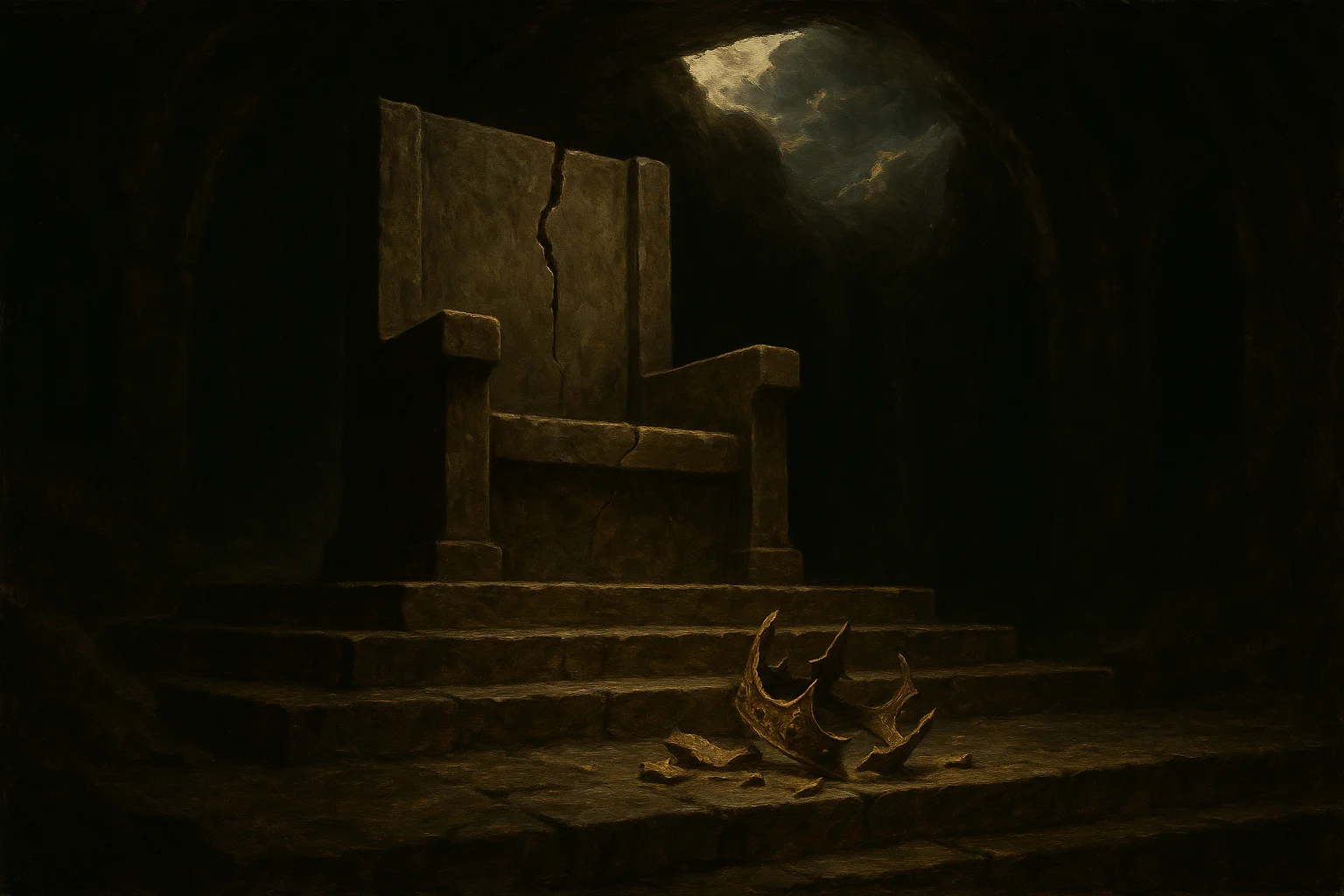
Mot rules the underworld and embodies death, drought, and the sterile earth. His name means "death" in Ugaritic, and his realm is described as a place of mud and filth, the opposite of Baal's rain-soaked heights. Mot has no palace. He has a throat. The tablets describe him as a devouring maw, and when Baal descends, the text says he is swallowed.
Mot is not evil in a moral sense. He is a cosmic force, necessary and inevitable, the counterpart to Baal's life-giving storms. The two gods are locked in a cycle, not a final battle. When one ascends, the other must yield, but neither is destroyed permanently.
El, Asherah, and Anat
El, the patriarch of the pantheon, resides at the source of the two rivers, a distant and often passive figure. He grants permissions, receives petitions, and mourns Baal's death, but he does not intervene directly. Asherah, El's consort and a figure associated with mother goddesses across the ancient Near East, appears in the cycle primarily as an advocate for her own sons and a political actor within the divine assembly.
Anat, Baal's sister and fiercest ally, is the goddess of war and the hunt. When Baal dies, she is the one who acts. She mourns, she searches, and ultimately she kills Mot in a scene of ritualized violence that reads like a harvest.
The Story: Baal's Descent and Death
The conflict begins when Mot sends messengers to Baal, summoning him to the underworld. The invitation is framed as a challenge Baal cannot refuse without losing face. Baal knows what awaits him. He instructs his servants to tell El that he has gone down to Mot's realm, and he takes with him his clouds, his winds, and his retinue.
The text of KTU 1.5 i 1–8 is blunt:
The gods shall know that you are dead, that the son of El has perished.
Baal descends. Mot devours him. The storm god is gone, and with him the rains cease. The earth dries. Crops fail. The cosmic order tilts toward death.
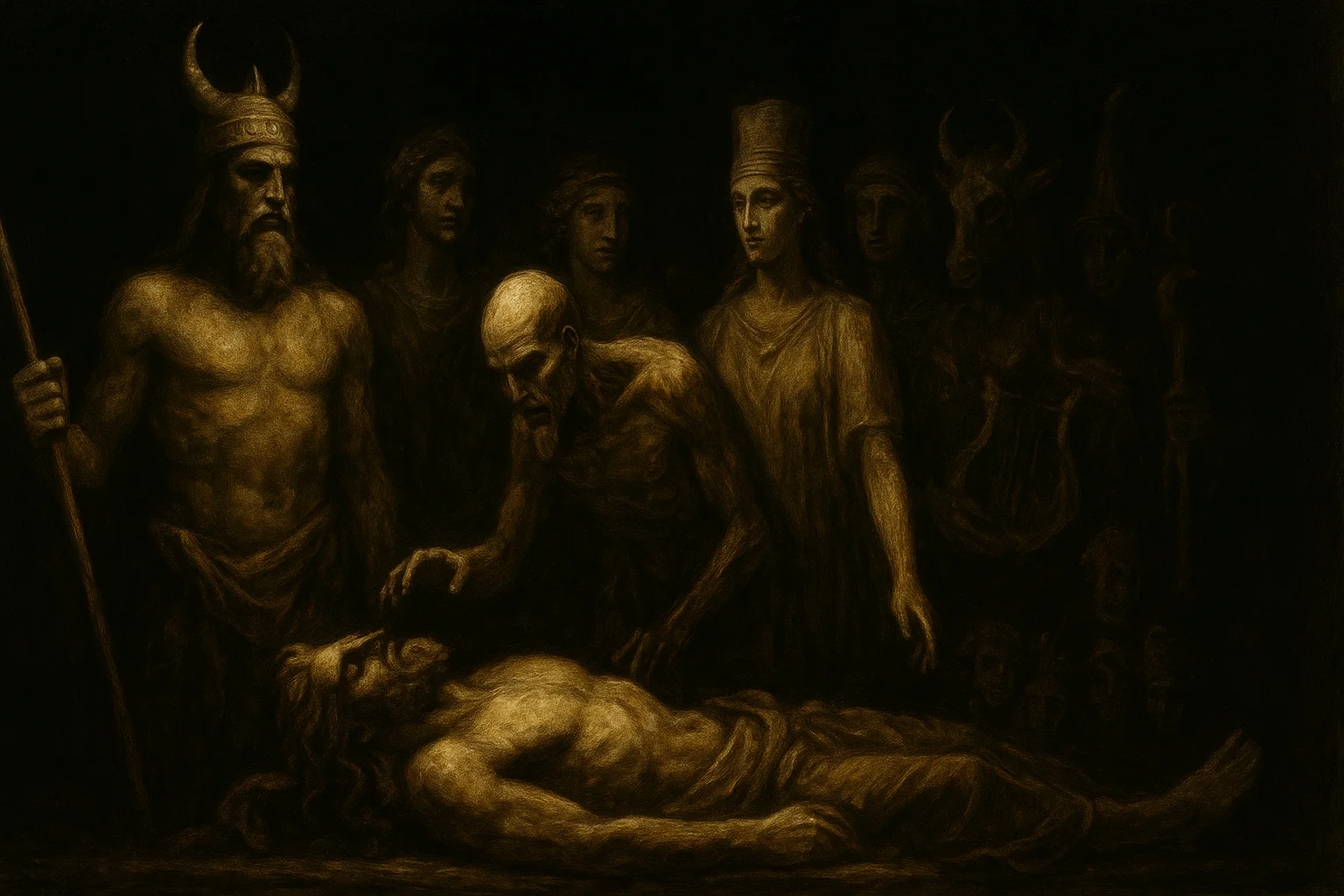
El, upon hearing the news, performs mourning rites. He descends from his throne, sits in the dust, pours ashes on his head, and lacerates his skin. Anat searches for Baal's body with the help of Shapash, the sun goddess, who can see into the underworld. They find him and bring him back to Mount Zaphon for burial. The text does not describe a corpse in detail, but it is clear that Baal is, in some sense, dead.
Anat's Revenge and the Return of Baal
Anat does not accept her brother's death. She confronts Mot and demands Baal's release. Mot refuses, boasting that he has consumed the storm god as one consumes a lamb. Anat's response is immediate and brutal. KTU 1.6 ii 30–37 describes her slaughter of Mot in language that mirrors agricultural processing:
She seizes Mot, the son of El. With a sword she splits him. With a sieve she winnows him. With fire she burns him. With millstones she grinds him. In the field she sows him.
The imagery is not metaphorical. Anat treats Mot's body as grain, cutting, threshing, burning, grinding, and scattering him across the earth. This is not simply revenge. It is ritual, the enactment of the harvest that must follow death if life is to return.
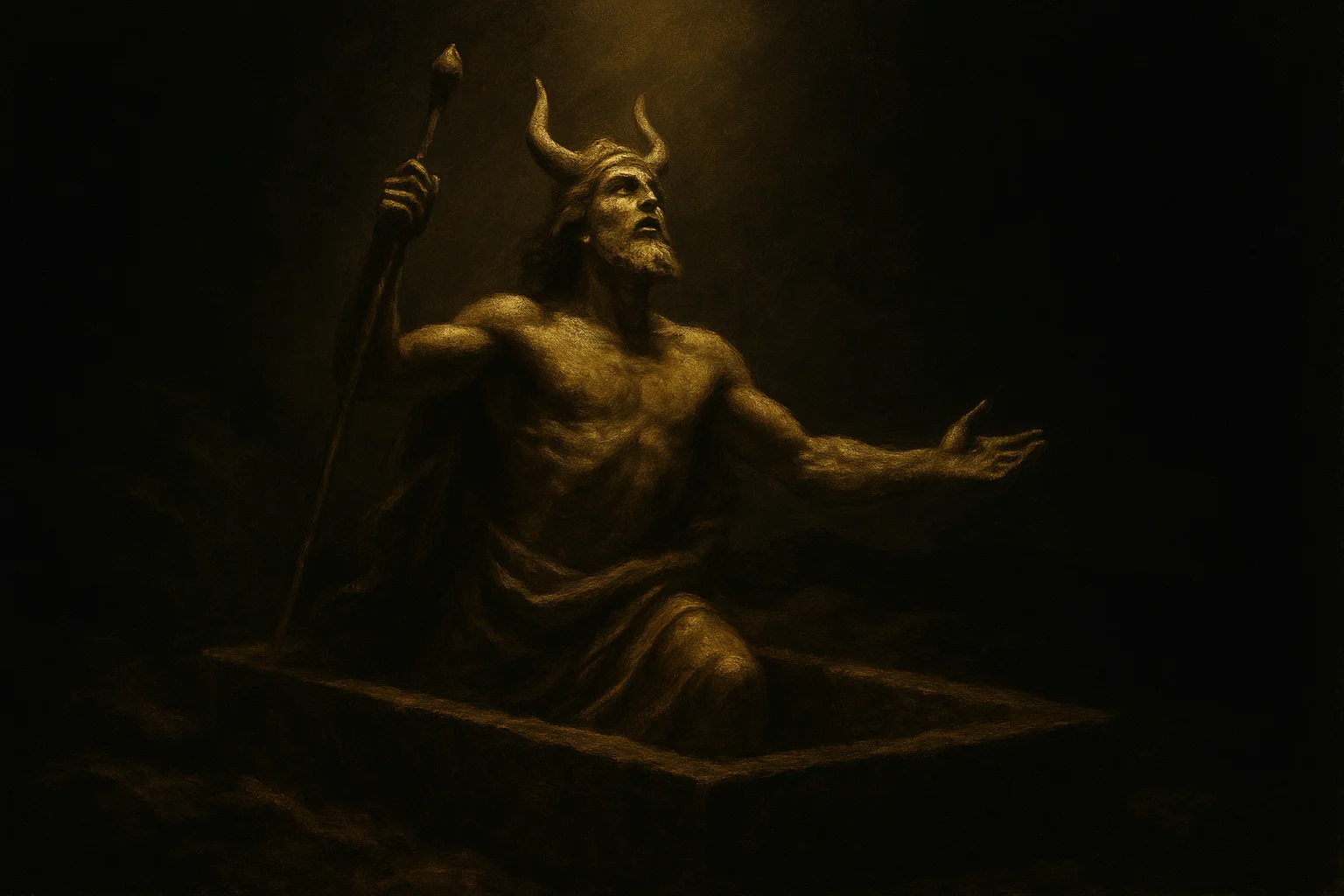
After Mot's dismemberment, El dreams. In KTU 1.6 iii 2–9, the high god sees the heavens raining oil and the wadis running with honey, signs that Baal lives. Shapash is sent to search, and Baal is found. He returns to his throne on Mount Zaphon, and the rains resume. The cycle closes with Baal restored to kingship, though the text hints that the conflict with Mot will recur.
Does Baal Resurrect? The Scholarly Debate
The question is not trivial. If Baal resurrects, he joins a category of gods whose death and return structure seasonal ritual and theological reflection across the ancient Near East and Mediterranean. If he merely escapes or is released, the pattern is different, and the comparative implications shift.
The Ugaritic text does not use a word that unambiguously means "resurrect." Baal is dead, then he is alive again, but the mechanism is unclear. Some scholars argue that Anat's destruction of Mot is the necessary act that frees Baal from death's grip. Others suggest that Baal's return is cyclical and automatic, tied to the seasonal calendar rather than a single dramatic event.
Mark Smith, in his study of Ugaritic narrative, notes that the text never describes Baal emerging from the underworld. He is simply found alive after Mot is destroyed. This has led some to propose that Baal's "death" is a kind of captivity or dormancy rather than biological cessation. The agricultural metaphor supports this: seeds lie dormant in the earth, then sprout when conditions allow.
Others, including John Day, emphasize the mourning rites and burial, which suggest a genuine death. The ambiguity may be deliberate, reflecting a theology in which death and life are states rather than events, and gods embody forces that wax and wane rather than individuals who live and die once.
Baal in Ugaritic Texts
Storm god descends to underworld, is devoured by Mot, mourned and buried, then returns after Mot is destroyed. No explicit resurrection verb; return is discovered, not narrated.
Dumuzi in Sumerian Texts
Shepherd god dragged to underworld by demons, mourned by Inanna, spends half the year below, half above. Return is negotiated, not a triumph over death.
Agricultural Cycles, Seasonal Ritual, and Royal Ideology
The Baal Cycle maps onto the agricultural calendar of the Levant with precision. Baal's death coincides with the dry season, roughly May through September, when no rain falls and the land turns brown. His return aligns with the onset of the autumn rains in October, the moment when planting begins and life returns to the fields.
Ritual texts from Ugarit suggest that the myth was performed or recited during seasonal festivals. The king, as Baal's representative on earth, may have played a role in these rites, enacting the god's descent and return to ensure the rains would come. This is speculative, as no detailed ritual script survives, but the pattern is consistent with other ancient Near Eastern practices where myth and ritual reinforce each other.
The political dimension is harder to ignore. Baal's kingship is contested, won through combat, and periodically threatened. The cycle legitimates a model of kingship that is active, martial, and dependent on divine favor rather than inherited right. El, the elder god, grants authority, but Baal must prove himself repeatedly. This mirrors the political realities of Late Bronze Age city-states, where kings ruled by force and diplomacy, not dynastic inevitability.
- Baal's palace is built only after his victory over Yam, symbolizing earned sovereignty.
- Mot's challenge tests Baal's willingness to risk death for cosmic order.
- Anat's violence restores balance but does not eliminate death permanently.
- El's dream signals divine approval of Baal's return, not human agency.
Echoes in Later Traditions
The Baal Cycle did not survive the collapse of Ugarit in 1200 BCE as a living tradition, but its motifs reappear in later texts. The Hebrew Bible preserves polemics against Baal worship, evidence that the storm god remained a rival to Yahweh for centuries. Psalm 29, with its imagery of the divine voice thundering over the waters, echoes Baal's titles and may have originated as a Canaanite hymn.
The combat myth, in which a storm god defeats a sea dragon or serpent, recurs in Babylonian, Hittite, and biblical literature. Marduk's battle with Tiamat in the Enuma Elish, Yahweh's defeat of Leviathan in Job and the Psalms, and even Thor's encounters with Jörmungandr share structural elements with Baal's victory over Yam. These are not borrowings in a simple sense but variations on a widespread mythological pattern that links storm gods, chaos waters, and cosmic order.
The question of dying-and-rising gods has been debated since the early twentieth century, often in the context of Christian theology and comparative religion. Scholars like James Frazer grouped Baal with Osiris, Adonis, and Attis as examples of vegetation deities whose death and return symbolize agricultural cycles. More recent work, particularly by Jonathan Z. Smith and Mark Smith, has questioned whether "resurrection" is the right category for these myths, arguing that each tradition operates within its own logic and that forcing them into a single pattern obscures more than it clarifies.
What remains clear is that the Baal Cycle addresses a problem central to agrarian societies: the dependence on forces beyond human control and the need to make sense of seasonal death and renewal. The myth does not offer a solution so much as a narrative framework for living with uncertainty.
Frequently asked questions
What are the Ugaritic tablets and when were they discovered?
The Ugaritic tablets are clay tablets inscribed in a cuneiform alphabet, discovered in 1929 at the site of ancient Ugarit, modern Ras Shamra on the Syrian coast, by French archaeologists following a farmer's accidental discovery of a tomb. The tablets date to the thirteenth century BCE and contain myths, rituals, administrative records, and diplomatic correspondence in the Ugaritic language, a Northwest Semitic tongue closely related to Hebrew and Phoenician. The Baal Cycle occupies six tablets catalogued as KTU 1.1 through 1.6, though the sequence and completeness remain debated.
How does Mot kill Baal in the Baal Cycle?
Mot does not kill Baal in the conventional sense; rather, he summons Baal to the underworld, and Baal descends, knowing he will be devoured. The text describes Mot as having a vast throat and consuming Baal as one would consume a sacrificial animal. Baal's death is announced to El and the divine assembly, mourning rites are performed, and Baal's body is buried on Mount Zaphon. The mechanism is swallowing or engulfment, not combat.
Does Baal actually resurrect or simply return from the underworld?
The Ugaritic text does not use an explicit resurrection term; Baal is dead, then later found alive after Anat destroys Mot, but the process of his return is not narrated in detail. Scholars debate whether this constitutes resurrection, escape from captivity, or a cyclical renewal tied to seasonal patterns. The ambiguity may reflect a theology in which gods embody natural forces that wax and wane rather than individuals who die and revive in a singular event. The text supports multiple readings, and no consensus exists.
What is the relationship between the Baal Cycle and agricultural seasons?
The Baal Cycle corresponds closely to the Levantine agricultural calendar, with Baal's death aligning with the dry season from May through September when no rain falls, and his return coinciding with the autumn rains in October that enable planting and crop growth. Mot embodies drought and sterility, while Baal represents the life-giving storms essential to farming. Ritual texts from Ugarit suggest the myth was recited or enacted during seasonal festivals, likely to ensure the rains would return and the land would remain fertile.
How does the Baal Cycle compare to other dying-and-rising god myths?
The Baal Cycle shares structural elements with myths of Dumuzi, Osiris, Adonis, and Attis, all of whom experience death or descent to the underworld and some form of return, often linked to agricultural or seasonal cycles. However, the specifics vary significantly: Dumuzi's return is negotiated and partial, Osiris remains in the underworld as king of the dead, and Baal's return is discovered rather than narrated as a triumphant emergence. Recent scholarship cautions against treating these as a single category, emphasizing that each tradition operates within its own theological and ritual logic.
Who is Anat and what role does she play in Baal's return?
Anat is Baal's sister and the goddess of war and the hunt, and she is the primary agent in Baal's return to life. After Baal's death, Anat mourns, searches for his body, and buries him, then confronts Mot and demands Baal's release. When Mot refuses, Anat kills him in a ritualized manner that mirrors agricultural processing: she splits, winnows, burns, grinds, and sows him across the field. This act of destruction appears to free Baal from death's grip, and he is subsequently found alive and restored to his throne.
Further reading on Mythologis
Read the full book
Want the whole story?
The complete edition is an instant PDF download here, with a paperback on Amazon for selected titles.
Canaanite
The Canaanite Mythology Book: Baal, El, Anat, and the Gods of the Ancient Levant
Baal, El, Anat, and the Gods of the Levant
The gods the Hebrew Bible warned against, recovered from the clay tablets of Ugarit: El the patriarch, Baal the storm-rider, Anat the war goddess, and Mot the lord of death. The mythology behind the Bible’s great rival.