
Jörmungandr: The Midgard Serpent
The world serpent who encircles Midgard, son of Loki, fated to kill and be killed by Thor at Ragnarök. What the Eddas actually say.
Contents
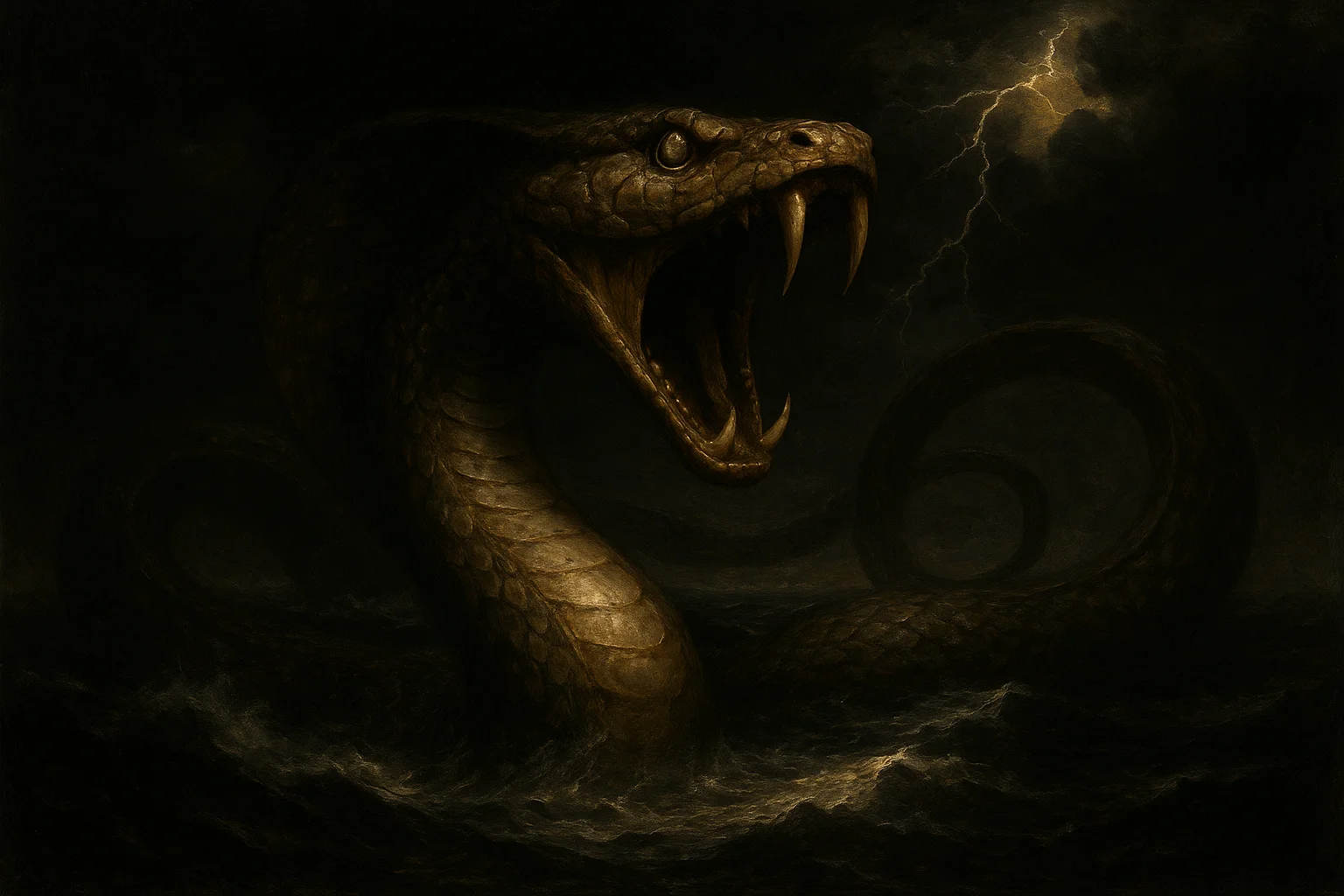
Jörmungandr is the monstrous serpent in Norse mythology who encircles Midgard, the world of humans, and holds his own tail in his jaws. Born of the trickster god Loki and the giantess Angrboða, he was cast into the ocean by Odin and grew so large that he wraps around the entire earth. At Ragnarök, he releases his tail and battles Thor, the thunder god, in a confrontation that kills them both. The Prose Edda's Gylfaginning preserves the fullest account of his role as both cosmic boundary and apocalyptic agent.
Most retellings frame Jörmungandr as Thor's nemesis and little more. But the serpent's function runs deeper than enmity. He is the living edge of the ordered world, the creature whose presence defines where human space ends and chaos begins. His story is one of containment, boundary, and the violent collapse of both.
Names and Meaning
The name Jörmungandr derives from Old Norse jörmun, meaning "great" or "mighty," and gandr, a term that carries connotations of magic, sorcery, and monstrous beings. The compound translates roughly to "great monster" or "mighty staff," though the second element resists clean translation. He is also called Miðgarðsormr, the Midgard Serpent, a title that foregrounds his cosmological position rather than his parentage.
Both names appear throughout the eddic corpus. The Prose Edda uses them interchangeably, while the Poetic Edda's Völuspá and Hymiskviða favour the latter. The choice of name often signals the narrative focus: Jörmungandr when the text emphasises his origin among Loki's monstrous children, Miðgarðsormr when the emphasis falls on his role as boundary.
Birth and Banishment
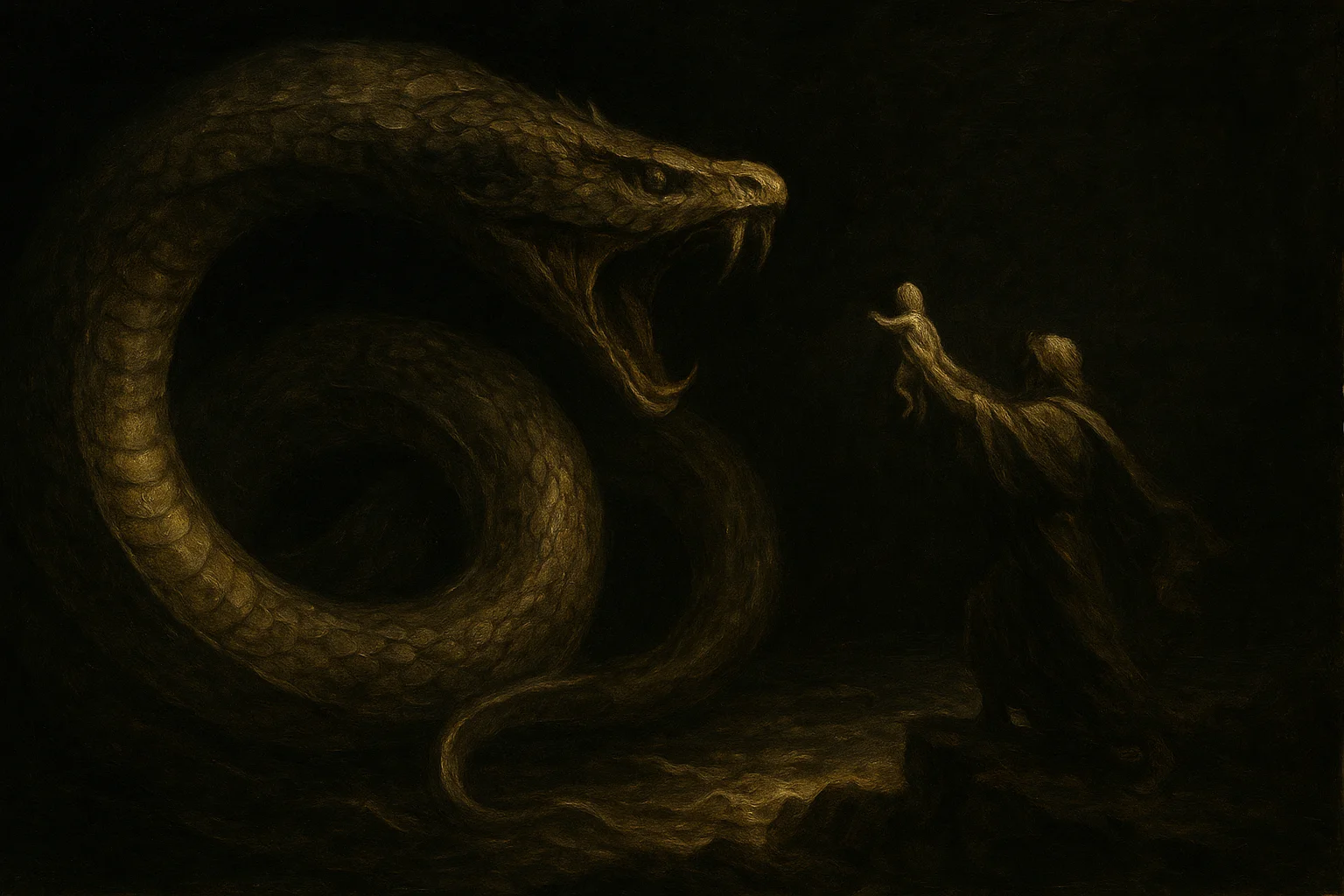
Jörmungandr is one of three children born to Loki and Angrboða in the land of the giants. His siblings are Fenrir, the wolf destined to swallow Odin, and Hel, who rules the realm of the dead. The Prose Edda's Gylfaginning, chapter 34, recounts how the gods learned of these offspring and grew alarmed at prophecies foretelling the destruction they would bring.
Odin took action. He cast Jörmungandr into the ocean that surrounds Midgard. The serpent sank to the seabed and grew. He grew until his body encircled the entire world, and he bit down on his own tail. There he remained, a living boundary between the human realm and the outer chaos, until the final days.
The banishment is not punishment in the moral sense. It is containment. Odin does not destroy the serpent because the serpent cannot be destroyed before his time. Instead, he places him where his presence serves a function: holding the world's edge in place.
The Serpent Who Holds the World
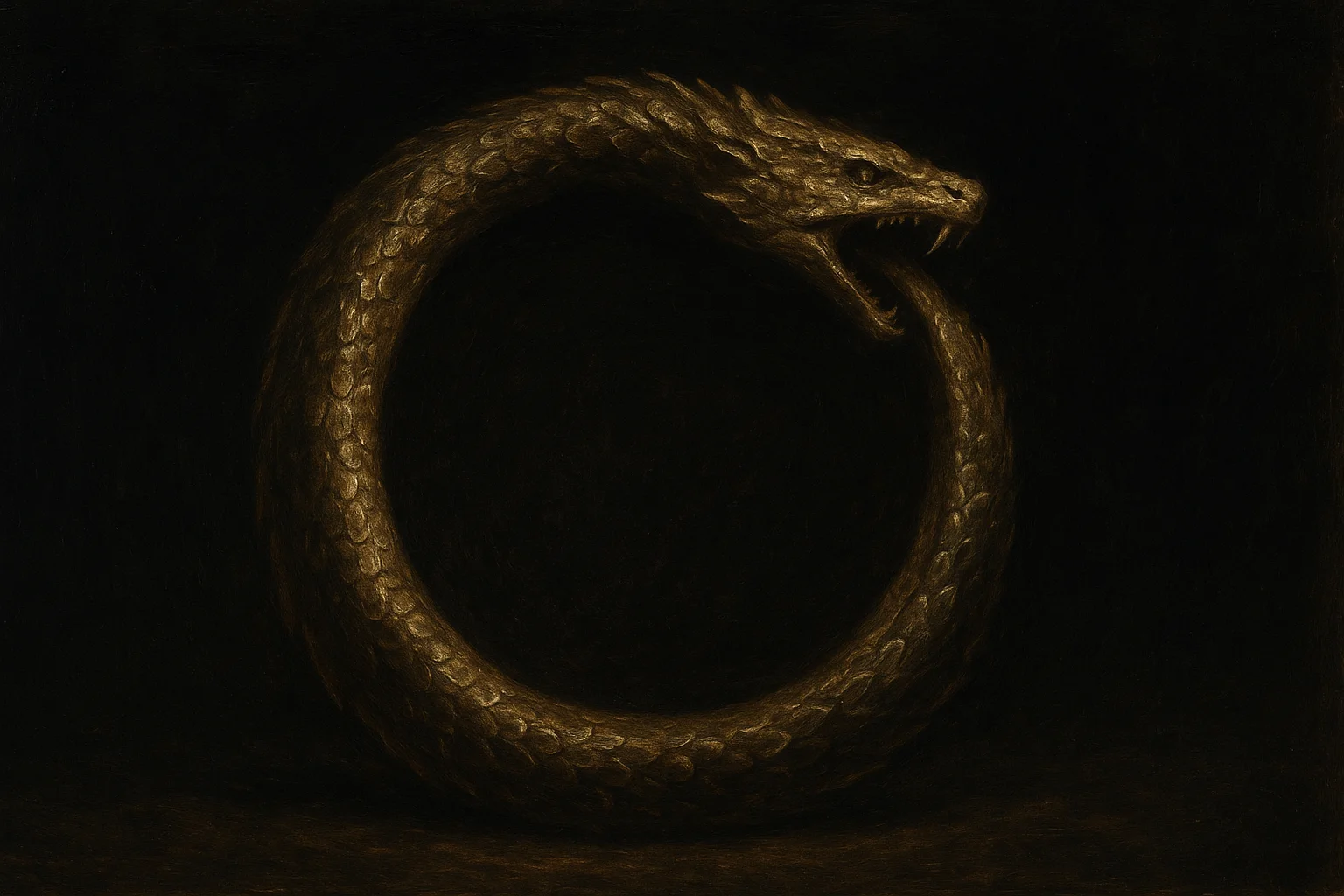
Jörmungandr's tail-biting posture is more than a detail. It is a cosmological statement. The serpent defines the limit of Midgard, the ordered space where humans and gods conduct their lives. Beyond him lies the ocean, and beyond the ocean, the lands of giants and formless threat. His body is the boundary itself.
This makes him one of several creatures that mark the limits of the known world in Norse thought. The great tree Yggdrasil structures the vertical cosmos; Jörmungandr structures the horizontal. He is not evil in the way a villain is evil. He is dangerous in the way a border is dangerous: cross it, and the rules change.
The image of the serpent biting its tail, the ouroboros, appears in many traditions. In Norse cosmology, it signals containment and tension. The serpent holds the world together by encircling it, but his presence is also a constant reminder that the boundary can break. When he releases his tail at Ragnarök, the end of the world, the ocean floods the land and the structure collapses.
Thor's Three Encounters
Thor, the thunder god, meets Jörmungandr three times in the surviving sources. Each encounter escalates. The first two are tests, near-misses, moments when the final confrontation almost arrives early. The third is mutual annihilation.
The Fishing Expedition
The most detailed account appears in the Poetic Edda's Hymiskviða, stanzas 20 through 24, and is retold in the Prose Edda's Gylfaginning, chapter 48. Thor travels to the hall of the giant Hymir and proposes a fishing trip. Hymir warns him not to row too far out, but Thor ignores the advice. He baits his hook with the head of an ox and rows beyond the edge of safety.
Jörmungandr takes the bait. Thor hauls the serpent up from the seabed, and the two lock eyes. Thor raises his hammer, Mjölnir, to strike. But Hymir, terrified, cuts the line. The serpent sinks back into the ocean. Some versions say Thor struck the serpent's head before the line was cut; others say the blow missed. The sources disagree, and the ambiguity matters. The encounter is a rehearsal for Ragnarök, not the event itself.
"The serpent gaped towards him from below; the god struck in fury the loathsome enemy's head. The mountains resounded, and the ancient earth shrank back; the fish sank into the sea." Hymiskviða, stanza 23, Poetic Edda
The Lifting of the Cat
In the Prose Edda's Gylfaginning, chapter 46, Thor visits the hall of Útgarða-Loki, a giant king who challenges him to a series of contests. One task appears simple: lift a grey cat from the floor. Thor strains and manages only to raise one of the cat's paws. He fails, humiliated.
Later, Útgarða-Loki reveals the trick. The cat was Jörmungandr, disguised by magic. That Thor lifted even one paw was an act of terrifying strength, because it meant he had raised part of the world-encircling serpent from the ocean floor. The test was not about lifting a cat. It was about whether Thor could break the boundary before the appointed time. He could not, and that is why the world endured.
Ragnarök: Mutual Destruction
At Ragnarök, Jörmungandr releases his tail. The ocean surges over the land. He crawls onto the battlefield at Vigrid, spewing venom into the air and sea. Thor meets him there. The Prose Edda's Gylfaginning, chapter 51, and the Poetic Edda's Völuspá, stanzas 55 and 56, both describe the outcome.
Thor kills the serpent with a blow from Mjölnir. But the venom has already done its work. Thor takes nine steps back from the corpse and falls dead. The god and the serpent destroy each other, the pattern of mutual destruction at the world's end made literal.
Thor and Jörmungandr
Mutual destruction: the god kills the serpent but dies from its venom nine steps later, neither surviving the encounter.
Odin and Fenrir
Asymmetric destruction: the wolf swallows Odin whole, and Odin's son Víðarr avenges him by tearing Fenrir's jaws apart.
Cosmological Function
Jörmungandr is not merely a monster to be slain. He is a structural element of the cosmos, and his death is inseparable from the world's end. This distinguishes him from creatures like Fenrir, whose binding is an act of containment that delays but does not define the cosmic order. Jörmungandr's encirclement is the order. When he lets go, the boundary dissolves.
The serpent's role intersects with broader Norse ideas about cosmological boundaries. The gods do not create a static, eternal world. They create a world that must be maintained, defended, and ultimately lost. Jörmungandr is part of that maintenance. His presence keeps Midgard coherent, even as his nature ensures that coherence is temporary.
This is why the gods do not kill him when they have the chance. To kill him early would be to break the boundary early, to invite the flood and the collapse before the ordained time. The cosmology depends on his survival until Ragnarök. He is both threat and necessity.
World Serpents Beyond the North
Jörmungandr belongs to a widespread pattern of serpents that encircle or support the world. The motif appears across unrelated mythologies, and the similarities are structural rather than genealogical.
- In Hindu cosmology, the serpent Shesha or Ananta supports the god Vishnu and, in some accounts, the entire earth on his many heads.
- The Egyptian Mehen coils protectively around the sun god Ra's barque as it travels through the underworld each night.
- The Mesoamerican Quetzalcoatl, though often depicted as a feathered serpent and culture hero, shares the serpent's association with cosmic cycles and boundaries.
- The Greek Ouroboros, the tail-biting serpent, appears in alchemical and Gnostic texts as a symbol of cyclicality and self-containment.
These serpents share a function: they mark the edge of the ordered world or hold its structure in place. Jörmungandr is distinctive in that his release triggers not renewal but annihilation. Other traditions imagine the world serpent as eternal or cyclical. Norse cosmology imagines him as a timer set to run out.
The ouroboros image, in particular, invites comparison. Both Jörmungandr and the Greek ouroboros bite their tails, but the symbolism diverges. The ouroboros represents eternal return, the unity of beginning and end. Jörmungandr represents containment under pressure. His tail-biting is not serene. It is a restraint that will fail, and the myths make no secret of when and how.
Legacy and Modern Reception
Jörmungandr has enjoyed a robust afterlife in modern culture, often stripped of his cosmological weight and recast as a sea monster or dragon. Video games, fantasy novels, and comic books deploy him as a boss fight or a symbol of primal chaos, rarely engaging with his function as boundary-keeper.
The Marvel Comics version, popularised in films, reduces him to an obstacle for Thor to overcome. The serpent appears, Thor fights him, the story moves on. This is not entirely unfaithful to the myths, but it flattens the stakes. The eddic Jörmungandr is not an enemy to be defeated and forgotten. He is the condition of the world's existence and the agent of its end, and those roles cannot be separated.
More thoughtful engagements appear in literary and scholarly retellings. Neil Gaiman's Norse Mythology preserves the serpent's cosmological role and his three encounters with Thor, treating him as a figure of inevitability rather than mere antagonism. Scholarly work by figures like John Lindow and Rudolf Simek situates Jörmungandr within the broader logic of Norse eschatology, where creation and destruction as paired forces structure the narrative arc of the cosmos.
The image of the Midgard Serpent biting his tail has also migrated into modern iconography, often conflated with the ouroboros. Tattoos, logos, and album covers borrow the motif, usually signalling cyclicality or self-sufficiency. The Norse original is less tidy. Jörmungandr's circle is not a symbol of harmony. It is a holding pattern, and the myths tell us exactly when it breaks.
Frequently asked questions
Who are Jörmungandr's parents and why was he cast into the sea?
Jörmungandr is the son of Loki, the trickster god, and Angrboða, a giantess whose name means "she who brings grief." Odin cast the serpent into the ocean surrounding Midgard after learning of prophecies that foretold the destruction Loki's children would bring at Ragnarök. The banishment was an act of containment, not punishment, intended to delay the serpent's role in the world's end by placing him at the boundary of the ordered cosmos.
What does the name Jörmungandr mean in Old Norse?
The name Jörmungandr combines jörmun, meaning "great" or "mighty," with gandr, a term associated with magic, sorcery, and monstrous beings, yielding a sense of "great monster" or "mighty magical creature." He is also called Miðgarðsormr, the Midgard Serpent, a title that emphasises his cosmological role as the creature who encircles the world of humans. Both names appear throughout the Prose and Poetic Eddas, often used interchangeably depending on narrative focus.
How many times does Thor encounter the Midgard Serpent?
Thor encounters Jörmungandr three times in the surviving Norse myths. The first is the fishing expedition with the giant Hymir, recounted in the Poetic Edda's Hymiskviða, where Thor hooks the serpent and nearly kills him before the line is cut. The second is the lifting of the cat in Útgarða-Loki's hall, described in the Prose Edda's Gylfaginning, where the cat is revealed to be the serpent in disguise. The third and final encounter occurs at Ragnarök, when Thor kills the serpent but dies from its venom nine steps later.
What happens to Jörmungandr at Ragnarök?
At Ragnarök, Jörmungandr releases his tail and crawls onto the battlefield at Vigrid, spewing venom that poisons the air and sea. Thor confronts him and delivers a fatal blow with his hammer Mjölnir, killing the serpent. However, Thor is drenched in the serpent's venom and manages to take only nine steps away from the corpse before he collapses and dies. Their mutual destruction is one of the defining events of the Norse apocalypse, as recounted in the Prose Edda's Gylfaginning and the Poetic Edda's Völuspá.
Why does the serpent encircle Midgard and bite its own tail?
Jörmungandr encircles Midgard because he grew so large after being cast into the ocean that his body wraps around the entire world, and he bites his own tail to complete the circle. This posture serves a cosmological function: the serpent defines the boundary of the ordered human realm, separating Midgard from the outer chaos. His tail-biting is not a symbol of eternal return, as in other traditions, but a form of containment under tension. When he releases his tail at Ragnarök, the boundary collapses and the ocean floods the land.
How does Jörmungandr compare to serpents in other mythologies?
Jörmungandr shares structural similarities with world serpents in other traditions, including the Hindu serpent Shesha, who supports Vishnu and the earth, and the Egyptian Mehen, who coils protectively around Ra's solar barque. The Greek ouroboros also bites its tail, but symbolises eternal cyclicality rather than apocalyptic containment. What distinguishes Jörmungandr is that his release triggers not renewal but annihilation: his role is to hold the world together until the ordained moment of its destruction, making him both boundary-keeper and agent of the end.
Further reading on Mythologis
Read the full book
Want the whole story?
The complete edition is an instant PDF download here, with a paperback on Amazon for selected titles.
Mythology
The World Mythology Book: The Gods, Heroes and Myths of Every Culture
The Gods, Heroes and Myths of Every Culture, in One Volume
The whole of world mythology in a single volume: Greek, Norse, Egyptian, Japanese, Hindu, Celtic, Slavic, Mesoamerican and African myths gathered side by side, each drawn from the primary sources.