Canaanite
Bronze Age Levantine religion through the Ugaritic tablets. Gods, cosmology, ritual practice, and what survives when a tradition is written by its rivals.
Browse Canaanite
Most introductions to Canaanite mythology begin with Baal and end with a list of gods. They rarely explain where those names come from, why the texts are so fragmentary, or how a religion practised across a dozen city-states for more than a millennium resists tidy summary. The primary sources are clay tablets written in a language that went extinct before Rome was founded, discovered less than a century ago, and still debated line by line.
This is not a religion preserved in epic poems copied across centuries. It survives in administrative archives, ritual instructions, and mythological fragments unearthed from a single Bronze Age port.
What We Mean by Canaanite
The term Canaanite is a geographical and linguistic umbrella, not a unified political or religious identity. It refers to the Northwest Semitic-speaking peoples who inhabited the Levantine coast and hinterland, roughly modern Lebanon, coastal Syria, Israel, and Palestine, from the late third millennium BCE through the first millennium BCE.
Geography and Chronology
Canaan was never an empire. It was a network of city-states: Ugarit, Sidon, Tyre, Byblos, and others, each with its own king, patron deity, and ritual calendar. Political allegiance shifted between Egyptian, Hittite, and Mesopotamian spheres of influence. Religious practice varied by city, though the pantheon's core structure remained recognisable across the region.
The height of Canaanite culture coincides with the Late Bronze Age, roughly 1550 to 1200 BCE. After the Bronze Age collapse, Phoenician city-states carried forward Canaanite religious traditions into the Iron Age and beyond, spreading them across the Mediterranean through trade and colonisation.
The Problem of Sources
We possess no Canaanite Bible. The texts that survive are administrative, ritual, and mythological fragments, most of them from Ugarit, a port city destroyed around 1200 BCE. The tablets were baked by the fire that ended the city, preserving them by accident.
Other sources are hostile or secondhand: the Hebrew Bible's polemics against Canaanite worship, Philo of Byblos' Phoenician History (written in Greek, centuries after the fact, and preserved only in fragments by Eusebius), and scattered references in Egyptian and Mesopotamian records. Scholars work with what amounts to a partial script, missing scenes, and no director's notes.
The Ugaritic Texts and What They Tell Us
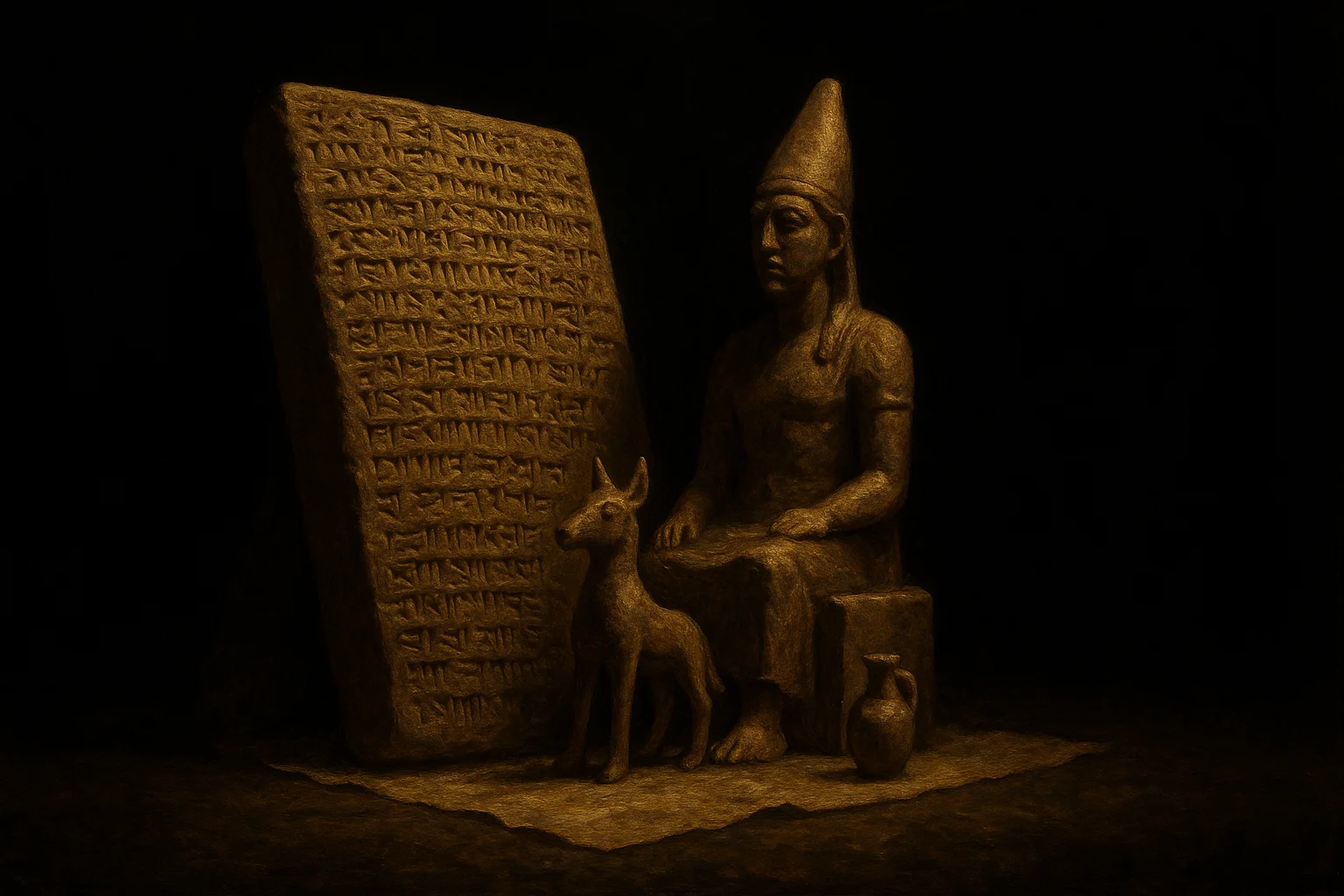
Between 1929 and the present, excavations at Ras Shamra, ancient Ugarit, have yielded more than 1,400 texts in the Ugaritic language, a previously unknown Northwest Semitic tongue written in a cuneiform alphabet. The mythological corpus includes the Baal Cycle (KTU 1.1 through 1.6), the Legend of Kirta (KTU 1.14 through 1.16), and the Legend of Aqhat (KTU 1.17 through 1.19), alongside dozens of ritual and administrative texts.
The Baal Cycle is not a single continuous narrative. It survives on six tablets, some damaged, with gaps and disputed readings. Translators disagree on verb tenses, divine epithets, and the sequence of episodes. What emerges is a story of cosmic conflict, seasonal death, and the precarious maintenance of fertility.
Ritual texts from Ugarit (KTU 1.39, 1.40, 1.41, 1.119) list offerings, festival calendars, and sacrificial procedures. They confirm that myth and ritual were inseparable: the stories were not entertainment but scripts for sacred action.
The Pantheon: El, Asherah, Baal, and the Assembly
The Canaanite pantheon is structured as a divine assembly, with El presiding as patriarch, Baal Hadad as active warrior and storm-bringer, and Asherah as consort and mother. Below them, a host of gods and goddesses govern specific domains: death, sea, war, fertility, craftsmanship.
El, the Bull and the Father
El is the senior deity, often called "Father of Years" or "Bull El." He dwells at the source of the two rivers, a cosmic location that suggests both primordial origin and remote authority. He is wise, aged, and largely withdrawn from direct action. Decisions are made in his assembly, but younger gods carry them out.
El's epithets emphasise stability and patriarchal authority. He grants kingship, blesses fertility, and arbitrates disputes among the gods. He is not, however, the god of storms or war. That role belongs to his son.
Baal Hadad, Storm and Fertility
Baal, meaning "lord" or "master," is a title rather than a proper name. The god's full designation is Baal Hadad, Hadad being the storm god known across the ancient Near East. He rides the clouds, wields lightning, and brings the rain that sustains agriculture.
Baal's primary myth, the Baal Cycle, recounts his battles against Yam (Sea) and Mot (Death). He defeats Yam to claim kingship, builds a palace, and then descends to the underworld, where Mot kills him. His death brings drought; his resurrection, orchestrated by his sister Anat, restores fertility. The pattern aligns with the seasonal cycle of the Levantine climate: the dry summer as death, the autumn rains as return.
Baal's role as a dying-and-rising god places him in a broader Near Eastern and Mediterranean pattern, though the details of his myth are distinctly Canaanite.
Asherah, Consort and Mother
Asherah is called "Lady Asherah of the Sea" and "Creatress of the Gods." She is El's consort and the mother of 70 divine children. Her role as mother goddess is both genealogical and functional: she intercedes, nurtures, and legitimates.
In the Baal Cycle, Asherah initially opposes Baal's bid for a palace but is won over by gifts. Her approval is necessary for El to grant permission. She appears as a power broker, not merely a passive consort.
Asherah's worship extended beyond Ugarit. The Hebrew Bible condemns her cult repeatedly (Exodus 34:13, Deuteronomy 7:5, Judges 2:13), and archaeological evidence, including inscriptions from Kuntillet Ajrud, suggests she was venerated alongside Yahweh in some Israelite contexts.
Anat, Mot, Yam, and the Supporting Cast
Anat is Baal's sister and fiercest ally, a goddess of war who wades through blood and dismembers enemies. In the Baal Cycle, she retrieves Baal from the underworld and slays Mot, grinding him like grain. Her violence is both terrifying and necessary.
Mot, whose name means "death," rules the underworld. He is not evil but inevitable. His realm is dry, dusty, and final. Baal's descent to Mot's domain is not a punishment but a cosmic necessity.
Yam, "Sea," embodies chaos and primordial threat. Baal's defeat of Yam echoes other ancient Near Eastern combat myths, including Marduk's battle with Tiamat in the Babylonian Enuma Elish. Yam is sometimes depicted as a dragon or sea serpent, a monstrous force subdued by the storm god's weapons.
Other deities include Kothar-wa-Khasis, the divine craftsman who forges Baal's weapons and builds his palace; Shapash, the sun goddess who guides the dead; and Resheph, a plague god later adopted into Egyptian and Phoenician worship.
Cosmology and Creation
No single Canaanite creation myth survives intact. The Ugaritic texts assume a cosmos already in place: heaven, earth, sea, and underworld, populated by gods and governed by El's authority. Creation is less a singular event than an ongoing process of ordering chaos.
Philo of Byblos, writing much later, preserves a theogony that begins with primordial elements: Desire, Air, and Chaos. From these emerge the first gods, who in turn produce the pantheon. Scholars debate how much of Philo's account reflects genuine Canaanite tradition and how much is Hellenistic reinterpretation.
What is clear from the Ugaritic texts is that the cosmos is contested. Yam threatens to engulf the ordered world; Mot claims all living things. The gods' task is not to create ex nihilo but to maintain boundaries: land against sea, life against death, fertility against drought.
The Baal Cycle: Death, Descent, and Return
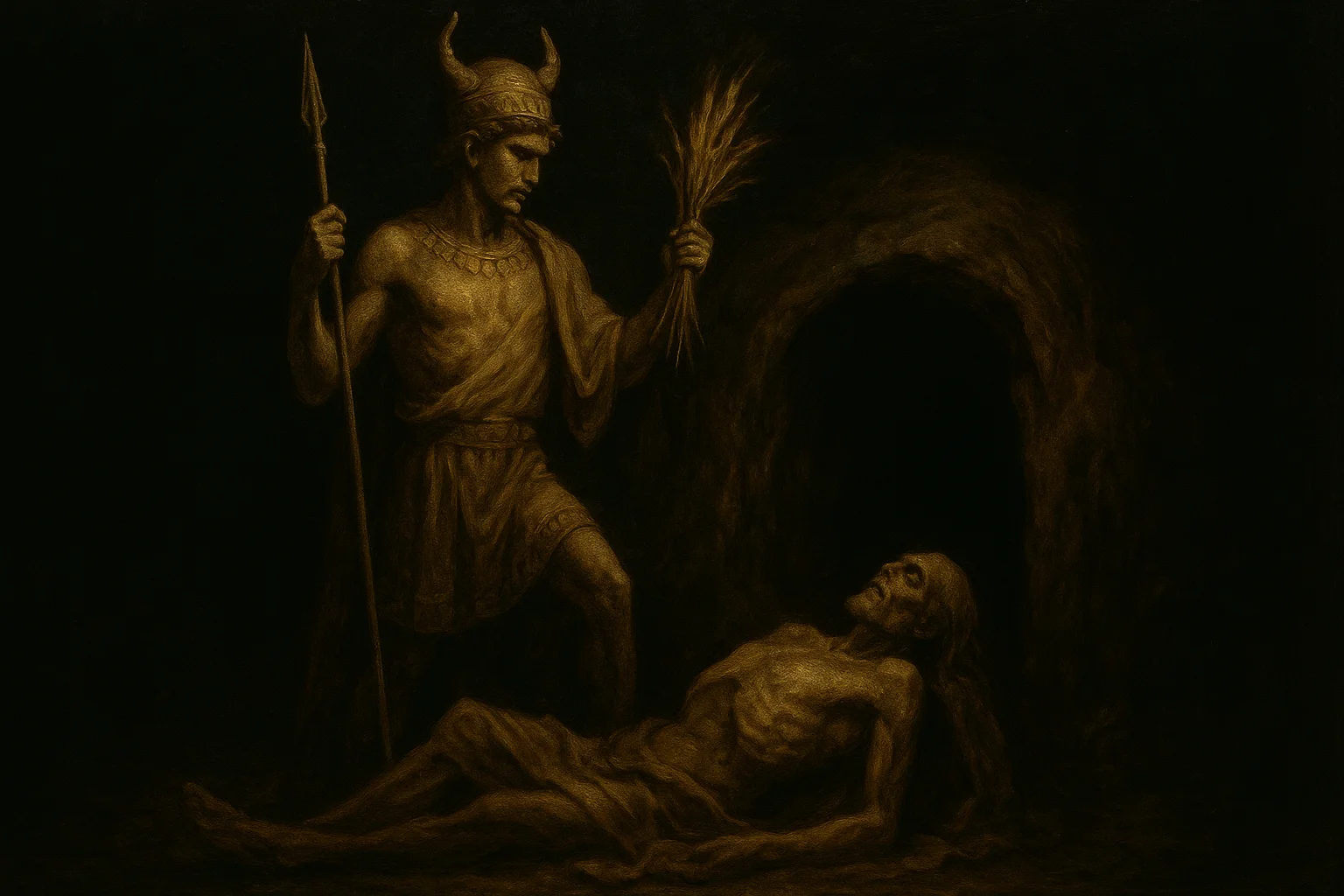
The Baal Cycle is the longest and most complete mythological narrative from Ugarit. It unfolds in episodes, each preserved on separate tablets, with gaps and disputed sequences.
"Baal the Mighty has died, the Prince, Lord of Earth, has perished." Baal Cycle, KTU 1.5
The cycle begins with Baal's conflict against Yam, who claims kingship over the gods. El initially favours Yam, but Baal, armed with weapons forged by Kothar, defeats the sea god and scatters his body. With kingship secured, Baal demands a palace befitting his status. Asherah intercedes with El, and the palace is built.
The second major episode concerns Mot. Baal sends messengers to the underworld, but Mot demands Baal descend in person. Baal complies, and Mot devours him. The earth becomes barren. El mourns, and Anat searches for her brother. She finds Mot, slays him, grinds his body, and scatters it in the fields. Baal returns, the rains come, and fertility is restored.
The cycle does not end with permanent victory. Mot eventually revives, and the conflict resumes, suggesting that the struggle between life and death is cyclical, not resolved once and for all.
Canaanite Baal
Descends to the underworld, is killed by Mot, and is resurrected by Anat's intervention. His death brings drought; his return, rain and fertility. The myth is seasonal and agricultural.
Mesopotamian Dumuzi
Descends to the underworld as a substitute for Inanna. His death is mourned annually, and his return is celebrated. The myth emphasises the goddess's agency and the inevitability of death's claim.
Ritual Practice and Sacred Space
Canaanite religion was not a matter of private belief but public ritual. Temples, sacrifices, festivals, and offerings structured the relationship between humans and gods.
Temples and High Places
Temples in Canaanite cities were the gods' earthly residences. The temple of Baal at Ugarit, for instance, was a monumental structure with courtyards, altars, and storage rooms for offerings. High places, open-air sanctuaries on hilltops, were also common, particularly for rituals involving Asherah and fertility rites.
The Hebrew Bible's repeated condemnation of "high places" (1 Kings 18, Deuteronomy 7:5) reflects their persistence and popularity. Archaeological evidence confirms that these sites remained active well into the Iron Age.
Sacrifice and Offerings
Ritual texts from Ugarit list offerings in meticulous detail: sheep, cattle, birds, bread, wine, and oil. Sacrifices were categorised by type: burnt offerings consumed entirely by fire, communion sacrifices shared between gods and worshippers, and purification offerings for atonement.
Animal sacrifice was the primary mode of communication with the divine. Blood was poured on altars, meat was roasted, and incense was burned. The gods were fed, honoured, and petitioned through these acts.
Fertility Rites and Ancestor Veneration
Fertility rites, often associated with Asherah and Baal, involved processions, sacred prostitution (though the evidence for this is contested), and seasonal festivals. The goal was to ensure agricultural abundance and human fertility.
Ancestor veneration was also central. The dead, called Rephaim, were honoured with offerings and invoked for protection. Tombs were sites of ritual activity, and the boundary between the living and the dead was permeable.
Canaanite Religion in the Hebrew Bible
The Hebrew Bible is both a source for and a polemic against Canaanite religion. It preserves the names of Canaanite gods, describes their rituals, and condemns their worship as abomination.
Baal is the most frequently mentioned Canaanite deity, often paired with Asherah. The prophet Elijah's contest with the prophets of Baal on Mount Carmel (1 Kings 18) dramatises the conflict between Yahweh and Baal as a contest over who controls rain and fertility. The narrative assumes that Baal worship was widespread and appealing.
Asherah appears as both a goddess and a cultic object, the asherah pole, a wooden symbol erected beside altars. Commands to cut down asherah poles (Exodus 34:13) suggest that her worship was deeply embedded in Israelite practice.
The biblical polemic is not disinterested history. It reflects a later theological agenda: the centralisation of Yahweh worship and the eradication of rival cults. But in condemning Canaanite religion, the Bible preserves details that would otherwise be lost.
Legacy and Survival
Canaanite religion did not vanish overnight. It evolved into Phoenician religion, which spread across the Mediterranean through colonies like Carthage. Phoenician inscriptions from Cyprus, Sardinia, and North Africa invoke Baal, Asherah, and other Canaanite deities well into the Roman period.
Elements of Canaanite mythology also survived in transformed guise. The combat myth of Baal and Yam influenced later Jewish apocalyptic literature, where Yahweh battles Leviathan, a sea serpent echoing Yam. The image of the divine council, with El presiding over lesser gods, shaped early Israelite conceptions of Yahweh's heavenly court.
Even the Hebrew Bible's fierce opposition to Canaanite religion testifies to its enduring power. You do not spend centuries condemning what is already forgotten.
Frequently asked questions
What are the primary sources for Canaanite mythology?
The primary sources are the Ugaritic tablets discovered at Ras Shamra, Syria, beginning in 1929. These include the Baal Cycle, the Legends of Kirta and Aqhat, and ritual texts. Secondary sources include the Hebrew Bible's polemics and fragments of Philo of Byblos' Phoenician History preserved by Eusebius.
Who were the main gods in the Canaanite pantheon?
El presided as father god and patriarch. Baal Hadad governed storms, rain, and fertility. Asherah was El's consort and mother of the gods. Anat, goddess of war, was Baal's sister and ally. Mot ruled death and the underworld, while Yam embodied the chaotic sea.
What is the Baal Cycle and why does it matter?
The Baal Cycle is the longest surviving Canaanite mythological narrative, recounting Baal's battles against Yam and Mot, his death, and his resurrection. It matters because it reveals the structure of Canaanite cosmology, the role of seasonal myth in agricultural religion, and the pattern of dying-and-rising gods common across the ancient Near East.
How did Canaanite religion influence early Israelite belief?
Canaanite religion influenced Israelite belief through shared pantheon structures, ritual practices, and mythological motifs. The divine council, the combat myth, and the veneration of Asherah alongside Yahweh all reflect Canaanite influence. The Hebrew Bible's polemics against Canaanite worship suggest it remained a live option for many Israelites.
Why is Canaanite mythology so fragmentary?
Canaanite mythology is fragmentary because it was not preserved in a canonical text. The Ugaritic tablets are administrative and ritual archives, not literary anthologies. Most were damaged by fire or time. Other sources are hostile (the Hebrew Bible) or secondhand (Philo of Byblos), and much was lost when Canaanite cities were destroyed in the Bronze Age collapse.