Egyptian Symbols: Sacred Icons and Their Meanings
From the ankh to the scarab, explore Egyptian symbols grounded in temple inscriptions, funerary texts, and archaeological evidence.
Contents
Looking for a complete introduction to Egyptian Symbols in just a few minutes? You’ve come to the right place! Read on !
Ancient Egyptian Symbols, Meaning and History
Full of mystery and spirituality, the mythology and culture of the ancient Egyptians are undoubtedly an important part of the history of civilization.
SUMMARY OF EGYPTIAN SYMBOLS :
- ANKH
- EYE OF HORUS
- EYE OF RA
- OUROBOROS
- AMEMPTAH or AMENTA
- BEETLE or EGYPTIAN SCARAB
- THE DJED PILLAR
- TYET, THE ISIS KNOT
- SYMBOL OF KA or “The spirit of Ka”
- THE EGYTIAN SYMBOL “BA”
Egyptian Symbols: Ka or the spirit of Ka
It is certain that, to a certain extent, we are now able to understand hieroglyphics, which represent events that took place during the time of the Pharaohs. That said, knowledge of Egyptian symbolism is essential to a good understanding of these times.
The Meanings of Modern & Ancient egyptian Symbols
Egyptian Symbols: The Ankh
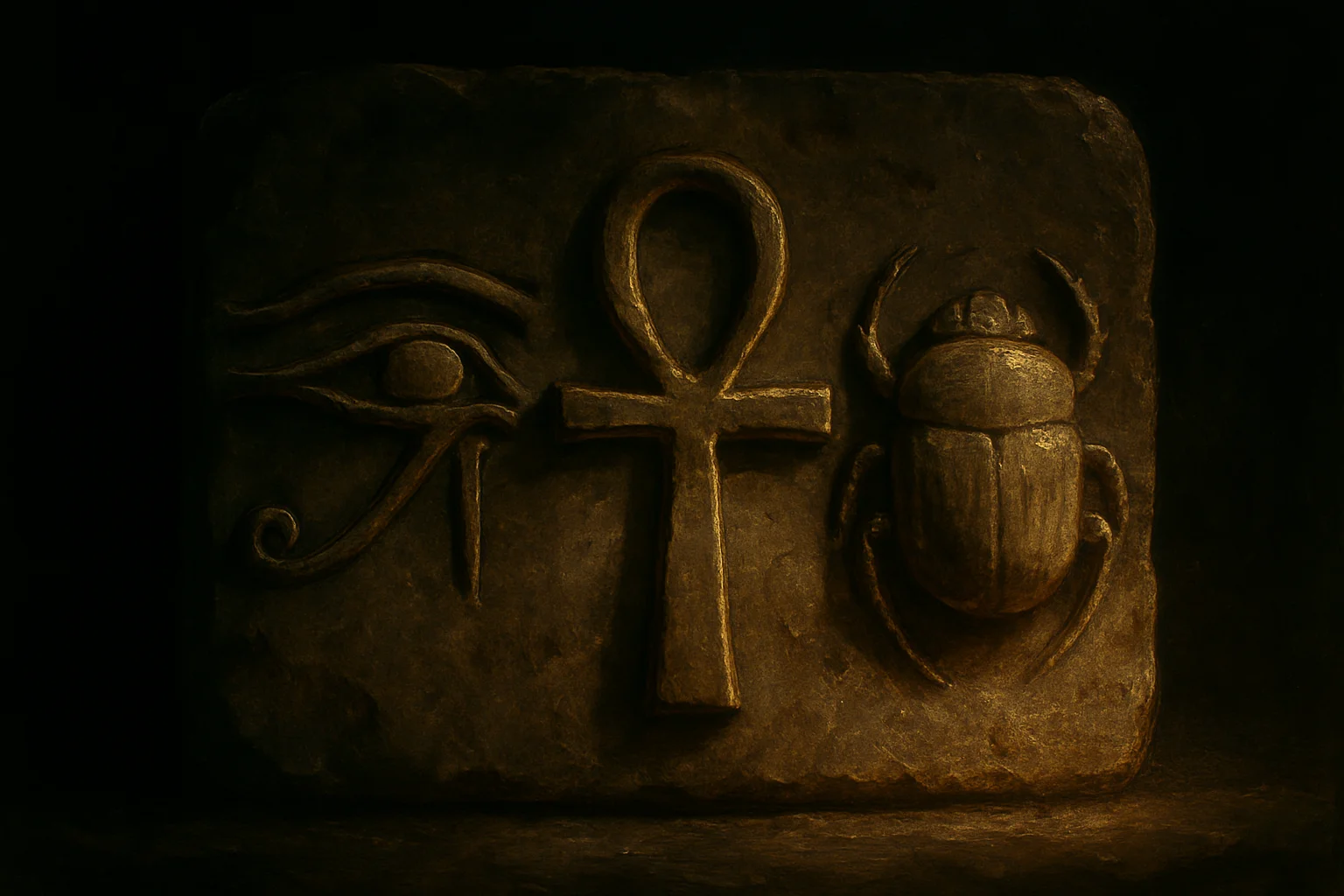
It is the most widely used symbol of all ancient Egyptian symbols. The Ankh (also known as “cruxansata” by Coptic Christians) represents life and immortality.
It has also been used as a symbol of the union between men and women, and in particular the union between Isis and Osiris, which was created to bring about the flooding of the Nile, thus bringing fertility to Egypt. This is the reason why the Ankh is also called the Key of the Nile.
It also represents the purifying and invigorating power of water, and clairvoyance (the ability to see the “afterlife”). It was also thought that the Ankh was “the key to eternity” and “the key to the underworld“.
Sometimes this symbol was drawn on the walls of temples because it was thought to attract divine protection.
_Read More about Ankh Symbol : _Meaning of the Egyptian Cross “Ankh”
Egyptian Symbols: Eye of Horus
Also known as Wadjet (Udjat, Uadjet, Uto, Wedjoyet, Edjo and Uto), the symbol of Horus’ eye represents protection, healing, good health and royal power. It is also considered as the symbol of the moon. The ancient Egyptians believed that the amulets that wore Horus’ eye had healing powers. The Horus Eye has also been used as a medical tool to measure ingredients in the preparation of remedies.
According to the myth, Horus and Seth clashed to replace Osiris after his death and Seth wounded Horus in the left eye. Hator (or Toth) would have cured the eye using magic but Horus would have offered his eye to his father Osiris, to bring him back to life. This is why the** eye of Horus** is also known as a symbol of sacrifice.
The Eye of Providence (the Masonic eye that sees everything) present on US dollars would come from the eye of Horus.
_Read More : _The eye of horus | the true meaning of the egyptian symbol
Egyptian Symbols: Eye of Ra
There are different myths about the origin of this symbol. However, the majority of experts believe that the symbol was actually the right eye of Horus, who would have converted into the eye of Ra in antiquity. The two symbols represented the same concepts for the most part. That said, according to other myths, the symbol of the eye of Ra would have represented the personification of many goddesses of Egyptian mythology such as Wadjet, Hathor, Mut, Sekhmet and Bastet.
Ra, also known as Ra, is the sun god of Egyptian mythology. That is why the eye of Ra represents the sun.
_Read More : _Meaning of the Re/Ra eye
Egyptian Symbols: Ouroboros
The ouroboros, in Egyptian mythology, was one of the symbols of the sun, because it represented the journeys of Aten, the solar disk of Egyptian mythology. In addition, the ouroboros represented rebirth, recreation of life and perpetuity.
In the Book of the Dead, the image of the “snake that eats itself or the snake that eats its tail” is closely associated with Atum, the first god born of the chaotic waters of Nun (the primordial water, from which creation would come first) who was born of these waters in the form of a snake that renews itself every morning.
The Egyptians passed the symbol of the ouroboros to the Phoenicians, who eventually passed it on to Greek culture. The name ouroboros was given to the symbol by the Greeks.
Also known as the symbol of infinity, the ouroboros is a symbol commonly used throughout the world, including in Nordic mythology, where it is known as Jörmungandr.
_Read More about The Ouroboros : _The symbolism of the Ouroboros _Read More about Jormungandr : _The Giant Sea Serpent in Norse Mythology & Viking Culture
Egyptian Symbols: Amemptah or Amenta
The symbol of the Amenta, in ancient Egyptian culture, represents the land of the dead (the earthly world). The Amenta, originally, was used as a symbol of the horizon, where the sun sets. Over time, it has been used to represent the western edge of the Nile, which is also the place where the Egyptians buried their dead. This is the reason why the Amenta would finally have become the symbol of the Inframonde.
Egyptian Symbols: The Beetle / Egyptian Scarab
The beetle is one of the most important symbols of ancient Egyptian culture. The dung beetle represents the sun, the recreation of life, resurrection and transformation.
When they saw the dung beetles grow manure balls (their food source), the ancient Egyptians thought that these beetles recreated life. This is due to the fact that they confused the eggs laid and buried in the sand by the female beetles of the dung beetle breed with the manure ball that they use as food. That is why they thought that these beetles had “created the life of nothingness”.
_Read More : _Meaning of the Egyptian Beetle/Scarab
Egyptian Symbols: The Djed pillar
The Djed pillar, also known as “the spinal column of Osiris“, is a symbol that represents strength and stability in the culture of ancient Egypt.
He is associated with Ptah, the god of creation and Osiris, the god of the infraworld and the dead. Although it was first known as the symbol of Ptah, the symbol of the Jed pillar has been adopted by the cult of Osiris over time. Hence the name “Osiris’ spine”.
The Egyptians thought that the Djed pillar was, in reality, the combination of the four pillars that supported the four corners of the earth.
Egyptian Symbols: Tyet – The Isis knot
Tiet or Tyet, also known as the knot of Isis or the blood of Isis, is an Egyptian symbol that closely resembles the symbol of the Ankh. Its meaning was also considered to be similar to that of the Ankh. It is assumed to symbolize life.
It was associated with the goddess Isis and is mainly used with the Ankh and the Djed pillar of Osiris, because together they were considered as a representation of the dual nature of life.
There is no precise information as to why he was given the name Isis’ blood, but it is assumed that it was given to him because it represented Isis’ monthly blood and the magical powers it conferred.
Egyptian Symbols: The symbol of Ka or the spirit of Ka
The Ka symbol is one of the most complex Egyptian symbols of the hieroglyphic era because it represents three different spiritual concepts. Ka represented the fact of receiving the lives of other men and gods, the fact of being the source of these powers and the spiritual double of all living men.
The word “Ka” literally means “spirit” or “soul”. It is believed to represent the soul that would have been inhaled by the goddesses Heket and Meskhenet at birth.
The Ka was also the spiritual double that was born with each human being. He lived but would not die with that person, because he continued to exist as long as he had a place to live, that is, a body in which to live. This is one of the main reasons why the ancient Egyptians mummified their dead. It was thought that the dead lost the possibility of living an eternal life if their bodies decomposed, thus causing the death of the Ka.
The Egyptian Symbol “Ba”
Resembling a bird (more precisely a falcon) with a human head, the symbol of Ba was represented entering or leaving someone’s grave or was placed next to the mummified body.
The word “Ba” can be interpreted as “soul” or “spirit”, but “spiritual manifestation” would be a more precise translation. Because Ba was a part of the soul, in ancient Egyptian beliefs. More precisely, we thought that Ba was the uniqueness of an object. This definition is quite similar to the definition of the term “personality”, for want of a better word. According to this belief, even an inanimate object could have a Ba.
As noted in Coffin’s Texts, Ba is born after a person’s death and unites with his Ka, the essence of vitality in future life – but some people believe that it already exists before death and that it would have survived the experience. The famous Egyptologist Louis Žabkar thought that the Ba who resurrected after death was the person himself.
Egyptian Symbols: Ma’at’s feather
The Maat or Ma’at pen is one of the most commonly used Egyptian symbols in hieroglyphics. The goddess Maat represented justice in Egyptian culture; therefore, Maat’s pen would represent the concept of “guaranteeing justice” in ancient inscriptions.
This is due to the fact that the ancient Egyptians believed that every man’s heart would be weighed and compared to the weight of Maat’s pen in the Salon des Deux Trités when his soul entered the Duat.
If his heart weighed the same thing (or was lighter) than the feather, it meant that this man was virtuous and could enter the Aaru (the paradise ruled by Osiris).
If not, his heart was eaten by Ammit, the goddess who ate souls, and man was cursed and condemned to wander the infraworld forever.
Deshret
Deshret, also known as the Red Crown of Egypt, is the symbol that represents Lower Egypt, the lands of the goddess Ouadjet. It is also used as a symbol of Kemet, the fertile lands of Seth’s territory.
Hedjet
Hedjet, the White Crown, is one of the two crowns of Egypt. It represented the kingdom of Upper Egypt and combined with the Red Crown of Lower Egypt to form the Pschent, the Double Crown of Egypt, during the unification of the country.
Pschent
The Pschent represented the Double Crown of Egypt, composed of the Red Crown and the White Crown, Deshret and Hedjet, which represented Lower Egypt and Upper Egypt respectively. It represented the unity of Egypt and the total control of the Pharaoh over that country.
The Chen ring
Shen is the spiral circle found in the culture of ancient Egypt. It represents the divinity. It was mainly used in Mesopotamia and Egypt. The symbol, which originally had a circular shape, was sometimes used as a cartridge. This type of use claimed to represent divine protection. This means that, according to the beliefs of the time, the person whose name was written in the symbol of Shen and who was often a king or a member of the royalty, was under divine protection.
Uraeus the cobra
Derived from the word “iaret”, which means “the risen one”, Uraeus is an important Egyptian symbol of antiquity that represents an ascending cobra. The symbol of Uraeus represented the connection between the gods and the pharaohs. Some of them were recognized by the Uraeus symbol they wore. Uraeus also symbolized the absolute authority and power of the gods and pharaohs.
It is believed that, in order for it to grant magical powers and guarantee the magical protection of the one who used it, this symbol had to be worn as an amulet.
The thief and the plague – Hekha and Nekhakha
The symbol of the pastor’s thief? in ancient Egyptian culture was the symbol of the state’s power over the people. The word “Hekha (HqA)”, which is also an epithet of Osiris, means “to govern”.
Similarly, the plague (Nekhakha) was considered as the symbol of royal power. The famous Egyptologist Toby Wilkinson believed that the symbol of the whirlwind represented the king’s coercive power and control over his subjects.
Menat
Closely associated with HathoryIhy, his son, Menat was the symbol of the goddess Hator. Indeed, “the Great Menat” was one of Hator’s numbers. The Menat symbol represented life, fertility, birth, rebirth, power and joy. The Egyptians wore amulets decorated with this symbol in the hope that it would bring them prosperity, fertility and fortune.
Relationship between the gods and Egyptian symbols
As already mentioned, religion in ancient Egypt was completely integrated into the daily life of the Egyptians. The gods were present from birth, throughout life and the transition from earthly life to eternal life, and then continued to care for souls in the other life. The spiritual world was always present in the physical world and this was symbolically represented in art, architecture, amulets, statues and objects used by the nobility and clergy in the performance of their duties.
These symbols, in a largely illiterate society, played a vital role in transmitting the most important cultural values to the Egyptian people, generation after generation. The peasant had no access to literature, poetry, or hymns that told the story of their gods, pharaohs and country, but they could see an obelisk or bas-reliefs on temple walls and discover their history through the symbols used.
Thus, each amulet or Egyptian representation had a meaning that conveyed the history of the gods and the symbolism that was related to it.
Frequently asked questions
What is the difference between Egyptian hieroglyphs and religious symbols?
Hieroglyphs are components of the Egyptian writing system that record language through phonetic and logographic signs, while religious symbols are visual icons that encode theological concepts and function as ritual instruments. A hieroglyph can represent a sound, a word, or a grammatical element depending on context, whereas a symbol like the ankh or scarab operates as a condensed expression of divine power, used in temple reliefs, funerary objects, and amulets. Some forms, such as the ankh, serve as both a hieroglyph meaning "life" and a sacred symbol that gods hold to grant breath and vitality. The distinction matters because hieroglyphs communicate information, while symbols enact divine presence.
What does the ankh symbol mean in ancient Egyptian culture?
The ankh represents life, breath, and the divine authority to sustain existence, appearing in the hands of gods who hold it to the nose of the king or the deceased to transfer the breath of life. In temple reliefs at Karnak and elsewhere, gods extend the ankh to the pharaoh, a visual formula that legitimizes royal power by demonstrating divine approval. The symbol also appears on funerary objects, where it ensures continued existence in the afterlife, as seen in the Papyrus of Ani and other Book of the Dead manuscripts. Amulets shaped like the ankh were worn by the living and placed on mummies as protective charms.
Why was the scarab beetle sacred to the Egyptians?
The scarab beetle was sacred because its behavior of rolling dung balls across the sand was interpreted as a model of the sun's daily journey, embodying the principle of self-generation and transformation. The god Khepri, depicted as a scarab or a man with a scarab head, pushes the solar disc across the sky each morning, and the verb kheper means "to come into being." Scarab amulets were placed over the heart of the deceased during mummification, inscribed with spells from the Book of the Dead to prevent the heart from testifying against the deceased during judgment. The scarab thus functioned as both a symbol of solar rebirth and a practical tool for ensuring safe passage through the afterlife.
How did Egyptians use symbols in funerary practices?
Egyptians used symbols in funerary practices as active tools that guided and protected the deceased through the underworld, not as mere decorative elements. The djed pillar appeared on coffin bases to ensure stability, the Eye of Horus on coffin exteriors to protect the body, and heart scarabs inscribed with spells were placed over the mummy's chest to prevent the heart from betraying the deceased during judgment. Tomb walls in the Valley of the Kings and Queens displayed symbols like the ankh, shen ring, and ouroboros, each one a stage in the transformation from mortal to justified spirit. These images, combined with spells from the Book of the Dead, enabled the deceased to navigate the dangers of the Duat and achieve eternal life.
What is the meaning of the Eye of Horus versus the Eye of Ra?
The Eye of Horus, or wedjat, represents healing, protection, and completeness, originating from the myth in which Horus's eye was torn out by Seth and restored by Thoth, while the Eye of Ra is the destructive solar eye, often personified as the lioness goddesses Sekhmet or Hathor, sent by Ra to punish enemies or rebellious humanity. The Eye of Horus appears as an amulet in tombs and on boats, warding off evil and ensuring safe passage, and its parts correspond to mathematical fractions used in measuring grain. The Eye of Ra, by contrast, operates as a weapon that incinerates foes and purifies through destruction, as described in temple inscriptions at Edfu and in the Myth of the Distant Goddess. The two eyes serve opposite but complementary functions in Egyptian theology.
How did Egyptian symbols convey royal power and divine authority?
Egyptian symbols conveyed royal power and divine authority through temple reliefs that depicted gods transferring instruments like the ankh, was sceptre, and djed pillar to the pharaoh, visually demonstrating that the king's legitimacy derived from divine approval. These images, found at Karnak, Luxor, and Abu Simbel, were understood as active transfers of divine energy, not metaphorical representations. Royal crowns and regalia incorporated symbolic elements such as the uraeus serpent, crook and flail, and was sceptre, each one tied to the king's role as maintainer of cosmic order. The symbols functioned as both proof and instruments of the pharaoh's divine mandate, visible to priests, courtiers, and foreign visitors who entered the temple precincts and recognized the visual language of power.
Further notes
Eye of Horus (Wedjat)
Healing, protection, restoration. Associated with Horus and the lunar cycle. Used as an amulet for safe passage and completeness. Mathematical fractions embedded in its parts.
Eye of Ra (Solar Eye)
Destruction, solar power, purification. Associated with Ra and lioness goddesses. Sent to punish enemies or rebellious humanity. Represents the dangerous, protective force of the sun.
Free 25-page sample
Want the whole story?
Take the first 25 pages free. If it pulls you in, the full edition is yours as an instant PDF download, with a paperback on Amazon for selected titles.
Egyptian
The Egyptian Mythology Book: Ra, Osiris, Isis, Anubis, and the Sacred Stories of the Pharaohs
Ra, Osiris, Isis, Anubis, and the Sacred Stories of the Pharaohs
Three thousand years of Egyptian sacred stories. The Duat, the weighing of the heart, the cult of Osiris, and the daily voyage of the sun.
More from Egyptian
All articles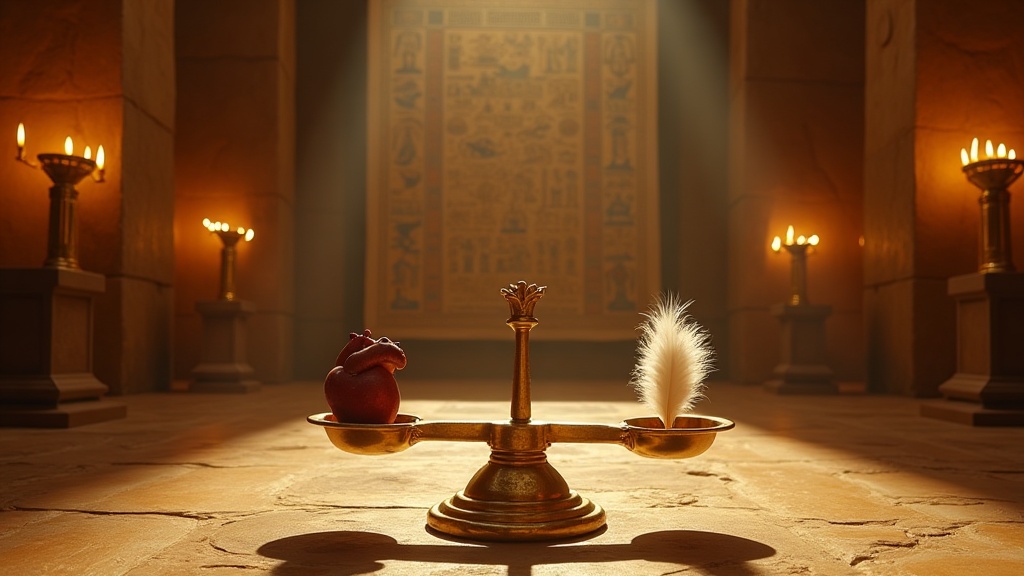
Egyptian
The Book of the Dead: Egypt's Guide to Eternity
Ancient Egypt's most sacred funerary text was not a single book but a living archive of spells, maps, and prayers that guided the dead through the perils between death and eternal life.
Egyptian
Eye of Horus: The Protective Amulet That Watched Over the Living and the Dead
Worn by pharaohs and fishermen alike, the Eye of Horus is one of antiquity's most potent protective symbols, carrying the weight of cosmic battle, divine healing, and eternal vigilance.
Egyptian
Ra the Sun God: Egypt's Supreme Ruler of Light and Creation
Ra, the ancient Egyptian sun god, blazed at the very heart of a civilization that worshipped light as the pulse of creation itself. Discover his origins, his many forms, and the sacred journey he took across the sky and through the underworld every single day.
Egyptian
The Ankh: Egypt's Eternal Symbol of Life
The ankh is ancient Egypt's most recognizable hieroglyph, a looped cross carried by gods and pharaohs alike as the very key to immortal life. Discover its origins, meanings, and sacred legacy.