
The Ankh: Egypt's Eternal Symbol of Life
The ankh is ancient Egypt's most recognizable hieroglyph, a looped cross carried by gods and pharaohs alike as the very key to immortal life. Discover its origins, meanings, and sacred legacy.
Contents
The Shape That Holds a Universe
Few symbols in the history of human civilization carry the concentrated weight of the ankh. A simple teardrop loop set atop a T-shaped cross, it appears carved into temple walls at Karnak, painted across the fingers of gods in papyrus scrolls, pressed into faience amulets buried with the dead, and inscribed on the lips of pharaohs receiving divine breath. The ancient Egyptians called it the ankh (𓋹), a word that functioned simultaneously as a noun meaning "life," a verb meaning "to live," and a name used by both mortals and deities. In the hieroglyphic writing system, the sign served all three roles without contradiction, because for the Egyptians, life was not a condition to be described from the outside. It was a living force, a current that ran through gods, kings, and the land of the Nile itself.
Its geometry invites interpretation. The loop at the top has been read as the rising sun cresting the horizon, as the knot that ties body to soul, as the womb of the goddess Isis, and as the sandal strap whose cross-section it eerily resembles in profile. No single reading has ever won unanimous scholarly approval, which is itself telling: the Egyptians rarely confined a sacred sign to one layer of meaning. Symbols were meant to hold multiplicity, to refract truth the way still water refracts light.
Origins Lost in the Deep Past
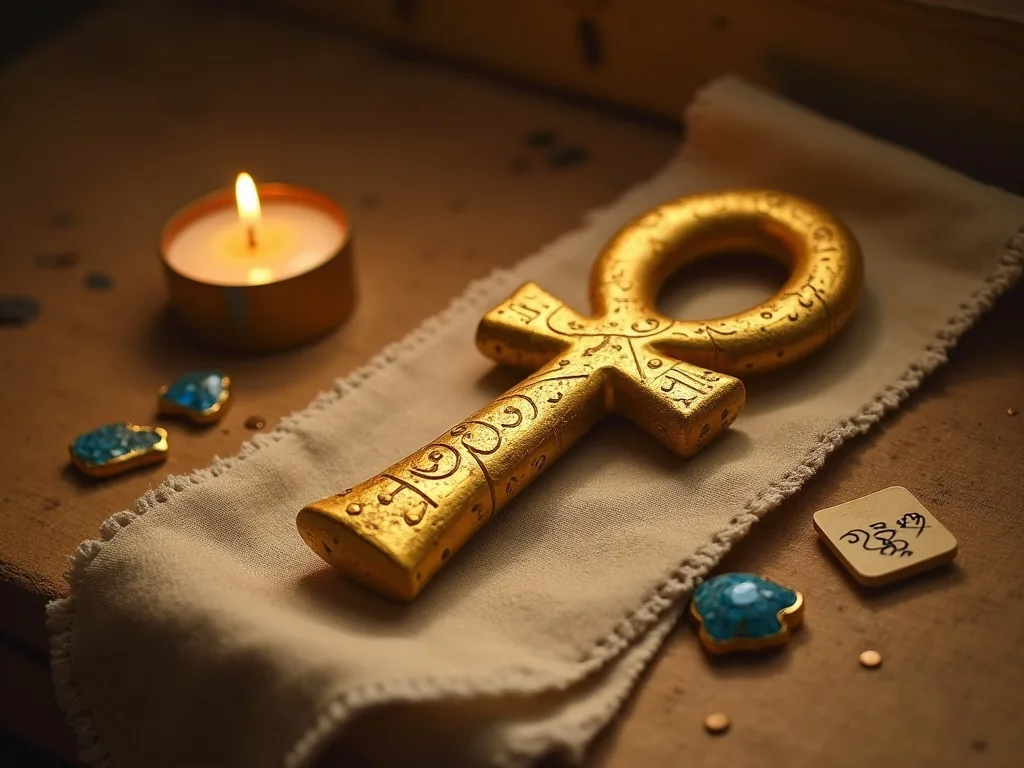
The ankh's precise origin remains one of Egyptology's more pleasurable mysteries. Its earliest confirmed appearances date to the First Dynasty, roughly 3100 BCE, already fully formed as though it had arrived without a childhood. No transitional or proto-ankh forms have been identified with confidence, which suggests either that the symbol migrated from an older tradition now lost to archaeology, or that its origins are simply older than the surviving record.
Several theories have earned serious consideration over the decades.
The Sandal-Strap Hypothesis
The most widely cited theory, advanced and refined by scholars including Sir Alan Gardiner, proposes that the ankh derived from the top-view silhouette of an Egyptian sandal strap. The loop passed over the ankle; the horizontal bar ran across the top of the foot; the vertical stem extended along the sole. Gardiner noted that the Egyptian word for sandal strap, nkh, shares consonants with ankh, and consonantal similarity carried enormous weight in Egyptian hieroglyphic reasoning. The sandal, moreover, was a charged object: gods were shown barefoot in the sacred inner sanctum, while the act of putting on sandals signified stepping into the world of the living. The sandal-strap reading therefore carries a metaphorical logic as well as a linguistic one.
The Knot of Isis
Another school associates the ankh with the tyet, a symbol closely related to Isis and sometimes called the "knot of Isis" or "blood of Isis." The tyet resembles an ankh with its horizontal arms folded downward, and the two signs appear together in ritual contexts with such frequency that they seem to form a complementary pair: the ankh representing life in its active, generative sense, the tyet representing protection and the mysteries of rebirth through the goddess's body. Together they flanked the djed pillar, the symbol of Osiris's stability, forming a triad of eternal principles.
A Solar Symbol
A third interpretation reads the loop as the disk of the sun and the cross as the horizon line over which it rises, the complete shape encoding the daily miracle of solar rebirth. This reading aligns with the ankh's prominent role in solar theology, particularly during the Amarna period under Pharaoh Akhenaten, when the rays of the Aten (the solar disk) were depicted reaching down toward the royal family, each ray terminating in a small hand holding an ankh directly to the nostrils of the king and queen. In that startling image, the symbol was not merely decorative but functionally theological: the sun itself delivering the breath of life.
Gods Who Carry the Key
In Egyptian iconography, the ankh is almost never depicted alone. It lives in hands, specifically divine hands. The gods carry it the way a physician carries an instrument, purposefully, with expert knowledge of what it can do.
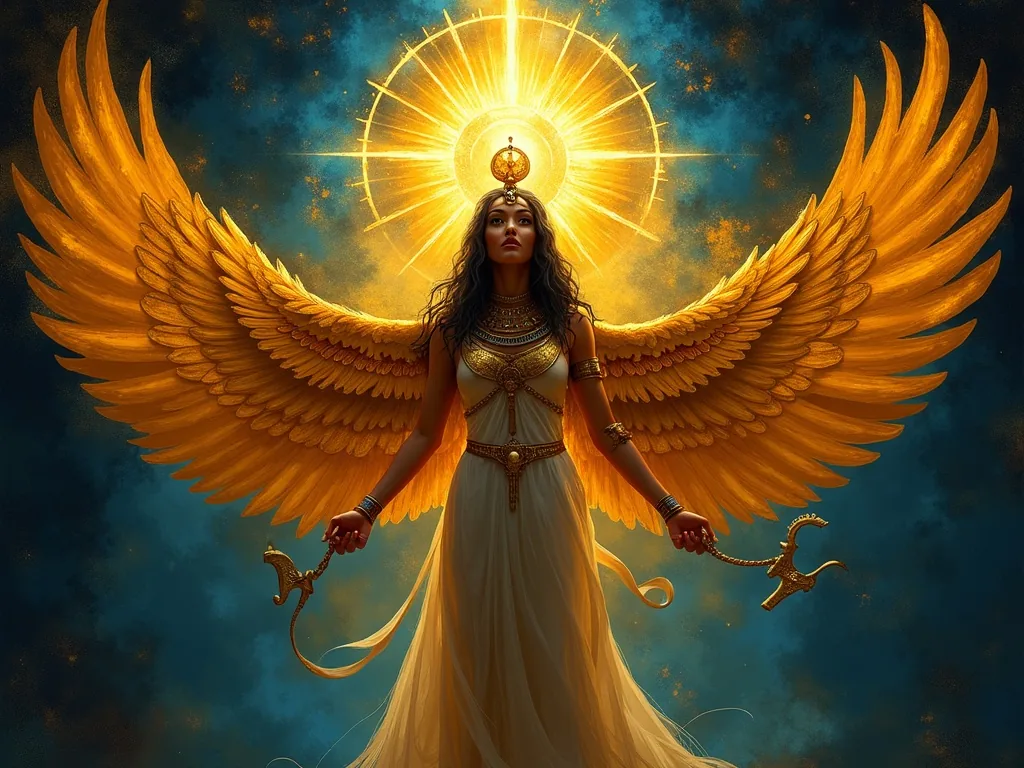
Osiris, god of the dead and resurrection, holds the ankh as a promise: that death is not termination but transformation. His entire mythological narrative, of dying, being reassembled by Isis, and returning to sovereignty in the underworld, enacts what the ankh encodes in a single glyph.
Isis wields it as a healer's tool. In the spells preserved in the Book of the Dead and in the older Pyramid Texts, Isis revives Osiris partly through the power of words and partly through direct contact with the ankh's generative force. She is sometimes shown pressing the loop to the mouths of the deceased, transmitting the ka (the vital life-force) back into bodies that had lost it.
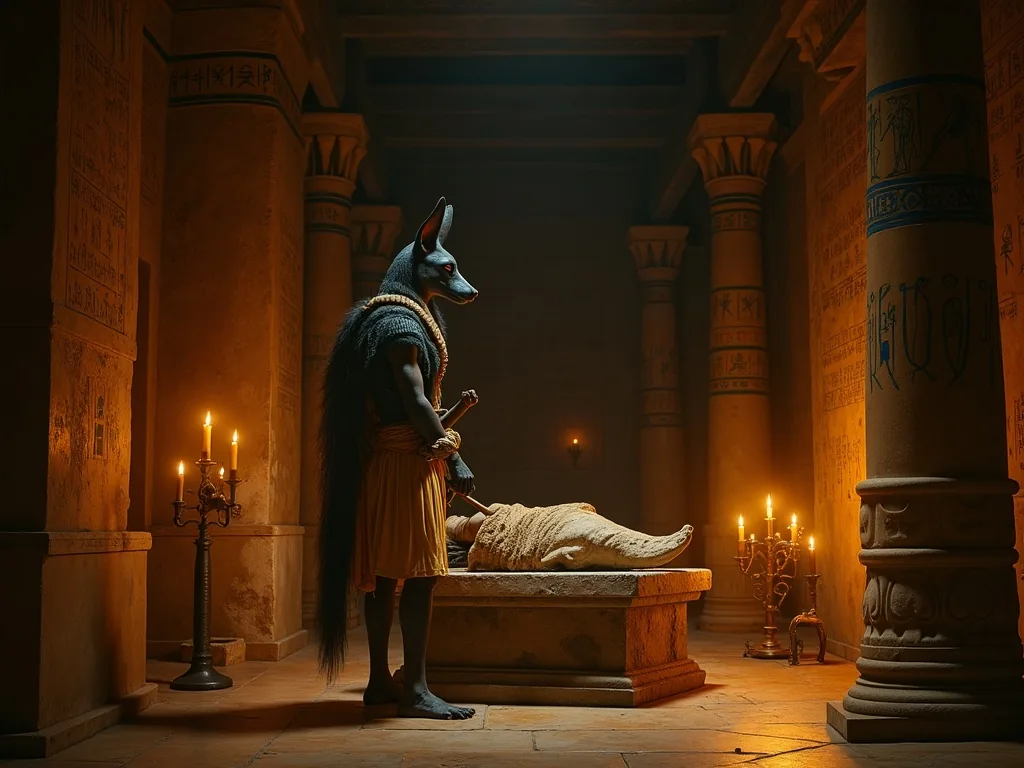
Anubis, the jackal-headed guardian of the embalming hall, carries the ankh in many funerary scenes, signaling that even in the realm of death, life remains the governing principle. The Egyptian underworld, the Duat, was not conceived as a place of absence but as a domain of transformed life, where the sun itself traveled each night to be reborn each morning.
Sekhmet, the lioness goddess of destruction and healing, carries the ankh to signal that her terrifying power over plague and war is ultimately in service of life's continuation. The healer and the destroyer shared the same face.
Hathor, goddess of love, music, and celestial beauty, holds it alongside the sistrum (her sacred rattle), connecting sensory pleasure, fertility, and living abundance to the same symbolic root.
The pharaoh received the ankh directly from the gods in temple reliefs, the visual language of divine investiture. When Thutmose III appears at Karnak being embraced by Amun-Ra, the god touches the ankh to the king's nose, breathing eternal life into him as a ritual renewal of royal legitimacy.
The Ankh in Funerary Practice and the Book of the Dead
Perhaps nowhere is the ankh more operationally significant than in the elaborate architecture of Egyptian funerary belief. The goal of death rites was not simply to preserve the body but to ensure the continued living of the deceased in the Field of Reeds (the Aaru), a paradisiacal afterlife mirroring the best of earthly existence. The ankh was therefore a necessary piece of that survival kit.
Amulets in the shape of the ankh were placed within mummy wrappings, pressed against the chest or throat, positioned to infuse the preserved body with the vital force it would need in the judgment hall of Osiris. Faience ankh amulets in blue and green (colors associated with fertility, the Nile, and new growth) have been recovered from tombs across Upper and Lower Egypt, from the humblest burials of the Old Kingdom to the gilded treasures of New Kingdom royalty.
The Pyramid Texts, among the oldest religious writings on Earth, invoke ankh repeatedly in resurrection spells directed at the deceased king. The formula "may you live" (ankha) recurs as both aspiration and declaration, a speech act in the Egyptian sense: words spoken with divine authority do not merely describe reality, they create it.
Ankh, Mirror, and the Word for Life
One detail of material culture illuminates the symbol's reach beyond the purely ritual. The Egyptian word for mirror, ankh, is identical to the word for life. Bronze hand mirrors of the New Kingdom were frequently made with handles cast in the shape of a woman and a head-piece in the form of the ankh loop, the reflective disk of the mirror serving as the loop itself. To look into a mirror was, at least etymologically and perhaps experientially, to look into life. The reflection confirmed presence, confirmed existence, confirmed the living quality of the observer. The conflation of mirror and life-symbol is not coincidence but a coherent philosophical statement about visibility, identity, and vital force.
Legacy Across Cultures and Time
The ankh did not die with ancient Egypt. As Hellenistic and later Roman culture absorbed Egyptian religious currents, the symbol traveled. The Coptic Christians of Egypt, inheritors of the Nile Valley's deep past, adopted a cross form called the crux ansata (Latin for "cross with a handle"), which is visually indistinguishable from the ankh. Coptic funerary stelae from the third and fourth centuries CE show Christ or saints holding the looped cross in contexts that clearly owe as much to pharaonic iconography as to Roman Christian art. The symbol's resonance with themes of resurrection, eternal life, and divine breath made the transition almost inevitable.
In the modern world, the ankh has become one of the most reproduced symbols in jewelry, tattoo culture, and popular iconography, often worn as a general emblem of spirituality, protection, or connection to ancient wisdom. This ubiquity risks flattening what was once a precisely tuned theological instrument. Yet even in its simplified contemporary form, the ankh retains a curious gravity. People who know nothing of Isis or the Field of Reeds are drawn to its shape, sensing in that looped cross something that gestures toward permanence, toward the irreducible fact of being alive.
The Living Hieroglyph: What the Ankh Still Teaches
The ankh endures because the question it encodes never grows old. What is life? Where does it come from? How can it be preserved, renewed, and passed on? The Egyptians answered by drawing a loop over a cross and placing it in every divine hand they depicted, making the answer visible in stone and pigment across three thousand years of continuous civilization.
It is not a simple symbol. Every layer peeled back reveals another: sandal strap to foot to movement through the world; sun to horizon to the daily promise of return; breath to nostrils to the invisible force animating flesh; mirror to face to the self confirmed in looking. The ankh holds all of these at once, which is precisely why the gods carry it so naturally. Life itself does not submit to single explanations. It only submits to being lived, which is perhaps exactly what the Egyptians meant to say when they picked up a chisel and struck that first perfect loop into limestone four thousand years before the present moment.
Free 25-page sample
Want the whole story?
Take the first 25 pages free. If it pulls you in, the full edition is yours as an instant PDF download, with a paperback on Amazon for selected titles.
Egyptian
The Egyptian Mythology Book: Ra, Osiris, Isis, Anubis, and the Sacred Stories of the Pharaohs
Ra, Osiris, Isis, Anubis, and the Sacred Stories of the Pharaohs
Three thousand years of Egyptian sacred stories. The Duat, the weighing of the heart, the cult of Osiris, and the daily voyage of the sun.
More from Egyptian
All articles
Egyptian
Eye of Horus: The Protective Amulet That Watched Over the Living and the Dead
Worn by pharaohs and fishermen alike, the Eye of Horus is one of antiquity's most potent protective symbols, carrying the weight of cosmic battle, divine healing, and eternal vigilance.
Egyptian
Ra the Sun God: Egypt's Supreme Ruler of Light and Creation
Ra, the ancient Egyptian sun god, blazed at the very heart of a civilization that worshipped light as the pulse of creation itself. Discover his origins, his many forms, and the sacred journey he took across the sky and through the underworld every single day.
Egyptian
Anubis: God of the Dead, Guardian of the Scales
Anubis, the jackal-headed deity of ancient Egypt, presided over embalming, the underworld, and the judgment of souls. His is one of the oldest and most enduring divine figures in human history.
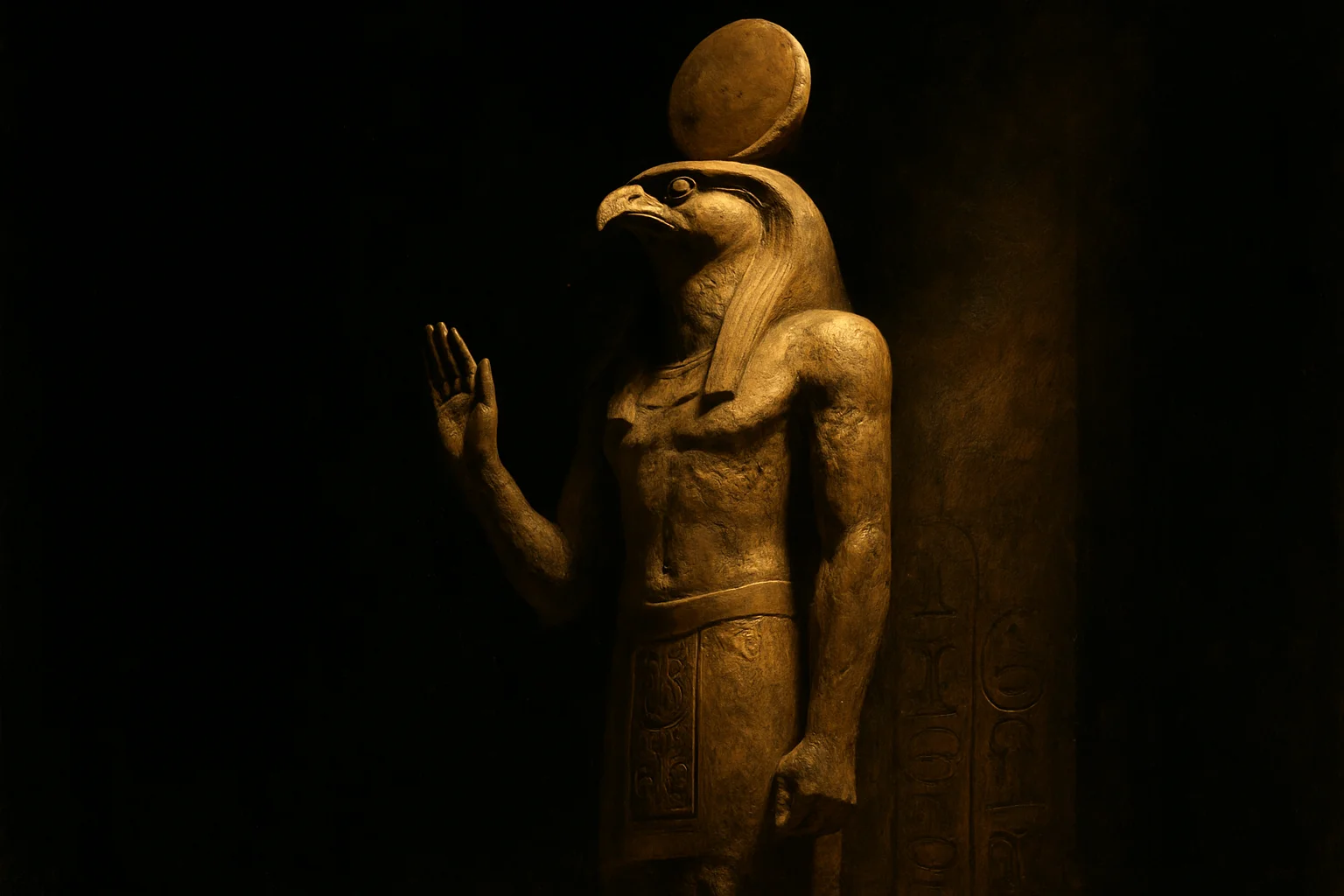
Egyptian
Egyptian Gods: Divine Powers and Sacred Authority
How Egyptian gods wielded power through cult, kingship, and cosmic order. Grounded in Pyramid Texts, temple inscriptions, and ritual practice.