
The Book of the Dead: Egypt's Guide to Eternity
Ancient Egypt's most sacred funerary text was not a single book but a living archive of spells, maps, and prayers that guided the dead through the perils between death and eternal life.
Contents
A scribe bent over a papyrus roll in the Valley of the Kings, his reed pen tracing a prayer to Osiris in columns of black and red ink. The papyrus would be rolled tight, sealed inside a wooden coffin, and never read again by living eyes. It was not written for the living. It was written for the moment when the person inside that coffin would stand alone before forty-two divine judges, heart weighed against a feather, and need every word.
That document is what scholars now call the Book of the Dead. The ancient Egyptians called it Reu nu pert em hru, which translates literally as "the spells for going out by day." The title matters. These were not instructions for dying. They were a passport for living again, on the other side of darkness.
No single author wrote it. No single year produced it. The collection grew across roughly fifteen centuries, drawing from older texts carved into pyramid walls, painted onto coffins, and memorized by priests. By the New Kingdom (circa 1550-1070 BCE), it had crystallized into recognizable form: a portable compendium of spells, vignettes, and prayers that an Egyptian could commission, personalize, and carry into the grave.
From Pyramid Texts to Papyrus: How the Spells Were Born

The oldest ancestors of the Book of the Dead predate it by nearly a thousand years. The Pyramid Texts, carved in hieroglyphs inside the burial chambers of Old Kingdom pharaohs beginning with Unas around 2375 BCE, were the first written attempts to guarantee a royal soul's safe passage through the afterlife. They were exclusively royal property. A commoner had no access, and no need: the king alone was considered divine enough to require written protection.
Democratization came gradually. During the First Intermediate Period and the Middle Kingdom (circa 2181-1550 BCE), the sacred formulae migrated from pyramid walls onto the insides of wooden coffins, a genre scholars call the Coffin Texts. Now a wealthy merchant or a provincial official could be buried with protective spells. The theology expanded too: Osiris, once the exclusive destination of pharaonic souls, became accessible to any Egyptian who could afford proper burial.
The Coffin Texts numbered over 1,000 individual spells. The compilers of the New Kingdom drew from this pool selectively, editing, combining, and rearranging until a recognizable canon of around 200 spells emerged. This is what we call the Book of the Dead, though the spells were never used all at once. A single papyrus might include 30, or 60, or 150 spells depending on the buyer's budget and the scribe's judgment about which dangers the deceased was most likely to face.
The first canonical version, known as the Theban Recension, appears around the reign of Thutmose III (circa 1479-1425 BCE). A later standardization during the Saite Period (664-525 BCE) imposed a more fixed ordering of spells numbered 1 through 189 by modern Egyptologists, though the ancient scribes never numbered them at all.
The Architecture of the Underworld: Geography and Guardians
The afterlife the Book of the Dead describes is not a vague paradise. It has topography. The soul must cross the Duat, a liminal underworld realm that mirrors the journey of the sun god Ra through the twelve hours of night. Each hour is a gate. Each gate has a guardian whose name must be spoken aloud for passage to be granted.
The realm the soul aims for is Aaru, the Field of Reeds, an idealized Egypt where the wheat grows taller than any wheat on earth and the dead till their plots in eternal leisure. But Aaru is earned, not given.
Between death and Aaru stands the Hall of Two Truths, Maati, where Osiris presides over the psychostasia: the weighing of the heart. The heart of the deceased is placed on one side of a golden scale. On the other side rests Ma'at's feather, the feather of truth and cosmic order. If the heart is lighter than the feather, or equal to it, the soul passes. If the heart is heavy with wrongdoing, the crocodile-headed monster Ammit waits beside the scale to devour it, erasing the person from existence entirely.
The forty-two assessors who stand in the Hall each represent a specific vice: murder, theft, falsehood, cruelty to cattle, eavesdropping on conversations. The deceased must recite the Negative Confession, a declaration of innocence before each assessor in turn:
- "I have not slain men."
- "I have not stolen the property of the gods."
- "I have not caused pain."
- "I have not been deaf to the words of truth."
- "I have not fouled water."
Forty-two declarations, each addressed to a named deity in a named city. The spell required was Spell 125, arguably the most famous single text in the entire corpus.
The Major Spells: What an Egyptian Needed to Survive

Not all 189 spells carried equal weight. Certain chapters were considered indispensable; scribes included them even in the cheapest versions of the Book of the Dead.
Spell 1 governed the day of burial itself, allowing the deceased to take their rightful place in the procession. It was ritual orientation: the dead person claiming their place in the ceremony, asserting presence.
Spell 17 is among the oldest and most theologically dense, describing the nature of Ra, Atum, and creation itself. It reads almost like a philosophical treatise, with marginal annotations that appear to be ancient commentaries on contested interpretations. Egyptians, it turns out, debated their scripture.
Spell 64 claimed to allow the soul to "go out by day," to leave the tomb and move freely in the world of the living. Combined with Spell 89, which enabled the soul to reunite with the ba (the mobile, personality-bearing part of the self that could fly between worlds), these spells defined the Egyptian concept of post-mortem freedom.
Spell 110 described the Field of Reeds in detail: its canals, its islands, its eternal harvests. It was accompanied in premium manuscripts by a full vignette, a painted map of the afterlife that a craftsman would spend days illustrating.
Spell 125, the Negative Confession and weighing of the heart, was almost never omitted. Its accompanying vignette, showing Anubis adjusting the scale while Thoth records the result and Ammit crouches in anticipation, is the single most reproduced image from ancient Egyptian religious art.
Spell 130 transformed the deceased into a divine being, equal to the sun god himself on certain sacred days. The ambition of Egyptian eschatology was not mere survival; it was deification.
Anubis, Thoth, and the Divine Court
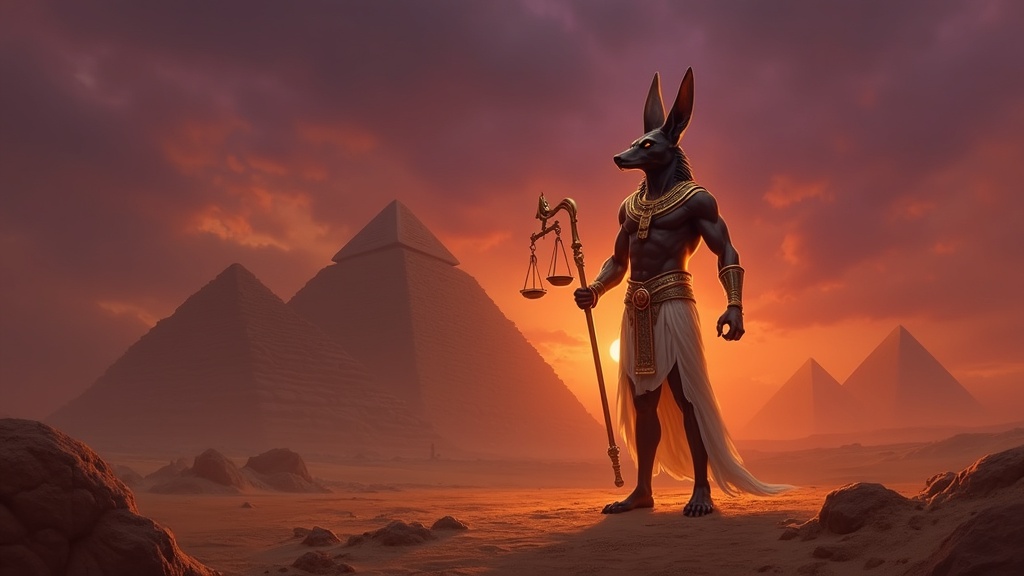
The drama of judgment required a cast. Anubis, the jackal-headed god of embalming and cemeteries, served as psychopomp: he guided the soul into the Hall of Two Truths and steadied the scales with careful hands. His role in the Book of the Dead is precise and procedural. He does not judge; he facilitates. His black coloring was not arbitrary, either: in Egyptian symbolism, black was the color of fertile Nile silt and resurrection, not death and despair.
Thoth, the ibis-headed god of writing and knowledge, stood at the scale with a reed pen and palette, recording the result. He was the divine notary, and his inscription of a verdict made it cosmically binding. When the heart passed the test, it was Thoth who announced it to Osiris and the assembled court.
Osiris himself sat enthroned at the far end of the hall, wrapped in mummy linen, wearing the Atef crown of Upper Egypt, holding the crook and flail. He was both the judge and the proof: he had died, been dismembered by Set, been reassembled by Isis, and been resurrected. Every person who passed judgment became, in a theological sense, an Osiris. The Egyptians prefixed the names of the justified dead with "Osiris" in official texts: "Osiris the scribe Ani", "Osiris the lady Hunufer."
Isis and her sister Nephthys flanked the throne, their wings extended as emblems of protection. The four Sons of Horus, four canopic deities who guarded the preserved organs, stood on a lotus flower before the scales. The entire court was a theological architecture built to give the soul of an ordinary person a fighting chance.
The Papyrus of Ani and Other Great Manuscripts
The finest surviving copy of the Book of the Dead is the Papyrus of Ani, now held at the British Museum (EA 10470). Ani was a royal scribe and accountant of offerings at Karnak, probably active around 1275 BCE. His papyrus stretches nearly 24 meters when fully unrolled, illustrated with some of the most vivid vignettes ever produced by an Egyptian artist.
The painting of Ani's heart-weighing scene fills an entire register. Every figure is named in caption text. Ani and his wife Tutu stand to the left, hands raised in the gesture of adoration. The scale occupies the center. Thoth stands to the right. Ammit crouches below, ready. Above, the forty-two assessors sit in ranked rows. It is simultaneously a religious text, a legal document, and a work of art.
The Papyrus of Hunefer (also at the British Museum, EA 9901), produced for an overseer of royal cattle around 1275 BCE, is equally striking, slightly shorter, and remarkable for the clarity of its Negative Confession vignette. The Greenfield Papyrus, owned by the lady Nesitanebisheru around 950 BCE, stretches 37 meters, the longest known copy.
These were not mass-produced items. A high-quality papyrus commissioned from a professional scriptory could take weeks to complete. Scribes left blank spaces for the client's name, to be filled in after the patron purchased the roll, which is why some surviving copies contain obviously incorrect names inserted by a different hand, or worse, blank spaces where the name was never added at all.
The Book of the Dead Across Time: Ptolemaic and Roman Eras

The Book of the Dead did not die with the pharaohs. When Alexander the Great conquered Egypt in 332 BCE and the Ptolemaic dynasty replaced native rule, Egyptian funerary religion proved remarkably resilient. Greek-speaking elites who adopted Egyptian burial customs commissioned their own papyri. The spells were adapted into demotic script (a cursive Egyptian hand), and eventually into Coptic.
The Ptolemaic period saw the emergence of the Book of Breathing and the Book of Traversing Eternity, later funerary texts that abbreviated and reshaped the older spells for a new cultural moment. But the core theology, heart weighed against feather, soul claiming innocence before divine judges, the soul's right to move freely in the light, persisted.
Roman-period mummy cases from the first and second centuries CE still bear abbreviated versions of Spell 6, the spell animating the shabti figurines placed in the tomb to perform corvée labor in the afterlife on the deceased's behalf. The Egyptian conviction that the right words, spoken or written, could command supernatural forces proved more durable than any empire.
When Egypt converted to Christianity and later to Islam, the physical papyri passed into the ground. Medieval European travelers occasionally dug them up and called them "letters to the dead." It was not until the nineteenth century that the French Egyptologist Étienne Chabas first attempted a systematic study, and his colleague Karl Richard Lepsius who coined the name "Todtenbuch" (Book of the Dead) in 1842, a title that stuck even though it misrepresents the Egyptian original almost entirely.
Cross-Cultural Echoes: Tibet, Mesopotamia, and Greece
The scenario of a soul judged after death is not uniquely Egyptian, though Egypt developed the most elaborate procedural mechanics for it. The Bardo Thodol, the Tibetan text known in the West as the Tibetan Book of the Dead, shares the concept of a critical liminal period during which the soul's conduct and awareness determine its destination. Both texts function as guides: read aloud to the dying or the recently dead, intended to orient the soul during its most disoriented moment.
Mesopotamian tradition, in the Epic of Gilgamesh and the Descent of Inanna, describes an underworld guarded by gates, each requiring the traveler to give something up. The parallel with the gated hours of the Duat is structural rather than literary: two cultures wrestling with the same question through similar spatial metaphors.
Greek mythology offers Hermes as psychopomp, mirroring Anubis. The Greek underworld also features judgment: Minos, Rhadamanthus, and Aeacus assess the souls of the dead. But where Egyptian judgment was procedural and individual (each heart weighed, each vice named), the Greek system leaned on general reputation and life-long character. The Egyptian vision was more lawyerly, more granular, and in its own way more democratic: any person willing to memorize the right spells could argue their case.
What Scholars Still Debate
The study of the Book of the Dead has advanced significantly since Lepsius, but genuine debates remain open.
The question of belief is perhaps the most profound. Did ancient Egyptians literally believe that the spells worked, that reciting Spell 64 would cause the soul to exit the tomb and bask in sunlight? Or were the spells performative in a more symbolic sense, the ritual enactment of a desired reality? Egyptologist Jan Assmann, in his landmark "Death and Salvation in Ancient Egypt" (2001), argues that Egyptian funerary religion operated in a "cultural memory" framework: the spells were both believed and performed, the distinction between literal and symbolic being a modern imposition on a pre-modern mind.
The question of standardization is also contested. The Saite Recension is sometimes described as a "canon," but the variability between manuscripts even within that period is significant. Was there ever a priestly authority that regulated content, or was the scriptory tradition sufficiently decentralized that scribes exercised real editorial judgment?
Finally, the social history of the papyri raises questions about access and inequality. A top-tier Papyrus of Ani required wealth most Egyptians did not possess. Did the poor die without protection? Some scholars point to small linen strips bearing abbreviated spells, cheap wooden boards, and even oral transmission as evidence that the theology was accessible across class lines, even if the illuminated manuscripts were not.
Frequently Asked Questions About the Book of the Dead
Frequently asked questions
What is the Book of the Dead, exactly, and who wrote it?
No single person wrote the Book of the Dead. It grew organically from the Pyramid Texts (circa 2375 BCE) through the Coffin Texts of the Middle Kingdom into the canonical New Kingdom papyri. Professional scribes working in temple scriptories composed, edited, and copied the spells for individual clients. The "authors" are essentially anonymous, though several spells are attributed to specific gods, particularly Thoth.
How many spells does the Book of the Dead contain?
Modern Egyptologists have catalogued 192 individual spells across the known manuscripts, though no single papyrus ever contained all of them. A typical New Kingdom copy might include between 30 and 150 spells. The Saite Recension (664-525 BCE) established a more fixed sequence numbered by scholars from 1 to 189, but the Egyptians themselves never imposed a rigid numbering system.
What is the Negative Confession and where does it appear?
The Negative Confession appears in Spell 125, one of the most copied and illustrated sections of the Book of the Dead. It is a declaration the deceased makes before forty-two divine assessors in the Hall of Two Truths, denying specific sins: murder, theft, lying, sacrilege, cruelty to animals, and more. The confession was not a general plea for mercy but a precise legal declaration, matched to named gods in named sacred cities.
Where can the original manuscripts be seen today?
Major collections are held at the British Museum in London (including the Papyrus of Ani and the Papyrus of Hunefer), the Egyptian Museum in Cairo, the Louvre in Paris, the Metropolitan Museum of Art in New York, and the Rijksmuseum van Oudheden in Leiden. The British Museum's online Ani papyrus viewer allows study of the full 24-meter roll in high resolution.
Is the Book of the Dead related to the Tibetan Book of the Dead?
Only by loose structural analogy. Both texts guide a soul through a critical post-death transition, and both were used in ritual contexts near the moment of death. The similarity is parallel evolution rather than cultural borrowing. The Tibetan Bardo Thodol dates to the 14th century CE and belongs to the Nyingma school of Vajrayana Buddhism, a tradition with no direct connection to ancient Egyptian religion.
Could ordinary Egyptians afford a copy of the Book of the Dead?
Wealth determined quality, not access entirely. Wealthy officials commissioned lavish illustrated papyri spanning many meters. Poorer Egyptians might receive abbreviated spells written on linen strips, small wooden boards, or shabtis. Some scholars believe key spells were also transmitted orally and that priests recited protective formulae during burial rites, providing some degree of access to anyone who could afford a proper funeral.
The Living Legacy: How the Book of the Dead Still Speaks
The Egyptians built their civilization around the certainty of continuity. Monuments were meant to endure. Names were meant to be spoken. The worst fate an Egyptian could imagine was not death but obliteration, the erasure of the name and the image, the second and final death.
The Book of the Dead was the technology built to prevent that erasure. And by a sharp irony, the papyri that were buried to be forgotten have survived to be read. Ani's name is spoken every day in the British Museum reading rooms. The lady Hunufer's face, painted by a craftsman whose own name we will never know, looks out from conservation-quality glass at visitors from every continent.
The theological ideas the spells encode have also proven portable. The image of the heart weighed against a feather became one of the most persistent metaphors in Western thought about moral accountability, absorbed into early Christian iconography of judgment and still recognizable in contemporary culture. The Negative Confession, a person standing before a court and declaring not what they have done but what they have refused to do, anticipates legal and ethical frameworks that would emerge millennia later.
Scholars of comparative religion, from E. A. Wallis Budge in the nineteenth century to Jan Assmann and Erik Hornung in the twentieth, have repeatedly returned to the Book of the Dead as the most complete surviving evidence of how a pre-modern civilization thought about consciousness, moral weight, and what it might mean for a person to persist beyond the body. The conversation it started has not ended. The feather is still on the scale.
Free 25-page sample
Want the whole story?
Take the first 25 pages free. If it pulls you in, the full edition is yours as an instant PDF download, with a paperback on Amazon for selected titles.
Egyptian
The Egyptian Mythology Book: Ra, Osiris, Isis, Anubis, and the Sacred Stories of the Pharaohs
Ra, Osiris, Isis, Anubis, and the Sacred Stories of the Pharaohs
Three thousand years of Egyptian sacred stories. The Duat, the weighing of the heart, the cult of Osiris, and the daily voyage of the sun.
More from Egyptian
All articles
Egyptian
Eye of Horus: The Protective Amulet That Watched Over the Living and the Dead
Worn by pharaohs and fishermen alike, the Eye of Horus is one of antiquity's most potent protective symbols, carrying the weight of cosmic battle, divine healing, and eternal vigilance.
Egyptian
Ra the Sun God: Egypt's Supreme Ruler of Light and Creation
Ra, the ancient Egyptian sun god, blazed at the very heart of a civilization that worshipped light as the pulse of creation itself. Discover his origins, his many forms, and the sacred journey he took across the sky and through the underworld every single day.
Egyptian
The Ankh: Egypt's Eternal Symbol of Life
The ankh is ancient Egypt's most recognizable hieroglyph, a looped cross carried by gods and pharaohs alike as the very key to immortal life. Discover its origins, meanings, and sacred legacy.
Egyptian
Anubis: God of the Dead, Guardian of the Scales
Anubis, the jackal-headed deity of ancient Egypt, presided over embalming, the underworld, and the judgment of souls. His is one of the oldest and most enduring divine figures in human history.