
Eye of Horus: The Protective Amulet That Watched Over the Living and the Dead
Worn by pharaohs and fishermen alike, the Eye of Horus is one of antiquity's most potent protective symbols, carrying the weight of cosmic battle, divine healing, and eternal vigilance.
Contents
The Wound That Became a Symbol
Every great symbol is born from a story, and the Eye of Horus is no exception. Its origin lies in one of Egyptian mythology's most dramatic confrontations: the eternal struggle between Horus, the falcon-headed sky god, and his uncle Set, god of chaos and the desert.
According to the Contendings of Horus and Set, a narrative preserved in the Papyrus Chester Beatty I (dating to the reign of Ramesses V, around 1150 BCE), the two gods clashed repeatedly over the throne of Egypt, left vacant by the death of Osiris. During one ferocious battle, Set gouged out Horus's left eye, tearing it into six pieces and scattering them across the earth. The eye did not merely represent sight; it represented the very wholeness of the sky, since Horus's right eye was the sun and his left eye was the moon.
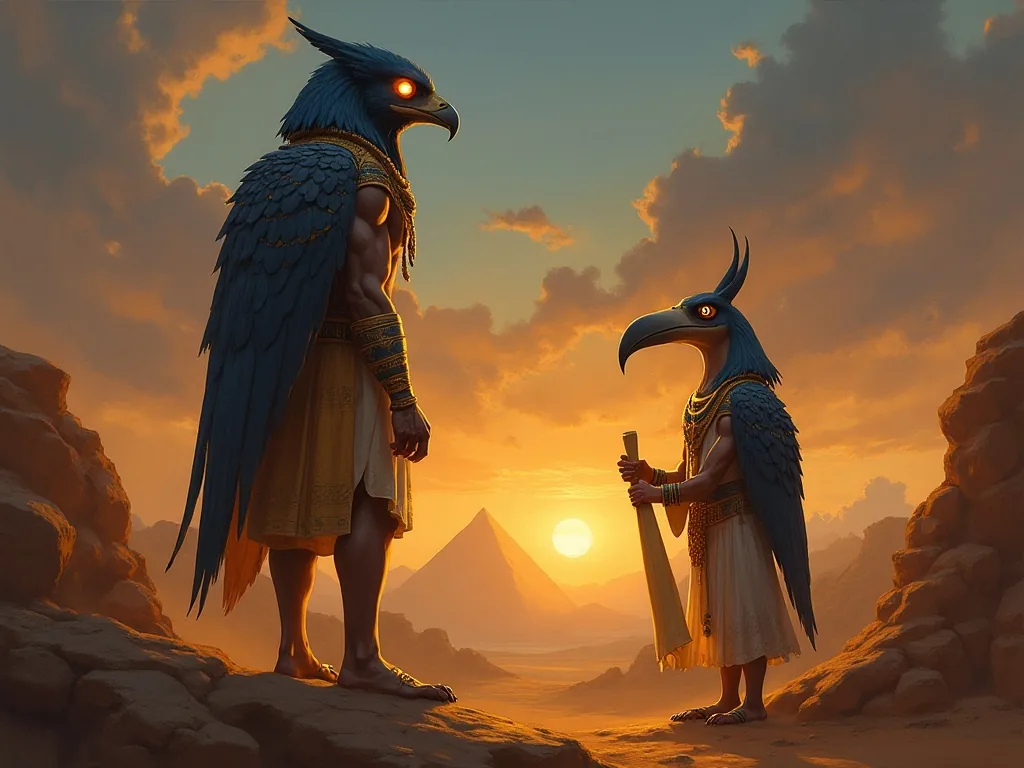
The goddess Thoth, master of wisdom and restoration, recovered the fragments and reassembled them. In some versions of the myth, it was Hathor, goddess of love and healing, who poured the restored eye back into Horus's face. Either way, the healed eye was returned to Horus, who then offered it to his dead father Osiris as an act of filial piety. That act of offering is itself charged with meaning: the restored eye became the hieroglyphic word wedjat, meaning "the one that is whole" or "the sound one."
From brokenness came wholeness. From violence came protection. That paradox is the engine of the symbol's power.
Anatomy of the Wedjat
The visual form of the wedjat is one of the most recognizable pictograms from the ancient world. It combines the human eye with the distinctive markings found beneath the eye of a peregrine falcon, the bird most closely associated with Horus.
The symbol's components are precise and deliberate:
- The eyeball and brow: representing sight, perception, and divine watchfulness.
- The teardrop marking below the inner corner: echoing the dark facial stripe of the lanner or peregrine falcon.
- The spiral curling from the outer corner: sometimes interpreted as the bird's tail feathers or as a coiling protective force.
Egyptian mathematicians and scribes gave the wedjat an additional layer of meaning by assigning fractional values to each of its six parts. Each fragment recovered by Thoth corresponded to one of the six senses recognized in ancient Egyptian thought (sight, hearing, smell, taste, touch, and thought). Together the fractions added to 63/64, with the remaining 1/64 said to have been supplied by Thoth's own magic to make the eye complete. This numerological encoding suggests that the wedjat was understood as a symbol of near-perfect, divinely supplemented wholeness, never a claim to absolute perfection, but a striving toward it.
The Eye of Horus Protective Amulet in Funerary Practice
No context reveals the wedjat's importance more completely than the Egyptian funerary tradition. Amulets bearing the Eye of Horus were among the most commonly placed objects within mummy wrappings, and their use spanned nearly three millennia, from the Old Kingdom period (c. 2686 BCE) through the Roman period (30 BCE onward).
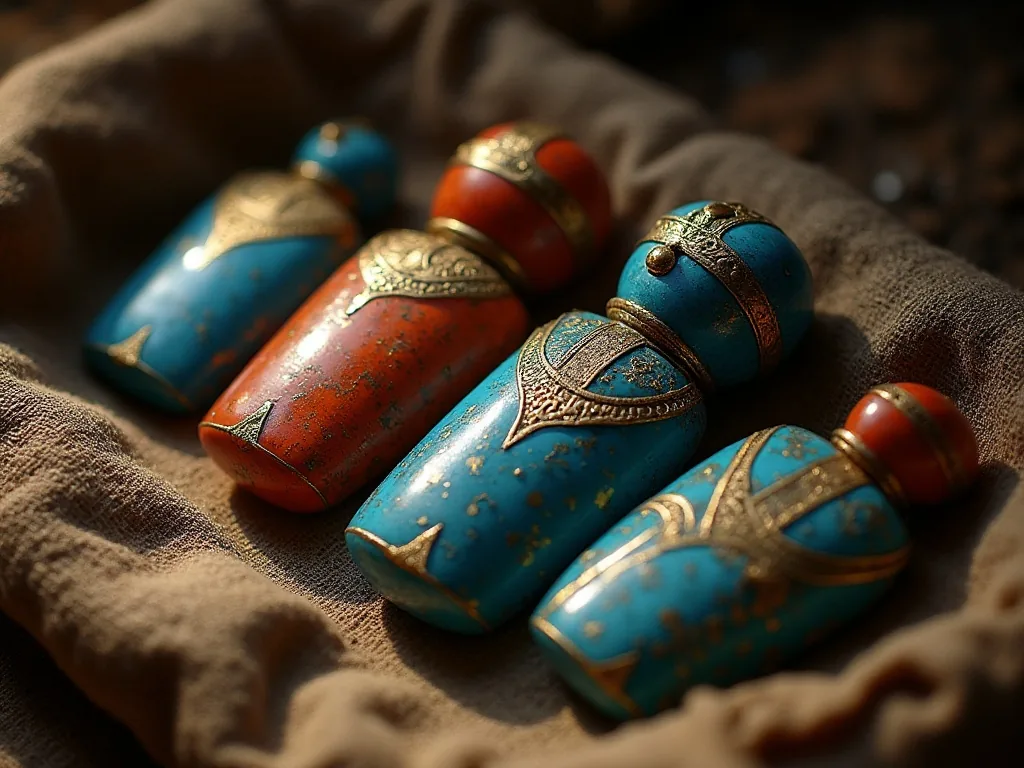
Archaeological finds at Saqqara, Abydos, and Deir el-Medina have yielded thousands of wedjat amulets in faience (glazed quartz composition), carnelian, lapis lazuli, gold, and steatite. Their placement within mummy bandages was not random. Texts from the Book of the Dead, particularly Spells 140 and 167, specify that a wedjat amulet placed at the throat or chest of the deceased would provide divine protection during the perilous journey through the Duat, the Egyptian underworld.
The logic was elegantly reciprocal. Just as Horus had offered his restored eye to his father Osiris to protect and revive him, every deceased Egyptian who was ritually identified with Osiris in death received the same protective gift. The amulet was not mere superstition; it was a theological statement. To wear the wedjat in death was to participate in the mythological drama of resurrection itself.
The Technique of Ritual Consecration
Funerary amulets were not simply crafted and placed. Priests performed specific recitations over them, drawn from the Amduat (the Book of What Is in the Underworld) and related mortuary texts. The color of the amulet carried additional symbolism: blue or green faience connected the wedjat to fertility and rebirth (both associated with the Nile's annual flood), while gold specimens emphasized solar radiance and incorruptibility.
Living Protection: The Amulet Among the Living
The wedjat was equally present among the living. Sailors painted it on the prows of their boats so that the divine eye could guide them safely across the water. This practice persisted in Mediterranean cultures long after the decline of classical Egyptian religion; the "evil eye" painted on the bows of Maltese and Greek fishing vessels (known in Greek as mati) carries a visual lineage that many scholars trace, at least partially, back to the wedjat tradition.
Soldiers, merchants, and ordinary citizens wore wedjat amulets as pendants or rings throughout the New Kingdom period (c. 1550 to 1070 BCE). Workshops at Amarna, the short-lived capital of the Pharaoh Akhenaten, produced faience wedjat amulets in large quantities even during Akhenaten's radical religious reform, which suppressed most traditional deities in favor of the Aten. The persistence of the wedjat in that context is striking, suggesting it had achieved a cultural status that transcended even official religious upheaval.
Mothers placed wedjat amulets on children to ward off illness and the evil eye. Physicians used the wedjat as a symbol of their craft, since the act of healing echoed Thoth's reassembly of the fractured eye. The Rx symbol still used in modern pharmacy is sometimes linked by historians of medicine to the wedjat, though the connection remains debated; what is clear is that both symbols encode the idea of restoration through careful, expert intervention.

The Eye of Horus and the Eye of Ra: A Necessary Distinction
A persistent source of confusion, both in popular culture and occasionally in academic contexts, is the conflation of the Eye of Horus (wedjat) with the Eye of Ra. They are related but distinct.
The Eye of Ra is the destructive solar eye, the ferocious, outward-projecting force that Ra dispatches to punish human rebellion. In the myth of the Destruction of Mankind, preserved in the Book of the Heavenly Cow, Ra sends his eye in the form of Hathor (or Sekhmet, her lioness aspect) to slaughter humanity. The eye returns dripping with blood before Ra relents and tricks it into drinking red-dyed beer.
The Eye of Horus, by contrast, is the restored, inward eye. Where the Eye of Ra destroys, the wedjat heals and protects. Where Ra's eye is an instrument of divine wrath, Horus's eye is an instrument of filial devotion and regeneration.
That said, Egyptian theological thinking was comfortable with paradox and layered identity. By the Late Period (664 to 332 BCE), temple inscriptions increasingly merged the two eyes into a single concept of divine ocular power. The wedjat could be read simultaneously as Horus's offering and Ra's glare, both watching over the cosmos and burning away its enemies.
Cross-Cultural Echoes and Modern Legacy
The wedjat did not stay neatly within Egyptian borders. Phoenician traders carried faience wedjat amulets across the Mediterranean, depositing them in sanctuaries and graves from Sardinia to the Iberian Peninsula. Excavations at Carthage have uncovered substantial caches of Egyptianizing amulets, the wedjat prominent among them, adapted into Punic religious practice from roughly the seventh century BCE onward.
In the Greco-Roman period, the wedjat fused with Greek apotropaic traditions surrounding the eye. The concept of the apotropaion (a symbol that turns away evil) found a natural home in the wedjat's protective gaze, and the symbol appeared on lamps, gemstones, and household shrines across Egypt under Roman rule.
The modern proliferation of the Eye of Horus in jewelry, tattoos, and interior decoration is extraordinary. Detached from its mythological roots, it circulates as a generalized emblem of protection and spiritual awareness. That popularization carries both gains and losses: the symbol reaches millions of people who sense its power without knowing the story of Set's violence, Thoth's patience, or Horus's gift to his dead father. Yet the symbol survives precisely because it does something rare: it holds together the ideas of injury, restoration, and watchful love in a single, instantly legible image.
The Unblinking Vigil: Theological Depth of the Wedjat
At its deepest level, the Eye of Horus protective amulet is a meditation on what it means to be seen by the divine. The eye does not close. It does not sleep. In a universe governed by Ma'at (cosmic order and truth), the wedjat represents the universe's refusal to abandon those who belong to it.
Horus, whose eyes were the sun and moon, was literally the light by which all of creation was illuminated. To carry his eye was to carry a piece of that illuminating, ordering force. For the fisherman on the Nile, the soldier on the Nubian border, the child feverish in the night, the priest wrapping linen around a body in the embalming house: the wedjat promised the same thing to all of them. Something powerful was watching. Something that had been broken and made whole again understood what it meant to be vulnerable, and chose, despite that knowledge, to keep its gaze open.
That is not a small promise. Across three thousand years of continuous use, millions of human beings found it sufficient.
Free 25-page sample
Want the whole story?
Take the first 25 pages free. If it pulls you in, the full edition is yours as an instant PDF download, with a paperback on Amazon for selected titles.
Egyptian
The Egyptian Mythology Book: Ra, Osiris, Isis, Anubis, and the Sacred Stories of the Pharaohs
Ra, Osiris, Isis, Anubis, and the Sacred Stories of the Pharaohs
Three thousand years of Egyptian sacred stories. The Duat, the weighing of the heart, the cult of Osiris, and the daily voyage of the sun.
More from Egyptian
All articles
Egyptian
Ra the Sun God: Egypt's Supreme Ruler of Light and Creation
Ra, the ancient Egyptian sun god, blazed at the very heart of a civilization that worshipped light as the pulse of creation itself. Discover his origins, his many forms, and the sacred journey he took across the sky and through the underworld every single day.
Egyptian
The Ankh: Egypt's Eternal Symbol of Life
The ankh is ancient Egypt's most recognizable hieroglyph, a looped cross carried by gods and pharaohs alike as the very key to immortal life. Discover its origins, meanings, and sacred legacy.
Egyptian
Anubis: God of the Dead, Guardian of the Scales
Anubis, the jackal-headed deity of ancient Egypt, presided over embalming, the underworld, and the judgment of souls. His is one of the oldest and most enduring divine figures in human history.
Egyptian
Egyptian Gods: Divine Powers and Sacred Authority
How Egyptian gods wielded power through cult, kingship, and cosmic order. Grounded in Pyramid Texts, temple inscriptions, and ritual practice.