Duat: The Egyptian Underworld and Its Geography of the Afterlife
Beneath the visible world lay the Duat, an Egyptian underworld of rivers, gates, and judgment halls where the dead faced terrifying guardians before reaching eternal light.
Contents
The torchlight dies. The body is wrapped, the heart weighed, the name spoken. What comes next is not darkness and silence, but a landscape as intricate as any city the living ever built. Duat, the Egyptian underworld, stretches beneath the earth and through the body of the night sky: a realm of winding rivers, sealed gates, fire-breathing serpents, and judges who know every secret the soul has carried since birth.
Ancient Egyptian scribes spent centuries mapping this place. They scratched its corridors onto coffin lids, painted its guardians onto tomb walls at Thebes and Saqqara, and compiled its passwords into texts that became among the most copied documents in all of antiquity. The Amduat, the Book of Gates, the Book of Caverns, the Coffin Texts: each adds another hall, another hour, another name to learn. No other ancient civilization produced anything quite so architecturally precise about what waits after death.
The Duat was not invented to frighten. It was mapped to equip. Every gate has a guardian whose name, once spoken correctly, swings open. Every hour of the night has its terrain, its dangers, and its rewards. The dead who knew the routes did not wander; they walked with the confidence of travelers who have memorized every landmark on a road they have studied their whole lives.
The Geography of the Duat: A World Beneath the World
The Duat sits at the intersection of three cosmological spaces. It lies underground, below the sands of Egypt. It also runs through the body of the sky goddess Nut, whose arched form the sun must traverse each night before rebirth at dawn. And in certain texts it overlaps with the horizon itself, the akhet, that liminal edge where light and dark negotiate their boundaries.
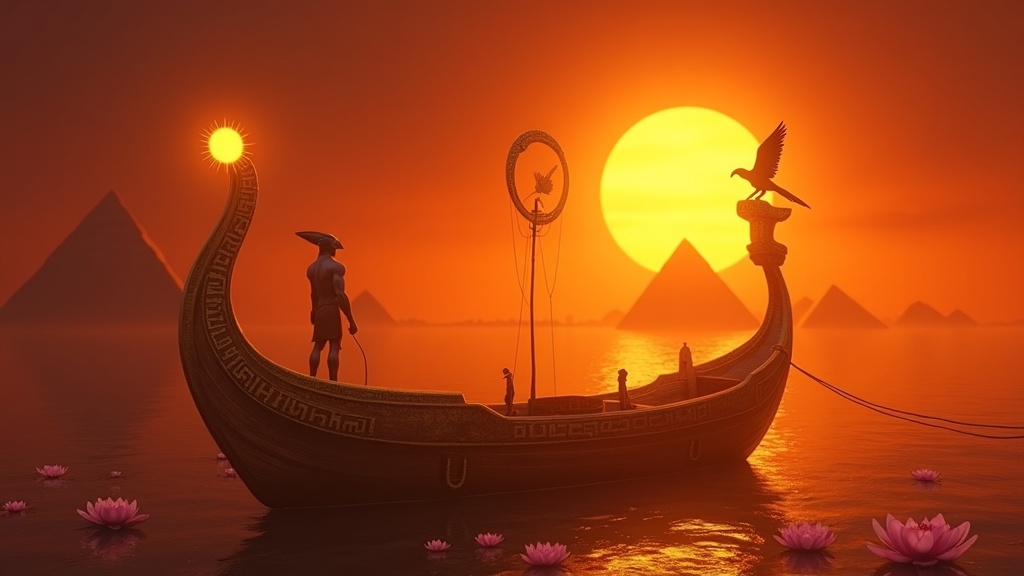
This layering is deliberate. Egyptian cosmology resisted the idea of a single, fixed location for the dead. The Duat was wherever the regenerative process happened, wherever the sun god Ra made his nightly passage from death to life. Because Ra's boat moved through it every night, the realm was also dynamic: it ran in twelve great divisions, one for each hour of darkness, each with its own name, character, and set of inhabitants.
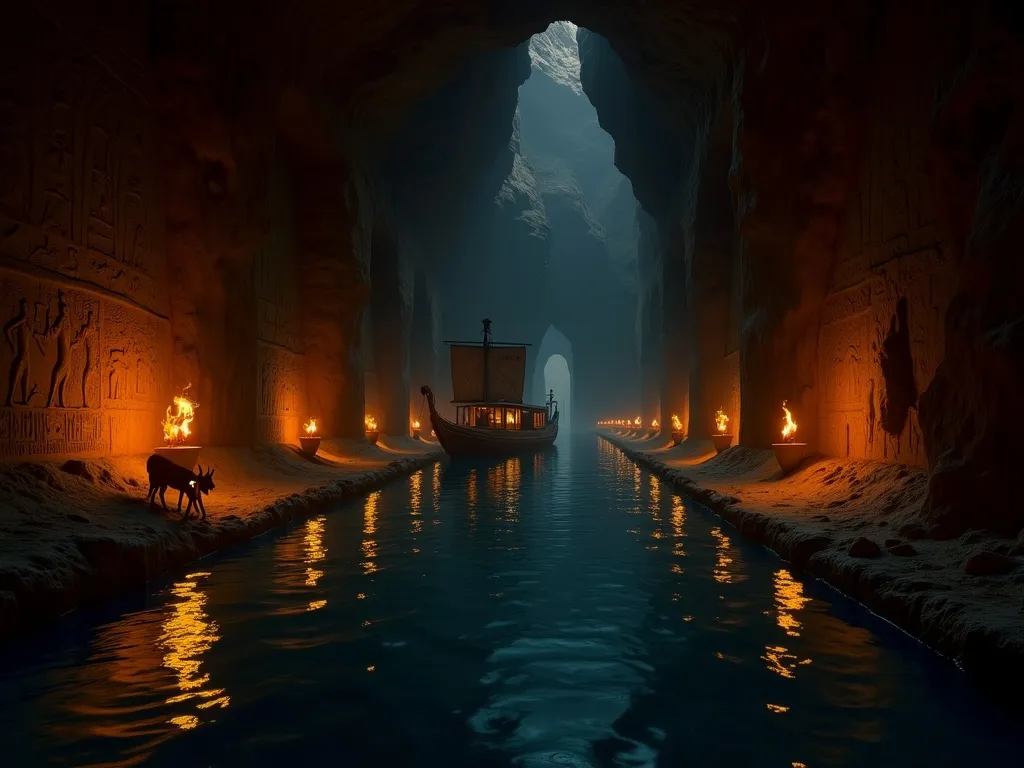
The twelve hours do not all look alike. The first hour opens into a wide river corridor, where Ra's barque sails with its divine crew. By the third and fourth hours, the river gives way to dry, sandy wastes, the Road of Rosetau, the domain of Osiris himself, so treacherous that even the sun god must be towed by jackals. The fifth hour holds the tomb of Osiris, a hidden chamber roofed with the body of a sphinx. The sixth hour is the deep midnight, the most dangerous point, where the solar serpent Apep waits to swallow the light entirely.
- Hours 1-3: The river of the West, first gates, early guardians
- Hours 4-5: The sandy Road of Rosetau, the tomb of Osiris, the sphinx
- Hours 6-7: Midnight, the confrontation with Apep, the regeneration of Ra's solar force
- Hours 8-10: The resurrection of the sun's body, distribution of offerings to the blessed dead
- Hours 11-12: The final push toward dawn, the birth canal of Nut, the emergence of Khepri
Each hour is sealed by a gate guarded by a serpent with a name the deceased must recite. The texts are explicit: get the name wrong, and the gate stays shut.
The Forty-Two Judges and the Hall of Two Truths
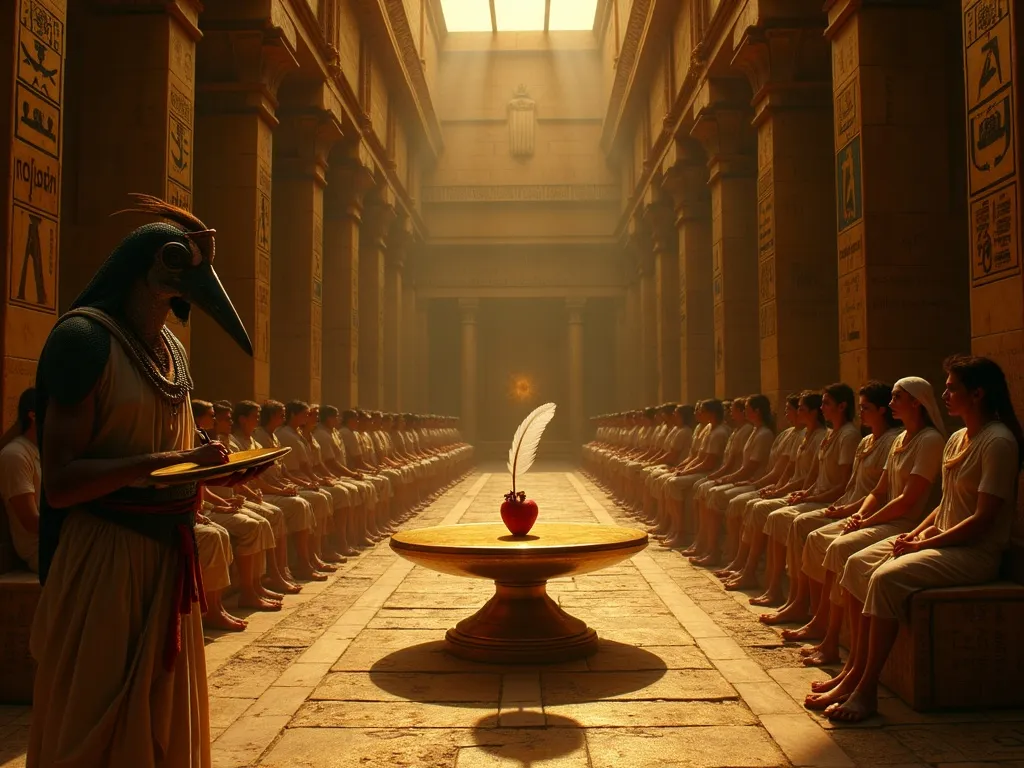
No scene in Egyptian religion carries more moral weight than the Weighing of the Heart, conducted in the Hall of Two Truths, Maaty in Egyptian. The deceased enters to find forty-two judges seated in a long row, each presiding over a specific sin. One judge governs lying. One governs theft. One governs cruelty toward animals. One governs the desecration of temple offerings. Each sin has its own officer and its own question.
The deceased speaks the Negative Confession, denying each transgression in turn, addressing each judge by name. "O Bone-Crusher, who comes from Herakleopolis, I have not caused pain. O Blood-Eater, who comes from the place of slaughter, I have not slaughtered sacred animals..." This continues through all forty-two offenses, a complete moral inventory.
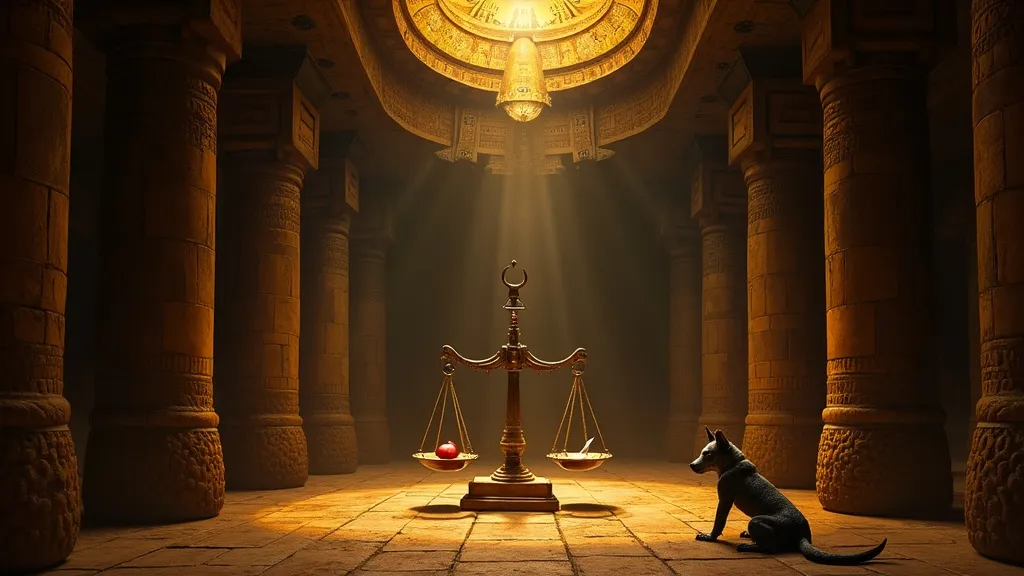
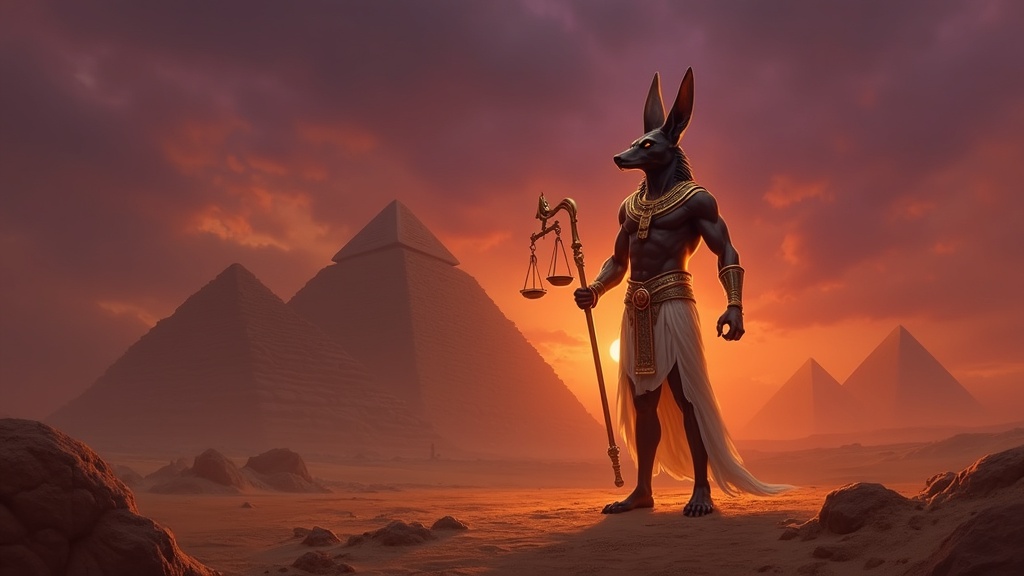
At the center of the hall stands the great scales. Anubis, jackal-headed and precise, places the heart of the dead on one pan. On the other sits the feather of Ma'at, the goddess of cosmic order, truth, and justice. If the heart balances perfectly against the feather, the soul passes. If it sinks under the weight of wrongdoing, Ammit devours it.
Ammit demands attention. She is not a god but a composite predator: the head of a crocodile, the forequarters of a lion, the hindquarters of a hippopotamus, the three most dangerous animals the Egyptians knew. She crouches at the foot of the scales, and souls condemned to her jaws suffer the second death, obliteration so complete that no resurrection can follow. There is no hell in the Duat in the Christian sense; there is only erasure.
Thoth, standing at the edge of the scene, records the verdict with his palette and brush. Ra and Osiris observe from their thrones. The judgment is witnessed by the entire divine court, which means the result cannot be appealed or altered. This is not an arbitrary tribunal; the scales do not lie.
Osiris, Ra, and the Two Lords of the Duat
A productive tension runs through every Duat text: two gods claim dominion over the underworld, and their relationship is never fully resolved.
Osiris rules as king of the dead, seated on his throne at the heart of the Duat, wearing the atef crown, holding the crook and flail. His myth, the murder at the hands of Set, the recovery of his body by Isis, the resurrection achieved through Isis's magic, makes him the prototype for every Egyptian who hopes to live again after death. To be "justified" (the standard phrase for a soul that passes judgment) is to become Osiris, to take his name, to share his fate.
Ra passes through the Duat but does not rule it. He arrives each night as an old man, even a ram-headed figure, exhausted by the day's journey across the sky. The Duat regenerates him. At the sixth hour, the two gods meet: Ra and Osiris fuse briefly into a single being, the ram-headed sun god resting within the mummy of Osiris. The Amduat calls this union "the one who hides the hours," a moment when solar energy and chthonic depth are inseparable.
Osiris
Rules the Duat permanently as king of the dead. His throne is in the fifth hour, in the region of Rosetau. The justified dead take his name and identity. He embodies the power of resurrection through stillness, through the preservation of the body.
Ra in the Duat
Passes through the Duat nightly, dying and regenerating each time. His power is cyclical motion, the solar barque, the movement of time. He brings light into the dark hours, awakening the dead temporarily at each hour as his boat passes.
This dual sovereignty matters for how Egyptians understood death. A dead person was simultaneously at rest (Osirian) and in perpetual regenerative motion (solar). The two were not contradictions; they were the two faces of eternal life.
The Book of the Dead and the Texts That Mapped the Duat
The texts that describe the Duat span more than two thousand years, from the Pyramid Texts (c. 2375 BCE) through the Coffin Texts (c. 2100-1700 BCE) to the Book of the Dead (Pert em Hru, "Coming Forth by Day," c. 1550 BCE onward). Each layer adds resolution to the picture.
The Pyramid Texts are the oldest: carved in vertical columns inside the burial chambers of Fifth and Sixth Dynasty pharaohs at Saqqara. They were initially royal property; only the king could speak their spells. The dead king identifies himself with Ra, with Osiris, with Horus, slipping between divine identities like a man who knows many languages.
The Coffin Texts democratized access. By the Middle Kingdom, wealthy non-royals could have the spells painted inside their wooden coffins, bringing the protection of the afterlife map to a broader class of the dead. Spell 1130 of the Coffin Texts contains a monologue by the creator god explaining the nature of the Duat; it is among the most theologically dense passages in Egyptian literature.
The Book of the Dead went further. Papyrus scrolls, sometimes stretching to twenty meters, were placed with the body, personalized with the owner's name. Chapter 125 contains the full Negative Confession. Chapter 64, one of the most coveted, claims to give the deceased complete freedom of movement throughout the Duat, to "come forth by day" at will, to return to the sunlit world above and re-enter the underworld whenever desired.
The Guardians: Serpents, Doorkeepers, and Named Demons
The Duat is populated with a precision that borders on bureaucracy. Each gate has a doorkeeper, a herald, and a guardian, three officers whose names must all be recited for passage. The Book of Gates lists seventy-four such figures by name across its twelve divisions. Their names are functional descriptions: "He who cuts off heads," "She who protects the disk," "Great of strength who drives away the rekhyt birds."
The serpents are the most visually striking. Apophis (also Apep), the chaos serpent, is the largest: coiled at the sixth hour, large enough to swallow the entire solar barque. Each night the crew of Ra, joined by Set wielding a spear, must subdue Apep. The fight is never permanently won. Apep regenerates by the next night, ready to swallow the light again. This nightly combat is not a failure of the gods; it is the structure of time. The tension between order and chaos cannot be resolved; it can only be maintained, hour by hour, night after night.
Other serpents serve the Duat rather than threatening it. Nehebkau (He Who Harnesses the Spirits) guards the entrance to the Hall of Two Truths. Mehen coils around the solar barque in the deepest hours, protecting Ra's regenerating body the way a snake coils around an egg. The serpent in the Duat is not a single symbol; it is a category of being that encompasses both the greatest threat and the most intimate protection.

The Field of Reeds: Where the Justified Dead Finally Rest
Beyond the judgments, beyond the gates, past the forty-two confessions and the scales and Ammit's crouching hunger, the Aaru opens. The Field of Reeds, sometimes the Field of Offerings or the Field of Rushes, is the Egyptian paradise: a landscape of waterways, green banks, and grain fields where the blessed dead live in a state that mirrors the best of earthly life.
The dead in Aaru farm. They fish. They receive offerings from their living descendants. The grain grows three times as tall as it does on earth, an image that appears in both the Coffin Texts and the Book of the Dead. The sun shines there, but it is the light of the Duat, perpetual and gentle. Osiris presides, and Ra's barque passes through the Field of Reeds each night as part of its circuit, briefly illuminating the dead who gather to see the solar light.
The justified dead could also aspire to become akh, a luminous, transfigured spirit capable of moving between the Field of Reeds, the Duat proper, and the sky. The akh joined the imperishable stars, the circumpolar stars that never set in the Egyptian night sky, circling the celestial pole in endless motion. For the most fully transfigured dead, eternity was not rest but an endless, radiant journey alongside the sun itself.
This is what all the gates, all the passwords, all the recitations were for: not survival, but transformation into a being of light that could move through every register of the cosmos without restriction.
The Duat in Scholarly Debate: Cosmology, Astronomy, or Ritual Space?
Modern Egyptologists have not settled every question about the Duat. A productive disagreement runs through the field about whether the Duat should be understood primarily as a geographic space (an actual underworld beneath the earth), as an astronomical phenomenon (the zone of the sky through which the sun moves at night, corresponding to parts of the Milky Way or specific star fields), or as a ritual space activated by the funerary texts themselves, existing only in the charged interaction between spoken spell and inscribed surface.
Jan Assmann's work on Egyptian theology, particularly his analyses of the solar theology of the New Kingdom, emphasizes the processual, temporal character of the Duat: it is less a place and more a passage, a structured duration with its own internal logic. Erik Hornung, whose translations of the Amduat remain the standard scholarly edition, reads the Duat as a genuinely imagined geography, one that Egyptians experienced in ritual and in dreams as concretely as they experienced the Nile Valley.
A third line of interpretation, associated with Egyptologists like John Coleman Darnell, focuses on the Duat's connections to the desert road system west of Thebes, the actual paths taken by funerary processions toward the Valley of the Kings. In this reading, the textual Duat maps onto real topography: the cliffs, wadis, and caverns of the western desert are the physical correlates of the Amduat's twelve hours.
None of these readings excludes the others. Egyptian thought was comfortable holding multiple layers of reference simultaneously: a text could be cosmological, astronomical, geographic, and ritual all at once, and the richness came precisely from that density of meaning.
Frequently Asked Questions About Duat the Egyptian Underworld
Frequently asked questions
What is the Duat in Egyptian mythology?
The Duat is the ancient Egyptian underworld, a structured realm through which the sun god Ra traveled each night and through which the souls of the dead passed after death. It comprised twelve divisions corresponding to the twelve hours of night, each with its own guardians, gates, and landscapes, ranging from waterways to desert roads to the Hall of Judgment where the heart was weighed against the feather of Ma'at.
What is the difference between the Duat and the Field of Reeds?
The Field of Reeds (Aaru) is a specific region within the broader Duat. The Duat encompasses the entire underworld geography, including the dangerous gates, the combat with Apep, and the Hall of Two Truths. Aaru is the paradise reached by souls who pass the judgment: a fertile, peaceful landscape of grain fields and waterways where the justified dead live in a form of eternal, renewed earthly life.
Who are the main gods associated with the Duat?
Osiris rules the Duat as king of the dead, particularly in the region of Rosetau at the fifth hour. Ra passes through it nightly in his solar barque, regenerating his solar force by merging briefly with Osiris at the sixth hour. Anubis presides over the Weighing of the Heart. Thoth records the verdict. Ma'at provides the feather for the scales. Ammit devours the hearts of the condemned. Each of the twelve hours also has its own resident deities and serpent guardians.
What texts describe the Duat in detail?
The primary sources are the Pyramid Texts (c. 2375 BCE, carved in royal burial chambers at Saqqara), the Coffin Texts (c. 2100-1700 BCE, painted inside wooden coffins for wealthy non-royals), and the Book of the Dead (Pert em Hru, c. 1550 BCE onward). The Amduat (literally "That Which is in the Duat") and the Book of Gates provide hour-by-hour accounts of Ra's nightly journey and are the most detailed geographic descriptions of the underworld.
Could ordinary Egyptians access the Duat after death, or only pharaohs?
Access expanded over time. The Pyramid Texts were exclusively royal, granting only the pharaoh the spells for safe passage. By the Middle Kingdom, the Coffin Texts extended this protection to wealthy non-royals. By the New Kingdom, the Book of the Dead was available to anyone who could afford a papyrus scroll prepared by scribes. The democratization of the afterlife is one of the most significant social developments in Egyptian religious history.
Is the Duat similar to the Greek underworld?
Both are structured realms for the dead with rivers, judges, and moral reckoning, but the underlying logic differs significantly. The Greek underworld (ruled by Hades) separates the dead into zones based on virtue but does not require the dead to navigate gates with spoken passwords, nor does it regenerate the sun. The Duat is fundamentally about transformation and cyclical renewal, not permanent residence in a shadowy realm. The Egyptian dead aim to become luminous, mobile beings, not shades in a gray Elysium.
How the Duat Shaped Three Thousand Years of Egyptian Civilization
The influence of the Duat was not confined to burial chambers. It structured how Egyptians built temples, oriented their cities, conducted rituals at every level of society, and understood the movement of the stars.
Temples at Karnak and Luxor were designed with a westward orientation toward the dead and a directional logic that mirrored the Duat's geography: outer courts as the first hours, inner sanctuaries as the deeper chambers, the holy of holies as the fifth-hour tomb of Osiris where the divine image rested in sealed darkness. Priests performing the Opening of the Mouth ceremony on temple statues were re-enacting the same resurrection rites used for the dead.
The calendar itself was calibrated against the Duat's rhythms. The seventy-day period of mummification corresponds to the seventy-day disappearance of the star Sirius (Sopdet) below the horizon, a period understood as Sirius traveling through the Duat before its heliacal rising announced the Nile flood. Death and return were written into the stars and into the agricultural year simultaneously.
When Egypt's religious traditions were absorbed into the Hellenistic world after Alexander's conquest in 332 BCE, the Duat traveled with them. Greek writers identified Osiris with Dionysus and with Hades. The mystery cults that spread through the Roman Mediterranean borrowed the Egyptian logic of initiation-as-death-and-rebirth. The Coffin Texts' promise that the deceased could "come forth by day" and move freely between the living world and the afterlife would echo, centuries later, in the cosmologies of the Hermetic tradition, where the soul's ability to ascend through the planetary spheres mirrors the Duat's architecture of gates and guardians and earned passage.
The Duat was never simply a belief about what happens after death. It was a complete theory of time, light, order, and the regenerative structure of existence itself: one that shaped the most durable civilization in the ancient world and left traces in traditions that its builders never could have anticipated.
Free 25-page sample
Want the whole story?
Take the first 25 pages free. If it pulls you in, the full edition is yours as an instant PDF download, with a paperback on Amazon for selected titles.

Egyptian
The Egyptian Mythology Book: Ra, Osiris, Isis, Anubis, and the Sacred Stories of the Pharaohs
Ra, Osiris, Isis, Anubis, and the Sacred Stories of the Pharaohs
Three thousand years of Egyptian sacred stories. The Duat, the weighing of the heart, the cult of Osiris, and the daily voyage of the sun.
More from Egyptian
All articles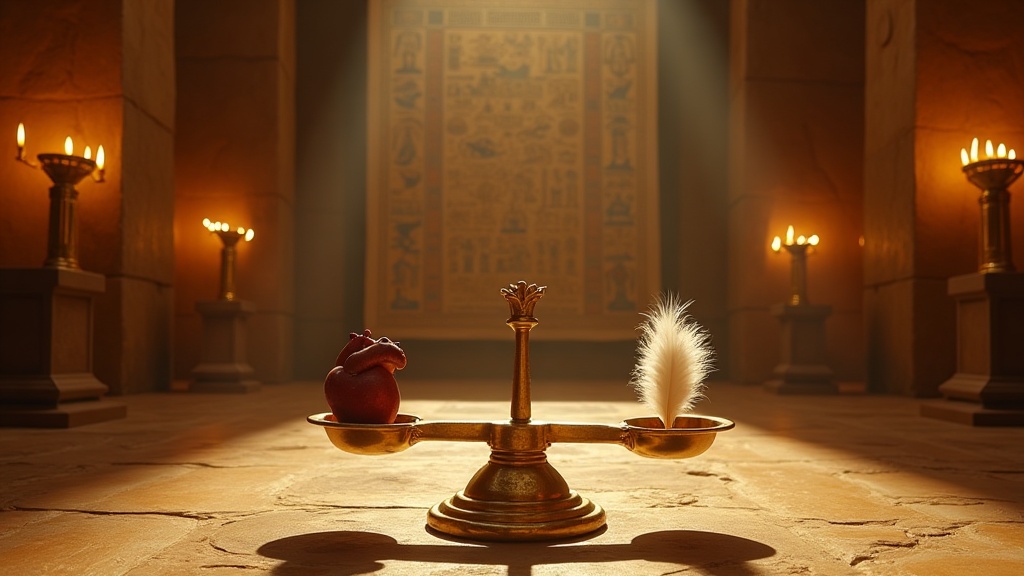
Egyptian
The Book of the Dead: Egypt's Guide to Eternity
Ancient Egypt's most sacred funerary text was not a single book but a living archive of spells, maps, and prayers that guided the dead through the perils between death and eternal life.
Egyptian
Ra the Sun God: Egypt's Supreme Ruler of Light and Creation
Ra, the ancient Egyptian sun god, blazed at the very heart of a civilization that worshipped light as the pulse of creation itself. Discover his origins, his many forms, and the sacred journey he took across the sky and through the underworld every single day.
Egyptian
The Ankh: Egypt's Eternal Symbol of Life
The ankh is ancient Egypt's most recognizable hieroglyph, a looped cross carried by gods and pharaohs alike as the very key to immortal life. Discover its origins, meanings, and sacred legacy.
Egyptian
Anubis: God of the Dead, Guardian of the Scales
Anubis, the jackal-headed deity of ancient Egypt, presided over embalming, the underworld, and the judgment of souls. His is one of the oldest and most enduring divine figures in human history.