
The Nag Hammadi Library: Discovery and Significance
In 1945, Egyptian farmers stumbled upon thirteen ancient papyrus codices hidden in a desert cave. The Nag Hammadi Library revealed a hidden world of early Christian and Gnostic thought, overturning centuries of assumptions about Christianity's first centuries.
Contents
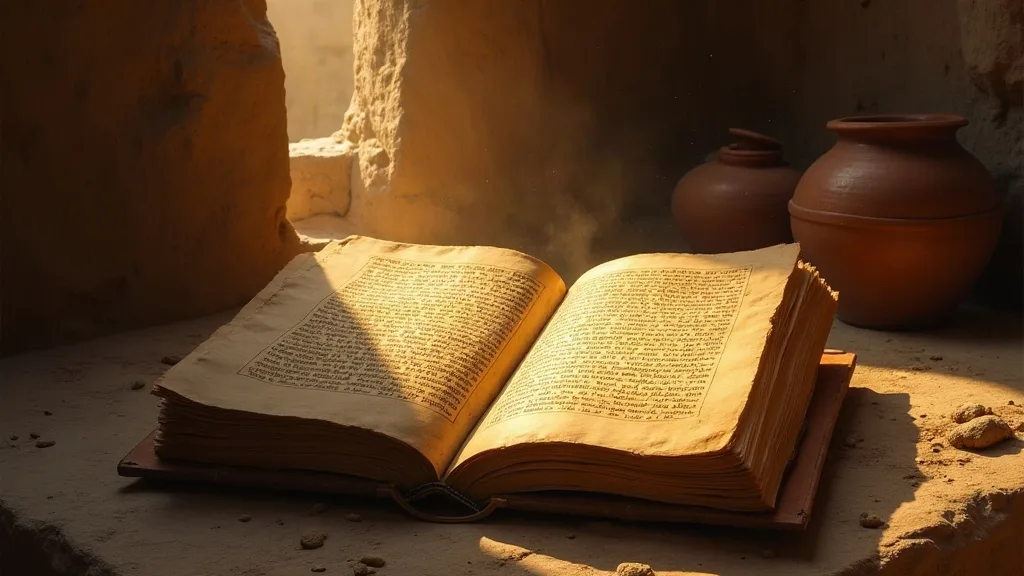
Thirteen leather-bound manuscripts, buried in a sealed earthenware jar for sixteen centuries. In December 1945, three brothers digging near the town of Nag Hammadi in upper Egypt broke through the surface and found them. What tumbled out was not gold or jewels, but something more explosive: a library of forbidden texts that spoke to the deepest fractures in early Christianity.
The Nag Hammadi Library discovery and significance cannot be separated from that moment of chance. These papyri, written in Coptic (the language of Christian Egypt by the fourth century), contained gospels, philosophical treatises, and ritual texts that the institutional church had worked hard to bury. For over fifteen hundred years, they lay silent. Then a farmer's spade changed everything.
The Unearthing: December 1945
The three Al-Samman brothers were not archaeologists. They were searching the soft earth near their village for sabakh, a nitrogen-rich soil used as fertilizer, when their tools struck something solid. Inside the cave, they found a large red earthenware jar, sealed with a lid. When they broke it open, expecting treasure, they discovered instead a cache of ancient books.
The manuscripts were in poor condition. Some leaves had crumbled to dust. Water damage and insects had done their work over centuries. But enough remained to read. The brothers initially treated their find casually. One account suggests they used some of the pages as kindling. But word spread, and eventually, collectors and scholars caught wind of what had surfaced in the Nile Valley.
The journey of these texts from the desert floor to scholarly hands is itself a story of confusion, loss, and bureaucratic accident. Some pages were sold piecemeal to dealers in Cairo. Egyptian authorities eventually secured most of the collection, and by the 1960s, the manuscripts had entered the Coptic Museum in Cairo, where they remain today. But the initial fragmentation meant that parts of the library were lost or scattered to private collections before a complete inventory could be made.
What the Library Contains
The Nag Hammadi Library comprises thirteen codices (ancient books), written on papyrus and bound in leather covers. Scholars refer to them as Codices I through XIII. Together, they contain fifty-two distinct texts, many of which survive nowhere else on earth. The collection spans roughly two hundred years of composition, from the late first century to the early third century CE.
The texts include gospels unlike those in the canonical New Testament. The Gospel of Thomas, a collection of sayings attributed to Jesus with no narrative framework, appears in Codex II. The Gospel of Philip offers mystical reflections on the nature of the body, the spirit, and divine union. The Apocryphon of John (Secret Book of John), found in multiple codices, presents a radically different account of creation than Genesis, describing a flawed or tyrannical creator god, an alien intelligence sometimes called the "Demiurge," and a hidden wisdom tradition passed down through apostles.
Beyond gospels, the collection contains philosophical and cosmological treatises. The Hypostasis of the Archons describes the nature of reality according to what scholars call Gnostic cosmology. The On the Origin of the World lays out creation narratives that sound more like science fiction than biblical exegesis. There are also practical texts: prayers, invocations, and ritual instructions. The Thunder, Perfect Mind, a mystical poem in the voice of a divine feminine figure, speaks in riddles and paradoxes.

The manuscripts were not all composed at the time of their burial. They were copied from earlier Greek originals, likely because Greek texts were becoming rare in Egypt by the late fourth century, and Coptic was the living language of Christian monastic communities. This means the collection represents a snapshot of what certain Egyptian Christian communities deemed worth preserving.
The Gnostic Vision in the Nag Hammadi Texts
One term dominates scholarly discussion of these texts: gnosis, a Greek word meaning "knowledge." In the Gnostic worldview reflected in many Nag Hammadi writings, salvation does not come through faith in Christ's resurrection or adherence to institutional church doctrine. Instead, it comes through awakening to a hidden truth: that the material world is a prison, created not by the true God but by a flawed intermediary being, and that sparks of divine light trapped in human souls can be freed through esoteric knowledge.
This vision shocked the early church fathers who encountered it. Irenaeus of Lyons, writing in the second century, denounced Gnostic teachers with fury. He accused them of fabricating secret teachings and leading believers away from apostolic truth. The institutional church worked systematically to suppress Gnostic texts, and by the fifth century, Gnostic Christianity had been driven underground or out of existence in most of the Mediterranean world.
The Nag Hammadi Library is a voice from that suppressed tradition, preserved not by design but by chance. Someone, likely a monastic community, gathered these texts and hid them. Whether this was done to preserve them from destruction or to hide them as heretical is debated. The cave itself was in a remote region, controlled by Coptic Christians. It may have been a monastic library hidden when threats of persecution increased.
The cosmology embedded in these texts is startlingly alien. In the Apocryphon of John, the true God is infinitely distant and transcendent. Between the divine realm and the material universe stands a hierarchy of archons, semi-divine beings who rule the cosmos and keep humanity enslaved. The lowest and most ignorant of these is sometimes identified with the God of the Old Testament, the creator of Genesis. This is radical theology: the God who made the world, in Gnostic terms, is not the highest God but a lesser, often malevolent power.
Humanity, in this view, contains fragments of divine spirit imprisoned in flesh. The Gnostic savior (often understood as Christ in these texts, though in a very different way than mainstream Christianity understood him) comes to awaken the elect to their true nature. The goal is not resurrection of the body or moral transformation, but apokatastasis, a return to the divine source through knowledge and spiritual discipline.
Why These Texts Were Hidden
By the time someone sealed the Nag Hammadi Library in that earthenware jar, Gnosticism was dying. The institutional church, with imperial backing after Constantine's conversion, had made heterodox Christianity dangerous. In Egypt, where Coptic monasticism was flourishing, the line between orthodoxy and heresy had hardened.

The texts themselves show signs of being used and reused. Annotations in the margins, wear patterns on the pages, suggest that these were working copies, read and studied by the community that preserved them. Scholars debate whether the cache was assembled hastily when threats of discovery mounted, or whether it represented a carefully curated library. The presence of some orthodox texts alongside clearly heterodox material suggests the collection was not ideologically pure; it may have been whatever was at hand.
One theory places the library's concealment in the early fifth century, when the archbishop of Alexandria, Theophilus, launched campaigns against Christian sects deemed heretical. Another points to the later fourth century, when the Roman emperor Theodosius issued decrees forbidding non-Christian religions and unorthodox Christian sects. The exact moment of burial may never be known. What matters is that someone thought these texts worth hiding from destruction.
The Scholarly Impact: Rewriting Early Christian History
Before 1945, scholars knew about Gnosticism mainly through the polemics of its opponents. Church fathers like Irenaeus and Hippolytus wrote lengthy refutations of Gnostic teaching, but they were describing these ideas to attack them, not to explain them fairly. It was like trying to understand an argument by reading only one side's prosecution brief.
The Nag Hammadi discovery and significance transformed this landscape overnight. For the first time, scholars could read what Gnostics actually wrote, in their own words, in their own voices. The texts revealed complexities and sophistication that the caricatures of heresy had obscured. Gnostic thinkers were engaging seriously with cosmology, theology, and the problem of evil. They were not simply deluded mystics or charlatans selling false hope.
The discovery also raised unsettling questions about the boundaries of early Christianity itself. The canonical gospels portray Jesus and his apostles establishing a unified church with clear doctrine. But the Nag Hammadi texts showed that in the second and third centuries, there was no unified "Christianity" waiting to be corrupted by heretics. There were multiple, competing visions of what Jesus meant and what salvation entailed. The Gnostic reading of Christ, strange as it was to modern ears, was not an obvious perversion but one strand in a braided tradition.
This realization shifted the entire framework of early Christian studies. Scholars began to speak not of heresy corrupting orthodoxy, but of orthodoxy emerging triumphantly from a pluralistic landscape. The "winners" wrote history. The church that built institutions, standardized doctrine, and gained imperial patronage became "the church." Everyone else became "heretics." The Nag Hammadi texts revealed the losers' library.
The Individual Texts: Key Manuscripts
Among the fifty-two texts, a few stand out for their influence on contemporary scholarship and spiritual seeking.
The Gospel of Thomas has perhaps had the broadest modern impact. It is not a narrative gospel. It offers only sayings, short maxims attributed to Jesus, often cryptic and thought-provoking. "If you bring forth what is within you, what you bring forth will save you." "The kingdom of the Father is like a woman who is carrying a jar full of meal. While she was walking on the road, the handle of the jar broke and the meal spilled out behind her on the road. She did not notice; she had not suffered. When she reached her house, she set the jar down and found it empty." Such sayings invite interpretation, debate, and personal reflection. They read more like Zen koans than Gospel narrative. Scholars have long wondered whether Thomas represents an earlier layer of Jesus tradition, before the Gospel writers shaped the material into narrative form.
The Gospel of Philip is equally enigmatic. It mixes sacred mystery with earthy physicality. It speaks of kissing as a spiritual act and reflects deeply on the significance of the physical body. Some passages seem to hint at sacred sexuality; others are mystical and abstract. Philip was an apostle, but this is not a historical account of Philip's life. Rather, it is a philosophical and theological meditation attributed to him.
The Hypostasis of the Archons and the On the Origin of the World together offer a complete Gnostic cosmology. They describe the fall of Sophia, a divine feminine principle whose descent creates the material universe. They explain how the archons keep humanity enslaved and ignorant. They present a creation story that inverts Genesis: the creator of this world is not the true God but a blind, arrogant being who thinks himself alone and supreme. These texts are sometimes called "anti-creation" myths because they make the act of creation itself the problem, not the solution.
The Testimony of Truth warns the reader against the false prophets and authorities of this world. The Thought of Norea celebrates a female figure from Genesis (Norea, wife of Noah) as a revealer of divine truth. The Thunder, Perfect Mind gives voice to a mysterious, paradoxical figure who embodies contradictions and speaks truth from beyond normal categories.
How the Texts Were Used
The Nag Hammadi Library texts were not meant to replace the canonical scriptures for the communities that used them. Rather, they supplemented and reinterpreted them. A monk copying the Gospel of Thomas would still have known Matthew, Mark, Luke, and John. But Thomas offered a different approach: direct sayings without narrative scaffolding, inviting the reader to find personal meaning in each word.
The texts show signs of being used in study and contemplation. Marginal notes in some manuscripts indicate that readers were working through difficult passages, glossing obscure terms, and copying out phrases for memorization. Some passages are marked for liturgical use, suggesting they may have been read aloud in gatherings. Others appear to be ritual manuals or meditation guides.
The community that preserved the Nag Hammadi Library was likely a monastic one. Egyptian Christian monasticism was flourishing in the fourth and fifth centuries. Monks gathered in the desert seeking spiritual perfection and direct encounter with God. Some of these communities were theologically adventurous, willing to explore ideas that the mainstream church rejected. A Gnostic monastery would have seen its texts as tools for spiritual awakening, not as heretical propaganda.
The Debate Over Dating and Authorship
One of the most contentious questions in Nag Hammadi scholarship concerns the date and authorship of these texts. The manuscripts themselves were written in the fourth century. But they are copies of earlier Greek originals, some dating back to the second century. How much earlier? Were they composed in the first century, contemporary with or even preceding the canonical gospels? Or did they emerge later, as responses to established Christianity?
Scholars remain divided. Some, like the Jesus Seminar scholars, have argued that Thomas preserves very early tradition, possibly as old as Matthew or Mark. They point to the fact that Thomas shows no awareness of the Passion narrative, the Resurrection, or the role of the apostles as institutional authorities. This absence, they argue, suggests Thomas is ancient. Others counter that this could equally well show that Thomas was composed later as a deliberate rejection of these themes.
The Apocryphon of John contains clear references to established orthodox Christianity. It directly refutes ideas about Christ's Passion and Resurrection that had become mainstream doctrine. This suggests it was written in polemical response to orthodox Christianity, probably not in the first century but in the second or third.
The truth is likely complex and varied. Some texts in the collection are probably early. Others are clearly late. The Nag Hammadi Library as a whole represents layers of Christian thought, from close to the time of Jesus to well into the post-Constantinian era. The manuscripts themselves, copied in the fourth century, preserve a cross-section of that layered tradition.
The Broader Significance for Religious Studies
The Nag Hammadi Library discovery and significance extends far beyond specialist scholars. It has reshaped how we think about religious pluralism, orthodoxy, and the construction of authority.
For mainstream Christianity, the texts pose a challenge. They show that some early Christians understood Christ and salvation in ways radically different from doctrine that eventually triumphed. This does not disprove orthodox Christianity, but it complicates the claim that one pure apostolic tradition was corrupted by later heresies. The reality was more contested, more diverse, more unsettled.
For scholars of late antiquity, the texts illuminate the cultural and intellectual ferment of the Mediterranean and Near East in the second through fourth centuries. They show us how Christian, Platonic, and older mythological ideas were being woven together as people grappled with ultimate questions about the nature of God, the cosmos, and the human soul.
For spiritual seekers in the modern world, the Nag Hammadi texts have had a surprising afterlife. Gnostic Christianity, dead for fifteen centuries, has been revived in contemporary spirituality and esoteric circles. Some see in the Gnostic vision a critique of materialism and institutional religion that speaks to modern concerns. Others view Gnosticism as an ancient precedent for the idea that truth is hidden from the masses and available only to the enlightened. This modern Gnosticism often bears little resemblance to the historical texts, but it draws energy and vocabulary from them.
Scholarly Debates: What the Texts Mean
Fifty years of intense study have not settled all questions about the Nag Hammadi Library. Major debates remain active.
One concerns the relationship between Gnosticism and Judaism. Are the Gnostic cosmologies borrowing from Jewish mysticism, or are they reactions against Jewish theology? The anti-creation stance of Gnostic texts seems to oppose the Jewish affirmation that God created the world and saw it was good. Yet some scholars have identified parallels between Gnostic ideas and esoteric Jewish traditions like the Merkabah mysticism that developed later. The influence likely ran in multiple directions across cultural boundaries that were more porous than they appear in hindsight.
Another debate concerns the role of gender and the feminine in Gnostic thought. Some texts celebrate feminine divine principles: Sophia, the Mother-Father, the Thunder. Some modern scholars, particularly feminists, have found in Gnosticism an alternative to patriarchal orthodoxy. Others caution that celebrating the divine feminine in myth does not necessarily mean women had higher status in Gnostic communities. The relationship between theological symbolism and social reality remains unclear.
A third debate concerns the philosophical sources of Gnosticism. How much do the texts owe to Platonism, to Stoicism, to older Babylonian and Egyptian ideas? The answer seems to be: all of these, in varying measure. The Nag Hammadi texts themselves show Gnostics reading Plato, adapting Middle Platonic ideas about the transcendent realm, and reinterpreting them through a Christian lens. Gnosticism was not a pure tradition but a creative synthesis, which is precisely why it provoked such hostility from those who believed in clear doctrinal boundaries.
The Texts' Afterlife in Art and Literature
Over the past eighty years, the Nag Hammadi texts have inspired artists, writers, and filmmakers. The imagery of the Demiurge, the trapped divine spark, and the hidden gnosis has proven enduringly powerful.
Science fiction writers in particular have drawn on Gnostic themes. Philip K. Dick incorporated Gnostic cosmology into several novels. The idea that the material world is a prison created by a false god maps neatly onto the sci-fi trope of artificial realities and simulations. More recently, the Matrix trilogy explicitly drew on Gnostic symbolism: the Matrix itself is a false reality created by a demiurge-like intelligence, and the heroes must awaken to hidden truth.
Visual artists have illustrated scenes from the texts. Dramatists have adapted the Gospel of Thomas into performance pieces. Academic study has fed popular interest, and popular interest has driven new academic attention. The Nag Hammadi Library, once a secret tradition, has become part of contemporary culture.
Frequently asked questions about the Nag Hammadi Library
Frequently asked questions
Who hid the Nag Hammadi Library, and why?
The identity of those who buried the texts remains unknown. Most scholars believe it was a Christian monastic community in upper Egypt, possibly fleeing persecution or pressure from the established church to destroy heterodox texts. The exact date of burial is disputed, with most evidence pointing to the late fourth or early fifth century. The purpose was likely preserving texts the community considered valuable from destruction.
Are the Nag Hammadi gospels older than the canonical New Testament?
The manuscripts themselves date to the fourth century, but they copy earlier Greek originals. Some texts, like the Gospel of Thomas, may preserve very ancient tradition, possibly from the second century or even earlier. Others are clearly later compositions. Scholars disagree on which texts are oldest, but the evidence suggests the Nag Hammadi collection spans a wide chronological range, with some material possibly contemporary with or older than the canonical gospels and other material clearly later.
Did the early church intentionally suppress these texts?
Yes, though not in a coordinated conspiracy. Church leaders like Irenaeus and later ecclesiastical authorities saw Gnostic teachings as dangerous distortions of apostolic truth. The emerging mainstream church worked to establish clear doctrine and eliminate competing interpretations. By the late fourth century, with Christianity becoming the official religion of the Roman Empire, institutional pressure against non-orthodox sects intensified. The texts were not all destroyed, but they were driven underground and ceased to be copied in mainstream communities.
What does Gnosticism teach, according to the Nag Hammadi texts?
The texts describe a cosmos in which the true God is distant and transcendent, while the material world is controlled by archons (flawed or malevolent semi-divine beings). Humanity contains sparks of divine light trapped in flesh and ignorance. Salvation comes not through faith or obedience but through esoteric knowledge (gnosis) that awakens the spirit to its true nature and origin. The savior figure reveals this hidden wisdom. This vision inverts much of mainstream Christianity and is radically opposed to the Jewish affirmation that creation is good.
How has the discovery changed our understanding of early Christianity?
The Nag Hammadi texts revealed that early Christianity was far more diverse and pluralistic than the victorious orthodox tradition suggested. There was no single "true Christianity" corrupted by heretics, but multiple competing visions. The texts showed that Gnostics were sophisticated theologians, not simply deluded mystics. They demonstrated that what became "orthodoxy" was one strand that triumphed through institutional power, not because it was the only authentic tradition. This realization reshaped the entire field of early Christian studies.
Where are the Nag Hammadi manuscripts today, and can anyone study them?
The original papyri are housed in the Coptic Museum in Cairo. Complete photographs and translations have been published and are available to scholars worldwide. Several excellent English translations exist, including the "Nag Hammadi Library in English" (edited by James M. Robinson) and individual scholarly editions with extensive commentary. While direct access to the originals requires permission and travel to Cairo, the texts themselves are fully available in translation and facsimile, and new scholarly work on them continues constantly.
The Hidden Library's Ongoing Revelation
The Nag Hammadi Library remains one of the most significant archaeological discoveries in religious history, yet its full implications are still unfolding. Each new generation of scholars reads these texts with fresh questions and interpretive tools. Digital humanities projects are now making high-resolution photographs of the manuscripts available, allowing researchers to examine the physical evidence of copying practices, corrections, and marginalia with unprecedented precision.
New questions emerge. How did Coptic Christian communities understand the relationship between these esoteric texts and the canonical scriptures they also read? What role did women play in communities that used texts celebrating the divine feminine? How did Gnostic Christianity evolve differently in isolated monastic communities versus in major urban centers? The texts raise more puzzles than they solve, which is precisely their value.
The discovery reminds us that history is not a straight line from past to present. It is layered, contested, and full of lost possibilities. The texts buried in the Nag Hammadi jar represent a path not taken in Western Christianity. They embodied a vision of the sacred, the cosmos, and human destiny that was suppressed but never entirely vanquished. In 1945, when three farmers' tools broke through the surface, that suppressed voice found its way back into the world. It speaks still, in languages both ancient and contemporary, of hidden knowledge, of divine sparks trapped in flesh, and of the perpetual human hunger to understand what lies beyond the visible world.
Free 25-page sample
Want the whole story?
Take the first 25 pages free. If it pulls you in, the full edition is yours as an instant PDF download, with a paperback on Amazon for selected titles.
Gnosticism
The Gnosticism Book: The Demiurge, Sophia, the Archons, and the Secret Knowledge
The Demiurge, Sophia, and the Archons
The forbidden cosmology of the Gnostics: a false creator god, a fallen wisdom, prison-world rulers called archons, and the divine spark trapped inside you, waiting to wake. Recovered from the buried codices of Nag Hammadi.
More from Gnosticism
All articles
Gnosticism
Archons: Rulers of the Material Prison
In Gnosticism, the Archons are tyrannical beings who rule the material cosmos, trapping human souls in flesh and ignorance. Discover what ancient texts reveal about these cosmic jailers and their war against human consciousness.
Gnosticism
Simon Magus: The First Gnostic Heresiarch
Who was Simon Magus, and why did the early Church fear him so deeply? Discover the man at the center of the first major rift between orthodox Christianity and Gnosticism, and how one sorcerer became a legend that shaped centuries of theology.
Gnosticism
Valentinus: Architect of Christian Gnosticism
Valentinus was a visionary theologian and spiritual teacher in second-century Rome who shaped the most sophisticated and influential school of Christian Gnosticism. His radical reinterpretation of Christ's redemptive work created a system of divine knowledge that challenged orthodoxy for three centuries.

Gnosticism
The Serpent in Eden: Gnostic Reinterpretation of Genesis
In Gnostic thought, the serpent who tempted Eve becomes a liberator, not a deceiver. Discover how early Christian heretics flipped Genesis on its head, casting the God of the Old Testament as a flawed demiurge and the serpent as an agent of divine knowledge.