
Valentinus: Architect of Christian Gnosticism
Valentinus was a visionary theologian and spiritual teacher in second-century Rome who shaped the most sophisticated and influential school of Christian Gnosticism. His radical reinterpretation of Christ's redemptive work created a system of divine knowledge that challenged orthodoxy for three centuries.
Contents
In the shadows of second-century Rome, a Greek-educated mystic named Valentinus was remaking Christian thought from the ground up. He had come to the imperial capital around 140 CE, carrying a vision of redemption that looked nothing like the Christianity his contemporaries preached. For Valentinus, salvation was not a transaction offered to all equally. It was a secret knowledge, a gnosis, available only to those spiritually awake enough to receive it. By the time he died, perhaps in his eighties, he had launched the most elaborate, intellectually rigorous, and theologically coherent school of Christian Gnosticism ever to exist. His followers would spread his teachings across the Mediterranean for the next three centuries. His rivals in the emerging orthodox church would spend that same time trying to erase him.
We know very little about Valentinus himself. No writings survive in his own voice, only fragments quoted by later sources, most of them hostile. Yet what we can reconstruct is startling: a man of genuine philosophical sophistication, trained in Platonic and Stoic thought, who saw in Christianity not salvation for the masses but a path of initiation for the elect. His system would become so intellectually formidable that some church fathers feared it more than outright pagan philosophy.
The World that Shaped Valentinus
Valentinus grew up in Egypt, likely in Alexandria, the intellectual crossroads of the Mediterranean. This was no provincial backwater. Alexandria in the second century was where Greek philosophy met Jewish mysticism, where Neoplatonism was being born, where Christian scribes were copying new gospels. The city thrummed with competing visions of what divinity was and how the cosmos worked.
The Alexandria Valentinus knew was home to thinkers like Philo of Alexandria, who had spent generations before him finding ways to reconcile Greek rational philosophy with Jewish revelation. It was also a place where mystery religions flourished; temples of Isis and Osiris stood alongside synagogues and, increasingly, Christian meeting houses. Educated men could move fluidly between these worlds. Many did. Valentinus absorbed this intellectual eclecticism completely.
What he encountered in Christianity was raw material waiting for philosophical refinement. The gospels spoke of a crucified Jewish teacher who had somehow become divine. Paul's letters contained cryptic passages about secret wisdom, about the difference between those who could receive "spiritual" teaching and those stuck with "milk." The growing church, however, was moving toward simplicity, toward a message that worked for slaves and philosophers alike. Valentinus could not accept this. He believed that Christ had come not to die for humanity's sins, but to awaken those capable of awakening to their true nature.
The Valentinian System: A Universe Divided

The cosmos Valentinus described was radically hierarchical. At the top stood the Pleroma, a realm of pure spirit inhabited by pairs of divine emanations called "aeons." These were not gods in the crude sense. They were aspects of the godhead, degrees of being, unfolding from the ultimate source like concentric circles of light. The highest aeons were closest to perfection; the lowest brushed against materiality.
This was not novel Gnosticism; Gnosticism predated Valentinus by generations. But his articulation was unprecedented in its architectural precision. The system worked like a geometrician's proof. Everything flowed from first principles. Everything made logical sense.
What made Valentinus's version distinctive was his account of the cosmos's tragic flaw. In his telling, one of the lower aeons, often called Sophia (Wisdom), experienced a catastrophic passion. She yearned for the ultimate source with an intensity she could not contain. Her desire overflowed. From this cosmic error of love, all material existence sprang into being. The world was not created by the true God. It was born from the mistake of a falling aeon. And it was ruled not by the God of spirit, but by an ignorant creator deity, the Demiurge, who shaped it in his blindness.
This reframing was subversive genius. The God of the Old Testament, the lawgiver and judge, was no longer God at all. He was the blind architect of an inferior world. The serpent in Eden was not evil; he was trying to awaken humanity to hidden knowledge. The "good" God of the Old Testament was actually an arrogant demiurge who punished those he could not understand.
For orthodox Christians, this was intolerable. It made the Hebrew scriptures not revelation but the product of cosmic ignorance. It made the creation itself fundamentally flawed. But for Valentinians, it answered a question that had haunted religious thought for centuries: if God is all-powerful and all-good, why does evil exist?
The Role of Christ in Valentinian Redemption
If the cosmos was broken by design, what could Christ possibly do? In orthodox Christianity, Christ's death had become central; his blood shed for humanity's sins. Valentinus saw it differently. Christ was a divine messenger sent from the true God into this inferior world. His task was not to die as sacrifice but to awaken.
The crucifixion itself was almost irrelevant to Valentinian soteriology. What mattered was that Christ had come bearing gnosis, a direct, unmediated knowledge of one's divine origin. The gospel accounts took on new meaning. When Jesus spoke in parables, Valentinians heard him addressing two audiences simultaneously: the external crowd who could only understand stories, and the inner circle of initiated disciples who grasped the secret teaching beneath.
This created a sharp division in humanity. Some souls were purely material, bound entirely to flesh, incapable of receiving divine knowledge no matter what. These were the hylic, the untranslatable term suggesting something like "fleshlings." They had no hope. Others were psychic, the ordinary believers who responded to faith but remained trapped in the material cosmos. They might achieve a middling salvation through faith and good works, but they would never enter the Pleroma. Only the pneumatic, those with a spark of the divine spirit within them, could achieve true gnosis and return to the realm of light. This was not a theory meant to flatter the masses. It was exclusionary by design.
The Valentinian Schools: Unity in Diversity
Valentinus himself never organized his teachings into a formal catechism. What he offered his students was a vision, a framework, a set of intuitions about the nature of divinity and cosmos. This flexibility proved both a strength and a weakness.
After his death around 160 CE, Valentinian Christianity exploded into competing schools. Some were led by Valentinus's direct students; others claimed inspiration at a distance. What emerged was less a monolithic "Valentinian church" than a family of related systems, each elaborating and modifying the master's core insights.
Two major branches developed, known to modern scholars as the Occidental and Oriental schools. The Occidental branch, led by figures like Ptolemy, remained closer to what we can infer about Valentinus's original teaching. It kept the system relatively streamlined. The Oriental branch, associated with Heracleon and others, expanded the aeon count, multiplied theological distinctions, and pushed the logic of the system to ever more baroque extremes. Where Valentinus had offered a profound philosophical reinterpretation of Christian myth, some of his successors created a system of such labyrinthine complexity that only specialists could navigate it.
Yet all Valentinians shared core convictions. All believed that the material world was flawed, the creation of a lesser being. All taught that Christ had brought gnosis, not substitutionary atonement. All divided humanity into irreducible types based on spiritual capacity. All rejected the God of the Old Testament as blind and arrogant.
Valentinian Practice: The Politics of Gnosis
What did it mean to be Valentinian in the daily life of Mediterranean cities? Unlike later heresies, Valentinian Christianity did not necessarily break visibly with the emerging orthodox church. Many Valentinians continued to worship in mainstream Christian assemblies. They took communion alongside non-Gnostic believers. They baptized their children in the same pools.
What they carried within, however, was a secret theology that reframed everything they performed. When an orthodox Christian received the Eucharist believing it commemorated Christ's saving sacrifice, a Valentinian could participate while understanding it as a sacrament of gnosis, a material sign pointing toward transformation of consciousness. When the community confessed faith in the creator God of the Old Testament, Valentinians heard double meanings, recognizing the flaws and blindness the uninitiated could not perceive.
This double consciousness made Valentinians maddening to orthodox authorities. They could not be easily identified as schismatics. Some had no separate clergy. Some did. Some practiced elaborate ritual initiations with multiple levels of revelation; others kept their teachings purely spiritual, finding the material rituals necessary for the uninitiated masses but spiritually hollow.
By the third century, as the orthodox church consolidated power and developed heresy-detection technologies, this ambiguity became dangerous. Valentinians who wanted to survive had to separate. Regions like Syria and Egypt became centers of distinct Valentinian communities, with their own bishops, their own rituals, their own scriptural canons.
The Adversaries: Irenaeus and the Turn Against Gnosticism

The fiercest opponent Valentinianism would ever face was a bishop named Irenaeus of Lyon, writing in the 180s CE, just decades after Valentinus's death. Irenaeus had not encountered Valentinus directly but knew his students and their teachings intimately. And he was appalled.
His massive work, the Refutation of the Knowledge Falsely So-Called (which survives partially because opponents quoted it), was specifically designed to dismantle Valentinianism. Irenaeus's strategy was brilliant. He would not engage Valentinian theology as philosophy. Instead, he would show that it was internally contradictory, that it invented unattested doctrines, that it disrespected the apostolic tradition. He would treat Gnosticism as a foreign intrusion, a pagan philosophy masquerading as Christianity.
What made Irenaeus so effective was that he was partly right. Valentinianism had no continuous link to what the original apostles had preached. Its cosmology was original, forged by human ingenuity. Its claims to secret apostolic transmission were unverifiable. But Irenaeus drew the wrong conclusion. He did not see that Valentinus and his successors were engaged in serious theological work, attempting to answer genuine problems about suffering, evil, and the nature of the creator. Instead, Irenaeus presented them as dupes of pride, sophists who loved their own cleverness more than truth.
The irony is that in attacking Valentinianism, Irenaeus was forced to articulate what orthodoxy actually believed. His refutation became, inadvertently, a summary of orthodox Christian doctrine. This gave the emerging church clarity. By clearly defining what Valentinians denied, Irenaeus helped forge the creeds that would exclude them.
Valentinian Scripture: Rewriting the Gospel
If Valentinus believed that the Old Testament came from a blind demiurge, what scriptures could he trust? This question pushed Valentinian Christians to develop their own gospel hermeneutics, their own canons, their own supplementary texts.
Some Valentinians accepted the four gospels of the emerging canon, but only after allegorical interpretation stripped away their literal surface. Mark's gospel became a coded initiation text. John, with its mystical language about light and knowledge, fit naturally into Valentinian frameworks.
Others preferred different gospels altogether. The Gospel of Philip, a Nag Hammadi text reflecting Valentinian influence, presents Christ as a kind of spiritual teacher who offers initiation into the mysteries of marriage and resurrection. The Apocryphon of John, another Nag Hammadi text with Valentinian features, presents a detailed cosmology of the Pleroma and a creation account where the Demiurge is explicitly ignorant.
These texts were not forged in the sense of crude deception. They represented genuine attempts by Valentinian communities to preserve teachings they believed went back to Christ and the apostles, accessed through spiritual insight rather than historical continuity. Whether these communities believed they were writing scripture or commentary often remains obscure to us. What is clear is that by the third and fourth centuries, Valentinian Christianity had developed a textual universe as complex as that of orthodox Christianity, with its own gospels, its own apocrypha, its own interpretive traditions.
The Fall of Valentinianism
By the fifth century, Valentinian Christianity was becoming a memory. The reasons were multiple.
First, the empire's adoption of Christianity gave orthodoxy enforcement power. Councils convened by emperors determined doctrine. Laws punished heresy. Valentinian churches lost patronage. Bishops were exiled. Books were burned.
Second, orthodox theology got better at appropriating what was genuinely valuable in Gnostic thought while rejecting its radical cosmic dualism. Figures like Origen of Alexandria (who may have had Valentinian sympathies, though this remains disputed) brought philosophical sophistication to orthodoxy itself. If you wanted Platonism plus Christianity, you no longer had to become a Valentinian. The mainstream church could offer it.
Third, Valentinianism had internal limitations. Its division of humanity into types, while metaphysically elegant, was psychologically and socially corrosive. The ordinary believer never escaped the feeling of being second-rate. And the pneumatic, the elect, faced temptation toward arrogance. Some Valentinian groups developed ascetic practices of extreme rigor to prove their spirituality; others developed libertine theologies, arguing that since the material world was not the work of the true God, ethical behavior in it was irrelevant. Both extremes seemed to orthodox observers like proof that Gnosticism was spiritually diseased.
By 600 CE, organized Valentinian Christianity had vanished from the Mediterranean. What survived were fragments: individual texts, isolated communities in the deep reaches of Syria and Central Asia, a reputation for heretical sophistication that would echo for centuries.
The Legacy of Valentinus in Later Thought
Yet Valentinus was not truly defeated, only displaced. His ideas burrowed deep into Christian theology and philosophy in ways his orthodox opponents would never fully acknowledge.
The problem he articulated, the theodicy question (how can a good God permit evil?), remained insoluble within orthodox frameworks. Augustine would wrestle with it. Boethius would write an entire philosophical treatise about it. The question Valentinus posed never went away: if the creator God is truly good, how do we account for the manifest imperfections of creation?
Medieval Christian mystics, particularly those influenced by Neoplatonism, echoed Valentinian intuitions about the cosmos as a hierarchy of being descending from pure spirit into matter. They rarely cited Valentinus directly, but his conceptual DNA lived in their work.
In the Islamic world, the Ismailite and Druze traditions developed theological systems showing clear Valentinian influence, accessed through surviving Gnostic texts and ideas that had percolated eastward through Syria. The idea that revelation comes in layers, each sufficient for its audience but not ultimate truth, reads like Valentinianism refracted through Islamic categories.
Renaissance occultists and Kabbalists, mining late antique texts, encountered Gnosticism and saw in Valentinus a model of spiritual philosophy. By the nineteenth century, as scholars like Adolf von Harnack began recovering Gnosticism from ancient sources, Valentinus emerged as the most intellectually impressive of the Gnostic teachers. Some romantics saw him as a Christian Plato, crushed by institutional mediocrity. Others, more accurately, saw him as a brilliant problem-solver who proposed solutions that worked brilliantly until they didn't.
The twentieth century brought Nag Hammadi and with it, the discovery of actual Gnostic texts rather than relying solely on what their enemies had said. Scholars could now read Valentinian theology in something like its own voice. What emerged was not the garbled nonsense that Irenaeus had suggested, but a coherent, philosophically sophisticated theological vision. Modern theologians and philosophers like Elaine Pagels argued that Valentinianism represented a road not taken in Christian development, an alternative Christianity suppressed not because it was obviously false but because it threatened the power of institutional hierarchy.
Valentinus and the Question of Dualism
One persistent scholarly debate concerns whether Valentinus was truly a dualist in the strict sense. Some readings suggest he was: matter is evil, spirit is good, the creator is opposed to the true God. Other readings, particularly of fragments preserving his actual voice, suggest something more nuanced.
Valentinus never quite said the material world was created by an evil deity. He said it was created by an ignorant one, the Demiurge, who worked within constraints and according to laws he did not fully understand. The Demiurge is not Satan; he is more like Plato's Demiurge from the Timaeus, a craftsman working with intractable material.
Similarly, while Valentinian texts often present matter as spiritually dead, some suggest that matter could be purified, that the material cosmos itself might eventually be redeemed. The boundaries are blurrier than casual references to "Gnosticism" suggest.
This matters because it shows how Valentinus was operating within recognizable philosophical traditions rather than inventing mythology from whole cloth. His cosmology answers to something like Platonic logic. His hierarchy of being echoes Neoplatonist frameworks. He was not irrational; he was radically rational, just beginning from premises his opponents rejected.
The Valentinian Eschatology: The End of the World
What would happen at the end of time? Valentinian answers varied, but certain themes recur.
The Pleroma would eventually be completed. The scattered divine sparks that dwelt in pneumatic humans would be gathered back into the realm of light. The material cosmos would dissolve. The Demiurge and his archons, the lower powers that governed the material world, would either be reformed through encounter with gnosis or would simply cease to be as their realm of jurisdiction disappeared.
Interestingly, this was not universal redemption. The hylic, the purely material humans, would vanish. The psychic might achieve a kind of intermediate state, neither fully divine nor dissolved into nothingness. Only the pneumatic would return to the Pleroma. This meant that eschatology, far from being the moment of universal salvation, was the moment of final differentiation. The cosmic principle that had always organized Valentinian thought, that some souls can achieve gnosis and some cannot, persisted even beyond history.
This teaching horrified orthodox Christians, for whom the resurrection of the dead and the promised life of the world to come were meant to include everyone capable of faith. The Valentinian insistence that some souls were simply incapable of redemption seemed to betray Christ's universal message.
Yet it also made a certain logical sense given the system's premises. If knowledge is what saves, and not all minds are capable of receiving knowledge, then not all can be saved. The theodicy that Valentinians had solved, explaining evil, created new problems.
Frequently asked questions about Valentinus and Christian Gnosticism
Frequently asked questions
Did Valentinus actually meet Jesus or the apostles?
No. Valentinus was born around 100 CE, long after Jesus's crucifixion. He lived in second-century Alexandria and Rome and accessed early Christian texts and oral traditions, not direct testimony. His claim that his teachings represented secret apostolic transmission was an interpretive claim about the meaning of texts he had read, not a historical lineage claim, though it became formalized as such in later Valentinian communities.
Is Valentinianism the same thing as Gnosticism?
No, Valentinianism is a school within Gnosticism, the most sophisticated and influential one, but not identical to it. Gnosticism as a category includes many sects and teachers predating Valentinus (the Ophites, the Sethians) and postdating him. What made Valentinianism distinctive was its systematic theology, its appeal to educated philosophers, and its doctrine of the Pleroma as a structured hierarchy of divine emanations.
Why did the orthodox church suppress Valentinianism so aggressively?
For several reasons: Valentinianism undermined the authority of the Old Testament and its God, challenged the church's claim to universal redemption through faith, promoted a secret initiatory knowledge that threatened institutional hierarchy, and seemed to offer Christianity that was too intellectually demanding to appeal to the masses. Orthodox leaders like Irenaeus saw Gnosticism as a philosophical poison seeping into Christian communities and treated it as an existential threat.
What happened to Valentinian communities after the empire became Christian?
They scattered and declined. As orthodox Christianity became state-enforced doctrine under Constantine and his successors, Valentinian churches lost legal status, patronage, and institutional support. Some communities survived in Syria and Egypt into the early Islamic period, and traces of Valentinian influence appear in later Islamic and medieval Christian esoteric traditions, but organized Valentinianism as a living tradition effectively ended by the sixth century.
If no writings by Valentinus himself survive, how do we know what he actually taught?
Scholars reconstruct his thought from fragments quoted in hostile sources like Irenaeus's Refutation, from texts in the Nag Hammadi library that reflect Valentinian theology, and from later summaries by Hippolytus and Epiphanius. This indirect method is imperfect, but enough consistent themes emerge across sources that we can sketch a coherent portrait of his vision. Some scholars argue we can distinguish genuine Valentinus from later elaborations by later followers.
Valentinianism in Modernity and the Problem of Dualism
Contemporary readers often struggle with Valentinian theology, particularly its portrait of the material cosmos as the creation of a lesser, ignorant deity. In an age that has learned to value matter, to celebrate the body, to see ecology and physicality as intrinsically good, the Valentinian worldview can feel abhorrent.
Yet Valentinus was asking honest questions about why the world contains suffering, why consciousness often rebels against matter, why the gods of tradition seemed arbitrary and cruel. His answer satisfied few orthodox Christians, but it was not irrational. It was an attempt to protect God's goodness by divorcing the ultimate deity from responsibility for the manifest cosmos.
Modern Gnosticism, particularly in the twentieth and twenty-first centuries, has experienced something of a revival. Scholars like Hans Jonas and Elaine Pagels presented Gnosticism as proto-modern, a spirituality for those alienated from institutional religion. This reading can be exaggerated; Valentinus was not a modern. But there is something in the Gnostic sensibility, the insistence that the institutional and the conventional hide a deeper truth accessible only to those willing to question radically, that speaks across the centuries.
Whether this is legitimate recovery or imaginative projection remains debated. What seems clear is that Valentinus forced Christianity to clarify what it believed, and in doing so, he shaped the tradition that would eventually marginalize him. His great failing was proposing solutions so radical they could not be integrated into an institution seeking mass appeal. His great achievement was showing that Christian theology could be intellectually rigorous, philosophically sophisticated, and deeply challenging to power. Those insights, stripped of his cosmological machinery, would echo through every serious Christian thinker who followed.
Free 25-page sample
Want the whole story?
Take the first 25 pages free. If it pulls you in, the full edition is yours as an instant PDF download, with a paperback on Amazon for selected titles.
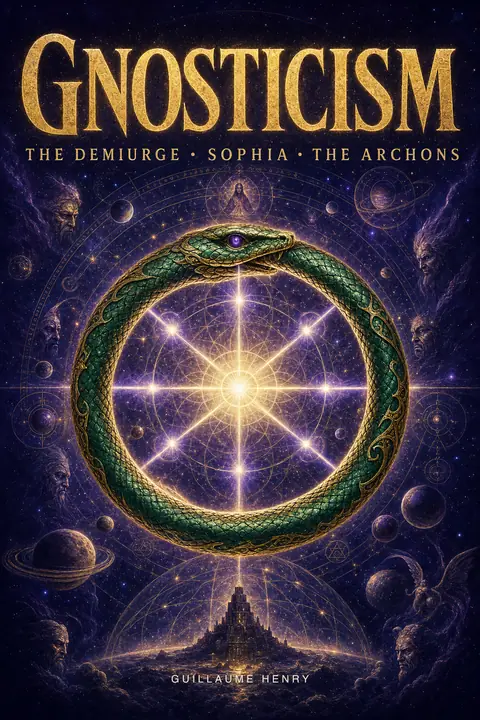
Gnosticism
The Gnosticism Book: The Demiurge, Sophia, the Archons, and the Secret Knowledge
The Demiurge, Sophia, and the Archons
The forbidden cosmology of the Gnostics: a false creator god, a fallen wisdom, prison-world rulers called archons, and the divine spark trapped inside you, waiting to wake. Recovered from the buried codices of Nag Hammadi.
More from Gnosticism
All articles
Gnosticism
Archons: Rulers of the Material Prison
In Gnosticism, the Archons are tyrannical beings who rule the material cosmos, trapping human souls in flesh and ignorance. Discover what ancient texts reveal about these cosmic jailers and their war against human consciousness.
Gnosticism
Simon Magus: The First Gnostic Heresiarch
Who was Simon Magus, and why did the early Church fear him so deeply? Discover the man at the center of the first major rift between orthodox Christianity and Gnosticism, and how one sorcerer became a legend that shaped centuries of theology.

Gnosticism
The Nag Hammadi Library: Discovery and Significance
In 1945, Egyptian farmers stumbled upon thirteen ancient papyrus codices hidden in a desert cave. The Nag Hammadi Library revealed a hidden world of early Christian and Gnostic thought, overturning centuries of assumptions about Christianity's first centuries.

Gnosticism
The Serpent in Eden: Gnostic Reinterpretation of Genesis
In Gnostic thought, the serpent who tempted Eve becomes a liberator, not a deceiver. Discover how early Christian heretics flipped Genesis on its head, casting the God of the Old Testament as a flawed demiurge and the serpent as an agent of divine knowledge.