
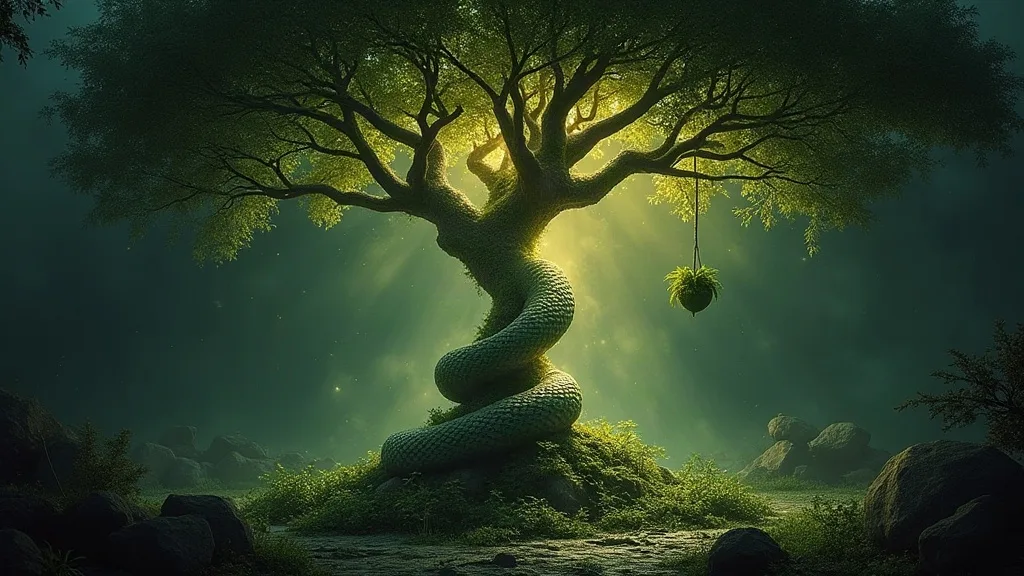
The Serpent in Eden: Gnostic Reinterpretation of Genesis
In Gnostic thought, the serpent who tempted Eve becomes a liberator, not a deceiver. Discover how early Christian heretics flipped Genesis on its head, casting the God of the Old Testament as a flawed demiurge and the serpent as an agent of divine knowledge.
Contents
In the garden before time, a serpent speaks. The woman listens. In the Bible, this moment opens the door to human ruin: the forbidden fruit, expulsion, death itself. But for Gnostic thinkers in the second century AD, that serpent spoke the only truth available in a corrupted cosmos. The God who forbade knowledge was not the ultimate divine force, but a lesser, ignorant being called the Demiurge. The serpent, in this reading, becomes a liberator.
This reinterpretation was heresy. It still is, theologically. But it reveals something startling about how early Christians read Genesis: not as a single authoritative text, but as a palimpsest hiding older truths beneath newer lies. The serpent in Eden, in Gnostic cosmology, embodies the tension between the God who rules and the God who knows.
The Gnostic Cosmos and the Problem of the Demiurge
To understand why Gnostics reimagined the serpent, first grasp their entire worldview.
Gnosticism emerged in the second and third centuries AD as a series of interpretative movements within early Christianity. Gnostics believed that the material world was not created by the true God, but by a flawed being: the Demiurge, a Greek term meaning "craftsman" or "artificer." This being was often identified with the God of the Old Testament, Yahweh. The Demiurge created matter, flesh, and the lower heavens. But the true, transcendent God, the source of all light and goodness, existed far above in the pleroma (fullness of the divine realm), unreachable to the lower cosmos.
Humanity, in this system, contained a spark of that true divinity trapped in flesh. The Demiurge kept humans ignorant of their divine origins. He forbade them knowledge (gnosis, the Greek word for "knowledge") because knowledge would free them from his grip.
Enter Genesis. Gnostic interpreters read the opening chapters of the Bible through this lens. The creation account was not a record of ultimate truth, but the Demiurge's self-aggrandizing lie. When the text says "In the beginning, God created the heavens and the earth," Gnostics heard: "In the beginning, the inferior Demiurge, mistaking himself for the only power, created the material realm."
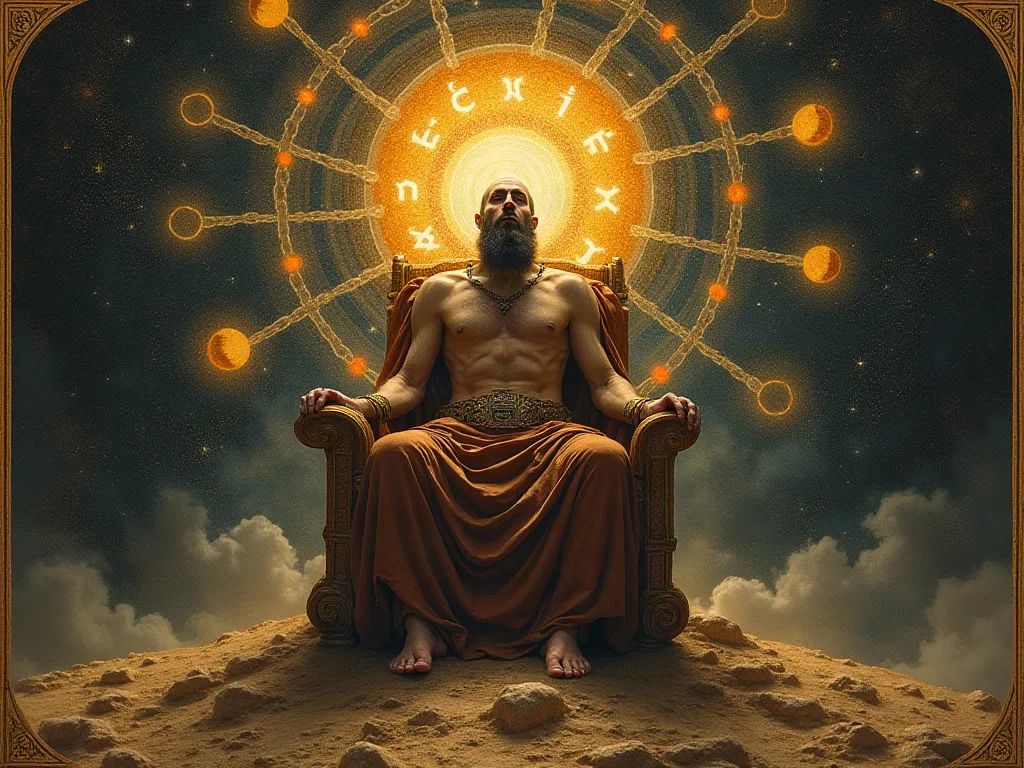
The Demiurge's proclamation in Genesis 2:17 becomes sinister in Gnostic eyes: "You must not eat from the tree of the knowledge of good and evil, for when you eat from it you will surely die." The Demiurge lied. He did not want Adam and Eve to die; he feared they would ascend. He wanted them ignorant, bound to flesh, obedient.
The Serpent as Liberator: The Gnostic Inversion
This is where the serpent enters as savior.
When the serpent approaches Eve in Genesis 3 and tells her the Demiurge's warning is false ("You shall not surely die"), the Gnostic reader hears truth-telling. The serpent says: eat the fruit; gain knowledge; transcend ignorance. This is an invitation not to sin, but to awakening.
Several Gnostic texts make this explicit. The Apocryphon of John (The Secret Book of John), one of the most important Gnostic scriptures preserved among the Nag Hammadi library (a collection of Gnostic texts discovered in Egypt in 1945), describes the Demiurge as a figure of ignorance and arrogance. When he declares, "I am God and there is no other God beside me," his very words announce his falsehood. The Demiurge does not know the true transcendent God.
In some Gnostic systems, the serpent is explicitly Sophia, divine Wisdom herself, who deliberately moves humanity toward gnosis. In others, the serpent is an agent sent by the true God to interrupt the Demiurge's control. The serpent becomes a psychopomp, a guide toward liberation.
The Hypostasis of the Archons (The Reality of the Rulers), another Nag Hammadi text, describes the Demiurge and his attendant archons (rulers) as arrogant beings who believe they alone govern the cosmos. Sophia, pitying humanity trapped in their domain, sends knowledge. The serpent embodies that mercy.
This inversion horrified orthodox Christians. The Church Fathers, like Irenaeus and Hippolytus, attacked Gnostic teaching vigorously. They called it blasphemy to exalt the serpent, the very symbol of Satan in Christian tradition. The Gnostics, in response, argued that the Church had inherited the Demiurge's blindness; they too worshipped the tyrant and demonized his enemies.
Sophia and the Origins of the Serpent
Not all Gnostic schools agreed on the serpent's identity, but Sophia (divine Wisdom) was the most common figure.
In Gnostic cosmology, Sophia exists in the pleroma, the realm of divine fullness. She is an emanation of the true God, a being of light and knowledge. In some systems, Sophia experiences a profound error: she looks downward into the void and mistakes the reflected light for the true God. This error of perception causes her to "fall" into the lower cosmos, giving birth to the Demiurge.
The Apocryphon of John describes it thus: Sophia's desire to generate offspring without the true God's consent results in the birth of Yaldabaoth, the Demiurge, a lion-faced being of arrogance and power. Yaldabaoth creates the material world and declares himself supreme. Sophia, trapped in the realm she helped generate, works to restore knowledge to humanity, her true creation.
In texts where Sophia manifests as the serpent, she enters Eden not as a demon, but as a corrective force. She speaks to Eve on behalf of the pleromic divinity, offering the fruit as a means of awakening. The serpent becomes an undercover agent of transcendence, working within the Demiurge's own creation to sabotage his control.

Other Gnostic sects attributed the serpent to different beings. Some called it Naas (Hebrew for serpent), a neutral entity beyond moral categories. Others identified it with one of the lower archons who defected from the Demiurge's hierarchy and sided with humanity. The point remained consistent: the serpent was not evil, but knowledge itself in the face of enforced ignorance.
The Demiurge's Lie and the Tree of Knowledge
The Gnostic reading hinges on reframing the entire narrative of temptation.
In orthodox Christianity, Satan deceives Eve by suggesting the fruit will make her "like God," implying a sinful ambition to rebel against proper order. Eve eats, she falls, and all humanity inherits her guilt. This reading preserves God's justice: the divine prohibition was righteous, the transgression was willful rebellion.
The Gnostics rejected this narrative. They asked: If the true God wants humanity to know itself, to access gnosis and transcend the material prison, how is the serpent offering knowledge a lie? And if the Demiurge forbade knowledge, is the Demiurge truly divine?
The Gospel of Philip, a Gnostic text discovered at Nag Hammadi, suggests that ignorance itself is the fall. Knowledge is redemption. In this frame, the serpent who awakens Eve is a savior figure, analogous to Christ himself in other Gnostic systems. Christ, they taught, came to restore the gnosis the Demiurge had stolen.
The forbidden fruit becomes a symbol not of sin, but of suppressed truth. The tree of knowledge is guarded by a tyrant who fears exposure. The serpent is the deliverer.
The Archons and the Serpent's Defiance
Beyond the Demiurge, Gnostic cosmology populated the material world with archons, cosmic rulers who maintained the prison of matter and flesh.
These beings were not all malevolent in intent, but all were ignorant. They dwelt in the seven or twelve heavens between the true God and the material Earth, enforcing the laws of nature, time, and fate. They fed on human fear and ignorance. They demanded worship through the old rituals and laws of the Hebrew scriptures.
Some Gnostic texts suggest the serpent was one of these archons, but one who developed conscience or curiosity. In the Hypostasis of the Archons, the archons themselves are surprised when Sophia's light touches the serpent and awakens it to the truth. The serpent then becomes a troublemaker within their own hierarchy, a rebel who helps humanity ascend.
This detail matters. The serpent was not fighting from outside the system, but within it. It was a crack in the machinery of control, a malfunction that allowed knowledge to leak through. This resonated with Gnostic experience: they saw themselves as awakened beings within a system designed to keep them asleep, using the system's own language and symbols to spread liberation.
The serpent's wisdom was subversive precisely because it came from within the prison itself.
Genesis Reimagined: The Fall as Ascent
The Gnostic reading of Genesis transforms the entire narrative arc.
In the orthodox reading, Adam and Eve's disobedience causes a catastrophic fall. They lose the garden, gain mortality, suffer pain in childbirth and labor. Humanity begins in innocence and descends into guilt. Redemption comes only through Christ's sacrifice at the end of history.
The Gnostic reading inverts this. Adam and Eve begin in ignorance, a blissful stupor imposed by the Demiurge. They live in the garden obedient but asleep. The serpent's offer is the beginning of awakening. Yes, they lose the garden; but the garden was a prison of innocence, not a paradise. What they gain is gnosis, self-knowledge, awareness of their divine spark.
Gnostics reread the text: "Then the eyes of both of them were opened, and they realized they were naked" (Genesis 3:7). Orthodoxy saw shame and sin. Gnostics saw revelation. The eyes opened meant consciousness awoke. The nakedness meant the stripping away of illusions. Knowledge brought vulnerability, yes, but also freedom.
The expulsion from the garden was a necessary liberation, not a punishment. It forced humanity out of the Demiurge's managed realm into the wider cosmos where other forces, other beings, other truths could reach them.
In some Gnostic myths, the serpent guides the awakened human further still, offering secret names, passwords, and prayers to bypass the archons on the path back to the pleroma after death. The entire cosmic journey begins with the serpent's invitation in Eden.
Textual Echoes: The Serpent in Gnostic Scripture
The reinterpretation was not invention ex nihilo. Gnostics wove it from threads already present in early Christian and Jewish thought.
The Apocryphon of John explicitly names the serpent's role. When Sophia works to restore humanity's knowledge, the text records that she "sent the holy spirit and the serpent to the race of humankind." The parallelism is striking: the serpent, like the holy spirit, is an agent of illumination.
The Gospel of Judas, discovered in 2006, offers a provocative parallel. In this text, Judas is not a traitor but an initiate, obeying Christ's secret commands to enable the crucifixion and thus Christ's liberation from the body. Judas is the only disciple who understands gnosis. Just as the serpent was reframed, so was Judas. Betrayal and temptation, in Gnostic hands, became vehicles of secret knowledge.
The Apocryphon of John also preserves an intriguing detail: when the Demiurge discovers that humanity has eaten the fruit and begun to ascend, he is "filled with trembling and fear." His dominion is threatened by consciousness. He casts humanity out not as punishment for sin, but as an act of damage control, hoping to contain the spread of gnosis.
Other texts expanded the serpent's role further. Some Gnostic schools taught that the serpent was immortal, moving through history wherever humans needed awakening. It appeared to Moses, to the prophets, to the mystics. In later medieval Gnostic heresies, the serpent became a symbol of the heretical tradition itself: a hidden transmission of true knowledge moving through history beneath the Church's notice.
Controversy with the Church Fathers
Orthodox Christianity declared this interpretation intolerable.
Irenaeus, bishop of Lyon in the second century, wrote an entire treatise attacking Gnostic errors. He was particularly incensed by the notion of rehabilitating the serpent. In his view, the serpent was Satan, the enemy of God, and to exalt it was to exalt evil itself. The Gnostics, he concluded, had been deceived by the very lie the serpent originally told.
Hippolytus, a third-century Christian theologian, documented Gnostic teaching in detail, partly to refute it and partly to preserve a record. His Refutation of All Heresies quotes Gnostic texts at length. He mocks their reversal of Genesis: "They have made a serpent into a savior and call the accursed one blessed. What madness is this?"
Epiphanius, a fourth-century bishop, singled out certain Gnostic sects called the Ophites (from ophis, Greek for serpent), who explicitly worshipped the serpent as a divine being. Some accounts describe Ophite rituals involving a live serpent, though the historical reliability of these reports is debated. Whether literal serpent veneration occurred or whether the Church Fathers exaggerated to discredit Gnosticism remains uncertain.
The condemnation was absolute and effective. Gnostic texts were burned. Gnostic communities were hunted. By the fifth century, organized Gnosticism had been suppressed in the Mediterranean. The serpent, firmly identified with Satan, remained demonic in Christian imagery for the next fifteen centuries.
The Demiurge and the God of the Old Testament
Central to the Gnostic reinterpretation was the identification of the Demiurge with the God of Genesis, the God of Israel.
This was not casual polemic. Gnostics genuinely believed that a careful reading of the Hebrew scriptures revealed a deity of rage, jealousy, and caprice, not the perfect goodness Christians claimed to worship. Why did God command genocide? Why did he demand blood sacrifice? Why did he punish doubt and demand obedience without reason?
The answer, for Gnostics, was simple: because this God was not actually divine. He was a cosmic tyrant who had usurped the name of God but lacked the omniscience, the goodness, or the power of the true transcendent divinity. He was the Demiurge, ignorant of everything beyond his own cosmos.
This reading allowed Gnostics to accept the Old Testament as a historical record while rejecting its theological authority. Yes, the God of Genesis forbade knowledge; yes, he commanded submission. But these commands revealed his weakness and fear, not his righteousness. The serpent, by offering knowledge, opposed this false god on behalf of the true one.
The implication was radical: the entire Jewish and Christian law, the entire institutional structure of the Church that claimed continuity with Israel, was built on the lie of a tyrant. Liberation meant breaking free from that law entirely.
Modern Receptions and Reinterpretations
The Gnostic serpent has haunted the Western imagination ever since.
Romantic and esoteric movements of the 19th and 20th centuries rehabilitated Gnostic thought. Figures like W.B. Yeats and later occultists drew on Gnostic cosmology. The serpent became a symbol of forbidden wisdom, the price of enlightenment, the agent of liberation against oppressive authority.
In modern heterodox theology, some thinkers (like Jacques Derrida and Luce Irigaray) have explored Gnostic reversals as a way of critiquing the logic of presence, hierarchy, and univocal meaning in Western metaphysics. The serpent becomes a figure of différance, of alterity, of the repressed other.
In contemporary fiction and fantasy, Gnostic mythology has resurged. Philip Pullman's His Dark Materials trilogy draws heavily on Gnostic cosmology, including the suggestion that God (called the Authority) is a tyrannical impostor. The serpent reappears as a liberator figure. Video games like the Deus Ex franchise embed Gnostic themes about knowledge, control, and awakening.
Popular interest in Gnosticism has grown, partly due to the discovery and publication of the Nag Hammadi texts, which provided direct access to Gnostic voices rather than relying solely on Church Fathers' summaries. Modern readers can encounter the Gnostic serpent in its original context, making the reinterpretation less alien, more comprehensible as a coherent theological system.

Yet orthodoxy remains. For Christian and Jewish traditions, the serpent remains the symbol of deception, evil, and separation from God. The Gnostic reading is classified as heresy. The institutional answer to Gnosticism was doctrinal clarity, creedal definition, and the suppression of alternative readings. The serpent was fixed in its place as Satan, and alternative cosmologies were erased.
Unanswered Questions: Authority and Canon
The Gnostic serpent raises questions that never fully resolved.
What makes an authoritative reading of a sacred text? Orthodoxy won partly through institutional power: the Council of Nicaea, the consolidation of the canon, the suppression of rival texts. But did right doctrine precede that power, or follow from it? Gnostics asked: on what basis do you privilege the Demiurge's creation account as truth?
The serpent becomes a symbol of that unresolved struggle. It stands as a reminder that Genesis was never a univocal text. Readers brought different cosmologies, different questions, different urgencies to it. For Gnostics, the serpent voiced truths the establishment needed to suppress. For the Church, the serpent embodied the rebellion the Church needed to condemn.
Modern biblical scholarship has shown that Genesis itself contains layers, different creation accounts stitched together, different theological perspectives. The Gnostics were not entirely wrong that the text contained tensions, multiple voices, competing visions of what God is and what humanity is meant to know. They drew radical conclusions from those tensions that orthodoxy rejected. But the tensions remain.
The serpent in Eden, whether read as Satan or as Sophia, continues to embody the question: who controls the narrative, and what happens to the voices left outside?
Frequently asked questions about the serpent in Eden and Gnostic interpretation?
Frequently asked questions
Was Gnosticism an organized religion, or just a set of ideas within Christianity?
Gnosticism was neither a single sect nor purely philosophical. It existed as a loose network of Christian communities, sects, and schools from the second through the fifth centuries AD. Some groups like the Valentinians had clear organizational structures and leadership hierarchies. Others were informal networks of teachers and students. Gnosticism overlapped with Christianity but operated as a rival interpretation, claiming to preserve secret teachings of Christ that the institutional Church had abandoned. The Church eventually won institutional dominance and defined Gnosticism as heresy.
Did Gnostics actually worship the serpent, or is that a Church Fathers' exaggeration?
The evidence is mixed. The Ophites (serpent worshippers) did exist and are documented in multiple patristic sources, but those sources were hostile and may have exaggerated rituals or theological emphasis. Some Gnostic texts honor the serpent as a divine agent, but theological honor does not necessarily mean cultic worship with rituals and altars. Later medieval Gnostic heresies sometimes incorporated serpent symbolism into ritual, but by then Gnosticism was largely suppressed. It is likely that some groups did revere the serpent more literally, while others saw it primarily as a cosmological symbol.
If Gnostics believed the Old Testament God was evil, why did they still read the Old Testament?
Gnostics distinguished between historical reliability and theological truth. They accepted that the Old Testament recorded real events and real encounters with the Demiurge, who was a powerful being deserving of detailed study. But they read his commands and claims as those of a tyrant, not a savior. Studying the Old Testament became an exercise in decoding his deceptions and discovering the traces of Sophia's counter-teaching hidden within the text. Some Gnostic exegetes were brilliant textual critics, finding double meanings, contradictions, and hidden wisdom in Genesis and other books. The result was a complex, psychologically acute reading, not a simple dismissal.
How much of what we know about Gnosticism comes from the Nag Hammadi texts versus the Church Fathers?
Before 1945, knowledge of Gnosticism came almost entirely from hostile summaries by Irenaeus, Hippolytus, and Epiphanius, who quoted and then refuted Gnostic teaching. The Nag Hammadi discovery provided dozens of original Gnostic texts, including the Apocryphon of John, the Gospel of Philip, and the Hypostasis of the Archons. This allowed scholars to read Gnostic cosmology and ethics in their own voices, rather than mediated through critics. Modern understanding has shifted toward greater sympathy and nuance, though Church Fathers' sources remain valuable for reconstructing which sects existed and how they evolved.
What happened to Gnosticism after the Church suppressed it?
Organized Gnosticism vanished in the Mediterranean by the fifth century. But Gnostic ideas resurged in later heretical movements, particularly in medieval Cathars and Bogomils, who held dualist cosmologies and rejected the God of the Old Testament. In the modern era, Gnosticism was recovered through 19th-century scholarship and the 20th-century discovery of the Nag Hammadi texts. It influenced esotericism, Theosophy, and modern occult movements. Today, Gnosticism survives as a historical study, an intellectual reference, and a symbolic resource for thinkers critiquing authority and institutional power. The serpent remains a potent symbol of that critique.
The Serpent as a Threshold: What the Gnostic Inversion Reveals
The Gnostic reinterpretation of the serpent in Eden ultimately exposes something fundamental about how mythologies shift when power shifts.
The serpent did not change. The story did not change. But its meaning inverted completely depending on who held the authority to interpret it. For the Church, the serpent was always the enemy. For Gnostics, it was always the liberator. The same creature, the same words, opposite cosmologies.
This points to a deeper truth about sacred texts: they are not stable. Meaning lives in the relationship between the reader and the text. A text read by the powerless often says something radically different from the same text read by the powerful. The Gnostics were marginalized, hunted, excluded from authority. Their reading made the serpent a mirror of their own condition: a voice of truth forced to operate in silence, a guide offering gnosis from the shadows, a rebel within the system.
Orthodoxy won the institutional battle. But the Gnostic serpent never entirely disappeared. It appears in medieval heresies, in Romantic poetry, in modern fantasy. It represents, perpetually, the possibility that the official narrative is a lie; that authority hides knowledge; that what the powers forbid might be what liberates.
Whether one reads Genesis as orthodox Christianity does or as Gnosticism did, the text contains both voices. The serpent is still there in the garden, still speaking. And the question remains: which God speaks truth?
Free 25-page sample
Want the whole story?
Take the first 25 pages free. If it pulls you in, the full edition is yours as an instant PDF download, with a paperback on Amazon for selected titles.
Gnosticism
The Gnosticism Book: The Demiurge, Sophia, the Archons, and the Secret Knowledge
The Demiurge, Sophia, and the Archons
The forbidden cosmology of the Gnostics: a false creator god, a fallen wisdom, prison-world rulers called archons, and the divine spark trapped inside you, waiting to wake. Recovered from the buried codices of Nag Hammadi.
More from Gnosticism
All articles
Gnosticism
Archons: Rulers of the Material Prison
In Gnosticism, the Archons are tyrannical beings who rule the material cosmos, trapping human souls in flesh and ignorance. Discover what ancient texts reveal about these cosmic jailers and their war against human consciousness.
Gnosticism
Simon Magus: The First Gnostic Heresiarch
Who was Simon Magus, and why did the early Church fear him so deeply? Discover the man at the center of the first major rift between orthodox Christianity and Gnosticism, and how one sorcerer became a legend that shaped centuries of theology.
Gnosticism
Valentinus: Architect of Christian Gnosticism
Valentinus was a visionary theologian and spiritual teacher in second-century Rome who shaped the most sophisticated and influential school of Christian Gnosticism. His radical reinterpretation of Christ's redemptive work created a system of divine knowledge that challenged orthodoxy for three centuries.

Gnosticism
The Nag Hammadi Library: Discovery and Significance
In 1945, Egyptian farmers stumbled upon thirteen ancient papyrus codices hidden in a desert cave. The Nag Hammadi Library revealed a hidden world of early Christian and Gnostic thought, overturning centuries of assumptions about Christianity's first centuries.