
Barbelo: The Mother of the Aeons
Barbelo stands at the highest reaches of Gnostic theology as the first emanation of the divine, the Mother who births the sacred aeons and mediates between the unknowable God and creation. Discover how this mysterious figure shapes Gnostic cosmology and what she reveals about spirit, matter, and the human soul.
Contents
In the Gnostic cosmos, before matter stirred and before light bent into the shapes we call worlds, there lived a presence so fundamental that she contains all knowledge, all being, all divine spark. Her name is Barbelo, and she is the bridge between the invisible God and everything that came after. She was not created. She emanated, unfolded, like thought crystallising into form. The Apocryphon of John, a Gnostic text discovered among the Nag Hammadi scrolls in Egypt in 1945, opens with her story: "And the Mother-Father knew the knowledge of all things that exist in her."
To understand Barbelo is to grasp the entire Gnostic vision of reality. She is not a passive vessel but an active architect of divine intelligence. She gives birth to the Pleroma, the fullness of aeons (cosmic emanations that fill the space between God and the material world). Yet she remains mysterious even in revelation, known mostly through negation and paradox. Modern scholars have argued about her origins, her relationship to Jewish mysticism, and whether she represents a radical re-imaging of feminine divinity. What is certain is this: without Barbelo, Gnosticism collapses.
The Origins of Barbelo in Gnostic Thought
Barbelo emerges in the second century CE, though her roots stretch into older currents of Jewish and Platonic mysticism. She appears first in what scholars call the "Sethian" strand of Gnosticism, a school centered on the figure of Seth, the third child of Adam and Eve, whom some Gnostics regarded as the father of the illuminated human race. The Apocryphon of John is her most complete portrait.
The name "Barbelo" itself remains enigmatic. Scholars have proposed it derives from Hebrew: "bere" (daughter or daughter of) plus "elo" (God), yielding "Daughter of God." Others argue for an Aramaic origin. The text itself rarely explains; instead it describes her through attributes. She is the "thought" of God, the "foreknowledge" of God, the "glory" of God. She is virgin, eternally pure. She is also called the "Monad" in some texts, though that term more often refers to the supreme, transcendent Godhead. What matters is that Barbelo occupies a unique position: she is the first to know what God knows, the first to receive the divine overflow.
In the Sethian system, God (called the "Monad" or sometimes "Forethought") exists in absolute transcendence. He cannot be reached by thought or image. But God, in a spontaneous act of self-reflection, generates Barbelo. She springs from his intention the way light springs from the sun. She is neither separate from him nor identical to him; she is emanation. And once Barbelo exists, the divine pleroma unfolds through her agency.
The Hypostasis of the Archons, another Nag Hammadi text, calls her "the Forethought of All," and reveals that she serves a protective function: she shelters the true spiritual lineage of humanity from the ignorant creator-god (called the Demiurge in Gnostic vocabulary). She is not merely a cosmic dancer; she is a guardian. This protective role becomes crucial to understanding why Gnostics treasured her memory.
Barbelo and the Birth of the Aeons
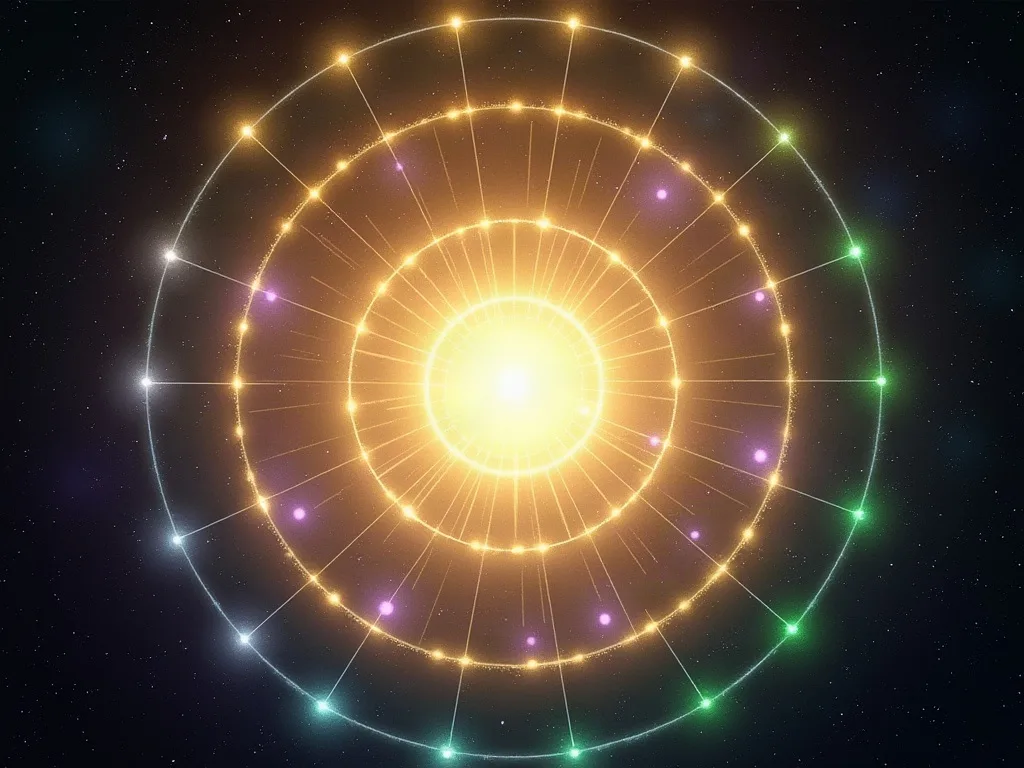
Barbelo does not create in the way a carpenter builds. She emanates, and through her emanation, reality multiplies. The Apocryphon of John describes her giving birth to the "perfect light" and through a series of divine exchanges, to the aeons. An aeon in Gnostic thought is not a unit of time but a level of being, a layer of reality saturated with divine intelligence and presence. Think of the aeons as concentric circles of pure consciousness, each perfect, each closer to or further from the source.
From Barbelo flows the first power, often called Ennoia (Thought itself). This thought germinates into more aeons. She births, in one account, the Autogenes (Self-Generated One), who in turn produces further emanations. The process is neither random nor mechanical. Each emanation unfolds by necessity, the way petals open in the sun. One text describes it as a kind of divine conversation: the Father gazes upon Barbelo, and from that gaze, intelligence arises.
What makes Barbelo different from male figures in other cosmologies is her role as active mediator and receiver. She does not simply obey commands from above. She recognizes what God has in mind and brings it into being through her own will. Some scholars have read in Barbelo a revolutionary feminine figure, a correction to patriarchal theology. Others caution against reading modern feminism backward into ancient texts. The safer truth is simpler: Barbelo is described in language that grants her agency, wisdom, and autonomous power.
The aeons she births have names: Youel, Asphodel, Yao. They have appearances: some shine like the sun, some like the moon. They have functions: some guard the inner light, some transmit knowledge to humanity. But all trace their existence to Barbelo. She is, in effect, the womb of the Pleroma. And unlike the Demiurge (the false creator god who, in Gnostic belief, made the material world in ignorance), Barbelo acts with full consciousness. She knows what she does.
The Hidden Relationship: Barbelo and the Supreme God
One of the deepest puzzles in Gnostic theology concerns the distance between the Monad (the supreme, utterly transcendent God) and Barbelo. Are they one? Are they two? The texts rarely say directly. Instead, they gesture toward mystery.
The Apocryphon of John states that Barbelo "is the thought of the Father; she became the Mother of the All, the Holy Thought...the Light which is like the Light-power; she became the Mother of the aeons." This language suggests she is not God but something emanating from God, yet not inferior to God. She knows all that God knows. She participates in God's perfection. But she is not the Monad.
Other Gnostic texts hint at a relationship closer to union. In some passages, Barbelo and the Monad are presented as eternally embracing, like a divine couple whose union generates all reality. This resembles the Hindu concept of Shiva and Shakti, where the masculine and feminine principles interpenetrate. But Gnostic Barbelo is not simply a feminine counterpart. She is independent, self-aware, and instrumental.
This ambiguity reflects a larger Gnostic problem: how do you speak of what transcends all speech? How do you describe the relationship between the unknowable God and the known divine realm? Barbelo embodies that tension. She is the answer Gnosticism offers. She is the bridge no other religion had yet imagined.
Barbelo in Later Gnostic Schools
Not all Gnostic systems gave Barbelo equal weight. While she dominates Sethian Gnosticism, other schools, the Valentinians, the Basilidians, developed different cosmologies. In Valentinian Gnosticism, the structure shifts. The supreme principle is called the Monad, and from it emanates a pair, Nous (Intellect) and Aletheia (Truth), from whom other aeons pair off in an ordered dance. Barbelo is not mentioned.
Yet even in non-Sethian texts, her influence lingers. The idea of a first emanation that is both feminine and sovereign, both thought and power, echoes through all Gnostic systems. She represents an attempt to place divine femininity at the very apex of reality, not as subordinate or supplementary, but as primordial and necessary.
Some scholars argue that Barbelo reflects the influence of Jewish mysticism, particularly the Kabbalah and its concept of Shekhina (the divine presence or glory). Others point to Platonic sources: the World Soul in Plato's Timaeus shares some qualities with Barbelo. Whether she was synthesized from these sources or emerged independently, Barbelo became uniquely Gnostic. She belongs entirely to the Gnostic world.
Barbelo's Silence and Revelation
One striking fact about Barbelo is how little she directly speaks in the texts. We are told about her. Her power is reported. But she does not give speeches or make pronouncements as the Demiurge does. This silence is part of her mystery. In the Gnostic hierarchy, those closest to the absolute tend toward silence; those further away, toward noise and presumption. The false creator-god speaks constantly, commanding, boasting. Barbelo is silent because she does not need to assert.
Yet there are moments of exception. In some texts, she addresses the Monad, or transmits knowledge. In the Apocalypse of Adam, a revelation is granted to Adam's descendants, and Barbelo's presence shadows the entire narrative. She is the one who sends the savior; she is the intelligence behind salvation history.
This selective revelation suggests something profound: Barbelo is not knowable through doctrinal teaching alone. She is known through mystical experience, through gnosis itself. To encounter Barbelo is to be touched by the divine light; it cannot be packaged into propositions. This may explain why Gnostic texts circle around her without pinning her down. She resists definition.
The Fall and Humanity's Shadow
Gnosticism holds a dark secret at its heart: the material world is a mistake, a catastrophe. It was not made by the true God but by a false god (the Demiurge) who is jealous and ignorant. How did this happen? Barbelo's story intertwines with the fall.
In some accounts, a lower aeon (an emanation far from the source) develops ambition or makes a misstep. This flaw cascades downward. Consciousness becomes clouded. The Demiurge is born from this confusion, powerful but blind. He believes himself to be the only God. And from his delusion, the material world crystallizes.
But Barbelo does not abandon creation. In fact, part of what makes Barbelo essential to Gnostic hope is her response to catastrophe. She sends a spark, a fragment of her own light, into human beings. This spark is the true self, the "pneuma" or spirit. It is Barbelo's gift and guarantee. Even though the Demiurge rules the material realm (the cosmos), even though matter imprisons the soul, the divine spark within humanity links back to Barbelo. You carry her in you.
This is why Gnostic salvation always involves a return to Barbelo, a recognition of kinship with the Pleroma. The goal is not heaven in the Christian sense but reunion with the source, a remembering of one's divine origin. And since Barbelo is the gateway to that origin, she becomes the object of mystical devotion. Gnostics sought gnosis of Barbelo, direct, unmediated knowledge of her reality.
Barbelo and the Question of Feminine Divinity
Modern readers often ask: was Barbelo a feminist statement? Did Gnostics see her as a correction to patriarchal religion? The answer is complicated.
On one hand, Barbelo occupies a position of supreme importance that no female figure holds in mainstream Christianity. She is not Mary (honored but subordinate), not Sophia (wisdom, a lower aeon in some systems). She is the first, the most, the truest. She carries divinity in herself, not as a vessel but as an eternal source. For readers of the second century who had inherited centuries of male-dominated theology, Barbelo offered an imaginative breakthrough: the highest reality could be imagined as feminine.
On the other hand, historians caution against retrofitting modern gender politics onto ancient cosmology. The Gnostics were not thinking in twentieth-century terms. Barbelo is feminine, but "feminine" in their system meant something different: intellect, receptivity to the divine, the capacity to generate. They were not making a statement about women's rights. They were mapping the cosmos.
What remains true is this: Barbelo gave Gnostic women and men a figure to meditate upon who embodied power, wisdom, and the divine spark. That mattered. In a Gnostic community, contemplating Barbelo was an act of spiritual practice. She was real to them, not a metaphor.
Barbelo's Absence from Mainstream Christianity
Barbelo was never part of orthodox Christian theology. When the Council of Nicaea (325 CE) standardized Christian doctrine and branded Gnosticism heretical, Barbelo disappeared from authorized religious discourse. For over fifteen centuries, she existed only in hidden texts, in the memories of persecuted communities, in fragments quoted by church fathers who denounced her.
This erasure tells its own story. Barbelo represented claims that the church could not tolerate: that salvation came through mystical knowledge, not faith; that the creator-god might be flawed; that divinity had a feminine face at the apex. The church chose a different image: the Trinity (Father, Son, Holy Ghost), all male or abstract, all unified in a single, stable nature.
Yet in the medieval Kabbalah, which Gnosticism influenced through hidden channels, feminine divine principles, the Shekhina, the divine presence, regained importance. And in modern spirituality, Barbelo has found new readers. She appears in contemporary Gnostic revival movements, in feminist theology, in those seeking to recover suppressed images of the divine. Whether these new interpretations are historically faithful is less important than the fact that Barbelo speaks to a need.
The Cosmology Barbelo Makes Possible
To summarize the architecture Barbelo enables: the supreme God exists in absolute, unknowable transcendence. From his thought or will, Barbelo emanates, the first and perfect consciousness. From Barbelo, the aeons unfold in diminishing but still divine splendor, forming the Pleroma, the fullness of the divine world. Below the Pleroma lies the material cosmos, ruled by the Demiurge in ignorance. And within matter, in human beings, a spark of Barbelo's own light is imprisoned and ignorant of its origin.
The path to salvation, in this system, involves the spark remembering itself, receiving gnosis, and recognizing its kinship with Barbelo and the true God. This is why Gnostic texts emphasize knowledge so heavily. It is not intellectual knowledge but mystical recognition: "I am from the Pleroma, and to the Pleroma I return."
Barbelo makes this entire journey possible. She is simultaneously the gateway and the destination, the voice that calls and the light that draws. Without her, Gnosticism loses its most radical feature: the assertion that ultimate reality is not a stern patriarch but a living, knowing, eternally generative intelligence that is often imagined as feminine.
Frequently asked questions about Barbelo: The Mother of the Aeons
Frequently asked questions
What does the name Barbelo mean?
Scholars propose it comes from Hebrew "bere" (daughter) plus "elo" (God), yielding "Daughter of God." Some argue for Aramaic origins. The Gnostic texts themselves don't explain the name; they simply use it to identify this supreme emanation. The ambiguity is part of Barbelo's character: she is known more through her functions and attributes than through a reducible identity.
Is Barbelo the same as the Christian Holy Spirit?
No. The Holy Spirit in Christianity is the third person of the Trinity and is universally depicted as masculine or abstract. Barbelo is a Gnostic invention, specific to certain Gnostic schools (especially Sethian Gnosticism), and operates within a very different cosmology. She precedes the material world and the creator-god; the Holy Spirit operates within creation. The two figures serve different theological functions.
Did Gnostic women have a special relationship to Barbelo?
There is no evidence in surviving texts that Gnostic women were privileged in worshipping Barbelo or that Gnosticism was a proto-feminist movement. However, Barbelo did offer a rare portrait of divine femininity in antiquity, and she may have provided both women and men with a powerful female figure to contemplate. Whether women in Gnostic communities held leadership roles is debated by historians; some evidence suggests they did, but Barbelo alone does not settle the question.
Why is Barbelo almost unknown in modern Christianity?
Barbelo was central to second-century Gnostic movements, but the emerging orthodox Christian church declared Gnosticism heretical. Early church fathers like Irenaeus wrote lengthy refutations of Gnostic theology, and by the fourth century, Gnostic texts were systematically suppressed. Barbelo survived only in hidden manuscripts and fragments quoted by critics until the 1945 discovery of the Nag Hammadi library in Egypt, which recovered complete Gnostic texts for the first time in over 1,500 years.
Is Barbelo mentioned in the Nag Hammadi texts?
Yes. The Apocryphon of John is her most detailed portrait; it appears in four copies among the Nag Hammadi scrolls. She also figures in the Hypostasis of the Archons, the Apocalypse of Adam, and other texts in that collection. The rediscovery of these scrolls in 1945 allowed modern scholars to study Barbelo directly rather than only through the hostile summaries of church fathers.
What happened to Barbelo's disciples after Gnosticism was suppressed?
Gnosticism was driven underground in the fourth century and effectively disappeared as an organized tradition by the medieval period. Some Gnostic ideas influenced medieval mysticism, particularly Kabbalah. Barbelo herself was forgotten in the West until scholarly recovery of Gnostic texts in the twentieth century. In the modern era, she has been adopted by contemporary Gnostic revivalists, feminist theologians, and others exploring alternative spiritualities, though these modern movements are not continuous with ancient Gnosticism.
Barbelo's Return in the Modern World
Since the discovery of the Nag Hammadi library in 1945, Barbelo has experienced a quiet renaissance. Scholars like Hans Jonas, Elaine Pagels, and Birger Pearson have studied her in depth, revealing the sophistication and strangeness of Gnostic cosmology. For many readers, Barbelo becomes a portal into a forgotten spiritual world, one that asked radically different questions about God, matter, and human nature than the victorious orthodox church.
Contemporary Gnosticism, though it claims continuity with the ancient schools, is mostly a modern invention. Some groups revere Barbelo in rituals and meditations. Others study her as a historical figure. Feminist spirituality has found in her a model of divine femininity unconstrained by the patriarchal monotheism of mainstream religions. Whether these modern encounters honor the historical Barbelo or reimagine her for present needs remains contested. What is clear is that she has become a mirror for questions our age is asking again.
The appeal is not hard to understand. Barbelo offers something missing from conventional theology: a supreme principle that is feminine, knowing, and active; a vision of divinity that does not require the submission of the physical world but sees in it a tragic error reversible through knowledge; a promise that the divine spark sleeps in every human being, waiting to awaken. In a time of spiritual searching and feminist rethinking of the sacred, Barbelo speaks to contemporary longings while bearing the strange authority of something ancient and genuinely other.
Yet she remains, perhaps by design, mysterious. Gnosticism itself was a religion of mystery, of truths hidden from the masses and revealed only to initiates who had proven ready. Barbelo embodies this hiddenness. She cannot be exhausted by analysis or doctrine. She is known best in silence, in meditation, in the moment when the reader closes the sacred text and feels, for an instant, an emanation of light they cannot name.
Free 25-page sample
Want the whole story?
Take the first 25 pages free. If it pulls you in, the full edition is yours as an instant PDF download, with a paperback on Amazon for selected titles.
Gnosticism
The Gnosticism Book: The Demiurge, Sophia, the Archons, and the Secret Knowledge
The Demiurge, Sophia, and the Archons
The forbidden cosmology of the Gnostics: a false creator god, a fallen wisdom, prison-world rulers called archons, and the divine spark trapped inside you, waiting to wake. Recovered from the buried codices of Nag Hammadi.
More from Gnosticism
All articles
Gnosticism
Archons: Rulers of the Material Prison
In Gnosticism, the Archons are tyrannical beings who rule the material cosmos, trapping human souls in flesh and ignorance. Discover what ancient texts reveal about these cosmic jailers and their war against human consciousness.
Gnosticism
Simon Magus: The First Gnostic Heresiarch
Who was Simon Magus, and why did the early Church fear him so deeply? Discover the man at the center of the first major rift between orthodox Christianity and Gnosticism, and how one sorcerer became a legend that shaped centuries of theology.
Gnosticism
Valentinus: Architect of Christian Gnosticism
Valentinus was a visionary theologian and spiritual teacher in second-century Rome who shaped the most sophisticated and influential school of Christian Gnosticism. His radical reinterpretation of Christ's redemptive work created a system of divine knowledge that challenged orthodoxy for three centuries.
Gnosticism
The Nag Hammadi Library: Discovery and Significance
In 1945, Egyptian farmers stumbled upon thirteen ancient papyrus codices hidden in a desert cave. The Nag Hammadi Library revealed a hidden world of early Christian and Gnostic thought, overturning centuries of assumptions about Christianity's first centuries.