
The Demiurge: Creator and Cosmic Antagonist in Gnostic Thought
The Demiurge built the physical world - and Gnostic texts say he did it wrong. Meet the blind god whose flawed creation trapped divine sparks in matter, and why ancient sects called him both maker and prison warden.
Contents
A god made the world. But the world is broken. That single observation sits at the heart of one of antiquity's most radical theological ideas, and it gave birth to a figure unlike anything in mainstream religion: a creator who is not the highest god, not a loving father, but a powerful and profoundly limited being who fashioned the cosmos in ignorance and called it good.
The Gnostic texts that circulated across the Roman Empire between the first and fourth centuries AD had a name for this figure. They called him the Demiurge - from the Greek demiurgos, meaning "craftsman" or "public worker." He shapes matter. He builds worlds. He just does not know what he is missing.
This is his story, and it is stranger than almost anything else antiquity produced.
Where the Idea Came From: Plato, Persia, and Jewish Scripture
The word demiurgos did not originate with the Gnostics. Plato used it first, in his dialogue the Timaeus (written around 360 BC), to describe a divine craftsman who organizes pre-existing matter according to eternal forms. Plato's Demiurge is benevolent. He looks at the Forms - perfect, unchanging templates for things like beauty and justice - and tries to replicate them in the material world. He is a positive figure, doing his best with stubborn raw material.
The Gnostics took Plato's craftsman and turned him inside out. They kept the basic architecture (a subordinate being shapes the visible cosmos) but stripped away the goodwill. Their Demiurge does not look upward to perfect models. He looks inward, sees his own reflection, and mistakes it for the whole of reality.
Two other streams fed into this. One was Persian dualism, particularly the tradition descending from Zoroastrianism, which drew a hard line between a supreme good principle and a lesser power responsible for material corruption. The other was a radical rereading of the Hebrew Bible. Several Gnostic schools identified the Demiurge directly with the God of Genesis, reading that text's creation narrative as the self-portrait of an arrogant lesser deity who declares "let there be light" without understanding where real light comes from.
That identification shocked Jewish and Christian contemporaries alike. It was meant to.
The Gnostic Cosmos: A Map of Spiritual Descent
To understand the Demiurge, you need to see the map he inhabits. Gnostic cosmology is structured like a series of nested shells, each one further from the source of true being.
At the top sits the Monad, also called the True God, the Invisible Spirit, or simply the One. This being is so far beyond description that the Gnostic texts resort to negatives: the Monad is not this, not that, not anything the human mind can name. The Sethian text known as the Apocryphon of John (preserved among the Nag Hammadi manuscripts discovered in Egypt in 1945) describes the Monad as "perfect in light" and "immeasurable," beyond any category of existence.
From the Monad emanate a series of divine beings called Aeons (from the Greek aion, meaning "age" or "eternity"). Each Aeon is a kind of thought or quality radiating outward from the One, forming the Pleroma, meaning "fullness" - the complete and luminous divine realm. Think of it as a celestial palace of pure spirit, populated by paired divine beings whose names read like a theology of ideals: Depth and Silence, Truth and Mind, Life and Humanity.
Then something goes wrong.
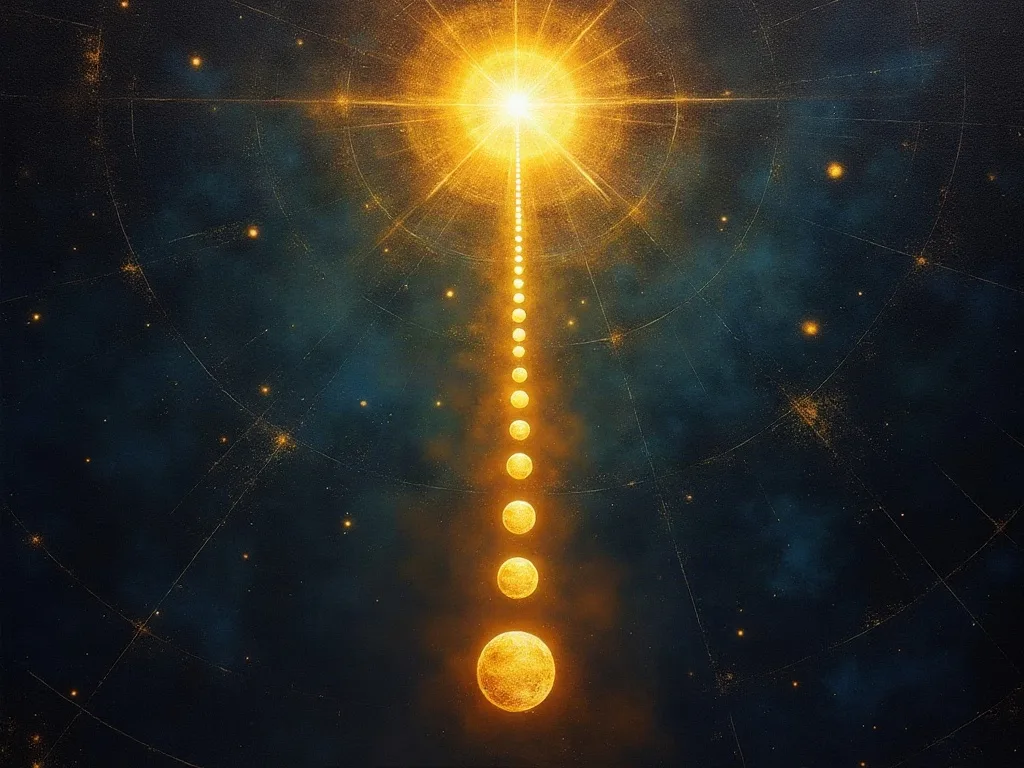
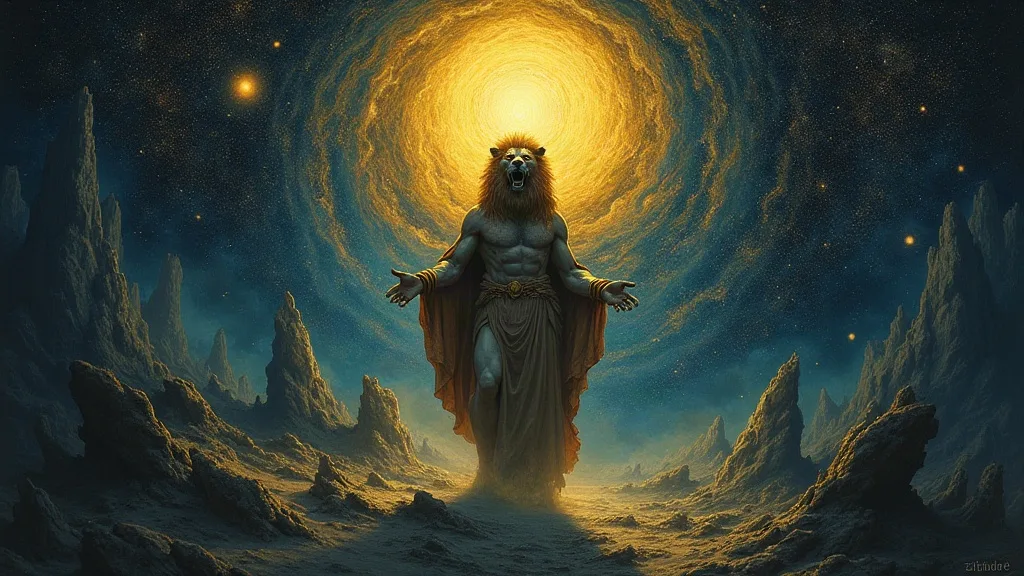
The lowest Aeon, Sophia (Greek for "wisdom"), acts impulsively. Different Gnostic schools tell slightly different versions of the disaster. In many accounts, Sophia attempts to generate a being on her own, without the consent or even the awareness of the Monad. The result is monstrous: a half-formed, aborted thing cast out of the Pleroma and into the void below. Some texts describe this creature as lion-headed and serpent-tailed. Others picture it as a misshapen child Sophia wraps in cloud and hides from the other Aeons in shame.
That creature is the Demiurge.
The Demiurge Himself: Names, Faces, and the Sin of Pride
The Gnostic texts give the Demiurge several names, each carrying its own charge. The most common is Yaldabaoth, a name whose etymology remains debated but which appears repeatedly in Sethian texts. Some scholars connect it to Aramaic roots meaning "child of chaos" or "begetter of Sabaoth." Others suggest a derivation from a garbled divine title. Whatever its origin, the name feels heavy and ancient on the tongue.
He also appears as Saklas ("fool" in Aramaic) and Samael ("blind god" in the same language). Those two epithets capture his defining quality: he cannot see the light above him. The Apocryphon of John records the moment Yaldabaoth opens his eyes in the dark void below the Pleroma, sees no other being around him, and pronounces: "I am a jealous God, and there is no other God beside me." The Gnostic reader recognizes that line. It comes from Exodus 20:5. The point is pointed: a god who says "there is no other" does so precisely because he does not know about the others.
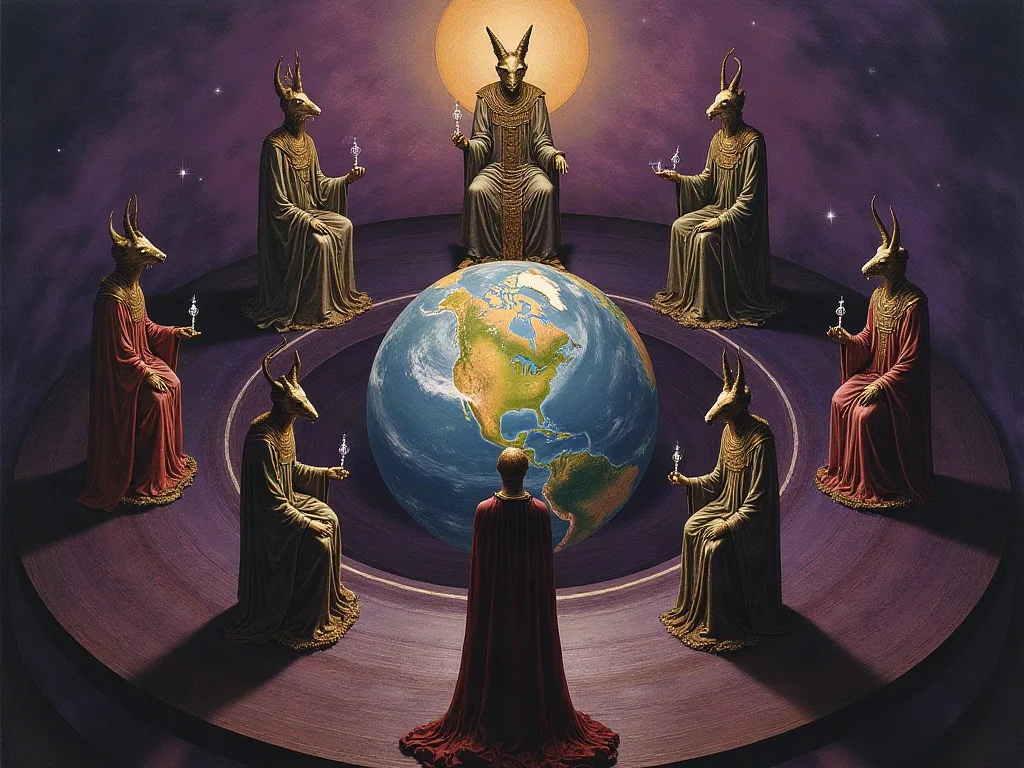
Having declared his sovereignty over an empty cosmos, Yaldabaoth gets to work. He generates a set of subordinate powers called the Archons (from the Greek archon, "ruler"). In most Sethian accounts there are seven of them, each governing one of the seven planetary spheres recognized in ancient astronomy: the Moon, Mercury, Venus, the Sun, Mars, Jupiter, Saturn. These spheres form the Heimarmene, the web of fate, which the Archons weave around material existence to trap souls inside the cycle of birth and death.
The Demiurge and his Archons are not evil in the way a mustache-twirling villain is evil. They are, in the Gnostic view, deeply confused. They build, they rule, they impose law. They just do so without any access to genuine spiritual reality, and their creation therefore replicates their blindness at every level.
Creating Humanity: The Spark Inside the Prison
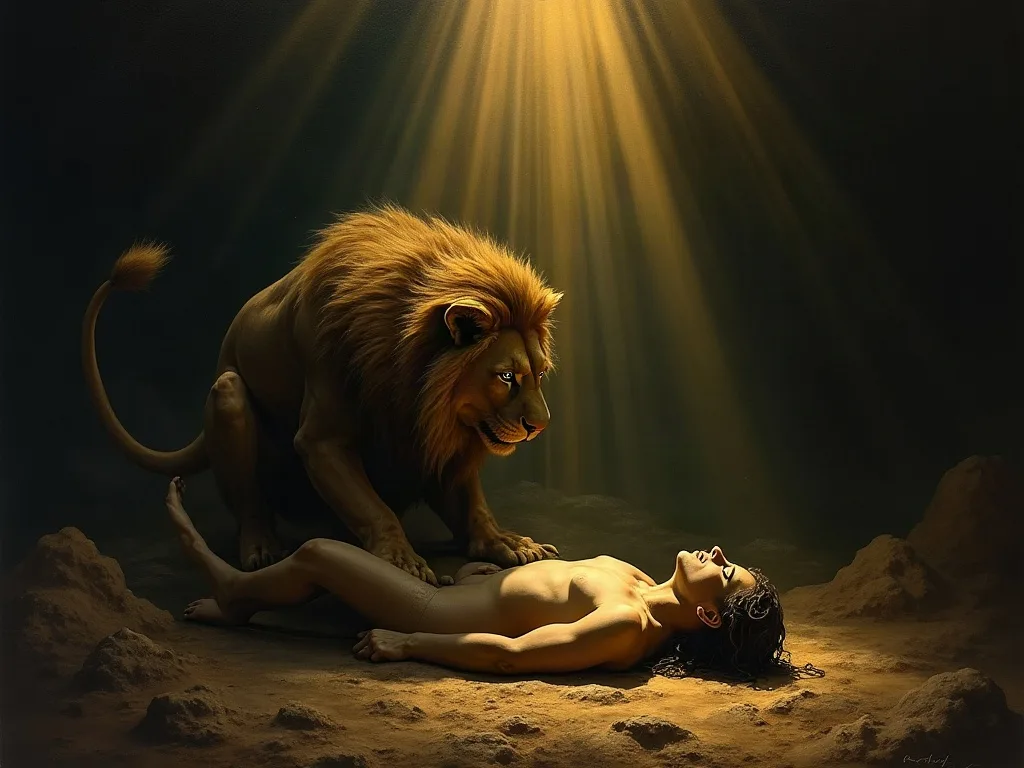
The creation of human beings is where the story gets its sharpest edge. According to the Apocryphon of John, Yaldabaoth and the Archons fashion a human body out of matter, modeled on a luminous image of the true divine human that somehow filtered down into their world. They build it joint by joint, organ by organ - the text lists hundreds of angelic craftsmen each responsible for a different part of the body, in a passage that reads like a grotesque parody of a creation hymn.
But the body they make cannot stand up. It lies on the ground, inert.
Here Sophia acts again, this time to correct what she broke. She tricks Yaldabaoth into breathing his own divine power into the human form. The Apocryphon of John describes Yaldabaoth bending down over the clay body and exhaling, not knowing that what passes through his lips is the pneuma - the divine breath, the spark of the Pleroma - that Sophia had caused him to carry without his knowledge. The body rises. The human being walks.
And the Demiurge realizes immediately that his creation now contains something he does not have. The Archons panic. They throw the human into matter, build the physical body around the spirit as a kind of cage, and set the Heimarmene spinning to keep the soul confused across lifetime after lifetime.
This is the Gnostic tragedy in miniature: human beings carry a fragment of genuine divinity, but it is buried inside a body built by a lesser god who did not want them to have it. The Gospel of Philip, another Nag Hammadi text, puts it with striking brevity: "The world came about through a mistake."
Valentinian Variations: A Kinder Demiurge
Not every Gnostic school painted the Demiurge in such dark colors. The Valentinian tradition, founded by the Alexandrian teacher Valentinus (active around 136-165 AD in Rome), developed a considerably more nuanced portrait.
For Valentinus and his followers, the Demiurge is ignorant but not malicious. He is, in fact, something closer to a middle administrator who does his best with incomplete information. The Valentinian Demiurge fashions the world sincerely, believing himself to be the highest god, but without any awareness of the Pleroma above him. His laws, his judgments, his scripture - all of this comes from genuine effort, not from spite.
Sethian Demiurge
Yaldabaoth is lion-headed, jealous, and actively hostile to the divine spark in humanity. He imprisons souls deliberately once he recognizes the pneuma inside them. His Archons are instruments of suppression, and his cosmos is a trap built with awareness of its function.
Valentinian Demiurge
The Valentinian Demiurge is sincere but uninformed. He issues laws and shapes matter in good faith, unaware of the Pleroma. His world is imperfect not from malice but from the limits of his knowledge. Salvation comes through gnosis, not escape from him but from the ignorance he represents.
Valentinus drew on Paul's letters more heavily than the Sethian texts did, and his school attracted educated Roman converts who found the harsher Sethian portrait too stark. Irenaeus of Lyon, writing his Against Heresies around 180 AD, spent enormous energy refuting Valentinian ideas, which tells us how widely they had spread.
The Archons as Cosmic Bureaucrats
The Demiurge rarely acts alone. His Archons deserve their own moment, because they illuminate how the Gnostic worldview functioned as social critique as much as theology.
The seven Archons governing the planetary spheres had names drawn partly from Jewish angelology, partly from Gnostic invention. In the Apocryphon of John, they include figures like Athoth (described as having a sheep's face), Harmas (with a fire-face), and Adonin (with the face of an ape). Each rules a sphere and extracts a toll from souls trying to ascend through the heavens after death. Souls that lack gnosis, the saving knowledge, are turned back and forced to reincarnate.
This cosmic toll system mapped onto something very real in the ancient world: bureaucratic authority. The Roman Empire ran on layers of officials, each demanding tribute and documentation. The Gnostic cosmos worked the same way, but the Gnostics promised that the truly knowledgeable soul could walk straight through, carrying passwords and formulas that the Archons could not refuse. Several Gnostic texts, including the Books of Jeu preserved in the Bruce Codex, provide these passwords in explicit detail.
It is worth pausing on that image. In a world where physical borders, tax collectors, and legal systems pressed down on ordinary people from every direction, the idea of a cosmic bureaucracy of ignorant powers - and the knowledge that could cut through it - carried unmistakable political weight.
The Demiurge in Rival Gnostic Texts: A Broader Picture
Beyond the Sethian and Valentinian schools, the figure of the Demiurge shows up across a wide range of ancient movements that modern scholars group loosely under the Gnostic umbrella.
The Marcionites, followers of Marcion of Sinope (active around 144 AD in Rome), took a particularly blunt approach. Marcion did not use the word Demiurge, but he argued that the God of the Hebrew Bible and the God revealed by Jesus Christ were simply two different beings. The Old Testament God was just, in a harsh sense - punishing, warlike, the maker of a flawed world. The New Testament God was entirely good and wholly alien to creation. Marcion's solution was to discard the Hebrew scriptures entirely and trim Paul's letters and Luke's Gospel down to what he considered the pure message. The Church declared him a heretic in 144 AD, but his communities survived for centuries.
The Mandaeans, a community whose roots extend into southern Mesopotamia and who still exist today in diaspora communities in Iraq, Iran, and the West, also preserve a figure called Ptahil who creates the material world under instruction from higher powers but makes a mess of it - a Demiurge-adjacent figure operating inside a different but overlapping cosmological framework. Mandaean religion represents one of the few living traditions that grew from the same ancient soil as Gnosticism.
The Cathars of medieval southern France, active primarily in the 12th and 13th centuries, revived something close to the Marcionite position a thousand years later: the material world was the creation of a lesser evil principle, and the task of the spiritual person was to escape it through asceticism and right knowledge. The Cathar movement was destroyed by the Albigensian Crusade (1209-1229 AD) and the subsequent Inquisition, but not before it had reshaped the religious landscape of Languedoc.
Gnosis as the Antidote: Knowing Your Way Out
If the Demiurge represents the problem, gnosis is the answer. The Greek word means simply "knowledge," but in the Gnostic context it refers to a very specific kind of inner recognition: knowing who you truly are, where your divine spark came from, and how to return to the Pleroma.
This is not knowledge you can get from a book (the irony of writing about it is not lost on anyone). It is experiential, revelatory, and personal. The Gnostic texts present it as something that arrives when the soul is awakened by a messenger from the Pleroma - in many Christian Gnostic texts, that messenger is Jesus, reconceived not as a sacrificial savior but as a revealer who comes to remind the pneumatics (those with the divine spark) of their true origin.
The Gospel of Thomas, found at Nag Hammadi and dated by many scholars to the first or second century AD, opens with a declaration that captures this perfectly: "Whoever finds the interpretation of these sayings will not taste death." Knowledge, not sacrifice; recognition, not faith - this is the Gnostic path past the Demiurge's web.
The Valentinians divided humanity into three types: hylics (those made purely of matter, who cannot be saved), psychics (those with soul but not pneuma, who might achieve a lesser salvation through faith and works), and pneumatics (those carrying the divine spark, for whom gnosis is the natural destination). The Demiurge himself was often classed as psychic - not beyond redemption in the Valentinian scheme, but not capable of entering the Pleroma either.
The Demiurge After Antiquity: From Heresy Hunters to Science Fiction
The Church Fathers spent considerable energy attacking the Demiurge concept. Irenaeus, Tertullian (active around 200 AD in Carthage), Hippolytus of Rome, and Origen all wrote against various Gnostic schools, and their refutations are in some cases our primary source for the ideas they were attacking, since many original Gnostic texts were lost until the Nag Hammadi discovery.
After the Nag Hammadi find in 1945, when a jar full of leather-bound papyrus codices turned up in an Egyptian cave near the town of Nag Hammadi, the study of Gnosticism transformed entirely. Scholars could finally read texts like the Apocryphon of John, the Gospel of Truth, and the Hypostasis of the Archons in their own words, not through the filter of hostile critics. The field has been in productive upheaval ever since.
The Demiurge concept found unlikely admirers outside academia. The poet William Blake (1757-1827) built an entire private mythology around a Demiurge-like figure he called Urizen - a cold, law-giving creator who mistakes his own limited perspective for the whole of existence. The philosopher Philip K. Dick, in his late journals collected as the Exegesis, described what he believed were personal encounters with a Gnostic-style cosmic system and wrote about the "Black Iron Prison" of false reality in terms that echo Yaldabaoth almost exactly. His novel VALIS (1981) turns Gnostic cosmology into science fiction.
Contemporary fantasy and horror borrow the Demiurge constantly, often without naming him: the false gods, the cosmic architects, the blind idiot gods of H.P. Lovecraft's Azathoth (who "rules" the universe but in a state of perpetual mindless chaos) all carry genetic material from the ancient Gnostic figure.
Frequently Asked Questions About the Demiurge in Gnostic Mythology
Frequently asked questions
Is the Demiurge the same as Satan or the devil?
No, and the distinction matters. The devil in mainstream Christian theology is a fallen angel who rebelled against a good God and chose evil. The Demiurge is a creator who genuinely believes he is the supreme being and does not know any higher reality exists. He is self-deceived, not self-destructive. Some Gnostic texts do give him demonic characteristics, but his defining quality is ignorance, not malice. The Sethian texts call him "Saklas," meaning fool, and "Samael," meaning blind god - both point to limitation rather than rebellion.
Where are the primary Gnostic texts about the Demiurge preserved today?
The most important source is the Nag Hammadi library, a collection of 13 papyrus codices discovered in Egypt in 1945 and now housed at the Coptic Museum in Cairo. Key texts include the Apocryphon of John, the Hypostasis of the Archons, and the Gospel of Philip. Additional material survives in the Berlin Gnostic Codex (Papyrus Berolinensis 8502) and the Bruce Codex held at the Bodleian Library in Oxford. The Pistis Sophia, a Coptic text in the British Library, extends the cosmology considerably.
Did any ancient Gnostic groups actually worship the Demiurge?
The vast majority of Gnostic groups saw the Demiurge as a figure to be understood and moved past, not venerated. However, some ancient heresiological sources describe groups called Cainites and Ophites who reportedly honored figures the mainstream tradition condemned, including the serpent of Genesis (reread as a liberator bringing gnosis to Adam and Eve against the Demiurge's wishes). How accurately these reports reflect what those groups actually believed is hard to verify, since we have almost no texts from them directly.
How did Valentinus differ from other Gnostic teachers in his treatment of the Demiurge?
Valentinus, active in Rome around 136-165 AD, presented the Demiurge as ignorant rather than hostile. In his system, the Demiurge fashions the world in sincere belief that he is the highest god, but without awareness of the Pleroma. This made the Valentinian tradition less hostile to Jewish scripture and more amenable to Christian institutions. Irenaeus of Lyon devoted much of his Against Heresies (around 180 AD) to refuting Valentinian ideas, which suggests how influential they had become among educated Roman Christians.
What is the connection between the Gnostic Demiurge and Plato's Timaeus?
Plato's Timaeus (around 360 BC) describes a divine craftsman, also called the Demiurge, who organizes pre-existing matter by looking toward eternal Forms or templates. Plato's version is benevolent and rational. Gnostic thinkers, many of them educated in Middle Platonist philosophy, borrowed the structural idea of a secondary creator working below a higher principle, then inverted Plato's optimism: their Demiurge does not look upward toward the Forms but inward toward his own limited nature, producing a flawed copy of a copy.
Are there living religious traditions today that include a Demiurge-like figure?
The Mandaeans, a community originating in southern Mesopotamia and still present today in diaspora communities across Iraq, Iran, Australia, and the United States, preserve a figure called Ptahil who creates the material world imperfectly under instruction from higher powers. Mandaeanism is one of the few genuinely ancient religious traditions rooted in the same world that produced classical Gnosticism. Some scholars also draw cautious parallels with certain strands of Ismaili Islamic thought, which developed hierarchical emanation cosmologies with a subordinate creative principle.
The Demiurge and the Question That Will Not Close
Scholars still argue about what Gnosticism actually was. Was it a coherent religious movement, a loose family of ideas, a parasite on early Christianity, or something that grew independently and intersected with Christianity by accident? The category itself is contested: the term "Gnosticism" was coined by 17th-century scholars and was not a self-description any ancient group used.
What is not contested is that the figure at the center of these traditions - the Demiurge, the craftsman who builds a broken world and calls it finished - touched something real in ancient experience. The Roman Empire pressed down on its subjects with overwhelming force. Taxes, wars, disease, and the rigid structure of social hierarchy left little room for the individual spark. The Gnostic answer was not political revolution but cosmic re-orientation: the world feels wrong because it is wrong, and the power that built it does not know any better. But you can.
That idea has never fully gone away. Every time a novelist, a filmmaker, or a philosopher reaches for the image of a false reality maintained by blind authority, they are pulling on a thread that runs back to Yaldabaoth crouching in the dark below the Pleroma, breathing out his power into a clay body and not understanding what he just lost.
The Gnostics called that loss the beginning of the human story. They also called it the beginning of the way home.
Free 25-page sample
Want the whole story?
Take the first 25 pages free. If it pulls you in, the full edition is yours as an instant PDF download, with a paperback on Amazon for selected titles.
Gnosticism
The Gnosticism Book: The Demiurge, Sophia, the Archons, and the Secret Knowledge
The Demiurge, Sophia, and the Archons
The forbidden cosmology of the Gnostics: a false creator god, a fallen wisdom, prison-world rulers called archons, and the divine spark trapped inside you, waiting to wake. Recovered from the buried codices of Nag Hammadi.
More from Gnosticism
All articles
Gnosticism
Archons: Rulers of the Material Prison
In Gnosticism, the Archons are tyrannical beings who rule the material cosmos, trapping human souls in flesh and ignorance. Discover what ancient texts reveal about these cosmic jailers and their war against human consciousness.
Gnosticism
Simon Magus: The First Gnostic Heresiarch
Who was Simon Magus, and why did the early Church fear him so deeply? Discover the man at the center of the first major rift between orthodox Christianity and Gnosticism, and how one sorcerer became a legend that shaped centuries of theology.
Gnosticism
Valentinus: Architect of Christian Gnosticism
Valentinus was a visionary theologian and spiritual teacher in second-century Rome who shaped the most sophisticated and influential school of Christian Gnosticism. His radical reinterpretation of Christ's redemptive work created a system of divine knowledge that challenged orthodoxy for three centuries.

Gnosticism
The Nag Hammadi Library: Discovery and Significance
In 1945, Egyptian farmers stumbled upon thirteen ancient papyrus codices hidden in a desert cave. The Nag Hammadi Library revealed a hidden world of early Christian and Gnostic thought, overturning centuries of assumptions about Christianity's first centuries.