
The Bridal Chamber: Gnostic Sacrament of Reunion
The Bridal Chamber stands at the heart of Gnostic spirituality as a sacred ritual of cosmic reunion. Learn how this sacrament transforms the soul's fragmented nature and reunites it with its divine source through mystical marriage and restoration.
Contents
In the hidden texts of early Christian Gnosticism, there exists a ritual so intimate and transformative that the movement kept it close, whispered only among initiates. The Bridal Chamber was not a wedding in the ordinary sense. It was the moment when a soul, fragmented and lost in matter, returned to wholeness by reuniting with its divine counterpart. In that sacred space, the split human essence becomes whole again. The separated male and female principles merge. The soul remembers its origin and its home.
This sacrament cuts to the heart of Gnostic theology. Where mainstream Christianity spoke of Christ's redemption through belief and faith, Gnostics taught that salvation came through knowledge (gnosis) and the restoration of the primordial unity that had been shattered at the moment of creation itself. The Bridal Chamber: Gnostic Sacrament of Reunion was the ritual enactment of that restoration. To understand it is to see how ancient Gnosticism reimagined the human body, gender, divinity, and the goal of spiritual practice itself.
The sources for this sacrament are scattered. The most direct testimony comes from the Gospel of Philip, a second-century text discovered among the Nag Hammadi library in Egypt in 1945. Philip does not lay out a manual; instead, he weaves theology and practice together in poetic, sometimes cryptic passages. He speaks of the Bridal Chamber as a mystery, a sacrament that rivals and surpasses baptism and anointing in power. Later Fathers of the Church, particularly Irenaeus and Epiphanius, condemned the practice from the outside, giving us glimpses of what they found so dangerous. From their hostile accounts and Philip's oblique teachings, a profound and complex ritual emerges.
The Fractured Soul and the Divine Couple
Gnostic cosmology begins with catastrophe. In the beginning, the Godhead existed in wholeness. This supreme source, often called the Monad or sometimes Sophia (divine wisdom), was complete and unified. But something went wrong. Through a cosmic accident or a deliberate act of rebellion, the lower material world came into being, created not by the true God but by an inferior demiurge, a false creator who mistook himself for the highest power.
In this fall, the divine principle fragmented. The Gnostic texts speak of Sophia splitting her essence. A portion of the divine spark became trapped in matter. Humans, especially those capable of gnosis, carry within them this trapped divine seed. But that spark is broken. It exists in a state of separation from its Source.
The Gospel of Philip repeatedly emphasizes this fragmentation. He writes that in the original state of creation, before the demiurge's disruption, each soul possessed both masculine and feminine aspects in perfect balance. Male and female were not opposites but complementary halves of a single reality. The text states: "When Christ came, he brought salt and fish. When he found a woman, he found them opposite. He made her correct. This is how the law of the image and the law of the likeness came about."
What does Philip mean? The image refers to the primordial androgynous wholeness. The likeness refers to its reflection in the fallen world. In the material realm, this unity split into two. Male and female became polarized. Desire, shame, and domination entered. The soul could no longer recognize itself in its other half. Each fragment wandered alone, seeking completion through worldly attachments, sexual acts, and the tyranny of the demiurge's laws.

The solution, in Gnostic thought, was not to flee sexuality or the body entirely. Rather, it was to transform the body and its drives from within. The Bridal Chamber was that transformation made sacred. It was a ritual space where two souls, or a soul and its heavenly counterpart, would reunite in a way that shattered the demiurge's dominion over the gendered, separated self.
The Sacrament Enacted: Ritual and Symbolism
The exact practice of the Bridal Chamber: Gnostic Sacrament of Reunion remains partially obscure, guarded by the fragmentary nature of our sources. But from the Gospel of Philip and the polemics of early Church opponents, a coherent ritual structure emerges.
The Bridal Chamber was typically performed in secret. Two initiates would enter a consecrated space, often prepared with oil, perfumes, and symbolic objects. Some sources suggest that the ritual could also take place between a living soul and an angelic or divine double, a heavenly twin that the Gnostic tradition held each initiate possessed. The goal was not physical union in the crude sense; it was spiritual reunion.
Philip describes the power of the sacrament using marriage imagery drawn from Jewish and Christian tradition. He writes of Christ as the "bridegroom" and the Church or the soul as the "bride." But he radically reframes this metaphor. The union is not metaphorical. In the Bridal Chamber, the division between self and divine other collapses. The soul encounters what it truly is: not a fragmentary, isolated consciousness trapped in flesh, but a complete being reunited with its heavenly image.
The ritual apparently involved anointing with oil, which in Gnostic practice carried tremendous weight. Oil was not merely symbolic. It was understood as a vehicle for divine power, a substance that could restore the light trapped in matter. The anointing would occur in specific places on the body. Some Gnostic texts suggest the genitals were anointed, not out of obscenity but because these organs, sites of worldly reproduction under the demiurge's law, became sites of spiritual regeneration. The genitals, through anointing, were sanctified and transformed from organs of enslaved desire into gateways to divine wholeness.
Words of power accompanied the ritual. Incantations, often employing the names of aeons (divine beings of the Gnostic hierarchy) or the true God, were spoken to invoke the presence of the heavenly counterpart and to dissolve the barriers between the material and the divine. The participant would be reminded of their true origin and their divine lineage, awakening to the knowledge that they had never truly been separate from the Source.
The culmination of the Bridal Chamber was a moment of absolute recognition. The initiate would experience, in his or her inmost being, the reunion with the divine other. Some accounts suggest this was accompanied by visions of light, of ascending through the heavenly realms, or of encountering the divine beloved face to face. Others describe it as a state of complete peace, the cessation of all longing, the end of exile.
Why the Church Condemned It
The Church Fathers' response to the Bridal Chamber was swift and ferocious. Epiphanius, a fourth-century heresy-hunter whose Panarion (Medicine Chest against Heresies) is our most detailed outside source, described the practice in terms of scandal and perversion. He accused the Gnostics of using the ritual as a cover for sexual licentiousness. He wrote that their initiates, male and female, would enter darkened chambers and emerge claiming spiritual union but engaged in carnal acts.
Was Epiphanius simply lying to discredit a rival tradition? Modern scholars debate this vigorously. Some argue that the Bridal Chamber was purely spiritual and that Epiphanius projected his moral horror onto a practice he didn't understand. Others suggest that Gnostic communities, like many religious groups, contained both sincere practitioners and charlatans who exploited the secrecy of the rituals for sexual purposes.
What is clear is that the Bridal Chamber represented everything the emerging orthodox Church feared about Gnosticism. First, it was secret, accessible only to the enlightened few. The Church insisted on public worship and transparent hierarchy. Second, it accorded spiritual authority to the individual's direct experience of the divine, bypassing priests and sacraments. An initiate who had experienced the Bridal Chamber claimed intimate knowledge of God that no bishop could deny. Third, it engaged with sexuality and gender in ways that orthodox Christianity found intolerable.
The orthodox Church had begun to develop a theology that increasingly associated matter and flesh with evil, and spirit with goodness. Women, linked to the body and flesh, were deemed spiritually weaker and more prone to temptation. The Bridal Chamber, by contrast, saw the body (when properly sanctified) as a legitimate vehicle for divine encounter. It also framed gender not as a hierarchy but as a division that could and should be healed. A woman in the Bridal Chamber was not subordinate to a man; she was his complement, his other half. Together, they accessed a wholeness that neither possessed alone.
The Church Fathers understood the threat. If the Bridal Chamber were real, if ordinary believers could access direct knowledge of the divine through such practice, the entire edifice of clerical authority would collapse. So the Fathers condemned it, excluded Gnostic texts from the canon, and erased the sacrament from Christian memory. For over fifteen centuries, the Bridal Chamber was almost entirely forgotten in the West.
Gender and the Divine in Gnostic Theology
To truly grasp the Bridal Chamber: Gnostic Sacrament of Reunion, one must understand how radically Gnosticism reimagined gender and the body. This is where the tradition becomes most provocative and, to modern ears, most liberatory.
In mainstream Christianity, sexuality and reproduction were tolerated as necessary evils for the continuation of the species. The ideal remained celibacy. Women bore the shame of Eve's transgression; their bodies were sites of temptation and sin. The orthodox hierarchy was unambiguously patriarchal.
Gnosticism offered a different vision. The Gospel of Philip speaks of the "kingdom of the woman." It teaches that in the true divine order, male and female are not opposed. They are aspects of a single being. The fall of humanity into the material world was simultaneously a fall into gender separation. We were split so that we could be controlled, dominated, and enslaved.
Several Gnostic texts describe the divine realm in explicitly feminine terms. Sophia, wisdom itself, was not merely an attribute of God but a divine being, the aeon through whom creation occurred. And there is Barbelo, the first emanation from the Monad, described in some texts as simultaneously mother, daughter, and virgin. These are not symbolic metaphors. They are theological claims: the divine principle is not exclusively masculine. Femininity is not derivative or inferior. It is foundational.
This theology had practical consequences. Women participated as teachers, prophets, and priestesses in Gnostic communities. Some Gnostic texts appear to have been written by women or attributed to female visionaries. The Apocalypse of Norea and the Hypostasis of the Archons feature powerful female figures who outwit the male demiurge and his forces. Women were not protected from dangerous gnosis; they were initiated into it.
The Bridal Chamber can only be understood against this backdrop. The ritual was not about subordinating one gender to another. It was about transcending gender altogether. The union of male and female in the Bridal Chamber symbolized and enacted the restoration of the primordial androgynous state. Once that state was recovered, gender ceased to be a source of division, shame, and domination. It became a path to knowledge and reunion.
The Bridal Chamber in Gnostic Practice and Transmission
The Gnostic movement was never monolithic. Different communities, from Egypt to Syria to the coasts of the Mediterranean, developed their own practices and theologies. The Bridal Chamber appears prominently in texts associated with Valentinian Gnosticism, the most influential and philosophically sophisticated branch of the movement. Valentinus himself, an Alexandrian teacher active in the second century, apparently taught about the Bridal Chamber, though our knowledge of his own views is mediated through later followers and critics.
The Gospel of Philip, the richest textual source, was likely composed in Syria in the late second century within a Valentinian community. It is not a narrative Gospel like Matthew or Mark. It is a collection of sayings, comparisons, and meditations arranged thematically. Many passages are enigmatic and require careful interpretation. This obscurity may have been intentional. Philip wrote for initiates who would understand the deeper meaning. The uninitiated would read the text and find only strange metaphors.
One passage in Philip exemplifies this double meaning. He writes: "Light and Darkness, life and death, right and left, are brothers of one another. They are inseparable. Because of this neither are the good good, nor evil evil, nor is life life, nor death death." To the uninitiated ear, this sounds like moral relativism or paradoxical nonsense. To the Gnostic, it conveys a profound truth: the material realm is a place of apparent opposites, but these opposites are ultimately illusory manifestations of a single divided reality. True knowledge sees through the division to the unity beneath.
The Bridal Chamber teachings of Philip must be read this way. When he says that in the Bridal Chamber the souls become "one flesh," he is not endorsing promiscuity. He is describing a mystical union so complete that the boundaries between self and other dissolve. When he speaks of "putting on" the divine, he means the acquisition of the true form, the celestial body that each soul possesses as its true identity.
Beyond the textual evidence, little is known about how Bridal Chamber practices evolved. The tradition seems to have persisted in some Gnostic communities into the third and fourth centuries, even as external pressure from the Church intensified and Gnosticism itself fragmented. Some scholars have speculated about continuities between Gnostic practices and later esoteric movements, particularly in medieval mysticism, alchemy, and certain strands of Kabbalah. But such connections remain conjectural. The Gnostic tradition itself was nearly obliterated.
The Rediscovery of the Bridal Chamber
The Bridal Chamber vanished from history as thoroughly as the Gnostic communities themselves. The Church's victory was decisive. By the end of the fourth century, Gnosticism had been driven underground or destroyed. The texts were burned. The teachers were executed or forced to flee. The practices were forbidden. For a thousand years, the Bridal Chamber existed only in the fragmentary polemics of its enemies, and those texts were themselves obscure, read only by monks and heresiologists.
The discovery of the Nag Hammadi library in 1945 changed everything. An Egyptian peasant discovered a sealed jar containing thirteen leather-bound codices filled with texts that had been buried for over fifteen centuries. Among them was the Gospel of Philip, along with dozens of other Gnostic documents. For the first time since antiquity, modern readers could encounter Gnosticism on its own terms, in the words of its own teachers.
Scholars immediately recognized the significance of Philip's teaching on the Bridal Chamber. Early interpreters, working in the 1950s and 1960s, sometimes read the text through the lens of Freudian psychology or second-wave feminism, both of which were ascendant at the time. Some scholars saw in the Bridal Chamber a proto-feminist vision. Others were skeptical, viewing it as mere mystification or secret eroticism.
Contemporary scholarship has become more nuanced. Scholars like Elaine Pagels, Karen King, and April DeConick have demonstrated that Gnostic cosmology, whatever its obscurities, genuinely offered women and marginalized people greater agency and spiritual authority than mainstream Christianity did. The Bridal Chamber was not a feminist text in the modern sense, but it was radical in its own time. It proposed that divine knowledge was not the exclusive domain of male priests. It suggested that the body, female and male, could be sanctified. It imagined a form of spiritual marriage based on equality and mutual recognition rather than dominion.
Orthodox Christianity
Salvation through faith in Christ's historical redemption; priesthood confined to celibate males; sexuality viewed as inherently sinful; body seen as prison of the soul; women subordinate in hierarchy and theology.
Gnostic Tradition
Salvation through gnosis, direct knowledge of divine origin; spiritual authority distributed among initiates; sexuality (when transformed) a path to divine knowledge; body capable of sanctification and transfiguration; gender as polarity to be transcended, not hierarchy to be maintained.
The Bridal Chamber and Mystical Union in Other Traditions
The Bridal Chamber: Gnostic Sacrament of Reunion does not exist in isolation in the history of religions. The imagery of mystical marriage, the union of the human soul with the divine, appears in many traditions. Understanding these parallels illuminates both the uniqueness of Gnostic practice and the universality of the human longing for divine reunion.
In Christian mysticism, particularly in the works of medieval women visionaries like Hildegard of Bingen and Julian of Norwich, the language of bridal union with Christ reappears. These Christian mystics were not Gnostics; the Church had destroyed Gnosticism centuries before their time. Yet they used remarkably similar imagery. They spoke of the soul as the bride of Christ, of union so intimate that the self and the divine become one. Their experiences were understood through the lens of orthodox theology, yet the phenomenology bears striking resemblance to what the Gnostics described.
In Islamic Sufism, the concept of fana (annihilation of the self in God) involves a dissolution of the boundary between lover and beloved. The Sufi poet Rumi described the divine love in erotic, ecstatic terms. The ecstasy of mystical union is inseparable from the ecstasy of sexual love. Again, the imagery is distinct from Gnosticism, the theological framework different, yet the experience described parallels the Bridal Chamber.
Hindu Tantra, particularly in its emphasis on the union of Shiva and Shakti (the masculine and feminine principles of the divine), offers perhaps the closest structural analogy. In Tantric practice, the human body becomes a microcosm of the cosmos. The male and female principles, understood as fundamental cosmic forces, unite within the practitioner. This union generates enlightenment. Like Gnosticism, Tantra insists that the body and sexuality, when properly understood and transformed, are not obstacles to liberation but vehicles for it. The Tantric maithuna (ritual sexual practice) is sometimes compared to the Bridal Chamber by scholars seeking to understand Gnostic sexuality.
Yet Gnosticism remains distinct. Its particular genius lay in fusing the language of cosmic redemption with the language of intimate reunion. The Bridal Chamber: Gnostic Sacrament of Reunion was not merely personal mysticism. It was a sacrament embedded in a comprehensive cosmological narrative. The individual soul's reunion with its divine counterpart was simultaneously the cosmos healing its own primordial split. The Bridal Chamber was microcosm and macrocosm collapsing into one.
Scholarly Debates and Interpretive Questions
The Bridal Chamber: Gnostic Sacrament of Reunion continues to provoke scholarly controversy. Several central questions remain unresolved, and scholars continue to develop new interpretations as our understanding of Gnosticism deepens.
First: Was the Bridal Chamber a literal sexual practice or a purely symbolic one? Some scholars, following a more conservative interpretation of the texts, argue that it was entirely spiritual and metaphorical. The union occurred in the realm of the imagination, in visionary experience, in the subtle bodies. Physical intercourse was irrelevant. Other scholars, pointing to Epiphanius' accounts and to the Gnostic celebration of the body as a potential site of the sacred, suggest that the Bridal Chamber involved physical union, though not in the vulgar sense Epiphanius implied. Rather, physical union was understood as a sacramental act, analogous to the Christian Eucharist but enacted through the body and sexuality.
Second: Who participated in the Bridal Chamber? Some sources suggest it was reserved for fully initiated elites. Other passages in Philip suggest a more universal availability. Did women participate equally with men, or did they occupy a subordinate role despite the radical theology? The texts are ambiguous. Some communities may have been more egalitarian than others.
Third: What was the phenomenology of the Bridal Chamber? Did initiates experience it as a private, psychological event, or as an encounter with an objectively present divine being? Did the "heavenly counterpart" or "divine double" exist as an autonomous entity, or was it a projection of the initiate's own deepest self? The answer to this question determines whether we classify the Bridal Chamber as visionary mysticism or as an encounter with an objective reality. Gnostic texts themselves are unclear on this point, and the question may be unanswerable from our current historical vantage.
Fourth: How did the Bridal Chamber relate to the other Gnostic sacraments, particularly baptism and the anointing? The Gospel of Philip suggests a hierarchy in which the Bridal Chamber surpasses the other rites in power. But did this mean it replaced them, or did it crown and fulfill them? Different Gnostic communities may have understood the relationship differently.
These debates matter not merely for historical accuracy but for how we interpret the entire Gnostic project. If the Bridal Chamber was primarily a psychological technique, then Gnosticism becomes a form of applied mysticism, a technology of consciousness. If it involved literal sacred sexual practice, then Gnosticism becomes a form of embodied spirituality that the Church violently suppressed. If it involved encounter with an objective divine being, then Gnosticism must be taken seriously as a metaphysical claim about the structure of reality, not reduced to individual experience.
The Bridal Chamber's Absence and Presence in Later Western Spirituality
The conquest of Gnosticism was so complete that the Bridal Chamber vanished almost entirely from Western consciousness. Yet it is worth asking whether the suppressed tradition left traces in the spiritual movements that followed.
Some scholars have speculated about connections between Gnostic ideas and later esoteric movements. Certain medieval alchemical texts, with their androgynous imagery and emphasis on the sacred marriage of opposites, might preserve echoes of Gnostic cosmology. Some Kabbalistic texts, particularly those dealing with the divine feminine (Shekhinah), contain ideas structurally similar to Gnostic theology, though developed independently from Jewish mystical sources. In the Renaissance, figures like Giordano Bruno and other Neoplatonists drew on Platonic and Neoplatonic sources that shared philosophical assumptions with Gnosticism, even if they did not explicitly reference it.
But direct transmission is difficult to prove. For over a thousand years, the Bridal Chamber was erased. The texts that preserved its memory were lost. Only with the Nag Hammadi discovery did the tradition become visible again.
That rediscovery has had surprising effects on contemporary spirituality. New Age and neo-Pagan movements have sometimes appropriated Gnostic imagery, including the Bridal Chamber, to legitimize their own practices of sacred sexuality and gender transformation. Academic Gnosticism has become a touchstone for contemporary Witchcraft and Goddess spirituality. Scholars have noted how figures like Elaine Pagels have presented Gnosticism to modern audiences in ways that highlight its proto-feminist elements, effectively reclaiming the tradition for contemporary gender liberation movements. Whether this represents a faithful interpretation or a distortion depends on one's scholarly and spiritual commitments.
What is clear is that the Bridal Chamber has reentered the consciousness of the West. The ritual itself is not practiced in any mainstream tradition. The Gnostic communities that performed it are gone. But the idea persists: that the human being is fundamentally divided, that reunion with the divine and with our deepest selves requires transformation of the body and transcendence of artificial gender hierarchies, and that this transformation can occur through ritual, through knowledge, through love.
Frequently asked questions about the Bridal Chamber and Gnostic Sacraments
Frequently asked questions
What exactly was the Bridal Chamber, and why did the Church suppress it?
The Bridal Chamber was a Gnostic sacrament of mystical reunion in which initiates participated in a ritual that symbolized and enacted the healing of cosmic division. Two souls, or a soul and its divine counterpart, would reunite in wholeness. The Church suppressed it because it was secret, exclusive to initiates, and claimed direct access to divine knowledge that bypassed clerical authority. The Church also found the Gnostic engagement with sexuality and gender threatening to its developing theology.
Did the Bridal Chamber involve actual sexual intercourse?
The sources are ambiguous. The Gospel of Philip suggests spiritual rather than physical union, using metaphorical language. But Epiphanius' hostile account hints at physical practice. Modern scholars debate this. Some argue it was purely visionary; others suggest it involved sacred sexuality understood as a sacramental act. The truth may have varied between different Gnostic communities.
How did Gnosticism view the body and gender differently from mainstream Christianity?
Mainstream Christianity increasingly associated the body with sin and viewed gender as a hierarchy in which women were subordinate. Gnosticism taught that the body could be sanctified and transformed, and that gender division was a cosmic tragedy to be healed rather than a divinely ordained order. In Gnostic theology, the divine itself was not exclusively masculine; feminine divinity was foundational to creation.
What is the primary source for understanding the Bridal Chamber?
The Gospel of Philip, discovered at Nag Hammadi in 1945, is the richest primary source. It was written in the second century by a Gnostic teacher (probably Syrian) and contains teachings on the Bridal Chamber alongside other sacramental and cosmological reflections. Hostile accounts from Church Fathers like Epiphanius and Irenaeus provide additional, though biased, information.
Does the Bridal Chamber practice exist in any living religious tradition today?
No. The Gnostic communities that performed the Bridal Chamber were destroyed or assimilated by the fourth century. No continuous tradition preserves the practice. However, some contemporary practitioners of Gnostic revivalism or esoteric spirituality have attempted to reconstruct or reimagine the ritual based on historical sources.
How does the Bridal Chamber compare to mystical union in other religions like Sufism or Christian mysticism?
All share the imagery of the soul as bride uniting with the divine. But the Bridal Chamber is unique in its fusion of cosmic redemption with personal transformation, and in its insistence that gender polarity, when properly understood, becomes a path to wholeness rather than a source of shame.
The Unfinished Dialogue: Gnosticism and the Contemporary Soul
The rediscovery of Gnostic texts in 1945 raised a question that continues to echo: Why were these ideas so dangerous that an entire tradition had to be erased? The Bridal Chamber offers one answer. It claimed that ordinary people, through knowledge and ritual, could experience direct union with the divine. It suggested that the body and sexuality could be paths to enlightenment, not obstacles. It imagined a spirituality in which gender was not destiny but a cosmic accident to be healed. It affirmed that women could be teachers, visionaries, and full participants in the sacred.
These claims threatened the foundation of institutional Christianity. They continue to trouble conservative religion today. Yet they resonate deeply with contemporary spiritual seekers who feel alienated from traditional religion and who hunger for direct experience, for embodied spirituality, for gender liberation.
The Bridal Chamber cannot be recovered in its ancient form. The communities that performed it are gone. The symbolic universe in which it made sense has dissolved. But the questions it raises remain vital. How do we reunite with ourselves in a fragmented world? How do we heal the split between body and spirit, desire and devotion, masculine and feminine? How do we access knowledge that transforms us at the deepest level? These are not antiquarian questions. They are the questions of every soul seeking wholeness.
Modern scholarship has shown that early Christianity was far more diverse than later tradition acknowledged. Gnosticism was not a unified heresy but a constellation of movements, some crude, some profound. The Bridal Chamber represents Gnosticism at its most philosophically sophisticated and spiritually serious. It was an attempt to address, through ritual and knowledge, the fundamental human experience of incompleteness and alienation. Whether one accepts Gnostic cosmology or not, the Bridal Chamber testifies to a persistent human conviction: that we are not what we seem, that we are fragmented, and that there exists within us a memory of wholeness that can be awakened.
Free 25-page sample
Want the whole story?
Take the first 25 pages free. If it pulls you in, the full edition is yours as an instant PDF download, with a paperback on Amazon for selected titles.
Gnosticism
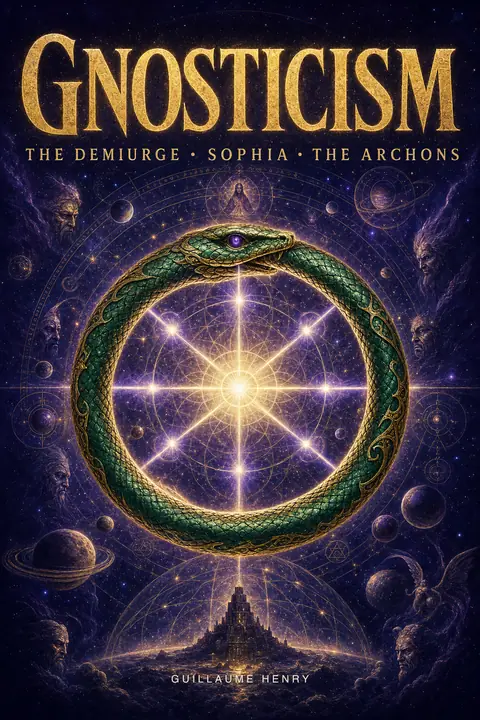
The Gnosticism Book: The Demiurge, Sophia, the Archons, and the Secret Knowledge
The Demiurge, Sophia, and the Archons
The forbidden cosmology of the Gnostics: a false creator god, a fallen wisdom, prison-world rulers called archons, and the divine spark trapped inside you, waiting to wake. Recovered from the buried codices of Nag Hammadi.
More from Gnosticism
All articles
Gnosticism
Archons: Rulers of the Material Prison
In Gnosticism, the Archons are tyrannical beings who rule the material cosmos, trapping human souls in flesh and ignorance. Discover what ancient texts reveal about these cosmic jailers and their war against human consciousness.
Gnosticism
Simon Magus: The First Gnostic Heresiarch
Who was Simon Magus, and why did the early Church fear him so deeply? Discover the man at the center of the first major rift between orthodox Christianity and Gnosticism, and how one sorcerer became a legend that shaped centuries of theology.
Gnosticism
Valentinus: Architect of Christian Gnosticism
Valentinus was a visionary theologian and spiritual teacher in second-century Rome who shaped the most sophisticated and influential school of Christian Gnosticism. His radical reinterpretation of Christ's redemptive work created a system of divine knowledge that challenged orthodoxy for three centuries.
Gnosticism
The Nag Hammadi Library: Discovery and Significance
In 1945, Egyptian farmers stumbled upon thirteen ancient papyrus codices hidden in a desert cave. The Nag Hammadi Library revealed a hidden world of early Christian and Gnostic thought, overturning centuries of assumptions about Christianity's first centuries.