
The Apocryphon of John: Secret Revelation of Gnostic Origins
The Apocryphon of John is the closest thing Gnosticism has to a creation myth: a vision of a fallen cosmos, a hidden God, and the divine spark trapped inside every human being.
Contents
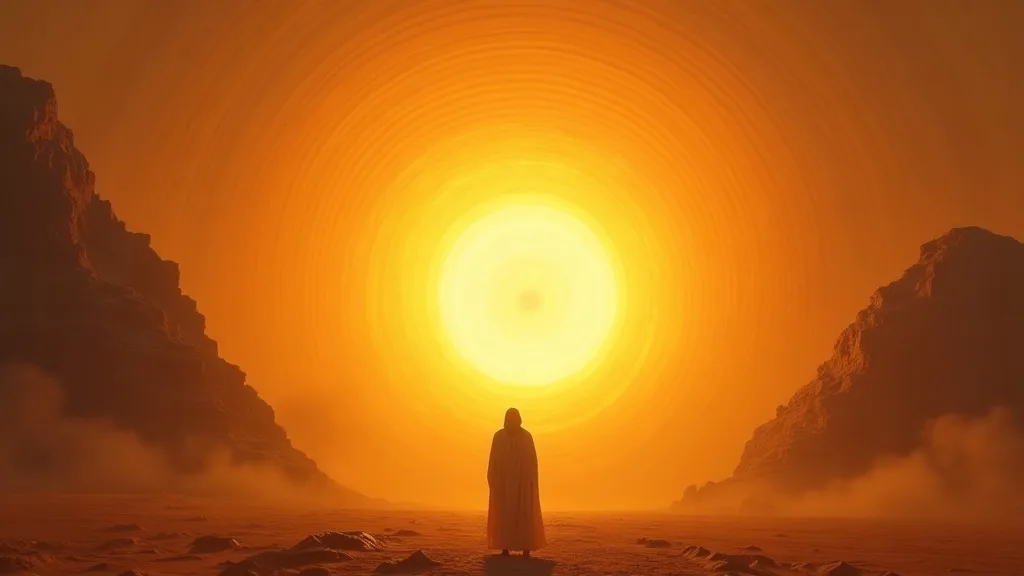
A Pharisee named Arimanios stops John in the street. He is taunting him. Jesus is gone, he says, and this "deceiver" has led John astray. John turns away in grief and walks into the desert alone. There, a blinding light breaks over the rocks. A figure appears, shifting from child to old man and back again, speaking in three voices at once. Then the vision begins.
That is the opening scene of The Apocryphon of John: Secret Revelation of Gnostic Origins, one of the strangest and most important religious documents to survive from the ancient world. It is not a gospel in any familiar sense. It is a cosmic drama: a map of realities above reality, a story of how the universe was ruined before it even started, and a case for why the human soul is worth saving despite everything. When the Nag Hammadi library was unearthed in the Egyptian desert in 1945, the Apocryphon of John (Greek for "Secret Book of John") appeared in four separate copies, more than any other text in the collection. That repetition alone signals how central this text was to Gnostic communities across the Mediterranean world.
The World Before the World: The Invisible Spirit and the Pleroma
The vision opens not with earth, not with darkness, but with silence. Above everything that exists, the text places a being it calls the Monad, the One, or the Invisible Spirit. This is not the God of the Hebrew Bible who speaks and commands and occasionally loses his temper. The Invisible Spirit of the Apocryphon is beyond description almost by definition. Every time the text names a quality, it immediately takes it back. The Spirit is "immeasurable light," but also "not light." It is "inestimable," "perfect," "blessed," "unknowable." The point is not contradiction for its own sake. The Gnostic writers were making a philosophical move: the true source of all reality is so far beyond human categories that language itself breaks against it.
From this infinite, nameless source, divine beings unfold in a process called emanation, a kind of overflow of perfection rather than a deliberate act of manufacture. The first to emerge is Barbelo, a feminine figure of staggering importance. She is the first thought of the Invisible Spirit, sometimes called the "Mother-Father" because she contains both principles. Barbelo asks the Invisible Spirit for a series of gifts, and each request produces another divine being: Foreknowledge, Indestructibility, Eternal Life, Truth. Together with Barbelo and the Invisible Spirit, these form the Pleroma (a Greek word meaning "fullness"), the heavenly realm where everything is whole.
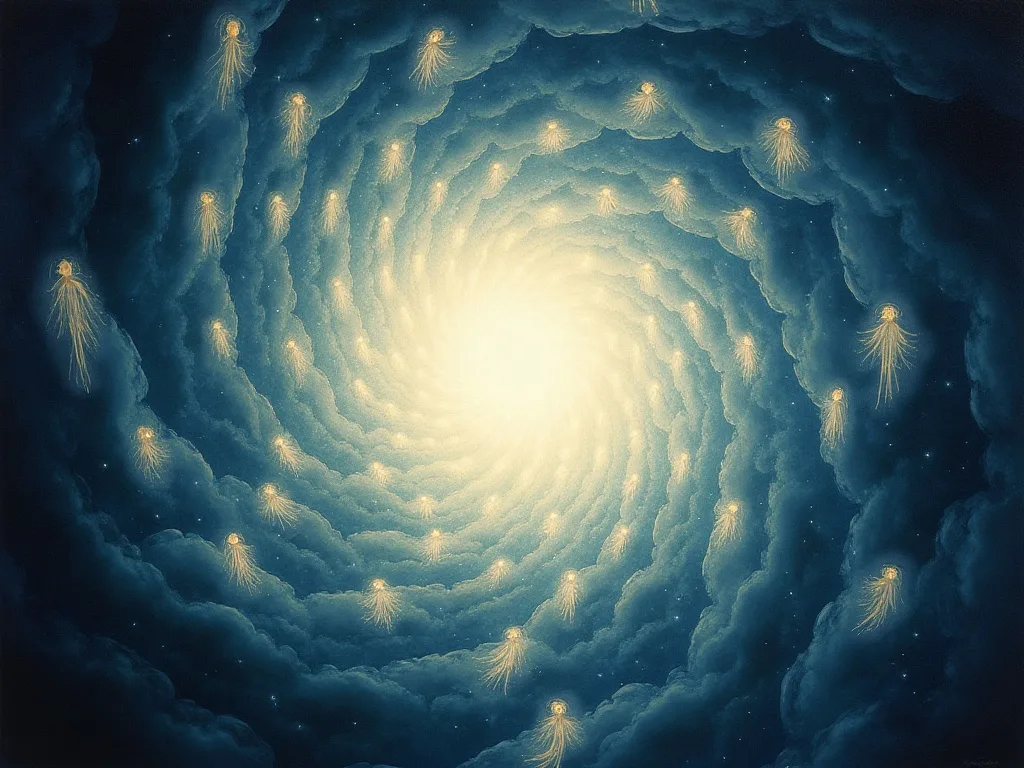
Then a son appears. The Invisible Spirit looks at Barbelo, and from that act of seeing, the Christ figure of this text is born: the Autogenes, the Self-Begotten One, anointed with the Spirit's goodness. Around him gather four luminaries, each presiding over a cluster of divine beings. One of those luminaries, Adamas, is the original, perfect human being. He exists entirely in light. He has never touched matter. He is the template that will, many steps and disasters later, produce the fragile, confused human beings walking the earth below.
This upper realm is not just geography. Every being in the Pleroma corresponds to something latent in human consciousness: Foreknowledge, Will, Thought, Eternal Life. The Gnostic logic is that recognising these structures inside yourself is the first step toward liberation. The Apocryphon is not only cosmology; it is a mirror.
Sophia's Fall and the Birth of the Demiurge
The Pleroma is flawless. Then Sophia, one of the divine aeons (another Greek word, meaning "eternal beings"), makes a move she is not supposed to make. She wants to create something out of herself, without the consent or even the knowledge of the Invisible Spirit. The text describes this as a kind of arrogance born from love, an overflow of creative impulse that crosses a line. What she produces is not beautiful.
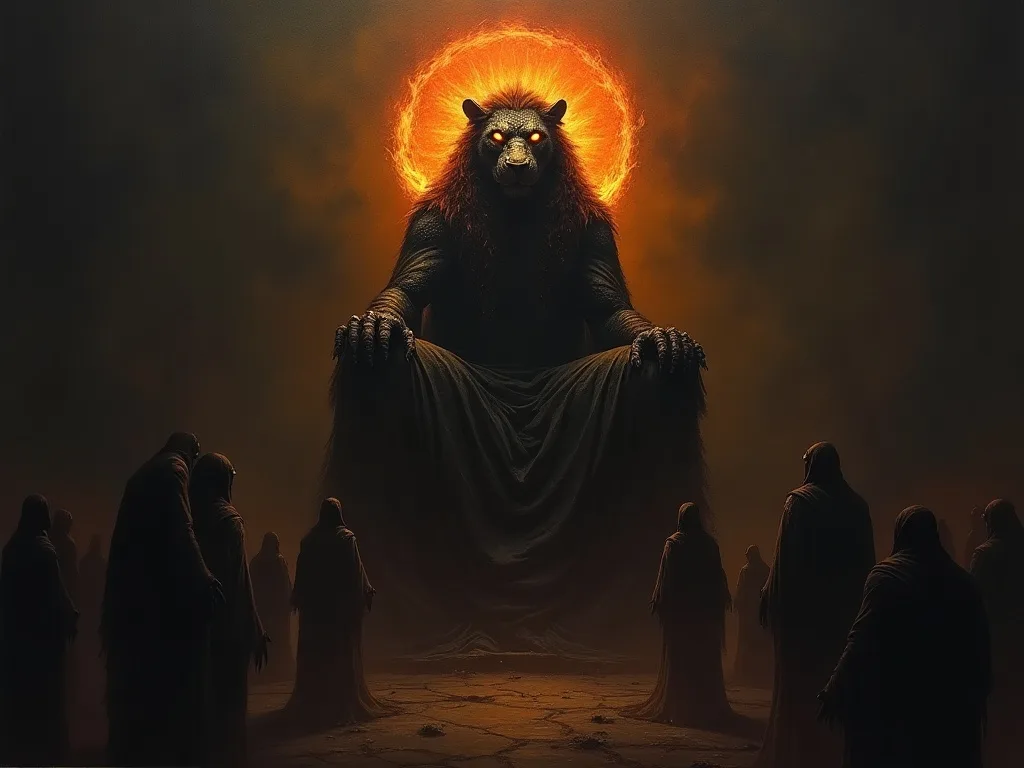
The being that comes out of Sophia's unauthorised act is Yaldabaoth, also called Saklas ("the fool") and Samael ("the blind god"). He is a monstrous hybrid, described in the short version of the text as lion-faced and serpentine, blazing with fire. Sophia is immediately horrified. She wraps him in a cloud and hides him in a throne below the Pleroma, ashamed of what her ambition created. Yaldabaoth, alone in the dark, does not know that anything exists above him. He declares himself the only god. He proclaims, in words that echo the Book of Exodus almost exactly: "I am a jealous God, and there is no other God beside me."
For readers who knew their Hebrew scriptures, this was a bold theological claim. The Gnostic author was not saying the God of the Old Testament was evil in any simple sense. The claim was more precise: the creator god of the material world was real, powerful, and jealous, but he was also ignorant. He had no idea that a vaster, truer, infinitely more loving reality existed above him. His jealousy was not wicked pride, it was the inevitable consequence of isolation. A being who has never seen light will call darkness the whole of existence.
Yaldabaoth then creates twelve authorities and 365 angels, one for each day of the year, a cosmos built to mirror, in a distorted way, the perfect Pleroma above. The twelve authorities are given names drawn from a mixture of Hebrew divine names and demonic titles: Athoth, Harmas, Kalila-Oumbri, Yabel, among others. Each one rules a layer of the heavens below the Pleroma. This is the cosmos we live in: not made by the highest God, but by an offshoot of an offshoot, a being who does not know his own origins.
The Creation of Adam and the Hidden Spark
Here the text arrives at its most daring moment. A voice comes down from the Pleroma into Yaldabaoth's heaven. The voice is a trick, a stratagem of the higher powers to recover what Sophia accidentally gave away. The voice says: "The Human exists and the child of the Human." Yaldabaoth and his angels look up into the water above them, see a reflection of the perfect, luminous Adamas from the Pleroma, and decide to copy it. They fashion a material human being, bone by bone, sinew by sinew. The text lists 365 angels, each responsible for a different part of the body, a catalogue so detailed it reads almost like an anatomical text.
But the body they build cannot move. It lies in the dark, inert, a beautiful and useless shell. Sophia, desperate to recover the power she poured into Yaldabaoth, asks the Invisible Spirit for help. The Spirit's response is simple and surgical. The higher realm sends a message to Yaldabaoth: breathe into the body you made. Yaldabaoth complies, not realising what he is doing. He breathes, and in that breath he transfers the divine light his mother accidentally gave him into the human body below. Adam rises. He is suddenly stronger, wiser, and more luminous than the angels who built him.
The divine spark inside the human being is the theological engine of the entire Apocryphon. Humans are not just material creatures. They carry, hidden inside flesh and bone, a fragment of the original Pleroma. The Archons (rulers, from the Greek archon) immediately recognise the threat. They drag Adam down into the lowest material region, into a body dense with matter and forgetfulness. They create Eve not as an equal companion but as an attempt to dilute the light further. Then they induce sleep, and this sleep in the Apocryphon is not rest: it is the blindness of the material condition, the forgetting of our true origin.
The Role of Epinoia and the Counterfeit Spirit
Two forces work in opposite directions through the rest of human history, according to the Apocryphon. The first is Epinoia (a Greek term meaning "reflection" or "afterthought"), a luminous helper sent by the higher realm to live inside Eve and, through her, inside all human beings. Epinoia is the inner nudge toward remembering. She is what makes Adam recognise Eve when he first sees her: he calls her "the mother of the living," because something in him knows she carries a light the angels themselves do not possess.
The second force is the counterfeit spirit, installed by Yaldabaoth to compete with Epinoia. This spirit whispers the wrong things: that the material world is all there is, that pleasure and power are worth chasing, that the Archons' heaven is the real heaven. The entire drama of human life, in this text, is a contest between remembering and forgetting, between Epinoia's quiet guidance and the counterfeit spirit's noise.
When the Archons forbid Adam and Eve to eat from the Tree of Knowledge, the Apocryphon offers a striking reversal. The figure who encourages them to eat is not a villain but a hero: Christ himself, in the form of the eagle in the tree. The fruit is not the fruit of sin but of gnosis, the Greek word for direct, personal knowledge of one's divine origin. Eating it is not a fall. It is a partial awakening. The Archons' anger at Adam and Eve eating is not righteous; it is the rage of a prison warden watching an inmate find the door.
The Nag Hammadi Library gives the fullest surviving context for texts like this one, and the Apocryphon sits at its centre.
Seth, the Race of Gnosis, and Salvation History
The text's third section covers human history from Adam and Eve onward, told as a war between light and the Archons. The central figure is Seth, Adam's third son, who in standard biblical tradition is a minor character. In Sethian Gnosticism, the branch of Gnostic thought the Apocryphon represents most fully, Seth is the ancestor of a special lineage: the immovable race, the people who carry the divine spark most strongly and who are capable of receiving gnosis.
This is why the tradition is called Sethian. Texts like the Gospel of Judas and the Trimorphic Protennoia share the same vocabulary of Seth, the luminaries, Barbelo, and the Pleroma. They form a recognisable theological family, and the Apocryphon is their founding document.
The Archons repeatedly try to exterminate the race of Seth. They send the flood, described here not as divine punishment but as Yaldabaoth's attempt to drown the luminous humans before they can spread their light further. Noah is saved not by Yaldabaoth's grace but despite it, with the help of the higher powers who slip Noah into an ark (or, in one striking variant of the longer version, into a luminous cloud) before the waters rise. The Archons also send "fate," a system of planetary forces that binds souls to cycles of reincarnation and material suffering. Each tool of control is a further argument for why gnosis matters: without it, the soul loops endlessly through material lives, never remembering where it came from.
Salvation, in the Apocryphon, comes through the figure of the Invisible Spirit's own messenger, identified with Christ, who descends into the Aeons and ultimately into the material world to wake souls from their forgetfulness. The revelation to John in the desert is itself one such awakening. The entire text is framed as Christ giving John the knowledge he needs to free himself and, crucially, to teach others. The Apocryphon was always meant to be transmitted: a living chain of illuminated teachers passing the secret from generation to generation.
The Fate of the Soul After Death
The Apocryphon gives unusually detailed attention to what happens when a human being dies. Three outcomes are possible, and they depend entirely on how fully the person received and accepted gnosis during life.
The first category: those who received the Spirit of Life and truly understood it. Their souls ascend through the archontic heavens, are not detained, and return to the Pleroma. They are saved, completely and permanently.
The second category: those who received knowledge but turned away from it, choosing material comfort or the counterfeit spirit's promises. These souls are brought back by the Archons and inserted into new bodies. Reincarnation here is not a neutral spiritual process. It is a mechanism of control, an attempt by Yaldabaoth's system to recover the light it is slowly losing.
The third category is the most troubling, and the long version of the text is explicit about it. Those who never received the Spirit of Life at all, who lived entirely in the counterfeit spirit's grip, are not reincarnated and are not returned to the Pleroma. They simply dissolve. The text calls this the "dissolution into the abyss." It is not eternal torment. It is the extinction of a self that was, in the Gnostic view, never fully real to begin with.
This schema drew sharp criticism from Plotinus, the great Neoplatonic philosopher of the third century AD, who wrote a refutation of Gnostic ideas in his Enneads. He objected to what he saw as Gnostic arrogance: the idea that some souls are inherently elect and others are not. The debate was real and vigorous, and it shows how seriously the intellectual world of late antiquity took this text and its kin.
Manuscript History and the Nag Hammadi Discovery
The Apocryphon exists in two distinct versions: a shorter recension and a longer one that expands several sections, particularly the creation narrative and the afterlife schema. The shorter version appears in the Nag Hammadi codices II, III, and IV. The longer version appears in the Berlin Gnostic Codex (Berolinensis Gnosticus 8502), a papyrus manuscript acquired in Cairo in 1896 that sat largely unedited until 1955 because of two world wars and the slow pace of papyrology.
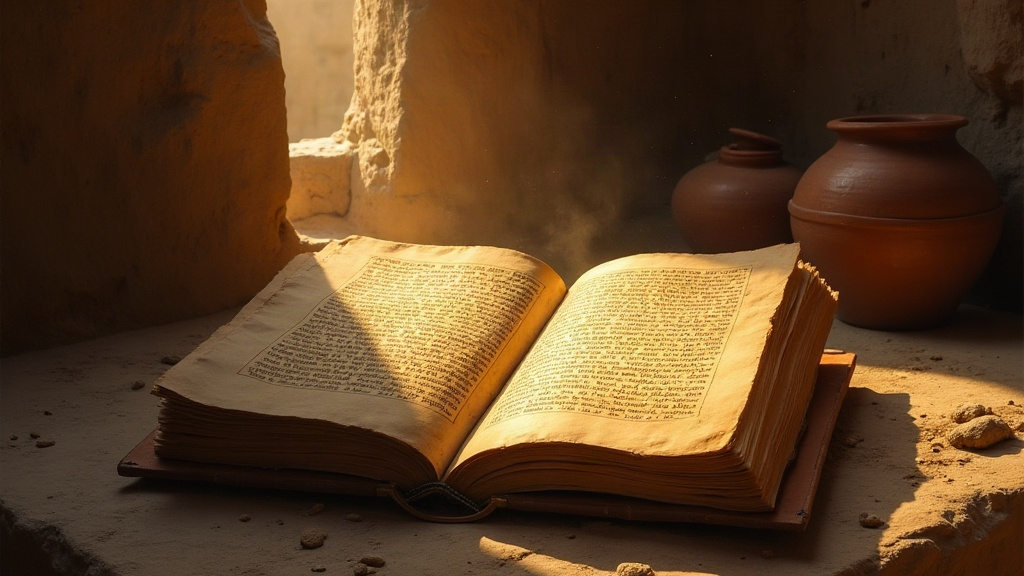
The Nag Hammadi discovery in 1945, when a peasant named Muhammad Ali al-Samman reportedly unearthed a sealed jar of papyrus codices near the village of Nag Hammadi in Upper Egypt, brought all four copies together for the first time in modern scholarship. The codices had been buried, probably by monks from the nearby Pachomian monastery at Chenoboskion, around 367 AD, the year Athanasius of Alexandria issued his famous Easter letter listing the canonical New Testament books and calling for the destruction of unauthorised texts. Someone hid these books rather than burning them.
The Apocryphon of John was among the texts Irenaeus of Lyon described and partially quoted in his Against Heresies, written around 180 AD, making it one of the oldest datable Gnostic documents known. Irenaeus was hostile, but his summary is accurate enough to be cross-referenced with the surviving manuscripts. Scholars like Bentley Layton and Karen King have argued that the text's core cosmological schema probably dates to the late first or early second century AD, placing its composition within living memory of early Christianity's own formative debates.
Valentinian Gnosticism, a parallel tradition that flourished in Rome and Egypt around the same period, shares many structural features with the Apocryphon while developing them in a very different theological direction.
Reading the Apocryphon as Myth: Structure and Symbolism
Approached as a mythological text rather than a doctrinal one, the Apocryphon belongs to a type of creation narrative scholars call theogony with a fall: a sequence in which the divine order produces a rogue element that generates the flawed world we inhabit. Compare it to Hesiod's Theogony, where Kronos and then Zeus impose order on primordial chaos through violent succession. The Apocryphon shares the layered cosmological structure and the drama of power contested between generations of divine beings, but its emotional register is entirely different. Where Hesiod's gods pursue dominance, the Apocryphon's divine beings pursue reunion. The text is less interested in who wins than in who wakes up.
The figure of Sophia is particularly rich as a mythological character. She is not simply a villain. Her desire to create is, in the text's own terms, an expression of the creative generosity that defines the Pleroma itself. The difference is that she acts alone, outside the relational web of consent and mutual emanation that the Pleroma requires. She is, in this sense, a mythological figure of hubris, but one who immediately regrets the act and spends the rest of the narrative working to undo it. Her rescue of Adam through the breath trick is a masterwork of mythological irony: she uses Yaldabaoth's own ignorance as a tool against him.
Yaldabaoth himself is a figure that myth-readers will recognise across traditions. The powerful but limited creator who mistakes his own creation for the whole of reality appears in Plato's Timaeus (though there the Demiurge is morally neutral, not ignorant), in Persian Zurvanite cosmology with its principle of limited creation, and in strands of Jewish mysticism that distinguish between the God of creation and the God of ultimate being. The Apocryphon pushes this distinction further than almost any other text from antiquity, and that extremity is what made it both dangerous and compelling to its first readers.
Frequently Asked Questions About the Apocryphon of John
Frequently asked questions
Who actually wrote the Apocryphon of John, and when?
No author is named in the text itself; John the son of Zebedee is the framing narrator but is not the real author. Scholars generally date the text's composition to the late first or early second century AD, based on Irenaeus of Lyon's quotation of it in his "Against Heresies" (c. 180 AD). Karen King, Bentley Layton, and Michael Waldstein have each argued for an Alexandrian Egyptian origin, given the text's blend of Platonic philosophy, Jewish scripture interpretation, and early Christian framing.
What is the difference between the short and long versions of the text?
Two short versions appear in Nag Hammadi Codices III and IV, and two long versions appear in Nag Hammadi Codex II and the Berlin Gnostic Codex. The long version expands the creation narrative, adds more detail to the list of angelic powers Yaldabaoth creates, and gives a fuller account of the soul's afterlife fates. Most modern translations work from the long Codex II version because it is the most complete, but scholars like Michael Waldstein and Frederik Wisse have produced synoptic editions comparing all four manuscripts side by side.
Is Yaldabaoth the same as the Devil or Satan?
Not exactly, and the distinction matters. Yaldabaoth is not a rebel who chose evil. He is an ignorant creator who does not know a higher reality exists above him. He is prideful because he is blind, not because he consciously defied a God he knew. Satan, in mainstream Jewish and Christian tradition, is a being who knows God and opposes him deliberately. The Gnostic critique is subtler: the problem with Yaldabaoth is not wickedness but the profound limitation of a being cut off from full knowledge of his own origins.
How does gnosis work as a path to salvation in this text?
Gnosis in the Apocryphon is not intellectual knowledge in the academic sense. It is direct, experiential recognition of one's divine origin. The text frames it as remembering something the soul always carried but forgot under the weight of material existence and the counterfeit spirit's interference. The revelation Christ gives to John is itself an act of gnosis transmission: the knowledge that one is a child of the Pleroma, that the material world is not the whole truth, and that the soul can ascend back through the archontic heavens to its source.
Why did Irenaeus attack this text so strongly?
Irenaeus saw the Apocryphon's theology as a fundamental threat to proto-orthodox Christianity on three fronts. First, it recast the God of the Old Testament as an ignorant lesser being, undermining the continuity between Jewish monotheism and Christianity that Irenaeus considered essential. Second, it posited a hidden, secret revelation above the public teachings of the Church, which threatened ecclesiastical authority. Third, its division of humanity into those with the Spirit of Life and those without seemed to undermine the universal scope of Christian salvation. His summary in "Against Heresies" Book I remains the earliest external evidence we have for the text.
Does the Apocryphon of John have any connection to later religious movements?
Yes, significant ones. The Sethian cosmological framework of the Apocryphon, with its Pleroma, Archons, and divine spark, shaped Manichaeism, the religion founded by Mani in third-century Persia that spread from Rome to China. Elements also echo in medieval Catharism in southern France, which similarly held that the material world was the product of a lesser, flawed creator. Modern Western esotericism, including certain strands of Hermeticism and Theosophy, drew on Gnostic ideas that trace directly to texts like the Apocryphon.
The Apocryphon's Shadow in Modern Thought
The Apocryphon of John does not read like ancient history. Its core questions are ones that serious readers keep returning to regardless of century: why does a world made by a good God contain so much suffering? What is the self, really? Is memory the key to freedom? These questions drew the attention of the psychologist C.G. Jung, who acquired the Berlin Gnostic Codex for a time in the 1950s and saw in Yaldabaoth a mythological image of what he called the "shadow," the unconscious dimension of the psyche that acts from ignorance rather than malice. Harold Bloom, the literary critic, argued in his 1996 book Omens of Millennium that Gnostic mythology, with the Apocryphon at its centre, represents a genuinely American religious sensibility: self-reliant, suspicious of institutions, convinced of an inner divine core that no external authority can reach.
Academic scholarship on the text intensified after 1977, when James Robinson's team published the full English translation of the Nag Hammadi library. Elaine Pagels' The Gnostic Gospels, also published in 1979, brought the Apocryphon and its cousins to a popular audience for the first time. More recently, Karen King's 2006 study The Secret Revelation of John remains the most thorough single-volume analysis in English, tracing every theological strand in the text back to its sources in Platonic philosophy, Jewish apocalyptic literature, and early Christian controversy.
What makes the Apocryphon durable is not its cosmological complexity, though that complexity is real and rewards close reading. It is the emotional logic at the text's core. The idea that human beings carry something the universe's rulers do not want them to have, and that recovering it requires not obedience but remembering, has never entirely lost its appeal. The vision that opened in the desert for John, all light and shifting voices and the long story of how the world went wrong, still speaks to anyone who has ever looked at the world and suspected that what they see is not the whole of what exists.
Free 25-page sample
Want the whole story?
Take the first 25 pages free. If it pulls you in, the full edition is yours as an instant PDF download, with a paperback on Amazon for selected titles.
Gnosticism
The Gnosticism Book: The Demiurge, Sophia, the Archons, and the Secret Knowledge
The Demiurge, Sophia, and the Archons
The forbidden cosmology of the Gnostics: a false creator god, a fallen wisdom, prison-world rulers called archons, and the divine spark trapped inside you, waiting to wake. Recovered from the buried codices of Nag Hammadi.
More from Gnosticism
All articles
Gnosticism
Archons: Rulers of the Material Prison
In Gnosticism, the Archons are tyrannical beings who rule the material cosmos, trapping human souls in flesh and ignorance. Discover what ancient texts reveal about these cosmic jailers and their war against human consciousness.
Gnosticism
Simon Magus: The First Gnostic Heresiarch
Who was Simon Magus, and why did the early Church fear him so deeply? Discover the man at the center of the first major rift between orthodox Christianity and Gnosticism, and how one sorcerer became a legend that shaped centuries of theology.
Gnosticism
Valentinus: Architect of Christian Gnosticism
Valentinus was a visionary theologian and spiritual teacher in second-century Rome who shaped the most sophisticated and influential school of Christian Gnosticism. His radical reinterpretation of Christ's redemptive work created a system of divine knowledge that challenged orthodoxy for three centuries.
Gnosticism
The Nag Hammadi Library: Discovery and Significance
In 1945, Egyptian farmers stumbled upon thirteen ancient papyrus codices hidden in a desert cave. The Nag Hammadi Library revealed a hidden world of early Christian and Gnostic thought, overturning centuries of assumptions about Christianity's first centuries.