
The Gospel of Thomas: Sayings of the Living Jesus
A 2nd-century collection of 114 sayings attributed to Jesus, the Gospel of Thomas rewrites everything you thought you knew about early Christian belief. What did it hide, and why?
Contents
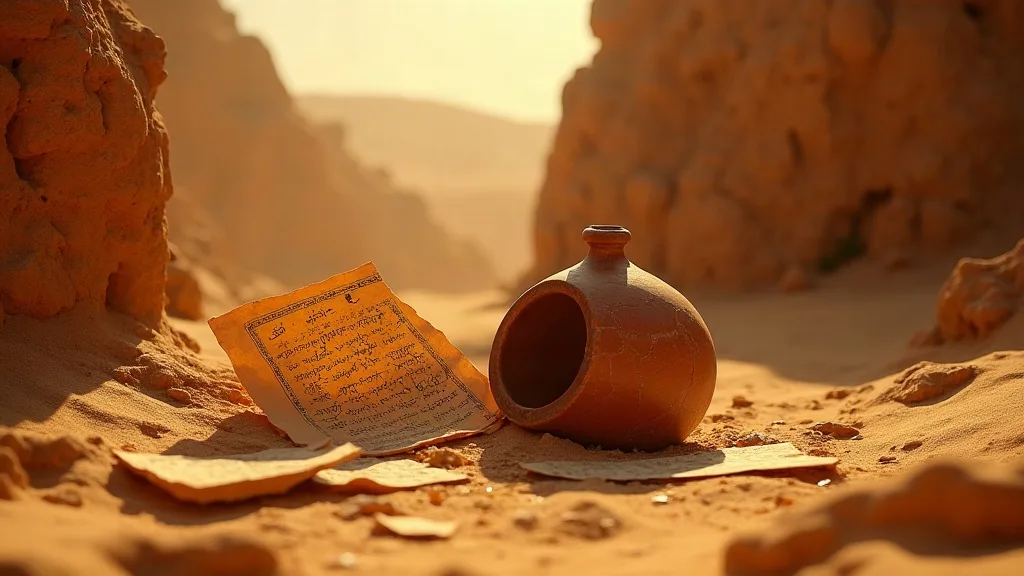
A clay jar buried in the Egyptian desert held the most unsettling religious document of the twentieth century. In December 1945, near the town of Nag Hammadi, a farmer named Muhammad Ali cracked open a sealed earthenware vessel and found thirteen leather-bound papyrus books. Most scholars now agree they were hidden sometime around the late fourth century, likely by monks from the nearby Pachomian monastery, protecting texts the newly orthodox church had declared heretical. One of those texts was The Gospel of Thomas: Sayings of the Living Jesus, and it arrived like a stone thrown through a stained-glass window.
Unlike the four canonical gospels, Thomas contains no birth narrative, no miracles, no passion story, and no resurrection account. It is instead a list. One hundred and fourteen sayings, each opening with the same formula: "Jesus said". The prologue frames the entire collection with a claim that is both an invitation and a challenge: whoever finds the true meaning of these words, it says, will not taste death. The stakes, in other words, could not be higher.
What makes Thomas so compelling, and so theologically disorienting, is that many of its sayings appear almost verbatim in Matthew, Mark, and Luke. Others are stranger, denser, and wholly unlike anything in the New Testament canon. Together they paint a portrait of Jesus as a teacher of hidden wisdom rather than a saviour of souls, a figure whose power lies not in sacrifice but in the spark of self-knowledge he hands to those willing to look inward.
From Oxyrhynchus to Nag Hammadi: The Long Road to Discovery
The text did not arrive entirely without warning. Between 1897 and 1903, British archaeologists Bernard Grenfell and Arthur Hunt excavating the ancient rubbish heaps at Oxyrhynchus, Egypt, unearthed several Greek papyrus fragments bearing a cluster of sayings attributed to Jesus. These fragments, catalogued as P.Oxy. 1, P.Oxy. 654, and P.Oxy. 655, puzzled scholars for decades. They matched nothing in the canon. When the Nag Hammadi library surfaced, the puzzle resolved: the Oxyrhynchus fragments were pieces of an earlier Greek version of Thomas, composed perhaps as early as the mid-second century AD.
The Nag Hammadi copy, the one scholars work from today, is written in Sahidic Coptic, a dialect of ancient Egyptian rendered in a Greek-derived alphabet. The manuscript dates to roughly 340-380 AD. Scholars generally place the original composition of Thomas between 50 and 150 AD, with a significant minority arguing that some of its sayings may predate the canonical gospels themselves. The debate is not settled, and it is one of the most energetic arguments in the field of New Testament scholarship.
The collection takes its name from the apostle Didymos Judas Thomas, whose name means "twin" in both Greek (didymos) and Aramaic (thomas). The Syriac Christian tradition, centred on ancient Edessa in what is now southeastern Turkey, regarded Thomas as the twin brother of Jesus. That detail is not incidental. In Gnostic reading, the twin symbolises the relationship between the earthly self and the divine inner spark: two forms of the same essential being.
What the 114 Sayings Actually Say
The sayings of The Gospel of Thomas resist easy categorisation, which is precisely why they have attracted so much attention. Some are straightforward wisdom, close cousins to the Sermon on the Mount. Saying 54, for instance, reads: "Blessed are the poor, for yours is the kingdom of heaven." A reader of Luke would recognise it immediately.
But then comes Saying 70: "If you bring forth what is within you, what you bring forth will save you. If you do not bring forth what is within you, what you do not bring forth will destroy you." Nothing in the synoptic gospels reads quite like this. It is not a command to love your neighbour. It is an instruction to excavate the self.
The sayings cluster around several recurring ideas:
- The Kingdom of God as present reality: Saying 3 states that the Kingdom is not in the sky or in the sea but is "inside you and outside you." Whoever knows themselves will find it.
- Light within: Saying 24 has the disciples ask where Jesus is, and he answers: "There is light within a person of light, and it illuminates the whole world."
- The solitary one: The Greek word monachos, meaning "solitary" or "unified", appears in Sayings 16, 49, and 75. Those who are solitary and chosen will enter the bridal chamber. Some scholars see this as the origin of the Christian monastic ideal; others read it as Gnostic language for the soul that has reunited with its divine source.
- Children and nakedness: Saying 37 asks when the disciples will see Jesus, and he answers: when they can undress without shame, as children do, and trample their garments underfoot. The garment, in Gnostic symbolism, represents the body, the material layer that covers the divine spark.
- The stone and the wood: Saying 77 is among the most-quoted in popular culture: "Split a piece of wood; I am there. Lift up the stone, and you will find me there." Jesus is not confined to a person or a place. He is present in matter itself.
The collection also contains Saying 114, which has generated genuine scholarly controversy. In it, Simon Peter says Mary (almost certainly Mary Magdalene) should leave the group because women are not worthy of life. Jesus responds that he will "lead her and make her male, so that she too may become a living spirit resembling you males." Feminist scholars and historians debate vigorously whether this represents misogyny, a Gnostic metaphor for spiritual transformation beyond gender, or a later addition to an earlier text.
The Gnostic Framework: Hidden Knowledge and the Divine Spark
To read Thomas well, it helps to understand the broad Gnostic framework that shaped it, even if Thomas itself sits at the edges of that tradition rather than at its centre. Gnostic mythology holds that the material world was not created by the supreme God but by a lesser, flawed deity called the Demiurge. Human beings carry within them a fragment of divine light, a pneuma or spark, which has been trapped in matter and forgotten.
Salvation, in this view, is not atonement for sin. It is gnosis, from the Greek word for "knowledge," specifically self-knowledge that recognises the divine origin of the inner spark. The Gospel of Thomas never uses the word gnosis directly, and it does not present the full cosmological architecture found in texts like the Apocryphon of John, with its elaborate ladder of divine beings called Aeons and its myth of the fall of Sophia. But its core orientation aligns: the path to life runs inward, not upward through ecclesiastical hierarchy or outward through ritual observance.
Scholars like Elaine Pagels, whose 1979 book The Gnostic Gospels brought these texts to a mainstream audience, argue that Thomas represents an early strand of Christianity in which Jesus functioned primarily as a wisdom teacher, a guide to interior transformation. The canonical gospels, Pagels notes, increasingly emphasised the uniqueness of Jesus as cosmic redeemer, a shift that served the institutional needs of a growing church. Thomas preserves a different, older possibility.
Thomas and the Synoptic Gospels: Parallel, Divergent, Earlier?
One of the central questions in New Testament scholarship is whether Thomas knew Matthew, Mark, and Luke, or whether Thomas and the synoptics drew on shared earlier sources independently. The answer matters enormously. If Thomas used the synoptics, it is a second-century compilation, interesting but derivative. If it is independent, some of its sayings may be among the oldest words attributed to Jesus anywhere in writing.
The case for independence rests on several observations. When Thomas shares a saying with the synoptics, the Thomasine version is often shorter and lacks the theological commentary the synoptic evangelists added. Scholars call this the "Q hypothesis" parallel: just as Matthew and Luke are believed to have drawn on a now-lost sayings source called Q (from the German Quelle, meaning "source"), Thomas may represent a separate stream from that same early tradition.
Helmut Koester of Harvard Divinity School argued through the 1980s and 1990s that certain Thomas sayings reflect a stage of transmission earlier than the synoptic versions. His position remains contested but influential. Nicholas Perrin, by contrast, has argued that Thomas shows signs of Syriac influence suggesting it was composed after the synoptic gospels were already in circulation, possibly in Edessa around 175 AD. The debate continues in academic journals and conference rooms, and it is unlikely to be resolved without the discovery of new manuscripts.
What is not in dispute: the overlap is real and striking. Saying 9 in Thomas is the parable of the Sower, familiar from Mark 4. Saying 20 is the mustard seed. Saying 65 is the parable of the Wicked Tenants. In each case, the Thomas version strips away the allegorical explanation that the canonical gospels provide. Thomas hands you the parable and walks away. You are expected to crack it open yourself.
Who Was Doubting Thomas, and Why His Name Matters
The choice of Thomas as the text's attributed author is not random. In the Gospel of John, Thomas is the apostle who refuses to believe in the resurrection until he touches Jesus's wounds, earning him the permanent epithet "Doubting Thomas." That reading, though, is a canonical reading. In the Syriac tradition, Thomas was celebrated as the apostle who understood Jesus most deeply, his twin in spirit if not in flesh.
The Gospel of John contains a striking moment that Thomas's gospel seems to answer directly. In John 14:5, Thomas says to Jesus: "Lord, we do not know where you are going. How can we know the way?" Jesus answers: "I am the way, the truth, and the life." In the Gospel of Thomas, the same question produces a completely different kind of answer. Saying 13 has Jesus draw Thomas aside privately and whisper three words to him. When the other disciples ask what was said, Thomas replies: "If I tell you one of the words he said to me, you will pick up rocks and stone me, and fire will come from the rocks and devour you." The secret is unspeakable. The tradition of Thomas is built on that silence.
The twin symbolism goes deeper still. In several Gnostic texts, including the Book of Thomas the Contender found alongside the Gospel of Thomas at Nag Hammadi, Thomas is explicitly identified as Jesus's twin. If Jesus represents the divine spark in its pure form, Thomas represents the human soul that recognises it. The name of the author is itself a teaching.
The Kingdom That Is Already Here
Perhaps the single most theologically radical element of The Gospel of Thomas: Sayings of the Living Jesus is its treatment of the Kingdom of God. In the canonical gospels, particularly in Mark, the Kingdom is imminent but not yet present: a future event that will break into history with power. In Thomas, it has already arrived, and the problem is not that it is delayed but that people cannot see it.
Saying 113 makes this explicit. The disciples ask when the Kingdom will come. Jesus answers: "It will not come by watching for it. It will not be said, 'Look, here!' or 'Look, there!' Rather, the Father's kingdom is spread out upon the earth, and people don't see it." This is not apocalyptic deferral. It is a present, pervasive reality that ordinary consciousness misses.
This idea connects Thomas to wisdom traditions far beyond Christianity. The Upanishads, a series of Sanskrit philosophical texts composed between roughly 800 and 200 BC, describe the Atman, the individual self, as identical with Brahman, the universal ground of being. The Kingdom that is inside and outside you simultaneously sounds strikingly similar to that ancient Indian teaching. Scholars like Raimon Panikkar and Elaine Pagels have noted these resonances, and while no direct historical link between Thomas and Vedic thought has been established, the parallel speaks to something the human mind reaches for across cultures and centuries.
Closer to home in the Gnostic tradition, the same idea shapes texts like the Pistis Sophia, where the divine light is not somewhere above the stars but is the very substance of the soul, buried under layers of ignorance and forgetting. Thomas's Jesus does not ask his listeners to wait. He asks them to wake up.
How the Church Responded, and Why Thomas Was Suppressed
The Gospel of Thomas did not survive the fourth century in open circulation. By 367 AD, Athanasius, the Bishop of Alexandria, issued his famous Easter letter in which he listed the twenty-seven books he considered canonical New Testament scripture and explicitly ordered that any other texts be destroyed. Scholars believe this edict is what prompted the monks of the Pachomian community to seal their library in a jar and bury it in the cliffs near Nag Hammadi.
The reasons for Thomas's exclusion are not hard to reconstruct. A text that places self-knowledge above faith, that omits the crucifixion and resurrection entirely, that suggests the Kingdom is already present for anyone with eyes to see: such a text offers no obvious role for a priestly class, no need for sacraments, and no leverage for institutional authority. The Christianity that emerged from the Council of Nicaea in 325 AD was building a universal church with a clear hierarchy and a fixed creed. Thomas pointed in the opposite direction.
This is not to say the church was simply wrong and Thomas simply right. The canonical tradition preserved a powerful social and ethical vision, a community of care, accountability, and shared practice, that the purely interior path of Thomas might never have generated on its own. The historian Karen King at Harvard Divinity School has spent decades arguing that what we call "heresy" and "orthodoxy" in early Christianity are retrospective labels applied to an originally diverse field of practice. Thomas was not suppressed because it was fringe. It was suppressed because it lost a power struggle.
The Gospel of Thomas in Modern Scholarship and Spirituality
Since the Nag Hammadi library became publicly accessible in the 1970s, The Gospel of Thomas has attracted a remarkable breadth of readers. Academic New Testament scholars like John Dominic Crossan and the scholars of the Jesus Seminar used Thomasine sayings extensively in their reconstruction of the historical Jesus. Crossan's 1991 book The Historical Jesus treated Thomas as a primary source of comparable weight to the canonical gospels.
Outside the academy, Thomas has become something of a touchstone for readers seeking a Christianity of interiority over institution. The theologian Matthew Fox drew on it in developing Creation Spirituality. The poet and translator Stephen Mitchell included Thomas sayings in his widely-read rendition of Jesus's teachings. The text has appeared in novels, films, and documentaries, most famously in the 2006 film The Da Vinci Code adaptation, though the film dramatised Thomas's existence rather than its actual content.
What is striking is how different the text looks depending on who reads it. A contemplative Christian sees a mystical Jesus, a teacher of the interior life. A secular scholar sees a second-century compilation of wisdom traditions. A Gnostic practitioner sees a map of the soul's journey back to the divine. Thomas accommodates all three because it was written, deliberately, to resist a single fixed meaning. "Seek and do not stop seeking," it says in Saying 2, "until you find. When you find, you will be troubled. When you are troubled, you will marvel."
Frequently Asked Questions About the Gospel of Thomas
Frequently asked questions
Is the Gospel of Thomas part of the Bible?
No. The Gospel of Thomas is not included in any mainstream Christian biblical canon. It was excluded from the New Testament canon established by early church councils and bishops, most notably via Athanasius's 367 AD letter listing accepted scriptures. It belongs instead to the Nag Hammadi library, a collection of texts discovered in Egypt in 1945 that preserve multiple strands of early Christian and Gnostic thought.
Who actually wrote the Gospel of Thomas?
The text attributes itself to "Didymos Judas Thomas," the apostle known in John's gospel as Doubting Thomas. Virtually no mainstream scholar believes Thomas the apostle literally wrote it. Most date the original composition to somewhere between 50 and 150 AD, with debate centring on whether the Greek source text predates, parallels, or borrows from the synoptic gospels. The attribution to Thomas signals the Syriac Christian tradition's belief that Thomas had uniquely intimate knowledge of Jesus's teachings.
What language was the Gospel of Thomas originally written in?
The surviving complete manuscript is in Sahidic Coptic, dating to around 340-380 AD. Three earlier Greek fragments found at Oxyrhynchus (P.Oxy. 1, 654, and 655) confirm that a Greek version existed before the Coptic translation. Many scholars believe the original composition was in Greek, though a minority argue for a Syriac original, which would place its composition in the eastern Christian communities around Edessa rather than in Egypt.
What is the relationship between the Gospel of Thomas and Gnosticism?
Thomas shares key orientations with Gnostic thought: the primacy of self-knowledge, the idea of a divine light hidden within the human being, and scepticism toward the material world. However, it lacks the elaborate cosmological mythology found in other Gnostic texts such as the Apocryphon of John, with no Demiurge, no Sophia myth, and no system of Aeons. Scholars like April DeConick place Thomas within a "primitive" or "proto-Gnostic" tradition, while others argue it represents an independent wisdom-gospel tradition that Gnostic communities later adopted.
Why does Saying 114 say Jesus will make Mary Magdalene 'male'?
Saying 114 is one of the most discussed and most controversial passages in the entire text. Jesus tells Peter he will "make Mary male" so she can become a living spirit. In Gnostic and broader ancient Mediterranean thought, "male" and "female" often functioned as spiritual metaphors rather than biological categories: the divine, transcendent realm was coded as "male," the material, corruptible realm as "female." Making Mary "male" likely meant elevating her to the level of spiritual completion. Some scholars see this as evidence of an early egalitarian strand later overlaid with patriarchal language; others argue the saying is a late addition reflecting second-century gender anxieties.
What is the most important saying in the Gospel of Thomas?
Scholars disagree, but Saying 3 is frequently cited as the theological heart of the entire collection. It reads: "If your leaders say to you, 'Look, the Kingdom is in the sky,' then the birds will get there first. If they say 'It's in the sea,' the fish will get there first. Rather, the Kingdom is within you and outside you. When you know yourselves, then you will be known." This saying encapsulates the Thomasine vision of a Kingdom that is already present, accessible through self-knowledge rather than doctrine or ritual.
What Thomas Still Asks of Its Readers
The Gospel of Thomas was never meant to be easy. It opens with a warning that its sayings are hidden, and it keeps that promise. Saying 2 describes the seeker who finds as someone first troubled, then marvelling, then reigning, then resting. Trouble comes before the marvel. The text is designed to produce discomfort as a spiritual method.
That quality has given it remarkable staying power across two thousand years of suppression and rediscovery. In the late second century, the church father Hippolytus of Rome quoted Thomas in his Refutation of All Heresies, trying to discredit it. He succeeded in preserving fragments of it instead. In the fourth century, monks buried it to keep it safe. In 1945, a farmer cracking a jar open found it again. None of those hands holding the text were neutral. All of them recognised something in it worth fighting over.
Modern readers come to Thomas from angles those ancient custodians never imagined: through comparative religion, through psychoanalysis, through the study of Zen koans, through feminist theology, through plain curiosity. What they find is a portrait of Jesus that the canonical tradition does not quite contain, a teacher who locates salvation not in his own death but in the moment his listener finally understands what has always been there. The Kingdom, Thomas insists, is already spread across the earth. The only question is whether you can see it.
That question, addressed to readers in every century, remains as open now as when someone first put stylus to papyrus and wrote: "These are the hidden sayings that the living Jesus spoke."
Free 25-page sample
Want the whole story?
Take the first 25 pages free. If it pulls you in, the full edition is yours as an instant PDF download, with a paperback on Amazon for selected titles.
Gnosticism
The Gnosticism Book: The Demiurge, Sophia, the Archons, and the Secret Knowledge
The Demiurge, Sophia, and the Archons
The forbidden cosmology of the Gnostics: a false creator god, a fallen wisdom, prison-world rulers called archons, and the divine spark trapped inside you, waiting to wake. Recovered from the buried codices of Nag Hammadi.
More from Gnosticism
All articles
Gnosticism
Archons: Rulers of the Material Prison
In Gnosticism, the Archons are tyrannical beings who rule the material cosmos, trapping human souls in flesh and ignorance. Discover what ancient texts reveal about these cosmic jailers and their war against human consciousness.
Gnosticism
Simon Magus: The First Gnostic Heresiarch
Who was Simon Magus, and why did the early Church fear him so deeply? Discover the man at the center of the first major rift between orthodox Christianity and Gnosticism, and how one sorcerer became a legend that shaped centuries of theology.
Gnosticism
Valentinus: Architect of Christian Gnosticism
Valentinus was a visionary theologian and spiritual teacher in second-century Rome who shaped the most sophisticated and influential school of Christian Gnosticism. His radical reinterpretation of Christ's redemptive work created a system of divine knowledge that challenged orthodoxy for three centuries.
Gnosticism
The Nag Hammadi Library: Discovery and Significance
In 1945, Egyptian farmers stumbled upon thirteen ancient papyrus codices hidden in a desert cave. The Nag Hammadi Library revealed a hidden world of early Christian and Gnostic thought, overturning centuries of assumptions about Christianity's first centuries.