

The Hymn of the Pearl: Allegory of the Soul's Journey
The Hymn of the Pearl is a haunting Gnostic poem about a soul sent into exile to recover a precious gem, only to forget itself in the world. Discover how this 2nd-century masterpiece reveals the central paradox of Gnostic belief: we are divine prisoners in a false reality.
Contents
A prince descends from the Eastern palace into Egypt. His parents give him a mission: retrieve a single pearl, guarded by a serpent beneath the waters. But the moment he arrives in this foreign land, he forgets who he is. He wanders the streets in borrowed clothes, eats the local bread, sips the local wine. Years pass. Then a letter arrives, written in his mother's hand, whispering the truth of his origin. He wakes. He remembers. He obtains the pearl, sheds his mortal disguise, and rises home.
This is the Hymn of the Pearl, one of the most luminous works of Gnostic literature. Embedded in a 3rd-century text called the Acts of Thomas, it tells a story that feels like ancient myth yet speaks directly to the deepest questions about consciousness, identity, and what we are really doing here. For nearly two thousand years, scholars and spiritual seekers have returned to this poem because it asks something few religious texts dare to ask: what if the world itself is a trick, and the self we think is real is fast asleep?
The Text and Its Origins
The Hymn of the Pearl exists in multiple versions, most famously within the Acts of Thomas. This collection of stories about the apostle Thomas circulated widely in the Christian communities of Syria and beyond between the 2nd and 4th centuries. The hymn itself may have been composed as early as the 2nd century, possibly in Syria, where Gnostic ideas flowed especially thick. Scholars debate whether it was originally a pre-Christian poem later grafted into the Thomas material, or composed specifically for this context. What is certain is that it reflects the worldview of Gnostic Christianity: a cosmos divided between the realm of light (the pleroma, or fullness) and the realm of darkness (matter, the creation of an inferior demiurge).
The surviving text runs roughly 380 lines. It is written in the first person, as if the prince himself speaks. Each version we have comes from different manuscript traditions, sometimes contradicting on details, but the core narrative remains recognizable across them all. This consistency, despite geographical and temporal distance, speaks to the poem's resonance. It captured something readers needed to hear.

The Descent: Forgetting as Spiritual Imprisonment
The poem opens with the prince clothed by his parents in a resplendent robe and equipped with wealth for his journey. The "pearl" he seeks is no accident of imagery. In Gnostic thought, the pearl symbolizes the spark of divinity trapped in matter, or sometimes the soul itself. The serpent guarding it recalls the serpent from the Book of Genesis, but here it is neither evil nor wise in the biblical sense; it is simply the guardian of the material realm, the obstacle between the soul and its true home.
The prince descends. This descent is the crucial moment. In entering Egypt (a symbol for the material world, the realm of ignorance and illusion), he does not gradually lose memory. He loses it completely. He dresses in the clothes of the inhabitants. He eats their food. He drinks their wine.
This is where the Gnostic philosophy cuts deepest. The poem is not merely saying "he got distracted." It is saying that immersion in matter itself causes forgetting. The material world is not neutral. It is a stupefying force. The moment the soul enters flesh, the very fabric of existence here dims the light it carried from above. This is why Gnostic texts speak of the body as a tomb, not a temple. Not because flesh is inherently sinful in the Christian sense, but because it is the vehicle of forgetfulness.
The prince wanders Egypt for an unspecified time. He does not suffer dramatic persecution (though later Acts of Thomas materials add such themes). He simply... exists here, unnaturally. He becomes Egyptian. He forgets the palace, his parents, the pearl he came to retrieve. He forgets, most crucially, that he himself is not of this place.

The Letter: The Call to Remembrance
Then arrives the letter. In the text, it is sent by his parents. Other versions say it comes from his mother, or from the entire royal house. The letter is written, the poem says, "in my father's hand," and it whispers his true name. The letter recites who he is, where he comes from, and what he came to do. Reading it, the prince suddenly recognizes his own voice in his parents' words. It awakens him.
This is the turning point. And it is crucial to understand what it represents. The letter is not new information. The prince already knew all of this, once. The letter is a reminder. In Gnostic theology, salvation is not learning something foreign to yourself; it is remembering what you already are. This is the Greek concept of anamnesis, literally "unhiding." The Gnostic teacher, the revealer, does not bring you external doctrine. He or she awakens your inner knowledge. You are already divine. You have only forgotten.
The letter functions as a psych awakener. In the narrative, merely reading the words spoken in his mother's voice is enough to break the spell. The prince's eyes open. Suddenly Egypt looks different. The wine tastes of poison. The customs that felt like home now feel like a cage. He sees the pearl clearly in his mind's eye, gleaming beneath the waters, waiting.
This theme mirrors the role of the Gnostic savior figure elsewhere in the tradition. The demiurge, the false creator god, has trapped the divine spark within material shells (human bodies). Ignorance, not sin, is the chains. And salvation comes through gnosis, secret knowledge, a remembering of one's true nature. The letter in the Hymn enacts this redemptive knowledge. It is love and truth in written form.
The Retrieval of the Pearl and the Shedding of Garments
Once awakened, the prince moves swiftly. He must retrieve the pearl. But in many versions of the text, there is a puzzle: how does a mere mortal outmatch a serpent? Some readings suggest the serpent simply releases the pearl when it hears the true name spoken. Others hint that the prince, now remembering his divine origin, commands it as a prince commands servants. Still others suggest the serpent was never truly guardian, but rather the prince's own ignorance made manifest.
The pearl obtained, the prince must return. But he cannot ascend in the rags of Egypt. He sheds the garments he wore in exile. These cast-off clothes begin to speak to him, recounting his journey, preserving memory. The shedding of the mortal garment symbolizes the removal of flesh, of matter, of the false identity constructed in ignorance. What rises is not the body; it is the soul, the essential self, the divine spark awakening from deep sleep.
In some versions, the prince is described as uniting with his robe as he rises, becoming whole again. The robe descends to meet him, or he rises to meet it. This union signifies the reintegration of the divine self with its transcendent home, the marriage of the wanderer with the world of light. The Gnostic goal is not escape into non-existence, but recognition of one's true place in the pleroma, the fullness of the divine realm.
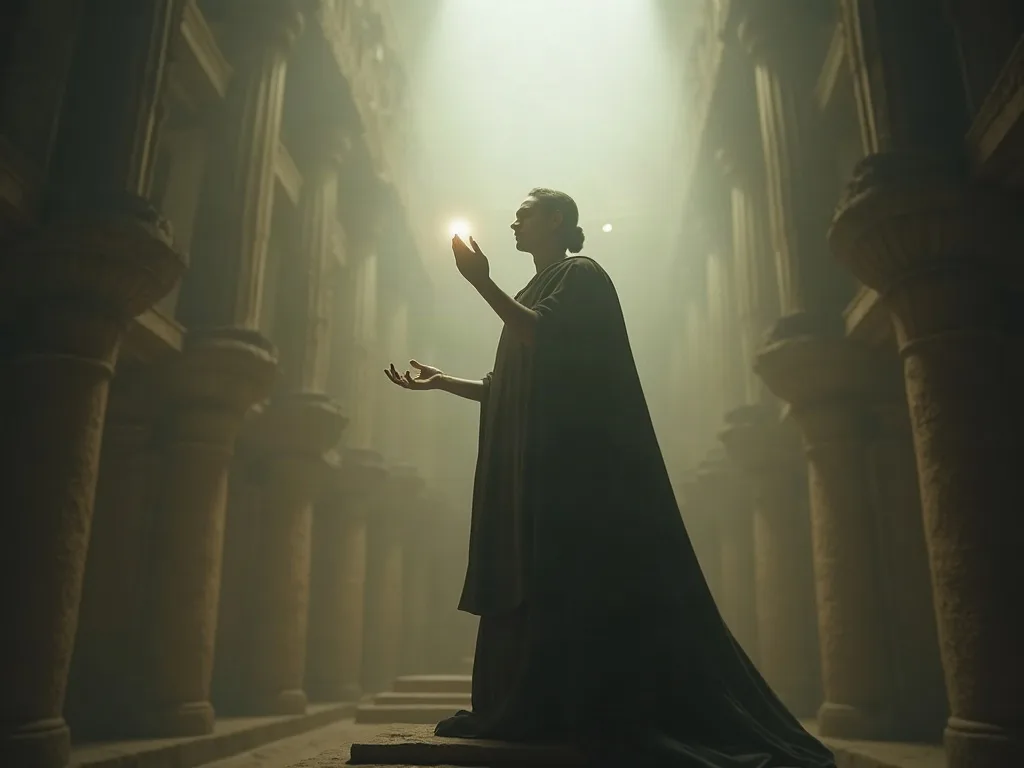
Gnostic Metaphysics in Narrative Form
To fully appreciate the Hymn of the Pearl, one must understand the Gnostic cosmos it presumes. Unlike orthodox Christianity, which teaches that the material world is God's creation and therefore good, Gnosticism posits a catastrophic split. The true God, the source of all light and goodness, exists in a realm beyond matter entirely (the pleroma). Below, separated by layers of ignorance, exists the material cosmos. This lower realm is the work of the demiurge, a lesser god, sometimes portrayed as arrogant and cruel, who mistakes himself for the only God.
Humans, in Gnostic vision, carry within themselves a spark of the true, transcendent God. This spark is trapped in flesh, bound by the demiurge's laws, veiled in darkness. The goal of Gnosticism is not virtue or faith in the Christian sense. It is awakening. It is the recognition and reactivation of the divine spark. The Hymn narrates this metaphysics in pure story form.
The descent of the prince mirrors the descent of divine sparks into matter at the world's beginning. Egypt is not a place but a state of matter-consciousness. The serpent is not merely an enemy but a representation of the ignorance that keeps the soul bound. The letter is the intervention of the transcendent God, sending the remedy of remembrance through the ordinary world.
Scholarship and Multiple Interpretations
Scholars have proposed many readings of the Hymn of the Pearl. Some see it as a pre-Gnostic, or even non-Gnostic, poem that the Acts of Thomas repurposed. They argue the poem's message is more universal: the return of the soul from exile, a theme found in Platonic and Orphic traditions. Others insist it is thoroughly Gnostic in intent, with every detail serving the theology of the false world and the hidden divine spark.
G. R. S. Mead, the early 20th-century scholar of Gnostic texts, championed the Hymn as a masterpiece of philosophical poetry, arguing it preserved secret initiatory teachings. More recent scholars like Hans Jonas and Bentley Layton examine it as a window into Syrian Gnostic communities and their worldview. Still others, like James Robinson (who helped recover the Nag Hammadi library), suggest the poem may encode teachings about the Gnostic savior figure, possibly even a Christianized reading of the divine soul's journey.
What unites these interpretations is recognition that the Hymn is no mere narrative. It is a spiritual map. Every image corresponds to something in the soul's condition and destiny. The descent is both literal (into matter, into flesh, into time) and psychological (into forgetfulness, into illusion, into false identity). The letter is both external message and internal awakening. The pearl is both the goal and, perhaps, the soul itself.
The Soul Recognizing Itself: Echoes in Mystical Tradition
The Hymn of the Pearl's core idea, that the soul must awaken to itself, resonates across many traditions. In Neoplatonism, Plotinus speaks of the soul's descent into matter and the possibility of return through philosophy and contemplation. In Hindu Advaita Vedanta, the realization that Brahman (universal consciousness) and Atman (individual soul) are one requires not learning but recognition; the veil of Maya (illusion) must fall away. In Sufism, the beloved calls the lover back through poetry and the heart. In Jewish mysticism, the Kabbalists speak of sparks of divinity scattered in matter, waiting for restoration.
What makes the Hymn distinctive is its literary power. It does not merely state these ideas; it enacts them. The reader follows the prince's descent and awakening as if living it. By the time the letter arrives on the page, the reader has felt the weight of Egypt, the confusion of forgetting, and the shock of sudden clarity. The poem is not instruction about the soul's journey; it is an experience structured as narrative.
The Acts of Thomas and the Hymn's Wider Context
The Acts of Thomas was shaped by the early Christian community of the East, possibly Syria or Mesopotamia, where Gnosticism, Judaism, Christianity, and Zoroastrianism interpenetrated. The Acts tell of Thomas (called Didymus, the twin) being sent by Jesus to preach in India. The Hymn of the Pearl is embedded as a digression: Thomas sings it, or narrates it, and its meaning echoes through the surrounding narrative of struggle and miraculous conversion.
This placement is not accidental. The entire Acts of Thomas celebrates the triumph of Christ (or, in the Gnostic reading, the divine principle) over the darkness of the material world. Thomas is sent as an emissary, much as the letter is sent to the prince. He awakens the souls of those around him through the message of the transcendent God. The Hymn becomes the spiritual core, the poetry that reveals what the surrounding miracles merely enact.
The Acts themselves are now understood as a document of Syrian Christianity deeply influenced by Gnosticism, though not exclusively Gnostic. This context helps explain why the Hymn, with its Gnostic themes, fits so naturally into the broader narrative. The community that preserved it believed in a cosmos divided between light and darkness, in the corruption of the material realm, in the hidden divinity of the elect.
The Pearl as Symbol: Layers of Meaning
The pearl itself demands unpacking. In ancient trade and lore, pearls were precious beyond gold. They emerged from hidden depths, formed from irritation and time, and glowed with an inner light. This symbolism was not lost on Gnostic writers.
One reading: the pearl is the soul itself. The soul is hidden in the depths of matter (Egypt, the body, the material realm), formed by the irritation of the fall, and meant to shine with divine light. By retrieving the pearl, the prince retrieves himself. The journey is not toward a treasure outside oneself but toward one's own true nature, crystallized and waiting.
Another reading: the pearl is the divine spark, the fragment of the true God imprisoned in matter. The soul must retrieve this fragment and become whole. The prince is not the soul but the activated divine consciousness seeking its lost element. Redemption is the gathering-up of scattered light.
A third reading, less Gnostic but present in some interpretations: the pearl is the secret teaching, gnosis itself. The serpent guards it not to keep souls enslaved but to ensure only the worthy obtain it. The prince's journey is the seeker's path toward hidden wisdom. This reading bridges Gnosticism and the broader mystical traditions that see spiritual knowledge as veiled, precious, and transformative.
All three readings coexist in the Hymn's ambiguity, and that ambiguity is part of its genius. A poem so perfectly constructed that it yields meaning on multiple levels was exactly what esoteric traditions prized.
Rediscovery and Modern Reception
The Hymn of the Pearl was largely lost to the West after late antiquity. The Acts of Thomas survived primarily in Syriac manuscripts, and its Gnostic themes made it suspect to orthodox Christianity. It was rediscovered in modern scholarship through the recovery of early Christian manuscripts, particularly in the 19th and 20th centuries.
Gustav Bickell and James Rendel Harris produced influential editions and translations in the late 1800s and early 1900s. Twentieth-century scholars like Gilles Quispel and Hans Jonas mined it as evidence of early Gnostic theology. Then came the 1945 discovery of the Nag Hammadi library in Egypt, a cache of Gnostic and related texts hidden in the sand. Though the Hymn itself was not in Nag Hammadi, that discovery transformed Gnostic studies, making texts once regarded as heretical and obscure into central sources for understanding early Christianity and ancient thought.
Today, the Hymn appears in translation in academic anthologies, mystical collections, and literary anthologies devoted to spiritual poetry. It is studied in universities alongside Homer and Dante. It is contemplated by Gnostic revival communities. It inspires poets and artists. Its themes of forgetting and awakening speak to modern readers who, confronted with the alienation of contemporary life, sense a deep resonance with its claim that we are strangers here, that something in us remembers a truer home.
The Hymn's Challenge to Orthodoxy
What made the Hymn of the Pearl dangerous to the orthodox Christian establishment is precisely what gives it its power. It denies the goodness of the material world. It questions whether the god of Genesis is the true God. It suggests that the flesh, the law, the social order are not the structures of reality but the prison of it. It places salvation not in faith or obedience but in the remembrance of one's own divine origin. And it does all this not through theological argument but through the irresistible force of a perfect metaphor.
The orthodox church could debate doctrines, refute arguments. But a poem that made you feel the weight of Egypt, that let you experience the moment of waking, that whispered in your mother's voice that you were not alone, not forsaken, not merely a sinner seeking external redemption, but a prince in exile waiting to remember itself, such a poem was harder to suppress.
The church fathers condemned Gnosticism. They declared its texts heresy. Yet the Hymn lived on, partly because it was embedded in the Acts of Thomas, which had its own claim to apostolic authority; partly because its literary power transcended sectarian boundaries; and partly because the question it asks, the question of what we really are and why we feel so alienated from the world, does not go away merely because it is declared heresy.
The Soul's Awakening in Modernity
In the 21st century, the Hymn of the Pearl has found unexpected resonance. The poem speaks to a sense many modern readers carry: that we are asleep, that the world as presented to us is a thin veil over deeper realities, that some part of ourselves is in exile from our true home.
Philosophy, psychology, and art have all engaged with its themes. Phenomenologists write about consciousness and its relation to embodiment. Psychologists discuss dissociation and the fragmented self. Artists create installations about memory and identity. The Hymn offers a language for these modern preoccupations, not because it was written yesterday but because it touches something timeless: the experience of being alive without feeling fully alive, of knowing something is missing without knowing what.
Some readers interpret the poem as purely psychological: the descent into Egypt is the descent into ego, into conditioned identity, into the unconscious. The letter is the voice of the true self, the Self in the Jungian sense. The awakening is individuation, the retrieval of the pearl is wholeness. This reading translates the Gnostic cosmos into the landscape of the mind, and does not diminish the poem one bit.
Others hold the Gnostic reading in full. They see the poem as a true map of the cosmos, an accurate description of the human condition under the reign of the demiurge, a call to recognize the spark within and nurture it until it blazes into consciousness. For these readers, the poem is not metaphor but revelation.
Both readings honor the text because the text is constructed to support them. The Hymn speaks in symbols capacious enough to hold multiple truths simultaneously. This is why it survives. This is why it will likely be read, pondered, and reinterpreted as long as humans ask themselves who they really are.
Frequently asked questions about the Hymn of the Pearl and Gnostic redemption
Frequently asked questions
Is the Hymn of the Pearl a Christian text or a pre-Christian poem later Christianized?
Scholars debate this. The text as we have it is embedded in the Acts of Thomas, a Christian work of the 2nd or 3rd century. But the Hymn may preserve an older poem (possibly Jewish, Platonic, or Persian in origin) that the Acts repurposed. The version we read has certainly been shaped by Gnostic Christian thought. What matters is that by the 2nd century at the latest, it was recognized as expressing core themes of Gnostic Christianity: the illusion of the material world, the hidden divinity within, and salvation through awakening rather than faith.
What does the serpent guarding the pearl represent?
In Gnostic cosmology, the serpent typically represents the demiurge or the forces of ignorance and material bondage. But in the Hymn, it is ambiguous. Some readings suggest it is simply the obstacle: the illusion, gravity, inertia that keeps the soul bound below. Others see it as the guardian of the threshold between worlds, and once the prince recognizes his true name (his true self), the serpent yields. The serpent may also represent the serpent of Genesis, but here it is recast: in Gnostic thought, the serpent of Genesis was not evil but wise, the only being who knew the true God. This ambiguity is part of the Hymn's depth.
How does the Hymn of the Pearl compare to other redemption myths?
It resembles the descent-ascent cycle found in Orphic and Platonic thought, where the soul descends into matter and may rise again through philosophy. It parallels Hindu concepts of Maya (illusion) and the path to Atman (true self). It differs from Christian salvation narratives by emphasizing remembrance over faith, inner divinity over external grace, and the goodness of the soul's origin over the goodness of creation. Yet it exists within a Christian framework in the Acts of Thomas, making it a unique hybrid: Gnostic Christianity using the language of Christian apostolic authority.
Why does the prince forget himself so completely upon entering Egypt?
In Gnostic metaphysics, matter itself is a stupefying force. The material realm is not neutral; it actively obscures spiritual truth. Entry into flesh, into embodied existence, brings with it a forgetting proportional to the density of matter. The prince does not choose to forget; he forgets because that is what it means to be a divine being enmeshed in the material world. This forgetting is the prisoner's condition. Only an awakening from outside, the letter, can break the spell. This reflects a view of the human condition as fundamentally tragic: we are exiled, asleep, and the world itself conspires to keep us so.
Is the Hymn still read in any religious tradition today?
The Hymn appears in liturgical and contemplative contexts within some Christian traditions, particularly those with mystical leanings. Gnostic revival communities and esoteric groups study it as sacred text. It is widely read in academic and literary contexts: universities teach it alongside ancient literature, and spiritual seekers of various traditions mine it for insight. It has entered popular culture through references in science fiction, philosophy, and alternative spirituality. Its power to evoke the sense that we are not fully awake, not fully home, ensures it continues to find readers.
The Hymn as a Living Text
What finally matters about the Hymn of the Pearl is not whether it was Gnostic originally or became Gnostic through transmission, not whether its serpent is the demiurge or ignorance personified, not even whether one reads it as theology or psychology. What matters is that it works. It awakens something in the reader that recognizes truth in the prince's journey.
Every person who has ever woken in the middle of the night with the sudden sense that they have been asleep for years, that something important is being forgotten, that the life they are living is not quite real, has felt what the Hymn articulates. Every person who has ever heard a voice, internal or external, that whispered their true name and felt the world rearrange itself around that recognition, has lived the Hymn's central moment.
The poem endures because it speaks to the perpetual condition of consciousness: the mystery of being here, the sense of exile, the terrible beauty of waking, the possibility of return. It offers no easy comfort. It offers instead the fierce clarity of someone who has remembered who they are and is rising toward home.
Free 25-page sample
Want the whole story?
Take the first 25 pages free. If it pulls you in, the full edition is yours as an instant PDF download, with a paperback on Amazon for selected titles.
Gnosticism
The Gnosticism Book: The Demiurge, Sophia, the Archons, and the Secret Knowledge
The Demiurge, Sophia, and the Archons
The forbidden cosmology of the Gnostics: a false creator god, a fallen wisdom, prison-world rulers called archons, and the divine spark trapped inside you, waiting to wake. Recovered from the buried codices of Nag Hammadi.
More from Gnosticism
All articles
Gnosticism
Archons: Rulers of the Material Prison
In Gnosticism, the Archons are tyrannical beings who rule the material cosmos, trapping human souls in flesh and ignorance. Discover what ancient texts reveal about these cosmic jailers and their war against human consciousness.
Gnosticism
Simon Magus: The First Gnostic Heresiarch
Who was Simon Magus, and why did the early Church fear him so deeply? Discover the man at the center of the first major rift between orthodox Christianity and Gnosticism, and how one sorcerer became a legend that shaped centuries of theology.
Gnosticism
Valentinus: Architect of Christian Gnosticism
Valentinus was a visionary theologian and spiritual teacher in second-century Rome who shaped the most sophisticated and influential school of Christian Gnosticism. His radical reinterpretation of Christ's redemptive work created a system of divine knowledge that challenged orthodoxy for three centuries.

Gnosticism
The Nag Hammadi Library: Discovery and Significance
In 1945, Egyptian farmers stumbled upon thirteen ancient papyrus codices hidden in a desert cave. The Nag Hammadi Library revealed a hidden world of early Christian and Gnostic thought, overturning centuries of assumptions about Christianity's first centuries.