
Gilgamesh: The King Who Sought Eternal Life
Gilgamesh ruled Uruk, fought monsters, and crossed the waters of death chasing a secret that no mortal could keep. His epic is the oldest great story humanity ever wrote down.
Contents
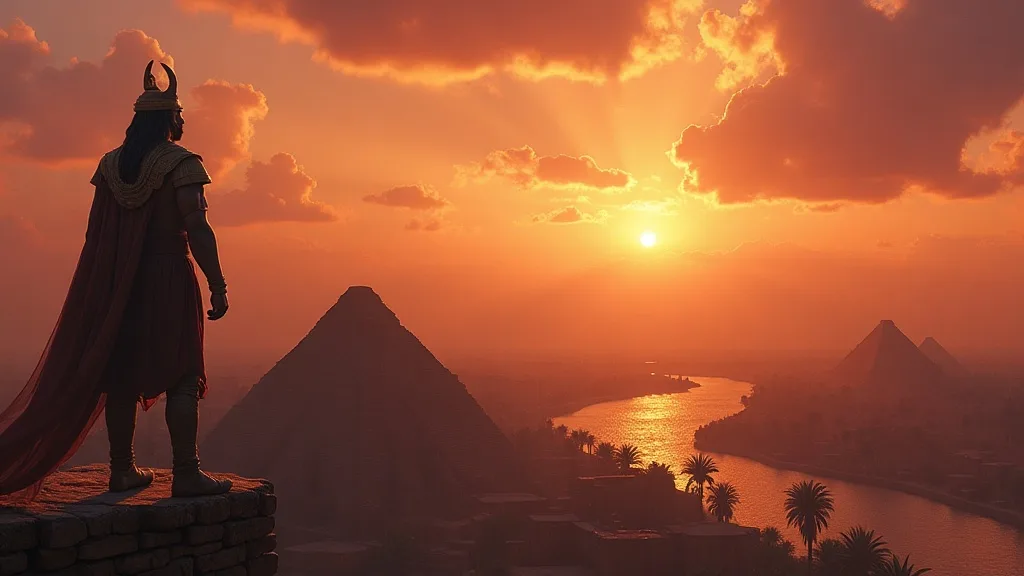
The walls of Uruk were built to last forever. Gilgamesh himself laid the first bricks, pressing cedar heartwood into mud mortar on the banks of the Euphrates, and the city rose from that labor like a boast aimed at the gods. He was two-thirds divine, one-third human - a ratio that ancient Sumerian scribes recorded without irony, because it explained everything: his terrifying strength, his sexual excess, his refusal to accept limits, and the grief that would eventually crack him open.
Gilgamesh: The King Who Sought Eternal Life is the central question of the oldest written epic on earth. Scholars date the earliest Sumerian narrative poems about him to around 2100 BCE, while the twelve-tablet Akkadian Standard Babylonian Version, assembled by a scholar-scribe named Sin-leqi-unninni, reached something like its final form around 1200 BCE. Clay tablets bearing his name have been recovered from Nineveh, Nippur, Megiddo, and even Hittite Anatolia. His story belongs to no single city and no single century.
He began as a tyrant. He ended as something the ancient Near East had no clean word for: a man who stared into the void, came back empty-handed, and chose to keep living anyway.
The Tyrant of Uruk and the Birth of Enkidu
Gilgamesh ruled Uruk with the weight of a man who knew he was exceptional and had not yet learned what to do with that knowledge. The epic opens with the city already under his thumb. He exhausted the young men with forced labor on his walls and, according to the poem, claimed the right to sleep with brides before their husbands. His people cried out to the great gods of the sky: to Anu, to Enlil, to Aruru the mother-goddess who had shaped Gilgamesh from clay.
Aruru's answer was Enkidu. She pinched off clay, flung it into the wilderness, and from it grew a man covered in matted hair, running with gazelles, drinking at watering holes with lions. He was the shadow self Gilgamesh needed before he could become the king his city deserved.
A trapper's son spotted Enkidu and panicked. He reported to Gilgamesh, who sent a temple prostitute named Shamhat into the steppe. She spent six days and seven nights with Enkidu. After that union, the animals at the watering hole shied away from him. He had crossed a threshold - not degraded, but initiated into the human world. Shamhat dressed him, taught him bread and beer, and led him toward Uruk.
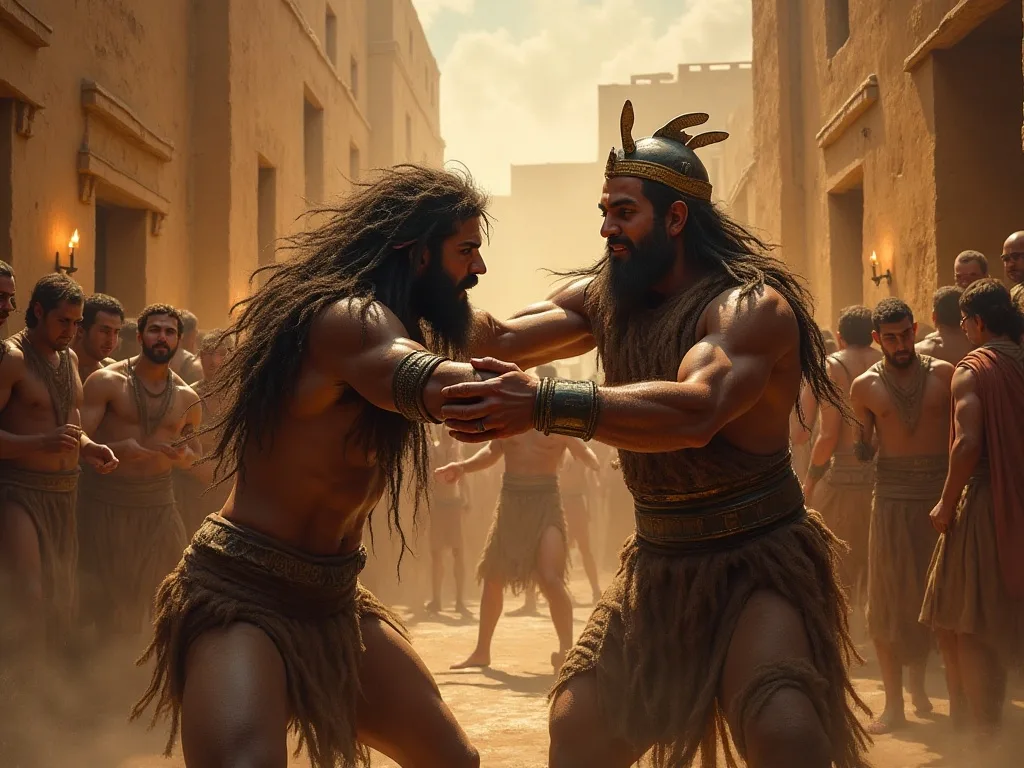
Their first meeting was a brawl. Gilgamesh was blocking a wedding-house door, asserting his prerogatives, when Enkidu stepped in front of him. The two men grappled in the street, doorposts splintering, walls shaking, until Gilgamesh threw Enkidu to the ground. And then, for reasons the poem never fully explains but every reader understands, they embraced. They became like brothers. The tyrant's excess had found its counterweight.
The Cedar Forest: Glory, Violence, and the Voice of Humbaba
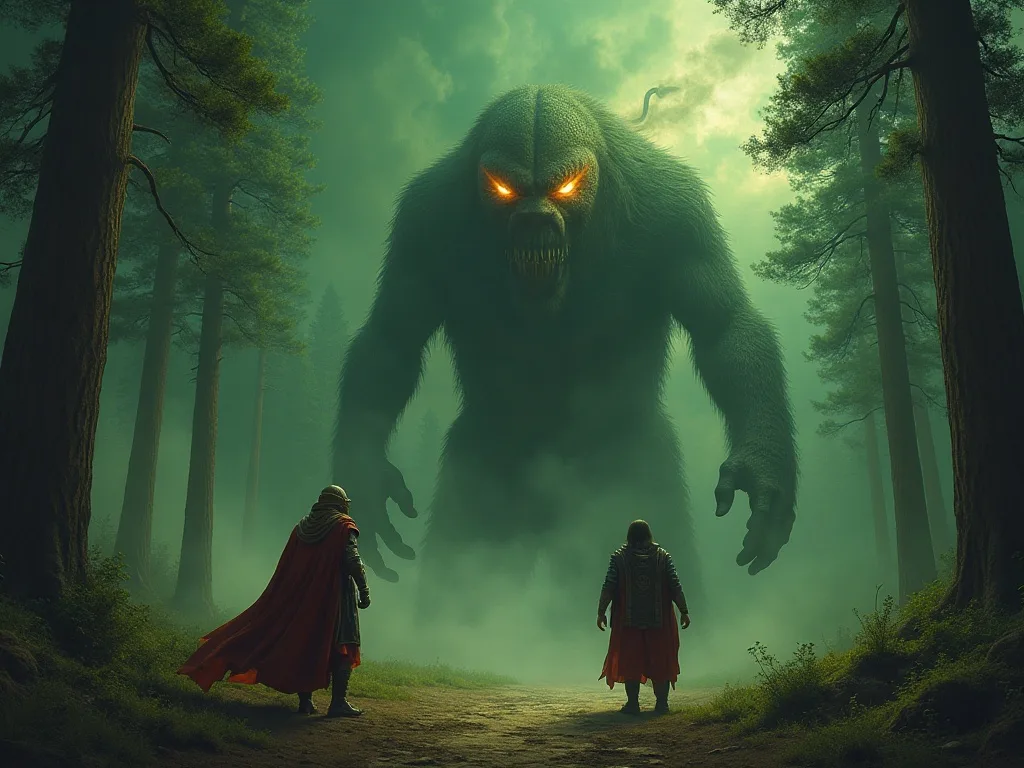
Once paired, the two men did what heroes do: they looked for a worthy enemy. Gilgamesh proposed a campaign to the Cedar Forest far to the west - modern Lebanon and Syria hold the ruins of its memory - where a monstrous guardian named Humbaba kept the trees sacred on behalf of the god Enlil. Cutting the cedars meant defying divine order. Enkidu, who had lived on the wilderness side of that order, understood the weight of the transgression. He argued against it.
Gilgamesh answered with the line that defines him in his heroic phase: "Who can scale heaven, only the gods. Only the gods live forever under the sun. As for mankind, numbered are their days, whatever they achieve is but wind." Better, he said, to die in battle and leave a name behind than to rot away in obscurity.
The Sumerian god of the sun, Shamash, blessed the campaign. He gave Gilgamesh thirteen winds to pin Humbaba down. The two heroes marched fifty leagues a day, ate one meal in three days, and dug wells in the sand to drink from. At the Cedar Forest, Humbaba's voice was like a flood, his breath like fire, his mouth was death. He pleaded for his life once they had him cornered, promising to cut trees freely for the king.
Gilgamesh wavered. Enkidu did not. Enkidu urged the killing, and Humbaba died, cursing them both before his head was struck off. They felled the great cedars and floated the timber downriver on a raft. The glory was real. So was the curse.
The Goddess Ishtar and the Bull of Heaven
Ishtar, goddess of love and war, watched Gilgamesh return to Uruk dusty and radiant from the cedar campaign. She offered him marriage, a proposal that would have meant divine patronage, divine fertility, the protection of Uruk's fields and herds. Gilgamesh refused her. His refusal was not modest - it was a catalogue of her previous lovers, every one of them transformed or killed by her fickleness: the shepherd Dumuzi condemned to the underworld, the bird Allallu with broken wings, the horse driven by the bit and whip, the lion slaughtered in pits.
The insult landed hard on Olympus-level heights. Ishtar went to her father Anu weeping and demanded the Bull of Heaven as a weapon of revenge. When Anu hesitated, she threatened to break down the gates of the underworld and release the dead to eat the living. Anu gave her the Bull.
The Bull snorted three times over Uruk and the earth opened. Hundreds of young warriors fell into the pits. On the fourth snort, Enkidu seized the Bull by the horns. Gilgamesh drove a sword between the neck and the shoulder blades, and the animal died with a bellow that shook the rooftops. Enkidu tore off a haunch and flung it in Ishtar's face.
That night, the city feasted. Gilgamesh washed his hair, polished his weapons, and put on his royal crown. Ishtar stood on the city wall and wailed. The heroes had gone too far.
The Death of Enkidu and the First Grief
The gods met in assembly. Humbaba was dead. The Bull of Heaven was dead. Someone had to pay. They decided on Enkidu.
He fell ill. He lay on his bed for twelve days, weakening. In lucid moments he cursed the trapper who had first spotted him and Shamhat who had brought him into civilization, then recalled her kindness and retracted the curse. He dreamed of the underworld: a man with the head of a bird and the claws of an eagle who dragged him down to the House of Dust, where former kings sat in the dark, wearing feather-cloaks, eating clay and dust. On the twelfth day, Enkidu died.
Gilgamesh's response was not composed. He wept. He circled the body for six days and seven nights, refusing to let the burial happen, watching the worm fall from Enkidu's nostril. That worm was the moment immortality stopped being an abstract problem and became a personal one. He tore his fine garments and put on lion skins and walked into the steppe.
Scorpion-Men, Siduri, and the Waters of Death
Gilgamesh traveled toward the sunrise, toward the mountains at the edge of the world where the sun rises and sets. At the gate of those mountains stood the Scorpion-people, creatures whose upper bodies were human and whose lower bodies were scorpions, their terror reaching heaven and their aura covering the mountains. They studied Gilgamesh - two-thirds divine, their instruments told them - and opened the gate.
He walked through twelve leagues of total darkness inside the mountain, no light in front, no light behind, until he emerged into a garden where the trees bore gems as fruit: carnelian, lapis lazuli, agates as leaves. This was the garden of the sun, and it was beautiful, and Gilgamesh walked through it without slowing.
At the edge of the sea he found Siduri, a tavern-keeper sitting behind a wall with a golden bowl and a golden vat. She barred her door when she saw him coming, this gaunt man in lion skins with grief in his eyes. He convinced her to open. She gave him the most honest advice anyone in the epic offers:
"When the gods created mankind, they allotted death to mankind, but life they retained in their own keeping. As for you, Gilgamesh, let your belly be full, make merry every day and night, dance and play day and night... gaze upon the child who holds your hand, let your wife delight in your embrace."
He refused. He asked for the way to Utnapishtim, the one mortal the gods had granted eternal life.
Siduri pointed him toward Urshanabi, the ferryman, who kept the Stone Ones and the Punting Pole. Through a mishap in their first meeting, Gilgamesh destroyed the Stone Ones and had to cut a hundred and twenty punting poles instead, since no living hand could touch the Waters of Death. He poled across.
Utnapishtim and the Secret of the Flood
Utnapishtim lived at the Mouth of the Rivers with his wife, the only two humans the gods had ever made immortal. He was old beyond counting, and calm in a way that makes grief look like weather. When Gilgamesh arrived and explained his quest, Utnapishtim asked the same question Siduri had asked in softer language: "Do you really think you can find eternal life?"
Then Utnapishtim told him the story. The gods had decided to send a flood. The god Ea, bound by the assembly's oath of silence, spoke not to Utnapishtim directly but to the reed walls of his house, telling the walls to build a great boat. The boat was a cube: 120 cubits on every side. Utnapishtim loaded silver and gold, all living creatures, his family, and the craftsmen of his city. For six days and seven nights the storm raged, flattening everything. The boat grounded on Mount Nimush. He sent out a dove, then a swallow, then a raven. The raven did not return. He disembarked. The gods smelled the sacrifice and gathered like flies. Enlil was furious that anyone had survived. Ea shamed Enlil into accepting what had happened. And Enlil himself took Utnapishtim and his wife by the hand and knelt them down and touched their foreheads and said: "Hitherto Utnapishtim has been but human, henceforth Utnapishtim and his wife shall be like unto us gods."
The flood narrative in Tablet XI of the Epic of Gilgamesh predates the Genesis account by at least five centuries in its written form. Scholars including Martin West, Andrew George, and Wayne Horowitz have mapped the direct transmission lines between the Babylonian and Hebrew versions, noting identical structural elements: the divine warning, the cube-shaped vessel, the three birds, the sacrifice, the rainbow (replaced in the Babylonian version by Ishtar's lapis lazuli necklace).
But Utnapishtim's point was not to impress Gilgamesh. His point was that the gods held a unique assembly for that one occasion and will not hold it again. Immortality was a singular accident of divine politics. It cannot be repeated.
As a test, he told Gilgamesh to stay awake for seven days and seven nights - sleep being the minor image of death. Gilgamesh sat down, and sleep blew over him like a breeze, and he slept for seven days. Utnapishtim's wife baked one loaf of bread per day and set them beside him as he slept, so he could not deny the passing time. When he woke, the loaves ranged from fresh to rotted.
The Plant at the Bottom of the Sea
On the point of leaving empty-handed, Utnapishtim's wife persuaded her husband to give Gilgamesh something: the location of a plant that grew at the bottom of the sea, thorny like a rose, that could restore an old man's youth. Not immortality. Renewal. Gilgamesh tied stones to his feet and walked on the sea floor, found the plant and pulled it, let the stones go and rose back to the surface.
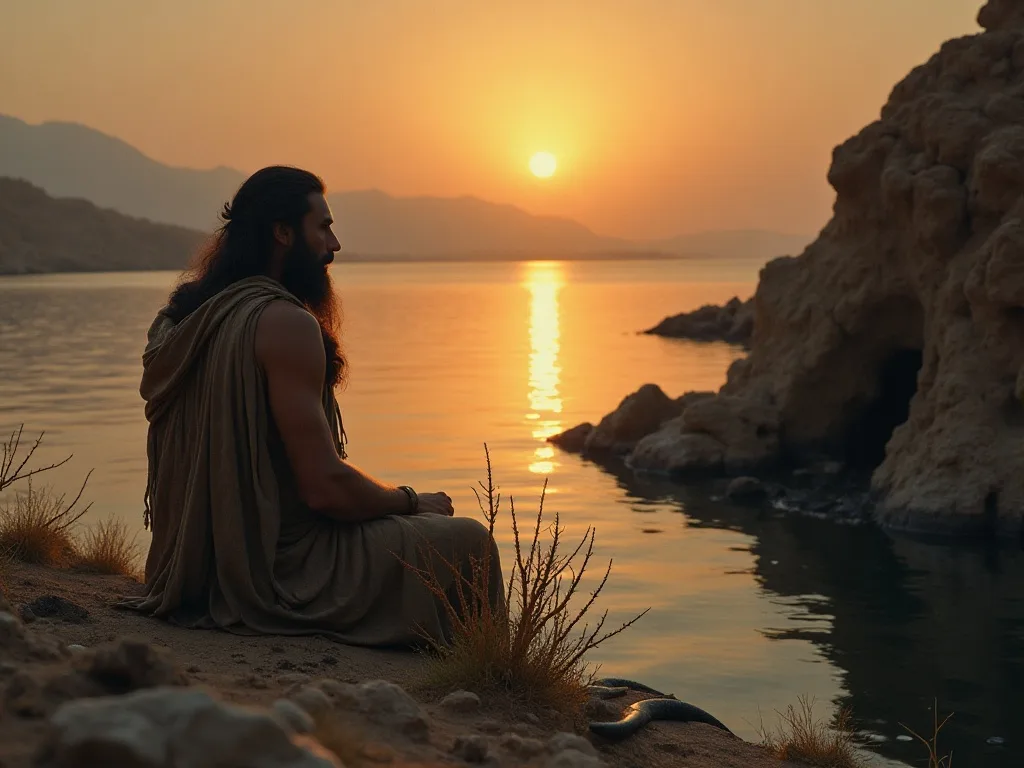
He carried the plant back across the Waters of Death with Urshanabi. On the road home he stopped at a cool watering hole. While he bathed, a snake smelled the plant's fragrance, came up from a hidden hole, and carried it away. As it went, it shed its skin. That is why snakes renew themselves - a small, spare etiological note in the middle of Gilgamesh's biggest failure.
He sat down and wept. Urshanabi sat beside him.
Uruk's Walls: The Answer Hidden in Plain Sight
The epic's final move is quiet, almost architectural. Urshanabi and Gilgamesh arrive at Uruk. Gilgamesh, with no plant and no immortality and no Enkidu, turns to the ferryman and says: look at the walls. See how they are laid. See the inner city, the date-palm garden, the temple precinct. One third city, one third garden, one third clay pits. Examine the foundation terrace. Touch the brickwork - kiln-fired brick. The plans were drawn by the Seven Sages.
This is how the poem opened. The narrator had told us, before anything began, to climb the walls of Uruk and walk the edge, to find the copper chest and the lapis tablet inside it, and to read the story of Gilgamesh, who had seen everything.
The walls endure. Not the king, not Enkidu, not the cedar trees. The built thing endures, and inside it is written the story of a man who learned that the walls were enough.
Gilgamesh in Modern Scholarship and Living Culture
Andrew George's 2003 critical edition of the Epic of Gilgamesh for Penguin, running to two volumes with facing cuneiform text, remains the scholarly standard. New tablet fragments continue to surface: in 2015, a 20-line fragment (Tablet V) acquired by the Sulaymaniyah Museum in Iraqi Kurdistan added fresh material to the Cedar Forest episode, including details about Humbaba's face made of looped intestines. The epic is literally still being recovered.
Gilgamesh's cultural afterlife is enormous. Rainer Maria Rilke read an early translation and felt it as "among the greatest things that can happen to a person." The story fed into Hermann Hesse, into Jorge Luis Borges, into contemporary novels like Philip Roth's Everyman (which borrows the structure of a mortality quest without citing it). Scholars of comparative religion note that the Gilgamesh-Enkidu bond prefigures the structure of the Achilles-Patroclus bond in the Iliad by several centuries, both stories using the death of a beloved companion as the engine of the hero's transformation.
In Iraq, Gilgamesh is national heritage. A massive bronze statue of him stands in front of the University of Sydney's Faculty of Arts. In 2003, during the looting of the Iraq Museum, the Warka Vase - one of the earliest depictions of Inanna/Ishtar and closely related to the ritual world of Gilgamesh's Uruk - was among the pieces stolen and later partially recovered.
The unresolved questions are real and alive. Was there a historical Gilgamesh? Most Assyriologists now believe there was a genuine king of Uruk in the Early Dynastic period around 2700 BCE, and the Sumerian King List records him as having ruled for 126 years. Whether any campaign against Humbaba or any journey to Utnapishtim reflects actual events is beyond recovery. The poem is clear that it doesn't matter. The poem says: go touch the bricks. They are there.
Frequently Asked Questions About Gilgamesh and His Epic
Frequently asked questions
What is the oldest known version of the Gilgamesh story?
The oldest texts are a group of five separate Sumerian poems about Gilgamesh, composed around 2100-2000 BCE during the Third Dynasty of Ur. These include "Gilgamesh and Agga," "Gilgamesh and the Bull of Heaven," and "Gilgamesh, Enkidu, and the Netherworld." They are shorter, more episodic, and were probably recited at court. The unified twelve-tablet Akkadian epic, assembled by Sin-leqi-unninni, came much later, around 1200 BCE, weaving these episodes into a single narrative arc.
Was Gilgamesh a real historical person?
Almost certainly a real king, though the mythologized version far overshadows the historical one. The Sumerian King List places him as the fifth king of the First Dynasty of Uruk, ruling for 126 years, which signals legendary status. Ancient Mesopotamian texts also refer to him as a builder of Uruk's walls and a figure of divine parentage. Some scholars, including Thorkild Jacobsen, have argued he likely ruled around 2700-2600 BCE during the Early Dynastic period, making him a contemporary of the earliest Egyptian pharaohs.
How does the flood story in the Epic of Gilgamesh relate to Noah's Ark?
The Babylonian flood story, told by Utnapishtim in Tablet XI, shares a striking number of specific details with Genesis 6-9: divine warning to a single righteous man, a boat built to divine specifications, the loading of animals, a multi-day storm, the boat grounding on a mountain, and the sending of birds to test whether the waters had receded. The Babylonian version predates Genesis in written form by several centuries. Most scholars today see the Genesis account as part of a broader flood-narrative tradition that circulated across the ancient Near East, with the Babylonian version being the oldest surviving written form of that tradition.
What is the significance of Enkidu's death in the Epic of Gilgamesh?
Enkidu's death is the pivot of the entire epic. Before it, Gilgamesh pursues fame as an abstract ideal, using the promise of a lasting name to justify risk. After it, death becomes intimate and personal. He has watched the exact process of decay in someone he loved more than anything. The mortality quest that drives the second half of the poem is not philosophical curiosity but grief converted into action. Many scholars, including Jeffrey Tigay, read the first and second halves of the poem as deliberately structured to show how grief reshapes identity.
What does the snake stealing the plant of rejuvenation mean?
The episode functions on several levels simultaneously. As an etiology, it explains why snakes shed their skin and appear to renew themselves. As a narrative beat, it is Gilgamesh's final and most complete failure: he cannot hold onto even the consolation prize. But scholars including Martin West and Andrew George read the theft not merely as tragedy but as clarification. The plant was called "The Old Man Becomes Young Again" - it was renewal, not immortality. Even had he kept it, it would not have solved the problem. The snake's theft forces the hero back to the only answer available: the walls of Uruk, the permanent record of a life fully lived.
How does the Epic of Gilgamesh compare to the Iliad or Odyssey?
The comparison is instructive but asymmetric. The Gilgamesh epic predates Homer by roughly five centuries in its written form. Both traditions feature a hero of partly divine parentage, a grieving warrior whose companion dies, and a journey to the edge of the world. Martin West, in "The East Face of Helicon" (1997), documented specific textual parallels between Gilgamesh and the Homeric epics, arguing for genuine transmission rather than coincidence. The structure of Achilles' grief over Patroclus in the Iliad mirrors Gilgamesh's grief over Enkidu closely enough that many scholars consider the Homeric tradition to have absorbed, transformed, and redirected Mesopotamian material.
The Walls as Answer: Permanence Against the Void
The poem's final image is not a god descending, not a miracle, not even a consolation. It is a city wall made of kiln-fired brick, which will outlast the man who built it.
That is a specific and demanding answer to the question Gilgamesh spent two thirds of the poem screaming into the wilderness. The gods keep life for themselves. The waters of death are real. The plant of renewal gets stolen by a snake. What remains is what the hands built: Uruk, three leagues of wall and garden and sacred ground, and inside the copper chest at the city's foundation, a lapis tablet with the whole story written on it.
The poem instructs the reader to be that reader. To find the tablet. To read the story. That recursive gesture, the text pointing to itself as the artifact that endures, is what makes the Epic of Gilgamesh something more than a mortality quest. It is the earliest written argument that literature itself is the answer to death, that the story survives when the king does not.
Scholars still argue about Sin-leqi-unninni's intentions, about whether the Utnapishtim episode was always part of the epic or added later, about what exactly the Scorpion-people guard. New tablets will continue to surface from Iraqi soil, each one adding a line or a variant. Gilgamesh keeps being recovered, kept being assembled from fragments, kept refusing to be finished. The walls of Uruk are still standing in the meaning that matters.
Read the full book
Want the whole story?
The complete edition is an instant PDF download here, with a paperback on Amazon for selected titles.
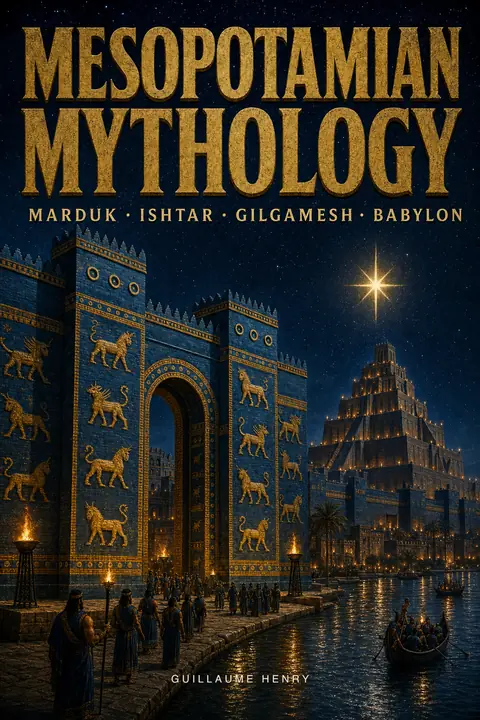
Mesopotamian
The Mesopotamian Mythology Book: Marduk, Tiamat, Ishtar and the Sacred Stories of Babylon's Cosmic Order
From Sumer to Assyria: The Gods Who Shaped Civilization
The full sweep of Mesopotamian myth from Sumer through Babylon and Assyria. Marduk's battle with Tiamat, Ishtar's descent, the Enuma Elish, and the Anunnaki who ruled before the flood.
More from Mesopotamian
All articles
Mesopotamian
Inanna's Descent to the Underworld: The Oldest Journey Through Death
Inanna, Queen of Heaven, stripped of her power gate by gate, faced her dark twin in the land of no return. Her story, written 4,000 years ago, is the oldest recorded descent myth on Earth.
Mesopotamian
Inanna: Goddess of Love, War, and the Morning Star
Inanna ruled desire, battle, and the blazing planet Venus from the oldest cities on earth. Her myths rewrote how humanity understood power, descent, and resurrection.
Mesopotamian
Ishtar: Goddess of Love and War in Ancient Mesopotamia
Ishtar ruled the Mesopotamian cosmos as the goddess of desire, war, and the morning star. Her myths shaped civilization for three thousand years and still echo in every culture that followed.
Mesopotamian
Marduk: King of the Babylonian Gods
Marduk rose from a minor deity of Babylon to the supreme god of Mesopotamia, slaying the chaos-dragon Tiamat and building the cosmos from her body. His story reshaped ancient religion for over a thousand years.