
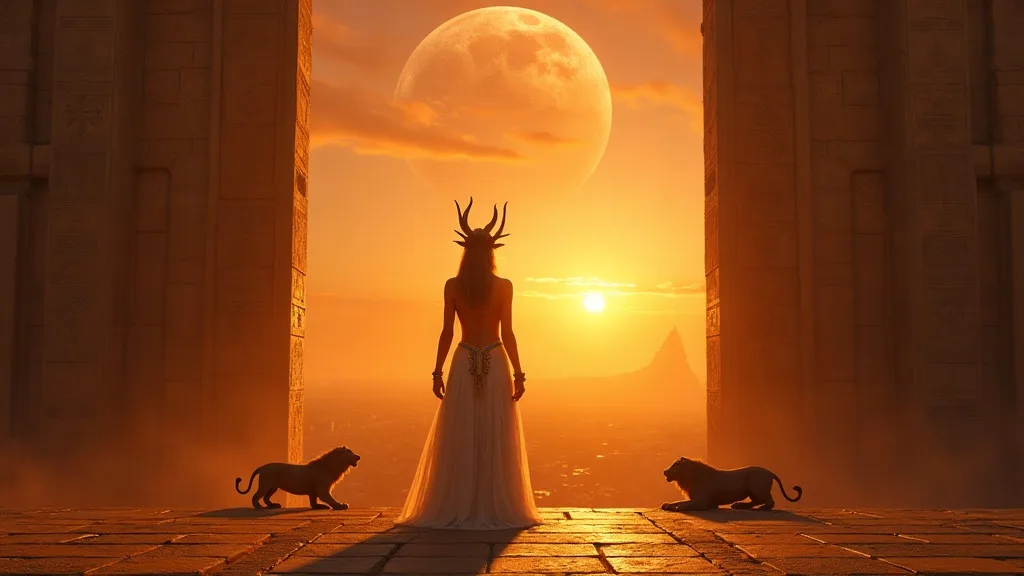
Inanna: Goddess of Love, War, and the Morning Star
Inanna ruled desire, battle, and the blazing planet Venus from the oldest cities on earth. Her myths rewrote how humanity understood power, descent, and resurrection.
Contents
She arrives before dawn, blazing on the eastern horizon, and the whole city of Uruk holds its breath. Priests of the Eanna temple read her light the way sailors read the sea. To the Sumerians, Inanna: Goddess of Love, War, and the Morning Star was not a symbol. She was a presence that walked through marriages, through harvest seasons, through the blood-soaked aftermath of battle, and back again.
No other deity in the ancient Near East carried such an openly contradictory portfolio. She owned the me, the divine powers that organised civilisation itself. She could shatter armies and spark desire in a single breath. For roughly three thousand years, from the Early Dynastic period (c. 2900 BCE) to the late Babylonian era, her cult stretched from Nippur to Nineveh. The hymns composed in her honour by the high priestess Enheduanna around 2285 BCE are the oldest attributed literary works in human history, making Inanna's mythology not just old but foundational.
Queen of Heaven: Inanna's Origins and Names
The name Inanna derives most likely from the Sumerian Nin-an-ak, "Lady of Heaven." Her Akkadian counterpart Ishtar carries the same celestial throne but shifts certain emphases: the Akkadian tradition amplifies her martial fury and softens the erotic autonomy that Sumerian texts celebrate so openly. Both names describe Venus, the planet that Mesopotamian astronomers tracked with extraordinary precision, recording its eight-year cycle of appearances as the Morning Star and Evening Star by at least the Old Babylonian period.
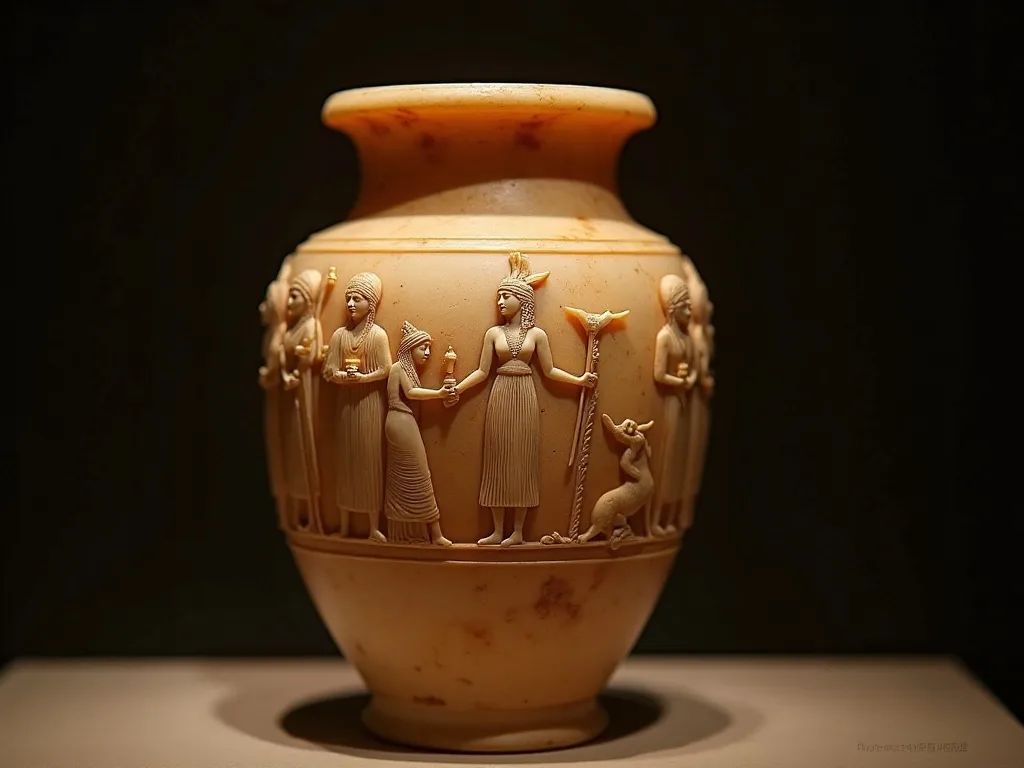
Her cult center was the Eanna ("House of Heaven") precinct at Uruk, one of the world's first true cities. Excavations there have uncovered the great Uruk Vase, a carved alabaster vessel dating to roughly 3000 BCE, which depicts a procession of offerings moving toward a robed female figure almost certainly identifiable as Inanna. This single object places her at the center of the world's earliest urban ceremonial life.
Her parentage varies by source. In most Sumerian texts, she is the daughter of the moon god Nanna (also called Sin) and the goddess Ningal. This makes her the sister of Utu, the sun god, a sibling relationship that recurs constantly in her myths, where Utu functions as her closest moral counsellor. In some traditions, she is instead the daughter of An, the sky god, which explains the epithet "Queen of Heaven" more directly. The Akkadian Ishtar is often listed as a daughter of Anu (the Akkadian An) or sometimes of Sin, reflecting the syncretic borrowings between the two traditions.
The Me: How Inanna Stole the Powers of Civilisation
The myth known as Inanna and Enki gives the sharpest account of how a single deity came to dominate Mesopotamian religious life. Enki, the god of wisdom and freshwater, holds the me in his treasury at Eridu. The me are the building blocks of ordered life: kingship, priesthood, descent into the underworld, the art of lovemaking, the craft of smithing, the sound of music, the practice of law. Enki's list in the myth runs to over one hundred entries.
Inanna travels to Eridu, dines with Enki, and the two drink together. Whether the ale loosens his guard or whether Inanna simply outmanoeuvres him is left productively ambiguous in the text. He hands over the me one by one, each transfer marked by the refrain "he gave them to her." When Enki sobers and realises what he has done, he sends sea monsters to retrieve his gifts. Inanna, riding in the Boat of Heaven, repels them all and sails back to Uruk. The city celebrates.
The myth is more than a story about trickery. It argues that Inanna, specifically the patron of Uruk and of human desire, is the rightful custodian of culture. Power flows not from the old patriarchal seat at Eridu but from the city itself, from love, creativity, and war together.
Descent to the Great Below: Inanna and the Underworld
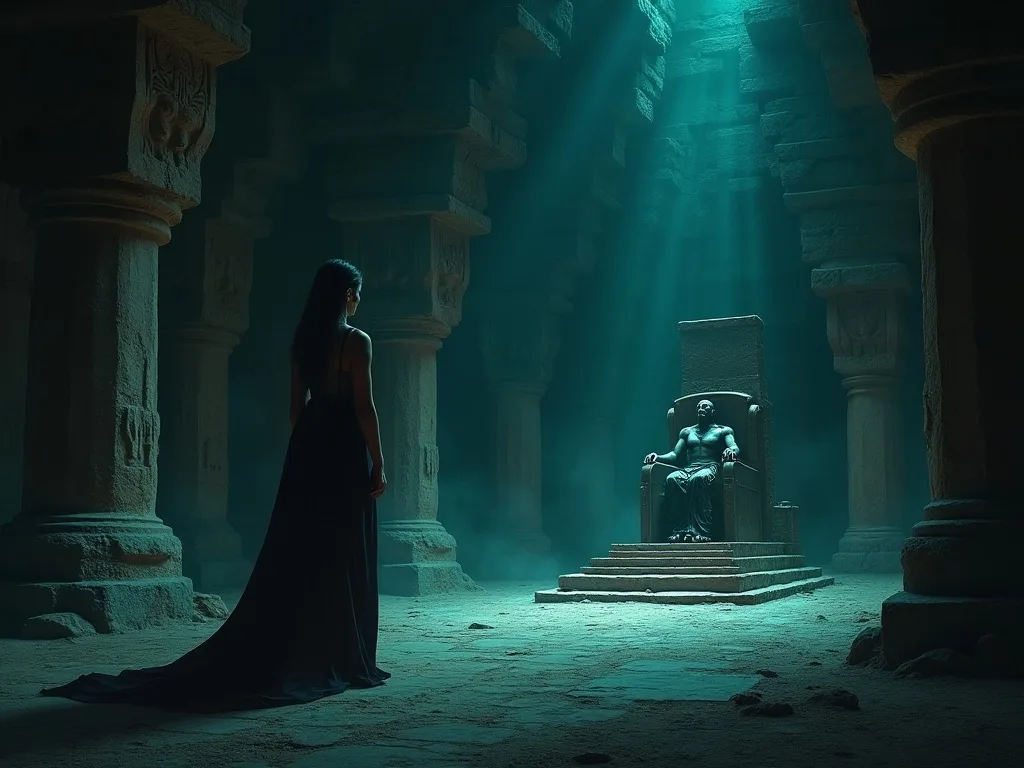
No Mesopotamian story has generated more scholarly ink than Inanna's Descent to the Underworld, preserved on tablets from the Third Dynasty of Ur (c. 2100-2000 BCE) and from the Old Babylonian period. It is a myth about a god who dies and returns, which places it in conversation with later resurrection traditions across the ancient world.
Inanna descends to the Kur, the Great Below, ruled by her sister Ereshkigal, Queen of the Dead. Her stated reasons vary across versions: curiosity, a desire to attend the funeral of Ereshkigal's husband Gugalanna, or a more aggressive ambition to seize the underworld itself. She dresses in her full regalia: crown, lapis-lazuli necklace, golden ring, breastplate, and more. She warns her servant Ninshubur to raise a mourning cry if she does not return in three days.
At each of the seven gates of the underworld, a gatekeeper removes one item of her power. Gate by gate, she is stripped down. When she arrives before Ereshkigal, she is naked. Ereshkigal turns the "eye of death" on her, and Inanna is killed, her body hung on a hook like a slab of meat. The image is brutal and deliberate.
Three days pass. Ninshubur mourns and petitions the gods. Enlil and Nanna refuse to help. Enki acts. He fashions two small beings from dirt, gives them the food and water of life, and sends them to the underworld with instructions to simply mourn with Ereshkigal, whose grief is absolute. When the mourning creatures offer her the gifts, the queen of the dead relents, and Inanna is restored.
But there is a price. The underworld requires a substitute. Inanna returns to find her husband Dumuzi sitting on her throne, well dressed and unmourned. She does not hesitate. She hands him over to the demons. Later myth adds nuance: Dumuzi's sister Geshtinanna offers to take his place for half the year, establishing a seasonal alternation. Here, centuries before the Greeks told of Persephone, Mesopotamia had already written a complete theology of seasonal death and return.
The seven-gate structure carries symbolic freight that scholars still debate. Samuel Noah Kramer, who translated the key Sumerian tablets in the twentieth century, argued the descent reflected actual initiatory ritual. More recent scholars including Thorkild Jacobsen and Betty De Shong Meador have focused on the political theology embedded in the text, specifically the argument that no power, not even the goddess's own, operates outside the law of reciprocity.
Inanna and Dumuzi: Love, Loss, and Sacred Marriage
The texts collected under the heading of the Sacred Marriage (hieros gamos) form one of the richest corpora in Sumerian literature. These poems, some intensely erotic, some deeply elegiac, trace the courtship, marriage, and eventual loss of Inanna and her shepherd-king Dumuzi. A passage from one Old Babylonian hymn runs: "My honey-man, my honey-man sweetens me always. My lord, the honey-man of the gods, he is the one my womb loves best."
The institution of the sacred marriage likely involved the annual ritual union of the king with the goddess, either literally (with a priestess representing Inanna) or symbolically, to ensure fertility for the land. Scholars remain divided on the precise ritual practice, but the textual evidence for the ideology is overwhelming.
What makes the Dumuzi cycle extraordinary is its emotional register. Inanna's grief for Dumuzi after she hands him over to the Gallu demons is raw and specific. One lament runs: "He is gone, he is gone to the breast of the earth." The myths refuse to sentimentalise the sacred. Love and political necessity intersect without resolution, which is partly why the texts read so powerfully to modern readers.
Warrior Goddess: Inanna on the Battlefield
The martial dimension of Inanna sits uneasily for readers who expect love goddesses to be soft. Mesopotamia made no such separation. The Hymn to Inanna by Enheduanna describes her inciting mass slaughter with the energy of a storm: "Like a dragon she has deposited venom on the land. When she roars at the earth, no vegetation can stand up to her."
She is depicted on cylinder seals armed with weapons bundled on her back, lions at her feet. The Stele of the Vultures from Lagash (c. 2450 BCE) shows a giant divine hand holding enemies in a net, imagery scholars associate with the celestial warrior's intervention in human battles. By the Akkadian period, Ishtar had absorbed this quality so completely that kings of Assyria regularly invoked her as a war goddess before major campaigns.
Her planetary identity as Venus reinforces the martial register. Venus as the Morning Star rises before the sun and, in Mesopotamian metaphor, leads the solar army into the sky. As the Evening Star she is the last light standing after the sun falls. Both positions encode vigilance, combat readiness, and the liminal moment between worlds.
She is also the mistress of paradox in gender. Sumerian hymns repeatedly describe her transformative power over sex and gender: she turns men into women and women into men, transforms priests into priestesses and soldiers into weavers. Her cult included gala priests who performed laments in a special ritual dialect and whose social identity sat deliberately outside binary categories. This detail is not incidental. Inanna's power over gender transformation was theological, not marginal.
Venus Observed: Mesopotamian Astronomy and Inanna's Star
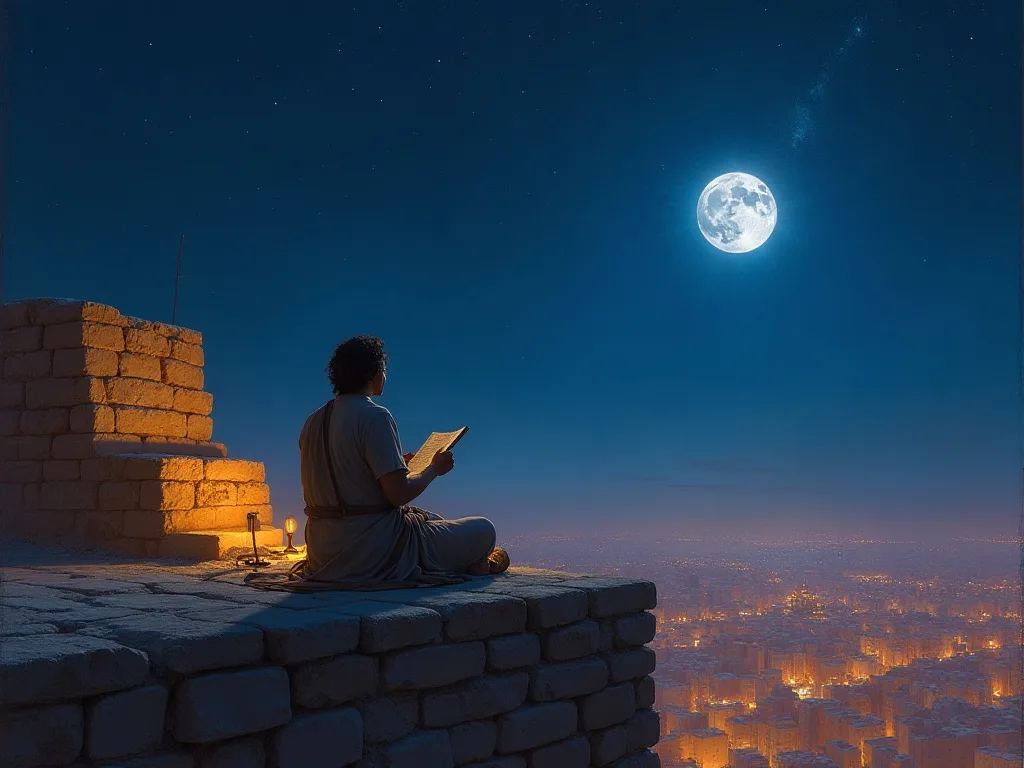
Mesopotamian astronomers tracked Venus with striking accuracy. The Venus Tablet of Ammisaduqa, dated to around 1650 BCE and preserved in later Assyrian copies, records twenty-one years of Venus risings and settings alongside omens. It is among the oldest systematic astronomical records in human history. The tablet makes no separation between astronomy and theology: each disappearance of Venus from the sky is Inanna's descent, each reappearance her return.
The eight-year cycle of Venus, during which the planet traces a near-perfect pentagram against the zodiac, was already understood in rough terms by Babylonian astronomers. It grounded the mythology in observable celestial mechanics, giving Inanna's death and resurrection a reliable, repeating calendar. Her myth was not just a story. It was a predictive tool.
This astronomical grounding distinguishes the Mesopotamian Venus tradition from later Greek treatments of Aphrodite or Roman treatments of Venus. The Greeks named the planet for the goddess; the Mesopotamians built the goddess's entire narrative arc from the planet's behaviour. The observation came first.
Inanna's Legacy Across Traditions
The influence of Inanna on subsequent Near Eastern religious traditions is difficult to overstate. The Canaanite goddess Astarte carries her war-and-love portfolio almost intact. The Egyptian Hathor shares the celestial queenship and erotic power, though through different textual channels. The Greek Aphrodite, born from the sea near Cyprus, a Phoenician trading post, almost certainly absorbed Ishtar-Inanna attributes through Levantine contact.
The Descent narrative finds echoes in the myth of Persephone's abduction, in the death-and-resurrection pattern of Osiris, and in later mystery cult traditions across the Hellenistic world. Whether these are direct borrowings or parallel responses to the same astronomical and agricultural concerns is a question scholars debate without settled consensus. What is clear is that Inanna arrived first, and the others follow in her wake.
Her survival into the modern imagination has been quiet but persistent. The nineteenth-century decipherment of cuneiform, led by scholars including George Smith and later Samuel Noah Kramer, brought her texts into Western consciousness. Kramer's 1969 book The Sacred Marriage Rite introduced the erotic hymns to a broad audience. Since then, Inanna has appeared in depth psychology (Jungian analysts read the Descent as a model of individuation), in feminist theology, in poetry, and in contemporary fiction.
The Akkadian Gilgamesh epic, the oldest long narrative poem, gives a striking snapshot of how even the greatest hero handled her attention: badly. When Gilgamesh rejects Ishtar's marriage proposal by cataloguing the fates of her former lovers, her rage brings the Bull of Heaven down on Uruk. The episode is not presented as the goddess being petty. It is presented as a king failing to understand that rejecting the principle of sacred love has cosmic consequences.
Frequently Asked Questions About Inanna, Goddess of Love, War, and the Morning Star
Frequently asked questions
What is the difference between Inanna and Ishtar?
Inanna is the Sumerian name; Ishtar is the Akkadian equivalent, adopted by Babylonian and Assyrian traditions. The two share the same core mythology, the Morning Star identity, the descent narrative, and the love-war portfolio, but Akkadian texts tend to emphasise martial fury more heavily, while Sumerian hymns give greater space to erotic autonomy and the me mythology. By the first millennium BCE, Ishtar had largely absorbed Inanna in common usage across Mesopotamia.
Who wrote the earliest hymns to Inanna?
The high priestess Enheduanna, daughter of Sargon of Akkad, composed a cycle of hymns to Inanna around 2285 BCE, including "The Exaltation of Inanna" (Inninsagurra) and "Inanna and the Pantyheon" (Inninmehusa). These are the oldest attributed literary works in human history, predating Homer by over fifteen centuries. A calcite disc depicting Enheduanna was excavated at Ur and is now held at the Penn Museum in Philadelphia.
What are the seven gates in the myth of Inanna's Descent?
The seven gates of the underworld are the threshold points through which Inanna passes on her way to the Kur, the Great Below. At each gate, a gatekeeper removes one piece of her divine regalia: her crown, her lapis-lazuli necklace, her golden ring, her breastplate, her gold bracelet, her measuring rod, and finally her royal robe. Each removal corresponds to a loss of power and identity. She arrives before Ereshkigal completely stripped of her divine attributes, which is both a humiliation and a prerequisite for the death that follows. The seven-gate structure likely reflects Mesopotamian cosmological ideas about seven heavenly and underworld layers.
Was the Sacred Marriage of Inanna and Dumuzi an actual ritual?
Scholars debate this. Textual evidence confirms the ideology of a sacred marriage (hieros gamos) in which the king ritually united with Inanna to secure fertility and legitimacy. Whether this involved a physical union between the king and a priestess, or a purely symbolic ceremony, remains contested. Thorkild Jacobsen argued for a real ritual act; more recent scholars including Julia Assante have questioned whether the erotic hymns were ritual scripts at all, proposing instead that they are literary texts celebrating royal legitimacy through marital metaphor.
How did Mesopotamian astronomers connect Inanna to the planet Venus?
Babylonian astronomers documented Venus's appearances and disappearances systematically, most famously in the Venus Tablet of Ammisaduqa (c. 1650 BCE). Each of Venus's heliacal risings and settings was interpreted through the lens of Inanna's mythology: her disappearance from the sky matched her descent to the underworld, her reappearance her return from death. This was not metaphor layered over observation; the astronomical record and the theological narrative were, for Mesopotamian scholars, the same document read at two registers simultaneously.
What happened to Inanna's worship after the fall of Mesopotamian civilisations?
Her cult persisted remarkably late. Ishtar temples remained active in Assyrian cities into the seventh century BCE. At Assur and Nineveh, Ishtar held a central military role, invoked by kings on campaign. After the Achaemenid Persian conquest of Babylon in 539 BCE, her cult continued within a syncretised Persian-Babylonian framework. The Hellenistic period saw her absorbed into the figure of Aphrodite and later Astarte in the Levant. By the Roman era, her mythology had been dispersed through multiple deity forms, but specific cult practice under her own name had largely ended by the first or second century CE.
The Descent as Model: Inanna's Enduring Psychological and Theological Force
Three thousand years after the last Ishtar temple fell silent, the descent myth still generates serious scholarship and genuine creative response. The reason is structural: the narrative encodes a pattern that recurs in human experience with stubborn regularity. A figure of great power voluntarily enters a place of absolute powerlessness, is stripped of every external marker of identity, dies, and returns changed.
Jungian analyst Sylvia Brinton Perera published Descent to the Goddess in 1981, reading Inanna's journey as a map of psychological breakdown and renewal specifically relevant to women reclaiming instinctual power suppressed by patriarchal culture. The book found a large readership and remains in print. More recently, poet and scholar Betty De Shong Meador translated the Enheduanna hymns directly from Sumerian in her 2009 book Inanna, Lady of Largest Heart, giving English readers access to the raw texture of the original verse for the first time without academic mediation.
What these modern engagements share is an insistence that Inanna is not a curiosity from a dead civilisation. The paradox she embodies, love that contains war, desire that demands sacrifice, power that can only be proven by surrendering it, is not resolved in any of her myths. She does not arrive at peace. She arrives back at the city of Uruk with demon escorts and a husband newly condemned. The morning star rises, brilliant and cold. The city holds its breath again.
That irresolution is the point. Mythology that offers clean answers goes stale. The Inanna myths, precisely because they hold their contradictions without blinking, keep finding new readers who recognise something true in the pattern: that the forces that create also destroy, and that a goddess capacious enough to hold both is more honest about human experience than any figure who rules only one half of it.
Read the full book
Want the whole story?
The complete edition is an instant PDF download here, with a paperback on Amazon for selected titles.
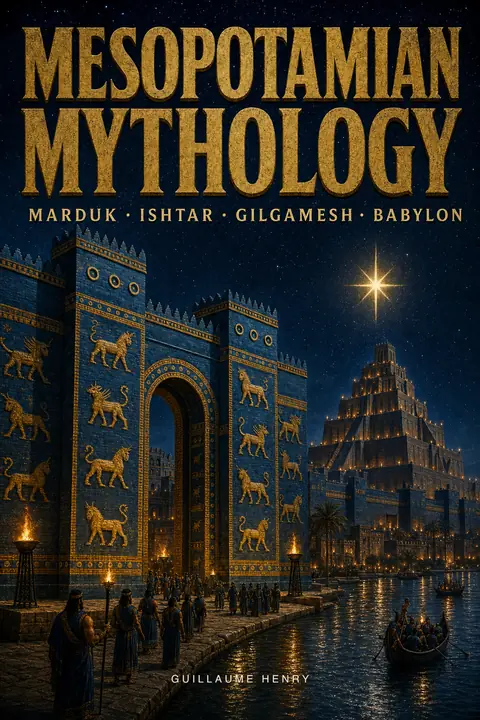
Mesopotamian
The Mesopotamian Mythology Book: Marduk, Tiamat, Ishtar and the Sacred Stories of Babylon's Cosmic Order
From Sumer to Assyria: The Gods Who Shaped Civilization
The full sweep of Mesopotamian myth from Sumer through Babylon and Assyria. Marduk's battle with Tiamat, Ishtar's descent, the Enuma Elish, and the Anunnaki who ruled before the flood.
More from Mesopotamian
All articles
Mesopotamian
Gilgamesh: The King Who Sought Eternal Life
Gilgamesh ruled Uruk, fought monsters, and crossed the waters of death chasing a secret that no mortal could keep. His epic is the oldest great story humanity ever wrote down.
Mesopotamian
Inanna's Descent to the Underworld: The Oldest Journey Through Death
Inanna, Queen of Heaven, stripped of her power gate by gate, faced her dark twin in the land of no return. Her story, written 4,000 years ago, is the oldest recorded descent myth on Earth.
Mesopotamian
Ishtar: Goddess of Love and War in Ancient Mesopotamia
Ishtar ruled the Mesopotamian cosmos as the goddess of desire, war, and the morning star. Her myths shaped civilization for three thousand years and still echo in every culture that followed.
Mesopotamian
Marduk: King of the Babylonian Gods
Marduk rose from a minor deity of Babylon to the supreme god of Mesopotamia, slaying the chaos-dragon Tiamat and building the cosmos from her body. His story reshaped ancient religion for over a thousand years.