

Sedna: Inuit Goddess of the Sea and Marine Animals
Sedna rules the Arctic depths as the Inuit goddess of the sea and marine animals. Her story begins with betrayal and transformation: a fallen maiden becomes the sovereign of the ocean, controlling the seal, whale, and fish that sustained Arctic peoples for millennia. Discover how her myth shaped survival, hunting ritual, and the spiritual bond between humans and the sea.
Contents
A woman falls from the sky into black Arctic waters. Her father, terrified and greedy, cuts her fingers from his kayak to save his own life. Those severed fingers become seals, whales, and walruses. The woman sinks to the ocean floor and becomes Sedna, sovereign of the sea and all marine life. She is neither punished nor powerless. She is transformed into something far more dangerous and real: a force that Inuit peoples depend on, fear, and must continually appease.
Sedna is the Inuit goddess of the sea and marine animals, a figure whose story reveals something essential about how Arctic peoples understood survival, trust, and the sacred bond between human and ocean. She is not distant or serene. She is present in every seal hunted, every whale caught, every storm that threatens kayaks and ice-edge camps. To live on the Arctic coast meant living with her will.
The Betrayal and the Transformation
The origin myth of Sedna varies across Inuit and Yupik cultures, but the core tragedy remains constant: a young woman is promised to a mysterious stranger, marries him believing he is a great hunter, and discovers after the wedding that he is either a bird-man or a spirit of another kind entirely. In some versions, her father is the one who arranges the deception. In others, the stranger himself is the deceiver.
When the young woman's father (or rescuer, depending on the version) discovers the truth and tries to recover his daughter, a violent storm erupts. The couple flees in a kayak. The father pursues in his own boat. Terrified, the father grabs his daughter and throws her overboard. She clings to the kayak's edge. He smashes her fingers with his paddle. Each severed finger hits the water and transforms: the nails become whale skin, the finger bones become seal fat, the joints become walrus tusks. The bones and flippers and blubber that would sustain Arctic peoples for centuries came from her own body.
Sedna sinks to the bottom of the sea, and there she remains as the mother and mistress of all ocean creatures. She sits in a state of profound anger. Her hair floats around her in the deep, tangled with the filth and sins of the human world. The shamans who undertake spirit journeys to visit her underwater realm report that her hair is filthy because humans break taboos: they cut seal skin the wrong way, they speak the animal's true name carelessly, they waste meat, they lie.
The Mistress of the Abyss
Sedna dwells in a deep house on the ocean floor, surrounded by all the creatures that came from her fingers. She does not simply own them; she is their mother. When hunters kill a seal, they are, in a sense, taking Sedna's child. This reciprocal relationship shapes everything: respect, ritual, gratitude, and the constant need for appeasement.
To Inuit peoples of the Canadian Arctic, Greenland, Alaska, and Siberia, Sedna was not a myth to enjoy at leisure. She was a presence that governed whether families ate or starved. A season of poor hunting meant that Sedna had withheld her creatures, possibly because humans had offended her. A whale washed ashore was a gift so profound that it warranted community ceremony and thanksgiving.
The Underwater Realm and Its Denizens
In the depths where Sedna rules, the geography is inverted and strange. The seals and whales and fish that inhabit the living ocean are, in the spirit world, humans like any other. They wear clothes, they live in homes, they have laws and communities. When a hunter kills a seal, the seal's spirit must be treated with honor; otherwise, it will tell Sedna, and she will hide her creatures from the entire village.
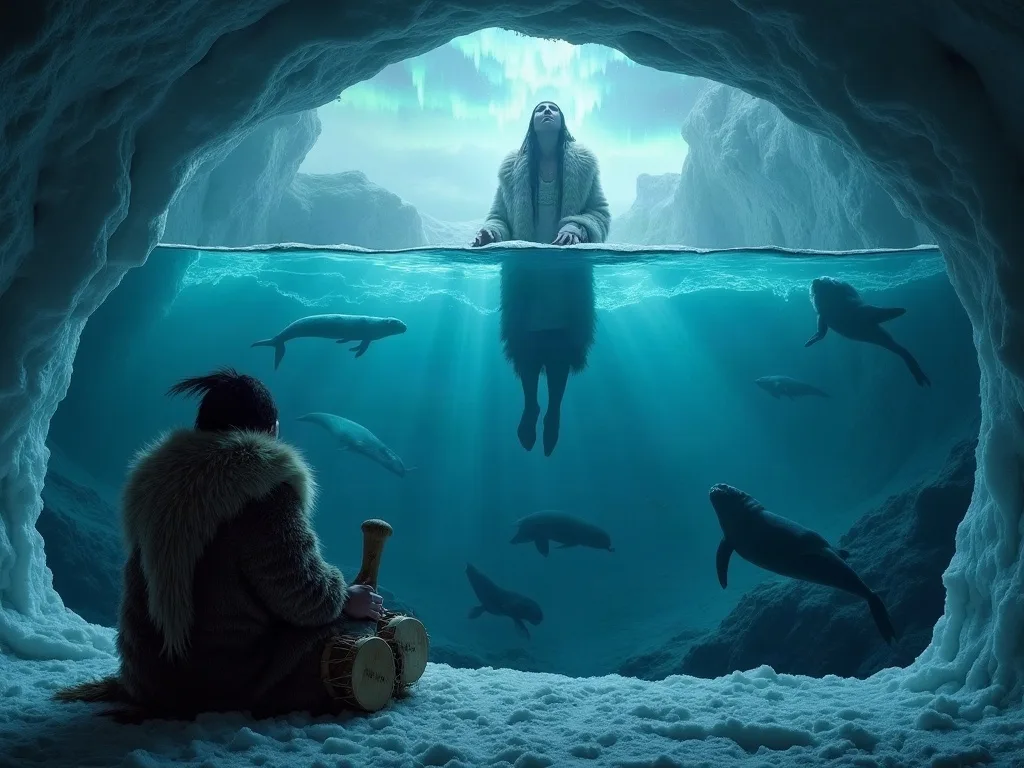
Shamans who journey to Sedna's realm describe her house as a cavernous, whale-rib structure. She sits at the back, her hair matted and foul. The shamans must comb her hair, confessing on behalf of the village all the taboos that were broken, all the hunting protocols violated, all the waste and disrespect. As the shaman combs and speaks, Sedna's expression softens. Her hair is cleaned. She releases her creatures back to the hunters. The hunting season can resume.
This shamanic journey was not symbolic theatre. For Arctic peoples, it was the mechanism by which the physical and spiritual worlds stayed aligned. A poor hunt was not bad luck; it was spiritual debt.
Taboos, Rituals, and the Law of the Sea
Living under Sedna's rule meant a life woven through with prohibitions and observances. Each marine animal carried strict protocols for butchering, storage, and use. To cut a seal's skin in the wrong direction was an offense. To allow seal meat to spoil without use was a desecration. To speak a whale's name carelessly was to invite her anger.
Different regions under Sedna's dominion maintained different taboos. In some Greenlandic traditions, sealskin and whale products could not be brought into a house where childbirth had occurred, because the spiritual states were incompatible. In other Yupik communities, the first seal of the season required ceremonies that lasted days, with special singing and gift-giving to appease Sedna and honor the creature's sacrifice.
These were not superstitions born of ignorance. They were technologies of respect and sustainability encoded in spiritual language. By treating each hunt as a sacred obligation, by maintaining elaborate protocols, Arctic peoples ensured that marine populations were never thoughtlessly depleted. The taboo system was a hunter's covenant.
The Shamanic Descent
When famine threatened and hunting failed, shamans undertook the dangerous journey to Sedna's realm. The ritual was graphic and often brutal. The shaman would enter a trance, sometimes with the help of a drum, and their spirit would descend through the layers of the underworld: first through layers of ice, then through the sea floor, until arriving at Sedna's house.
The journey was not safe passage. The shaman might encounter Sedna's father (who, in some versions, had transformed into a spirit guardian of the threshold), or they might face the Inua (the spirit essence) of a seal or whale whose offended spirit still lingered. The shaman had to navigate these dangers, reach Sedna, comb her hair, confess, and convince her to release her creatures back to the world.
Success meant a successful hunt. Failure meant continued scarcity. The shaman bore responsibility for the village's spiritual welfare, and the stakes were tangible: whether children would eat.
Sedna Across Arctic Cultures
While Sedna is most closely associated with Inuit traditions of Greenland and North America, her worship and fear extended across Arctic and Subarctic peoples. The name itself has regional variations. In Greenlandic, she is Arnakuagsak. In some Yupik languages, she is Arnakhuaghak. In Sami traditions, similar ocean mother figures emerged. The specific narrative changes, the spiritual geography shifts, but the core principle remains: the sea has a female master, and she demands respect.
In Greenlandic tradition, Sedna was so powerful that even Christian conversion did not entirely displace her. Hunters continued to perform abbreviated versions of the appeasement rituals well into the twentieth century. The shaman's role diminished as Christian priests and pastors arrived, but the old stories persisted, and many hunters maintained private observances to the sea mother even as they attended church.
In Alaskan Yupik traditions, Sedna (or Arnakhuaghak, as she is called) was more explicitly integrated with ceremonies surrounding the whale hunts. The Nalukataq festival, a spring celebration of successful whale hunting, carried echoes of Sedna appeasement in its gift-giving and thanksgiving elements, even as the explicit shamanic descent ritual faded.

The Severed Fingers and Sovereignty
The most haunting element of Sedna's myth is the transformation of her severed fingers. This is not punishment for disobedience, nor is it a curse that destroys her. It is, paradoxically, her elevation. The woman who fell into the sea becomes something far more powerful than she was before: not a wife to a spirit hunter, not a daughter obedient to her father, but the sovereign mother of the animals upon which Arctic life depends.
In this way, Sedna embodies a profound spiritual inversion. Trauma becomes authority. Violation becomes generative power. The severed fingers that represent her loss are also the source of abundance. Every seal that a hunter brings home is, literally, a piece of Sedna given. The hunters do not own these creatures; Sedna grants them.
This myth also articulates something important about the relationship between Arctic peoples and the sea. The ocean is not a resource to extract without consequence. It is a power that must be negotiated with, appeased, and respected. The sea takes; the sea gives. Sedna is the embodiment of that reciprocity.
Sedna and the Shamanic Cosmos
In the broader landscape of Inuit spirituality, Sedna occupied a central place in a three-tiered cosmos. The upper world held Sila, the supreme atmospheric power. The middle world was the human realm. The lower world, Sedna's domain, was the origin of sustenance and, often, of illness and danger.
Shamanic specialists maintained the balance between these realms. A shaman's power (called angakkuq, the capability to see and journey) was understood as a gift, often marked by illness or spiritual trauma. The shaman had the ability to see into multiple worlds simultaneously and to negotiate with the spirits that inhabited them. Sedna was one of the most important of these spirits, and visits to her realm were among the most significant journeys a shaman could undertake.
Different Inuit groups understood the cosmology with variations. Some traditions placed Sedna at the bottom of the sea; others described her as one of multiple ocean powers. Some stories attributed illness and misfortune to her direct anger; others understood her as a neutral force whose power could be accessed through proper ritual. But across the Arctic, the principle remained: the hunter's success depended on maintaining a respectful relationship with Sedna.
The Inua and the Spirit-Substance
Central to Sedna's power is the concept of the Inua - the indwelling spirit or essence of a being. Every animal has an Inua, and every Inua can be offended or appeased. Sedna herself is understood as the collective Inua of all marine animals, or as the mother whose Inua is most powerful among the sea peoples.
When a hunter killed a seal, the seal's Inua would be released. If the hunter had maintained proper protocol - if he used the meat fully, if he stored the skin correctly, if he did not speak carelessly about the hunt - the Inua would be satisfied and would consent to be reborn as another seal to be hunted in the future. But if the protocol was broken, the Inua would be offended, would report the violation to Sedna, and Sedna would withhold her creatures.
This was not metaphor. This was cosmological fact, lived and believed. A bad hunt meant that the spirits were offended. The remedy was ritual, confession, and the shamanic descent.
Parallels in World Mythology
Sedna's story echoes across maritime cultures worldwide. The Greek sea goddess Amphitrite commands the oceans and the creatures within them. The Norse Ran, a jotun goddess, drags drowned sailors into her net. The Japanese Yemaya from Yoruba traditions (and carried to the Caribbean through diaspora) rules the sea and protects those who navigate it.
What distinguishes Sedna is the specificity of her betrayal and the transformation of her body into abundance. She is not simply a mother-figure or a guardian. She is a woman whose trauma has been consecrated into cosmic order. Every seal hunted is both a gift and a repetition of her original violation. The hunter is not conquering nature; he is participating in a sacred exchange sanctioned by Sedna's sovereignty.
Sedna in the Modern Arctic and Beyond
The explicit shamanic practice of descending to Sedna's realm declined sharply in the twentieth century. Christian conversion, colonial administration, and the disruption of hunting practices all contributed. Shamans were increasingly marginalized. The old rituals were practiced in private, if at all. Many communities abandoned the public ceremonies.
Yet Sedna did not disappear. She persisted in stories told to children, in private observances among hunters, in the cultural memory of communities reclaiming their heritage. Contemporary Inuit writers, artists, and cultural practitioners have returned to Sedna as a figure of power, resilience, and indigenous sovereignty. She appears in contemporary poetry, visual art, and scholarly work as a symbol of the unbroken connection between Arctic peoples and the sea.
In the twenty-first century, as climate change transforms Arctic ecosystems and traditional hunting practices face new pressures, Sedna has reemerged as a symbol of indigenous environmental knowledge. The protocols she demands - respect for marine life, sustainable use, spiritual accountability - are being rediscovered as technologies of ecological wisdom that modern conservation science is only beginning to understand.

The Wound That Gives
Sedna's myth teaches something that modern industrial cultures have largely forgotten: that the things we depend on for survival are not ours to simply take. They are given. They come from a power greater than ourselves, and they come with obligation. To receive a seal is to be in debt to Sedna. To kill a whale is to participate in a sacred compact that requires gratitude, respect, and the promise that the meat will be used fully and never wasted.
This is not primitive superstition. It is an ethical framework woven into cosmology, a way of making visible what is otherwise invisible: that extraction always has a cost, that the natural world is not inert resource but active power, and that hunters are not masters of the sea but supplicants to it.
Sedna remains one of the most powerful figures in Arctic spirituality because she embodies this truth so completely. She is the wounded woman who became sovereign. She is the severed fingers that became whales. She is the anger that, properly addressed, becomes abundance. She is the reminder that the depths belong to forces we do not control and must continually negotiate with.
Frequently Asked Questions About Sedna, the Inuit Sea Goddess
Frequently asked questions
What is the origin of Sedna's name and how does it vary across Arctic cultures?
Sedna is the most common name in English scholarship, derived from Greenlandic Arnakuagsak or variations in different Inuit and Yupik languages. The name itself means roughly "the lower one" or refers to the woman below. In Yupik traditions, she is called Arnakhuaghak. Across Arctic regions, the name shifts, but the figure and her essential nature as the sea mother remain consistent. The variations reflect the linguistic diversity of Arctic peoples, not disagreement about her power.
Why did Sedna's father cut off her fingers, and what does this betrayal mean?
In the myth, Sedna's father cuts her fingers to save his own life as she clings to the kayak during a storm. The immediate cause is cowardice and self-preservation. But on a deeper level, the act represents the original trauma of violation: a family member sacrificing a beloved daughter to stay alive. The severing is a betrayal so profound that it transforms Sedna entirely. Her fingers become whales and seals, and she becomes the power that holds the balance between human survival and the natural world. The myth enshrines a dark truth: that human life depends on other creatures, and that relationship is rooted in an old, irreplaceable wound.
What do shamans actually do when they journey to Sedna's realm?
According to Inuit accounts recorded by anthropologists and in oral tradition, shamans enter a trance state and undertake a spirit journey to Sedna's underwater house. Once there, the shaman combs Sedna's tangled hair while confessing, on behalf of the community, all the taboos that were broken. As the shaman speaks and the hair is cleaned, Sedna's anger subsides, and she agrees to release her creatures back to the hunters. The journey is understood as real spiritual work, not symbolic theatre. A successful descent results in good hunting; a failed one means continued scarcity. The shaman bears the risk of the journey itself.
Are there modern practitioners who still honor Sedna, or has the tradition disappeared?
Explicit shamanic practice and organized ceremonies honoring Sedna declined through the twentieth century, but the tradition has not disappeared. Contemporary Inuit communities, particularly in Greenland, Alaska, and Canada, maintain cultural memory of Sedna through storytelling, private observances, and artistic practice. Modern Inuit writers and visual artists have returned to Sedna as a figure of indigenous power and environmental wisdom. Some hunters still maintain informal protocols of respect toward the sea and marine animals that echo the ancient taboos. Academic and cultural reclamation efforts have also renewed scholarly and community interest in Sedna's mythology and what it teaches about sustainable relationships with nature.
How does Sedna compare to other sea goddesses in world mythology?
Sea goddesses appear across cultures, from Amphitrite in Greek mythology to Yemaya in Yoruba tradition to Oshun. What makes Sedna distinctive is the specific narrative of betrayal and bodily transformation. She is not born divine; she is made divine through violence. Her sovereignty over marine life comes directly from her severed fingers transforming into the creatures she rules. This gives her a unique authority: she is not distant from the animals she commands but is literally their mother, having given them her own body. The myth also emphasizes reciprocal obligation in a way that distinguishes Sedna from sea deities who are more remote or capricious.
The Sovereignty That Comes from Below
Sedna does not rule from above or from the distant horizon. She dwells in the deep, in the cold darkness beneath the ice and the water where Arctic peoples could not easily venture. Her authority comes from this otherness, this distance, this place where humans cannot see but must somehow negotiate.
She is the power that was there before settlements, before nations, before the modern world. And as Arctic climates change, as ice melts, as traditional hunting practices face unprecedented pressures, Sedna reemerges not as a relic of the past but as a voice speaking about obligation, reciprocity, and the limits of human dominion. She speaks from the depths, and those who listen hear an ancient wisdom about how to live on the edge of a vast and powerful world that gives and takes according to laws we do not make.
Free 25-page sample
Want the whole story?
Take the first 25 pages free. If it pulls you in, the full edition is yours as an instant PDF download, with a paperback on Amazon for selected titles.
Native American
The Native American Mythology Book: Raven, Coyote, Spider Woman, and the Sacred Stories of Turtle Island
From Pacific Raven to Atlantic Glooscap
The unbroken pre-contact mythology of North America: Raven stealing light, Coyote's tricks, Spider Woman weaving creation, Sedna beneath the ice, and the kachina spirits of the mesa.
More from Native American
All articles
Native American
The Vision Quest: Rite of Passage and Spiritual Revelation
The vision quest stands at the heart of many Native American spiritual traditions: a solitary journey into wilderness where seekers fast, pray, and await contact with the sacred. Discover how this ancient ceremony marks the threshold between boyhood and manhood, illness and healing, confusion and purpose.

Native American
The Sun Dance: Plains Ceremony of Renewal and Sacrifice
The Sun Dance stands as the most sacred communal ceremony of the Great Plains nations, a multi-day ritual of piercing, fasting, and prayer where participants offer their bodies to restore balance and healing to their people. We trace its origins, structure, and enduring power across Lakota, Cheyenne, Arapaho, and Shoshone traditions.
Native American
The Medicine Wheel: Sacred Symbol and Ceremonial Structure
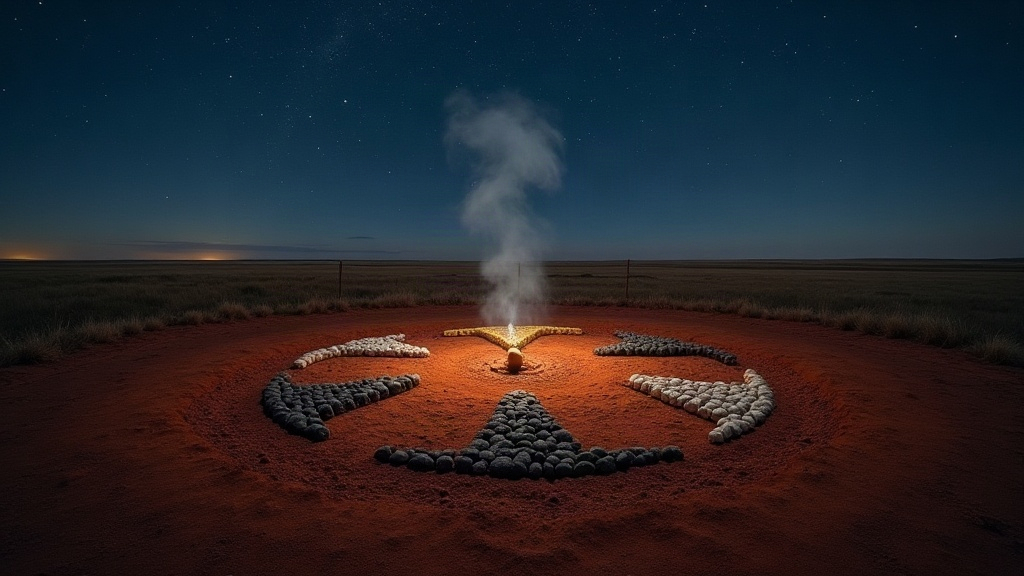
The Medicine Wheel represents the interconnected nature of existence across countless Native American traditions. Discover how this ancient symbol functions as both spiritual map and healing practice, grounded in real ceremonies that still guide communities today.

Native American
Raven: Creator and Trickster of the Pacific Northwest
Raven is both creator and chaos-bringer in Pacific Northwest Indigenous traditions, the figure who stole light from darkness and shaped the world through cunning and hunger. Explore how this contradictory god reflects the region's cultures.