

The Sun Dance: Plains Ceremony of Renewal and Sacrifice
The Sun Dance stands as the most sacred communal ceremony of the Great Plains nations, a multi-day ritual of piercing, fasting, and prayer where participants offer their bodies to restore balance and healing to their people. We trace its origins, structure, and enduring power across Lakota, Cheyenne, Arapaho, and Shoshone traditions.
Contents
The ceremony begins before first light. Men and women gather in a circle on the open plain, their bodies painted, their intention sealed. As the sun breaks the horizon, the drum sounds, and the dancers step forward toward the center pole. For the next three or four days, they will neither eat nor drink. Many will pierce their skin with wooden sticks attached by rope to that pole, then dance backward, resisting, until the flesh tears free. This is the Sun Dance: Plains Ceremony of Renewal and Sacrifice, the most profound act of devotion in Native American spiritual life.
The Sun Dance is not a single ceremony but a complex ritual shared, with variations, across the Lakota, Cheyenne, Arapaho, Shoshone, Crow, Blackfoot, and other Plains nations. Each tribe guards its own protocols, songs, and spiritual meanings. Yet all versions rest on the same foundation: a person's willingness to suffer and sacrifice for the collective healing of the tribe. In this act, the dancer becomes a conduit between the human world and the sacred, offering his or her body as a prayer the Creator cannot ignore.
Origins and Early Practice
The origins of the Sun Dance ceremony lie deep in Plains culture, though the exact timeline remains debated among scholars. The earliest documented references appear in ethnographic records from the 18th and 19th centuries, when traders, soldiers, and anthropologists first observed the ritual among Lakota and Cheyenne peoples. However, tribal oral traditions suggest the ceremony is far older, passed down through generations as a response to the spiritual needs of the Plains peoples.
The Sun Dance did not exist in isolation. It emerged within a broader context of Great Plains spirituality, where seasonal hunts, vision quests, and communal ceremonies marked the rhythm of tribal life. The ceremony appears to have crystallized around the late 18th century, though some nations claim it in their origin stories as ancient knowledge received directly from spiritual beings.
What we know from primary accounts comes largely from Lakota sources, especially through interviews conducted by anthropologists such as James R. Walker in the early 1900s. Walker documented detailed descriptions from holy men like Sword, a Lakota elder, who explained the theological architecture of the ritual. The Cheyenne have their own distinct lineage, recorded by scholars like George Bird Grinnell, who worked with tribal historians in the late 19th century.
Before the U.S. government's suppression in the late 1880s, the Sun Dance ceremonies took place each summer when the buffalo herds gathered and bands could meet on neutral ground. The ritual was both spiritual necessity and social occasion. Tribes would camp together for weeks, celebrate unions, resolve disputes, and perform the collective ceremonies that bound them as a people.
The Sacred Structure: Lodge, Pole, and Journey
The physical space of the Sun Dance ceremony carries deep symbolic weight. The ritual takes place within a great circular lodge, often called the Sun Dance lodge, with an opening facing east toward the rising sun. At the center stands the pole, a tall cottonwood tree selected and felled with ceremony. The pole's top receives a buffalo skull and an eagle nest or bundle of willows, symbols of the animal world and the sky spirits. Prayers hang from the pole on colored cloth strips or leather offerings, each one a petition rising toward the sacred.
The lodge itself is built of stripped cottonwood poles arranged in a circle, their tops meeting overhead. The circular form reflects fundamental Plains cosmology: the circle represents completeness, the gathering of all beings in harmony. The opening to the east acknowledges the direction from which light and life emerge each day. As dancers move deosil (sunwise) around the pole, they align their bodies with the apparent motion of the sun itself.
The procession to gather the pole begins the ceremonial cycle. A war party or hunting party rides out to find the right tree, an act laden with symbolic resonance. The selecting of the cottonwood is not arbitrary; it must stand straight and unblemished. The felling is conducted with prayers and tobacco offerings. The tree is then carried back to the prepared ground, an act of collective strength. When the pole is raised into the center of the lodge, the ceremony's heart is literally planted in the earth.
The Journey of Purification and Fasting
Dancers who pledge to participate in the Sun Dance ritual begin their preparation days or weeks beforehand. They fast and perform sweat lodge ceremonies, purifying their bodies and minds. Some undergo vision quests, seeking spiritual guidance for the sacrifice they will make. The vows are spoken aloud to the tribe: "I will dance. I will not eat or drink. I will endure."
When the ceremony opens, the dancers enter the lodge in ritual procession. They wear their finest regalia: breechcloths, eagle feathers, painted bodies, and moccasins decorated with quillwork or beading. Each dancer carries a pipe and tobacco. The singers sit in a central position, the drum positioned before them. As the sun rises, the first songs begin.
The dancing itself follows a strict pattern. Dancers move in a sunwise direction around the pole, their feet barely leaving the ground in a hypnotic step. They blow on eagle bone whistles, the piercing notes carrying their prayers skyward. With each dawn, the intensity increases. By the second and third days, the dancers' bodies show the strain: faces swollen and glistening with sweat, lips parched, eyes fixed on the pole or the sky.
Some dancers choose to pierce. They approach a designated piercer, a recognized spiritual elder and healer, who uses a knife or bone implement to create small incisions in the skin of the chest or back. A wooden stick, often made from a sapling, is then inserted through the opening. A rope connects the stick to the central pole. From this point, the dancer's fate is bound to the pole itself. When music swells and the drum accelerates, the dancer leans back, pulling against the rope, resisting with every muscle until the stick tears free and blood runs down the chest. This is the moment of greatest power, the moment when the sacrifice becomes physical, undeniable, witnessed by all.
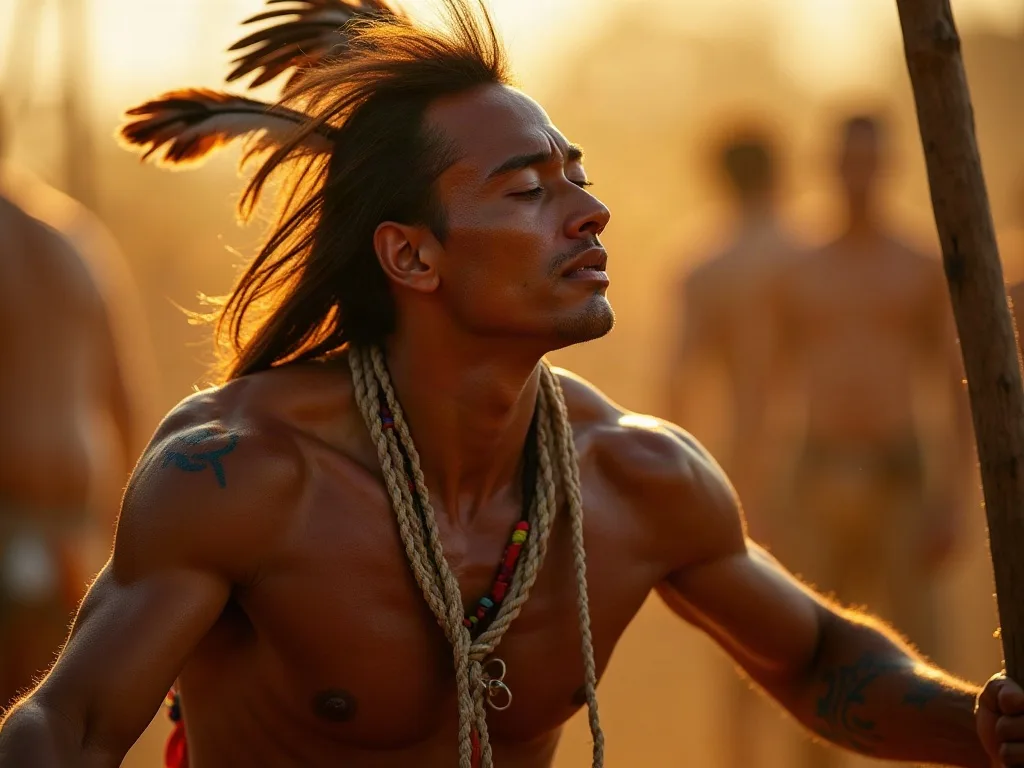
The piercing is not presented in ethnographic accounts as torture. Rather, participants and observers describe it as an ecstatic act, a threshold experience where the dancer's consciousness shifts. The pain is real, but so is the spiritual clarity that comes with it. Many dancers report that once the initial piercing occurs, the pain diminishes or transforms into something else entirely. Some dancers pierce multiple times, or pierce their arms and legs as well as their chests. The number and location of pierces varies according to personal vow and tribal custom.
Not all dancers pierce. Some commit to the full fast and four-day dance without piercing, their sacrifice expressed through endurance alone. The witness of the community is what matters most: the people see the pledge kept, the body offered, the tribe upheld.
Spiritual Meaning: Sacrifice for the People
The theological core of the Sun Dance ceremony rests on a principle of reciprocal exchange between the human, animal, and spiritual worlds. When the Plains peoples hunted the buffalo, they took life. The buffalo gave its flesh to feed the tribe. In return, the tribe owed respect, gratitude, and renewal. The Sun Dance is that payment: the human body, voluntarily offered, re-establishes the balance.
According to Lakota teachings recorded by scholars like Joseph Epes Brown, the ceremony is an act of mitakuye oyasin, often translated as "all my relations." The phrase reminds the dancer that he or she is not separate from the Earth, the animals, the plants, the sky beings, the ancestors, or the future generations. By piercing his chest, the dancer says: I accept my place in this web. I owe a debt to all who have sustained me. I pay it now with my body.
The vows made in the Sun Dance are specific and potent. A parent might pledge to dance if their child recovers from illness. A young person might vow to pierce as a first act of adult responsibility. A hunter might give thanks for a successful hunt. A warrior might seek spiritual protection or cleansing after taking a life in battle. The vows are remembered by the tribe. When the dancer keeps that pledge, the entire community is affected; a spiritual debt is settled, a wound is healed, an imbalance is restored.
The role of the spirits in the Sun Dance ritual is active and present. The ceremony is performed to honor the Creator, the Sun (which is itself a manifestation of divine power), and the animal spirits, particularly the buffalo and the eagle. The songs sung during the dance are often ancient, their words carrying prayers in the tribal language. Some songs address the buffalo directly, asking permission to hunt. Others call on the eagle to carry prayers to the sky. The spirits are not distant; they are invited into the lodge, they witness the sacrifice, and their power enters the bodies of the dancers and radiates outward to bless the people.
Variations Across Nations
The Sun Dance as practiced by the Lakota differs in important ways from the Sun Dance ceremony as performed by the Cheyenne, Arapaho, or Shoshone. These are not sloppy variations but distinct expressions of each nation's spiritual understanding and historical experience.
The Lakota ceremony, as documented by James R. Walker and later by Joseph Epes Brown, emphasizes the central pole and the direct connection between the dancer and the sacred. The Lakota pipe, the calf pipe or chanupa, is often invoked. The piercing is a core feature, though not all Lakota dancers pierce. The Lakota songs and prayers are in Lakota language, their meter and imagery rooted in Lakota poetic tradition.
The Cheyenne Sun Dance, recorded by George Bird Grinnell and later researchers, centers on the pole but also incorporates a sacred bundle, an object of immense spiritual power kept by a chosen keeper. The Cheyenne ceremony is guarded by a priestly class of ceremonial specialists who perform precise ritual actions in precise order. The songs, the piercing protocols, and the structure of the camp around the lodge follow patterns that Cheyenne tradition maintains with careful attention.
The Arapaho and Shoshone versions similarly reflect their own cosmologies and historical memory. What unites them is the commitment to sacrifice, the acknowledgment of community interdependence, and the belief that human suffering, when given willingly and in the proper form, has the power to heal and renew.
Suppression and Survival
The U.S. government's approach to Native American religious practices in the late 19th century was systematic erasure. Indian agents, backed by federal law, actively suppressed the Sun Dance and other tribal ceremonies. The rationale was assimilationist: the government believed that eliminating Native religious practice would hasten the absorption of Indians into American society. The piercing was especially targeted as "barbaric" and "unchristian."

By the 1880s, the Sun Dance was illegal on many reservations. Agents confiscated ceremonial regalia, banned gatherings, and punished participants. Soldiers were deployed to prevent ceremonies. Some tribes were forced to perform the Sun Dance in secret, in isolated locations far from agency oversight. Other tribes, unable to gather in sufficient numbers or unable to access sacred sites, let the ceremony lapse for decades.
The suppression was not total. Among the Lakota, the Crow, the Blackfoot, and other nations, the Sun Dance endured through clandestine practice and through the determination of spiritual leaders who kept the knowledge alive and passed it to younger generations. By the 1950s and 1960s, as Native American civil rights movements gathered strength, tribes began to publicly reclaim and perform their ceremonies. The Indian Religious Freedom Act of 1978 formally protected Native American religious practices, including the Sun Dance. What had been suppressed could now be practiced openly.
Today, the Sun Dance has experienced a renaissance. Many tribes have reinstated the ceremony, and new generations of dancers have taken up the vow. The ritual remains strikingly similar to descriptions from a century ago, though with inevitable adaptations to modern life. Dancers may travel from across the continent to attend. Recorded songs and videos preserve knowledge that might otherwise be lost. Yet the core remains unchanged: the pole, the fast, the drum, the sacrifice, the community witnessing and receiving the gift.
The Sacred Pipe and Cosmic Order
The Sun Dance ceremony is inseparable from the sacred pipe, the chanupa in Lakota. The pipe is not merely a ceremonial object; it is a cosmological diagram. The bowl represents the Earth and all earthly beings. The stem represents the connection between Earth and Sky. The tobacco burned within is an offering carried by smoke to the spirits.
According to Lakota teaching, the sacred pipe was brought to the people by the White Buffalo Woman, a spirit being of immense power. She appeared to the tribe in ancient times and gave them the pipe, along with the instructions for the Sun Dance and other ceremonies. The story of the White Buffalo Woman is preserved in oral tradition and has been recorded in various forms by tribal historians and anthropologists.
When a dancer holds the pipe during the Sun Dance, he or she holds a bridge between all worlds. The pipe's presence in the lodge sanctifies the space. The smoke rising from the pipe during the ceremony's opening and closing rituals carries the prayers of all present directly to the Creator. The songs often reference the pipe, reminding dancers and witnesses of the original covenant between the people and the sacred.
The appearance of a white buffalo in the present day is considered a sign of the White Buffalo Woman's continued regard for the people. Such sightings are rare and are reported as spiritually significant events. The last widely documented white buffalo birth occurred at a farm in Wisconsin in 1994, and it was interpreted by many Native people as a renewal of the covenant and a sign that the old ways must be honored and preserved.
Women in the Sun Dance
Historically, the Sun Dance ceremony has been predominantly male, with male dancers taking the most prominent roles in piercing and fasting. However, this was not universal, and contemporary practice has expanded to include women as full participants.
Among some Lakota bands, women have participated in the Sun Dance for many generations, fasting and dancing without piercing, or in some cases piercing as well. The testimonies of women who have danced reveal experiences parallel to those of men: spiritual clarity, physical endurance, the profound sense of giving to the collective. Contemporary women dancers often emphasize that they dance on behalf of their families, their nations, the Earth itself, and future generations.
The role of menstruation in traditional ceremony practice is often misunderstood. Rather than being a barrier to participation, the menstruating woman's connection to cycles of creation and renewal is acknowledged as sacred. Some tribes maintain protocols around menstruation in ceremonial contexts, but these are understood not as prohibitions but as expressions of respect for the power of that time. Modern women dancers navigate these traditions in ways that honor both ancient understanding and contemporary experience.
The Ceremony Today
Contemporary Sun Dance ceremonies continue to be held each summer on reservations across the Great Plains. The Lakota, Cheyenne, Arapaho, Crow, Blackfoot, and other nations maintain and perform the ceremony with seriousness and spiritual intentionality. The ceremony remains largely closed to outsiders; photography is prohibited, and participation as a dancer or even as a witness requires invitation and respect for tribal protocols.
The experience of a modern dancer is shaped by the pressures and possibilities of contemporary life. Some dancers come to the Sun Dance lodge with the same vows their ancestors made: thanksgiving for survival, petition for healing, commitment to community. Others come seeking personal transformation or spiritual re-grounding in the face of historical trauma and ongoing colonialism. The ceremony has become, for many tribes, a practice of decolonization, an assertion that Native spirituality remains alive, powerful, and necessary.
The pain endured in the Sun Dance is real, but participants and observers consistently report that it is not the defining element of the experience. What people remember is the community, the drum, the songs, the moment of piercing, the visions that sometimes come, the deep sense of connection to something beyond themselves. The ceremony remakes the dancer each time. Those who have danced often speak of a before and after in their spiritual lives.
Scholarly Interpretation and Ongoing Debate
Anthropologists and religious scholars have offered various interpretations of the Sun Dance ritual. Some early accounts, written by observers without deep knowledge of Plains languages or theology, reduced the ceremony to spectacle or suffering. This colonial gaze misrepresented the ceremony's purpose and meaning, emphasizing pain rather than prayer, sensation rather than sacrifice.
Later scholarship, informed by interviews with tribal members and by respectful engagement with Native intellectual traditions, has approached the ceremony with more nuance. Joseph Epes Brown's work, particularly his dialogues with the Lakota holy man Black Elk, presented a detailed theological framework that shows how the Sun Dance coherence with broader Native American spiritual principles: reciprocity, relationality, the sanctity of all life forms, and the responsibility of humans to maintain balance on Earth.
Contemporary Native American scholars and spiritual leaders have also written and spoken about the Sun Dance from insider perspectives. Their work emphasizes that the ceremony is not a museum piece or a historical artifact to be analyzed, but a living practice with ongoing spiritual and political significance. Some stress the anti-colonial dimension: the Sun Dance is an assertion of tribal sovereignty, an act of refusal to let colonial violence erase Native ways of being.
One ongoing scholarly debate concerns the ceremony's pre-contact history. Some scholars suggest that in its present form, the Sun Dance crystallized in the late 18th or early 19th century, potentially incorporating elements from other ceremonial traditions or responding to historical pressures (the decline of buffalo, the compression of tribal territories, etc.). Others, grounded in tribal oral tradition, argue for a deeper antiquity. The debate remains open and is best resolved through collaboration between tribal historians and academic scholars, with the former's authority prioritized.
The Sun Dance in Contemporary Native Identity
For many Plains peoples today, the Sun Dance ceremony has become a cornerstone of Native identity and resistance. After decades of suppression, the reassertion of the ceremony is an act of cultural and spiritual sovereignty. Young people learning the dances, the songs, and the protocols from elders are reclaiming a heritage that colonialism tried to destroy.
The ceremony also serves practical functions in modern tribal life. Sun Dance gatherings bring scattered communities together. They provide occasions for youth to connect with elders and learn tribal history and language. They affirm that Native ways of being are not only historically significant but spiritually powerful and relevant to contemporary needs.
The experience of trauma and ongoing injustice in Native communities has intensified the Sun Dance's significance. Participants often speak of using the ceremony to process grief, to assert resilience, to honor ancestors who suffered and survived. The piercing becomes an embodied response to historical pain: the body is marked, blood is shed, but the dancer endures. The community witnesses that endurance and is strengthened by it.

Frequently Asked Questions About the Sun Dance
Frequently asked questions
Why do some Sun Dance participants pierce their skin?
Piercing is a form of direct, physical sacrifice offered to the spirits and to the people. When a dancer pierces, he or she is saying: I offer my body. I accept pain so that my people may be healed or blessed. The piercing is not punishment or torture but a sacred act that many dancers experience as spiritually transformative. Not all dancers pierce; some fulfill their vow through fasting and dancing alone.
How long does the Sun Dance ceremony last?
The traditional Sun Dance ceremony lasts for three or four days, though preparation and surrounding activities may extend the gathering to a week or more. Dancers fast (without food or water) for the duration, dancing from sunrise to sunset each day. The rhythm of the ceremony follows the sun's movement across the sky, beginning in the east at dawn and concluding as the sun sets in the west.
Can non-Native people participate in or attend the Sun Dance?
Most tribes maintain strict protocols about who may enter the Sun Dance lodge and in what capacity. As a general rule, the ceremony is closed to outsiders unless specifically invited by tribal leaders. This protects the ceremony's integrity and honors its sacred nature. Some tribes may allow respectful observation from a distance, but this is not guaranteed and varies by nation and by individual ceremony leader.
What do the colors and symbols in the Sun Dance represent?
Colors carry specific meanings in Plains spirituality. Red often represents the earth and the south; yellow represents the sun and the east; black represents mystery and the north; white represents purity and the west. The buffalo skull atop the pole represents the animal world and the gratitude owed to the buffalo for sustaining the people. Eagle feathers represent the sky and the connection to the spirit world. Each tribe maintains its own specific symbolic language, and meanings can vary.
How has the Sun Dance changed since the colonial period?
The core elements of the Sun Dance ritual have remained remarkably consistent since the 19th-century accounts. However, the ceremony was suppressed for decades and had to be reconstructed and revived by tribal communities. Contemporary versions incorporate modern realities (travel, communication, health care) while maintaining spiritual authenticity. Some tribes have also adapted certain aspects to include women more fully and to respond to contemporary spiritual and political needs.
What is the relationship between the Sun Dance and other Native American ceremonies?
The Sun Dance is one of many sacred ceremonies practiced by Plains nations. It exists alongside vision quests, sweat lodge ceremonies, naming ceremonies, and other rituals. Each ceremony serves distinct spiritual purposes. The Sun Dance's particular power lies in its communal nature, its scale, and its function as an annual renewal of the people's covenant with the Creator and with one another.
The Sun Dance as Decolonial Practice
The resurgence of the Sun Dance ritual in recent decades represents more than spiritual revival. For many Native peoples, it is an act of decolonization: a reclaiming of ways of knowing, being, and relating that colonialism sought to destroy. By dancing, fasting, piercing, and offering their bodies in the old way, participants assert that Native cultures are not museum pieces but living, evolving traditions rooted in the land and in spiritual truth.
The ceremony's centrality to Plains identity today cannot be separated from the history of genocide, forced assimilation, and ongoing injustice. The same government that outlawed the Sun Dance has built wealth on the appropriation of Native lands. The same assimilationist ideology that criminalized the ceremony continues in various forms. When a young person chooses to pledge to dance, to fast, to pierce, they are making a statement: I will not forget who I am. I will not abandon the ways of my ancestors. I will keep this covenant alive.
The Sun Dance also points to a different relationship between human and Earth than the one dominant in industrial Western societies. The ceremony affirms that humans are part of creation, not its masters; that we owe debts to the animals, the plants, the waters, and must pay those debts through respectful action. In a time of ecological crisis, that understanding has gained new relevance. Some environmental scholars and activists have pointed to indigenous ceremonies like the Sun Dance as models for how humans might live in genuine reciprocity with the Earth.
The continuing power of the Sun Dance lies precisely in this combination: it is at once an ancient tradition, carefully preserved through oral transmission and scholarly study; a living practice, adapted and renewed each year as new dancers take their vows; and a political statement, an assertion of Native sovereignty and an indictment of colonialism. The pole rises each summer, and the people gather. The drum sounds. The dancers step forward. The sacrifice continues, and the renewal goes on.
Free 25-page sample
Want the whole story?
Take the first 25 pages free. If it pulls you in, the full edition is yours as an instant PDF download, with a paperback on Amazon for selected titles.
Native American
The Native American Mythology Book: Raven, Coyote, Spider Woman, and the Sacred Stories of Turtle Island
From Pacific Raven to Atlantic Glooscap
The unbroken pre-contact mythology of North America: Raven stealing light, Coyote's tricks, Spider Woman weaving creation, Sedna beneath the ice, and the kachina spirits of the mesa.
More from Native American
All articles
Native American
The Vision Quest: Rite of Passage and Spiritual Revelation
The vision quest stands at the heart of many Native American spiritual traditions: a solitary journey into wilderness where seekers fast, pray, and await contact with the sacred. Discover how this ancient ceremony marks the threshold between boyhood and manhood, illness and healing, confusion and purpose.
Native American
The Medicine Wheel: Sacred Symbol and Ceremonial Structure
The Medicine Wheel represents the interconnected nature of existence across countless Native American traditions. Discover how this ancient symbol functions as both spiritual map and healing practice, grounded in real ceremonies that still guide communities today.

Native American
Sedna: Inuit Goddess of the Sea and Marine Animals
Sedna rules the Arctic depths as the Inuit goddess of the sea and marine animals. Her story begins with betrayal and transformation: a fallen maiden becomes the sovereign of the ocean, controlling the seal, whale, and fish that sustained Arctic peoples for millennia. Discover how her myth shaped survival, hunting ritual, and the spiritual bond between humans and the sea.

Native American
Raven: Creator and Trickster of the Pacific Northwest
Raven is both creator and chaos-bringer in Pacific Northwest Indigenous traditions, the figure who stole light from darkness and shaped the world through cunning and hunger. Explore how this contradictory god reflects the region's cultures.