
The Medicine Wheel: Sacred Symbol and Ceremonial Structure
The Medicine Wheel represents the interconnected nature of existence across countless Native American traditions. Discover how this ancient symbol functions as both spiritual map and healing practice, grounded in real ceremonies that still guide communities today.
Contents
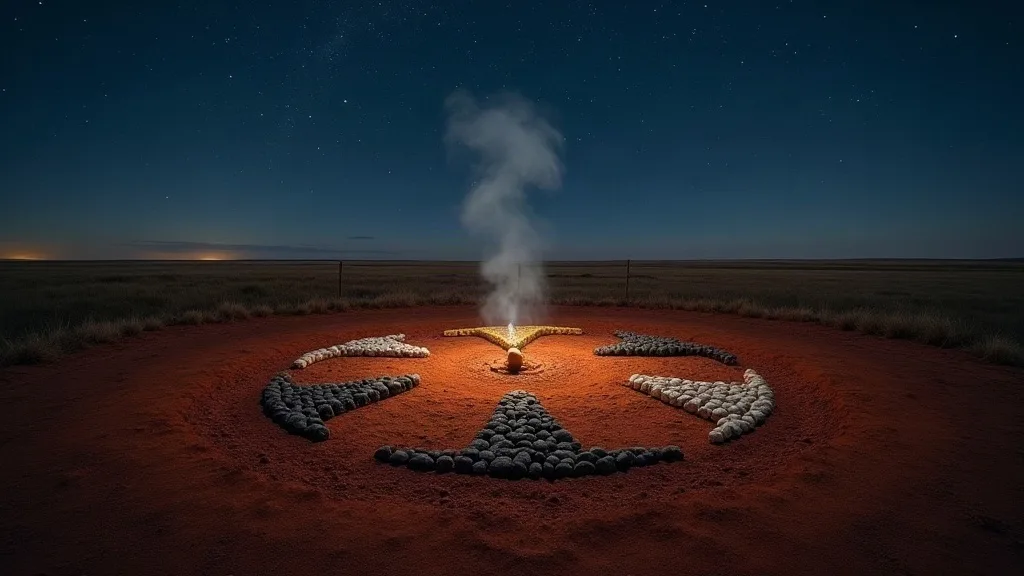
The wheel takes form in a circle drawn on earth, quartered by two lines that cross at the center. At each of the four directions, a color appears: red, yellow, black, white (though the precise palette shifts between tribes and teachings). A person stands at the threshold between four worlds, four seasons, four aspects of self. No words are needed. The shape itself speaks: everything is connected, nothing stands alone, the cycle returns.
The Medicine Wheel is not one symbol but many, each rooted in the lived cosmology of distinct Native American nations. What unites them is a geometry of balance: the circle broken into quarters, often with animals, plants, elements, or cardinal directions assigned to each. For the Lakota, the Cheyenne, the Haudenosaunee, the Diné, and many others, the wheel is a teaching tool, a ceremonial space, a map of how the world works and how a human being fits inside it.
This is not abstract spirituality. The Medicine Wheel appears in earth and stone across the landscape. It governs when ceremonies happen, what songs are sung, how conflicts are resolved. It shapes medical practice, education, justice. To understand it is to glimpse how indigenous North America organized knowledge itself.
The Structure and Geometry of the Medicine Wheel
The basic form is deceptively simple. A circle. A cross dividing it into four quadrants. The four cardinal directions form the axis: East, South, West, North (though some traditions reverse or reorder them). Each direction carries a full spectrum of meaning: a color, an element, a season, an animal, a human quality, a stage of life, an emotional or spiritual state.
The Lakota version, as taught in Oglala Sioux communities and recorded by scholars like Thomas E. Mails, pairs the directions like this: East corresponds to the eagle and illumination (dawn, new beginnings, innocence), South to the mouse and growth (summer, trust, feeling), West to the bear and introspection (autumn, strength, looking inward), North to the buffalo and wisdom (winter, purification, perspective). The colors vary by teacher and context. Some say red for South, yellow for East, black for West, white for North. Others invert or rotate the scheme entirely. The variation is not error; it reflects how each nation and each keeper of the teachings holds the symbolism alive and relevant.
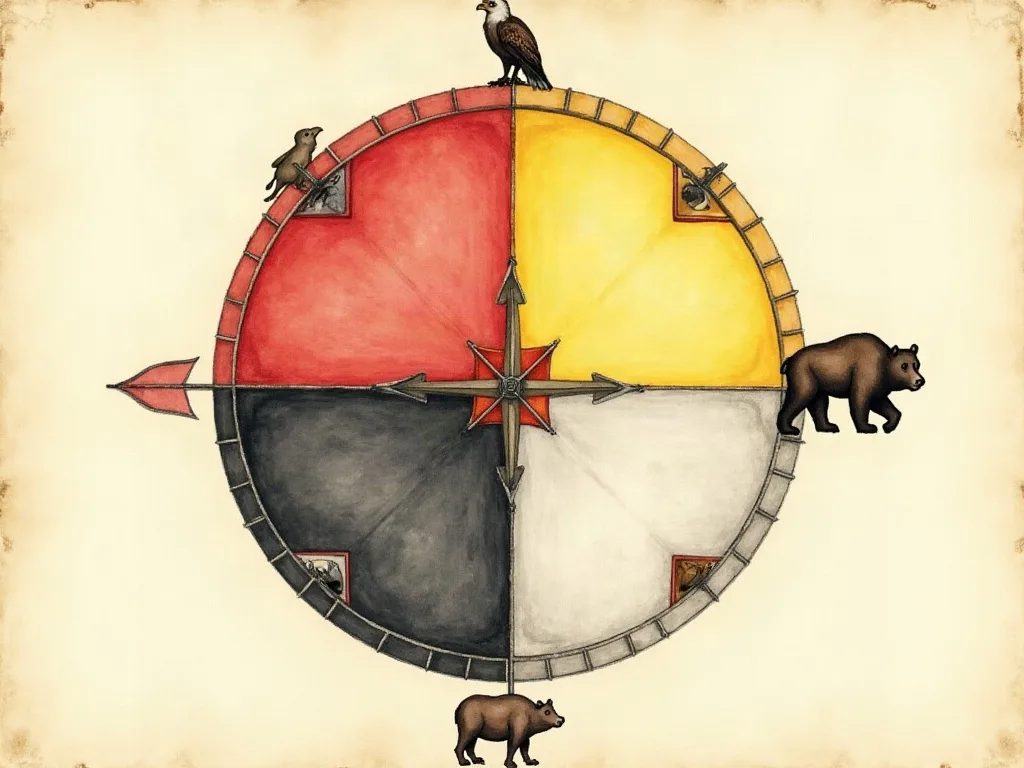
At the center of the wheel stands the axis point, sometimes marked with a fifth color (green, representing all living things and balance). This center is the place of integration, where all directions meet and neutralize each other. The human heart. The fire in the lodge. The meeting place. From this still point, one can face any direction and see the whole circle. No direction dominates. Each has equal weight.
The circle itself symbolizes continuity and return. It has no beginning and no end. Unlike a line or a square (which suggest hierarchy or endpoints), the circle mirrors the annual cycle, the daily cycle, the spiral of growth and return that characterizes life on earth. Many indigenous teachings emphasize spirals rather than strict circles: the wheel is not static, but always turning, always bringing the same lessons back but at a deeper level.
Origins and Regional Variations
The Medicine Wheel as a formal teaching structure likely crystallized during the contact and post-contact periods, when indigenous scholars needed to synthesize and preserve knowledge during upheaval. However, the geometric and spiritual principles underlying it are ancient. Many nations describe cycles of four: the Haudenosaunee (Iroquois Confederacy) organize their cosmology around four brothers, four corn varieties, four winds. The Mesoamerican Popol Vuh, though not strictly North American, describes four creations of humanity, each failed until the fifth (maize-based) one succeeded. The number four itself appears across the Americas as an organizing principle.
The most widely recognized contemporary teaching comes from the Northern Plains nations, particularly the Lakota and Cheyenne. This version was systematized and taught to a broader audience beginning in the 1960s and 1970s, as indigenous scholars and spiritual leaders began deliberately reconstructing and sharing traditions that colonization had nearly erased. Figures like Wallace Black Elk and other Lakota elders documented their teachings in writing and workshops, making the Medicine Wheel concept available to indigenous communities rebuilding their own practice.
It is crucial to note: different tribes have different wheels. The Diné (Navajo) cosmology incorporates directional symbolism, but their sacred narrative emphasizes the Holy People and the emergence from lower worlds, not a simple four-part balance. The Haudenosaunee emphasize the Three Sisters (corn, beans, squash) and the number three in many teachings, alongside four directions. The Pacific Northwest Coast nations, the Southwest Pueblo peoples, the Great Basin tribes each have their own directional systems. The Medicine Wheel in its now-familiar form is primarily a Great Plains and Plains-influenced teaching, and to treat it as pan-Indian universal would erase real diversity.
Ceremonial and Healing Applications
The Medicine Wheel structures actual ceremony. In many traditions, a sweat lodge (inipi in Lakota) is conducted with the participant facing one direction at a time, calling in the qualities and beings associated with that direction. The structure of the ceremony mirrors the wheel: four rounds of heat and prayer, each opening and closing a different direction. By the end, the person has acknowledged all four aspects of existence and integrated them inside their own body.
Healing practitioners use the wheel as a diagnostic and treatment map. A patient may be suffering from an imbalance: perhaps too much of the West (introspection, isolation, dark-mindedness) and not enough of the South (trust, play, feeling). The healer's work is to restore the person to the center, where all four are present but none dominates. This is not diagnosis of disease in the Western medical sense; it is understanding the person as a system out of balance and moving them toward wholeness.
The wheel also organizes time and social rhythm. Many communities mark the year in four seasons, each associated with a direction and a teaching focus. Gatherings, initiations, councils, and decision-making ceremonies may be scheduled according to directional alignment. A young person entering adulthood might be taken to each direction in turn, receiving teachings from elders who embody each quadrant's wisdom.
The Medicine Wheel as Educational Framework
Indigenous education before colonization was experiential and place-based. Children learned by doing, by observing seasons, by listening to stories told at the right moment in the cycle. The Medicine Wheel formalizes this into a teachable structure. Each direction becomes a classroom, each season a curriculum.
The East teaches new beginnings, clarity, the mind. Learning happens here. Vision and planning originate from the East. A child's education might begin with East teachings: observation, naming, thinking clearly about the world.
The South holds emotional and social learning. Play, trust, relationships, art, feeling. The young person learns to feel their own heart and to honor others' hearts. Fire, warmth, growth, passion belong to the South.
The West is the place of introspection and mystery. Here one learns to listen inward, to tolerate darkness and unknowing, to find one's own medicine (gift or power). This is where adolescents often go on vision quests: alone, fasting, calling to their personal spirit guides. The West teaches humility and depth.
The North is wisdom, perspective, elder knowledge. After passing through the South's growth and the West's introspection, a person returns North with integration. They understand their place in the community and can begin to teach others. The North is where the grandparents sit.
By the time a person has cycled through all four directions in their life, they carry a complete education. Many traditions describe the human lifespan as a journey around the wheel: childhood (East), youth and passion (South), middle age and inward work (West), elderhood and wisdom (North). Then the cycle may begin again, spiraling deeper.
Symbolic Associations Across Traditions
While the basic fourfold structure appears across many nations, the specific assignments vary. Here is a sampling of how different communities organize the wheel:
Lakota tradition places the red direction (South) at the bottom, following the view from many Plains peoples that South is downward, rising, associated with the mouse and innocence. East (yellow, eagle) is to the right, the direction of illumination. West (black, bear) is to the left, the place of introspection and depth. North (white, buffalo) is upward, the direction of wisdom and the ancestors. The four races of humanity are sometimes assigned to the four directions, though this teaching reflects post-contact influence and is not emphasized by all teachers.
Haudenosaunee cosmology centers on the Three Sisters (corn, beans, squash) but also recognizes four directions and four winds. Some Haudenosaunee teachings assign the cardinal directions to the Four Brothers (Sky Holder, the Three Brothers) and their roles in creation. The specific mapping shifts by community and keeper of knowledge.
Diné teachings incorporate directional symbolism with the colors: white to the east (dawn), blue to the south (day), yellow to the west (sunset), and black to the north (night). These align with the Diné sacred mountains and the journey of the sun. The Diné emergence story adds layers that go beyond a simple four-part balance, emphasizing the complexity of a people emerging from one world into another.
Cheyenne teachings (recorded by scholars like David Svaldi) often place the North direction toward the earth and stability, with variations in the other quadrants depending on the specific teaching circle and keeper.
The point: there is no single "correct" Medicine Wheel. Authenticity comes from learning directly from a teacher rooted in a particular tradition, not from adopting a generic version. This is why many indigenous educators now emphasize learning "your own nation's wheel" rather than treating Medicine Wheel teachings as a commodified spiritual product to be consumed by anyone.
The Medicine Wheel in Contemporary Practice
Since the 1980s, the Medicine Wheel has become widely visible in Native American communities rebuilding ceremonial practice after the suppression era (roughly 1890 to 1975, when many ceremonies were banned by the U.S. federal government and boarding school systems). It appears in healing circles, educational curricula in tribal colleges, addiction recovery programs, and conflict resolution frameworks. Organizations like the Native American Church, which incorporate peyote ceremonies and cross-cultural synthesis, have also adopted and adapted Medicine Wheel teachings.
Non-Native practitioners have also adopted the Medicine Wheel, sometimes respectfully and sometimes as appropriation. This has created tension within indigenous communities. Some teachers deliberately share the wheel publicly as a gift and teaching tool; others see public appropriation as theft of intellectual and spiritual property. There is no single indigenous position: Native people are not a monolith, and they disagree about what should be shared openly and what should remain within communities.
The most common appropriation occurs when the wheel is stripped of its ceremonial and relational context and treated as a self-help or wellness product: "find your type," "heal your direction," "harness the power of the four elements." Removed from the lived practice, relationships, and rigorous training that indigenous communities require, it becomes a surface symbol divorced from its roots. Many indigenous teachers and organizations now explicitly request that non-Native people interested in Medicine Wheel teachings seek education from Native teachers and communities directly, as a form of respect and accountability.
Scholarly and Spiritual Debates
Scholars of Native American religions, including Thomas McEvilley, Ake Hultkrantz, and more recent indigenous scholars like Inés Talamantez, have noted that the Medicine Wheel as a systematic teaching appears more formally in the late 20th century than in pre-contact sources. This does not mean it is inauthentic; rather, it reflects how indigenous communities have always adapted and synthesized teachings in response to historical pressure. The geometric clarity of the wheel may itself be a response to colonization: a way of codifying and preserving knowledge that might otherwise disperse.
Some scholars also debate the degree to which the wheel reflects pan-Indian influence versus distinct tribal knowledge. The spread of the wheel through workshops, books, and Native American activism movements of the 1960s and 1970s means that many contemporary communities now learn the wheel through cross-tribal networks rather than solely from their own nation's elders. This is not corruption of the tradition but rather the reality of how indigenous knowledge moves in the modern world. Communities choose what to adopt, adapt, and preserve.
One significant debate centers on the relationship between the Medicine Wheel and the Haudenosaunee Confederacy's teachings about balance and four directions. Some scholars argue that the wheel is fundamentally a Haudenosaunee contribution to wider Native American thought; others contend that the geometric principle is ancient and widespread. Without access to detailed pre-contact sources (many were destroyed or not written down), this remains an open question that indigenous scholars continue to investigate.
Another ongoing discussion involves the relationship between the Medicine Wheel and Christian and New Age spiritual traditions. Some indigenous theologians have explored how the wheel might be compatible with Christian ideas about wholeness and redemption, while others see any such fusion as a dilution of indigenous teachings. Still others argue that indigenous spirituality has always been adaptive and that such dialogue is itself part of a living tradition.
The Medicine Wheel in Art, Landscape, and Contemporary Culture
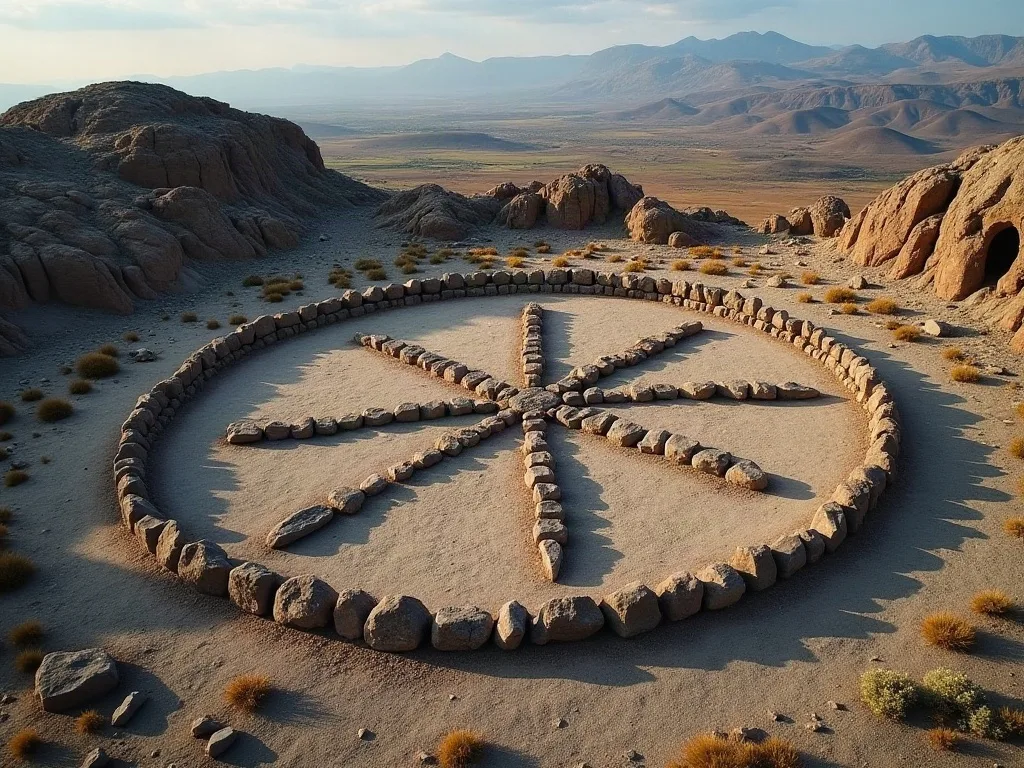
The wheel appears visibly in numerous places across North America. The Medicine Wheel alignments in the Bighorn Mountains of Wyoming (documented by archaeologist John Eddy in 1974) consist of a stone circle with spokes radiating outward, aligned to solstice and equinox sunrises. While not all scholars agree that this structure dates to pre-contact times or that it was specifically used as a teaching wheel, many Crow and Cheyenne people recognize it as part of their ancestral landscape. Similar stone circles and alignments appear in other locations, though their dating and original function remain subject to scholarly discussion.
Contemporary Native American artists regularly use the Medicine Wheel as a visual motif in paintings, sculptures, beadwork, and digital media. Artists like George Littlechild (Enoch Cree Nation) have incorporated the wheel into their work as a way of asserting indigenous identity and educating viewers about Native cosmology. The wheel appears on logos, educational materials, and in public art installations throughout North America, sometimes with the full consent of local tribal communities and sometimes as generic appropriation.
The wheel has also entered mainstream wellness culture, appearing in yoga studios, therapy offices, and self-help literature, often stripped of its cultural and spiritual context. This visibility has made it simultaneously more known and more misunderstood by non-Native audiences. Many indigenous educators now actively work to reclaim and clarify the wheel's authentic meanings.
Frequently asked questions about the Medicine Wheel
Frequently asked questions
Is the Medicine Wheel used in all Native American traditions?
No. The Medicine Wheel as a formal teaching structure is most prominent in Great Plains nations and communities influenced by Plains culture. The Haudenosaunee, Diné, Pueblo peoples, and Pacific Northwest tribes have their own directional and cosmological systems, some of which share principles with the wheel but organized differently. Learning "your own nation's wheel" rather than adopting a generic version is important for authenticity and respect.
What is the significance of the four colors in the Medicine Wheel?
Colors represent the four directions and the qualities associated with them, but the specific color assignment varies by tradition. Some Lakota teachings use red, yellow, black, and white; others use different palettes. The colors often correspond to skin tones of the four races (a post-contact addition), but many contemporary teachers emphasize the symbolic meaning (red for South/fire/growth, yellow for East/light/clarity, etc.) rather than racial association. Always ask your specific teacher which color palette is used in their tradition.
Can non-Native people learn about and use the Medicine Wheel?
Many indigenous teachers have deliberately shared Medicine Wheel teachings with non-Native audiences as a gift and educational tool. However, this should happen with acknowledgment of the wheel's origins in specific Native American traditions and with direct education from Native teachers when possible. Using the wheel in a commercialized, decontextualized way (as a personality system or wellness product) is considered appropriative by many indigenous communities. Respect and accountability matter more than access.
How old is the Medicine Wheel as a teaching structure?
The geometric principles underlying the wheel (fourfold division, cyclical time, directional mapping) are ancient in Native American thought. However, the Medicine Wheel as a systematic, formalized teaching structure as we know it today was largely crystallized and documented in the mid-to-late 20th century, as indigenous communities rebuilt and preserved their traditions after suppression. This does not make it inauthentic; rather, it reflects how living traditions evolve and adapt to new historical circumstances.
What is the connection between the Medicine Wheel and healing practices?
The Medicine Wheel provides a diagnostic framework for understanding imbalance in a person's life or community. Healers use it to identify which direction (or quality) is over-expressed or depleted, then work to restore equilibrium by calling in the medicine of the other directions. This might involve ceremony, counseling, plant medicine, or other practices depending on the specific tradition and healer.
Are there sacred Medicine Wheels marked on the landscape?
Yes. Stone Medicine Wheels and alignments appear in several locations across North America, including the Bighorn Medicine Wheel in Wyoming, which may align with seasonal sun positions. However, scholars debate the age and original function of these structures. Many local tribes recognize them as part of their ancestral landscape. Contemporary communities also create Medicine Wheels in earth for ceremonies and teachings.
Living Practice and Ongoing Revitalization
The Medicine Wheel continues to evolve as a teaching and ceremonial framework. Contemporary indigenous educators are integrating it with modern challenges: environmental sustainability, social justice, mental health, and community healing. The wheel becomes a tool for asking: What does each direction teach us about living ethically? How can we bring balance to communities fractured by poverty, addiction, and historical trauma?
Some communities have created specialized wheels addressing specific topics. A "Justice Wheel" maps the four aspects of a just response to harm. A "Green Wheel" or "Ecological Wheel" shows how each direction relates to environmental stewardship. These are not departures from tradition but rather continuations of how indigenous peoples have always adapted foundational teachings to meet their time's urgent questions.
The Medicine Wheel's strength lies in its flexibility and depth. It can be taught to a five-year-old as a simple story of four animals and directions. It can guide a healer's diagnostic work. It can organize a nation's ceremonies and calendar. It can inspire art, poetry, and social change. It is simultaneously a children's picture book and a lifetime spiritual practice. This scalability is not a weakness but precisely why the wheel has survived suppression and continues to guide indigenous communities toward wholeness.
Free 25-page sample
Want the whole story?
Take the first 25 pages free. If it pulls you in, the full edition is yours as an instant PDF download, with a paperback on Amazon for selected titles.
Native American
The Native American Mythology Book: Raven, Coyote, Spider Woman, and the Sacred Stories of Turtle Island
From Pacific Raven to Atlantic Glooscap
The unbroken pre-contact mythology of North America: Raven stealing light, Coyote's tricks, Spider Woman weaving creation, Sedna beneath the ice, and the kachina spirits of the mesa.
More from Native American
All articles
Native American
The Vision Quest: Rite of Passage and Spiritual Revelation
The vision quest stands at the heart of many Native American spiritual traditions: a solitary journey into wilderness where seekers fast, pray, and await contact with the sacred. Discover how this ancient ceremony marks the threshold between boyhood and manhood, illness and healing, confusion and purpose.

Native American
The Sun Dance: Plains Ceremony of Renewal and Sacrifice
The Sun Dance stands as the most sacred communal ceremony of the Great Plains nations, a multi-day ritual of piercing, fasting, and prayer where participants offer their bodies to restore balance and healing to their people. We trace its origins, structure, and enduring power across Lakota, Cheyenne, Arapaho, and Shoshone traditions.

Native American
Sedna: Inuit Goddess of the Sea and Marine Animals
Sedna rules the Arctic depths as the Inuit goddess of the sea and marine animals. Her story begins with betrayal and transformation: a fallen maiden becomes the sovereign of the ocean, controlling the seal, whale, and fish that sustained Arctic peoples for millennia. Discover how her myth shaped survival, hunting ritual, and the spiritual bond between humans and the sea.

Native American
Raven: Creator and Trickster of the Pacific Northwest
Raven is both creator and chaos-bringer in Pacific Northwest Indigenous traditions, the figure who stole light from darkness and shaped the world through cunning and hunger. Explore how this contradictory god reflects the region's cultures.