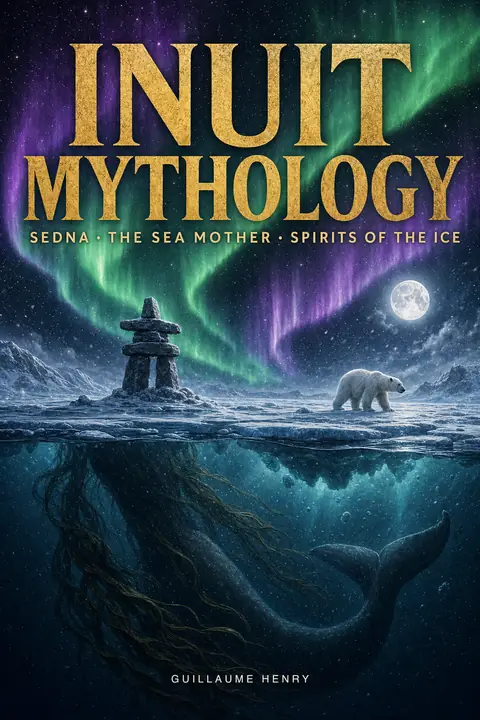
Inuit
From Sedna's severed fingers to the drumbeats that call spirits back to earth, Inuit mythology is one of humanity's most vivid cosmologies. This guide traces its gods, rituals, and living traditions.
Browse Inuit
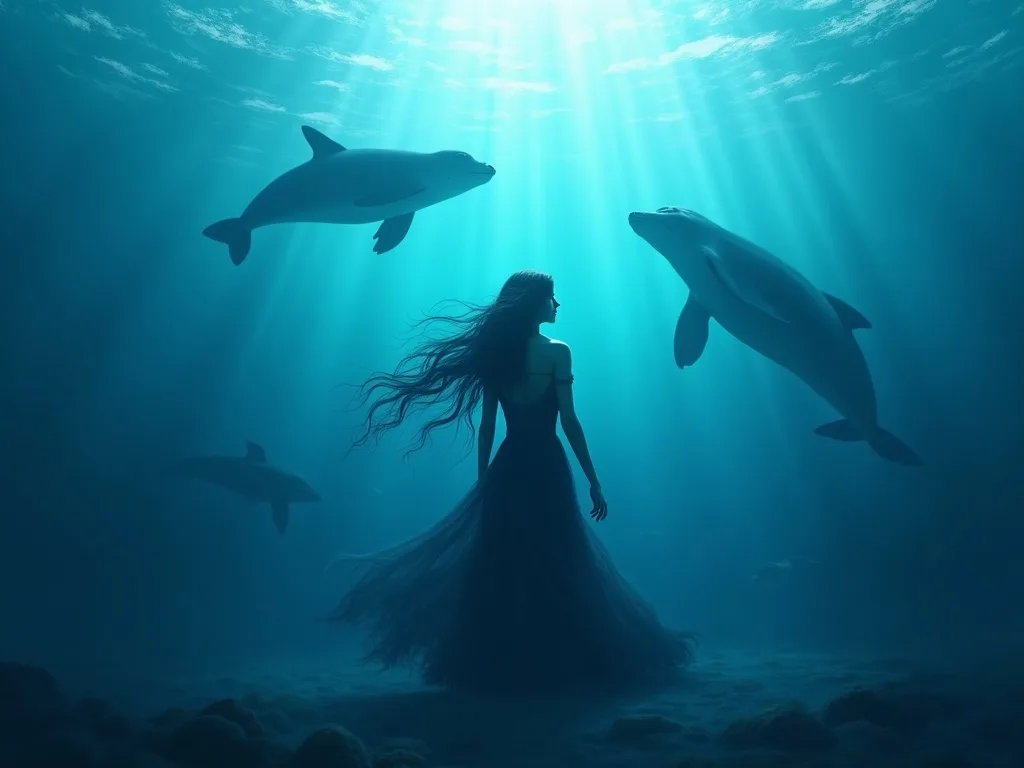
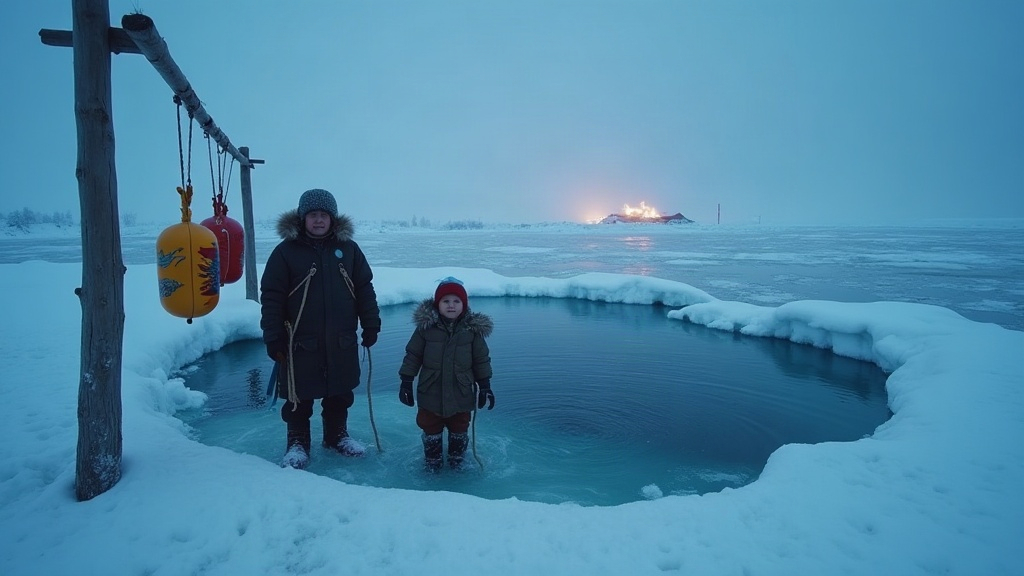
The sea moves before anything else. In the oldest Inuit stories, the ocean is not a setting but an actor, heaving and breathing and granting life or withholding it according to its own patience. The shaman kneels at the breathing hole in the ice, closing his eyes. Somewhere below the surface, where the cold grows absolute, a woman sits tangled in her own black hair. The animals of the sea are hers to release or to keep.
That image, a woman at the ocean floor surrounded by seals and whales and fish swimming through her matted hair, is the nerve center of Inuit mythology. It contains everything the tradition cares about: the fragility of the hunt, the debt owed to animals, the necessity of the mediator who can travel between worlds. No other mythology on earth has been shaped so completely by a single ecological fact: the Arctic is lethal, and only the right relationships, spiritual as much as practical, keep human beings alive there.
This guide covers the full arc of Inuit mythological tradition: the great figures, the cosmological structure, the role of the shaman, the moral philosophy encoded in story, and the extraordinary persistence of these narratives into the twenty-first century.
Who the Inuit Are and Where the Stories Come From
The term Inuit (plural; singular Inuk) means "people" in Inuktitut, the language family stretching from Alaska through Canada to Greenland. It encompasses dozens of regional groups: the Yupik of Alaska and Siberia, the Inupiat of northern Alaska, the Kivalliq and Kitikmeot peoples of the central Canadian Arctic, the Labrador Inuit, and the Kalaallit of Greenland. Linguists and archaeologists connect them all to the Thule culture that expanded rapidly eastward from Alaska around 1000 CE, though the deeper roots go back to the Dorset people and earlier Arctic cultures dating to at least 4,000 years ago.
The myths were carried in memory, not in writing. Elders recounted them during the long polar nights, the uvlungiaq, when storms pinned communities indoors and the darkness lasted weeks. Telling certain stories in summer was prohibited in some regions; the tales belonged to winter, to the season of scarcity and spiritual danger. Missionaries, beginning in the 18th century, collected fragments, often misreading them through Christian filters. The first serious ethnographic records came from Franz Boas, who lived among the Cumberland Sound Inuit in 1883-1884 and published The Central Eskimo in 1888. Knud Rasmussen's Fifth Thule Expedition (1921-1924) produced the richest documentation: Rasmussen, himself part-Greenlandic, traveled 20,000 miles by dogsled and recorded oral accounts from shamans and elders across the entire circumpolar region.
Those records form the primary scholarly archive. They are the "Eddas" of Arctic mythology: imperfect, filtered through translation, yet irreplaceable.
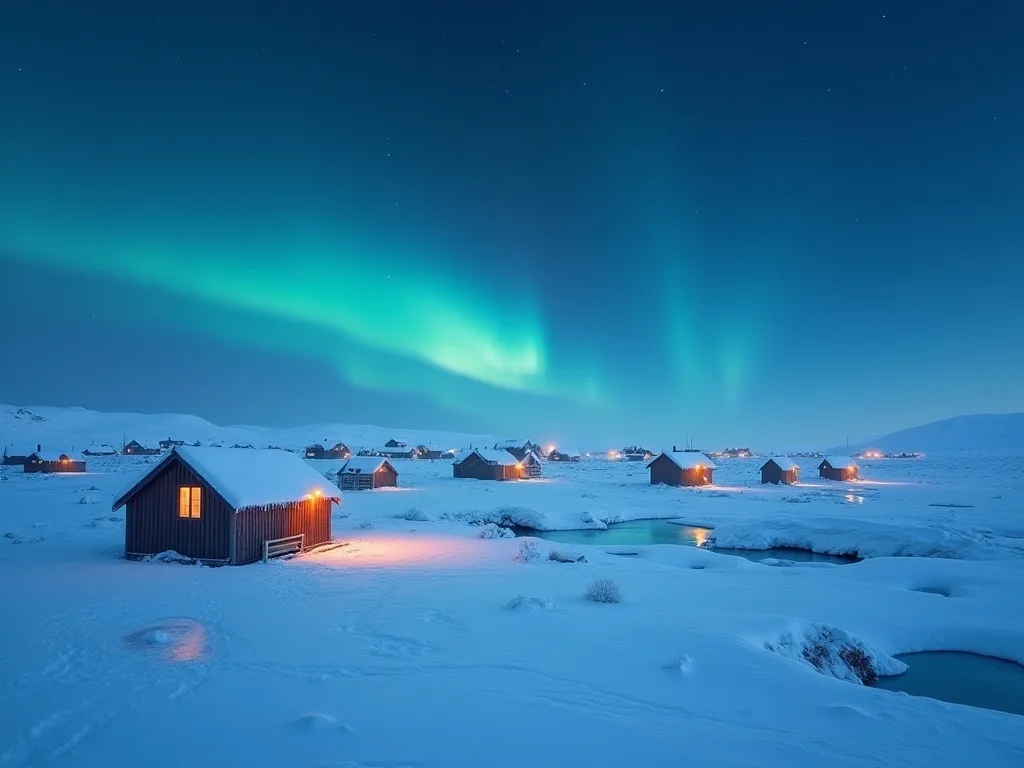
Sedna: The Woman Beneath the Sea
Sedna is the central mythological figure across nearly the entire Inuit world. She is the keeper of sea animals, the source of all marine life, and the spiritual axis around which the hunt revolves. Her story is a creation myth told through an act of violence, and it carries an ethical weight that reverberates through every seal hunt and every ritual at sea.
The core narrative runs like this: a young woman is cast from a boat, either by her father, her husband, or both. As she clings to the gunwale, her fingers are chopped off joint by joint. Each severed joint sinks into the sea and transforms: the first joints become seals, the second joints become walruses, the fingertips become whales. Sedna herself sinks to the ocean floor, where she becomes the mistress of Adlivun, the underworld beneath the water.
The story varies by region. In some versions, Sedna marries a dog who transforms into a man, or a fulmar who promises her comfort but delivers misery. In others, her father betrays her out of fear or greed; in others, a betrayed husband seeks revenge. What never changes is the structural logic: Sedna's suffering is the price of abundance. The animals are her body, distributed. To hunt is to take from her.
This is why the shaman's journey to Sedna is the most critical ritual act in traditional Inuit religion. When the hunt fails, when seals refuse to surface and starvation approaches, the shaman enters trance, descends through the ocean floor, and visits Sedna. He combs the tangles from her hair, because human transgressions, broken taboos, improperly treated animal bones, disrespected rituals, accumulate as knots in her hair and she cannot release the animals until they are untangled. The shaman's task is to negotiate, to apologize on behalf of the community, to restore the relationship.
This is not allegory. For the communities who told this story, it described a real mechanism of cause and effect. Mistreat an animal, and Sedna knows. Make amends, and the seals return.
The Structure of the Inuit Cosmos
Inuit cosmology divides existence into visible and invisible layers, though the boundary between them is permeable in ways that European cosmologies rarely imagine.
The physical world, Sila, is also the concept of air, breath, weather, and cosmic intelligence simultaneously. Sila is not a god in the Western sense; it is more like a pervasive awareness that permeates all matter. The wind that strips frost from a hunter's cheek and the intelligence that orders the universe share the same word. This conflation of environment and mind is characteristic of Inuit thought.
Above the earth, the sky holds the souls of the dead. The Northern Lights, aqsarniit in some dialects, are understood in several traditions as the spirits of the dead playing games, or as torches carried by the dead to guide the living, or as powerful spirits who can be summoned or appeased. In Greenlandic tradition, the aurora can be dangerous: whistling at them is said to draw them down.
Below the earth lies Adlivun, the cold underworld where Sedna rules and where the dead who violated taboos must wait before rising to Qudlivun, the Land of the Moon, which is the upper heaven. The Moon itself, Aningaat or Alignak depending on region, is a male spirit who governs fertility, childbirth, tides, and the hunt. He watches over humanity from above, pulling the tides with the same authority Sedna commands from below.
The Inua system is the cosmological spine. Every living thing, every geographic feature, every phenomenon possesses an inua: an indwelling spirit or inner person. The seal has an inua. The stone has one. The weather has one. The shaman's drum has one. This is not animism in the dismissive sense the word sometimes carries; it is a rigorous ontological position holding that personhood is not a human monopoly. The hunter who respects the seal's inua by treating its body properly ensures the soul will be reborn and allow itself to be caught again. The hunter who wastes meat or breaks the disposal rituals insults the inua and forecloses future hunts.
Shamanism and the Angakkuq
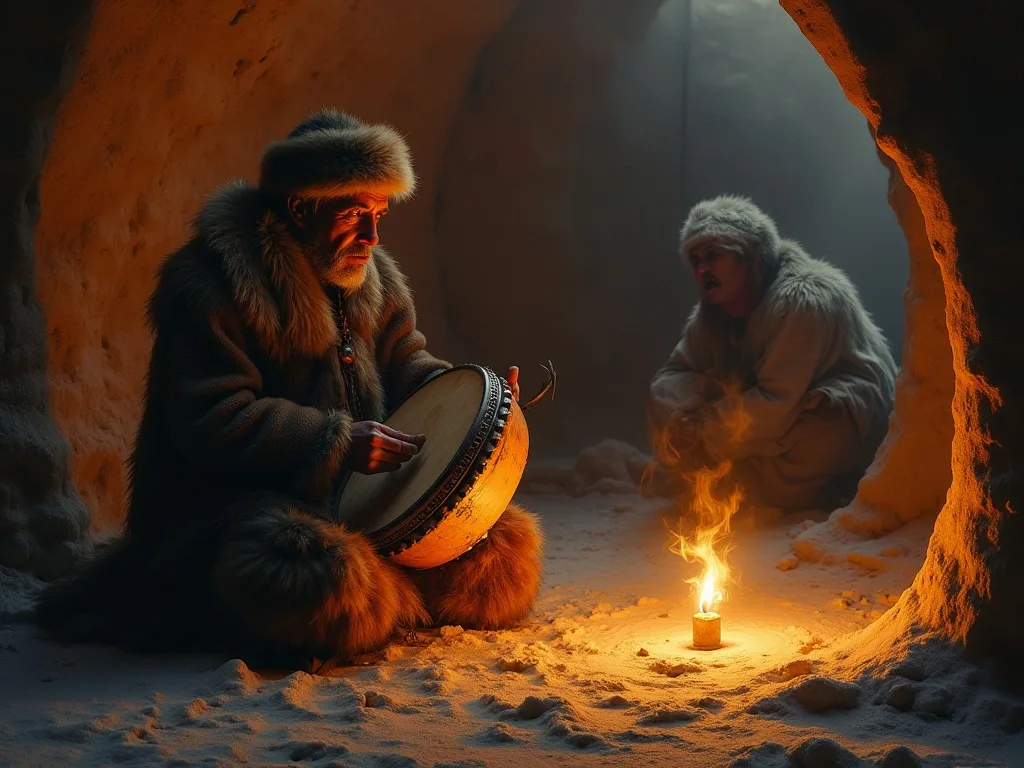
No figure in Inuit mythology and religious practice stands taller than the angakkuq (plural: angakkuit): the shaman. The word resists clean translation. "Healer" is too narrow, "priest" too institutional, "medium" too passive. The angakkuq is a trained specialist who has earned the ability to leave their body, travel between worlds, speak with spirits, diagnose illness, retrieve lost souls, negotiate with Sedna, and interpret the causes of misfortune.
The angakkuq receives their calling involuntarily. A spirit, often encountered during a period of extreme suffering or solitude, claims the future shaman. Training follows: years under an established angakkuq, learning the spirit geography of the cosmos, acquiring tuurngait, helper spirits who accompany the shaman on journeys. The Greenlandic accounts recorded by Rasmussen describe tuurngait taking forms as varied as polar bears, dead ancestors, and strange hybrid creatures with no name in the everyday world.
The initiatory experience often involves a vision of the shaman's own death and skeletal reduction. Rasmussen recorded an account from the Iglulik shaman Aua, who described seeing his own flesh stripped away until only bones remained, then being rebuilt. This dismemberment-and-reconstruction pattern appears in shamanic traditions from Siberia to the Amazon, but the Arctic version is particularly intimate with cold and darkness, the literal conditions under which bones are reduced.
The drum, qilaut, is the shaman's primary instrument. Its circular frame maps the cosmos. The drumbeat opens the path between worlds. In ceremony, the angakkuq dances, drums, and chants until the transition occurs, and those present can sometimes hear the spirits' voices through the shaman's altered vocalizations. The Yupik tradition preserves an extraordinary record of these ceremonies, including the Kivgiq, or Messenger Feast, where drumming and dancing maintained relationships between communities and between humans and the spirit world.
The angakkuq was not uniformly feared. In stable times, they were community members who also hunted and raised families. They held authority but also carried enormous responsibility: a failed healing, an unexplained death, could turn a community against its shaman. The position was dangerous, politically and spiritually.
Major Spirits and Beings of the Arctic Spirit World
Beyond Sedna and the inua system, Inuit mythological tradition contains a rich population of beings who govern different aspects of Arctic existence.
Nanook (or Nanuq in Inuktitut) is the polar bear spirit, the master of bears, and a model of the ideal hunter. The polar bear occupies a unique status: it hunts seals using techniques almost identical to those of human hunters, and it is the only Arctic animal that will stalk and kill humans. This symmetry made it a being of high spiritual status. Killing a polar bear required specific rituals; its skull was often placed facing a particular direction so its soul could depart properly. The bear's inua was considered especially powerful and potentially dangerous if disrespected.
Sila, already mentioned as the breath-intelligence of the cosmos, also appears as a personified weather spirit in some traditions. When the weather turns violent, Sila is offended. When it is calm, Sila is at peace. Some elders describe Sila as the oldest force in the universe, predating even the spirits.
Aningaat, the Moon Man, chases his sister the Sun across the sky in a story that echoes the Norse Máni and Sól. In the Inuit version, the Moon Man is not malevolent but lonely and powerful; he governs animal fertility and sometimes descends to earth to interact with humans. In some regional accounts, he punishes those who break hunting taboos by sending poor weather.
Ijiraq are shapeshifting spirits who lure children away into the wilderness and cause them to become lost. They are associated with the caribou migration and with the disorienting effects of the tundra on perception. Parents warned children about Ijiraq as both spiritual reality and practical caution: the Arctic landscape can kill through spatial confusion as surely as through cold.
Qalupalik lurk beneath the sea ice, snatching children who wander too close to the water's edge. They are depicted as humanoid, with long fingernails and greenish skin, carrying the children they steal in their amauti, the traditional Inuit baby-carrying parka. Like many creatures that target children in world mythology, the Qalupalik serve a dual function: they enforce the moral geography of survival and they personify a very real danger.
Atanarjuat, though primarily a hero rather than a spirit, deserves mention here. His story, recorded across Nunavut and immortalized in Zacharias Kunuk's 2001 film Atanarjuat: The Fast Runner, is one of the great narrative cycles of Inuit tradition. A wrongly accused man flees naked across the sea ice to escape his enemies, survives through physical endurance and spiritual protection, and eventually restores justice. The story encodes Inuit ethical values: the wrongness of murder, the power of spiritual help, the necessity of restraint, and the long arc of justice.
Animals, the Hunt, and the Ethics of Killing
The relationship between humans and animals in Inuit mythological thought is not one of dominance but of reciprocity under obligation. Animals possess souls. They choose to give themselves to hunters who are spiritually prepared and who will treat their remains correctly. This is not a metaphor: the belief governed every practical aspect of the hunt.
A hunter who caught a seal was required to offer it fresh water, because seals, as sea creatures, thirsted for fresh water. The Yupik practice of offering the first seal of the season a drink before butchering it was documented consistently by 20th-century ethnographers. The bones of the seal were returned to the sea so the soul could use them to regenerate. Wasting meat was not merely wasteful; it was a moral violation that damaged the community's future access to game.
The caribou, central to interior and migratory communities, held equally specific obligations. Mixing caribou and sea mammal tools or food was prohibited in many regions, the two worlds kept separate to prevent spiritual contamination. Women were often subject to stricter taboos around the hunt than men, their bodies understood as particularly powerful in relation to animal spirits.
This ethical framework shares structural similarities with traditions found elsewhere. The Green Man of Celtic tradition and the master of animals in Mesoamerican belief systems both encode a similar logic: the natural world is not resource but relationship. What distinguishes the Inuit version is its precision. The obligations are not vague reverence but specific, codified behaviors tied to identifiable consequences.
Creation Stories and the Shape of Inuit Time
Unlike many mythological traditions, Inuit stories rarely organize themselves around a single creation event. There is no Genesis moment, no cosmic egg, no world forged from a giant's body (as Ymir's bones become Midgard in Norse mythology). Instead, the world is described as already existing, gradually becoming more ordered through the actions of transformers and tricksters.
The most widespread creation-adjacent narrative involves the separation of earth and sky, which were once pressed together so tightly that no space existed for life. In some versions, a small animal or a person pushes them apart. In others, they simply drift open on their own. The emergence of space is the emergence of possibility.
The origin of daylight is another major narrative cycle. In many versions, the Raven (Tulimaq or Tulugaq) steals light from a being who is hoarding it, releasing it into the world. This connects Inuit tradition to the broader circumpolar Raven cycle found from Siberia through the Northwest Coast of North America. Raven as trickster-transformer is one of the most geographically widespread mythological figures on earth, and the Inuit version is among the most complex: Raven is simultaneously creator, thief, fool, and survivor.
The concept of Nunavut, "Our Land," is embedded in the mythological tradition as much as in the political geography created in 1999 when Canada established the territory. The land is not simply owned; it is inhabited by spirits with whom ongoing relationships must be maintained. This is why certain geographic features, specific mountains, estuaries, and hunting grounds, carry deep names that encode their spiritual significance. The landscape is a text as much as a territory.
Inuit Mythology in the Modern World
The story of Inuit mythological tradition in the 20th and 21st centuries is a story of suppression and resurgence. Canadian government residential schools, operating from the 1880s through the 1990s, systematically separated Inuit children from their families, languages, and oral traditions. The angakkuq tradition was specifically targeted by Christian missionaries, who had been active in Greenland since the 18th century and in Canada and Alaska from the 19th. By the mid-20th century, the open practice of shamanic ceremony had become rare in many communities.
What the disruption could not destroy was the structure of the belief. Elders who had survived the residential school system carried the stories. The land itself carried them. When cultural reclamation movements gathered force in the 1970s and accelerated through the 1990s, the mythological tradition proved more intact than anyone had expected.
Today, Inuit organizations such as Inuit Tapiriit Kanatami in Canada and Greenland's cultural institutions actively fund the documentation and teaching of traditional knowledge, including its mythological dimensions. Artists like Kenojuak Ashevak, whose iconic owls and transforming animals draw directly on inua concepts, brought Inuit mythological imagery to international audiences decades before the political reclamation of cultural rights. Zacharias Kunuk's Atanarjuat won the Camera d'Or at Cannes in 2001 and demonstrated that the narrative complexity of Inuit oral tradition translated with full force to cinema.
In academic circles, the study of circumpolar shamanism, driven partly by scholars like Mircea Eliade, Ronald Hutton, and Ann Fienup-Riordan, has given Inuit mythological tradition a serious place in comparative religious studies. Fienup-Riordan's work with Yupik communities in Alaska, conducted over several decades in genuine collaboration with community members, produced the most authoritative ethnographic record of Yupik ceremonial life, including the cosmological beliefs that underpin it.
The Kivgiq, the Messenger Feast involving days of drumming and dancing, has been publicly revived in several Alaskan communities since the 1980s. The drum is beating again.
Frequently Asked Questions About Inuit Mythology
Frequently asked questions
What is the most important figure in Inuit mythology?
Sedna, the woman beneath the sea, holds the central position across most Inuit cultural regions. She is the source of all sea animals, the ruler of the underwater underworld, and the being whose cooperation determines whether a community eats or starves. Her story exists in dozens of regional variants, but the structural logic, human transgression, Sedna's suffering, the shaman's negotiation, animal release, appears consistently from Alaska to Greenland. The shaman's journey to comb her hair is the most documented ritual act in the entire tradition.
Is Inuit mythology the same across all Arctic peoples?
No, and the differences matter. The Yupik of Alaska and Siberia, the Inupiat of northern Alaska, the Inuit of the Canadian Arctic, and the Kalaallit of Greenland share a broad cosmological framework, but names, specific stories, ritual practices, and even the character of major figures vary substantially. Sedna is called Takannaaluk in some Kivalliq traditions and Nunavgak in others. The Yupik have preserved ceremonial traditions, including the Messenger Feast and the Bladder Festival, that differ significantly from Eastern Arctic practices. Treating Inuit mythology as a single unified system distorts its richness.
What role did shamans play in Inuit society?
The angakkuq was the community's specialist in negotiating with the spirit world. This included healing illness (by retrieving a lost soul or appeasing an offended spirit), diagnosing the cause of failed hunts, traveling to Sedna to release withheld animals, and managing relationships with the dead. The role was not hereditary; it was conferred by a spirit calling, confirmed through training with an established shaman. Politically, the angakkuq held real authority but also real risk: failed healings or community disasters could be attributed to shaman failure. Knud Rasmussen's interviews with shamans including Aua, Orpingalik, and Najagneq remain the richest primary-source accounts available.
How do Inuit beliefs about animals differ from Western views of nature?
The fundamental difference is ontological. Western traditions, particularly since the Enlightenment, have generally treated animals as resources or as beings without moral standing comparable to humans. Inuit tradition holds that animals are persons with souls (inua), that they choose to give themselves to hunters who are spiritually prepared, and that they require specific treatments of their remains to allow rebirth. The hunter's relationship to the hunted animal is therefore a moral and spiritual relationship, not merely an economic one. This produces a detailed code of obligations around the hunt: offering fresh water to a dead seal, returning bones to water, observing gender-based taboos around mixing different animal species' tools or food.
Are these myths still alive today?
Yes. Despite severe suppression through Canadian residential schools and missionary activity from the 18th through 20th centuries, Inuit oral traditions have shown remarkable resilience. The last Canadian residential school closed in 1997, and cultural reclamation has accelerated since. The drum dance and the Kivgiq feast have been publicly revived. Artists like Kenojuak Ashevak encoded mythological imagery into internationally recognized graphic art. Zacharias Kunuk's 2001 film Atanarjuat: The Fast Runner brought the Atanarjuat cycle to world audiences. Academic collaboration between researchers and Inuit communities, notably Ann Fienup-Riordan's work with Yupik elders, continues to produce authoritative records of living tradition.
What are the primary written sources for Inuit mythology?
The oldest substantial record is Franz Boas's The Central Eskimo (1888), based on fieldwork in Cumberland Sound. Knud Rasmussen's Fifth Thule Expedition reports (1921-1924), especially Intellectual Culture of the Iglulik Eskimos and The Netsilik Eskimos, are the richest comparative sources, covering the entire Canadian Arctic and Alaska. For Alaska, Edward William Nelson's The Eskimo About Bering Strait (1899) is foundational. Ann Fienup-Riordan's Boundaries and Passages: Rule and Ritual in Yupik Eskimo Oral Tradition (1994) is the definitive modern ethnographic account. Greenlandic mythology is documented in Hinrich Rink's Tales and Traditions of the Eskimo (1875).
The Circumpolar Thread: Inuit Mythology and the Wider Arctic World
One of the quieter revelations in comparative mythology is how consistently certain patterns appear across the entire Arctic and sub-Arctic band from Scandinavia to Siberia to Alaska. The master-of-animals figure, a being who controls access to game and must be ritually placated, appears in Saami tradition as Leibolmái, in Siberian Evenki belief as the Lord of the Forest, and in Inuit tradition as Sedna. The shaman who travels to a spirit realm to retrieve souls or negotiate with cosmic powers appears among the Norse völva, the Siberian kamilan, and the angakkuq. The trickster-raven transforms the world from Alaska to the Yenisei River.
This is not coincidence, and it is not borrowing in any simple direction. These traditions likely share deep roots in the paleolithic hunting cultures that spread across the northern hemisphere before the land bridge between Siberia and Alaska submerged around 11,000 years ago. The people who became the Norse and the people who became the Yupik shared ancestors. The myths remember that, even when the people who carry them do not.
What Inuit mythology adds to this conversation is specificity. Where other circumpolar traditions have been filtered through centuries of writing, state religion, and cultural mixing, the Inuit record, precisely because it was kept oral, because it was tied to a specific, extreme environment, retains a directness that is almost physical. The sea ice cracks underfoot. The bear's breath steams. Sedna waits below. The drum opens the door. These stories are not dressed in metaphor; they are the direct perception of a world in which the spiritual and the practical were never separate to begin with.
That refusal to separate the sacred from the functional, the myth from the hunt, the spirit from the seal, is what makes Inuit mythological tradition one of the most coherent and demanding cosmologies in human history. It asks more of its participants than most religions do: not faith in the abstract, but meticulous, daily, embodied attention to the living world. The consequence of inattention is not theological. It is hunger.
Major gods of Inuit
View all →
Inuit
Nanook: The Polar Bear Spirit Master
Nanook rules the Arctic as the supreme master of polar bears in Inuit belief. Learn his origin, his laws of the hunt, and why hunters still honour him today.
Inuit
Sedna: Goddess of the Sea and Marine Animals
Sedna rules the ocean and all its creatures in Inuit belief. A goddess born from tragedy, she demands respect from hunters and can grant abundance or withhold bounty. Her story reveals how the Arctic peoples saw power, punishment, and the sacred bargain between humans and the sea.

Inuit
Sila: The Breath of Life and Weather Spirit
Sila is the Inuit spirit of weather, breath, and life force itself, a boundless presence that moves through air and water, sustaining hunters and demanding respect. Discover how Arctic peoples understood this invisible power that controlled their survival.
Famous Inuit myths
View all →
Inuit
The Moon Man and Sun Sister: Cosmic Pursuit Myth
In Inuit cosmology, the Moon Man chases his sister, the Sun, across the sky in an endless celestial pursuit born from darkness and shame. Discover how this myth explains the rhythm of day and night, and why it still echoes in Arctic cultures today.

Inuit
The Legend of Sedna: How an Inuit Girl Became Ruler of the Depths
Sedna rules the ocean from the seafloor, her fingers transformed into seals and whales. Discover how a betrayed girl became the most powerful being in Inuit cosmology, and why hunters still honor her with rituals tied to survival itself.
Recent in Inuit
6 entries
Inuit
Angakkuit: Inuit Shamans and Spirit Mediators
Angakkuit are the shamans and spirit mediators of Inuit cultures, channeling power from the animal and spirit worlds to heal, guide, and maintain balance between the human and sacred realms. Discover how these intermediaries shaped Arctic survival and cosmology.
Inuit
Bladder Festival: Honoring Animal Souls in Inuit Tradition
The Bladder Festival is the most sacred ceremony in Yup'ik tradition, returning animal souls to the sea to ensure the hunt never fails. Learn the ritual, the myth, and the living practice.

Inuit
Inua: The Animating Spirit in All Things
In Inuit belief, every living thing holds an inua, an inner spirit that gives it power and identity. Learn how this ancient concept shapes the entire Inuit cosmos.
Inuit
The Moon Man and Sun Sister: Cosmic Pursuit Myth
In Inuit cosmology, the Moon Man chases his sister, the Sun, across the sky in an endless celestial pursuit born from darkness and shame. Discover how this myth explains the rhythm of day and night, and why it still echoes in Arctic cultures today.

Inuit
Inuksuk: Stone Markers of the Arctic Landscape
The Inuksuk stands as a silent guardian across the Arctic: stacked stones shaped by Inuit hands to guide hunts, mark sacred places, and embody the spirit of community. Learn how these markers bridge the visible and spiritual worlds.
Inuit
Kiviuq: The Eternal Wanderer Hero of Inuit Mythology
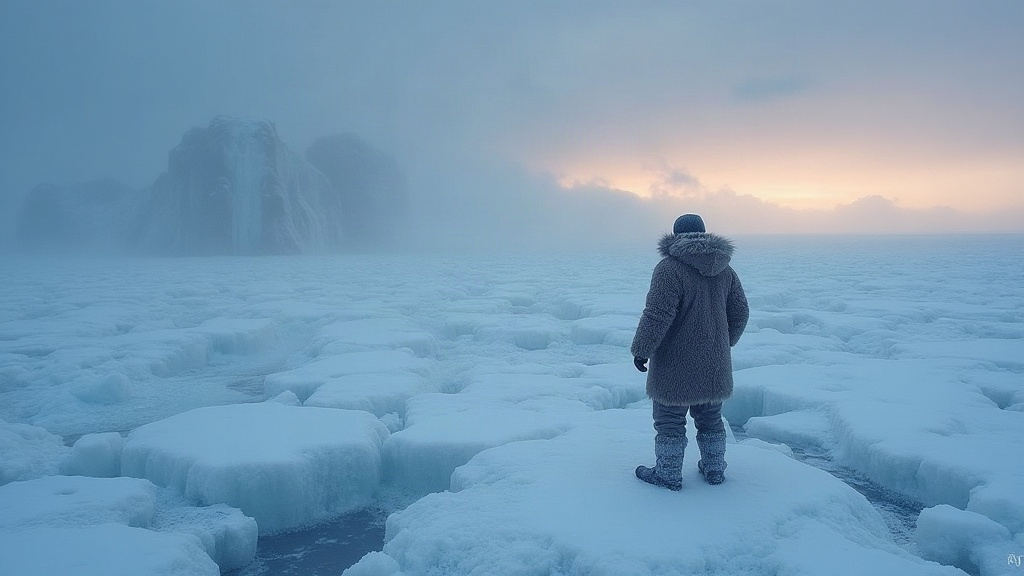
Kiviuq walks the Arctic ice as the hero who cannot die, hunted by monsters and shaped by starvation, yet never settling. Discover how this Inuit legend embodies survival, transformation, and the relentless human journey across the frozen world.