Cherokee
Cosmology, clan structure, and oral tradition of the Cherokee. From James Mooney's 1887-1890 field notes to living practice today.
Most online summaries of Cherokee mythology are digital reprints of James Mooney's field notes, collected between 1887 and 1890 and published by the Bureau of American Ethnology. Those notes remain indispensable, but they are ethnographic snapshots, not scripture. The stories Mooney transcribed belong to a living oral tradition that predates European contact by centuries and continues, in altered but unbroken form, among the Cherokee Nation, the Eastern Band of Cherokee Indians, and the United Keetoowah Band today.
This guide treats Cherokee mythology as a coherent cosmological system: a three-world structure, a seven-clan social order, and a body of sacred formulas that encoded both theology and practical medicine. The sources are fragmentary, the translation problems real, but the pattern is legible.
The Sources: Mooney, Oral Tradition, and What Survives
James Mooney's Field Seasons, 1887 to 1890
James Mooney arrived in Cherokee country in North Carolina during the summer of 1887, employed by the Bureau of American Ethnology under John Wesley Powell. He spent three field seasons among the Eastern Band, learning enough of the language to conduct interviews without an interpreter. His principal informant was Swimmer (A'yûn'inï), a medicine man and keeper of formulas who provided Mooney with both narrative accounts and ritual texts written in Sequoyah's syllabary.
Mooney's Myths of the Cherokee, published in 1900 as part of the Bureau's Nineteenth Annual Report, collects 126 stories. His earlier work, The Sacred Formulas of the Cherokees (1891), transcribes and translates ritual texts used for healing, hunting, and love magic. Both volumes are products of salvage ethnography, a discipline premised on the assumption that indigenous cultures were vanishing. That assumption was wrong, but the urgency shaped the method.
The Problem of Translation and Transcription
Mooney worked in a language he had learned as an adult, transcribing oral performances into English prose. The Cherokee language is polysynthetic, encoding subject, object, tense, and aspect within a single verb form. English flattens that structure. Mooney's translations are competent but not transparent. When he renders a formula as "Listen! Now you have drawn near to hearken," the original syllabary text carries layers of honorific address and ritual grammar that the English cannot hold.
Some stories were told to him in English by bilingual informants. Others he heard in Cherokee and translated himself. The published versions do not always indicate which is which. Scholars since Mooney have noted that his editorial hand smoothed narrative inconsistencies and imposed linear structure on stories that, in oral performance, loop and double back.
Living Tradition and Contemporary Cherokee Voices
Cherokee oral tradition did not end in 1890. Ceremonial knowledge continues to be transmitted within families and clans, though much of it remains private. Contemporary Cherokee scholars and storytellers, including Barbara Duncan, Thomas Belt, and members of the Cherokee Nation's language revitalization programs, have worked to contextualize Mooney's collection within a living tradition that adapts without erasing.
The stories Mooney recorded are not folklore curiosities. They are part of a knowledge system that includes clan law, seasonal ceremony, and the ethical structure of reciprocity between humans, animals, and the land.
Cosmology: The Three Worlds and the Vault of Sky
The Upper World, This World, and the Under World
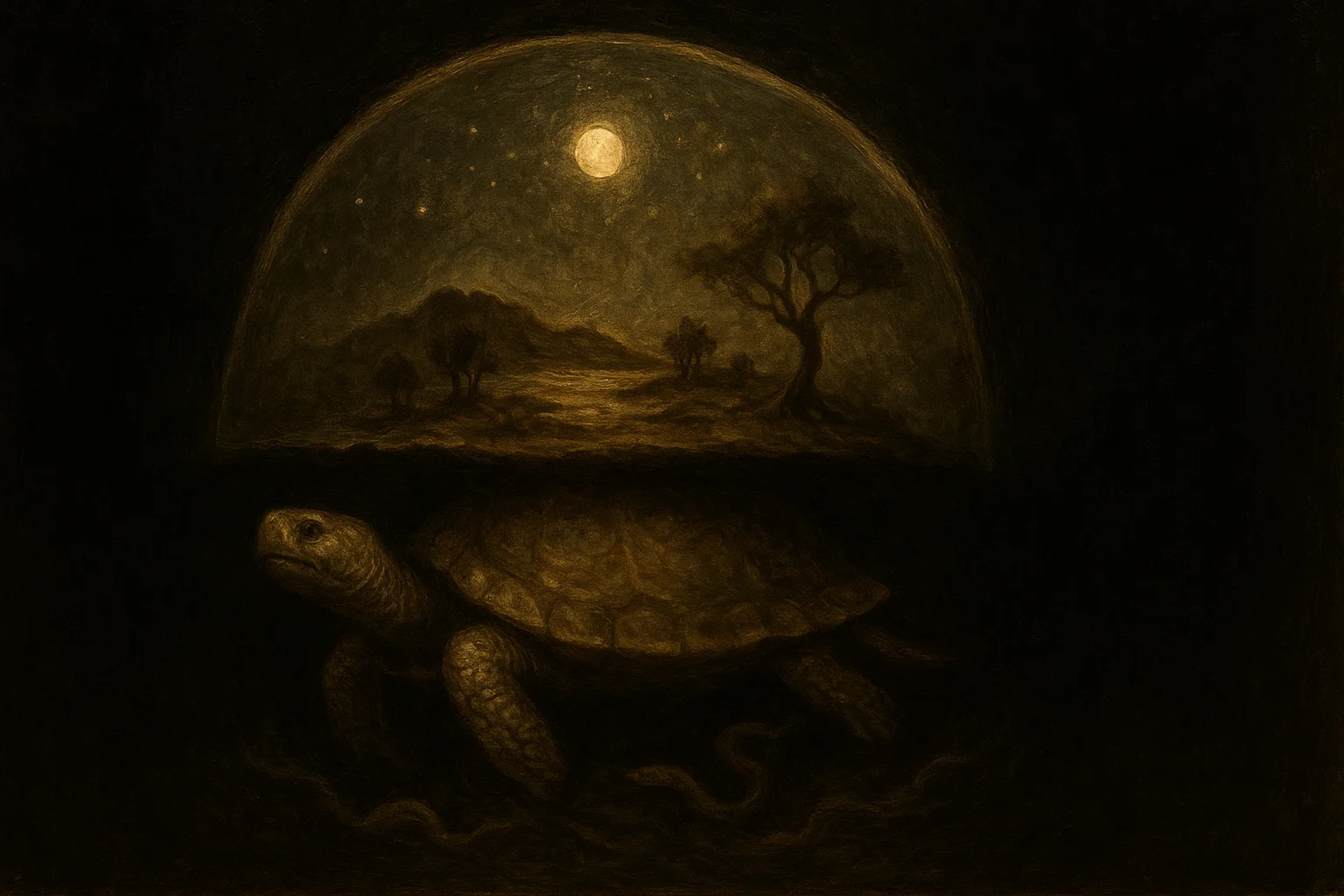
Cherokee cosmology organizes existence into three horizontal layers, stacked vertically and separated by the vault of the sky. The Upper World is the realm of order, light, and predictability. The Under World is the domain of chaos, transformation, and fertility. This World, the middle layer, is where humans live, balanced precariously between the two.
Each world has its own inhabitants. The Upper World is home to the Thunder Beings, who bring rain and maintain cosmic order. The Under World is inhabited by dragon traditions like Uktena, the great horned serpent, and other beings associated with water spirits and subterranean power. This World is shared by humans, animals, and the Nunnehi, immortal beings who live hidden among the mountains.
The Water Beetle and the Creation of Earth
In the beginning, according to the account Mooney recorded from Swimmer, all was water. The animals lived in Galun'lati, the sky vault, but it was crowded. The Water Beetle, Dâyuni'sï, volunteered to dive down and see what lay below. He brought up soft mud from the bottom, which spread and hardened to become the earth. The land was still too wet, so the Great Buzzard flew low over it, and where his wings struck the ground, valleys formed; where they lifted, mountains rose.
"When the earth was dry and the animals came down, it was still dark. They got the sun and set it in a track to go every day across the island from east to west." Mooney, Myths of the Cherokee (1900)
The earth is an island, suspended by four cords from the sky vault. When the cords break, the world will sink back into the water.
The Vault of Rock and the Suspension of the Island
The sky is a solid dome of rock, arching over the flat earth. Beyond it lies the Upper World. The sun travels across the underside of the vault each day, returning at night by an underground passage. The earth itself hangs from the vault by cords attached at the four cardinal directions. Some accounts say the cords are made of rawhide; others do not specify. When the world grows old and the cords fray, the island will fall.
The Seven Clans and Their Origin Stories
Clan Structure and Matrilineal Descent
Cherokee society is organized into seven matrilineal clans. A child belongs to the mother's clan, and clan membership determines marriage eligibility, ceremonial roles, and legal responsibility. Members of the same clan are considered siblings, regardless of blood relation, and marriage within a clan is prohibited.
The clans are named for animals or natural features, though the names do not imply totemic descent. A member of the Wolf Clan is not descended from wolves; the name marks a social and ceremonial identity, not a genealogical one.
The Animal Clans: Wolf, Deer, Bird, and the Rest
The seven clans are Wolf (Ani'-Waya), Deer (Ani'-Kawi), Bird (Ani'-Tsiskwa), Paint (Ani'-Wodi), Blue (Ani'-Sahoni), Long Hair (Ani'-Gilohi), and Wild Potato (Ani'-Gatagewi). Each has traditional roles, though the specifics vary by community and have shifted over time.
- The Wolf Clan traditionally provided war leaders and scouts.
- The Deer Clan was associated with hunting and runners.
- The Bird Clan held responsibility for messengers and diplomacy.
- The Paint Clan, named for the red pigment used in ceremony, included medicine people.
- The Blue Clan, sometimes called Panther, had roles in healing and ritual.
- The Long Hair Clan, also called Twister or Wind, was linked to weather magic.
- The Wild Potato Clan, sometimes translated as Bear, was responsible for gathering and agriculture.
Clan Roles in Ceremony and Governance
Clan membership determined who could perform certain ceremonies, who could serve on councils, and who bore responsibility for avenging a death. If a member of one clan killed a member of another, the victim's clan had the right to exact blood revenge, but only against the killer or another member of the killer's clan. This system of clan law persisted into the nineteenth century and was gradually replaced by tribal and federal legal structures.
Ceremonial knowledge was often, though not exclusively, passed down within clans. A medicine person might train a nephew or niece, ensuring that formulas and ritual procedures stayed within the matriline.
Principal Beings and Spirits
The Thunder Beings and the Sons of Kanati
The Thunder Beings, or Thunder Boys, are sons of Kanati, the Lucky Hunter, and Selu, the Corn Mother. In the story Mooney recorded, Kanati and Selu have one son, but he discovers he has a twin brother, the Wild Boy, who emerged from the blood Selu washed from game. The two boys, curious and reckless, release the animals Kanati had penned up, causing game to scatter across the world. They also kill their mother, Selu, after discovering she produces corn and beans by rubbing her body. She instructs them to drag her corpse across the ground, and where her blood falls, corn grows.
The boys eventually ascend to the Upper World and become the Thunder Beings, who bring rain and punish wrongdoers. They are not gods in the sense of receiving worship, but they are powerful and dangerous, and their intervention in human affairs is unpredictable.
Selu, the Corn Mother
Selu is the source of corn, beans, and squash, the three sisters of Southeastern agriculture. Her death is not a tragedy but a transformation: she becomes the food that sustains her people. The story encodes agricultural knowledge and the ethics of reciprocity. Corn is a gift, but it requires proper treatment. The first corn of the season is offered back to the earth, and certain formulas must be recited before planting.
Selu's name is related to the Cherokee word for corn, and her story is structurally similar to other Corn Mother narratives across the Eastern Woodlands, though the details vary.
The Nunnehi: The Immortal People
The Nunnehi are immortal beings who live hidden among the mountains, usually in caves or beneath the surface of rivers. They resemble humans but are taller, stronger, and invisible unless they choose to reveal themselves. They are generally benevolent, sometimes helping lost travelers or warning of danger. In some accounts, they fought alongside the Cherokee in battles against enemy tribes.
The Nunnehi are not spirits of the dead, though they are sometimes confused with them. They are a separate race, older than humans, who share the land but remain apart. Their dwellings are said to produce drumming and singing that can be heard at dusk.
Uktena and the Horned Serpent
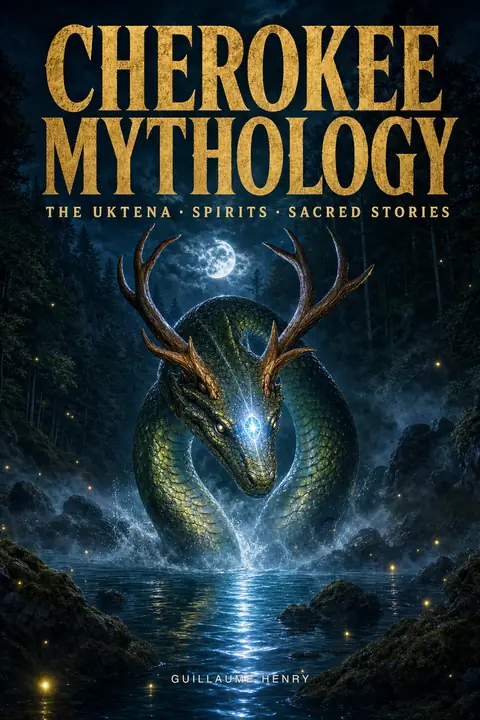
Uktena is a great horned serpent that lives in deep water and remote mountain passes. It has a crest of horns on its head and a blazing crystal, the Ulûñsû'tï, embedded in its forehead. The crystal grants immense power to anyone who possesses it, but obtaining it requires killing Uktena, a feat so dangerous that only the most skilled medicine people attempt it.
Uktena is not evil, but it is deadly. It kills with its gaze and its breath. The formulas for approaching it, recorded by Mooney in The Sacred Formulas of the Cherokees, involve elaborate purification and protective rituals. The serpent belongs to the Under World, the realm of transformation and danger, and it embodies the power that lies beneath the surface of things.
Cherokee Uktena
A horned serpent of the Under World, guarding a crystal of immense power. Dangerous but not malevolent; it kills those who approach unprepared.
Mesoamerican Quetzalcoatl
A feathered serpent associated with wind, knowledge, and the morning star. Divine rather than monstrous, though still linked to water and the underworld.
Sacred Formulas and the Role of the Medicine Person
Cherokee medicine people, or didanawisgi, were specialists in sacred formulas, memorized texts recited for healing, hunting, love, protection, and revenge. The formulas were not prayers in the Christian sense; they were performative utterances, words that accomplished what they named. A formula for snakebite did not ask for healing; it commanded the snake's spirit to withdraw.
Mooney collected over six hundred formulas, most of them written in Sequoyah's syllabary by Swimmer and other medicine people. The texts are terse, repetitive, and dense with metaphor. They invoke the four cardinal directions, name specific plants and animals, and call on the power of the Upper World to counteract threats from the Under World.
The formulas were private property, passed down within families or sold to other practitioners. A medicine person who revealed a formula without permission risked losing its efficacy. Mooney's collection, published in 1891, was controversial for this reason. Some Cherokee felt he had violated sacred trust; others saw the publication as a necessary act of preservation.
The role of the medicine person was not priestly. They did not lead public worship or mediate between humans and gods. They were technicians of the sacred, specialists in a body of knowledge that required years of training and precise execution.
Oral Tradition, Memory, and the Written Record
Cherokee oral tradition is not folklore in the sense of entertainment. It is a knowledge system, a way of encoding history, ethics, and practical information in narrative form. Stories about animals teach ecological knowledge; stories about the Thunder Boys encode the consequences of recklessness; stories about Selu explain the origin of agriculture and the ethics of reciprocity.
The introduction of Sequoyah's syllabary in 1821 allowed Cherokee speakers to write their own language for the first time. By the 1880s, when Mooney arrived, many medicine people were recording formulas in syllabary notebooks. This did not replace oral transmission, but it supplemented it, creating a hybrid system of memory and text.
Mooney's translations are a third-order representation: oral performance, transcribed into syllabary, translated into English. Each step introduces distortion. The English versions are useful, but they are not the stories themselves. They are ethnographic documents, valuable for what they preserve but limited by the circumstances of their creation.
Cherokee Mythology in Context: Southeastern Cosmologies
Cherokee cosmology shares structural features with other Southeastern traditions, including those of the Creek, Choctaw, and Chickasaw. The three-world model, the emphasis on balance between Upper and Under World forces, and the role of shape-shifting beings are widespread across the region. The catalogue of beings includes blood-drinking spirits and creatures that guard sacred knowledge, though the specific names and stories vary.
The Cherokee were part of a broader cultural and trade network that extended from the Atlantic coast to the Mississippi River. Stories, ritual practices, and cosmological concepts circulated along these networks, adapted and reinterpreted by each community. The Cherokee version of the earth-diver creation story, for example, has parallels among the Iroquois, the Algonquian-speaking peoples of the Great Lakes, and the Muskogean speakers of the Southeast.
What distinguishes Cherokee tradition is not its uniqueness but its coherence. The seven-clan system, the matrilineal structure, the emphasis on sacred formulas as memorized texts, and the integration of cosmology with daily life create a distinctive pattern within a shared regional framework.
Frequently asked questions
What is the most reliable source for Cherokee mythology?
James Mooney's Myths of the Cherokee (1900) and The Sacred Formulas of the Cherokees (1891) remain the most comprehensive written sources, based on fieldwork conducted between 1887 and 1890. However, they are ethnographic records, not scripture, and should be read alongside contemporary Cherokee voices and ongoing oral tradition.
Are the seven clans totemic?
No. The clan names refer to animals or natural features, but membership does not imply descent from those beings. The clans are social and ceremonial units, organizing marriage eligibility, legal responsibility, and ritual roles. The names mark identity, not ancestry.
What is the Ulûñsû'tï crystal?
The Ulûñsû'tï is a blazing crystal embedded in the forehead of Uktena, the great horned serpent. It grants immense power to anyone who possesses it, but obtaining it requires killing Uktena, a task so dangerous that only the most skilled medicine people attempt it. The crystal is both a source of power and a symbol of the risks inherent in seeking knowledge from the Under World.
How did Sequoyah's syllabary affect oral tradition?
Sequoyah's syllabary, introduced in 1821, allowed Cherokee speakers to write their own language. By the 1880s, many medicine people were recording sacred formulas in syllabary notebooks. This supplemented oral transmission without replacing it, creating a hybrid system that preserved ritual texts while maintaining the primacy of spoken performance.
What happened to Selu after her sons killed her?
Selu instructed her sons to drag her corpse across the ground seven times. Where her blood fell, corn grew. Her death was a transformation, not an ending: she became the food that sustains the Cherokee people. The story encodes agricultural knowledge and the ethics of reciprocity between humans and the plants that feed them.
Are the Nunnehi the same as ghosts?
No. The Nunnehi are a separate race of immortal beings, older than humans, who live hidden in caves and beneath rivers. They are not spirits of the dead. They are generally benevolent, sometimes helping lost travelers or warning of danger, and in some accounts they fought alongside the Cherokee in battle.