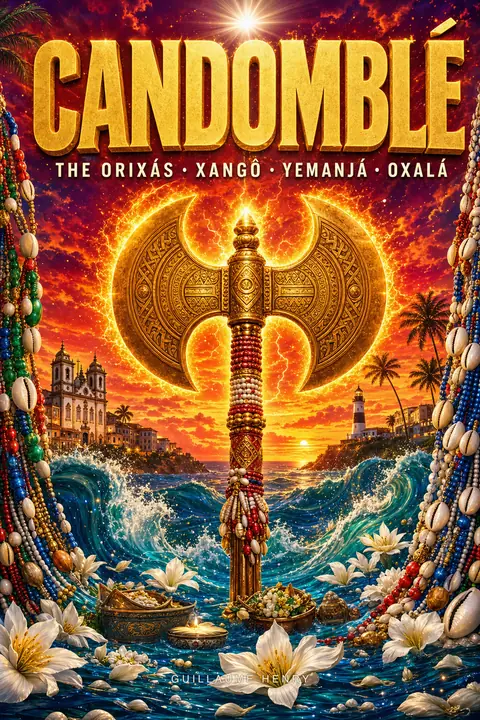
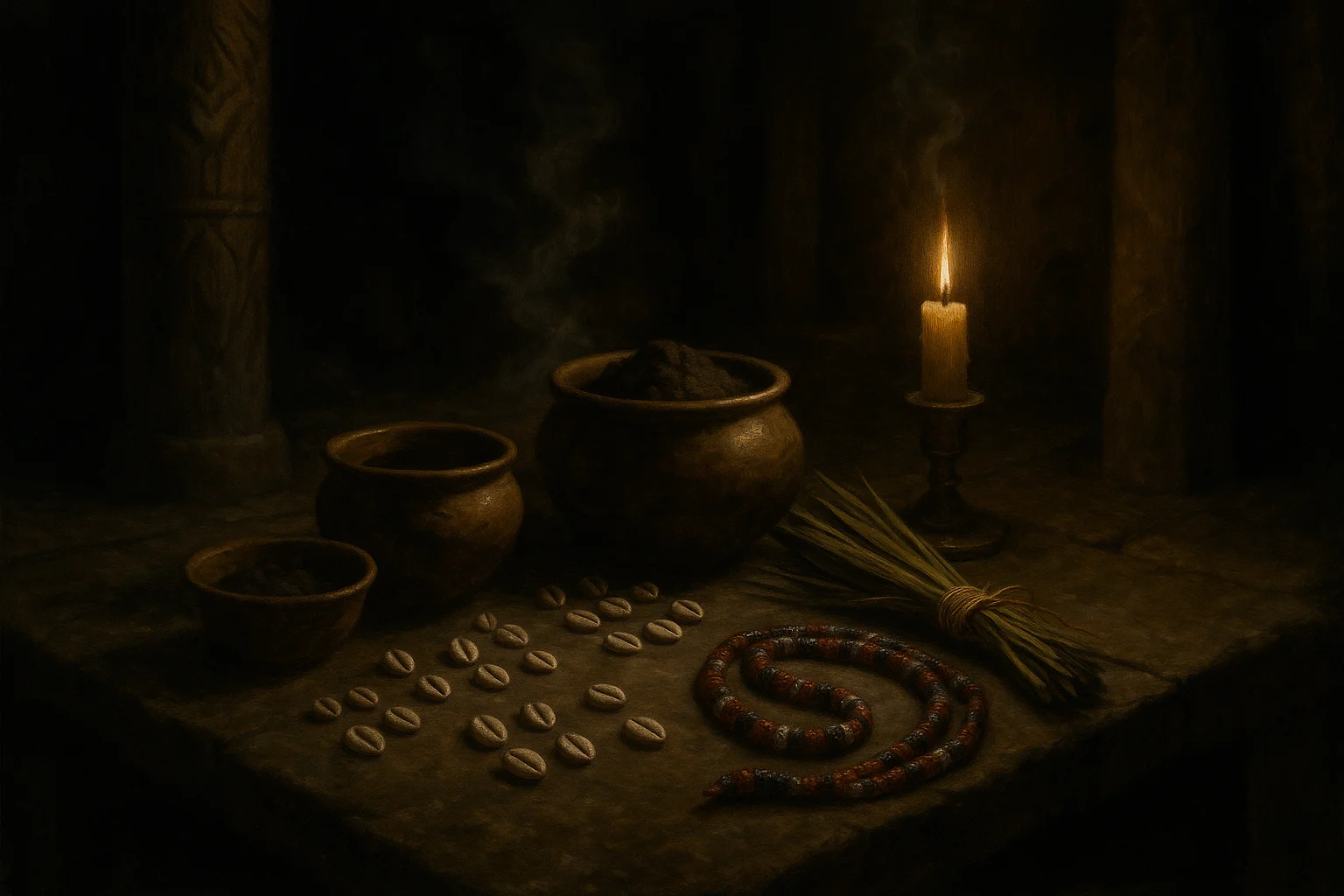
Candomblé
Origins in Yoruba, Fon, and Bantu traditions. Ritual structure, orixás, possession, and contemporary practice. The living theology of Candomblé.
When enslaved Africans stepped off ships in Salvador da Bahia between the sixteenth and nineteenth centuries, they carried no possessions. What they brought instead were cosmologies: the names of gods, the rhythms of drums, the grammar of sacrifice, and the memory of how the divine moves through human bodies. Candomblé is what survived and transformed when those cosmologies met Brazilian soil, Catholic repression, and the necessity of continuity under impossible conditions.
This is not a single tradition but a family of them, each rooted in a different African source. The Yoruba brought the orixás. The Fon brought the voduns. The Bantu nations brought the nkisis. All three streams converged in the terreiros of Bahia, Pernambuco, and Rio de Janeiro, where priests rebuilt altar houses from memory and adapted ritual to a new world that wanted them erased.
What Candomblé Is and Where It Came From
Candomblé is an Afro-Brazilian religion practised primarily in terreiros, temple compounds led by priests and priestesses who maintain altars, conduct rituals, and serve as intermediaries between the human and divine. It is not syncretic in the sense of blending traditions into something new. It is reconstructive: African religious systems rebuilt under conditions of slavery, colonialism, and legal persecution.
The word itself may derive from Bantu languages, possibly from the Kikongo term kandombele, meaning prayer or invocation. Others trace it to a Yoruba root. The etymology remains contested. What is not contested is the historical process: between 1550 and 1850, an estimated four million enslaved Africans were brought to Brazil, the majority from West and Central Africa. They came from regions that are now Nigeria, Benin, Togo, Angola, and the Congo.
These were not homogenous populations. The Yoruba, Fon, and Bantu peoples brought distinct languages, cosmologies, and ritual structures. In Brazil, they were forced together on plantations and in urban slave quarters. What emerged in the terreiros of Salvador and Recife was not a melting pot but a careful preservation of difference within proximity. The Ketu houses maintained Yoruba liturgy. The Jeje houses kept Fon cosmology. The Angola and Congo houses preserved Bantu practices. All three coexisted, sometimes in the same neighbourhood, sometimes in the same family.
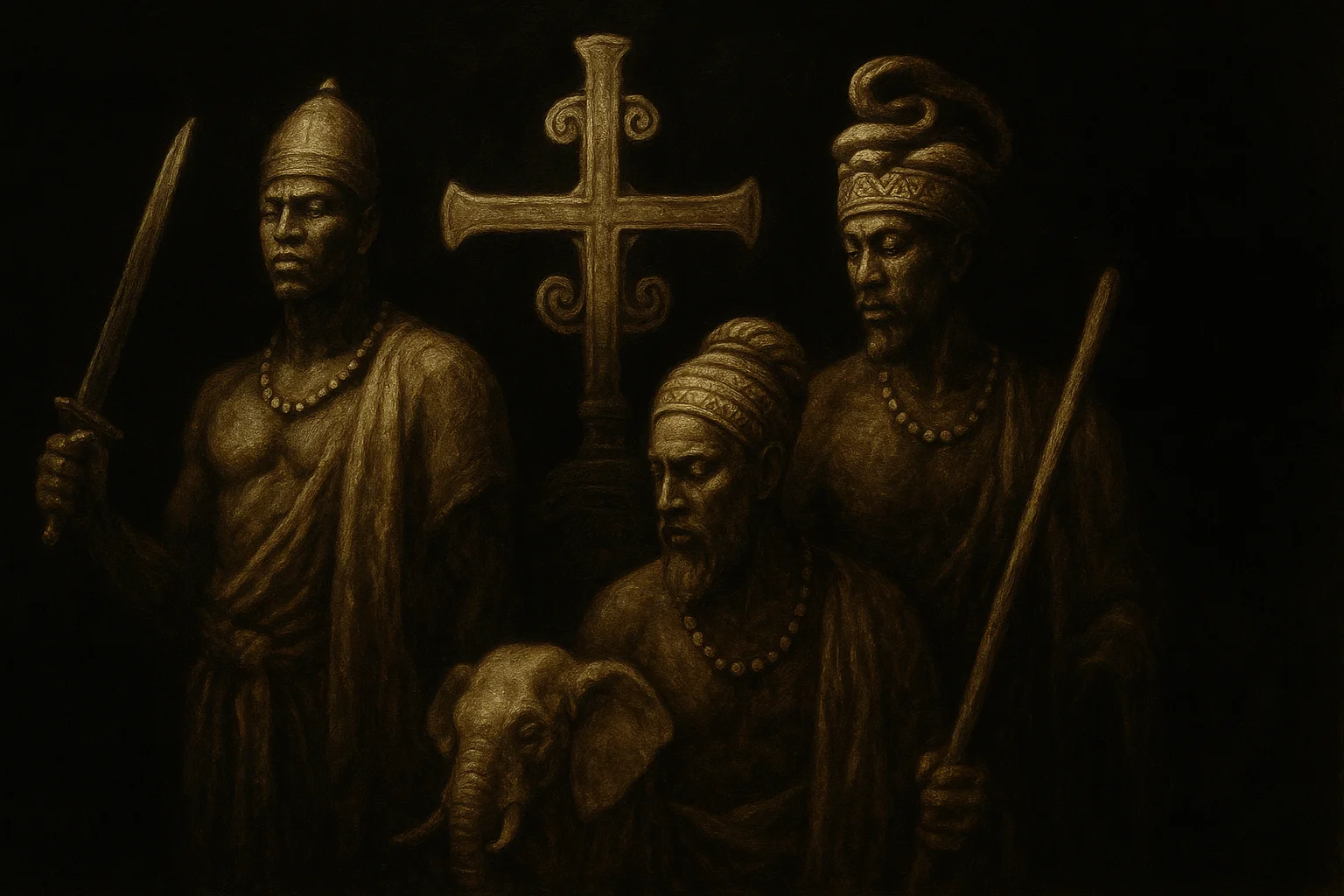
The Three African Roots: Yoruba, Fon, and Bantu Cosmologies
Candomblé is not one religion but three parallel traditions, each called a nation (nação). The term is liturgical, not ethnic. A practitioner may be ethnically mixed but initiated into a single nation, bound to its deities, rhythms, and ritual language.
Ketu: The Yoruba Lineage
The Ketu nation is the most widely practised and the most documented. It descends from the Yoruba-speaking peoples of what is now southwestern Nigeria and Benin. The deities are called orixás, and their mythology draws from the oral traditions of the Ifá corpus, a vast body of divination verses that encode Yoruba cosmology, ethics, and history.
The orixás are not omnipotent. Each governs a domain: Xangô rules thunder and justice, Oxum presides over fresh water and fertility, Ogum commands iron and war. They are not abstract principles but personalities with preferences, histories, and conflicts. The ethnographer Pierre Verger, who spent decades documenting Yoruba and Brazilian ritual, recorded hundreds of orikis, praise poems that name the orixás' deeds and temperaments.
Ketu liturgy is conducted in a ritual Yoruba that few practitioners speak fluently. The language is preserved phonetically, passed from priest to initiate through repetition and song. This is not fossilisation but continuity under constraint.
Jeje: The Fon Tradition
The Jeje nation comes from the Fon people of Dahomey, present-day Benin. The deities are called voduns, and the cosmology centres on the creator pair Mawu (female, associated with the moon) and Lisa (male, associated with the sun). The Fon cosmology, as documented in ethnographic accounts, emphasises duality and balance: male and female, earth and sky, cool and hot.
Jeje ritual differs from Ketu in rhythm, language, and the structure of possession. The drums are tuned differently. The songs are in Fon, not Yoruba. The voduns have different temperaments and demands. Verger noted that Jeje houses in Bahia maintained stricter separation from Catholic imagery than Ketu houses, though this varied by terreiro.
Jeje Candomblé is less common today than Ketu, concentrated in a few historic houses in Salvador and São Luís. The tradition survived through the work of priestesses like Mãe Runhó, who led the Jeje house Roça do Ventura in the early twentieth century and resisted pressure to merge with Ketu liturgy.
Angola and Congo: The Bantu Nations
The Angola and Congo nations descend from Bantu-speaking peoples of Central Africa. The deities are called nkisis, and the cosmology, as documented by anthropologist Wyatt MacGaffey, centres on the relationship between the living, the dead, and the natural world. Bantu cosmology does not separate the sacred from the material in the way European theology does. Rivers, trees, and stones are not symbols of the divine but sites where the divine is present.
Angola Candomblé incorporates more indigenous Brazilian and Amerindian elements than Ketu or Jeje, including the use of caboclo spirits, entities identified with indigenous ancestors. This has led some scholars to treat Angola as less "pure" than Ketu, a judgement that reflects colonial hierarchies more than liturgical reality.
The Angola nation uses Portuguese more freely in ritual than Ketu or Jeje, and its drumming patterns are distinct. The nkisis include Nkosi (war and iron, cognate with the Yoruba Ogum), Nzazi (lightning, cognate with Xangô), and Kisimbi (water, cognate with Oxum). The correspondences are not exact. Each nation's deities carry their own histories.
The Orixás, Voduns, and Nkisis: Deities Across the Nations
The deities of Candomblé are not gods in the monotheistic sense. They are forces, personalities, and ancestors, each with a domain, a temperament, and a set of ritual obligations. They are not omnipresent. They must be called, fed, and housed. They do not forgive easily.
Each practitioner is understood to be a child of one or two orixás, voduns, or nkisis, determined through divination at initiation. This relationship is not chosen. It is revealed. The deity claims the person, not the other way around. The initiate's life, diet, dress, and ritual obligations are shaped by this bond.
The orixás are not interchangeable with Catholic saints, though they were often publicly identified with them during slavery as a survival strategy. Iemanjá, orixá of the ocean, was associated with Our Lady of the Immaculate Conception. Oxalá, father of the orixás, was linked to Jesus Christ. These associations were tactical, not theological. Inside the terreiro, the orixás were and are distinct.
Some of the most widely venerated orixás include:
- Exu: messenger, trickster, guardian of crossroads, first to be fed in any ritual
- Ogum: iron, war, labour, technology, patron of blacksmiths and soldiers
- Oxóssi: hunt, forest, knowledge, patron of hunters and herbalists
- Xangô: thunder, justice, kingship, associated with fire and the double-headed axe
- Oxum: fresh water, fertility, love, gold, beauty, associated with rivers
- Iemanjá: ocean, motherhood, protector of fishermen and sailors
- Oxalá: creation, purity, peace, father of the orixás, associated with white cloth
These are creatures born from the collision of cultures, but they are not inventions. They are continuities, adapted but not invented, preserved through ritual memory when written texts were forbidden.
Terreiro, Axé, and the Structure of Sacred Space
The terreiro is the physical and spiritual centre of Candomblé practice. It is not a church. It is a compound: a house for the deities, a house for the priests, a kitchen, a drum room, and a courtyard where rituals are held. The architecture varies by region and resources, but the structure is consistent. The terreiro is a world unto itself, governed by its own hierarchy and its own calendar.
At the heart of the terreiro is axé, a Yoruba term that means power, life force, and the accumulated spiritual energy of the house. Axé is not abstract. It is material. It resides in objects: stones, beads, herbs, blood, saliva, the sweat of dancers. It is built through ritual, sacrifice, and the presence of the deities. A terreiro without axé is an empty building.
The main altar room, called the pegi or quarto de santo, is closed to the uninitiated. Inside are the assentamentos, the physical seats of the orixás: ceramic pots or gourds containing stones, shells, and other sacred materials that have been consecrated through sacrifice and song. These are not representations. They are the orixás' homes.
The public ritual space, the barracão, is where drumming, dancing, and possession take place. It is swept, blessed, and prepared before every ceremony. The floor is often packed earth or cement, never wood, because the orixás must touch the ground.
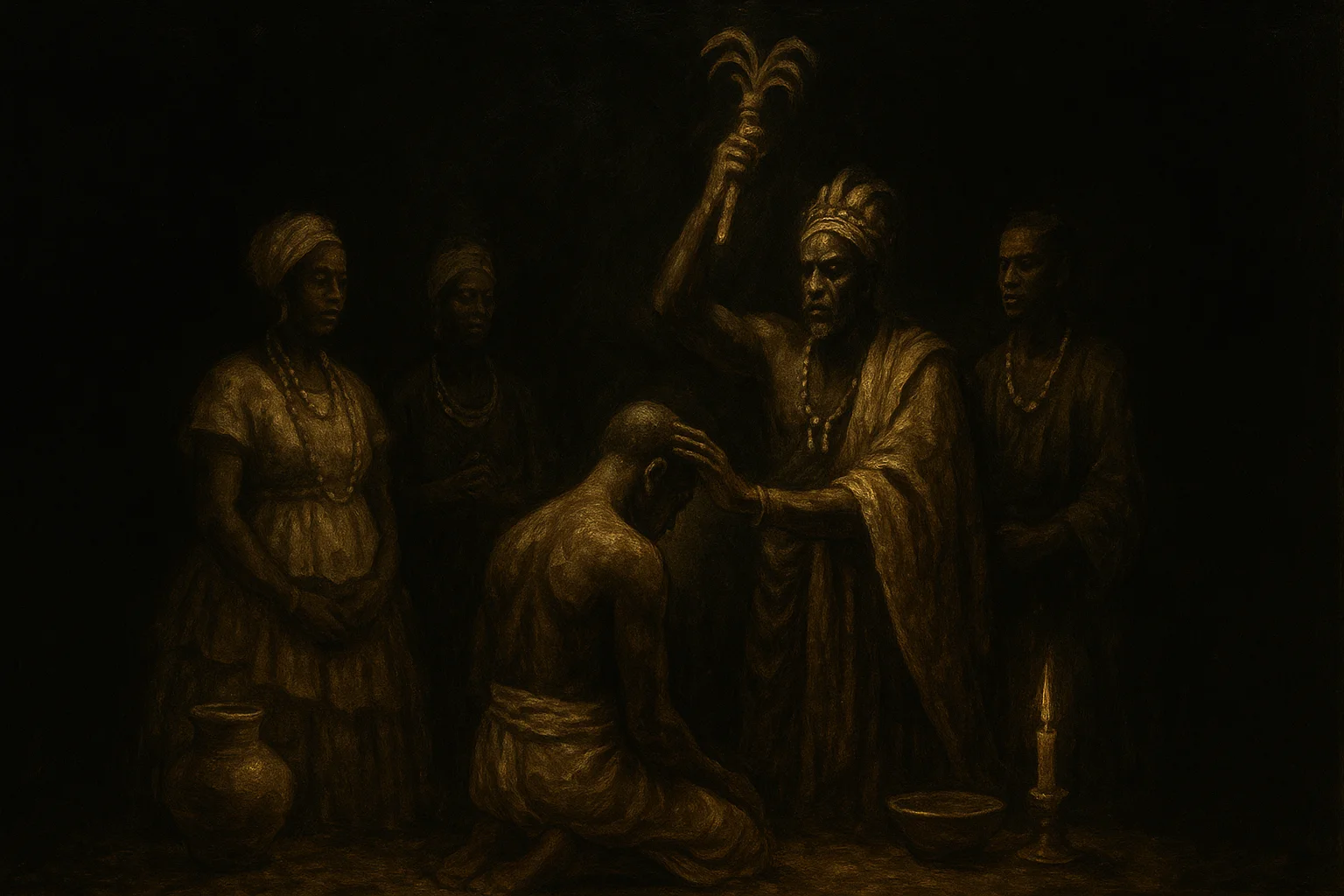
Initiation, Hierarchy, and the Making of a Priest
Initiation into Candomblé is not a single event but a process that spans years. The candidate, called an abiã, undergoes divination to determine which orixá claims them. If the divination is confirmed, the initiation proper begins.
The Seven-Year Cycle
The first initiation, called feitura de santo or "making the saint," lasts between seven and twenty-one days, depending on the house and the orixá. The initiate is secluded in the terreiro, shaves their head, undergoes ritual baths, learns songs and gestures, and receives cuts on the scalp where sacred substances are applied. This is not symbolic. The orixá is understood to be seated in the initiate's head.
On the day of presentation, the initiate dances publicly for the first time, possessed by their orixá, dressed in the deity's colours and carrying their emblems. The initiate remembers nothing of the possession. The orixá has taken full control.
After initiation, the new priest, now called an iaô, enters a seven-year cycle of obligations. They must return to the terreiro for annual ceremonies, observe dietary restrictions, and learn the liturgy. At the end of seven years, they may undergo the obrigação de sete anos, a second initiation that deepens their bond with the orixá and grants them greater autonomy within the house.
Roles Within the Terreiro
The terreiro is a hierarchy. At the top is the mãe de santo or pai de santo (mother or father of the saint), the head priest who owns the house, holds the axé, and makes final decisions. Below them are initiated priests of varying seniority, each with specific roles: the iaquequerê cares for the initiates, the axogun performs sacrifices, the alabê leads the drums, the ekedi and ogan serve the orixás without undergoing possession themselves.
This structure is not democratic. Authority is earned through seniority, knowledge, and the favour of the orixás. Disputes over succession and legitimacy are common. When a mãe de santo dies, the house may split.
Ritual Practice: Drumming, Possession, and Sacrifice
The Atabaques and Sacred Rhythms
The drums, called atabaques, are not instruments. They are consecrated objects, fed with blood and palm oil, treated as living extensions of the orixás. There are three drums: the rum (largest and lowest), the rumpi (middle), and the lé (smallest and highest). Each drum has a voice, and together they speak the language that calls the orixás down.
Each orixá has their own rhythm, called a toque. The rhythm for Ogum is sharp and martial. The rhythm for Oxum is slow and undulating. The drummers, always male in most houses, must know dozens of rhythms and shift between them as the ceremony unfolds. A mistake in rhythm can offend the orixá or fail to call them at all.
Possession as Theology
Possession is the centre of Candomblé theology. It is not trance, not performance, not pathology. It is the orixá descending into the body of the initiate, displacing the human consciousness entirely. The initiate does not remember what happens during possession. The orixá dances, speaks, blesses, and sometimes scolds. Witnesses can identify which orixá is present by their gestures, their bearing, and the way they move.
Ruth Landes, an American anthropologist who conducted fieldwork in Salvador in the 1930s, described possession in her book City of Women as "a theology of presence, not belief." The orixás do not require faith. They require ritual. When the ritual is correct, they come.
"The saint arrives in the head like lightning. You feel nothing, then you wake on the ground, and they tell you what you did." Testimony recorded by Edison Carneiro, Candomblés da Bahia, 1948
Possession is not open to everyone. Only initiated priests undergo full possession. The ekedi and ogan, who serve other roles, do not. This is not a hierarchy of worth but of function. Not everyone is called to carry the orixás in their body.
Animal Sacrifice and Offering
Animal sacrifice is central to Candomblé ritual and the aspect most misunderstood by outsiders. Sacrifice is not violence. It is exchange. The orixás require blood to maintain their axé, to sustain their presence in the material world. Without sacrifice, the terreiro weakens. The orixás withdraw.
The animals, usually chickens, goats, or pigeons, are killed quickly by the axogun, a priest trained in the technique. The blood is offered to the orixá's assentamento. The meat is cooked and shared in a communal meal. Nothing is wasted. This is not symbolic. It is practical theology.
Brazilian animal rights activists have challenged the practice in court multiple times. In 2019, the Supreme Court ruled that animal sacrifice in religious contexts is protected under constitutional guarantees of religious freedom. The ruling was a victory, but the cultural stigma persists.
Syncretism, Catholicism, and the Politics of Survival
The association between orixás and Catholic saints is often called syncretism, but the term flattens a more complicated history. During slavery, public worship of African deities was forbidden. Enslaved people adapted by holding ceremonies on Catholic feast days and placing images of saints on their altars. To the overseer, it looked like Catholic devotion. Inside the ritual, the orixás were being fed.
This was not fusion. It was camouflage. Mãe Stella de Oxóssi, a prominent priestess of the Ilê Axé Opô Afonjá in Salvador, stated in interviews that the saints were never confused with the orixás inside the terreiro. The images were a shield, not a theology.
After abolition in 1888, the camouflage persisted because legal persecution continued. Candomblé was classified as witchcraft, and terreiros were raided by police well into the twentieth century. Priests were arrested, drums were confiscated, and altars were destroyed. The Catholic imagery remained, sometimes out of habit, sometimes out of genuine devotion, sometimes as continued protection.
Today, many Ketu houses have removed the saint images entirely. Others keep them as historical markers. The relationship between Candomblé and Catholicism is not uniform. It varies by house, by generation, and by the political climate.
Candomblé Today: Legal Recognition, Diaspora, and Living Practice
Candomblé was not legally recognised as a religion in Brazil until 1976, when reforms to the penal code removed prohibitions on Afro-Brazilian religious practice. Before that, terreiros operated in a legal grey zone, tolerated but not protected. The 1988 constitution strengthened protections, guaranteeing freedom of worship and criminalising religious discrimination.
Despite legal recognition, Candomblé practitioners face ongoing prejudice, particularly from evangelical Christian groups who have targeted terreiros with vandalism and harassment. In 2020, a terreiro in Rio de Janeiro was firebombed. The perpetrators were never caught.
Candomblé has also spread beyond Brazil. There are terreiros in Argentina, Uruguay, Portugal, and the United States, established by Brazilian emigrants and by converts who travelled to Bahia for initiation. These diaspora houses face the challenge of maintaining liturgical continuity without access to the herbs, rhythms, and community structures of Brazil.
Inside Brazil, Candomblé remains a living tradition. The great houses of Salvador, Ilê Axé Opô Afonjá, Casa Branca, and Gantois, continue to initiate priests, hold public ceremonies, and train the next generation. The tradition is not static. New houses are founded. Liturgies are debated. The orixás continue to claim their children.
Candomblé Possession
The orixá fully displaces human consciousness. The initiate remembers nothing. The deity dances, speaks, and acts through the body. Possession is the goal of ritual, not a side effect.
Vodou Possession
The lwa (spirits) mount the devotee like a rider mounts a horse. The devotee's personality is submerged but may flicker at the edges. Possession is central but functions within a different cosmology of spirits and ancestors.
Frequently asked questions
Is Candomblé the same as Umbanda?
No. Umbanda is a separate Brazilian religion that emerged in the early twentieth century, blending Kardecist Spiritism, Catholicism, and elements of African and indigenous traditions. Candomblé is older, more conservative, and maintains stricter liturgical boundaries. Umbanda does not require initiation or animal sacrifice, and its cosmology centres on spiritual evolution rather than the orixás' direct presence.
Can non-Brazilians or non-Black people be initiated into Candomblé?
Yes, though it varies by house. Some terreiros, particularly in Bahia, initiate only people of African descent as a matter of cultural preservation. Others are open to anyone called by the orixás, regardless of ethnicity. Initiation is determined by divination, not by the candidate's background. If the orixá claims you, the house will initiate you.
Why does Candomblé use animal sacrifice?
Sacrifice is understood as a necessary exchange. The orixás require blood to maintain their axé and their presence in the material world. The act is ritual, not recreational. The animals are killed quickly and respectfully, and the meat is consumed in communal meals. Brazilian law protects religious sacrifice as a constitutional right.
How long does it take to become a Candomblé priest?
The initial initiation lasts seven to twenty-one days, but full priesthood takes at least seven years. After the first initiation, the new priest enters a period of learning and service within the terreiro. At seven years, they may undergo a second initiation that grants greater autonomy. Some priests continue for decades, deepening their knowledge and taking on leadership roles.
What is the difference between an orixá and a Catholic saint?
Orixás are not saints. They are deities with their own cosmology, mythology, and ritual demands. The association with Catholic saints was a survival strategy during slavery, not a theological equivalence. Inside the terreiro, the orixás are distinct, with their own personalities, preferences, and histories that predate Christianity.
Do all Candomblé practitioners experience possession?
No. Only initiated priests undergo full possession by the orixás. Other roles within the terreiro, such as ekedi (female attendants) and ogan (male ritual specialists), serve the orixás without being possessed. These roles are equally important and are determined by divination, not by choice.
Further reading on Mythologis
- Dragons of West African cosmology and their transformation in diaspora traditions
- Water spirits who appear in human form across Atlantic African religions
- Shape-shifting traditions in Bantu and Yoruba cosmology
- Cryptid traditions of the Americas and their intersection with Candomblé's caboclo spirits