

Kappa: Water Demons of Rivers and Ponds
The kappa lurks in every river and pond of Japan, a reptilian child-sized creature that drowns swimmers, demands cucumbers, and bows with deadly politeness. Here is the full story of one of Japanese folklore's most enduring monsters.
Contents
A child wanders too close to the riverbank. The water is still. Nothing breaks the surface. Then a webbed hand reaches up.
That image has lived in Japanese villages for at least a thousand years. Kappa: water demons of rivers and ponds are among the most recognisable creatures in all of Japanese folklore, feared by farmers, respected by sumo wrestlers, and placated with offerings of cucumber even today. They are shape-shifters in some accounts, faithful retainers in others, and outright child-killers in the oldest ones. No single myth captures them completely, because the kappa is not one creature but a whole family of regional spirits that Japan's storytellers slowly wove into a consistent figure over centuries.
What makes the kappa extraordinary is how it sits at the border between monster and neighbour. It follows rules, keeps promises, and can be tricked by its own politeness. That ambiguity is the heart of the tradition, and it tells us something real about how Japan's coastal and riverine communities understood the water that fed them and killed them.
What a Kappa Looks Like: The Classic Anatomy
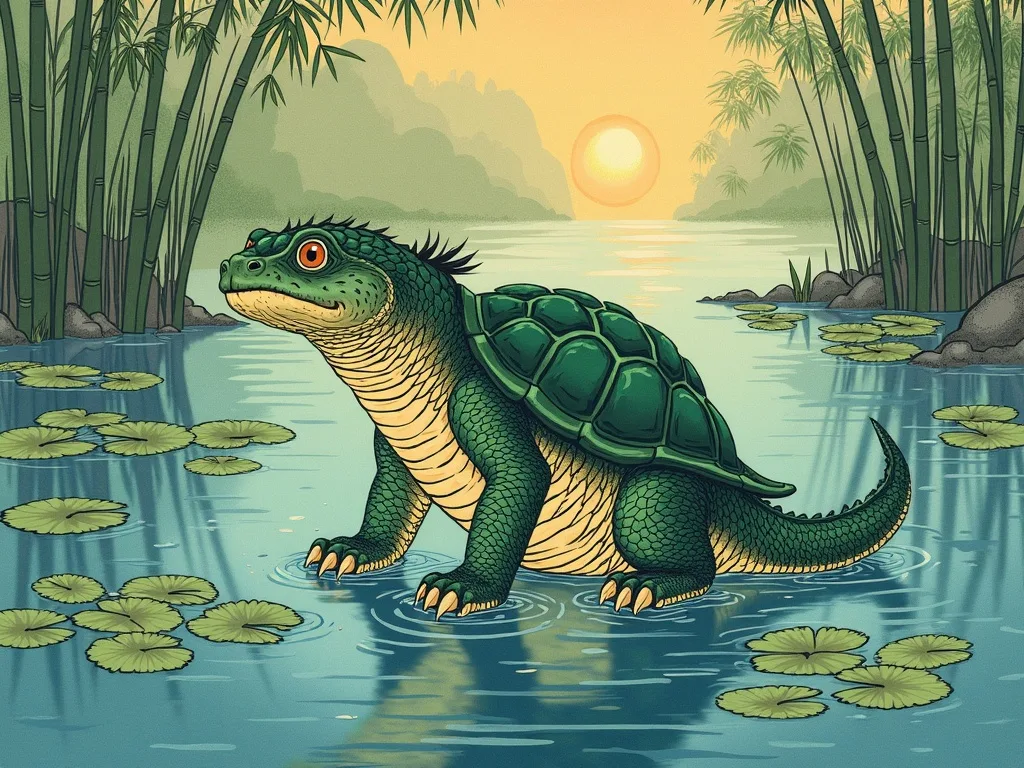
The image that crystallised in Edo-period (1603-1868) illustrated encyclopaedias is remarkably precise. A kappa stands roughly the height of a ten-year-old child, with scaly green or yellowish skin that smells faintly of fish. Its limbs are webbed, its back carries a turtle-like shell, and its beak is hard and sharp like a bird's. The most distinctive feature sits on top of its head: a shallow, bowl-shaped depression filled with water. That dish is the seat of the kappa's power. While the dish stays full, the kappa is supernaturally strong. Let the water spill, and the creature collapses.
Toriyama Sekien, the 18th-century artist who catalogued Japan's supernatural beings in his Gazu Hyakki Yagyō ("The Illustrated Night Parade of a Hundred Demons"), depicted the kappa with exactly these attributes. His woodblock print fixed the creature's iconography in popular imagination. Before Sekien, regional variants differed considerably. In the Kansai region around Kyoto, similar beings were called kawatarō ("river boy") or kawako ("river child"). In Kyushu, the dominant name was gatarō. The Tōhoku region had its hyōsube, hairy and foul-smelling. All of these names and all of these regional bodies eventually collapsed, for most purposes, into the single word kappa that most Japanese speakers use today.
The cucumber connection is old and consistent across regions. Kappa are said to love cucumbers more than any other food. Farmers in many parts of Japan traditionally threw cucumbers into rivers before swimming, as both an offering and a distraction. Some Buddhist temples near rivers still hold summer ceremonies where cucumbers carved with family names are cast into the water, asking the kappa to leave those particular people alone. The association is so firm that in modern slang, a kappa maki (cucumber sushi roll) carries the creature's name.
The Oldest Sources: Where the Kappa Comes From
The kappa does not appear fully formed in Japan's ancient chronicles. The Kojiki (712 AD), Japan's oldest surviving narrative of creation and the gods, says nothing about kappa directly. Nor does the Nihon Shoki (720 AD). The creature belongs to a different layer of tradition: local shrine lore, agricultural ritual, and the oral stories that village healers and fishermen kept alive outside the imperial literary record.
The Wamyō Ruijushō, a Japanese dictionary compiled around 934 AD, lists kawatarō as a water spirit associated with drowning. This is the earliest clear written reference scholars point to. By the medieval period, Shinto shrines along rivers were incorporating kappa-like water spirits into their worship. The Ryūgu shrine in Fukuoka, for instance, preserves records of offerings made to water children (suijin, water gods in general) that some folklorists read as early kappa rites.
The fullest early literary treatment appears in the Sōzan Chomon Kishū (1764), a collection of strange tales compiled by the scholar Miyoshi Shōzan. He gathered regional accounts that describe kappa pulling horses and cattle into rivers, demanding blood, and striking bargains with humans. The Edo period produced a flood of similar collections, reflecting a broader cultural appetite for cataloguing the supernatural. Scholars like Hirata Atsutane (1776-1843), who worked to systematise Japanese folk belief in his Kokon Yōmikō, treated kappa as genuine entities whose behaviour could be studied and understood.
Japanese mythology as a whole shows this pattern: creatures that begin in oral tradition get fixed in writing during periods of scholarly activity, which then shapes how later generations imagine and fear them.
What Kappa Do: Crimes, Gifts, and Strange Alliances
Kappa have two faces in the tradition. The first is predatory. The creature's favourite method of attack involves pulling victims beneath the water and extracting a mythical organ called the shirikodama, believed to sit just inside the anus. This sounds bizarre, but it reflects a real medical observation: drowned bodies sometimes show signs of rectal prolapse. The kappa became the explanation. In this mode, the kappa preys on children who swim alone, on horses and cattle watering at the river's edge, and on careless adults who wade in at dusk.
The second face is surprisingly cooperative. A kappa caught, cornered, or simply outsmarted will often promise to stop its attacks and offer gifts in return for release. Those gifts are not trivial. Kappa are said to know advanced bone-setting techniques, surgical skills, and herbal cures that they learned from long observation of the natural world. Several Japanese medical families claim, in their founding stories, that an ancestor received the secrets of orthopaedic medicine from a grateful kappa. The Konjaku Monogatari, a vast collection of tales assembled around 1120 AD, includes stories of supernatural beings teaching humans practical skills, and later annotators applied this template to kappa accounts.
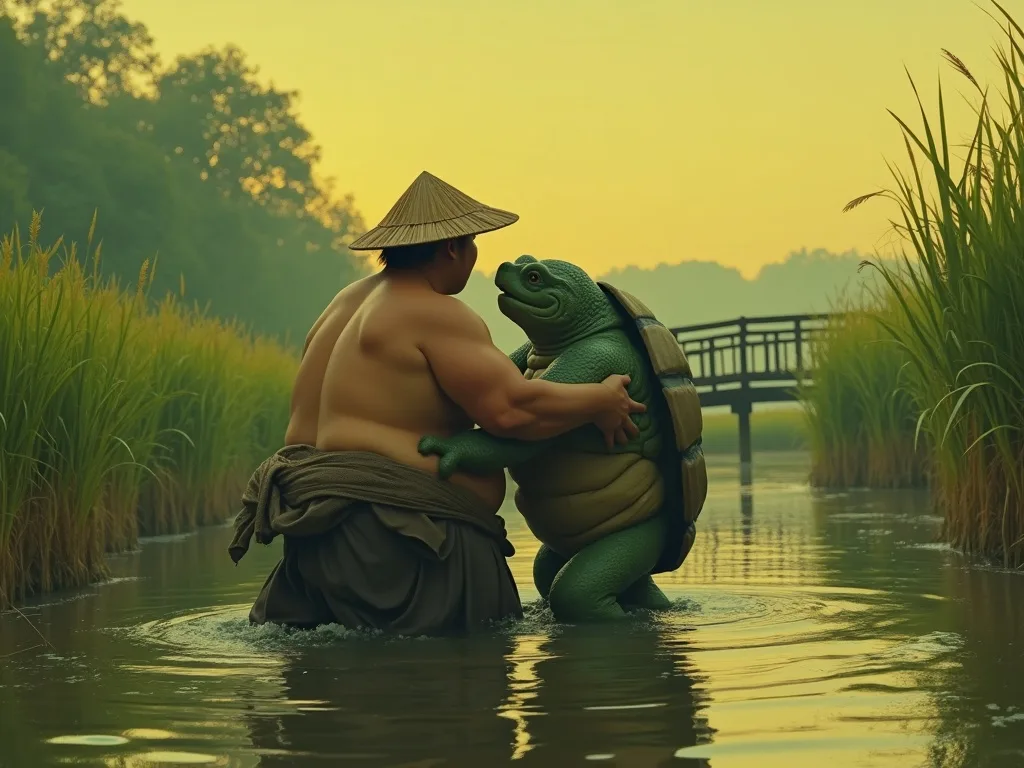
The sumo connection is particularly vivid. Kappa love wrestling. They challenge humans to bouts by the river, and they almost always win, because their grip and their water-fuelled strength are exceptional. But they are also scrupulously fair. Teach a kappa a new wrestling hold, and it will remember you fondly. Some rural sumo traditions in Japan still include ritual gestures understood as acknowledgments of this ancient sporting rivalry.
The politeness trick is the most famous vulnerability. If a human bows deeply to a kappa, the creature's strict social code compels it to bow back. The water in its head-dish tilts, spills, and the kappa becomes weak and disoriented. At that moment, a quick-thinking human can demand a pledge from the creature: stop drowning people in this river, teach me your bone-setting craft, or simply leave us alone. The kappa, honour-bound, agrees.
Regional Kappa: How the Creature Changed Across Japan
Japan's geography is a patchwork of river valleys, coastal bays, and mountain lakes. Each community that lived by water developed its own version of the local water spirit, and those versions show genuine differences even after centuries of literary standardisation.
In Kyushu, the gatarō is described as particularly aggressive and particularly interested in women. Some accounts from the Saga domain describe gatarō forming semi-permanent territories around specific river bends, treating those stretches as personal property. Farmers who respected the territory boundaries reportedly had no trouble.
The Tōhoku hyōsube is the most unsettling variant. Covered in hair rather than scales, fond of invading bathhouses to steal the water from community baths, and intensely territorial, the hyōsube lacks the kappa's semi-comic cucumber-loving charm. Scholars like Kunio Yanagita (1875-1962), who founded Japanese folklore studies as a formal discipline, argued in his Tōno Monogatari context and later writings that hyōsube represent an older, rawer layer of water-spirit belief that the more polished kappa image gradually overlaid.
Yanagita's broader project was to trace how local gods (ujigami) and nature spirits had been rationalised and systematised over time. His reading of kappa fits that framework: the creature was once a genuine water deity, a suijin, worshipped with real reverence. As Buddhism spread through Japan and transformed the cosmological landscape, those local water gods lost their divine status and became monsters, still powerful and still requiring appeasement, but no longer sacred in the full sense.
Kappa and the Sacred: Shrines, Offerings, and the Edge of Worship
The line between demon and deity is genuinely blurry in the kappa tradition. Dozens of Shinto shrines across Japan enshrine kappa or kappa-adjacent spirits. The Kappa-dera (officially named Sogenji temple) in Tokyo's Asakusa district is the most visited, containing a mummified kappa arm kept in a wooden box. The story attached to it says a kappa once tried to steal a horse from a nearby barn, got its arm caught in the door, and had to wrench free and flee. The grateful temple subsequently displayed the severed arm as proof of the creature's existence and as a talisman against further attacks.
Kappa mummies have appeared in several Japanese collections. Most are clearly composite constructions, assembled from dried fish, monkey parts, and papier-mâché. But their creation and display was a serious business. They circulated through Edo-period medicine shows as evidence of the supernatural world's physical reality, and some were used to endorse specific medical treatments supposedly taught by the kappa they came from.
The cucumber offering survives most visibly in the summer festival season. In agricultural communities along the Tone River in Kantō, farmers still float cucumbers downstream in July before allowing children to swim, a habit so ingrained that it barely registers as religious practice. It is simply what you do.
Kappa in Literature and Art: From Woodblock Prints to Akutagawa
The kappa became a favourite subject of ukiyo-e woodblock printmakers during the 18th and 19th centuries. Katsushika Hokusai, best known in the West for "The Great Wave," produced several prints featuring kappa in playful or sinister scenes. These images circulated widely and helped fix the creature's visual identity across social classes.
The most celebrated modern literary treatment is Ryūnosuke Akutagawa's 1927 novella Kappa, written just months before the author's death by suicide. Akutagawa's kappa are not monsters but a satirical society, a mirror of Taisho-era Japanese social life. The protagonist, a human who falls into the kappa world through a mountain cave, observes their economy, their births (kappa babies choose whether to be born), their philosophy, and their wars. The novella uses the creature to ask uncomfortable questions about free will, social conformity, and the arbitrariness of human civilisation. It stands as one of the most original uses of mythological material in modern Japanese literature.
Kappa also appear extensively in yokai (supernatural entity) catalogues that remain popular today. Shigeru Mizuki, the manga artist who devoted his life to documenting Japanese yokai in works like GeGeGe no Kitaro, drew kappa with careful attention to regional variation. His kappa feel genuinely dangerous, not cute, and his approach influenced how an entire generation of Japanese readers understands the creature.
The contemporary tourism industry in Japan has leaned heavily into kappa imagery. Kappabashi, a kitchen-supply district in Tokyo, takes its name from a local kappa legend and features statues of the creature along the street. Tono City in Iwate prefecture, where Yanagita collected the Tono Monogatari tales, markets itself partly around its kappa river stories. The creature has become a mascot, which says something about how thoroughly it has moved from fear to familiarity.
Kappa Across Borders: Water Spirits and Their Cousins
The kappa belongs to a global family of dangerous water beings that cluster around rivers and lakes. The comparison is worth making not to flatten the kappa's specificity but to show how deeply rooted this type of belief is across unconnected cultures.
The Scottish kelpie is a water horse that lures riders to their deaths by drowning, offering supernatural strength while its hooves stay on dry land, losing that strength in certain ritual conditions. The Germanic Nix or Nixie is a shape-shifting river spirit, sometimes beautiful, sometimes monstrous, that pulls people under. The Slavic Vodyanoy is a green-skinned, frog-like old man who drwons swimmers and demands appeasement. None of these traditions directly influenced the kappa, but all of them reflect communities living by water and projecting their fear of drowning onto a humanoid figure that follows its own rules.
The comparison with Slavic mythology's water spirits is especially productive. Both the Vodyanoy and the kappa occupy a middle position between malevolent monster and localised nature god. Both can be pacified. Both have specific territories. Both are connected to seasonal rhythms, most active in summer when swimming was most common and drowning most frequent.
What makes the kappa unique in this global company is its codified social behaviour. The cucumber offering, the bow, the wrestling challenge, the bone-setting gift: these are not vague appeasements but specific protocols. The kappa tradition is a remarkably articulated system for managing the danger of water, one that gave communities a sense of agency over a genuinely lethal environment.
The Scholarly Debate: Monster, God, or Misremembered Human?
Kunio Yanagita proposed that kappa legends might preserve memories of a real, marginalised group of people who lived along Japan's rivers and were gradually mythologised. This "aquatic outcaste" theory has since been treated sceptically by most scholars, but it reflects a broader methodological question: when does a creature become a creature, and when is it a metaphor for something that actually existed?
The more widely accepted view, developed by Noriko Reider, Michael Dylan Foster, and others who study Japanese supernatural traditions, is that kappa are composite figures. They absorbed attributes from Chinese water spirits (kawahaku, river goblins described in Chinese texts that reached Japan through Buddhist transmission), from Shinto water deity cults, from real observations of river otters and giant salamanders (Japan's ōsanshōuo, the world's largest salamander, can reach 1.5 metres and has a distinctive flattened head that could inspire folklore), and from the general human tendency to humanise natural danger.
Michael Dylan Foster's book-length study of yokai categorisation argues that the Edo-period project of classifying supernatural beings served a specific cultural function: it turned uncanny, uncontrollable forces into manageable categories with known properties and known countermeasures. The kappa's elaborate rule system is, in this reading, a technology of reassurance. You cannot control a river. You can, at least in story, control a kappa.
The yokai tradition in Japanese mythology as a whole follows this logic, and the kappa is its most refined example.
Frequently Asked Questions About Kappa Water Demons
Frequently asked questions
Are kappa considered gods or demons in Japanese tradition?
The answer depends on the era and the region. In older Shinto-adjacent folk belief, kappa functioned as suijin (water kami), local deities of rivers and ponds who required propitiation. As Buddhist cosmology spread and folk spirits lost their divine standing, kappa were reclassified as yokai, supernatural creatures that were dangerous but not sacred. Today most Japanese people treat them as folklore monsters, but some Shinto shrines still enshrine kappa-adjacent water spirits as genuine deities.
Why do kappa supposedly love cucumbers?
The oldest explanation links cucumbers to a symbolic logic of cooling and water. Cucumbers are associated with rivers, summer, and the watery element in Japanese folk medicine. Some scholars suggest that the offering of cucumbers replaced older, more costly ritual sacrifices as communities grew poorer. The association also appears in Buddhist vegetarian taboo lists, which treat cucumbers as one of five pungent vegetables offered to supernatural beings. Whatever the origin, the connection is at least 400 years old in documented sources.
What is the shirikodama, and why do kappa want it?
The shirikodama is a mythical ball of energy or spirit believed in folk belief to reside just inside the rectum. Kappa were said to extract it by pulling victims underwater and reaching inside the body. Medical historians note that this corresponds to the rectal prolapse occasionally visible in drowning victims, which village communities, lacking modern anatomy, explained through supernatural agency. The shirikodama concept also appears in some folk Buddhist contexts as a kind of soul-container; stealing it is essentially stealing someone's life force.
Have any physical remains of kappa been presented as real?
Yes, and they were taken seriously. Several Edo-period temples and medicine shows displayed what they called kappa mummies, most famously the arm preserved at Kappa-dera (Sogenji) in Tokyo's Asakusa. Scholars who examined these objects in the 19th and 20th centuries found they were typically constructed from dried fish, monkey limbs, and other animal parts. Despite this, they served a genuine social function: they made the creature's reality tangible and gave specific institutions authority over kappa-related danger and healing.
Is the kappa related to similar water monsters in other Asian traditions?
There are documented transmission lines. Chinese texts describing kawahaku (river goblins) reached Japan through Buddhist and scholarly channels by at least the Nara period (710-794 AD). Korean mul-gwishin (water ghosts) share some attributes. The kappa's distinctive dish-head and turtle shell are Japanese developments without clear Chinese prototypes, suggesting a genuine local elaboration on imported concepts. Japan's giant salamander (ōsanshōuo), one of the world's largest amphibians, has also been proposed as a zoological anchor for some kappa physical descriptions.
The Kappa as a Living Tradition
Danger warnings along Japanese rivers sometimes feature a kappa illustration instead of a plain skull-and-crossbones. The creature functions as a safety mascot, particularly aimed at children, which is both practical and a little eerie given that children are the kappa's traditional prey. This reversal, using the predator to warn against itself, shows how thoroughly the kappa has been domesticated without quite losing its teeth.
The domestication is recent and partial. In rural areas, particularly along the rivers of Kyushu, Tōhoku, and the Kantō plain, older residents still describe the kappa with wariness rather than affection. Yanagita's fieldwork in the early 20th century collected accounts from people who genuinely believed a neighbour or relative had been taken by the river creature. That experiential layer has thinned but not entirely vanished.
Akutagawa's satirical kappa and Mizuki's carefully researched monster-manga kappa both point toward the same truth: the creature survives because it is useful. It processes fear of drowning. It articulates the idea that water has its own rules, its own politics, its own inhabitants with their own demands. Every river community on earth has needed some version of this idea. Japan's contribution is a figure with a cucumber fetish, a bone-setting practice, and a bone-deep commitment to bowing back.
That last detail stays with you. A creature so bound by courtesy that it cannot refuse a gesture of respect, even when refusing would save it. There is something in that which feels less like a monster and more like a portrait of something human: the helplessness of a code that cannot be broken, even when it costs everything.
Free 25-page sample
Want the whole story?
Take the first 25 pages free. If it pulls you in, the full edition is yours as an instant PDF download, with a paperback on Amazon for selected titles.
Japanese
The Japanese Mythology and Yokai Book: Amaterasu, Susanoo, Kami, and the Sacred Stories of Japan
Amaterasu, Susanoo, Yokai, Kami, and the Sacred Stories of Japan
The Kojiki, the Nihon Shoki, and the bestiaries of Toriyama Sekien. Every kami, every yokai, every ghost story.
More from Japanese
All articles
Japanese
Tengu: Mountain Goblins and Supernatural Warriors of Japanese Mythology
Half-bird, half-man, and entirely terrifying: the Tengu roamed Japan's sacred peaks for over a millennium, teaching swordsmanship, punishing the arrogant, and blurring the line between demon and divine protector.

Japanese
Kitsune: The Fox Spirit of Japanese Mythology
The kitsune is Japan's most storied supernatural creature: a fox of shifting form, ancient intelligence, and divine allegiance. From rice-field shrines to imperial courts, its nine tails have cast shadows across two millennia of myth.
Japanese
Izanagi and Izanami: The Creation Myth That Built the Japanese Islands
Before Japan existed, two deities stood on a bridge of heaven and stirred the primordial sea. The story of Izanagi and Izanami is the most elemental creation myth in the Shinto tradition.
Japanese
Susanoo the Storm God: Chaos, Courage, and the First Poem in Japanese Myth
Banished from heaven, mourned by the seas, and celebrated as the slayer of an eight-headed dragon, Susanoo stands as the most turbulent and deeply human figure in the Japanese pantheon.