
Beowulf: The Dragon-Slaying Hero of Anglo-Saxon Myth
The Geatish warrior who fought Grendel, his mother, and a fire-drake. What the Old English poem reveals about heroism, fate, and kingship.
Contents
Beowulf is the central hero of the Old English epic poem that bears his name, a Geatish warrior who travels to Denmark to rid King Hrothgar's hall of the monster Grendel, later kills Grendel's mother in her underwater lair, and fifty years afterward dies fighting a dragon that threatens his own kingdom. The poem, composed sometime between the eighth and early eleventh centuries, survives in a single manuscript now housed in the British Library. It stands as the longest and most complete heroic poem in Anglo-Saxon mythology, blending historical Scandinavian settings with Christian editorial layers and older Germanic heroic traditions.
The text does not claim Beowulf lived. It places him among named historical kings and peoples, the Geats and Danes and Swedes, but offers no independent corroboration outside the poem itself. What it does offer is a portrait of heroism as the Anglo-Saxons understood it: courage measured not by victory alone but by the willingness to meet fate head-on, the duty a warrior owes his lord, and the loneliness that comes with kingship. The dragon fight, in particular, reads less like triumph than elegy.
Who Beowulf Was
The poem introduces Beowulf as the son of Ecgtheow, a warrior of the Geats, a people located in what is now southern Sweden. His maternal grandfather is Hrethel, king of the Geats, and his uncle and lord is Hygelac, who rules when the story begins. Beowulf arrives in Denmark as a young man, already renowned for strength but untested in the kind of combat that will define him. Lines 194 to 228 describe his arrival: he and fourteen companions cross the sea, land on the Danish shore, and are challenged by Hrothgar's coast-guard, who demands to know their business. Beowulf identifies himself plainly, states his purpose, and asks to be taken to the king.
He is not a prince. He is a thane, a retainer, and his reputation rests on deeds already done but not detailed in the text. The poem assumes the audience knows the shape of a hero when they see one: loyalty, physical prowess, and the kind of confidence that reads as either courage or arrogance depending on the outcome. Beowulf offers both.
The Fight with Grendel
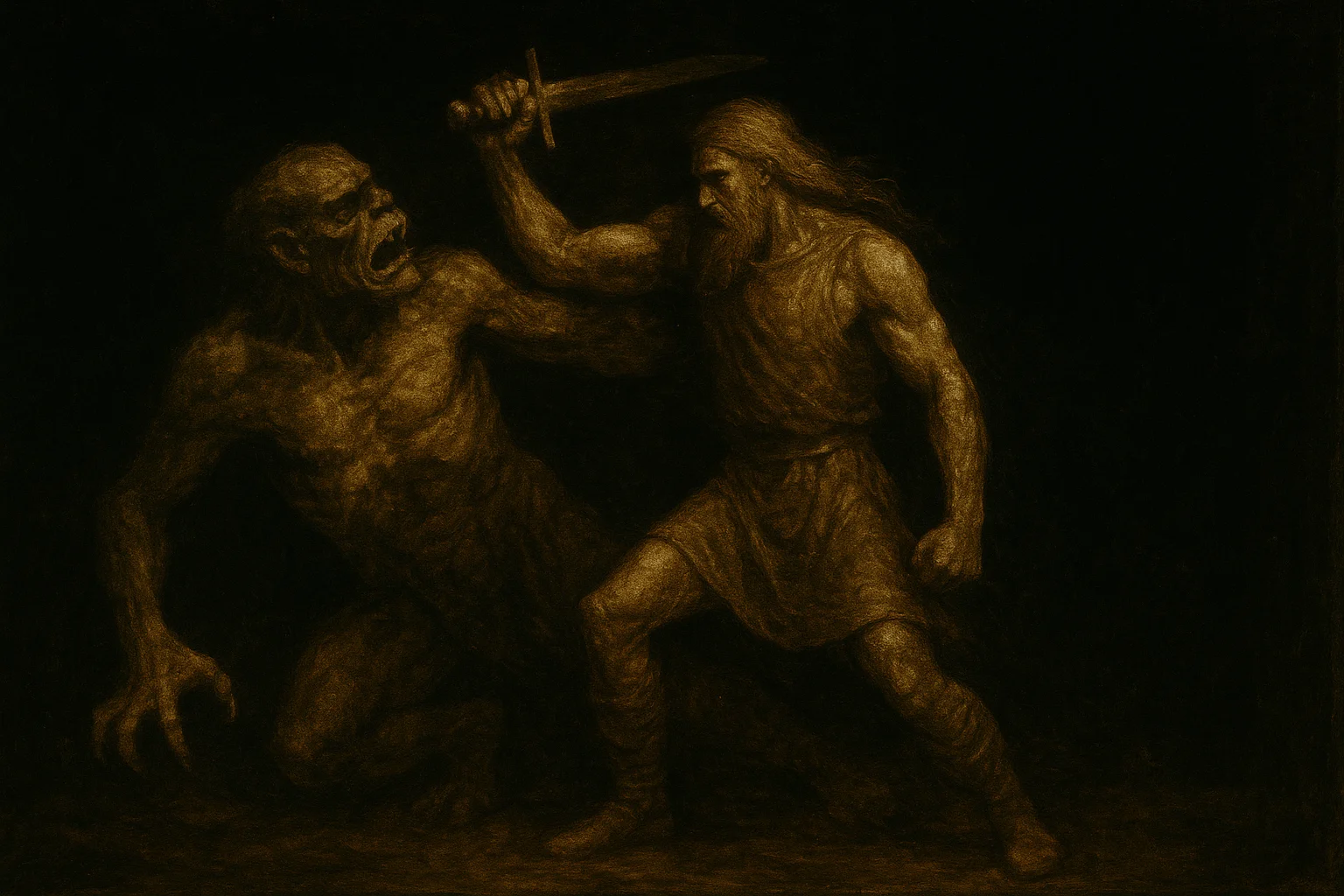
Grendel is described as a descendant of Cain, a creature who haunts the marshes and resents the joy in Heorot, Hrothgar's great hall. For twelve years he has raided the hall at night, killing and carrying off Hrothgar's warriors. No weapon can harm him. Beowulf, hearing of this in Geatland, sails to Denmark and offers to face the monster without sword or armor, matching strength to strength.
The fight takes place at night. Grendel enters the hall expecting easy prey. Beowulf seizes his arm and holds. The poem, lines 702 to 836, describes the struggle in terms of sound and structure: the hall shakes, benches are torn loose, the monster howls. Beowulf tears Grendel's arm from its socket. The creature flees to the fens to die. The severed limb is hung from the rafters as proof.
"The monster's whole body was in pain, a tremendous wound appeared on his shoulder. Sinews split and the bone-lappings burst. Beowulf was granted glory in battle." Beowulf, lines 815–818
Hrothgar rewards Beowulf with treasure, horses, and public honor. The Danes celebrate. The threat, they believe, is over.
Grendel's Mother and the Mere
The next night, Grendel's mother comes to Heorot. She kills Aeschere, Hrothgar's closest counselor, and retrieves her son's arm. The Danes are in despair. Hrothgar, now an old man, turns again to Beowulf. The hero agrees to hunt her, and Hrothgar leads him to the mere, a dark pool surrounded by cliffs and tangled woods, where water burns at night and no one dares go.
Beowulf dives in, fully armed. The descent takes most of a day. Grendel's mother drags him into a cavern beneath the water, a hall where firelight burns and no water enters. They fight. Beowulf's sword, Hrunting, lent to him by a Danish warrior, fails to cut her. She pins him, tries to stab through his mail. He throws her off, sees an ancient giant-made sword hanging on the wall, seizes it, and strikes. The blade cuts through her neck. Lines 1492 to 1569 describe the moment: the sword's blade melts like ice from the heat of her blood, leaving only the hilt. Beowulf takes the hilt and Grendel's severed head as trophies and swims back to the surface.
Hrothgar praises Beowulf but warns him against pride. The king's speech, often called the "sermon," reminds the young hero that strength fades, that every man will face death, and that generosity and wisdom matter as much as courage. Beowulf listens, accepts more gifts, and sails home to Geatland.
The Fifty-Year Reign
The poem compresses time. Hygelac dies in a raid on Frisia, a historical event datable to around 521 CE. Hygelac's son Heardred inherits the throne but is killed in a Swedish feud. Beowulf becomes king of the Geats and rules for fifty years. The text offers no detail of those decades, no campaigns or judgments, only the statement that he ruled well and grew old. When the dragon appears, Beowulf is an old man, his companions younger warriors who have never fought beside him in his youth.
This silence is deliberate. The poem is not interested in kingship as administration. It is interested in kingship as a condition that ends in death, and in the gap between the hero's strength and the king's duty.
The Dragon and the Final Battle
The Theft of the Cup
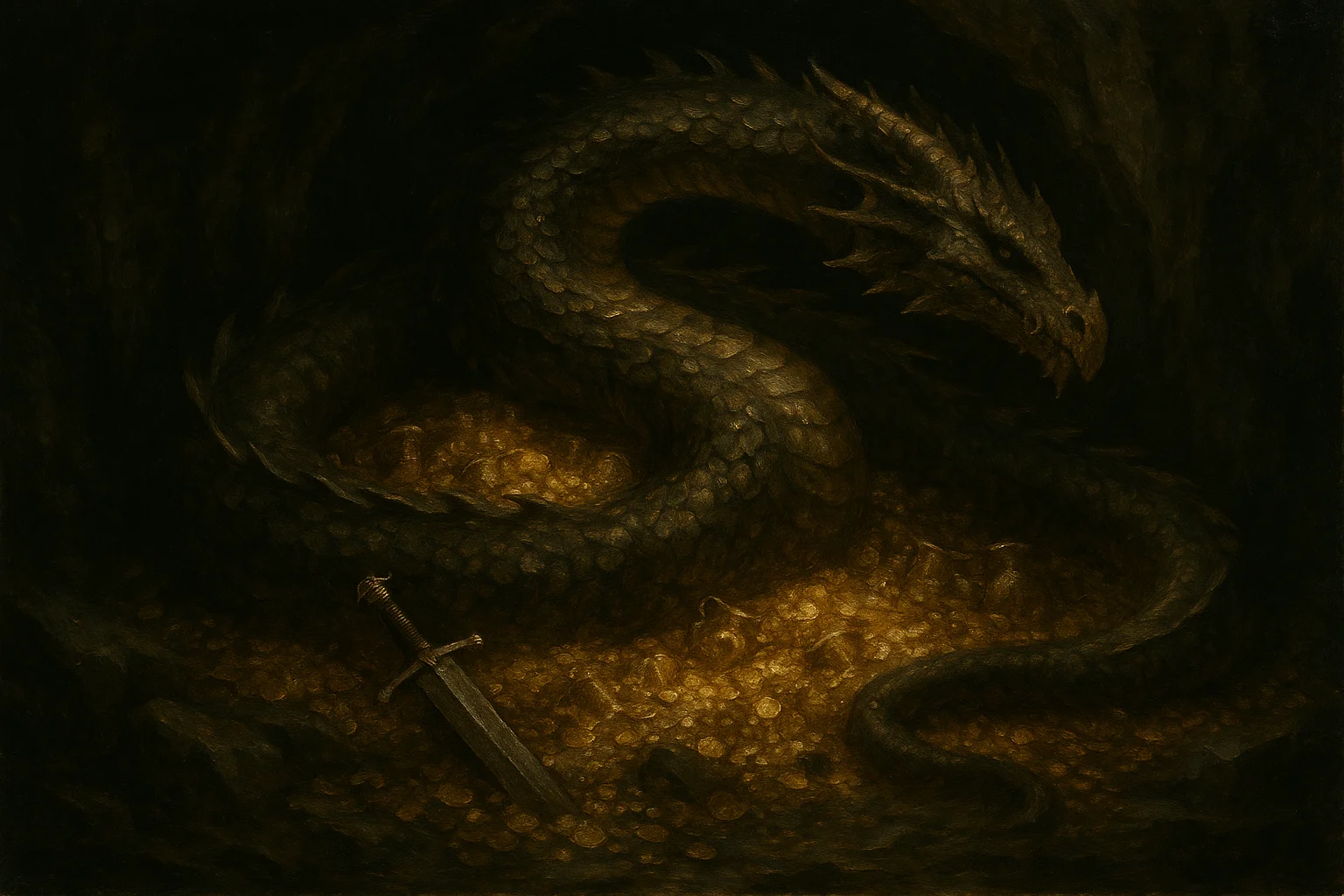
A dragon guards a hoard of ancient treasure, buried in a barrow by the last survivor of a forgotten people. The dragon has slept on the gold for three hundred years. A fugitive slave, fleeing punishment, stumbles into the barrow and steals a single cup to buy his master's forgiveness. The dragon wakes, discovers the theft, and begins to burn the Geatish countryside. Lines 2200 to 2220 describe the creature's rage: it flies by night, torching halls and farms, sparing nothing.
Beowulf's own hall is destroyed. He orders an iron shield made, knowing wood will not survive dragonfire, and announces he will face the creature alone. His men, eleven of them plus the slave who knows the barrow's location, accompany him to the mound. Beowulf tells them to wait. He will fight the dragon as he fought Grendel, one on one, though this time he brings sword and shield. He is old. He knows the odds.
Beowulf's Death
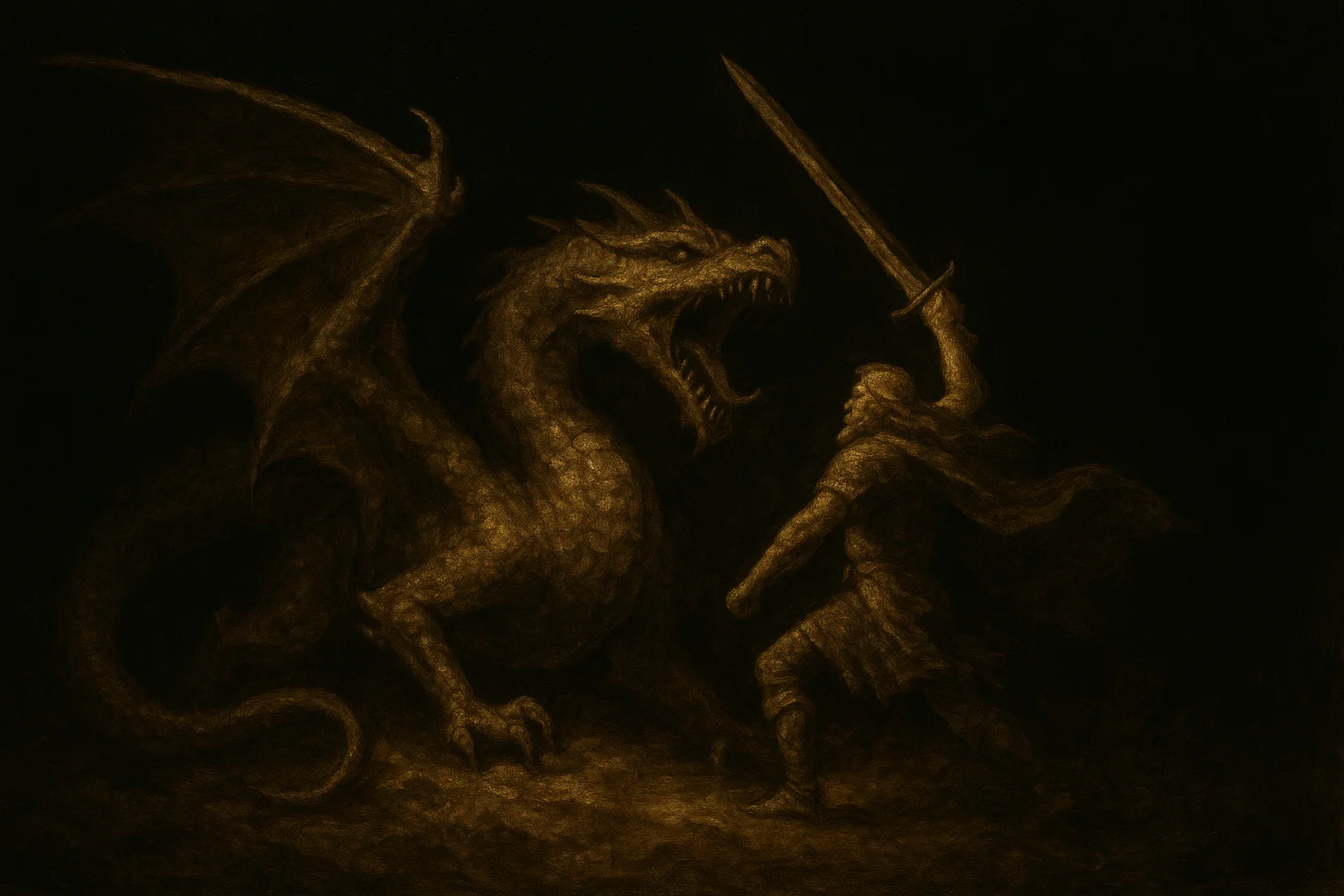
The fight goes badly. Beowulf strikes first, his sword glancing off the dragon's scales. The dragon lunges, coils around him, breathes fire. Beowulf's shield melts. His sword breaks. His companions, except one, flee into the woods. The one who stays is Wiglaf, a young kinsman who has never fought in battle before. Wiglaf rushes in, his own shield burning, and stabs the dragon in the belly. Beowulf draws a knife and cuts the creature's throat. Together they kill it.
But Beowulf has been bitten in the neck. The dragon's venom spreads. He knows he is dying. Lines 2710 to 2751 record his final words: he thanks God for the treasure, regrets that he has no son to inherit, and asks Wiglaf to bring him some of the hoard so he can see what he has won for his people. Wiglaf enters the barrow, gathers gold and jeweled cups, and returns. Beowulf looks at the treasure, gives Wiglaf his collar and helmet, and dies.
Beowulf's dragon
A solitary creature guarding a hoard, woken by theft, fought by an aging king who dies from wounds sustained in single combat.
Fáfnir in Norse tradition
A dwarf transformed into a dragon by greed, killed by the young hero Sigurd, whose victory brings fame but also a curse that follows the gold.
The Geats burn Beowulf's body on a pyre and build a barrow on a headland overlooking the sea, visible to sailors. The poem ends with the statement that he was the mildest and gentlest of kings, the most gracious to his people, and the most eager for fame. The treasure is buried with him, useless to the living.
Beowulf and Sigmund: Two Dragon-Slayers
The poem itself draws the comparison. After Beowulf kills Grendel, a Danish scop sings of Sigmund, son of Waels, the greatest of heroes, who killed a dragon and won its hoard. Lines 874 to 900 describe Sigmund's deed in brief: he fought alone, struck the serpent with his sword, pinned it to the cave wall, and loaded the treasure onto his ship. The scop's song is praise by analogy. Beowulf is being placed in the company of the dragon-slayers, the highest rank of Germanic hero.
But the parallel is not exact. Sigmund kills his dragon in his prime and sails away rich. Beowulf kills his dragon as an old man and dies in the act. The poem does not say which outcome is better. It simply places them side by side and lets the listener notice the difference. Glory, in both cases, is earned. Survival is not guaranteed.
The comparison extends beyond the poem. Sigmund's story, told more fully in the Völsunga saga, involves his son Sigurd, who kills the dragon Fáfnir and becomes the most famous dragon-slayer in Norse tradition. Beowulf's fight, by contrast, is the end of his line. He has no son. His people are left leaderless, facing Swedish invasion. The dragon's hoard brings no prosperity. It is buried again, as cursed and useless as it was before.
Fate, Glory, and the Price of Kingship
The poem uses the word wyrd repeatedly, usually translated as fate. Wyrd is not predestination in the Christian sense. It is the unfolding of events shaped by past actions, the pattern that emerges when courage meets circumstance. Beowulf speaks of it before every major fight: wyrd will decide, he says, and then he acts as though the outcome depends entirely on his effort. The tension is never resolved.
Hrothgar's sermon warns against ofermod, a term that means something like overconfidence or excessive pride, the belief that strength alone is enough. Beowulf listens but does not change. Fifty years later, he goes to fight the dragon alone, against the advice of his men, because that is what heroes do. The poem does not condemn him for it. It simply shows the cost.
- Beowulf's death leaves the Geats without a king and vulnerable to enemies.
- The treasure he wins is buried with him, serving no one.
- Wiglaf, the only companion who stayed, rebukes the others but cannot lead the people.
- The poem ends with the expectation of war and the destruction of the Geatish nation.
This is not the hero's journey as a template of transformation and return. It is a meditation on the limits of heroism, the gap between individual glory and collective survival. Beowulf wins fame, but fame does not save his people. The dragon is dead, but so is the king, and the Geats are worse off than before.
The poem's Christian editor, whoever he was, does not erase the older heroic ethic. He layers over it. Beowulf thanks God for the treasure, but he still dies for it. Grendel is a descendant of Cain, but he is also a creature of the fens, older than scripture. The dragon is not a symbol. It is a dragon, and it kills the hero, and the world goes on without him.
Frequently asked questions
Is Beowulf based on a real person?
Beowulf himself has no independent historical attestation outside the poem, and most scholars treat him as a legendary figure rather than a historical one, though the poem places him among historically attested peoples and kings such as Hygelac of the Geats, whose raid on Frisia around 521 CE is mentioned by the sixth-century historian Gregory of Tours. The Geats, Danes, and Swedes named in the poem correspond to real Scandinavian groups, and some of the feuds and genealogies align with other sources. Beowulf's monster-slaying, however, belongs to the realm of heroic legend, not chronicle.
What monsters did Beowulf fight?
Beowulf fights three antagonists across the course of the poem: Grendel, a man-eating creature described as a descendant of Cain who terrorizes the Danish hall Heorot for twelve years; Grendel's mother, an unnamed female monster who lives in an underwater cave and seeks revenge for her son's death; and a fire-breathing dragon that guards an ancient treasure hoard and devastates the Geatish countryside after a thief steals a cup from its barrow. Each fight escalates in difficulty and consequence, with the final battle resulting in Beowulf's death.
How does Beowulf kill the dragon?
Beowulf kills the dragon with the help of his young kinsman Wiglaf after his sword breaks and his iron shield is destroyed by dragonfire, leaving him wounded and vulnerable in single combat. Wiglaf stabs the dragon in its softer underbelly while Beowulf, despite being bitten in the neck, draws a knife and cuts the creature's throat, killing it but sustaining mortal wounds from the venom. The fight is described in lines 2538 to 2601 of the poem as a desperate, close-quarters struggle rather than a clean victory. Beowulf dies shortly afterward, making this the only one of his three battles that ends in his own death.
How does Beowulf compare to other dragon-slayers in Germanic tradition?
Beowulf differs from other Germanic dragon-slayers such as Sigurd and Sigmund primarily in that he kills his dragon as an old king at the end of his life rather than as a young hero at the height of his strength, and he dies in the process rather than claiming the treasure and continuing his adventures. The poem itself compares Beowulf to Sigmund in lines 874 to 900, praising both as great heroes, but the outcomes diverge: Sigmund wins fame and wealth, while Beowulf wins fame and death, and the treasure he claims is buried with him rather than enriching his people. The contrast suggests the poem is less interested in triumph than in the costs of heroism and the isolation of kingship.
What does the poem say about fate?
The poem uses the Old English word wyrd, often translated as fate, to describe a force that shapes events but does not eliminate human agency or the need for courage in the face of inevitable death. Beowulf repeatedly states that wyrd will decide the outcome of his battles, yet he prepares carefully, fights with full effort, and accepts responsibility for his choices, suggesting that fate in the poem is less about predestination and more about the unfolding consequences of action within a world where death is certain and glory is the only lasting reward. The Christian editor adds references to God's will, but the older heroic fatalism remains intact beneath the surface.
Further reading on Mythologis
Read the full book
Want the whole story?
The complete edition is an instant PDF download here, with a paperback on Amazon for selected titles.
Anglo-Saxon
The Anglo-Saxon Mythology Book: Woden, Thunor, Beowulf, and the Lost Gods of Pre-Christian England
The Sacred Stories Before Christianity Buried Them
The mythology of pre-Christian England: Woden's ravens, Thunor's thunder, Beowulf's monsters, and the Wyrd sisters who wove fate. Recovered from Beowulf, royal genealogies, and the grave goods.