Anglo-Saxon
Gods, cosmology, and monsters of pre-Christian England. What survives in Old English texts, what was lost, and how it differs from Norse tradition.
Browse Anglo-Saxon
The mythology of the Anglo-Saxons exists in fragments. What survives comes mostly from Christian scribes who preserved just enough of the old religion to condemn it, or from poets who wove pagan memory into Christian epic. Unlike the Icelanders, who wrote down their gods in the thirteenth century, the English converted early and wrote almost nothing of their pre-Christian cosmology. The result is a mythology known mostly by absence: place names, weekday names, a handful of charms, and one great poem that never names a god.
This is not Norse mythology transplanted. The Anglo-Saxon settlers who arrived in Britain during the fifth and sixth centuries brought their own variant of Germanic religion, and it diverged. The gods had different emphases. The monsters were local. And by the time anyone thought to write it down, Christianity had already rewritten the story.
What survives and what does not
The primary sources are sparse. Beowulf, composed sometime between the seventh and eleventh centuries, offers the longest sustained glimpse into Anglo-Saxon heroic culture, but it is a Christian poem about pagan ancestors. It mentions no gods by name. The Nine Herbs Charm, preserved in the Lacnunga manuscript, invokes Woden once in a healing formula. The Anglo-Saxon Chronicle records genealogies tracing royal lines back to Woden, treating him as an ancestor rather than an active deity. Bede's Ecclesiastical History names four months after gods or festivals, then moves on.
Ælfric's De Falsis Diis, written around the year 1000, describes the old gods only to dismiss them as demons. The Solomon and Saturn dialogues preserve cosmological speculation in riddling form, but the pagan material is already half-allegorised. The Rune Poem survived in a single manuscript destroyed by fire in 1731; we have only transcriptions.
What does not survive: creation myths, detailed theogonies, ritual calendars, temple hymns, or anything resembling the narrative density of the Eddas. The conversion happened too quickly and too thoroughly. By the time the English began writing in their own language, the church controlled the pens.
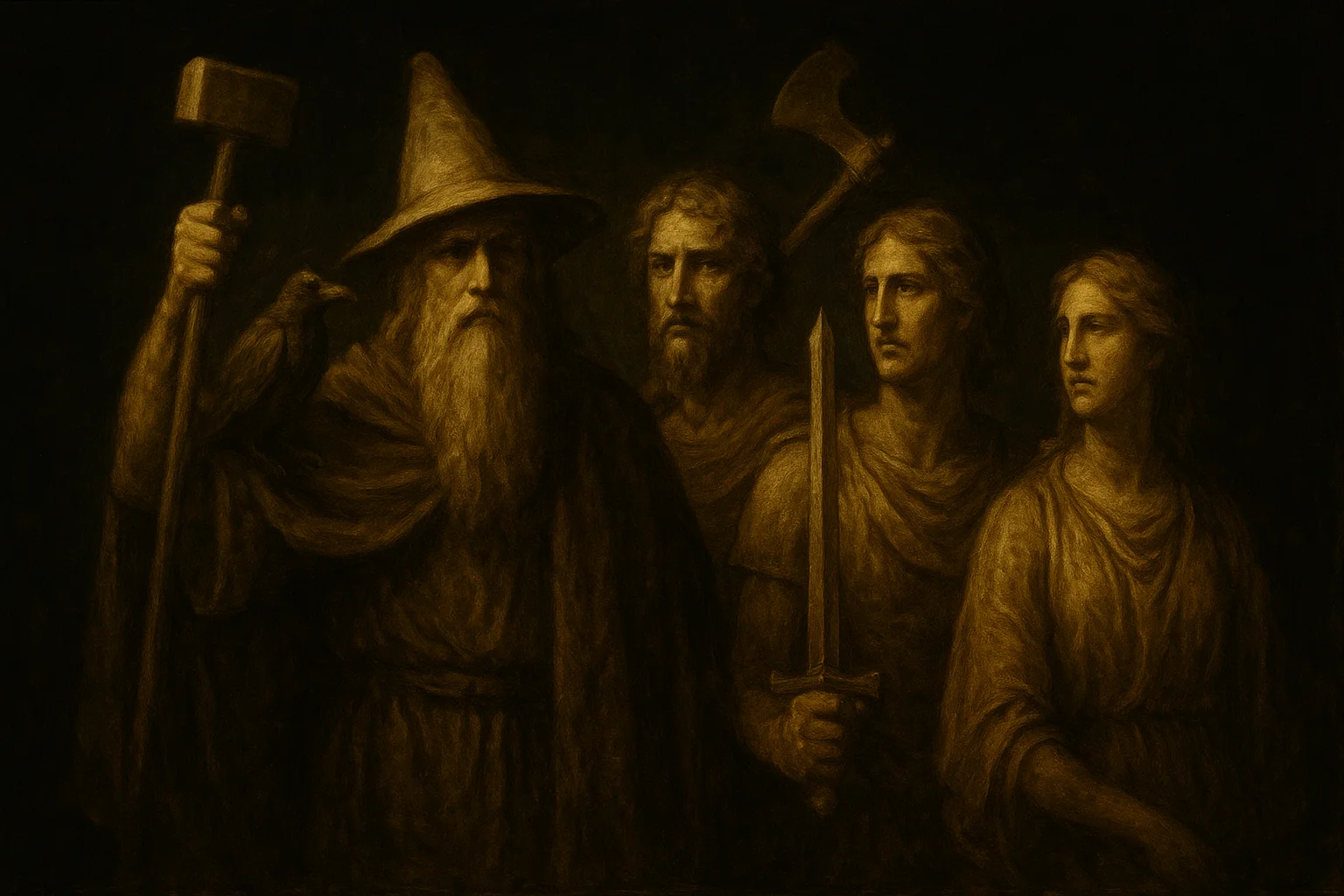
The gods: Woden, Thunor, Tiw, and the rest
The Anglo-Saxon gods are known primarily through three sources: place names scattered across the English landscape, the names of weekdays inherited from Roman interpretations, and occasional mentions in charms or genealogies. The pantheon resembles the Norse, but the details diverge.
Woden (Odin)
Woden appears more often than any other deity, but almost always in retrospect. Royal genealogies in the Anglo-Saxon Chronicle trace lines back to him, suggesting he functioned as a divine ancestor for the warrior elite. The Nine Herbs Charm credits him with slaying a serpent, the only narrative action attributed to him in the surviving Old English corpus:
A worm came crawling, it killed nothing. For Woden took nine glory-twigs, he smote the serpent so that it flew into nine parts. Nine Herbs Charm, Lacnunga manuscript
Place names like Woden's Barrow (Wodnesdenu) and Wednesbury (Wodnesbeorg) suggest cult sites, but no temple architecture survives. Unlike his Norse counterpart, Woden is never described as one-eyed in Old English sources, though the connection is probable. He governs wisdom, magic, and the dead, but the English sources give him less narrative attention than the Icelanders gave Odin.
Thunor (Thor)
Thunor survives mostly in place names: Thundersley, Thursley, Thunderfield. His name means thunder, and he corresponds directly to Norse Thor, but no Old English text describes his hammer, his goats, or his giant-slaying exploits. Bede identifies him with Jupiter, following the Roman interpretatio, which suggests a god of storms and possibly sovereignty. Thursday preserves his name. That is nearly all we have.
Tiw (Tyr) and Frig
Tiw gives his name to Tuesday. The Rune Poem associates the T-rune (Tir) with a star or constellation, calling it a token that keeps faith with nobles. This aligns with Norse Tyr's association with oaths and law, but no Anglo-Saxon text narrates his binding of Fenrir or his loss of a hand. He may have been a war god or a god of justice. The evidence does not stretch further.
Frig, whose name survives in Friday, is even more obscure. Bede equates her with Venus, implying a goddess of love or fertility, but no Old English charm or poem describes her. Some scholars connect her to Norse Frigg, Odin's wife, but the Anglo-Saxon sources are silent on her relationships or functions.
Eostre and the problem of single attestations
Bede mentions Eostre once, stating that the month of Eosturmonath was named after a goddess whose festival the pagans celebrated. No other source confirms her existence. Some scholars accept Bede's testimony; others suspect he invented her to explain the month name. The modern English word Easter derives from her name, or from the month, depending on which reconstruction you trust. This is the condition of much Anglo-Saxon mythology: one mention, no corroboration, and centuries of speculation.
Cosmology and the structure of the world
Middle Earth and the Nine Worlds question
The Old English term middangeard appears throughout the corpus, most famously in Beowulf, where it designates the human world. The word is cognate with Old Norse Midgard, but the cosmological architecture differs. No Anglo-Saxon text describes nine worlds, a world tree, or the tripartite structure found in Norse sources. Maxims I and Maxims II offer gnomic statements about the natural and social order, but they do not sketch a cosmic map.
What the sources do suggest is a world divided between the known and the monstrous. Beowulf places Grendel and his mother in a mere at the edge of human settlement, a boundary zone where the social order breaks down. Dragons guard hoards in barrows. The sea is a place of exile and testing. Geography is moral as well as physical.
Wyrd: fate without the Norns
Wyrd governs the Anglo-Saxon cosmos, but it is not personified. The word appears more than a dozen times in Beowulf, always as an impersonal force. Wyrd goes as it must. It sweeps away the doomed. It spares the brave when courage and fate align. Unlike the Norse Norns, who weave individual destinies, wyrd is a current, not a weaver.
Norse Fate
Personified as three Norns (Urd, Verdandi, Skuld) who weave at the base of Yggdrasil, determining the fate of gods and men through active intervention.
Anglo-Saxon Wyrd
An impersonal force, never personified in surviving texts, that governs outcomes but does not weave or speak. Wyrd is spoken of, not spoken to.
The distinction matters. Anglo-Saxon fate is less narrative, less mythologised. It functions more like a principle than a character. This may reflect the state of the sources, or it may reflect a genuine theological difference. We cannot know.
Monsters, elves, and the supernatural
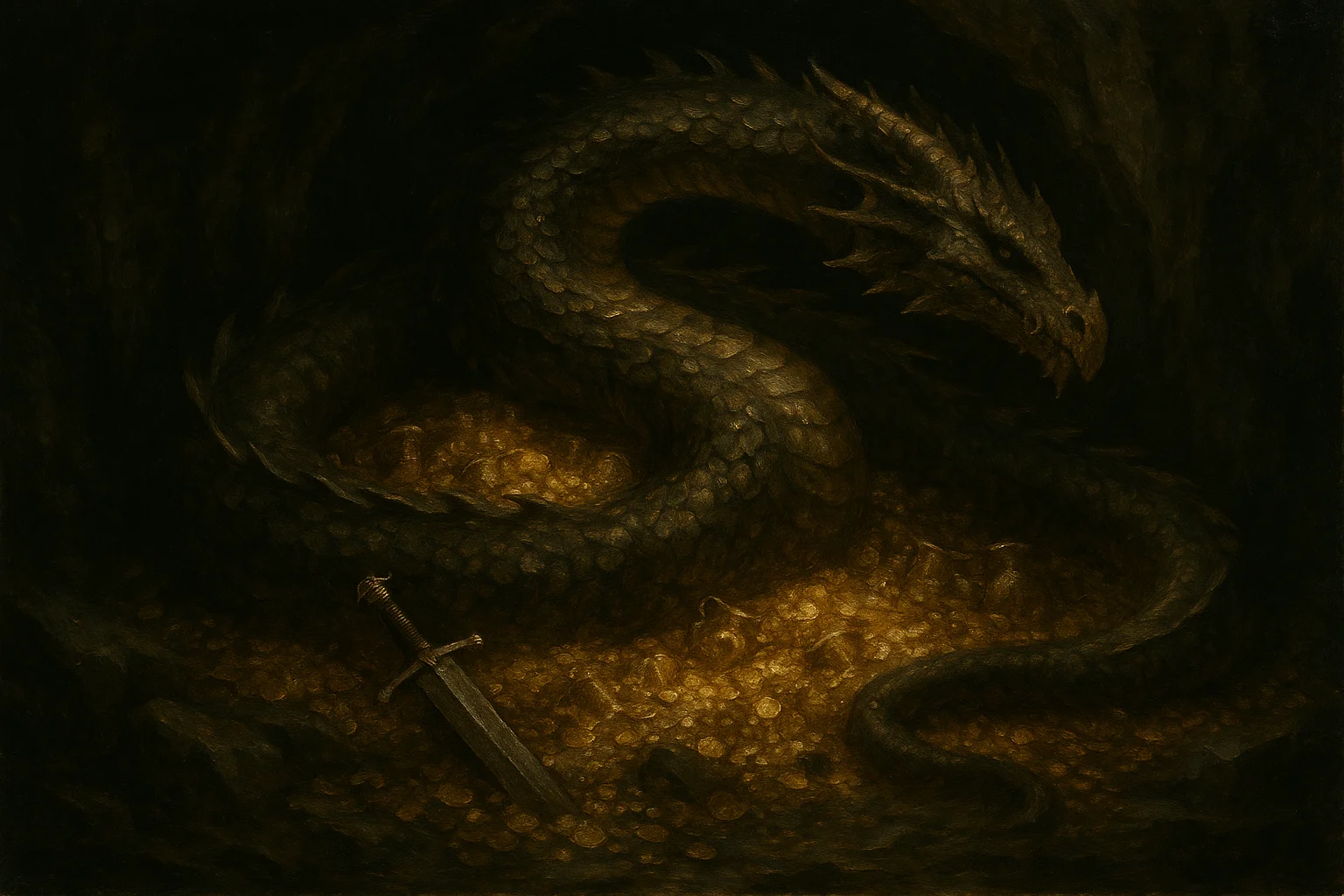
Beowulf is the primary catalogue of Anglo-Saxon monsters. Grendel, described as a descendant of Cain, is a werewolf-like creature who devours warriors in the night. His mother, unnamed and more dangerous, dwells in a submerged hall. The dragon that kills Beowulf guards a hoard for three hundred years, waking only when a thief disturbs it. These are not gods but mythological creatures that test the hero.
Elves appear in charms and medical texts, usually as sources of illness. The Nine Herbs Charm mentions "elf-shot," a condition caused by invisible arrows. Ælfric condemns those who make offerings to elves. The Old English word ælf does not carry the later associations of beauty or benevolence; these are dangerous beings, closer to spirits than to Tolkien.
Other supernatural entities include:
- Nicors: sea monsters mentioned in Beowulf as creatures Beowulf fought during a swimming contest
- Thyrs: giants or demons, mentioned in charms as hostile forces
- Dwarves: appear in medical texts as causes of disease, not as craftsmen
- Wights: land spirits or revenants, implied in place names and boundary charms
The taxonomy is loose. The sources do not systematise. What they share is a sense that the world is populated by hostile or indifferent powers that must be managed through ritual, courage, or both.
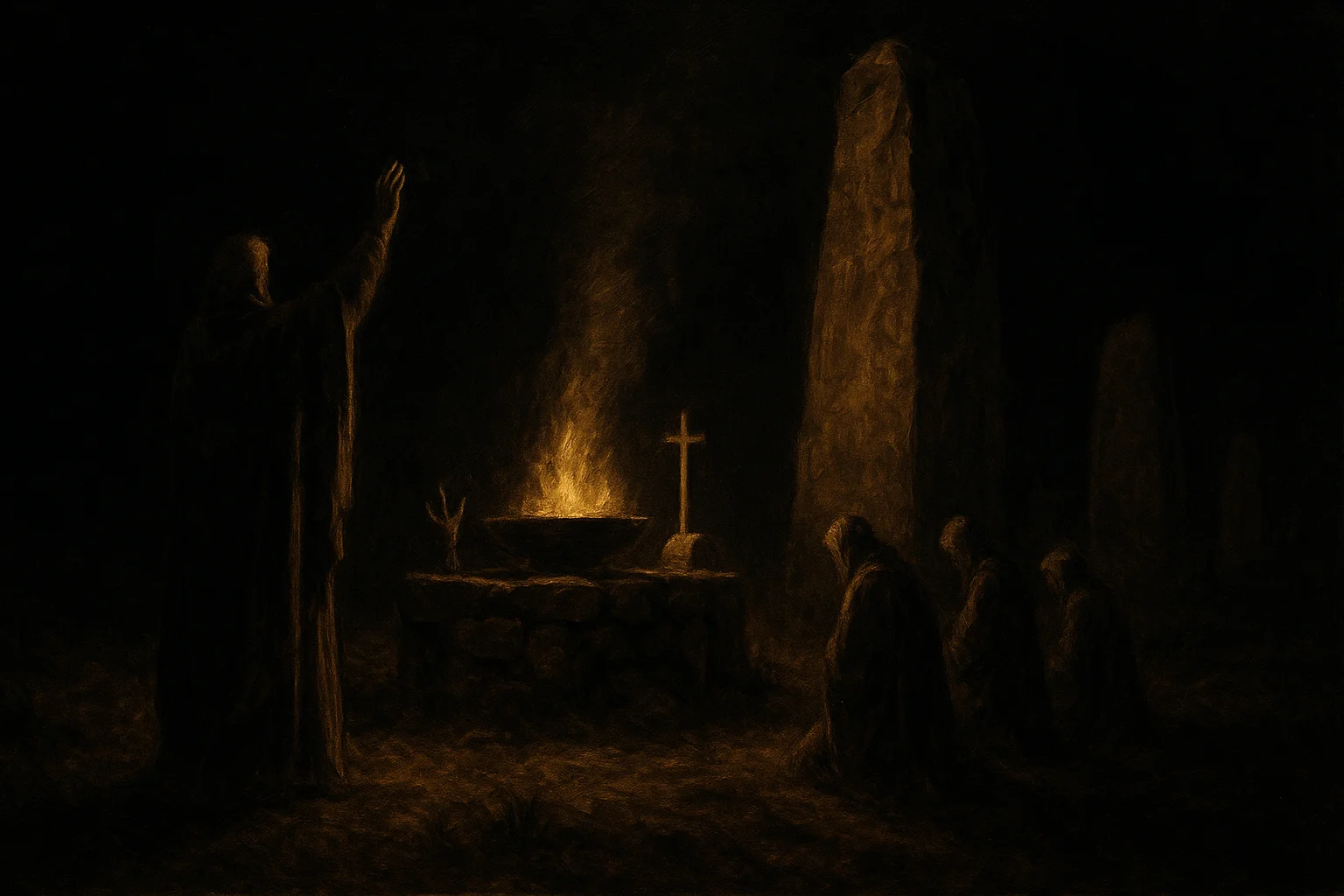
Ritual practice and sacred sites
Almost no direct evidence of Anglo-Saxon ritual survives. Bede mentions that the pagans sacrificed animals and held feasts in sacred groves, but he provides no details. The Anglo-Saxon Chronicle records the destruction of temples, but does not describe what happened inside them before they burned. Place names suggest cult sites: Harrow (hearg, meaning shrine), Wye (wig, meaning idol), and the many locations named after gods.
Archaeological evidence is fragmentary. Grave goods suggest belief in an afterlife that required weapons, jewellery, and food. Some burials are aligned with solar events. A few sites, like the temple at Yeavering in Northumbria, show evidence of large timber structures that may have served religious functions before conversion. But the rituals themselves are lost.
The charms preserved in manuscripts like the Lacnunga offer the closest glimpse of practice: spoken formulas, herbal remedies, invocations of Woden or Christ depending on the scribe's theology. These are hybrid texts, Christian in frame but pagan in vocabulary. They suggest a religion of spoken word and natural remedy, not of written scripture.
Christianity and the erasure of the old religion
The conversion of the Anglo-Saxons began in 597 when Augustine arrived in Kent, and it was largely complete by the end of the seventh century. The speed of the transition explains the scarcity of sources. There was no long twilight period in which pagans and Christians coexisted and recorded each other's beliefs. The church won quickly, and it controlled the scribes.
Bede's Ecclesiastical History describes the conversion as a series of royal decisions: kings converted, and their people followed. The old temples were either destroyed or rededicated. Pope Gregory instructed Augustine to repurpose pagan festivals rather than abolish them, a strategy that preserved the calendar but erased the theology. The result is a mythology known mostly through Christian reinterpretation.
Beowulf itself is a product of this erasure. The poet praises the hero's courage and mourns his death, but frames the story within a Christian cosmos. Grendel is a descendant of Cain. The dragon is a symbol of avarice. The pagan past is admired but also distanced, treated as a time of noble ignorance before the light of the gospel. This is not preservation. It is eulogy.
How Anglo-Saxon myth differs from Norse
The relationship between Anglo-Saxon and Norse mythology is close but not identical. Both descend from a common Germanic tradition, but they diverged after the migration period. The Norse preserved more narrative material because they converted later and because Icelandic scholars in the thirteenth century wrote down the old stories. The English converted earlier and wrote almost nothing.
Where the sources do overlap, differences emerge. Woden is less developed than Odin: no ravens, no spear Gungnir, no explicit connection to poetry or runes in the Old English corpus. Thunor is less prominent than Thor; no hammer Mjölnir, no goat-drawn chariot, no Jörmungandr. The cosmology is less structured: no Yggdrasil, no clear enumeration of worlds, no Ragnarok.
The monsters differ too. Beowulf features Grendel, a creature with no Norse equivalent, and a dragon that behaves more like a territorial predator than a cosmic serpent. The hero's journey in Anglo-Saxon tradition emphasises loyalty to the lord and the tragedy of the hall's fall, themes less central to Norse sagas.
Some scholars argue that the differences are accidents of preservation: if more Anglo-Saxon texts survived, the mythologies might look more similar. Others argue that the English developed a distinct tradition during their centuries in Britain, shaped by contact with Romano-British culture and by their own political fragmentation. Both views have merit. The evidence does not settle the question.
Frequently asked questions
What gods did the Anglo-Saxons worship before Christianity?
The primary gods were Woden (Odin), Thunor (Thor), Tiw (Tyr), and Frig (Frigg), known mainly through place names and the days of the week. Bede also mentions Eostre, a goddess associated with spring, though she is attested only once. Royal genealogies trace lines back to Woden, suggesting he held particular importance for the warrior elite.
How much of Anglo-Saxon mythology actually survives?
Very little. The main sources are Beowulf, which is a Christian poem about pagan heroes; the Nine Herbs Charm, which mentions Woden once; and scattered references in Bede, Ælfric, and the Anglo-Saxon Chronicle. No creation myths, detailed theogonies, or temple hymns survive. The conversion to Christianity happened too quickly for systematic recording of the old religion.
Is Anglo-Saxon mythology the same as Norse mythology?
No, though they share a common Germanic origin. The gods have similar names and functions, but Anglo-Saxon sources lack the narrative detail found in the Eddas. There is no Anglo-Saxon equivalent to Yggdrasil, Ragnarok, or many of the Norse cosmological structures. The differences may reflect genuine theological divergence or simply the accident of which texts survived.
What is Wyrd and how does it differ from Norse fate?
Wyrd is an impersonal force governing fate in Anglo-Saxon belief, mentioned frequently in Beowulf but never personified. Unlike the Norse Norns, who actively weave destinies, wyrd is spoken of as a current or principle that "goes as it must." It is a concept, not a character, and it carries no mythological narrative of its own.
What monsters appear in Anglo-Saxon texts?
Beowulf features Grendel, a Cain-descended creature who devours warriors; Grendel's mother, who dwells in a submerged hall; and a dragon that guards a hoard. Other sources mention nicors (sea monsters), elves (sources of illness), thyrs (giants or demons), and dwarves (also associated with disease). These creatures are hostile forces that must be confronted or managed through ritual.
Why is there so little written evidence of Anglo-Saxon pagan beliefs?
The Anglo-Saxons converted to Christianity rapidly, beginning in 597, and the church controlled literacy. By the time the English began writing in their own language, the old religion was already condemned or forgotten. Unlike Iceland, where paganism survived longer and was recorded in the thirteenth century, England had no late pagan period during which scribes preserved the myths.