
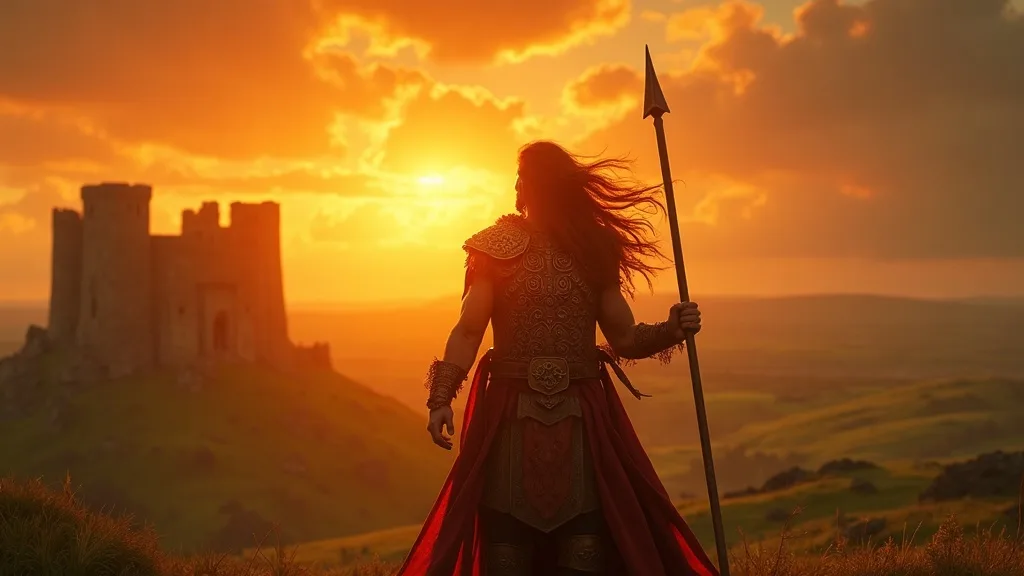
Lugh: The Many-Skilled God of Light
Lugh blazes through Irish mythology as the master of every craft, a solar warrior whose spear never missed and whose name echoes across Europe. Here is the full story of the Tuatha Dé Danann's brightest son.
Contents
The guards at the gate of Tara had one question for every newcomer: what skill do you bring? The stranger who arrived that day gave an unusual answer. He was a smith. They had one. He was a warrior. They had many. A poet, a harper, a sorcerer, a healer? Each time, the gatekeeper shook his head. Every craft was already filled. Then the stranger asked a different question: did they have anyone who was all of those things at once? The gate swung open.
That stranger was Lugh: the Many-Skilled God of Light, known in early Irish texts as Lugh Lámhfhada ("Lugh of the Long Arm") and celebrated across the Celtic world under cognate names from Lugdunum (modern Lyon, France) to Carlisle in Roman Britain. He is one of the most completely drawn figures in the entire mythological canon of Ireland, a god whose biography stretches from a perilous birth through epic warfare to a festival still quietly observed each August. He is not simply a sun god with a spear. He is the principle that mastery, when it is total, becomes something greater than the sum of its parts.
Lugh's Birth and the Shadow of Balor's Prophecy
Every hero story begins with a threat. Lugh's begins with a prophecy that chased him before he drew his first breath.
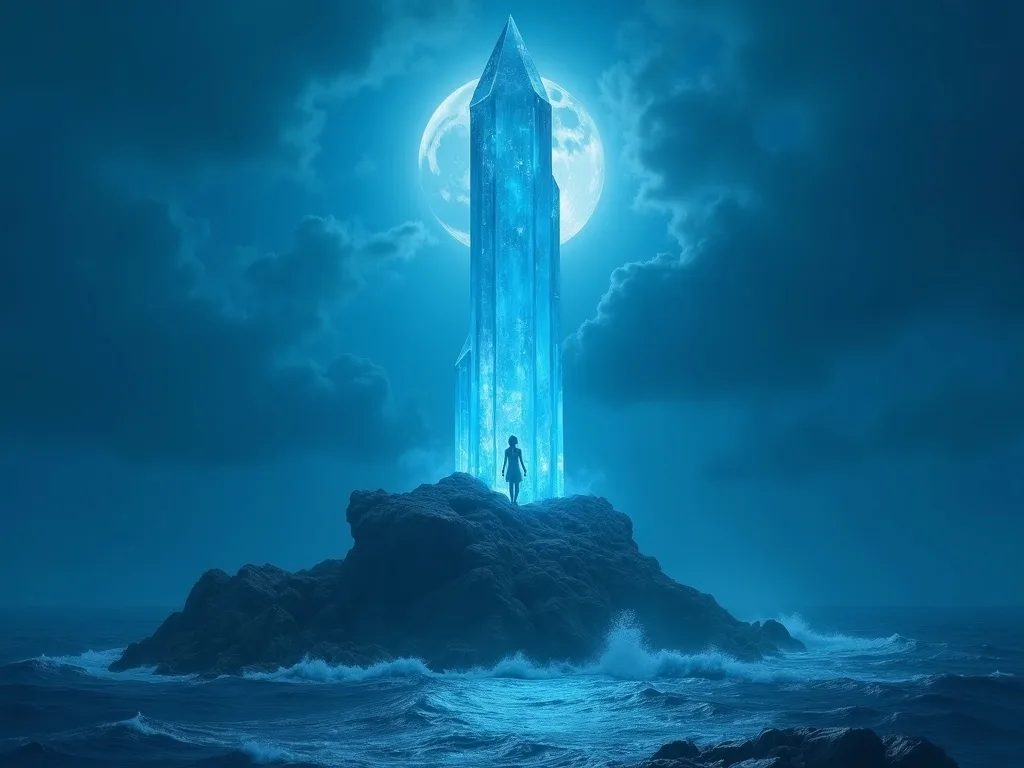
Balor of the Evil Eye, the fearsome king of the Fomorians, received a druidic warning: he would be killed by his own grandson. His response was immediate and pragmatic. He locked his only daughter, Ethlinn, in a crystal tower on Tory Island off the northwest coast of Ireland, sealing her away from any man. The plan was simple. No man reaches her; no grandson is born; no prophecy is fulfilled.
It failed, as such plans always do. A chieftain of the Tuatha Dé Danann named Cian, seeking a magical cow that Balor had stolen, infiltrated the tower with the help of a druidess named Biróg. He reached Ethlinn. She bore triplets. When Balor discovered the children, he ordered them drowned. One infant slipped free, saved again by Biróg, and carried across the sea to his father Cian. That child was Lugh.
His fostering tells us something crucial about how the Irish imagination understood divine education. Lugh was raised by Manannán mac Lir, the lord of the Celtic Otherworld and the sea, who gave him armour that no weapon could pierce, a horse named Aonbharr that could gallop across water, and a sword called Fragarach ("The Answerer") whose blade could cut through any shield. He was then fostered again, this time by a craftsman king named Goibniu's companion Tailltiu, or in some tellings by the Fomorian woman Tailtiu herself, who cleared the great plain of Ireland with her bare hands and died of exhaustion doing so. Lugh would later establish the festival of Lughnasadh in her honour.
The Tuatha Dé Danann and the Road to Tara
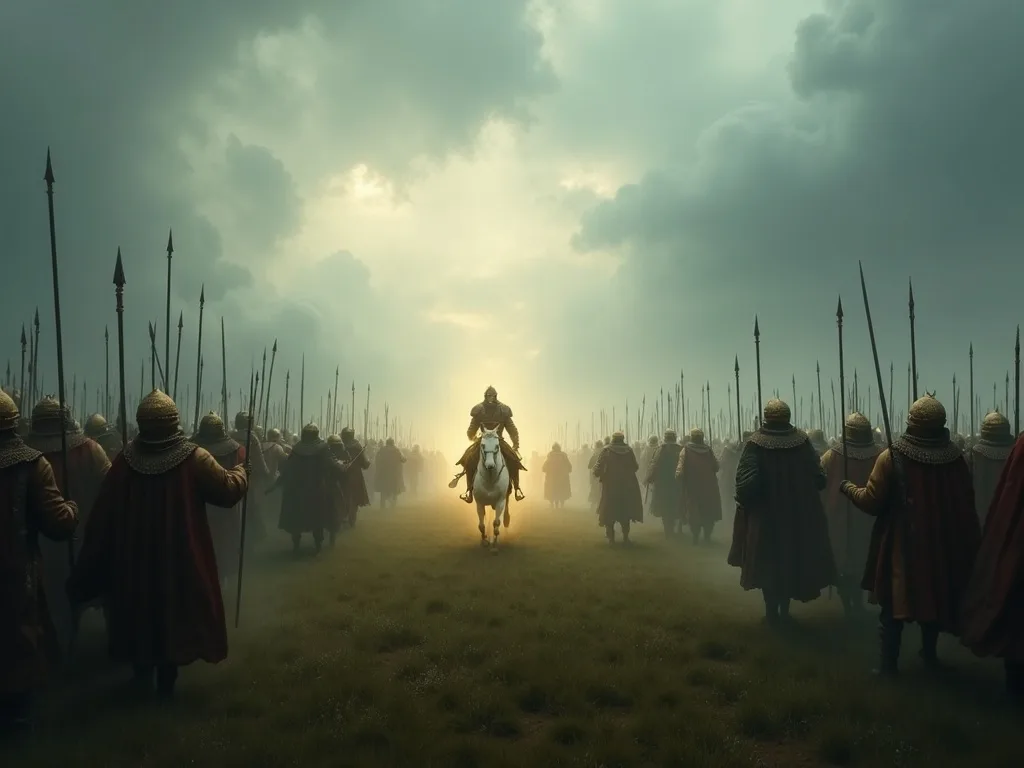
By the time Lugh arrived at Tara, the mythological capital of Ireland, the Tuatha Dé Danann were in political crisis. They lived under tribute to the Fomorians, the older, darker divine race of the depths, paying taxes in grain, milk, and the labour of their people. The great king Nuada had lost his arm in battle and been temporarily replaced by the foreign king Bres, whose miserly reign had left poets unfed and warriors insulted. Nuada had been restored with a silver arm by the physician Dian Cécht, and with an arm of flesh and bone grown by Dian Cécht's son Miach, but the Tuatha Dé Danann still lacked the spark to challenge Fomorian domination.
Lugh provided that spark.
His arrival at Tara, described with great relish in the text known as Cath Maige Tuired ("The Second Battle of Mag Tuired"), is one of the finest scenes in the entire corpus of Irish myth. Each time the gatekeeper turned him away, Lugh countered. The exchange reads less like a mythological catalogue and more like a job interview conducted under cosmological pressure. When Lugh finally posed his one-craftsman-in-all-trades question and the gates opened, Nuada gave up his own seat to this newcomer. The king played chess against Lugh and lost. Nuada recognised that Lugh's mind moved faster than his.
Lugh Lámhfhada was immediately installed as the military commander of the Tuatha Dé Danann. He spent the period before the decisive battle conducting what we would now call strategic intelligence: he went from craftsman to craftsman among the divine community, asking each what they would contribute to the war against the Fomorians. The smith Goibniu promised blades that would never miss. The physician Dian Cécht promised to heal the dead overnight in a well of regeneration. The sorcerers promised to hurl mountains. Lugh gathered every promise and wove them into a battle plan.
The Second Battle of Mag Tuired: Lugh's Defining War
The Second Battle of Mag Tuired (Moytura) is the Irish mythological equivalent of Ragnarök or the Mahabharata war. It is the great reckoning between divine order and primordial chaos, between the crafted world and the formless deep. Lugh's role in it is both tactical and personal.
The Tuatha Dé Danann fought with discipline forged by Lugh's pre-battle preparation. The wounded were healed each night in Dian Cécht's well; the broken weapons were re-forged by Goibniu and his brothers. The Fomorians had no such system. The battle turned on attrition and, ultimately, on a single confrontation.
Lugh had been ordered by the Tuatha Dé Danann leadership to stay back from the battlefield. He was too valuable to risk. The decision is almost comic in retrospect: a god described as the best warrior among them, kept in reserve while the fighting raged. Lugh, characteristically, disobeyed. He rode into the middle of the battle on his horse Aonbharr, moving along the lines in a one-legged, one-eyed posture that some scholars read as a shamanic stance, a deliberate embodiment of a liminal state. He raised the morale of the Tuatha Dé Danann with a verbal roscanna (a chanted incantation) while the fighting roared around him.
Then came Balor.
Balor of the Evil Eye arrived at the height of the battle. His eye was an instrument of mass destruction: it took four men to lift the eyelid, and whatever it looked upon died. He opened it on the Tuatha Dé Danann forces and the result was catastrophic. Lugh moved to face him. Balor, recognising his grandson, reportedly smiled and told the men lifting his eyelid to raise it a little higher so that he could see this young man well.
Lugh threw his spear, or in some versions used his sling-shot, and drove the projectile clean through Balor's eye. The eye was forced backward through Balor's head. When it opened on the other side, it killed twenty-seven Fomorian warriors standing behind him. The prophecy closed itself perfectly. The grandson had killed his grandfather with the grandfather's own weapon: sight turned back on itself.
The Fomorians were routed. Their king Indech was killed. Their general Bres was captured alive, and Lugh, in a moment that illuminates his character as clearly as anything in the text, spared Bres in exchange for agricultural knowledge. What days to plough, what days to sow, what days to reap. Lugh was not primarily a god of destruction. He traded mercy for wisdom.
Lugh's Weapons and the Four Treasures of Ireland
Celtic mythology places enormous weight on divine weapons, and Lugh sits at the centre of this symbolic system. His spear is one of the Four Treasures of the Tuatha Dé Danann, brought from the mythical city of Finias. The spear, called Lúin of Celtchar in some tellings, or simply the spear of Lugh in others, was said to be so eager for blood that it had to be kept with its head submerged in a cauldron of poisoned water to stop it burning through whatever held it.
The pairing of Lugh with the spear is consistent across sources. In Welsh mythology, his cognate figure Lleu Llaw Gyffes (whose name means "bright one of the skilful hand") appears in the Mabinogion, the great collection of Welsh mythological tales, and shares structural features with the Irish Lugh: a birth under curse, a fosterage, an eventual triumph over supernatural opposition. The name Lleu is nearly identical linguistically to Lugh, both deriving from a Proto-Celtic root Lugus, which most scholars connect to brightness, perhaps the brightness of an oath or the luminous clarity of skill brought to its highest expression.
The god Lugus was worshipped across Gaul and Roman Britain with a frequency that suggests he was among the most widely venerated deities of the continental Celtic world. Place names bear this out: Lugdunum (Lyon), Luguvalium (Carlisle), Laon in northern France. Julius Caesar, summarising Gaulish religion in the Gallic Wars, described Mercury as the most important deity of the Gauls, the inventor of all arts and the patron of commerce and travel. Most modern scholars identify this Mercury as Lugus/Lugh, since the attributes align: skill in all crafts, patronage of trade, a talent for cunning that shades into trickery.
Lugh as the Father of Cú Chulainn
If Lugh's own story is the arc of mastery, his most significant legacy in Irish mythology may be the child he fathered: Cú Chulainn, the great hero of the Ulster Cycle.
The circumstances are, again, marked by divine intervention and mortal crisis. A woman named Dechtire, sister of the Ulster king Conchobar mac Nessa, disappeared one day with fifty young women, seemingly swallowed by a fairy mound. Three years later, a flock of birds arrived at Emain Macha, the royal seat of Ulster, and led the warriors on a chase. Night fell. The warriors found a house where a couple sheltered them; during the night the man's wife gave birth to a boy, and swallows arrived carrying a newborn foal. In the morning, both the house and the couple had vanished. Only Dechtire remained, with the child and the foal beside her.
The man in the house had been Lugh. The child was his son, and Dechtire's family accepted this. The boy was given a name by the druid Morann and fostered in the elaborate system of aristocratic education that Ulster society prized. He became Sétanta, then Cú Chulainn ("Hound of Culann"), the warrior who held Ulster alone against the armies of Connacht in the great cattle-raid of the Táin Bó Cúailnge.
Lugh appears again during that war. When Cú Chulainn was wounded and exhausted after days of single combat, Lugh came to him in sleep, tended his wounds with Otherworldly herbs, and let him rest for three days while the Ulster warriors lay under a curse. Father nursing son; the god of light sustaining the next generation.
The father-son thread also braids with tragedy. Cú Chulainn would unknowingly kill his own son Connla, a grief that broke him. The pattern of sons destroyed by prophecy, of bloodlines carrying divine capacity and mortal cost, runs through the Lugh lineage like a dark musical phrase.
Lughnasadh: The Harvest Festival That Outlasted the Gods
Every August 1st, modern pagans, Irish heritage communities, and the curious observe Lughnasadh (sometimes anglicised as Lammas in the English tradition). The festival is one of the four great seasonal markers of the Celtic calendar alongside Imbolc, Bealtaine, and Samhain.
Its mythological origin is stated plainly in the medieval texts: Lugh established the festival in memory of his foster mother Tailtiu, who had died clearing the great plain of the Brega (in what is now County Meath) for agriculture. The festival she inspired was agricultural in its bones: the cutting of the first grain, the harvesting of bilberries from hillsides, the beginning of the season when summer tips toward autumn.
At the Hill of Taillt (Teltown), great assemblies were held: horse races, athletic competitions, legal contracts, and the famous Teltown marriages, trial unions contracted for a year and a day that could be dissolved by returning to the same spot and walking away from each other. This combination of athletic games, legal business, and seasonal harvest marks Lughnasadh as something more than a religious observance. It was a civic institution, and Lugh, as its patron, was as much a god of social order as of light.
The hilltop bilberry-gathering tradition survived in rural Ireland well into the twentieth century. Climbing Croagh Patrick in County Mayo on the last Sunday of July (called Reek Sunday) preserves something of this pattern, though the mountain has been entirely absorbed into Christian pilgrimage. The scholar Máire MacNeill documented these survivals exhaustively in her 1962 study The Festival of Lughnasa, tracing the festival's footprint across hundreds of Irish parishes. The evidence is not ambiguous: Lugh's festival proved more durable than his theology.
The Solar Symbolism and Scholarly Debate Around Lugh's Nature
The label "sun god" attaches to Lugh easily, perhaps too easily. The long arm is read as a sunbeam. The spear of light kills the evil eye. The name itself links to brightness. But the actual Irish texts are more careful than this reading suggests.
Lugh is never described in the medieval manuscripts as the sun personified. He does not drive a solar chariot. He does not set and rise. His epithet Ildánach points to skill, not to celestial mechanics. The scholar Kim McCone, in his work on Irish mythology and early Christianity, argued that the attempt to reduce Celtic gods to single natural phenomena reflects a nineteenth-century comparative methodology that the primary sources do not support. Lugh controls light in the sense that excellence illuminates: he is the patron of all crafted things, and craftsmanship requires clarity of vision.
The comparison with the Roman Mercury remains instructive. Mercury was not a sun god. He was a god of communication, intelligence, trade, and the crossing of boundaries. These are Lugh's attributes too. He crosses the boundary between the divine Tuatha Dé Danann and the mortal world (via Cú Chulainn). He crosses the boundary between enemy factions (sparing Bres). He crosses the boundary between one craft and all crafts.
A more careful designation might be "god of luminous skill" rather than "god of the sun," though the solar resonance is real and old enough that it should not be entirely discarded. Proto-Celtic Lugus may indeed carry a root meaning of brightness. The debate, still active among Celtic scholars, reflects a broader question about how to read ancient polytheism: do divine portfolios have a single organizing principle, or are they accumulations of function that resist reduction to any single key?
Lugh resists reduction. That may be his most defining trait.
Lugh's Vengeance and His Son's Blood
One chapter of Lugh's story sits outside the great battles: his personal vendetta against the sons of Tuireann. This tale, Oidheadh Chlainne Tuireann ("The Fate of the Children of Tuireann"), is the Irish mythological world's most concentrated meditation on the cost of blood.
Cian, Lugh's father, was killed by the three sons of Tuireann, Brian, Iuchar, and Iucharba, while in the form of a pig. They killed the pig. They tried to hide the act but Lugh knew it. Rather than executing them directly, he imposed an éric (a blood fine) in the form of a series of impossible quests: retrieving the cooking-spit of the women of Finchory from the bottom of the sea, bringing back the skin of a pig that healed all wounds, obtaining a poisoned spear from the King of Persia, and several others. The tasks are deliberately designed to destroy them, and they do. The sons of Tuireann complete the quests, mortally wounded in the process, and return to Ireland to beg Lugh for the healing pig's skin that could save them. He refused. They died. His vengeance was not rage but architecture: he built their destruction out of their own honour.
This episode is sometimes read as a mythological residue of ancient Irish legal procedure, where blood debts were settled through goods and labour rather than direct counter-violence. It also reveals something about Lugh's intelligence. He was a planner. The god who prepared the Second Battle of Mag Tuired by systematically polling every craftsman was the same god who designed a blood-fine that functioned as a death sentence.
Lugh in Modern Reception: From Lammas to Popculture
The long life of Lugh: the Many-Skilled God of Light in modern culture is both broad and uneven. In the revival of Celtic spirituality that began in the late eighteenth century and accelerated through the nineteenth, Lugh became something of a poster figure: the bright, masterful, multitalented divine hero that Romantic nationalism found easiest to celebrate.
W.B. Yeats drew on the deeper wells of Irish mythology with more care than most, and the Tuatha Dé Danann hover at the edges of his poetry and prose as the Sidhe, the fairy host of the hollow hills. Lady Gregory's 1904 compilation Gods and Fighting Men brought the Lugh stories to a general readership in accessible prose, though she smoothed many of the rougher mythological edges.
In contemporary fantasy fiction, Lugh appears both directly and in structural echo: the polymath divine warrior, the sun-bright champion who combines craft and war, recurs across the genre. In video games, tabletop roleplay systems, and graphic novels, the archetype of the "jack of all trades" divine figure often traces back, consciously or not, to Ildánach.
The pagan festival of Lughnasadh has expanded beyond Irish revival communities into broader neopagan practice, particularly in Wiccan traditions that adopted the Celtic seasonal calendar as a ritual framework. The festival's agricultural meaning has been reinterpreted as a time for reflecting on creative harvests: what work has come to fruition, what has been sown and what is now ready.
For historians and mythographers, Lugh remains one of the clearest windows into how the Celtic divine imagination worked: not as a pantheon of narrow specialists, but as a cast of beings who crossed every boundary they encountered, including the boundary between life and death, between one skill and all skills, between one people and every people.
Frequently Asked Questions About Lugh, the Many-Skilled God of Light
Frequently asked questions
What does Lugh's name actually mean?
The name derives from the Proto-Celtic root Lugus, which most linguists connect to brightness or luminosity, possibly in the sense of the flash of an oath or the clarity of a polished surface. The cognate appears in Gaulish place names like Lugdunum (Lyon) and in the Welsh figure Lleu Llaw Gyffes. The Irish epithet Lámhfhada ("Long Arm") has been interpreted as a reference to either a long-throwing spear arm or to a sunbeam, though neither reading is universally agreed upon in Celtic scholarship.
Is Lugh the same as the Celtic god Lugus worshipped in Gaul?
Almost certainly, yes. Caesar's description of a Mercury-type deity as the chief god of the Gauls, patron of all arts and commerce, matches the Irish Lugh's profile closely. Inscriptions from Roman Gaul and Britain dedicate altars to Lugus, and the wide distribution of place names derived from this root, from Lyon to Leiden, suggests a deity whose worship was pan-Celtic rather than confined to Ireland. The Welsh Lleu completes a triangle of cognate figures across three branches of the Celtic world.
Why did Lugh spare Bres after the Second Battle of Mag Tuired?
The text of Cath Maige Tuired presents this as a rational exchange: Bres's life in return for knowledge of the agricultural calendar, specifically when to plough, sow, and reap. This detail is not ornamental. It places Lugh in the role of the god who values civilised knowledge over pure revenge, and it connects his character to the agricultural festival of Lughnasadh. Some scholars read this as a mythological explanation for how Irish farmers came to understand seasonal agriculture, encoded as a divine transaction.
What is the connection between Lugh and Cú Chulainn?
Lugh is Cú Chulainn's divine father. In the birth narrative preserved in the Ulster Cycle, Lugh appears to Dechtire (Cú Chulainn's mother and the sister of King Conchobar) as a supernatural host and fathers the child who will become the greatest warrior of Ulster. During the Táin Bó Cúailnge, when Cú Chulainn was near death from exhaustion and wounds, Lugh appeared to him and healed him over three days, sustaining his son at the crisis point of the war.
What primary sources describe Lugh in detail?
The two most important primary texts are Cath Maige Tuired ("The Second Battle of Mag Tuired"), preserved in a sixteenth-century manuscript but drawing on much older oral traditions, and Oidheadh Chlainne Tuireann ("The Fate of the Children of Tuireann"), which recounts the blood-fine story. The Welsh cognate Lleu appears in the Fourth Branch of the Mabinogion, the collection of Welsh mythological tales compiled in the eleventh to thirteenth centuries. Máire MacNeill's The Festival of Lughnasa (1962) remains the essential scholarly study of Lugh's festival dimension.
Is Lugh really a solar deity, or is that a modern misreading?
The debate is live and unresolved. The linguistic root of his name does suggest brightness, and the spear-killing-the-evil-eye narrative has obvious solar resonances. However, the medieval Irish texts do not describe him as the sun personified, and his portfolio of crafts, law, music, healing, and sorcery extends well beyond solar symbolism. Scholar Kim McCone and others have warned against forcing Celtic deities into the single-sphere model inherited from nineteenth-century comparative mythology. Lugh is best understood as a god of luminous mastery rather than a narrow solar deity.
The Unresolved Legacy: What Lugh Still Teaches About Celtic Polytheism
The deeper one reads in Celtic scholarship, the clearer it becomes that Lugh unsettles easy categories. He is too complex for "sun god," too warlike for "craftsman deity," too merciful for "war god." He bargains with enemies, mourns his foster mother, nurses his wounded son, and engineers the deaths of his father's killers across a continent of quests. He is described with more psychological texture than almost any other figure in the Tuatha Dé Danann.
This complexity is not an accident of transmission. The medieval Irish monks who copied and compiled these texts were capable editors who could have reduced Lugh to a simpler type. They did not, which suggests they were working with source material that was genuinely rich, an oral tradition that had built up a character over centuries of telling.
What Lugh ultimately teaches is something about how the Celts understood excellence. In many ancient traditions, gods specialise: there is a god of smiths, a god of healing, a god of war. The Irish tradition does not entirely abandon this pattern, but it places above all specialists a figure who holds every craft simultaneously. That figure is not an administrator or a king in the ordinary sense. He is a living argument that the deepest skill is the integration of all skills.
That argument still has force. The best engineers read history. The best doctors understand statistics and human behaviour. The best generals know logistics and psychology and weather. Lugh, standing at the gate of Tara in a world that would not open for the merely excellent, embodies the oldest case for breadth as the highest form of depth.
The Tuatha Dé Danann eventually retreated into the sídhe, the hollow hills, when the Milesians arrived and claimed Ireland for mortal kind. Lugh went with them, into the Otherworld, where Manannán mac Lir still rules the sea and the threshold between what is seen and what is not. The festivals continued. The harvest came every August. The bilberries ripened on the hillsides. The gate, once opened for the man who could do everything, has never quite closed.
Read the full book
Want the whole story?
The complete edition is an instant PDF download here, with a paperback on Amazon for selected titles.
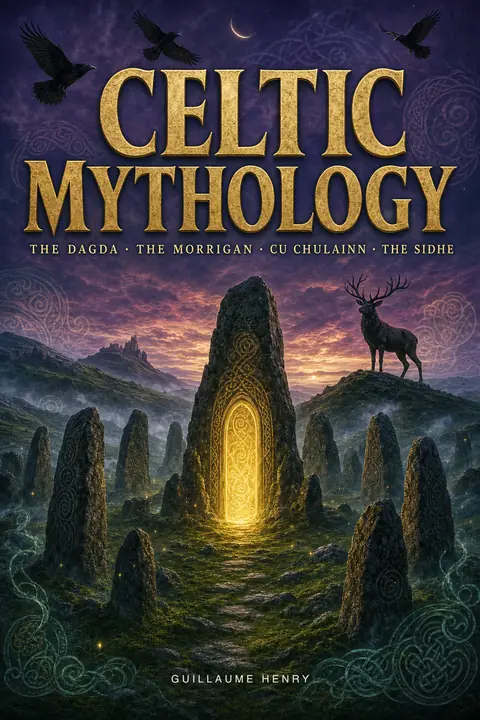
Celtic
The Celtic Mythology Book: The Tuatha Dé Danann, Cú Chulainn, the Morrigan, and the Sacred Stories of Pre-Christian Ireland and Wales
Gods, Heroes, and the Four Treasures of Eriu
The mythology of the Celts before Christianity: the Tuatha Dé Danann, Cú Chulainn's war-feats, the Mabinogion's enchantments, and the bog cauldrons that survived the centuries.
More from Celtic
All articles
Celtic
The Morrigan: Goddess of War and Fate in Celtic Myth
Shape-shifter, crow, battle-queen, prophetess: the Morrigan is the most complex war deity in the Celtic world, weaving fate into every clash of iron.
Celtic
Cu Chulainn, Hound of Ulster: Ireland's Greatest Hero
Cu Chulainn, the Hound of Ulster, stands as the fiercest and most celebrated hero in Irish mythology. Demigod, warrior, and tragic figure, his story reshapes everything you thought you knew about Celtic heroism.