
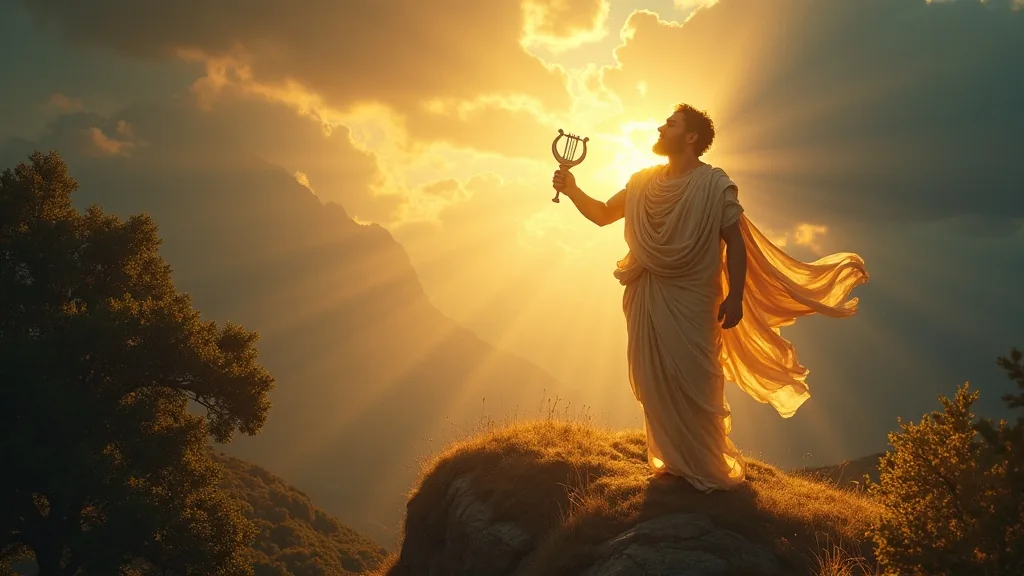
Apollo, God of Light: Sun, Prophecy, and the Radiant Mind
Apollo blazes at the center of Greek religion as the god of light, music, prophecy, and healing. His myths illuminate the ancient Greek vision of a world governed by reason, beauty, and divine order.
Contents
The Radiant God: Who Is Apollo?
Among the Olympians, Apollo stands apart with singular clarity. Where other gods carry the murky textures of night, sea, or the underworld, Apollo is fundamentally associated with illumination, both literal and spiritual. He is the god of light, of the sun's golden passage across the sky, of the prophetic word that cuts through ignorance, and of the musical harmony that orders the cosmos. The Greeks perceived him as an embodiment of what they called sophrosyne, a disciplined, luminous intelligence that neither veers into excess nor retreats into shadow.
He was born on the floating island of Delos, son of Zeus and the Titaness Leto, twin brother of Artemis the huntress. The moment of his birth was itself a mythic event: nine days of labor, the refusal of Hera's domain to offer shelter to Leto, and finally the miraculous blossoming of Delos into a golden paradise the instant Apollo touched the earth. Even the swans are said to have circled the island seven times in his honor, the number seven becoming sacred to him ever after.
Apollo and the Sun: Light as Divine Principle
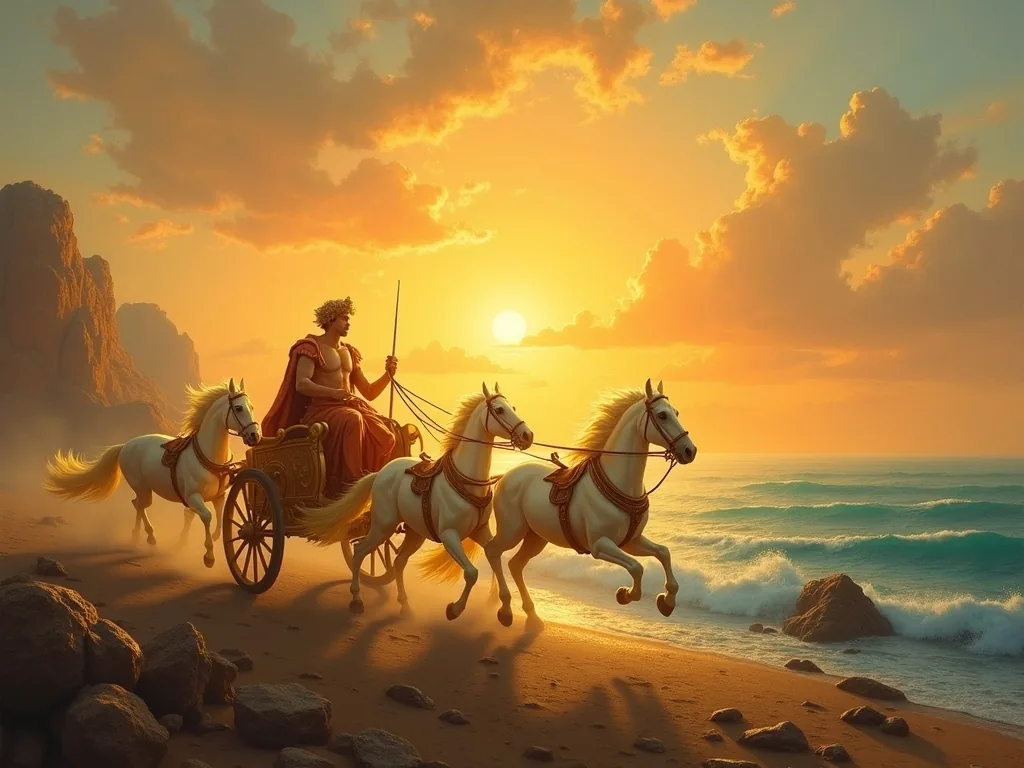
Apollo is often identified with Helios, the personification of the physical sun, though the two were originally distinct deities. Over the classical period, the two figures grew increasingly intertwined until Apollo absorbed many of Helios's solar attributes. By the Hellenistic and Roman eras, Apollo Helios was a coherent theological idea: the god whose chariot-fire illuminates both the natural world and the inner life of the mind.
The Greek concept of divine light was never merely optical. Light, in the Apolline tradition, meant:
- Truth: The light that makes hidden things visible, destroying deceit.
- Order: The regularity of the sun's path mirroring cosmic law.
- Reason: The Delphic maxim "Know thyself" (Greek: gnothi seauton) was inscribed at Apollo's oracle and expresses exactly this inner illumination.
- Purification: Apollo presided over katharsis, the cleansing of spiritual pollution, because light was understood to dispel corruption.
This layered understanding of light explains why Apollo governs domains that seem, at first glance, unrelated. Prophecy, medicine, music, and the sun are all expressions of a single principle: the capacity to see clearly, to make order, to heal the disordered, and to harmonize the discordant.
The Oracle at Delphi: Where Light Becomes Word
No site in ancient Greece concentrated Apolline power more intensely than Delphi, perched on the slopes of Mount Parnassus above the Gulf of Corinth. The sanctuary there bore the inscription "Nothing in excess" alongside "Know thyself," two phrases that distill Apollo's theology into moral imperatives.
The myth explaining Apollo's possession of Delphi is violent and primordial. The site was originally guarded by Python, a great serpent (or dragon) born from the mud left by the great flood, a creature of chthonic, pre-Olympian chaos. The young Apollo descended with his silver bow and slew Python, claiming the oracle for the Olympian order. The name Pythia, given to Delphi's prophetic priestess, commemorates the slain serpent: the oracle sits on the very site of that ancient conquest of darkness by light.
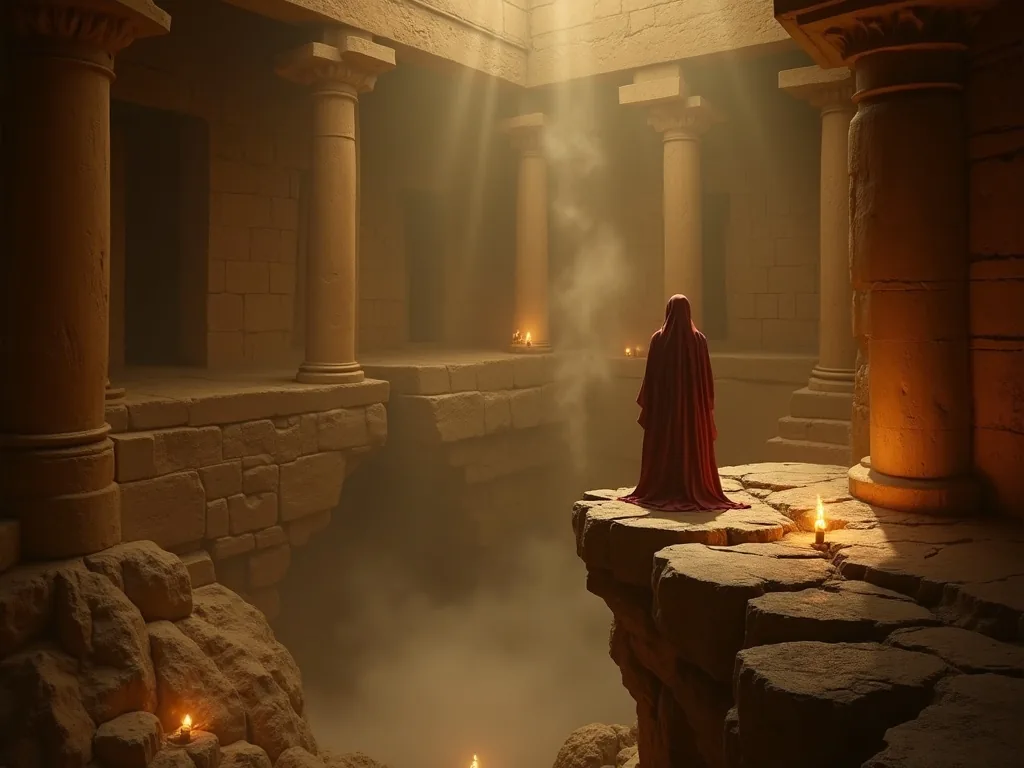
The Pythia, Apollo's mortal mouthpiece, sat upon a tripod over a chasm in the inner sanctum, the adyton, inhaling vapors (modern geology confirms the presence of ethylene gas from geological fissures) and delivering cryptic utterances. Kings, generals, and city-states traveled from across the Mediterranean world to consult her. Croesus of Lydia asked whether he should attack Persia; the oracle told him a great empire would fall. It did, but it was his own. Apollo's light illuminates, but it does not simplify.
The God Who Does Not Lie, Yet Deceives
A fascinating paradox runs through Apolline prophecy: he is the god of truth, yet his oracles are famously oblique. The Greeks resolved this not as contradiction but as a reflection of the nature of truth itself. Reality is complex, layered, and resistant to simple readings. Apollo does not deceive; mortals misread. The light is there, but the eye must be trained to see it.
Music, Poetry, and the Lyre
Apollo's association with music is as ancient as his solar identity. He is the lord of the Muses, the nine goddesses who preside over all creative and intellectual arts. He carries the kithara, a professional version of the lyre, and in myth he is an incomparable musician. The very harmony of the spheres, the Pythagorean idea that celestial bodies produce music through their ordered motion, was understood as an extension of Apolline order.
Two myths of musical contest illuminate his character with particular vividness.
Apollo and Marsyas
The satyr Marsyas found the double flute (aulos) that Athena had discarded after she saw her reflection while playing it. He became extraordinarily skilled and challenged Apollo to a contest. The Muses judged. Apollo won, partially by turning his lyre upside down and playing it, a feat impossible for the flute. His punishment of Marsyas was severe: he flayed the satyr alive, hanging his skin on a tree. The brutality of this act troubled ancient commentators. It reads as a warning that the Olympian order of rational, stringed music, associated with measure and light, does not tolerate the chaotic, ecstatic energy of the flute, associated with Dionysus and the untamed.
Apollo and Pan
When Pan challenged Apollo to a musical duel judged by Tmolus the mountain god and King Midas, the judge declared Apollo the winner. Midas alone dissented, and Apollo transformed his ears into donkey's ears as punishment for a failure of aesthetic judgment. The capacity to recognize beauty and truth was, for the Greeks, not merely aesthetic preference; it was a moral and intellectual faculty.
Love, Loss, and the Limits of Light
Apollo's mythology is rich with desire and grief. He is beautiful, radiant, ardently courted, yet his love stories carry a persistent melancholy.
Daphne: Apollo pursued the nymph Daphne relentlessly (driven partly by Eros's arrow, in revenge for Apollo's mockery of the love god's small bow). Just as Apollo reached her, Daphne prayed to her father, the river god Peneus, who transformed her into a laurel tree. Apollo embraced the tree and declared the laurel sacred to him forever. The laurel wreath crowning poets, athletes, and emperors carries this grief forward through millennia.
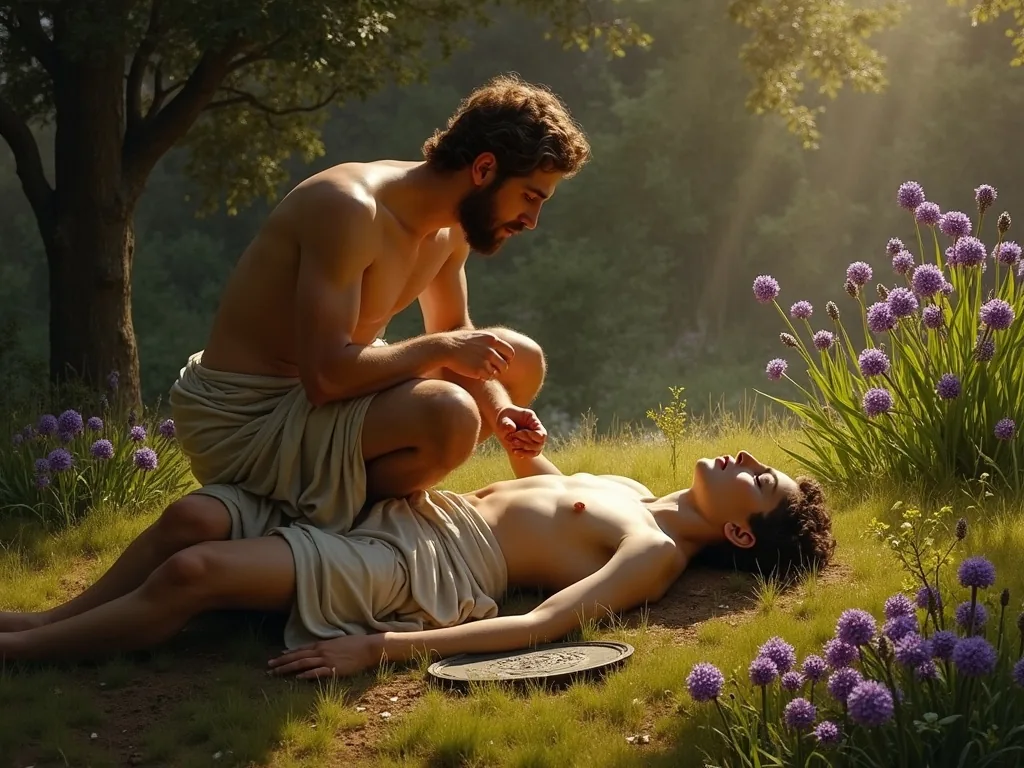
Hyacinthus: The Spartan prince Hyacinthus was perhaps Apollo's most beloved companion. During a game of discus, Zephyrus the west wind (jealous of Apollo's affection for the youth) deflected the discus so that it struck and killed Hyacinthus. From his blood Apollo caused the hyacinth flower to bloom, its petals marked with the Greek letters of lamentation, AI AI. Grief, here, becomes botanical immortality.
Cassandra: Apollo granted the Trojan princess Cassandra the gift of prophecy. When she refused his advances, he added a curse: she would always speak truth, and no one would believe her. She foresaw the fall of Troy in every detail and was dismissed as mad. The most terrible fate Apollo inflicted was not fire or transformation but isolation within perfect clarity.
Healer and Destroyer: The Two Faces of Apolline Light
Apollo carries the epithet Paian, healer, and is the father of Asclepius, the god of medicine. He governs the moment of plague's descent and also its departure. Pestilence arrives with his silver arrows, as in the opening of Homer's Iliad, when his wrath against Agamemnon rains plague arrows upon the Greek camp. The same hands that wound also heal, a paradox that frames the entire history of medicine.
His son Asclepius took the healing function further than the father intended, eventually resurrecting the dead. Zeus struck Asclepius with a thunderbolt for overstepping cosmic law. Apollo, in grief and fury, killed the Cyclopes who had forged Zeus's thunderbolts, and as punishment served the mortal king Admetus for a year, tending his cattle. Even the god of light must answer to limits.
Apollo in the Roman World and Beyond
The Romans adopted Apollo with unusual directness, keeping his Greek name rather than translating it, as they did for most Olympians. Augustus Caesar held Apollo as his personal divine patron, crediting the god with the victory at the Battle of Actium in 31 BCE and constructing the magnificent Temple of Apollo Palatinus on the Palatine Hill in Rome. The Augustan age was explicitly framed as an Apolline age: rational governance, ordered arts, the light of civilization renewing the world after civil war.
His image has persisted across centuries. The Renaissance made Apollo into the model of ideal masculine beauty and the patron of humanist learning. The Baroque period filled its ceilings with his chariot. In the twentieth century, the United States named its moon program Apollo, choosing a name that carried the freight of light, exploration, and the audacity of reaching beyond the familiar world.
The Eternal Noon: Apollo's Legacy in Human Thought
Apollo represents something that human cultures have returned to, reformed, and contested across recorded history: the faith that clarity is possible, that truth has a form that can be approached, and that beauty and reason are not opposites but allies. Friedrich Nietzsche famously positioned the Apolline against the Dionysiac in The Birth of Tragedy (1872), seeing in Apollo the principle of the individual, the bounded form, the luminous dream against Dionysus's oceanic dissolution. Even in being used as a philosophical foil, Apollo proves his enduring power.
He is not a comfortable god. He flays Marsyas, curses Cassandra, sends plague without warning, and loves those who are taken from him. But he also orders the cosmos, inspires the poet's tongue, heals the sick, and carries the only light by which mortals can hope to see their own nature. That is the bargain the god of light has always offered: illumination is available, but it costs something to receive it.
Free 25-page sample
Want the whole story?
Take the first 25 pages free. If it pulls you in, the full edition is yours as an instant PDF download, with a paperback on Amazon for selected titles.
Greek
The Greek Mythology Book: Zeus, the Olympians, the Heroes, and the Sacred Stories of Ancient Greece
Zeus, the Olympians, the Heroes, and the Sacred Stories of Ancient Greece
The complete guide to Greek mythology from Hesiod's Theogony to Homer's epics. Every Olympian, every hero, every descent to the underworld.
More from Greek
All articles
Greek
The Trojan War Origins: Discord, Desire, and the Apple That Broke the World
Before a single spear was thrown at Troy, a golden apple rolled across a banquet table and three goddesses made demands of a mortal shepherd. The seeds of the Trojan War were sown in divine vanity, a stolen bride, and a promise no one could keep.
Greek
Medusa the Gorgon: Monster, Martyr, and Mirror of Greek Fear
Medusa the Gorgon turns stone every eye that meets hers, yet her own story is one of transformation, divine violence, and enduring power. Here is the full myth, from serpent hair to severed head.
Greek
Athena: Goddess of Wisdom, War, and the Crafts of Civilization
Born fully armed from the skull of Zeus, Athena presided over wisdom, strategy, and the arts that make civilization possible. Meet the Olympian who shaped the ancient Greek world.
Greek
How the Greek Gods of Time Invented the Clock
How Chronos, Kairos, and the Horai shaped Greek timekeeping, from divine personification to the water clocks of Ctesibius and Plato's alarm.